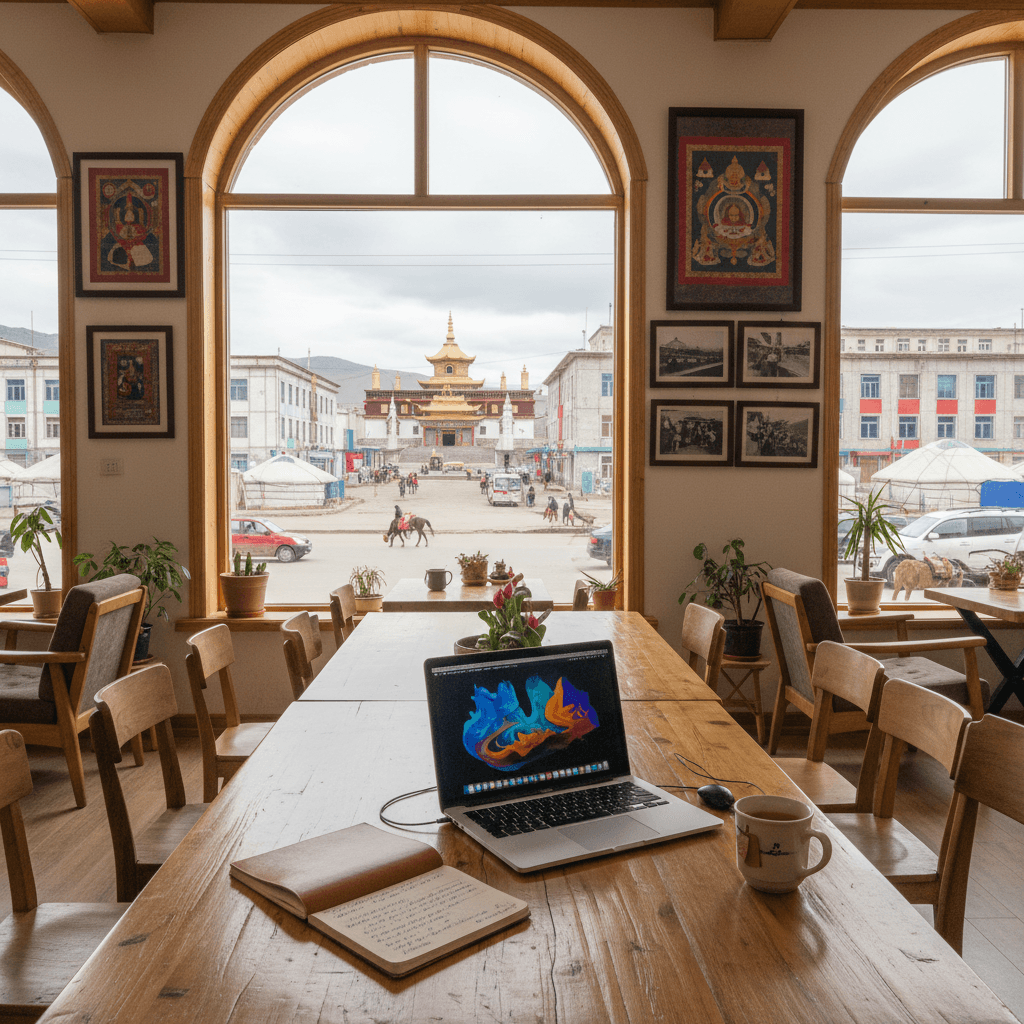
Uliastai
🇲🇳 Mongolia
The Frontier of the Far West
If Ulaanbaatar is the loud, smoggy heart of Mongolia, Uliastai is its quiet, rhythmic pulse. Tucked into the folds of the Khangai Mountains in Zavkhan Province, this is one of the oldest settlements in the country, but you won't find it on many nomad itineraries. It’s a place for the "pioneer" class of remote workers, those who are willing to trade high speed fiber optics for the chance to watch the morning mist roll off the Bogd River.
The vibe here is deeply parochial and unhurried. You aren't coming here for networking events or craft beer. You’re coming here to disappear into a landscape of larch forests and granite peaks. The town itself is a mix of weathered Soviet style apartments and sprawling ger districts, where the smell of coal smoke and fried khuushuur hangs in the air. It feels like a base camp rather than a tech hub, and that’s exactly why it appeals to a certain breed of traveler.
The Reality of the Remote Life
Living in Uliastai feels like stepping back twenty years. You’ll find yourself navigating dusty streets where horses are just as common as old Japanese SUVs. Most nomads who venture this far west use Ulaanbaatar as their logistical anchor, stocking up on supplies and solid tech before making the two day overland trek or catching a domestic flight to the local airstrip. It’s a rugged existence where your daily rhythm is dictated by the weather rather than a Slack notification.
Expect a total immersion in Khalkha Mongolian culture. English is rare, and you’ll likely be the only foreigner in the grocery store. This isolation brings a unique emotional weight; there’s a profound sense of solitude that can be either meditative or crushing, depending on your personality. You’ll spend your evenings drinking salty milk tea and watching the stars, which are brighter here than almost anywhere else on the planet.
Logistics and Infrastructure
Don't expect coworking spaces with ergonomic chairs. Your "office" will likely be a wooden table in a local guesthouse or a corner of a quiet cafe near the provincial government building. Connectivity is the biggest hurdle. While Unitel and Mobicom provide decent 4G coverage in the town center, it’s prone to flickering out during storms. Many serious remote workers bring a satellite backup or a high gain antenna to ensure they can hit deadlines.
- Connectivity: Reliable 4G in the center, but speeds drop significantly in the ger districts.
- Atmosphere: Traditional, quiet, and intensely local.
- Accessibility: High effort; requires a long bus journey or a pricey domestic flight from the capital.
- Best for: Writers, researchers, and those seeking a total digital detox with occasional check ins.
What Sets It Apart
Uliastai isn't a "hidden gem" because that implies it’s waiting to be discovered by tourists. It’s a functional administrative outpost that happens to be surrounded by some of the most striking alpine scenery in Central Asia. Unlike the tourist camps in Terelj, the hospitality here is raw and genuine. You aren't a customer; you're a guest. The cost of living is remarkably low, often under $800 a month if you’re living like a local, but the "price" you pay is in the lack of convenience. There are no food delivery apps, no English speaking gyms, and no safety net. It’s just you, your laptop, and the endless Mongolian steppe.
The Price of Going Off-Grid
Living in Uliastai is a lesson in extreme rural economics. You won't find the standard digital nomad price indexes here because the infrastructure simply doesn't exist in a commercialized way. While Ulaanbaatar offers a predictable $1,200 to $2,000 monthly lifestyle, Uliastai is significantly cheaper but demands a much higher "pioneer tax" in terms of effort and lack of convenience.
Most travelers find that their biggest expense isn't the daily cost of living, but the logistics of getting here and staying connected. Since there are no formal coworking spaces or Western-style apartment rentals, your budget will largely depend on your ability to negotiate local rates in cash. The Mongolian Tugrik is king here; don't expect to use a card for anything other than perhaps a few larger hotels or government offices.
Monthly Budget Estimates
- The Barebones Budget: $600 to $900 per month. This covers a basic guesthouse or a local apartment rental, eating primarily local mutton-based dishes, and using local transport. You'll be living like a local, which means limited amenities and potentially hauling your own water in certain districts.
- The Comfort Seekers: $1,200 to $1,500 per month. This allows for the best available housing in the town center, more frequent private drivers for excursions into the Zavkhan wilderness, and a heavy investment in private data plans or satellite internet backups.
Daily Life Costs
- Housing: A basic room or small apartment will likely run you between $300 and $500 a month if you can find a long-term arrangement. Short-term stays in local hotels usually hover around $25 to $40 per night.
- Food: Local meals like buuz (dumplings) or tsuivan (noodles) are incredibly cheap, often costing less than $3 to $5. A grocery run for basic staples like bread, dairy, and meat is inexpensive, but imported goods like coffee or fresh fruit are rare and pricey.
- Connectivity: Expect to pay $2 to $5 for 10GB of data through providers like Mobicom or Unitel. However, since the signal in Uliastai can be temperamental, nomads often spend more on multiple SIM cards to ensure they have coverage from different carriers.
- Transportation: Getting around the town center is mostly done on foot. If you need a lift, local "taxis" (usually just private cars) are affordable, often costing about $1 to $2 for a short trip across town.
Communication and Connectivity
Internet is the primary hurdle for anyone trying to work from the Zavkhan region. While Ulaanbaatar nomads enjoy 4G and decent cafe Wi-Fi, Uliastai requires more grit. There are no dedicated coworking spaces, and most local cafes aren't set up for laptop work. You'll rely heavily on mobile hotspots.
Expats recommend picking up a SIM card at the airport in Ulaanbaatar before heading west. Mobicom and Unitel have the best reach in rural areas. If your work requires high bandwidth, you might find yourself frustrated; many remote workers who venture this far west opt for a Starlink kit or similar satellite solutions, which adds a significant upfront cost to the "remote" experience.
The Reality of Rural Living
Financial planning for Uliastai should include a "emergency buffer." Healthcare facilities here are basic, and any serious medical issue will require an expensive flight or a long, bumpy drive back to the capital. Most travelers suggest carrying enough cash for your entire stay, as ATMs can be unreliable or run out of bills during local festivals or winter storms.
Despite the lack of amenities, the cost-to-experience ratio is unbeatable for the right person. You're paying for access to one of the most untouched landscapes on earth. Your "office" might be a wooden table in a town where the sound of horses is more common than the sound of cars, and for some, that's worth every Tugrik.
For the Hardcore Nomad
If you're heading to Uliastai, you aren't looking for a typical digital nomad hub with fiber optic internet and avocado toast. This is one of the oldest settlements in Mongolia, sitting in the shadow of the Bogd Khan Mountains. Most nomads who venture this far west treat the Town Center as their base of operations. It is a compact area where the administrative buildings, the local museum, and the main market are clustered together. You'll find a few basic guesthouses here where a bed might cost you $15 to $25 a night.
The vibe is quiet and functional. You won't find a dedicated coworking space, so your best bet is working from your guesthouse or one of the few local eateries near the main square. Internet is the biggest hurdle. While Unitel and Mobicom have towers here, speeds are often sluggish. Most travelers recommend bringing a local SIM card with a heavy data plan or even a satellite device if your work is high stakes. Expect to pay about $2 for 10GB of data, but don't count on it for video calls.
For the Immersion-Seeking Expat
Expats in Uliastai are rare, usually consisting of NGO workers or English teachers. They often gravitate toward the Ger Districts on the outskirts of the town center. Living here offers a truly authentic Mongolian experience, though it comes with a steep learning curve. You'll likely be fetching water from a local kiosk and heating your home with a coal or wood stove during the brutal winters, where temperatures regularly drop to -20°C or lower.
Life here revolves around the seasons. In the summer, the surrounding river valleys are beautiful, but the winters are harsh. Monthly expenses are incredibly low because there simply isn't much to spend money on. You can eat a hearty meal of buuz (steamed dumplings) or tsuivan (fried noodles) for about $3 at a local canteen. It is a cash heavy society, so make sure you load up on Tugrik before leaving Ulaanbaatar, as ATMs can be temperamental this far out.
For Families and Slow Travelers
Uliastai isn't a traditional family destination, but for those who want their kids to see a world without screens, the Southern Valley areas near the Chigestei River are the best choice. This area feels more open and less industrial than the center. There are no international schools here, so homeschooling is the only real path for nomad families. The draw for families is the safety and the outdoors. It's the kind of place where kids can wander and watch herders move their livestock through the streets.
Healthcare is limited to a basic provincial hospital, so families should pack a robust first aid kit and all necessary prescriptions. For a bit of social life, you'll find people gathering at the local Javkhlant Tolgoi hill, which offers views of the entire town and the surrounding peaks. It's a steep climb, but it's the local spot for sunset walks. If you need a break from the isolation, a jeep trek to the nearby Otgon Tenger mountain is the standard weekend escape, though it requires a sturdy 4x4 and a local guide.
For Solo Travelers and Pioneers
Solo travelers usually find themselves in the small hotels near the Uliastai Market. This is the heart of the town's commerce. It's a great place to meet locals and arrange transport to other parts of Zavkhan province. Since English is rarely spoken, you'll want to have an offline translation app ready to go. Safety is generally high during the day, though travelers suggest avoiding the unlit outskirts of the ger districts after dark, mostly due to the packs of dogs and the lack of street lighting.
Getting around is simple because the town is so small you can walk everywhere. If you need to go further, you can flag down a local car that acts as an informal taxi for about $1. For those looking to connect with others, the Modern Nomads style restaurants are the closest thing to a social hub. While it's a far cry from the nightlife in Ulaanbaatar, it's where you'll find the best food and perhaps another traveler passing through on their way to the Great Lakes Depression.
Connectivity and the Digital Grind
If you are heading to Uliastai with a heavy Zoom schedule or a deadline that requires high speed fiber, you might want to rethink your itinerary. This is one of the most remote provincial capitals in Mongolia. While Ulaanbaatar is busy branding itself as a digital nomad hub with $267 monthly hot desks, Uliastai remains a place where the internet is an afterthought. You are trading high speed pings for high altitude peaks.
Most nomads who venture this far west treat Uliastai as a base for expeditions rather than a place to clock forty hours a week. You won't find dedicated coworking spaces or sleek cafes with ergonomic chairs here. Instead, your office will likely be a corner table in a local hotel or a guesthouse where the Wi-Fi is shared with every other guest. If you need to get work done, do it early in the morning before the local network gets congested.
Staying Online
Reliable internet is the biggest hurdle in Zavkhan Province. While the town has basic coverage, it is notoriously spotty. Most travelers rely on mobile data rather than local Wi-Fi. You should pick up a SIM card before leaving Ulaanbaatar, as the kiosks at the airport or near Chinggis Square are much easier to navigate for English speakers.
- Mobicom and Unitel: These are your best bets for coverage. You can grab 10GB of data for around $5 to $9. Unitel often has better reach in the mountainous western regions.
- Gohub eSIM: If your phone supports it, an eSIM is a painless way to get connected the moment you land, though physical SIMs usually offer better local rates.
- Starlink: For serious remote workers, satellite internet is becoming the go to solution for Mongolia's rural stretches. If you aren't carrying your own dish, don't expect Starlink speeds in a standard Uliastai rental.
The Cafe Culture (Or Lack Thereof)
The "laptop cafe" culture hasn't reached this part of the steppe yet. In Ulaanbaatar, you can hang out at places like Modern Nomads and find a decent signal. In Uliastai, you are looking at local eateries where the focus is on mutton buuz and hot tea, not providing power outlets for foreigners. If you must work from a public space, look for the larger hotels in the town center. They are usually more accustomed to travelers sitting with devices, though you should always buy a few rounds of tea or a meal to keep the peace.
Power and Reliability
Electricity in Uliastai is generally stable, but the town is subject to the occasional outage, especially during harsh weather or maintenance cycles. If you are planning to work through the winter when temperatures hit -20°C, keep in mind that battery life on laptops and phones drops significantly in the cold. Always carry a high capacity power bank. Most nomads here find that a rugged, 20,000mAh battery is a mandatory piece of gear.
Practical Work Setup
Since there are no formal offices, your setup needs to be mobile and self sufficient. The town is compact and walkable, so you can move between your guesthouse and the few local government buildings or schools that might have better infrastructure. However, the best advice for Uliastai is to front load your work. Finish your major projects in Ulaanbaatar, where the $1,500 mid range lifestyle includes reliable hubs, and use your time in Uliastai for offline tasks or creative thinking while exploring the Zavkhan landscape.
- Best Work Window: June to September offers the best weather and fewer power disruptions.
- Backup Plan: Always have an offline version of your tasks. Google Translate's offline mode is a lifesaver when the signal cuts out mid conversation.
- Data Costs: Extremely low. Even on a budget of $800 a month, you can afford to burn through multiple data packages if the signal holds.
Staying Safe in the Western Frontier
Uliastai is a world away from the frantic energy of Ulaanbaatar. While the capital deals with typical big city issues like petty theft in crowded markets, Uliastai is a quiet, administrative hub where the pace of life slows to a crawl. It is generally very safe for foreigners, mostly because the community is small and people tend to look out for one another. You won't find the same level of street crime here, but you will stand out as a visitor.
The primary safety concerns in Zavkhan Province are environmental rather than criminal. The terrain is rugged and the weather is unpredictable. If you are heading out of the town center to explore the nearby mountains or lakes, never go alone without a local guide. Getting lost in the Mongolian steppe is a serious risk, as cell service drops off almost immediately once you leave the cluster of buildings. If you're walking around town at night, keep a torch handy. Street lighting is unreliable, and the pavement can be uneven or non-existent in the ger districts.
- Emergency Number: Dial 112 for general emergencies.
- Personal Safety: Avoid unlit areas after dark and be wary of stray dogs, which can be territorial near family compounds.
- Winter Risks: Extreme cold can dip below -30°C. Frostbite is a genuine threat if you aren't wearing professional grade arctic gear.
Healthcare and Medical Realities
Healthcare in Uliastai is basic. The town has a provincial hospital and several pharmacies, but they are equipped for routine issues and minor trauma. If you have a chronic condition, you must bring a full supply of your medications from home. Local pharmacies might have basic antibiotics or painkillers, but they rarely carry specialized western brands. Most pharmacists won't speak English, so having a translation app or a local friend is a lifesaver.
For anything serious, you will likely need to be evacuated to Ulaanbaatar or even out of the country to Seoul or Beijing. The flight from Uliastai to the capital is your fastest route, but these flights don't run every day and can be cancelled due to high winds. Medical evacuation insurance is not just a recommendation here; it is a requirement for any sensible nomad. Most travelers find that private clinics in Ulaanbaatar, like SOS Medica, are the only places in the country that meet international standards.
Practical Health Tips for Nomads
The diet in Zavkhan is heavy on meat and dairy, which can be a shock to the system. Travelers often report stomach upsets during their first week. Stick to bottled water, which is cheap and available in small grocery shops (shakhop) throughout the town. Tap water should always be boiled or filtered before drinking.
- SOS Medica (Ulaanbaatar): The gold standard for expats if you need to travel back for a check-up.
- Pharmacy Essentials: Stock up on charcoal tablets, rehydration salts, and broad-spectrum antibiotics before leaving the capital.
- Air Quality: While Ulaanbaatar suffers from heavy smog in winter, Uliastai is much clearer, though wood smoke in the ger districts can still be thick on cold nights.
Insurance and Preparedness
Before you hop on the long bus ride or flight to the west, check your policy fine print. Ensure it covers "adventure activities" if you plan on horse trekking. Most nomads find that a standard travel policy won't cut it if they need a helicopter lift from a remote valley. Expect to pay around $100 to $150 per month for high-end international coverage that includes remote evacuation. In a place like Uliastai, your best medical tool is a satellite communication device like a Garmin inReach, as your smartphone will often be a paperweight once you're five miles outside the town limits.
The Logistics of the West
Uliastai isn't a city where you'll find a grid of subway lines or a fleet of sleek rideshare vehicles. It's a rugged, compact outpost in Zavkhan Province where the pavement often gives way to dirt tracks. Getting here is the first hurdle, and getting around once you've arrived requires a mix of patience and a willingness to embrace the local pace.
Most nomads start their journey in Ulaanbaatar. From the capital, you have two main choices: a long bus ride or a domestic flight. The bus takes roughly 17 to 18 hours and costs about $25 to $35. It's an endurance test, but it's how the locals do it. If your budget allows, flying into Donoi Airport, located about 25 kilometers west of town, saves you days of travel. A one-way ticket usually runs between $120 and $180 depending on how far in advance you book with Hunnu Air or Aero Mongolia.
Navigating the Town Center
Uliastai itself is small enough that your own two feet are your best asset. The town is nestled in a river valley surrounded by mountains, and the central administrative district is highly walkable. You can cross the main hub in about 20 minutes. Most of the government buildings, the local museum, and the main markets are clustered together.
- Walking: Free and the most reliable way to get around the central "paved" area.
- Local Taxis: There are no official taxi apps like Uber here. Instead, you'll find "unmarked" taxis. You simply stand by the side of the road and stick your hand out. A ride within the town limits usually costs around 2,000 to 4,000 Tugrik (roughly $0.60 to $1.20).
- Language Tip: Since English is rare here, have your destination written in Cyrillic or saved as a photo on your phone to show the driver.
Venturing into the Wilds
If you're planning to visit the nearby Otgontenger Mountain or the high alpine lakes, you'll need more than a sedan. Digital nomads who want to explore the Zavkhan backcountry usually hire a Russian UAZ furgon (the iconic sturdy van) or a Japanese 4x4. These aren't just for show; the terrain is unforgiving and requires a high clearance vehicle.
Hiring a private driver with a vehicle typically costs between $80 and $120 per day, which usually includes fuel and the driver's expertise. It's a steep price for a solo traveler, so many expats and long term travelers try to group up at local guesthouses to split the cost. Don't expect to find car rental agencies where you can drive yourself; the lack of road signs and the technical nature of the driving make a local driver a necessity.
Connectivity and Practicalities
While you're moving around, don't count on seamless GPS. Download offline maps of the Zavkhan region before you leave Ulaanbaatar. While Mobicom and Unitel have towers in Uliastai providing decent 4G, the signal drops the moment you leave the town valley. If you're heading out for a day trip, tell your guesthouse host where you're going and when you expect to be back.
Winter travel in Uliastai is a different beast entirely. From November through March, temperatures can plummet to -30°C or lower. Vehicles often require specialized heaters, and travel times can double due to snow and ice. Most travelers recommend visiting between June and September when the mountain passes are clear and the rivers are crossable.
Transport Cost Summary
- Domestic Flight (UB to Uliastai): $120 to $180
- Intercity Bus: $25 to $35
- Town Taxi Trip: $1.00
- Daily 4x4 Rental with Driver: $100 average
- Airport Transfer (Donoi to Town): $10 to $15
The Language Gap
In Uliastai, English is a rarity. While you might find a few teenagers or teachers in Ulaanbaatar who speak conversational English, that safety net disappears once you land in Zavkhan Province. The primary language here is Khalkha Mongolian, and in this part of the country, it is spoken with a distinct western lilt that even some city dwellers find challenging.
You won't find menus with English translations or street signs in Latin script. Most locals are incredibly hospitable, but communication usually relies on a mix of heavy gesturing, drawing in the dirt, and a lot of patience. If you are planning to stay for more than a few days, learning the Cyrillic alphabet is a non-negotiable skill. It allows you to at least sound out signs for pharmacies or grocery stores.
Digital Communication and Connectivity
Staying connected in Uliastai is a test of your patience and your hardware. While Ulaanbaatar has a growing tech scene and reliable 4G, Uliastai is significantly more primitive. You can pick up a physical SIM card from providers like Mobicom or Unitel for around $5 to $9 for 10GB of data. However, do not expect those speeds to hold up for video calls or heavy uploads.
- Mobile Data: Expect 3G speeds at best within the town limits. Once you leave the cluster of buildings, signal drops to zero almost instantly.
- eSIM Options: Travelers often use Gohub for convenience, but these roaming profiles sometimes struggle to find a handshake with local towers in remote Zavkhan.
- Wi-Fi: There are no dedicated coworking spaces in Uliastai. Your best bet for internet is a handful of local government buildings or the few hotels in the center, but the connection is often shared and sluggish.
Essential Phrases for Survival
Nomads who have ventured this far west suggest keeping a list of phonetic phrases on your phone. Since you can't rely on a live connection for Google Translate, download the offline Mongolian dictionary before you leave the capital. Locals will appreciate any effort you make, even if your pronunciation is off.
- Sain baina uu? (pronounced: sign-bin-oo): Hello. This is the standard greeting.
- Bayarlalaa (pronounced: buy-ar-la-la): Thank you.
- Bi oilgohgui baina (pronounced: bee oil-goh-gwee bin): I dont understand.
- Yamar unetei ve? (pronounced: ya-mar oon-et-ay vay): How much is this?
The "Offline" Reality
Communication in Uliastai is more about face to face interaction than digital pings. If you need something done, you go find the person in charge rather than sending an email. Most transactions are handled in cash (Tugrik), and while some shops in the town center might have a card terminal, they frequently lose connection. Always carry small denominations for taxis or snacks.
For those working remotely, many travelers recommend bringing a satellite communication device like a Garmin inReach or a Starlink terminal if you are traveling by van. Relying on the local infrastructure for a 9 to 5 job is risky. Most people who visit Uliastai treat it as a "deep work" or "digital detox" location where they sync their tasks only when they return to the more robust networks of Ulaanbaatar.
Cultural Nuances
Non-verbal communication is just as important as the spoken word here. If you are invited into a ger on the outskirts of town, there are specific rules to follow. Never lean against the support pillars and always accept food or tea with your right hand, supported by your left elbow. These small gestures communicate respect far more effectively than a translated sentence ever could.
Survival of the Sharpest
Uliastai isn't a place where you'll find a mild, coastal breeze. Tucked away in the Zavkhan Province of western Mongolia, this town experiences some of the most dramatic temperature swings on the planet. You're looking at a subarctic climate that demands respect. In the dead of winter, usually January, temperatures can plummet to -30°C or lower. It's a dry, biting cold that keeps most people indoors and turns the surrounding mountains into a silent, frozen fortress.
The transition into spring is unpredictable. March and April often bring dust storms and fierce winds across the steppe. While the snow begins to melt, the ground remains frozen, making travel into the surrounding countryside a muddy challenge. If you're planning a remote work stint here, you'll want to avoid these shoulder months unless you have a high tolerance for grey skies and grit.
The Golden Window
The sweet spot for visiting Uliastai is a narrow window from June to early September. This is when the Khangai Mountains turn a brilliant green and the air finally loses its edge. July is the warmest month, with daytime highs hovering around 20°C to 22°C. It's perfect weather for trekking or setting up a mobile hotspot near the Bogd River, though you should expect occasional rain showers during these months.
If you can time your arrival for July, you might catch local Naadam festivities. Unlike the massive crowds in Ulaanbaatar, the Uliastai celebrations are intimate and rugged. You'll see wrestling, archery, and horse racing in their most authentic forms. Just keep in mind that this is peak travel season for the few foreigners who venture this far west, so transport into town can book up fast.
Seasonal Realities for Nomads
Working from Uliastai requires a different strategy than a stay in the capital. While Ulaanbaatar deals with heavy smog in the winter due to coal burning, Uliastai's air stays cleaner, but the isolation is much more intense. Most travelers find that late August is the best balance; the summer heat has faded, the bugs are gone, and the autumn colors begin to bleed into the larch forests.
Packing for this region is an exercise in layers. Even in the height of summer, the high altitude means nights can drop toward 5°C. You'll want a heavy down jacket for the evenings and light, breathable gear for the sun-drenched afternoons. If you're coming from Ulaanbaatar, expect Uliastai to be several degrees colder and significantly windier at any given time of year.
- Best for Trekking: July and August
- Best for Photography: September (Autumn colors)
- Most Challenging: December to February (Extreme cold)
- Rainy Season: Late July and August
What to Expect by Month
- June: The landscape finally wakes up. It's breezy and cool, with long daylight hours that give you plenty of time to explore after finishing your tasks.
- July: Peak warmth and social activity. Expect daytime highs of 22°C and the best chance of clear roads for exploring Zavkhan’s sand dunes or lakes.
- August: Similar to July but with more frequent rain. The greenery is at its peak, making it the most scenic time for those staying in gers on the outskirts of town.
- September: A rapid cool-down. By the end of the month, night frosts are common, and the first dustings of snow can appear on the peaks.
Connectivity and the Digital Grind
If you are heading to Uliastai, pack your patience along with your gear. This is pioneer territory for nomads. You won't find sleek coworking spaces like HUB Innovation Center in Ulaanbaatar here. Most travelers rely on Unitel or Mobicom SIM cards, which you should definitely pick up at the airport before heading west. A 10GB data package costs around $5 to $9. While 4G is surprisingly decent in the town center, it drops to nothing the moment you hit the steppe. For serious work, bring a satellite device or a high quality power bank, as local infrastructure can be temperamental during summer storms.
Money and Local Costs
Cash is king in Zavkhan Province. While Ulaanbaatar is increasingly digital, Uliastai operates on the Mongolian Tugrik (MNT). ATMs exist but don't count on them accepting every international card. It is smart to carry enough cash for your entire stay. Your daily burn rate here will be significantly lower than the $1,200 monthly average in the capital. A hearty dinner of buuz (dumplings) or tsuivan (fried noodles) usually runs under $4. Short taxi hops around the compact town center rarely exceed $1 or $2.
Getting There and Around
Reaching Uliastai is an adventure in itself. Most nomads fly into Chinggis Khaan International Airport and then take a domestic flight to Donoi Airport, which is about 25 kilometers outside of town. If you are feeling brave, the overland bus from Ulaanbaatar is a grueling 24 to 30 hour journey across varied terrain. Once you arrive, the town is largely walkable. For exploring the nearby Bogd Khan mountains or the Otgontenger strictly protected area, you will need to hire a 4WD vehicle and a local driver, which typically costs around $60 to $100 per day including fuel.
Cultural Etiquette
Uliastai is a traditional administrative hub, not a tourist trap. People are incredibly hospitable but expect you to follow local norms. If you are invited into a ger, always step over the threshold, never on it. When offered a bowl of airag (fermented mare's milk) or milk tea, receive it with your right hand, often touching your right elbow with your left hand as a sign of respect. Even a few words of Khalkha Mongolian go a long way. Start with Sain baina uu? (Hello) and Bayarlalaa (Thank you).
Health and Safety
The town is generally safe, though it is wise to avoid unlit areas at night and keep an eye on your belongings in crowded markets. Healthcare is basic. The local hospital can handle minor issues, but for anything serious, you will be looking at a flight back to Ulaanbaatar or even Seoul. Stock up on personal prescriptions and a solid first aid kit before leaving the capital. Also, keep an eye on the weather. Even in July, temperatures can swing wildly, and the sun at this altitude is intense. Pack high SPF sunscreen and layers for those sudden mountain chills.
Staying Fed and Social
Don't expect a third wave coffee scene. Social life revolves around local eateries and the occasional hotel bar. Most nomads find the best way to socialize is by joining organized expeditions or connecting with the small community of NGO workers and teachers in town. For a taste of modern Mongolian dining before you head into the wilderness, Modern Nomads in Ulaanbaatar is the gold standard, but in Uliastai, you will be eating like a local: lots of mutton, flour, and dairy. It is heavy, filling, and perfect for the climate.
Need visa and immigration info for Mongolia?
🇲🇳 View Mongolia Country GuideOff the Radar
Pioneer territory