Toledo
🇪🇸 Spain
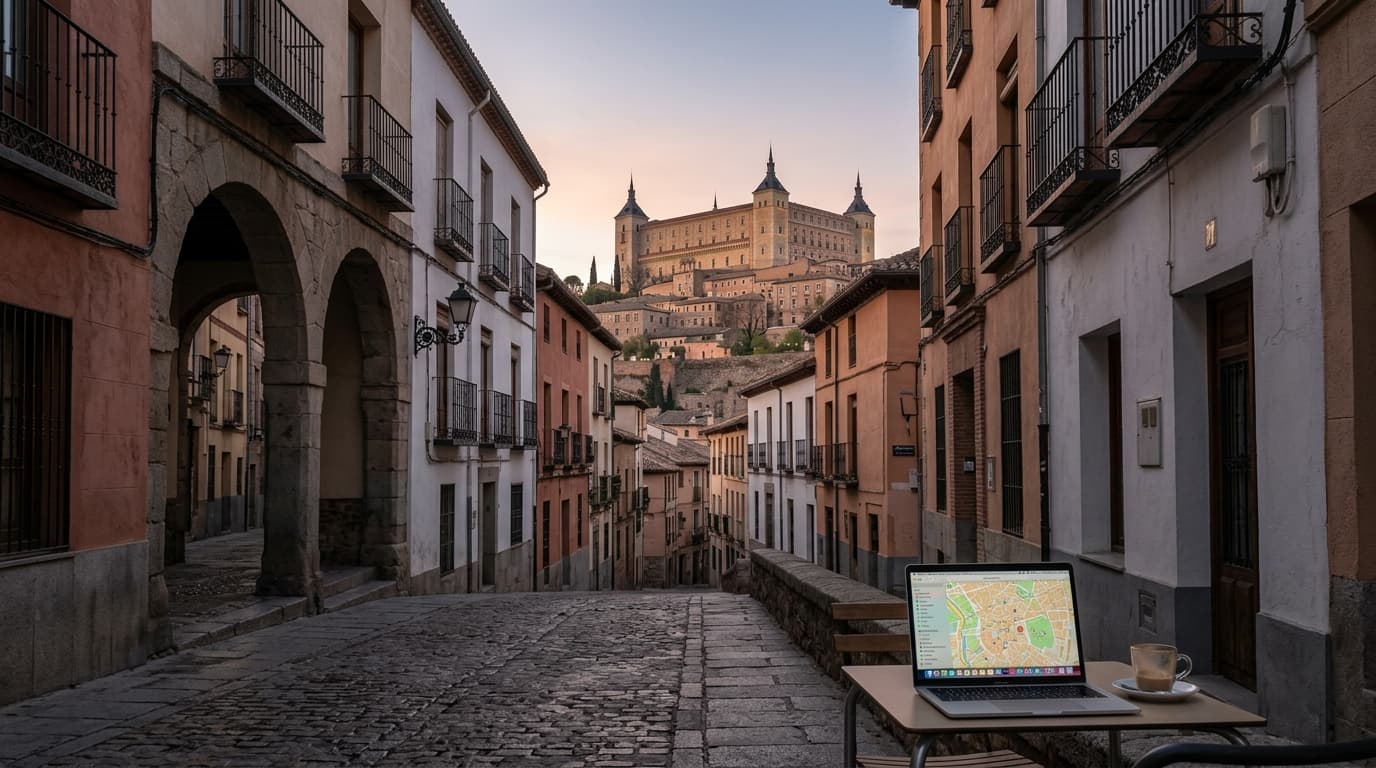
Toledo feels less like a place built for remote workers and more like a city that kept its own pace and never asked anyone else to catch up. It sits high above the Tagus, all steep lanes, stone walls and sudden views, with church bells, scooter engines and tour groups echoing off the old streets. That can be lovely for a few hours and maddening on a daily basis.
The city’s personality is tightly linked to its scale. The historic center is compact, walkable and heavy with history, but it’s also steep, uneven and not always easy on a laptop life. You’ll get long lunches, quiet evenings and a sense that the day still belongs to the neighborhood, not to your calendar. You won’t get the easy anonymity of Madrid or the polished remote-work scene of Valencia.
Most nomads who stay longer than a quick weekend end up thinking in two modes, the scenic core and the practical outer areas. The old town is where you go for atmosphere, museums and late-afternoon walks when the limestone glows warm and the air smells faintly of dust and roasted coffee. The newer parts feel more ordinary, with supermarkets, buses, apartment blocks and less drama, which is exactly why they work better for longer stays.
What it feels like day to day
- Rhythm: Slow in the afternoon, livelier at night, then quiet again after dinner.
- Noise: Bells, traffic on the ring roads and the hard slap of shoes on cobblestones.
- Climate: Summers are brutal, with heat bouncing off the stone and very little mercy.
- Practicality: Great for short-term immersion, less comfortable if you need flat streets and fast errands.
For remote work, Toledo is better as a thoughtful base than a productivity machine. Internet is decent in many apartments and cafés, but the city doesn’t have the thick coworking network you’d find in bigger Spanish hubs. If you like quiet mornings, long walks and evenings that smell like grilled meat, olive oil and cigarette smoke drifting through narrow lanes, it can be a strong fit. If you need constant variety, easy logistics and a built-in nomad crowd, you may get restless fast.
The city’s appeal is simple. It’s beautiful, a little inconvenient and never trying too hard. That mix gives Toledo a sharper character than most places on the nomad circuit and for the right person, that friction is exactly the point.
Toledo is cheaper than Madrid, but it’s not dirt-cheap. A solo nomad can get by on roughly €1,100 to €1,600 ($1,190 to $1,730) a month if they’re sensible with rent, cook often and don’t spend every evening in bars. The city’s old stone streets, steep climbs and tight medieval layout do make day-to-day life a little annoying, though. Groceries are normal for Spain, but taxis, occasional train trips and eating near the cathedral can add up fast.
Rent: A one-bedroom in the center often runs about €650 to €900 ($700 to $970), while a bit farther out, like Santa Bárbara, Buenavista or the west side near Avenida de Europa, you may find places closer to €500 to €700 ($540 to $755). Furnished flats for short stays cost more and landlords can be picky about paperwork, deposits and income proof. If you’re staying only a month or two, budget extra because the short-term market is annoyingly expensive.
Food and coffee: Weekly groceries for one usually land around €40 to €70 ($43 to $75) if you shop at Mercadona, Lidl or Carrefour and skip imported stuff. A menú del día still feels like a bargain, often €12 to €16 ($13 to $17), though prices jump near the tourist core. Coffee is usually about €1.50 to €2.50 ($1.60 to $2.70) and a beer in a neighborhood bar can be around €2 to €3 ($2.15 to $3.25).
- Public transport: Toledo’s buses are cheap, usually under €2 ($2.15) a ride, but the city is compact enough that many people just walk until their calves complain. The hills are real.
- Coworking: Flexible desks tend to start around €120 to €180 ($130 to $195) a month, with some day passes available if you only need a quiet spot and decent internet.
- Night out: A simple dinner with wine can run €20 to €35 ($22 to $38) per person, more if you sit in the old town and order anything with a view.
Best-value areas: Santa Bárbara is often the practical pick if you want lower rents and easy station access. The historic center is beautiful, but you pay for the scenery and the cobblestones, tourists and late-night noise can wear you down. Buenavista and the newer residential areas feel calmer and more modern, though you’ll trade charm for space and easier parking.
Card payments work almost everywhere, but keep some cash. Small tapas bars, corner bakeries and older landlords still like it and if your card reader fails at the wrong moment, you’ll feel the heat fast. The internet is generally solid in newer apartments, though many older flats have patchy wiring, so always test the connection before signing anything.
Toledo’s best areas depend on how much you want to trade convenience for atmosphere. The old city is the postcard version, all stone lanes, church bells and steep climbs, but the day-to-day sweet spot is usually a little outside the tightest tourist core, where the streets are calmer and the rent doesn’t bite quite as hard.
For nomads
Most nomads do best around the center-right edge of the old town, near the train station side and the flatter streets leading toward Zocodover. You’re close enough for coffee runs and late dinners, but you’re not dragging groceries up a hill every day. The internet is usually fine in newer apartments, though older buildings can have weak signal and thick walls that kill Wi-Fi in one room but not the next.
- Best fit: Zocodover, near the station or streets just outside the historic core
- Why stay here: Easy walks to cafes, bars and coworking-style workdays in town
- Watch for: Steep stairs, thin walls and noisy weekends when tour groups roll through
For expats
Expats who plan to stay a while usually like Santa Teresa and Buenavista more than the old town. These neighborhoods feel more lived-in, with supermarkets, pharmacies and better parking and you won’t hear footsteps echoing under your window at 2 a.m. The tradeoff is simple, less medieval charm, more practical living.
Santa Teresa is the safer bet if you want daily errands on foot and a straightforward commute into the center. Buenavista has a slightly more residential feel, with wider streets and bigger apartments, though it can feel a bit detached if you want bars and late-night life nearby.
- Best fit: Santa Teresa for convenience, Buenavista for space
- Why stay here: Better for long stays, errands and routines that don’t revolve around tourism
- Watch for: Less character, more car traffic and fewer spontaneous dinner spots
For families
Families usually find the center too awkward for everyday life. The narrow streets are lovely for an afternoon wander, but prams, school runs and weekly shopping get old fast when you’re climbing slopes with bags of oranges and bottled water. Santa María de Benquerencia and parts of Buenavista are easier on parents, with newer housing and more space.
If you want quieter evenings, look beyond the old city walls. Toledo can feel hushed after dark, with the occasional scooter buzzing past and church bells carrying over the rooftops, but family-friendly neighborhoods give you more room, less cobblestone stress and fewer headaches with parking.
- Best fit: Buenavista, Santa María de Benquerencia and family-sized housing near schools
- Why stay here: More space, easier parking and a less punishing daily routine
- Watch for: Longer walks to the historic center and fewer scenic streets outside the old town
For solo travelers
Solo travelers should stay in or near the old town if they want Toledo after dark, not just Toledo as a day trip. Zocodover and the lanes around it keep you close to tapas bars, late buses and the main drag, so you’re not crossing town alone after dinner. It’s lively enough without feeling chaotic.
That said, some corners get eerily quiet once the tour buses leave. If you’re sensitive to noise, avoid rooms facing the main squares, because the clatter of suitcases on stone and the chatter from terraces can go on later than you’d expect.
- Best fit: Zocodover and the streets just off the main square
- Why stay here: Easy social life, short walks and simple transport
- Watch for: Night noise, hills and prices that climb near the monument-heavy streets
Toledo’s internet is decent in the center, but don’t expect Madrid-level choice. In the old town, many apartments are in thick stone buildings, so Wi-Fi can be patchy until the router is upgraded. If you’re working remotely for long stretches, ask for a real speed test before you book, not just a promise that “it works fine.”
Most nomads end up living or working in Zocodover, Santa Teresa or near the train station in Santa Bárbara. Zocodover puts you close to cafés, lunch spots and bus links, but it can get noisy with day-trippers and the scrape of rolling suitcases over cobblestones. Santa Teresa feels easier for day-to-day life, with better access to supermarkets and quieter streets. Santa Bárbara is practical if you want the station, cheaper rents and fewer tourists under your window.
Coworking and work-friendly places
- Coworking spaces: Toledo doesn’t have a huge coworking scene, so expect fewer choices than in larger Spanish cities. Look for flexible desks, strong internet and air-conditioning in summer, because July heat can make working from a flat miserable.
- Cafés: Around Zocodover and Santa Teresa, a few cafés will let you linger with a laptop if you keep ordering. Coffee usually runs about €1.50 to €2.50 ($1.63 to $2.71) and a glass of beer or vermut often costs less than a coworking day pass.
- Libraries and study spaces: Good for quiet mornings, though hours can be awkward and seating is limited. They’re better for focused work than long calls, since Spanish public spaces can get strict about noise.
If you need video calls every day, Toledo can be a little annoying. The city is compact, the streets echo and church bells, scooters and the occasional burst of traffic all cut through a morning call. Buy a local SIM from Movistar, Orange, Vodafone or Digi if your building’s internet is flaky, because mobile data is often the backup that actually saves the day.
For coworking, ask locals, expat groups and hostel staff before you commit to a place. A lot of the better options here come and go and some offices only look active online. Travelers who stay a month or longer usually do best by combining a stable flat in Santa Teresa or Santa Bárbara with cafés and the train station area for backup workdays.
Toledo feels safe in the way many smaller Spanish cities do, with ordinary street life and very little of the aggressive stuff that keeps travelers on edge in bigger places. Pickpocketing can still happen around Plaza de Zocodover, the cathedral area and on crowded buses, so keep your phone zipped away and don’t leave a bag hanging off the back of a chair.
The old center is the easiest place to walk around after dark, especially around the main squares and restaurant streets, where you’ll hear glasses clink, voices spilling out of tapas bars and the occasional scooter cutting through the quiet. The steep lanes are another matter, though. Cobblestones get slick after rain and those dark, narrow streets can feel deserted fast once dinner crowds thin out.
For solo travelers, the usual common sense works well here. Stick to lit streets, use a licensed taxi or a ride app if you’ve been out late and don’t try to cross the river on foot at odd hours just to save a few euros. Daytime errands are easy enough, but Toledo isn’t a city where you want to wander half-drunk, squinting at your map in an empty lane.
Healthcare basics
Spain’s public healthcare system is solid and Toledo has the services you’d expect in a provincial capital. For urgent care, the main public reference point is Hospital Universitario de Toledo, while pharmacies are everywhere in the center and in the newer neighborhoods. Look for the green cross, because that glow is often the quickest sign you’re near help.
If you’re an EU visitor, bring your European Health Insurance Card. Non-EU travelers should keep private travel insurance with medical coverage, since a basic clinic visit or prescription can still turn into a headache if you’re paying out of pocket and don’t have paperwork ready.
- Emergency number: 112 for police, fire and medical help.
- Pharmacies: common in the center, but night and Sunday service rotates, so check the posted on-duty pharmacy notice.
- Heat: summers can be punishing, with dry air, baked stone and very little shade in some streets.
- Wildlife and bites: not a big urban issue, but ticks and mosquito bites can show up after walks near the river or countryside edges.
Most expats and long-stay visitors keep a simple kit at home, painkillers, antihistamines, blister plasters and basic stomach meds, because late-night pharmacy runs are easier to avoid than to plan around. If you need anything beyond routine care, private clinics in the city move faster than the public system, but they’re not cheap. Bring your passport, insurance details and a card that actually works in Spain.
Toledo’s old center is compact enough that you can cross a lot of it on foot, but don’t mistake the map for reality. The city sits on a hill with steep streets, stone steps and plenty of cobbles, so your calves will know about it by lunchtime. In summer, the heat bounces off the walls and the narrow lanes trap the smell of dust, fried food and exhaust.
For most visitors and remote workers, walking is the smartest default inside the historic core. The maze around the cathedral, Zocodover and the old Jewish Quarter is where cars feel like a nuisance anyway and many streets are either very tight or pedestrianized. Wear decent shoes, not flimsy trainers, because the worn stone gets slick after rain and the slopes are unforgiving.
Best for day-to-day movement:
- Walking: Best for the center, especially around Zocodover, the cathedral and San Juan de los Reyes.
- Urban buses: Handy for linking the station, the old town and newer neighborhoods when you don’t want to climb back up the hill.
- Taxis and ride-hailing: Useful late at night or after a long day, especially if you’re carrying luggage or heading uphill.
- Train: Fastest way to get to Madrid, which is why many nomads base themselves here and commute occasionally.
Local buses are cheap and practical, though they’re not always the fastest if you’re trying to move between tiny points in the old city. Services connect the lower areas, residential neighborhoods and the rail station, but schedules can feel a little thin outside peak hours. If you’ve got a laptop and a deadline, don’t plan your life around perfect punctuality.
Taxis are easy enough to find near central squares and the station and they’re the cleanest fix when Toledo’s hills start winning. Ride-hailing exists in Spain, but in a city this size it’s not something you should count on every minute. For airport runs or late arrivals from Madrid, many travelers just book a cab in advance and skip the hassle.
Neighborhoods that work well for getting around:
- Zocodover and the historic center: Best if you want to walk everywhere and don’t mind stairs.
- Near the train station: Easier for arrivals, departures and quick Madrid trips.
- Newer residential areas: Better if you want flatter streets, easier bus access and less tourist foot traffic.
The main downside is the same one locals complain about, the old town can feel awkward if you’re carrying groceries, hauling a suitcase or trying to dodge tour groups under the midday glare. Keep your days compact, use buses for the uphill bits and don’t assume a five-minute walk on the map will feel like five minutes in real life.
Toledo isn’t hard for English speakers to manage, but it’s not a place where you can glide by on tourist Spanish forever. In the old town, shopkeepers, bar staff and hotel staff usually have some English, though plenty of locals still switch straight into rapid Castilian. It can feel abrupt at first, especially in a bakery when the register is beeping, the phone is ringing and nobody’s slowing down for your sentence.
Spanish is the language you’ll need for anything practical, from doctor visits to rent disputes to dealing with banks. People in Toledo tend to speak clearly once you’re trying and they’ll usually warm up fast if you make the effort, even if your grammar’s a mess. A basic phrasebook or translation app goes a long way and offline translation is smart because signal can wobble in the thicker stone streets around the cathedral.
What helps day to day
- Spanish basics: Learn greetings, numbers, directions and payment words. That covers most errands.
- WhatsApp: It’s the default for local communication, including landlords, tutors and small businesses.
- Google Translate: Good for menus, signs and quick back-and-forth messages, especially with camera translation.
- Phone support: Don’t expect every office to be bilingual, so be ready to repeat names and addresses slowly.
For nomads and expats, the biggest communication friction isn’t English, it’s pace. Toledo people can speak fast, overlap each other in conversation and leave out the niceties foreigners expect. That’s normal, not rude. If you need something repeated, ask for “más despacio,” and you’ll save yourself a headache.
Texting is often easier than calling. Many local businesses reply more quickly on messaging apps than by email and some will never answer an email at all unless there’s money involved. If you’re booking a place to stay, asking about coworking or trying to get a repair sorted, send a short message with your name, the date and the exact request.
Public offices are a different story. Bureaucratic Spanish can be slow, formal and maddening, so bring copies of everything and don’t assume the person at the desk will explain much. If you’re handling residency, taxes or any legal issue, having a bilingual friend or paid interpreter can save hours.
For social life, locals appreciate directness more than polished small talk. A simple “¿Puedo sentarme?” or “¿Me recomiendas algo?” usually works fine and Toledo’s size makes repeat encounters common. The same barista or taxi driver may see you again next week, so a little Spanish pays off fast.
Toledo gets very hot, very fast. Summer afternoons regularly feel punishing, with stone streets throwing heat back up at you and not much shade once you’re away from the river or the city walls. July and August can be rough for walking between the old town, the cathedral and the Mirador del Valle, especially if you’re carrying a laptop bag or trying to work outside.
Spring and fall are the sweet spots. April, May, September and October usually bring the best balance of comfortable temperatures, good light for sightseeing and fewer headaches getting around on foot. The air feels cleaner, the evenings cool off quickly and the city is much easier to enjoy without stopping every 10 minutes for water.
Winter is quieter and cheaper, but it can feel stark. Days are short, mornings are crisp and the old stone buildings hold the cold, so you’ll want a proper coat and decent shoes. Rain isn’t a constant issue, but when it hits, the narrow streets can get slick and miserable, especially around the steeper parts of the historic center.
Best time to go
- April to May: Mild weather, long daylight and strong sightseeing conditions.
- September to October: Probably the best all-around window, with warm days and cooler nights.
- June: Still manageable, but heat starts building fast.
- July to August: Go only if you can handle serious heat and plan for early mornings, long lunches and late-evening walks.
- November to February: Quieter streets and lower prices, but cold mornings and less daylight.
If you’re working remotely, shoulder season is the practical pick. Cafes are less slammed, hotel rates tend to be kinder and you won’t spend the day sweating through your shirt on the climb back up into the old town. Toledo isn’t a beach city, so don’t expect the kind of year-round softness you get in coastal Spain.
Pack for the city’s quirks. Good walking shoes matter more than you’d think, because the streets are steep, uneven and hard on your feet. In summer, bring a hat, sunscreen and a refillable bottle. In winter, layers help indoors too, since many old buildings stay chilly even when the sun’s out.
The simplest answer is this, go in spring or fall if you can. You’ll still get the golden light, the cathedral bells, the smell of roasted meat drifting out of side streets and that dry, dusty Toledo air, just without the brutal heat or the winter bite.
Toledo runs on a slower rhythm than Madrid, but it’s still a working Spanish city, not a museum set. Expect steep hills, narrow lanes and lots of stone underfoot, which gets slick after rain and punishing in summer heat. Bring real walking shoes, a refillable bottle and a light layer for evenings, because the dry air can turn sharp once the sun drops.
Best base areas: The historic center is the obvious pick if you want to walk to the cathedral, river viewpoints and tapas bars, but parking is a headache and the hills get old fast. Santa Teresa feels easier for daily life, with more normal grocery stores, better bus access and a less touristy feel. The area around the train station is practical for short stays and day trips, though it’s quieter at night and less charming.
Housing usually makes more sense in the outer neighborhoods than inside the old walls. If you’re staying longer than a few weeks, ask for heating, air conditioning and internet speed in writing, because old buildings can be drafty in winter and sticky in August. Don’t assume a pretty apartment will be comfortable. Some of the nicest-looking places have tiny kitchens, weak water pressure and stairs that punish a heavy suitcase.
Coworking and remote work: Toledo doesn’t have Madrid-level coworking density, so book ahead if you need a desk every day. Look for small shared offices near the center or around Santa Teresa and check whether the space has reliable internet, quiet phone booths and real daylight. Cafés are fine for an hour or two, but many close early or fill up with locals on laptops, so they’re not ideal for a long workday.
Getting around: Walking is the default inside the old city and buses cover the flatter neighborhoods. Taxis are handy at night or after a long climb, but they’re not something most people use constantly. If you’re arriving by train, the station sits below the center, so you’ll probably end up climbing or taking a bus with a suitcase that feels heavier than it should.
- Groceries: Mercadona, Carrefour and neighborhood bakeries cover basics without much fuss.
- Money: Cards are widely accepted, but small cafés and corner shops still prefer cash.
- Heat: Summer afternoons can feel brutal on the limestone streets, so plan errands early.
- Safety: Toledo feels generally calm, but crowded viewpoints and buses are where pickpockets do their work.
Local etiquette: Late dinners are normal and service can feel unhurried. If you want the bill, ask for it, because it won’t always appear on its own. Sundays are quiet, many shops shut down and the city can feel almost sleepy except for the clatter of cups in the café terraces and the occasional tourist group echoing through the lanes.
Frequently asked questions
How much does it cost to live in Toledo as a digital nomad?
How much is rent in Toledo for a one-bedroom apartment?
Is Toledo good for remote work?
Which neighborhood is best for digital nomads in Toledo?
Is Toledo walkable for everyday life?
Is Toledo safe for solo travelers at night?
How expensive is coworking in Toledo?
Need visa and immigration info for Spain?
🇪🇸 View Spain Country GuideEasy Landing
Settle in, no stress