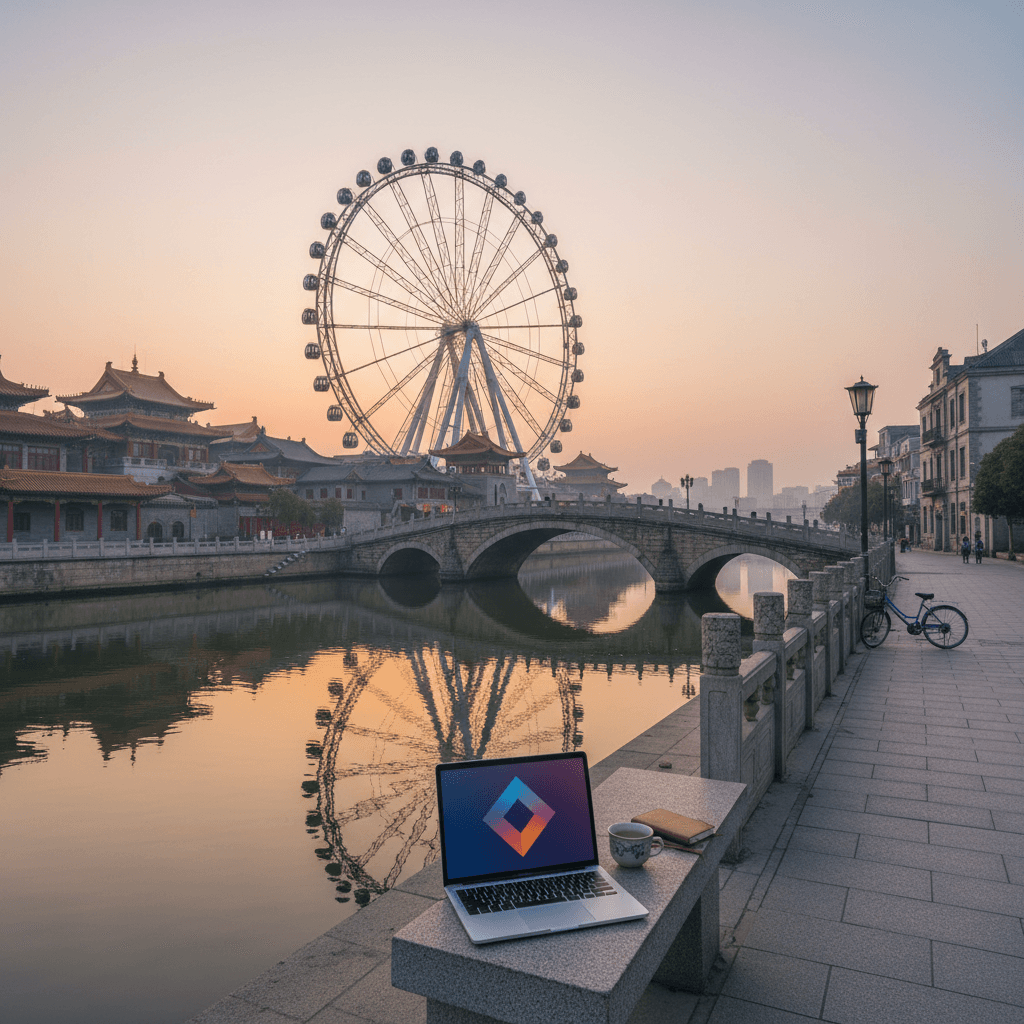
Tianjin
🇨🇳 China
The Vibe: Beijing’s Laid-Back Coastal Cousin
Tianjin is often overshadowed by its neighbor, Beijing, but for those who actually spend time here, that is exactly its charm. It feels like a massive, 15 million person city that somehow forgot to be stressed out. While Beijing is all about power and history, Tianjin is about the stroll. It is a place where futuristic glass libraries in the Binhai New Area sit just a short train ride away from 19th-century Italian villas and quiet, tree-lined concessions.
The city has a distinct "dual personality." One moment you are walking through Xiaobailou, surrounded by European architecture that feels more like Paris than North China, and the next you are at the Tianjin Eye, a massive ferris wheel built right over a bridge. It is weird, eclectic, and much more approachable than Shanghai or Shenzhen. Most nomads find the locals to be genuinely friendly, often stopping to help even if the language barrier is a hurdle. It is the kind of place where you can spend your morning in a high-tech tech hub and your evening watching traditional crosstalk comedy at the Deyun Club.
Why Nomads are Heading Here in 2025 and 2026
The biggest draw right now is the price tag. You can live a high-end lifestyle here for $1,200 to $1,500 USD per month, which is a fraction of what you would spend in China’s Tier 1 cities. It serves as a perfect "base camp." You get the perks of a mega-city, like reliable subways and massive malls like Tianhe City, but without the cutthroat pace. Plus, the high-speed rail can get you into Beijing in 30-50 minutes on express services, making it easy to grab the big city perks whenever you want them.
However, it is not all smooth sailing. The air quality can be hit or miss, and if you don't speak Mandarin, you will be relying heavily on your phone. This isn't a city where English is widely spoken on the street. You’ll need to be comfortable with apps and a bit of "digital survivalism" to get the most out of it.
The Neighborhood Breakdown
- Italian Style Street & Chifeng Road: This is the cultural heart. It’s walkable, artsy, and packed with photo ops like the Sacred Heart Church and the Zhongshuge bookstore. It’s perfect for solo travelers who want to be near the action, though it gets crowded with tourists on weekends.
- Xiaobailou: The go-to for expats. It’s central, full of history, and home to the Minyuan Square, a great spot to sit on the grass and people-watch. Expect to pay around 1,500 to 3,000 RMB for a decent apartment here.
- Binhai New Area: If you want "Cyberpunk China," this is it. It’s home to the Tianjin Science Museum and major tech companies. It’s further out and feels more industrial, but the infrastructure is brand new. Rents here for premium spots usually start at 4,000 RMB.
The Digital Infrastructure
Work-wise, Tianjin is a "cafe culture" city. While dedicated coworking spaces exist, most nomads find themselves setting up in modern cafes near the universities or in the Wanda Plaza area. Fixed broadband speeds are excellent, typically ranging from 80-200 Mbps, which is more than enough for heavy video editing or streaming. The "Great Firewall" is the main boss you’ll have to beat. Expats almost universally recommend using a Nomad eSIM to route your data through Hong Kong or Singapore, which lets you bypass local blocks on Google, Slack, and Instagram without needing a separate VPN on your phone.
What You’ll Love and What You’ll Hate
- The Wins: The food is incredible and cheap. You can grab local snacks for 15 RMB or a full seafood feast at the Old Wharf for about 80 RMB. The city is also incredibly safe, even late at night.
- The Challenges: The "cashless" transition is total. If you haven't linked your Alipay or WeChat Pay before arriving, you will struggle to pay for even a bottle of water. Also, the winter months from December to February are biting cold, so plan your stay for the spring or fall if you can.
Ultimately, Tianjin is for the nomad who is a little bit over the "famous" destinations and wants a place that feels authentic, affordable, and just a little bit strange in the best way possible.
The Bottom Line
Tianjin is one of the best kept secrets for nomads who want the perks of a major Chinese hub without the eye watering price tags of Beijing or Shanghai. You can live a very comfortable life here for $1,200 to $1,500 USD per month, which covers a modern apartment, daily dining out, and plenty of weekend trips. If you're on a tighter budget, you can scrape by on $700 USD, though you'll be trading a central location for a longer commute.
Monthly Budget Tiers
Living costs vary depending on how much you crave Western comforts. Most expats find that the middle ground offers the best value for money.
- The Budget Nomad (~$700/month): You'll likely live in the outer districts or a very modest studio. You're eating primarily at local noodle shops and street stalls, using shared bikes and buses to get around, and working from free cafes.
- The Mid-Range Expat (~$1,200/month): This is the sweet spot. You can afford a nice 1BR in Xiaobailou, eat at a mix of local spots like Yuehai Restaurant and mid-tier international cafes, and take DiDis (ride-sharing) when it rains.
- The High-End Resident ($2,000+/month): This tier gets you a luxury high-rise in the Binhai New Area, frequent upscale dining, and high-speed train travel to Beijing every weekend.
Housing and Neighborhoods
Rent is your biggest variable. Unlike the capital, Tianjin still offers high quality housing for reasonable rates. Just remember that most landlords expect a deposit and several months of rent upfront.
Xiaobailou (Central & European Vibe)
- Rent: 1,500 to 3,000 RMB
- Vibe: Very walkable with plenty of colonial architecture and proximity to Minyuan Square.
Binhai New Area (Modern & Tech-Focused)
- Rent: 4,000+ RMB
- Vibe: Futuristic and polished, home to the famous Tianjin Eye and the Science Museum. It's further out, so you'll spend more on transport.
Food and Daily Expenses
Eating out is often cheaper than cooking for yourself if you stick to local spots. Street food and snacks usually run about 150 RMB per day. If you're craving seafood at the Tianjin Old Wharf, expect to pay around 80 RMB per person for a solid feast. A mid-range dinner for two with drinks typically lands around 200 RMB.
For groceries, stick to local markets for produce. Imported goods at high-end malls like Tianhe City or Wanda Plaza will carry a heavy premium. A coffee at a decent cafe usually costs between 25 and 40 RMB, which is your "rent" for a few hours of workspace.
Transport and Tech
Public transport is incredibly cheap. A monthly pass for buses and shared bikes via Alipay or Meituan costs roughly 150 RMB. If you prefer the convenience of DiDi, a typical cross-town ride is about 20 to 40 RMB. Budget about 300 RMB a month if you use ride-hailing services daily.
Internet is a non-negotiable expense. While basic home setups are cheap, you'll need a reliable eSIM or a solid VPN to stay connected to Western sites. Most nomads recommend Nomad eSIM for its ability to bypass the firewall via Hong Kong routing. Expect to pay 200 to 500 RMB for a decent coworking setup or high-speed mobile data plan.
Key Costs at a Glance
- Domestic Beer (0.5L): 10 to 15 RMB
- High-Speed Train to Beijing: 55 to 65 RMB
- Street Food Meal (Jianbing): 8 to 15 RMB
- Gym Membership: 300 to 600 RMB per month
For Digital Nomads: Italian Style Street
If you're coming to Tianjin to work remotely, start your search near the Italian Style Street. It's the most walkable part of the city, packed with artsy cafes and European architecture that makes for a great backdrop while you're grinding through emails. Most nomads find the blend of historical vibes and modern conveniences like the Zhongshuge bookstore or Clock Tower Park makes it easy to stay productive without feeling isolated.
- The Vibe: Artsy, historic, and very photogenic. It's one of the few places where you'll find a high concentration of cafes suitable for laptop work.
- Monthly Rent: Expect to pay between 1,500 and 3,000 RMB for a decent studio or shared apartment.
- Nomad Perks: Close to the Deyun Club for local crosstalk shows and plenty of bars for post-work drinks.
- The Catch: It gets incredibly crowded with tourists on weekends. You'll want a good pair of noise-canceling headphones.
For Long-term Expats: Xiaobailou
Expats who plan on staying for a year or more usually gravitate toward Xiaobailou. It’s the central business district but with a much more refined, European soul than your typical skyscraper jungle. You've got Minyuan Square nearby, which is the local go-to spot for a sunset stroll or an outdoor coffee. It's the kind of neighborhood where you can find international grocery items and a few more English speakers than the rest of the city.
- The Vibe: Professional, upscale, and central. It feels like the heart of the "international" Tianjin.
- Monthly Rent: Prices here are on the higher side, starting at 3,000 RMB and going up quickly for premium units.
- Expat Perks: Excellent transit links and proximity to international medical clinics. It's the most convenient base for those who don't speak much Mandarin yet.
For Families and Tech-Heads: Binhai New Area
If you're moving with a family or you're a nomad specifically working in the tech sector, Binhai is where the future is happening. It's a bit of a trek from the historic center, but it's much more spacious and modern. You'll find the Tianjin Science Museum and the famous Tianjin Eye ferris wheel nearby. Everything here is built on a massive scale with wide roads and newer apartment complexes.
- The Vibe: Futuristic, industrial, and family-oriented. It feels like a separate city entirely.
- Monthly Rent: Budget at least 4,000 RMB for a comfortable family-sized apartment in a modern high-rise.
- Family Perks: Better access to modern parks, science centers, and newer school facilities.
- The Catch: It can feel a bit soulless and "concrete" compared to the leafy streets of the old concessions.
For Culture Lovers and Solo Travelers: Ancient Culture Street
For those who want to wake up and immediately feel like they're in China, the area around Ancient Culture Street and Chifeng Road is the place to be. It's less about "nomad infrastructure" and more about the sensory experience. You'll be surrounded by local snack stalls, traditional crafts, and the best seafood at Tianjin Old Wharf, where a massive meal usually costs around 80 RMB per person.
- The Vibe: Authentic, loud, and culturally rich. Great for people who want to practice their Mandarin daily.
- Rent: Highly variable, but you can find older, budget-friendly apartments for under 2,000 RMB.
- Solo Perks: You'll never be bored. The street food scene here is elite, with daily costs for food averaging around 150 RMB if you eat like a local.
Practical Neighborhood Tips
No matter where you land, make sure you have Alipay or Meituan ready to go. These apps are how you'll rent the shared bikes that everyone uses to bridge the gap between the subway station and your front door. If you're looking for modern shopping and standard amenities, keep Tianhe City or Wanda Plaza on your radar, as these areas serve as central hubs for most residential districts. Most expats recommend using the DiDi app for moving between these neighborhoods; it's significantly cheaper and easier than trying to hail a traditional taxi.
The Connectivity Reality
Working from Tianjin requires a bit of a tactical approach. While the city is a massive tech and industrial hub, Tianjin's internet speeds average around 80-200 Mbps for fixed broadband, making it one of China's fastest cities. However, the Great Firewall remains the primary connectivity challenge. Most nomads find the local infrastructure quite robust compared to other regional hubs.
The biggest hurdle isn't speed, it's the Great Firewall. To stay productive, expats recommend skipping the headache of local Wi-Fi for your primary work. Most travelers use an eSIM like Nomad because it routes through Hong Kong or Singapore, letting you access Google, Slack, and Instagram without a VPN. If you're staying long term, you'll want a local SIM from China Mobile or China Unicom paired with a rock solid VPN as a backup for your laptop.
Coworking and "Cafe Office" Culture
Tianjin doesn't have a massive, dedicated coworking scene like Bali or Chiang Mai. You won't find a WeWork on every corner. Instead, the community gravitates toward high end cafes and hotel lobbies in areas like Xiaobailou or the Italian Style Street. These spots usually have decent Wi-Fi and plenty of power outlets if you arrive early.
- Budget Workspaces: Local cafes are your best bet. A coffee usually runs about 30 to 40 RMB, and as long as it's not a peak lunch hour, staff generally won't mind you camping out for a few hours.
- Mid-Range Options: You can find local business centers that offer hot desks for roughly 200 to 500 RMB per month. These are more corporate than "nomad chic," but they provide a quiet environment and stable desks.
- Premium Spaces: In the Binhai New Area or near the major malls like Tianhe City, premium serviced offices can cost 1,000 RMB or more. These are mostly used by tech startups and international corporate types.
The Best Neighborhoods for Deep Work
If you need to get things done, where you stay matters. Xiaobailou is the expat favorite for a reason. It's central, feels a bit more European, and has the highest concentration of "laptop friendly" spots. The Minyuan Square area is also great for a midday break to clear your head between deep work sessions.
For those involved in tech or hardware, the Binhai New Area is the place to be. It's futuristic and modern, though it feels a bit more detached from the historic soul of the city. The libraries and modern cafes here are top notch, even if the commute to the old center is a bit of a trek.
Practical Tech Tips
Digital life in Tianjin happens inside two apps: Alipay and WeChat. You'll use these for everything from paying for your 200 RMB monthly coworking desk to grabbing a DiDi ride home. Make sure these are set up and linked to your international card before you arrive.
- Translation: Since English proficiency is low, keep Pleco or Baidu Translate open. You'll need them to ask for the Wi-Fi password (wǎngluò mìmǎ).
- Hotspotting: Because public Wi-Fi can be spotty and requires a Chinese phone number to sign in, most nomads rely on their own 5G hotspots.
- Power: China uses 220V. Most modern laptop bricks handle this fine, but double check your gear. The plugs are usually a mix of two flat pins or three angled pins.
Keeping Your Health in Check
Tianjin is a massive metropolitan hub, and while it doesn't have the same frantic energy as Beijing, the healthcare infrastructure is robust. Most expats head straight to Xiaobailou or the Heping District for medical care. This is where you'll find international clinics like Raffles Medical or United Family. These spots are a lifesaver because the staff speaks English and they understand international insurance protocols. If you're using local public hospitals, be prepared for a bit of a scramble; they're efficient but can be overwhelming if your Mandarin isn't up to par.
Pharmacies are on almost every corner, often marked by a green cross. You can find basic meds over the counter, but for anything specific, it's better to show a photo of the chemical name in Chinese using Baidu Translate. For a serious emergency, dial 120 for an ambulance. Most nomads find that a standard budget of $1,000 to $1,500 USD per month easily covers basic health needs and private insurance premiums.
The biggest health hurdle you'll face isn't a virus, it's the air. Like many industrial cities in Northern China, the AQI (Air Quality Index) can spike, especially during the winter heating season. Download an app like AirVisual to track daily levels. On "grey" days, locals and expats alike wear N95 masks and keep the air purifiers running at home. If you have asthma or sensitive lungs, this is something you'll need to monitor closely.
Staying Safe on the Streets
Tianjin is exceptionally safe for travelers and solo nomads. Violent crime is incredibly rare, and you'll often see people walking alone late at night without a second thought. The city is heavily monitored by CCTV, which acts as a major deterrent. Most of your "safety" concerns will actually be about traffic. Whether you're in the Italian Style Street or the Binhai New Area, electric scooters are silent and fast. They often zip onto sidewalks, so keep your ears open when you're walking.
While the city is secure, keep these practical safety tips in mind:
- Stick to DiDi: Avoid "black taxis" (unlicensed drivers) at the airport or Tianjin Port. Use the DiDi app; it's cheaper, tracks your GPS location, and has an emergency button built into the interface.
- Port Areas: If you're around the Beijiang or Nanjiang port zones, stay alert. These are high-traffic industrial areas with heavy truck movement. They aren't dangerous in terms of crime, but they aren't exactly pedestrian-friendly.
- Digital Safety: Since you'll be using Alipay and WeChat Pay for everything, keep your phone charged. Carrying a power bank is a safety requirement here; if your phone dies, you effectively lose your ability to pay for a ride home or access your ID.
- Scams: Be wary of the "tea house" or "art student" invite in heavy tourist spots like Ancient Culture Street. If a friendly stranger asks you to go somewhere else for a drink or a show, it's likely a setup for an inflated bill.
Emergency Contacts and Essentials
It's a good idea to keep your passport on you, or at least a high-quality digital scan. You'll need it for high-speed trains and checking into hotels. If you do run into trouble, the local police (Public Security Bureau) are generally helpful, though an interpreter app is a must.
- Police: 110
- Fire Department: 119
- Medical Emergency: 120
- Traffic Accidents: 122
Most long-term residents recommend joining local WeChat groups. These communities are the fastest way to get recommendations for English-speaking dentists or to find out which clinics are currently stocked with specific medications. In a city where the language barrier is high, these digital networks are your most reliable safety net.
The Logistics of Getting Around
Tianjin is a massive city, but its transit system is surprisingly intuitive once you get the hang of the local apps. Most expats and nomads find that the combination of a world class subway and cheap ride hailing makes owning a car completely unnecessary. If you are staying in central areas like Xiaobailou or the Italian Style Street, you can reach most of your daily needs on foot or by bike.
Public Transit and High Speed Rail
The metro system is the backbone of the city. It is clean, air conditioned, and incredibly cheap, with most rides costing between 2 RMB and 5 RMB. If you are heading out to the Binhai New Area for the day, expect a longer trek, but the lines are well connected. For regional travel, the high speed rail is a game changer. You can jump on a high-speed train at Tianjin Railway Station and reach Beijing in 30-50 minutes on express services, with some trains taking up to 90 minutes depending on the route and stops. Just remember that you must have your physical passport with you to board any train in China; digital copies won't cut it at the security gates.
- Subway: Reliable and covers all major districts. Use the Tianjin Metro app or Alipay to scan in.
- Buses: Extremely cheap, often around 2 RMB, but can be confusing if you don't read Mandarin. They are great for getting from the port or Binhai into the city center for about 30 RMB.
- High Speed Rail: Best booked via Trip.com. Tickets to Beijing usually cost around 55 RMB.
Ride Hailing and Taxis
Forget trying to hail a cab on the street. While they exist, most drivers are busy with app bookings. DiDi is the local equivalent of Uber and it's your best friend here. The app has a built in English interface and an automated translation tool for messaging your driver. It's generally safer and cheaper than traditional taxis because the price is locked in before you start. A typical 15 minute cross town trip will set you back about 20 to 30 RMB.
When arriving at Tianjin Binhai International Airport, ignore the "black taxi" drivers shouting in the arrivals hall. Follow the signs to the official taxi queue or find the designated DiDi pickup point. Always have a screenshot of your destination address in Chinese characters. Even with the best translation apps, showing a driver a clear image of a Chinese address is the fastest way to avoid a headache.
Shared Bikes and Walkability
Tianjin is famously flat, making it perfect for cycling. You'll see clusters of yellow and blue shared bikes on almost every corner. You can unlock these directly through Alipay or Meituan. It usually costs about 1.5 to 2.5 RMB for a 30 minute ride. It is the preferred way for nomads to zip between cafes in Chifeng Road or along the Haihe River banks.
Walking is particularly pleasant in the historic concessions. The Italian Style Street and the area around Minyuan Square are designed for pedestrians. Expats often spend their weekends wandering these neighborhoods because the European architecture and wide sidewalks feel a world away from the typical high rise urban sprawl.
Monthly Transport Budget Estimates
- The Budget Traveler: 150 RMB per month. This covers daily bus rides and heavy use of shared bikes.
- The Mid Range Nomad: 300 to 400 RMB per month. This allows for frequent DiDi rides when it's raining or when you're running late, plus regular metro use.
- The High End Commuter: 600+ RMB per month. This is for those living in Binhai who frequently take high speed trains to Beijing or use premium DiDi services daily.
The Language Gap
Expect a steep learning curve when you land. Mandarin is the pulse of the city, and unlike Shanghai or Beijing, English hasn't quite taken root here. Most digital nomads find that outside of high end hotels or international schools in Xiaobailou, you won't run into many locals who speak fluent English. It can feel isolating at first, but it also means you're getting a much more authentic experience than you'd find in the typical expat bubbles.
Expats recommend keeping a "cheat sheet" on your phone at all times. This isn't just for conversation; it's for survival. Since many taxi drivers and shop owners won't understand spoken English, having your destination written in Chinese characters is a lifesaver. Travelers often say that screenshotting your hotel address and the names of major landmarks like the Tianjin Eye or Minyuan Square is the first thing you should do after clearing customs.
Must-Have Apps for Translation
The right tech makes the difference between a productive workday and a frustrated afternoon. Forget Google Translate unless you have a rock solid VPN or a specialized eSIM. Instead, lean on these local favorites:
- Pleco: This is the gold standard for expats. It works offline and allows you to draw characters on the screen, which is perfect for translating menus or signs.
- Baidu Translate: This app handles the local dialect much better than Western alternatives. Its photo translation feature is excellent for reading labels at the grocery store.
- WeChat: Beyond being a messaging app, its built in translation tool for chats is how you'll communicate with landlords or local friends. Just long press a message to see the English version.
Navigating the Great Firewall
Communication isn't just about talking; it's about staying connected to the rest of the world. Fixed broadband speeds in Tianjin are robust, typically ranging from 80-200 Mbps, though you may still experience latency when trying to tunnel through the Great Firewall. Most nomads avoid the headache of local WiFi by using a Nomad eSIM. These cards route your data through Hong Kong or Singapore, letting you access Instagram, Slack, and Gmail without needing a separate VPN.
If you're planning to stay long term, you'll need a local SIM from China Mobile or China Unicom. You can set these up at the airport or in major malls like Tianhe City. You'll need your passport for registration, and it's best to bring a local friend or use a translation app to navigate the data plan options. Expect to pay around 100 to 200 RMB for a solid monthly data package.
Key Phrases for Daily Life
You don't need to be fluent, but showing effort goes a long way with the locals, who are generally friendly and patient with foreigners. Master these basics to get by in the markets of Ancient Culture Street:
- Nǐ hǎo: Hello. Use it for everyone.
- Duōshǎo qián?: How much? Essential for street food and markets.
- Tīng bù dǒng: I don't understand. This usually prompts the local to pull out their own translation app.
- Měi yǒu: Don't have it / No. You'll hear this often in shops.
- Wǒ yào zhège: I want this one. Pointing is perfectly acceptable here.
While the language barrier is one of the biggest complaints from the nomad community, it's also what keeps Tianjin's cost of living low and its culture intact. Once you've linked your Alipay and WeChat Pay to your international card, the "cashless" nature of the city actually reduces the need for complex verbal exchanges. Most transactions involve a simple scan of a QR code, making daily errands surprisingly smooth despite the lack of English.
The Sweet Spots: Spring and Autumn
If you're planning your stint in Tianjin, aim for the shoulder seasons. April and May are arguably the most pleasant months to be here. The city shakes off the winter gray, and the parks around Minyuan Square start to pop with green. Temperatures hover comfortably between 55°F and 75°F (13°C to 24°C), making it the perfect window to wander the Italian Style Street without breaking a sweat or needing five layers of thermal gear.
September and October offer a similar golden window. The humidity of the summer vanishes, leaving behind crisp air and clear skies. Expats often find this the best time for photography near the Tianjin Eye or long walks along the Haihe River. You'll get mild days and cool nights, typically staying within the 50°F to 70°F (10°C to 21°C) range. It's the most reliable weather you'll get all year.
The Summer Swelter
From June through August, Tianjin gets sticky. It's the rainy season, so expect sudden downpours and high humidity. Temperatures frequently climb into the mid-80s or low 90s°F (around 30°C to 34°C). If you're working from a cafe in Xiaobailou, you'll want to make sure their AC is up to the task. Most nomads find the combination of heat and urban smog a bit draining during these months, though the long evenings at the night markets are a decent trade off.
The Deep Freeze
Winter in Northern China is no joke. From December to February, the mercury often dips below 32°F (0°C) and stays there. It's a dry, biting cold, often accompanied by winds whipping off the Bohai Sea. While the city's heating systems are robust, the air quality can take a hit during these months. If you're here in January, you'll definitely need a heavy parka and a high quality mask for the days when the air gets thick. On the plus side, rent prices in short term apartments might be slightly more negotiable when the tourist crowds vanish.
Timing Your Arrival
Beyond the thermometer, you need to watch the calendar. Avoid moving or traveling during Golden Week (early October) or Chinese New Year (January or February). The city doesn't just get crowded; it effectively shifts gears. Many local shops close, and high speed train tickets to Beijing or the Binhai New Area become nearly impossible to book on Trip.com unless you've planned weeks in advance.
- Best for outdoor work: May and September. The air is clearest and the breeze is just right for patio working.
- Best for budget: November and March. These "bridge" months are chilly but often see lower prices for mid-range accommodation.
- What to pack: Heavy layers for winter, a sturdy umbrella for July, and a high quality air filtration mask for the stagnant days in late autumn.
Most long term residents suggest arriving in late August. You'll catch the end of the heat, settle into your neighborhood just as the perfect autumn weather hits, and have your Alipay and WeChat Pay systems fully sorted before the October holiday rush begins.
Connectivity and the Great Firewall
Living in Tianjin means mastering the digital dance. While Tianjin's internet speeds (80-200 Mbps) are generally adequate for video calls, the Great Firewall remains the primary connectivity challenge for accessing Western services. To keep your sanity and bypass the Great Firewall, skip the local hotel WiFi for work. Most expats recommend using a Nomad eSIM which routes through Hong Kong or Singapore, giving you a stable 5G connection and access to Western apps without a struggle.
For everything else, your phone is your lifeline. Download Alipay and WeChat Pay before you even land. China is a cashless society; you will struggle to buy a bottle of water without these apps. Link your international card and test it with a small purchase immediately. For local navigation and translation, Baidu Translate and Pleco are the gold standards since Google Maps and Translate are unreliable here.
Getting Around the City
Public transport is efficient and dirt cheap, but the language barrier makes it a bit of a puzzle. Skip the traditional taxis and use the DiDi app instead. It has an English interface and lets you type your destination, which saves you from the awkwardness of trying to explain a street name in Mandarin. If you do take a taxi, always have a screenshot of your destination address in Chinese characters to show the driver.
For short trips, grab a shared bike via Alipay or Meituan. It's the best way to explore the Italian Style Street or Chifeng Road. If you are heading to Beijing for the day, the high speed train is your best friend. Book tickets on Trip.com and remember that your passport is your ticket; you will need it to enter the station and board the train.
Budgeting for 2025-2026
Tianjin is significantly more affordable than Shanghai or Beijing. Most nomads live comfortably on $1,000 to $1,500 USD per month. Here is how those costs usually break down:
- Budget Tier: Around $700 USD monthly. You will be eating mostly street food for 150 RMB a day and living in outer districts where rent sits near 200 RMB per day for short stays.
- Mid-Range: Around $1,200 USD monthly. This covers a nice studio in Xiaobailou for 1,500 to 3,000 RMB and dining at spots like Yuehai Restaurant.
- High-End: $2,000+ USD monthly. This gets you a luxury apartment in the Binhai New Area for 4,000+ RMB and plenty of upscale seafood dinners at the Old Wharf.
Health and Safety
Tianjin is remarkably safe at all hours, though the air quality can be a literal headache. Expats suggest keeping an eye on the AQI levels and wearing a mask on hazy days. If you get sick, head to the international clinics in the Xiaobailou district rather than the public hospitals to find English speaking staff. In a serious emergency, the number for an ambulance is 120.
Language and Culture
English proficiency is low here. You will get by in big malls like Tianhe City or Wanda Plaza, but at local markets, you will be relying on translation apps and hand gestures. Learn the basics: Nǐ hǎo for hello and Duōshǎo qián? for how much. Locals are generally patient and friendly, especially if they see you are making an effort to navigate their world. Always carry your physical passport; you will need it for everything from checking into a hotel to registering a local SIM card at a China Unicom branch.
Need visa and immigration info for China?
🇨🇳 View China Country GuideHidden Gem
Worth the effort