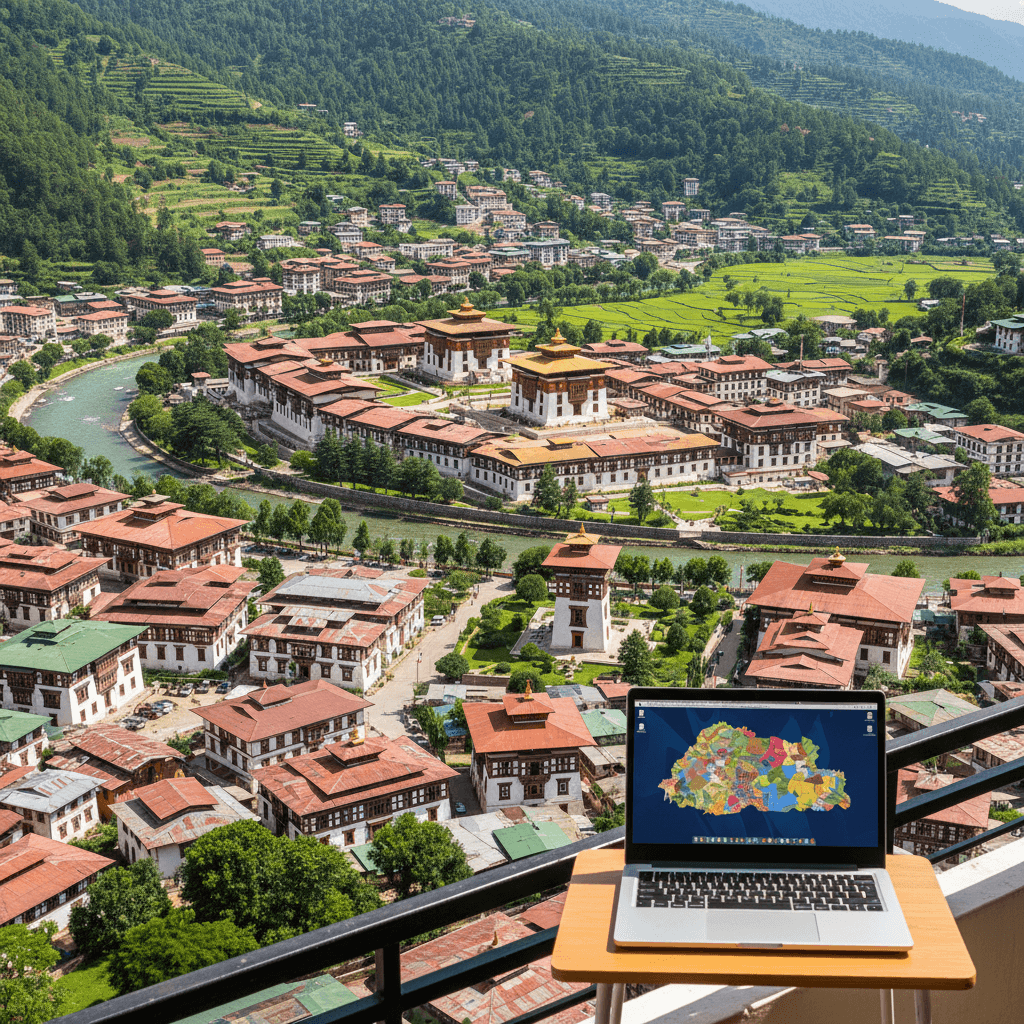
Thimphu
🇧🇹 Bhutan
Thimphu feels unusually calm for a capital. Monks in maroon robes, embassy SUVs, stray dogs and the smell of butter tea all share the same streets and the city somehow keeps its cool. It’s safe, walkable and genuinely pleasant if you like slow mornings and mountain air. Not loud. Not rushed.
The vibe is more monastery bell than nightclub bass. Most nomads settle into Kawajangsa, Motithang or Chubachu, then figure out fast that Thimphu works best if you’re fine with early nights, cold tile floors in winter and a social scene that leans toward coffee, hikes and the occasional low-key bar before the 11 pm curfew kicks in. Honestly, that’s half the charm, though it can feel isolating if you’re used to bigger nomad hubs.
What daily life feels like
- Pace: Slow, polite and a little old-school, with traffic honking softly through valleys instead of hammering you all day.
- Safety: Very good, even for solo women in central areas, though you should still watch your pockets in crowded markets.
- Work life: Internet is decent in town, but, frankly, 10 to 30 Mbps can test your patience on bad days.
- Nightlife: Limited, then gone early, so don’t come expecting late dinners and all-night bars.
Best areas for nomads
- Kawajangsa: Upscale, leafy and close to embassies, with better views and higher rents.
- Chubachu: Central and walkable, good if you want markets, museums and cafés nearby.
- Motithang: Quieter and polished, with easy access to the Takin Preserve and a more residential feel.
- Simtokha: Cheaper, more local and a bit out of the way, which some people love and others hate.
Budget-wise, Thimphu can be surprisingly manageable, with comfortable monthly living often landing around $600 to $1,200. Street food runs about $1.40 to $2.80, a taxi is usually $1.40 to $2.80 and coworking spaces like Innovate Bhutan or WorkSpace Thimphu give you a real desk when café WiFi starts acting up, which it sometimes does. You’ll hear rain on tin roofs, smell chili frying from lunch stalls, then sit down for work with a view of hills and prayer flags, that’s Thimphu at its best.
Thimphu can be cheap, but it isn't dirt cheap. A solo nomad can scrape by on about $412 a month if they live simply, cook often and keep transport to a minimum, while a more comfortable setup lands closer to $600 to $1,200 once you add a decent room, café workdays and the occasional taxi.
Rent is where the spread gets weirdly wide. A studio or small 1BR in the city center usually runs about 5,000 to 7,000 BTN or roughly $72 to $100, while outskirts spots like Simtokha can dip to $65 to $150 and nicer places in Kawajangsa or Motithang can jump to $150 to $300 because you're paying for views, quiet and a more polished neighborhood.
Typical monthly costs
- Budget living: $400 to $600, if you're careful and don't eat out much.
- Mid-range: $600 to $900, which, honestly, is where most nomads settle.
- Comfortable: $900+, with better housing, more café time and less penny-pinching.
- Coworking: $50 to $140 a month, depending on whether you want a simple desk or a proper setup.
Food is still reasonable, though groceries can feel pricier than India and street stalls are where the savings show up. Expect momos, chili cheese stew and fried snacks for about $1.40 to $2.80, a mid-range meal for $7 to $10 and fancier restaurants pushing higher, especially if you're ordering drinks or sitting somewhere with a valley view and the smell of butter tea drifting through the room.
Neighborhoods that make sense
- Chubachu: Best for central living, walkability and easy access to markets.
- Changangkha: Good if you want hill views and don't mind the climb.
- Kawajangsa: Safer, greener, pricier and popular with expats.
- Simtokha: Cheapest pick, but you're farther out.
Transport won't wreck your budget. Local buses are cheap but patchy, taxis usually run $1.40 to $2.80 a ride and a monthly pass can be around $4 to $7, though you'll end up walking a lot because the center's compact and the streets are lined with prayer flags, parked taxis and the occasional honk echoing off the hills.
Internet and coworking are the real trade-off. Fiber can sit anywhere from 10 to 47 Mbps, which works fine for most remote work, but speeds can wobble and café WiFi can get flaky, so places like Cafe Luna, Ambient Café, Innovate Bhutan, WorkSpace Thimphu and the TechPark spaces are where people go when they need fewer headaches and a plug point that actually stays alive.
Thimphu’s neighborhoods are small, but they feel pretty different once you’re living here, especially when the morning traffic starts honking, the incense drifts out of a monastery and your WiFi drops just as the rain hits the tin roof. The city’s compact, safe and weirdly easy to settle into, though the trade-off is clear: quiet nights, cold winters and some areas that feel a bit too tucked away.
Nomads
- Chubachu: Best if you want to walk to markets, museums and cafes without relying on taxis. It’s busier than the hill neighborhoods, but that’s the point and honestly it’s the easiest base for a first stay.
- Changangkha: Good for apartments, hill views and places like Cafe Luna, though the climbs can leave you breathing hard at altitude. Internet is usually decent here, which, surprisingly, matters more than the view after a few days of work.
- Work setup: Most nomads end up mixing a home base with coworking, so budget for places like WorkSpace Thimphu or Innovate Bhutan, because cafe WiFi can be patchy and a dead connection at 3 p.m. gets old fast.
If you want convenience over charm, stay near the center. Not fancy. Just practical.
Expats
- Kawajangsa: This is the polished choice, with embassies, greenery and a quieter, safer feel that suits professionals who don’t want constant street noise. Rents run higher, around $150 to $300 for a one-bedroom, so budget accordingly.
- Motithang: More residential and peaceful, with upscale homes and easy access to the Takin Preserve. It’s slightly remote and taxi rides add up, but the air feels calmer than downtown.
- Daily life: Both areas work well if you’re staying longer, especially if you want a cleaner, less chaotic base, though you’ll still need to plan around limited nightlife and the 11 pm curfew.
These are the neighborhoods people pick when they want sleep, space and fewer surprises. You’ll hear less traffic, more birds and the occasional prayer bell at dawn.
Families
- Kawajangsa: The safest, most settled-feeling option for families, with green streets and enough space that kids aren’t constantly dodging traffic.
- Motithang: Also strong for family living, because it’s quiet, residential and close to parks and the Takin area. It feels removed from the city rush without being stuck in the middle of nowhere.
- Practical side: Grocery runs, school pickups and taxi rides are easier here than in the outer outskirts, though you’ll still want to sort out transport early because buses are cheap but not exactly frequent.
Families usually do best in the west and north side of town, where the roads are calmer and the evenings feel safer. Cold floors, thin air and long winters still come with the package.
Solo Travelers
- Chubachu: The easiest place to land if you’re on your own and want cafes, shops and people around without feeling lost. It’s not quiet, but it’s social in a low-key way.
- Simtokha: Best for tighter budgets, with cheaper rent and a more local feel. The downside is location, because you’re on the edge of town and taxi dependence gets real.
- Safety: Thimphu is very safe overall, even at night in the center and upper areas, so solo women usually feel fine walking around, just keep the usual crowd caution in markets and busier streets.
If you’re staying short-term, start central, then move outward if you need more space or lower rent. That’s the cleanest way to avoid paying extra for a neighborhood you barely use.
Thimphu’s internet is decent in the center, frustrating once you drift out of town. Fiber from Bhutan Telecom and TashiCell can hit 10 to 47 Mbps, which is fine for calls, docs and light uploads, but if you’re pushing big files, honestly, you’ll feel the drag. The good news, weirdly, is that the city’s calm pace makes flaky WiFi slightly less maddening, because nobody’s pretending this is a hyper-connected digital capital.
Most nomads end up working from cafes first, then settling into a proper coworking spot once they realize their laptop battery and patience are both finite. Cafe Luna, Ambient Café and The Zone are the usual café picks, with Ambient often offering day passes around $2 to $4 and decent WiFi, though you should expect the usual espresso-machine hiss, chatter and the occasional power cut that kills the mood.
Best coworking options
- Innovate Bhutan: Small but practical, with a cabin option around 4,999 BTN and a larger plan around 6,999 BTN, plus day walk-ins near 350 BTN, so it’s one of the cheaper dedicated spaces.
- WorkSpace Thimphu: Usually around $50 to $100 a month, good for people who want desks and meeting rooms without the polished, soulless vibe you get in bigger cities.
- Thimphu TechPark and Bhutan Innovation Hub: Roughly $72 to $140 monthly, better if you want a more formal setup and don’t mind being around start-up types and the low hum of AC.
If you’re choosing a neighborhood for work, Chubachu and Changangkha are the safest bets, because they’re central enough for quick cafe runs and taxis, while Kawajangsa gives you quieter streets and better views if you don’t mind paying more. Simtokha is cheaper, but the commute can get annoying and uphill walks in thin mountain air aren’t cute after a long Zoom call.
Mobile data is the backup plan, not the main plan. Get a local SIM from Bhutan Telecom or TashiCell, keep a second data source if you rely on client calls and don’t assume rural trips will have usable signal, because once you leave the center, the connection gets spotty fast and sometimes just disappears.
- Local SIMs: Cheap to start, easy to buy with your passport and visa.
- Best use case: Backing up unstable cafe WiFi, not replacing it.
- Best mindset: Work earlier in the day, download files before leaving and avoid tight deadlines on monsoon afternoons.
Frankly, Thimphu’s coworking scene isn’t big, but it works if you’re flexible and don’t need Silicon Valley speed. The city’s quiet, the mountain air smells like pine and diesel and when the internet holds steady, which, surprisingly, happens more often in the center than people expect, you can actually get things done without too much drama.
Thimphu feels safe in the way a small capital should, quiet streets, polite drivers and very little street crime. Most nomads walk around the center and upper neighborhoods after dark without fuss and honestly the biggest annoyance is more likely to be a stray taxi horn than trouble. Pickpocketing can happen in crowded markets, though, so keep your phone zipped away and don’t leave a bag dangling off a café chair.
There aren’t really any hard no-go zones. Center city, Chubachu, Kawajangsa, Motithang and Changangkha are all fine and solo women usually report feeling comfortable here, even late in the evening if they’re sticking to lit streets. It’s calm, sometimes almost eerily so, with incense drifting from temples and the occasional dog bark echoing off the hills.
Healthcare basics
- Main hospital: JDWNRH, usually called Thimphu General Hospital, is the main public option and the best place to start for anything beyond a minor issue.
- Pharmacies: Easy to find in central Thimphu, so you can usually get basic meds, bandages and cold remedies without a long hunt.
- Serious cases: For major emergencies, people often get evacuated, because local care is improving but still limited for complex treatment.
- Emergency numbers: Police 113, ambulance 112.
The hospital is basic, though it’s improving and the newer specialty build-out is a sign the city’s health system is slowly catching up. For everyday stuff, it’s fine, but if you need advanced imaging, specialist surgery or anything high-stakes, don’t bluff your way through it, plan to leave the country. That’s the reality.
Bring a small personal kit, especially if you’re picky about brands or meds. Pharmacies carry the usual basics, but prescription stocks can be patchy and a rainy day at JDWNRH can mean waiting around under fluorescent lights with the smell of antiseptic and wet jackets hanging in the air.
Practical safety habits
- After dark: Stick to main roads and lit areas, then grab a taxi if you’re tired, it’s cheap enough.
- Valuables: Keep cash, cards and electronics out of sight in markets and buses.
- Transport: Use registered taxis or the DrukRide app, especially if you’re heading uphill at night.
- Mind the cold: Winter streets can be icy and the wind bites, so walk slowly on shaded slopes.
If you’re the type who likes a city with a bit of edge, Thimphu will feel almost too tame. That’s the point, though and most people end up appreciating it. Just don’t get careless because it feels gentle and don’t expect big-city medical backup when something really goes wrong.
Thimphu is easy to cover on foot if you stick to the center. The old part of town, around the clock tower, Chubachu and the main market streets, is compact, so most errands turn into a 20 to 30 minute walk with mountain air, the occasional bark from a street dog and that thin mix of incense and exhaust drifting through the road.
Walk first. It’s the best default and honestly the least annoying one. The city gets hilly fast, though, so shoes matter more than style and winter mornings can feel brutally cold on the pavement.
Walking
- Best for: Central Thimphu, quick errands, cafes, markets and short hops between coworking spaces.
- Watch out for: Steep streets, thin air and traffic that doesn’t always give pedestrians much patience.
Taxis are the next move when your legs are done. They’re cheap by international standards, usually around $1 to $3 for a short ride and you can flag one down pretty easily, but there’s no Uber, no Grab and no magic app backup if you’re standing in the rain.
DrukRide helps a lot, because it can show taxis and buses in one place and takes some of the guesswork out of hailing a ride. The catch is simple, service can be patchy, drivers don’t always show up exactly when you want and if you’re headed across town at rush hour, the ride can still crawl along behind slow buses and honking cars.
Taxis and apps
- Typical fare: $1 to $3 for short rides.
- Use DrukRide: For booking and real-time tracking, when it behaves.
- No ride-hailing giants: Don’t expect Uber-style convenience.
Public buses are the budget option, but they’re infrequent and not built for anyone who likes tight schedules. They work if you’ve got time to spare and if you’re heading somewhere simple, but most nomads I met treated them as a backup, not a daily routine.
Bicycles and scooters sound nice, then you hit the hills and remember where you are. Rental options aren’t common, the altitude can leave you weirdly winded and some streets are just too steep or uneven to make cycling feel smart.
Getting in and out
- Paro Airport transfers: Plan on 1 to 1.5 hours by taxi.
- Expected cost: Roughly $30 to $50 with a driver.
- For longer stays: Use a mix of walking, taxis and the occasional bus.
For day-to-day life, that mix works fine. Thimphu isn’t built for speed and that’s the point, but if you want to move fast, you’ll probably get frustrated, then take a breath, then book a cab.
Thimphu’s everyday language scene is pretty easy for visitors, though it’s a little more layered than it first seems. Dzongkha is the main language, Nepali pops up in some homes and businesses and English works well in hotels, cafés, coworking spaces and most offices, so you won’t spend your first week doing mime in the grocery store.
English is widely understood. In central Thimphu, you can usually sort out rent, taxis, SIM cards and café orders without much stress, though older shopkeepers and some drivers may prefer Dzongkha or just gestures. Honestly, that’s where a phone app helps more than your textbook ever will, especially when you’re trying to explain an address near Chubachu and the taxi driver is asking three different follow-up questions.
Useful Phrases
- Kuzu zangpo la: Hello, formal
- Kuzu zangpo: Hello, informal
- Kuzu: Hi, casual
- Thuk-je-che: Thank you
Use the formal greeting first, then relax into the shorter version if people do. Locals appreciate the effort and they usually smile when you try, which, surprisingly, goes a long way in a city where conversations are calm, polite and rarely rushed.
For translation, Google Translate does the job and it’s better than guessing, especially with menu items or apartment details. The odd part is that spoken English can be fine, then turn patchy the moment you get into slang, so keep your phrasing plain and don’t overcomplicate things.
Language won’t be your biggest headache here. The real friction is practical, like weak signal in a back street, a taxi driver who doesn’t know the landmark you mentioned or a landlord who’d rather text in short bursts than have a long chat. Still, most nomads get by quickly, because the city’s small, the pace is slow and people are used to dealing with foreigners.
How Communication Feels Day to Day
- Cafés and coworking: English is standard
- Taxis: Basic English or app-based booking
- Markets: Mix of Dzongkha, Nepali and gestures
- Government or formal settings: Use polite, simple English
In person, communication feels gentle, not noisy, with the occasional horn, phone buzz and shop radio in the background. If you speak slowly, keep your tone respectful and don’t try to bluff through a question you didn’t catch, people here are generally patient and that makes daily life much smoother.
Weather & Best Time to Visit
Thimphu sits in a subtropical highland pocket, so the weather changes fast and honestly, that’s part of the charm. Mornings can feel crisp enough for a fleece, then by afternoon you’re peeling layers while prayer flags snap in the wind and taxi horns echo off the hills. Winter is dry and bright, summer gets wet and muddy and the monsoon can make the whole valley feel soggy and a bit trapped.
Best months? October through February. Clear skies, big mountain views and that sharp Himalayan cold that makes coffee taste better, though nights can drop below freezing and the tile floors inside apartments feel brutally cold. Spring is nice too, with mild days and fewer crowds, but the light is softer and the views can turn hazy after lunch.
June to September is the rough patch. Rain comes hard, then harder and you’ll hear it hammering on tin roofs while the roads get slick and the air turns damp, earthy and heavy. July and August are the wettest months, so if you hate grey skies, leaky shoes and clouded-out mountain views, skip them.
Month-by-Month Feel
- January: Cold and clear, around 5°C / -3°C, good for views, bad for warm hands.
- June: Mild but wet, around 17°C / 11°C, with rain returning in full force.
- July: The wettest stretch, around 17°C / 12°C and honestly a slog.
- October: Peak travel weather, around 23°C / 14°C, bright and dry.
If you’re working remotely, October to early December is the sweet spot, because the weather’s stable, the air is clean and getting around on foot doesn’t feel like a chore. January and February work if you like cold, dry mornings, but pack proper layers, because the chill gets into your bones and the evenings arrive fast once the sun drops behind the ridges.
For most nomads, the answer is simple. Go in autumn, stay through early winter if you can and avoid the monsoon unless you actually like rain, fog and unpredictable delays. The city’s calmer then too, with less humidity, fewer weather headaches and a better chance of actually seeing the monasteries above the valley instead of staring into a white wall of cloud.
Thimphu is easy to like, but it’s not effortless. The city feels calm, smells like woodsmoke and chili oil and then the internet hiccups just when you need to send a file, so plan around that instead of pretending it’ll magically fix itself.
SIMs and data: Bhutan Telecom and TashiCell are the main options and you’ll usually need your passport and visa details at the airport or a shop. Starter packs are cheap, around $1.40, but data can feel pricey for what you get, honestly, especially if you’re used to fast, unlimited service in bigger nomad hubs.
Money stuff: ATMs are limited, fintech’s still thin on the ground and some places only want cash, so keep a buffer. Foreign income isn’t taxed here for nomads, which is great, though groceries and imported items can sting a bit if you’re coming from India or a cheaper Southeast Asian base.
Where to Stay
- Kawajangsa: Best for professionals who want quieter streets, embassy-area safety and cleaner views, but rent runs higher, around $150 to $300.
- Chubachu: The easiest area for walking to markets, museums and cafes, though it’s busier and a little less peaceful at night.
- Simtokha: Good if you’re watching rent, with places around $65 to $150, but you’ll be farther out and the vibe’s more local.
Most nomads hunt on Facebook groups first, then check Cozycozy for short stays, which, surprisingly, can land you a decent apartment for about $19 to $20 a night. The market is patchy, so if you see a clean flat in Motithang or Changangkha with a decent heater, move fast.
Getting Around
- Walk: The center is compact and 20 to 30 minutes on foot covers a lot.
- Taxi: Fares usually land around $1 to $3, no Uber, just flag one down.
- Bus: Cheap, but schedules can be annoying and infrequent.
- DrukRide: Handy for booking taxis and checking routes without waving cash around.
The hills matter, weirdly more than you expect, because a “short walk” can leave you warm, out of breath and staring at prayer flags flapping in cold air. Don’t bother with bike rentals unless you enjoy punishment.
Local manners: Take off your shoes in monasteries, don’t photograph inside temple halls and avoid public affection, even if it feels harmless. People are polite, the city feels very safe and the worst you’ll usually face is a stern look or a quiet correction from someone who’s seen it all before.
For food, skip the polished spots if you want the real rhythm of the place, head for momos at Zombala2, try emadatse when you can handle the heat and grab coffee at Cafe Luna or Ambient Café if you need WiFi and a chair that doesn’t fight your spine. Nightlife shuts down early, though, so plan your social life before 11 pm, because that curfew hits fast and the streets go hushed.
Need visa and immigration info for Bhutan?
🇧🇹 View Bhutan Country GuideEasy Landing
Settle in, no stress