Stone Town
🇹🇿 Tanzania
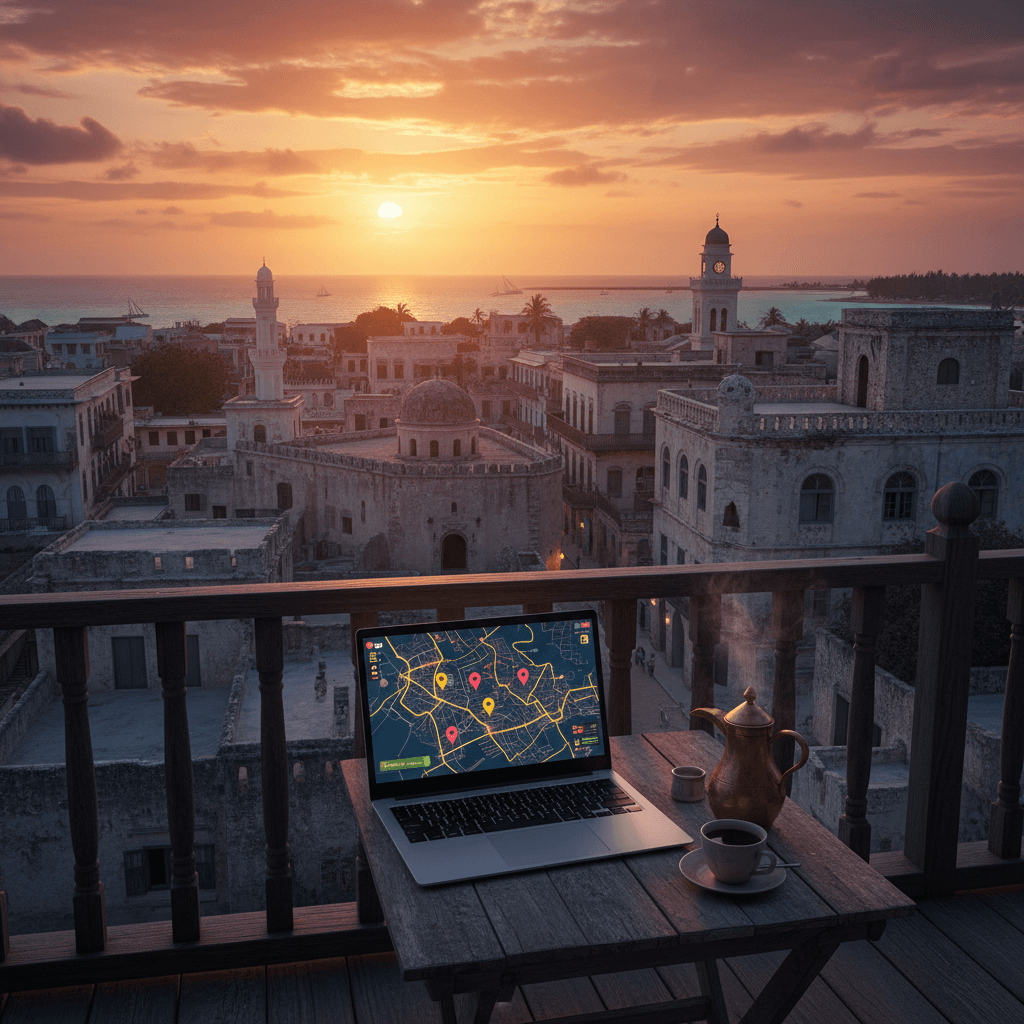
Stone Town doesn't ease you in gently. You step out of the airport taxi and the smell hits first, grilled fish and clove smoke and something floral you can't quite place, then the noise closes in: mopeds squeezing through alleys barely wide enough for two people, the echo of the evening call to prayer bouncing off coral-stone walls that have been standing since the 1800s. It's a lot. Most nomads say they either fall hard for it within 48 hours or spend a week feeling mildly overwhelmed.
What makes Stone Town genuinely different from other "affordable, walkable" nomad spots is the density of its history. This was a center of the Indian Ocean trade, a hub for Arab merchants, Indian traders and British colonizers and that layering is, honestly, still visible in the food, the architecture and the faces of the people who live here. It's not a museum, it's a working city, which means the UNESCO-listed medina also has laundry hanging from ornate wooden balconies and kids kicking footballs past centuries-old doorways.
The vibe skews relaxed but not sleepy. Polepole (slowly, slowly) is a real cultural value here, not a tourist slogan and you'll either find that calming or maddening depending on your deadline. Expats tend to say it recalibrates your pace in ways you don't expect.
Socially, Stone Town is more conservative than the beach towns to the north. Nightlife exists but it's modest, modest dress is expected outside tourist-facing spots and public displays of affection are genuinely frowned upon. That's not a dealbreaker, it's just the deal.
The tradeoffs are real. Power cuts happen, internet drops at inconvenient moments and petty theft in the markets is a known issue. Budget nomads can live comfortably on $700 a month, mid-range comfort runs closer to $1,200 and rents have climbed 8 to 12 percent recently as tourism pressure builds. It's still cheap by global standards, turns out, but it's not as cheap as it was two years ago.
Still, there's nowhere quite like it. The combination of genuinely affordable living, walkable infrastructure and a city that feels this layered and alive is, frankly, rare. Most people who come for a month end up extending.
Stone Town isn't cheap, not anymore. Rents jumped 8,12% recently as tourism picked up and that pressure's still being felt across the board. A solo nomad can technically survive on $400,$700 a month, but that means street food every day, a bare-bones studio and cafe WiFi instead of a proper coworking space.
Most nomads land somewhere in the $800,$1,200 range, which is, honestly, the sweet spot. You get a decent apartment, eat well and still have money left over. A comfortable expat lifestyle with air conditioning, private transfers and regular restaurant meals runs $1,500 or more.
Budget Tier ($400,$700/month)
- Rent: $100,$300 for a studio in Stone Town or Ng'ambo
- Food: Street food at Forodhani Night Market runs $2,$5; Lukmaan Restaurant does a fish curry for around $2
- Transport: Dala-dala minibuses cost $0.50 a ride, they're cramped and unpredictable but they work
- Coworking: Cafe Maua charges about $2.50 for a coffee and WiFi, which is frankly good enough for light days
Mid-Range Tier ($800,$1,200/month)
- Rent: $300,$500 for a studio; $550,$610 for a one-bedroom
- Food: Sit-down restaurants run $5,$10 a meal
- Transport: Scooter rental at $10,$15 a day gives you real freedom, though the roads are, weirdly, more chaotic than they look
- Coworking: Zanzibar Coworking Space charges $5 a day; The Train's House runs $12 a day or $180 a month for AC and reliable speeds
Comfortable Tier ($1,500+/month)
- Rent: $500+ for a quality one-bedroom
- Food: Upscale meals start around $15
- Transport: Private transfers at $15 or more per trip
Ng'ambo, turns out, is worth considering if you want to stretch your budget. Rents are cheaper and it's quieter, though you'll sacrifice walkability and most of the nomad infrastructure. Stone Town keeps you close to everything, you just pay for that convenience.
ATMs are available in Stone Town with roughly a $2 commission per withdrawal. M-Pesa and Tigo Pesa handle most daily transactions, so carry some local shillings but don't stress about cash for everything.
Stone Town doesn't have sprawling districts to choose from. It's a compact, walkable medina where the neighborhoods are more like zones and your choice basically comes down to two: inside the historic core or just outside it in Ng'ambo. Get that right and everything else falls into place.
For Digital Nomads
Stone Town proper is where you want to be. Coworking spaces like The Train's House and Zanzibar Coworking Space are both here, the cafes have WiFi and you can walk to Forodhani Night Market for a $3 grilled fish dinner after your last call. The streets smell like cardamom and salt air, the call to prayer echoes five times a day and honestly, it's one of the more atmospheric places you'll ever open a laptop.
The downside is real though. Power cuts happen, internet dips below 10 Mbps without warning and the alleys are, turns out, genuinely loud at peak hours. Most nomads use a Tigo SIM as backup and keep Speedify running, that's just the standard setup here.
For Expats on Longer Stays
Ng'ambo sits just across the creek from Stone Town and it's a completely different energy. Quieter streets, lower rents (studios start around $100 versus $300+ in the historic core) and a local residential feel that Stone Town's tourist-heavy lanes don't really offer. You're not walking to a coworking space, you're commuting, so factor that in.
Rents across both areas rose 8 to 12% recently due to tourism pressure, Ng'ambo is still the better value by a significant margin.
For Families
Ng'ambo, no question. Stone Town's narrow alleys aren't built for strollers or kids who need space, the noise is constant and petty theft in crowded markets is a genuine concern. Ng'ambo gives you room to breathe, neighbors who aren't tourists and lower monthly costs that add up fast over a multi-month stay.
For Solo Travelers
Stay in Stone Town. Full stop. The rooftop bars, the market chaos, the ornate carved doors on every corner, the smell of street food frying at dusk; you'd miss all of it from Ng'ambo. Budget $400 to $700 a month if you're keeping it lean, stay close to Forodhani and don't walk the quieter alleys alone after dark.
Stone Town's internet situation is, honestly, a mixed bag. You'll get 10,28 Mbps download speeds in most coworking spaces and cafes, which handles video calls fine, but step into the older medina alleys and the signal drops without warning. Power cuts happen too, usually short, but enough to kill your flow mid-call.
For serious work, skip the cafe-hopping and head straight to a dedicated space. Tarawanda Box and Kokaya Space are confirmed operating options in Stone Town that provide the infrastructure needed for a productive day. If you're up near the northern beaches, Nungwi Coworking charges $7.50 a day, though that's an hour's drive from the Stone Town core.
Cafes work in a pinch. Cafe Maua is the go-to, a coffee costs around $2.50 and the WiFi holds up well enough for async work, it's not the place for a three-hour Zoom marathon though. The ambient noise of the medina, motorbikes threading through alleys, the afternoon call to prayer echoing off coral stone walls, makes concentration a real effort in open-air spots.
For your SIM, get Vodacom or Tigo at the airport or any shop in town. A starter pack runs about $5, register it with your passport on the spot. Tigo has 5G coverage in Stone Town proper, turns out it's surprisingly fast for a city this size. Most nomads run a local SIM alongside their coworking WiFi and use the Speedify app to bond both connections, that combination handles most stability issues.
- Tarawanda Box: Reliable coworking environment in Stone Town.
- Kokaya Space: Modern workspace designed for digital nomads.
- Nungwi Coworking: $7.50/day. Better for beach-based nomads, far from Stone Town.
- Cafe Maua: $2.50 coffee, decent WiFi for light work.
- SIM cards: Vodacom or Tigo, $5 starter, 4G/5G in town.
Don't expect European reliability. But with the right setup, it works.
Stone Town is, honestly, safe enough for most travelers who keep their wits about them. Violent crime is rare. What you'll actually deal with is pickpockets in the markets near Forodhani and around the port, the kind of opportunistic stuff that happens anywhere tourists congregate with phones out and bags loose. Don't flash valuables, keep your bag in front of you in crowds and avoid walking alone through unlit alleys after dark, the medina's maze of narrow streets feels atmospheric at dusk and genuinely sketchy at midnight.
Isolated beaches at night are a real risk, skip them entirely. Most nomads find that basic street sense goes a long way here and the daytime vibe in Stone Town's core is relaxed, not threatening.
Healthcare is the bigger concern. Mnazi Mmoja Hospital is the main public facility and it's functional for minor things, but expats wouldn't go there by choice. Tasakhtaa Global Hospital handles private care reasonably well for cuts, infections, stomach issues, the stuff that actually comes up. Anything serious, a bad accident, a cardiac event, a complicated infection, you're looking at evacuation to Dar es Salaam, which is a 20-minute flight or a rough few hours by ferry. That's not a worst-case scenario, that's just the reality of island healthcare.
Pharmacies are genuinely everywhere in Stone Town, they're well-stocked for basics like antibiotics, antimalarials and rehydration salts and the staff are usually helpful. Travel insurance that covers medical evacuation isn't optional here, it's the one thing you shouldn't skip, full stop.
- Emergency police: 112
- Ambulance: Best coordinated through your hotel; response times vary wildly
- Private hospital: Tasakhtaa Global Hospital, Stone Town
- Public hospital: Mnazi Mmoja Hospital (basic, use for minor issues only)
- Serious cases: Evacuate to Dar es Salaam
Malaria is present in Zanzibar, take prophylaxis seriously and use repellent at dusk when mosquitoes are, turns out, relentless. Tap water isn't safe to drink, bottled water is cheap and everywhere, make it a habit immediately. The heat and humidity can dehydrate you faster than you'd expect, especially if you're walking the medina in the afternoon.
Stone Town is, honestly, one of the most walkable historic centers in East Africa. The old city core is compact enough that you'll cover most of it on foot, weaving through alleys barely wide enough for two people, past carved wooden doors and the smell of grilled fish drifting from Forodhani market. Don't expect wide pavements or smooth surfaces though, the streets are uneven coral stone and can get genuinely slippery after rain.
For anything beyond the old town, you've got a few options. Dala-dalas are the local minibuses and they cost around $0.50 a ride, cheap enough that most budget nomads use them daily, though they're crowded, loud and run on no fixed schedule that anyone's been able to confirm. Taxis are the saner choice for longer trips; expect $10 to $15 for a Stone Town to Nungwi run and negotiate before you get in because there's no meter.
There's no Uber or Bolt here. Your hotel or guesthouse can usually call a reliable driver and after a few days you'll have a number saved in your phone, that's genuinely how most expats handle it. Some nomads book through WhatsApp groups once they're settled in.
Scooter and bike rentals run $10 to $15 a day, which sounds appealing until you're actually on the road. Traffic is chaotic, roads outside the center are poorly lit and frankly the risk isn't worth it for most people unless you're experienced riding in developing-world conditions.
Getting to and from Zanzibar Airport takes about 15 minutes by taxi and costs $15 to $30 depending on how well you negotiate, it's a short ride but drivers know tourists are tired and will push the higher end.
- Walking: Best for Stone Town core; most coworking spaces, cafes and markets are within 20 minutes on foot
- Dala-dala: $0.50 per ride; good for Ng'ambo and local errands, less useful for tourists unfamiliar with routes
- Taxi: $10 to $15 for cross-island trips; no apps, negotiate upfront
- Scooter rental: $10 to $15 per day; turns out the roads are rougher than they look on a map
- Airport transfer: $15 to $30 by taxi, roughly 15 minutes
Swahili is the language of Stone Town, full stop. English gets you surprisingly far in tourist areas, coworking spaces and most restaurants, but step into the back alleys of Ng'ambo or haggle at Darajani Market and you'll want at least a few words of Kiswahili ready. Locals, honestly, light up when you try, even badly.
The basics are worth memorizing before you land:
- Jambo , hello (casual, used constantly)
- Asante , thank you
- Tafadhali , please
- Polepole , slowly (you'll hear this everywhere, it's practically a philosophy)
- Hapana , no (useful when touts approach near Forodhani)
- Bei gani? , how much? (non-negotiable market vocabulary)
Google Translate handles Swahili well enough for written text, though the audio translation can get clunky with regional accents. Download the Swahili language pack offline before you arrive, because you won't always have signal when you need it most.
Communication infrastructure is, turns out, more reliable than Stone Town's reputation suggests. Vodacom and Tigo SIMs run about $5 at the airport or any shop in town and 4G coverage inside Stone Town is solid for calls and video. Pick up a SIM before you leave the airport, registration requires your passport, it takes ten minutes and saves you the hassle later.
WhatsApp runs everything here. Landlords use it, tour operators use it, your dala-dala driver uses it, the woman selling cardamom coffee near the Old Fort uses it. If someone gives you a number, assume WhatsApp is the right channel, not a regular call.
One thing that catches nomads off guard: communication norms are more formal than you'd expect from a tropical island. Greet people before asking for anything, it's not optional politeness, it's how things work here. Skipping the greeting to jump straight to business reads as rude and you'll get slower service or a flat no as a result.
Arabic script appears on mosque signage and some older buildings, a reminder that Zanzibar's linguistic identity runs deeper than Swahili alone. You don't need to read it, but noticing it tells you something about where you are.
Stone Town sits close to the equator, so it's warm year-round, hovering between 25°C and 31°C (77°F to 88°F) no matter the month. The sea stays around 25°C to 29°C. That sounds idyllic and mostly it's, but the humidity is real; it clings to you, especially from November through April and walking the narrow stone alleys at midday feels like breathing through a warm, wet cloth.
The rainy seasons are the thing to plan around. There are two of them.
- Long rains (March to May): Heavy, persistent and genuinely disruptive. May alone can dump 255mm of rain. Flooding slows transport, power cuts spike and the internet, already inconsistent, gets worse. Most nomads skip this window entirely.
- Short rains (November to December): Lighter and more manageable, usually afternoon showers rather than all-day downpours. You can work around them.
- Dry season (June to October): The sweet spot. Temperatures drop slightly to a comfortable 24°C to 29°C, skies clear and the trade winds keep things from feeling suffocating. This is, honestly, when Stone Town is at its best.
- January to February: Dry and warm, with highs around 31°C. Popular with tourists, which means prices creep up and Forodhani Night Market gets crowded enough to make pickpockets happy.
June through October is the window most nomads target and for good reason. The air smells cleaner after the rains, the jasmine in the courtyards actually comes through and you're not constantly mopping your laptop off a sweaty table. Coworking spaces like The Train's House and Zanzibar Coworking Space fill up during peak dry season, so book accommodation early if you're coming in July or August.
Skip March through May if you can, the power outages alone will break your workflow and there's something deeply demoralizing about rain on a tin roof when you've got a deadline. November and December are a reasonable compromise if dry season doesn't work for your schedule, just pack a light rain jacket and accept that some afternoons are a write-off.
Shoulder seasons, turns out, offer the best value: late May or early June before the crowds arrive and late October before the short rains kick in. Fewer tourists, lower rents and the weather's still workable.
Stone Town runs on Swahili time and the sooner you accept that, the easier everything gets. Polepole, "slowly," isn't just a word here, it's honestly the operating system of the whole island.
SIMs and money first. Pick up a Vodacom or Tigo SIM at the airport before you leave arrivals, it's $5 and you'll register it with your passport on the spot. Both networks offer 4G and patchy 5G in Stone Town, speeds average 10 to 28 Mbps in the center, which is fine for calls and decent for uploads on a good day. For cash, ATMs are scattered around Stone Town and charge around $2 commission per withdrawal; M-Pesa and Tigo Pesa handle most small transactions once you're set up, so carry a mix of both.
Power cuts happen. Not occasionally, regularly. Most coworking spaces like The Train's House have backup power, which is exactly why the $12 day pass is worth it over a cafe on days when you need to actually ship work. Cafe Maua is fine for a morning coffee and email catch-up, not for a deadline.
Dress matters more than most nomad guides admit. Stone Town is a predominantly Muslim community and covering shoulders and knees isn't a suggestion, it's basic respect and you'll get noticeably warmer treatment from locals when you do it. Save the beachwear for Nungwi.
- Emergency numbers: Police 112, ambulance through your hotel front desk (faster than calling direct)
- Healthcare: Tasakhtaa Global Hospital for minor issues; anything serious means a transfer to Dar es Salaam
- Getting around: Dala-dalas run for $0.50 a ride, taxis to Nungwi run $10 to $15, there's no Uber so negotiate the fare before you get in
- Day trips worth doing: Prison Island, Jozani Forest, spice tours ($20 to $50 depending on the operator)
- Finding housing: Zanzibar Digital Nomads on Facebook is, turns out, more useful than Airbnb for monthly rentals
Markets are loud, fragrant with grilled fish and cumin and genuinely chaotic, keep your phone in a front pocket and your bag zipped. Haggling is expected, but aggressive bargaining reads as rude. Meet somewhere in the middle, say asante, move on.
Need visa and immigration info for Tanzania?
🇹🇿 View Tanzania Country GuideHidden Gem
Worth the effort