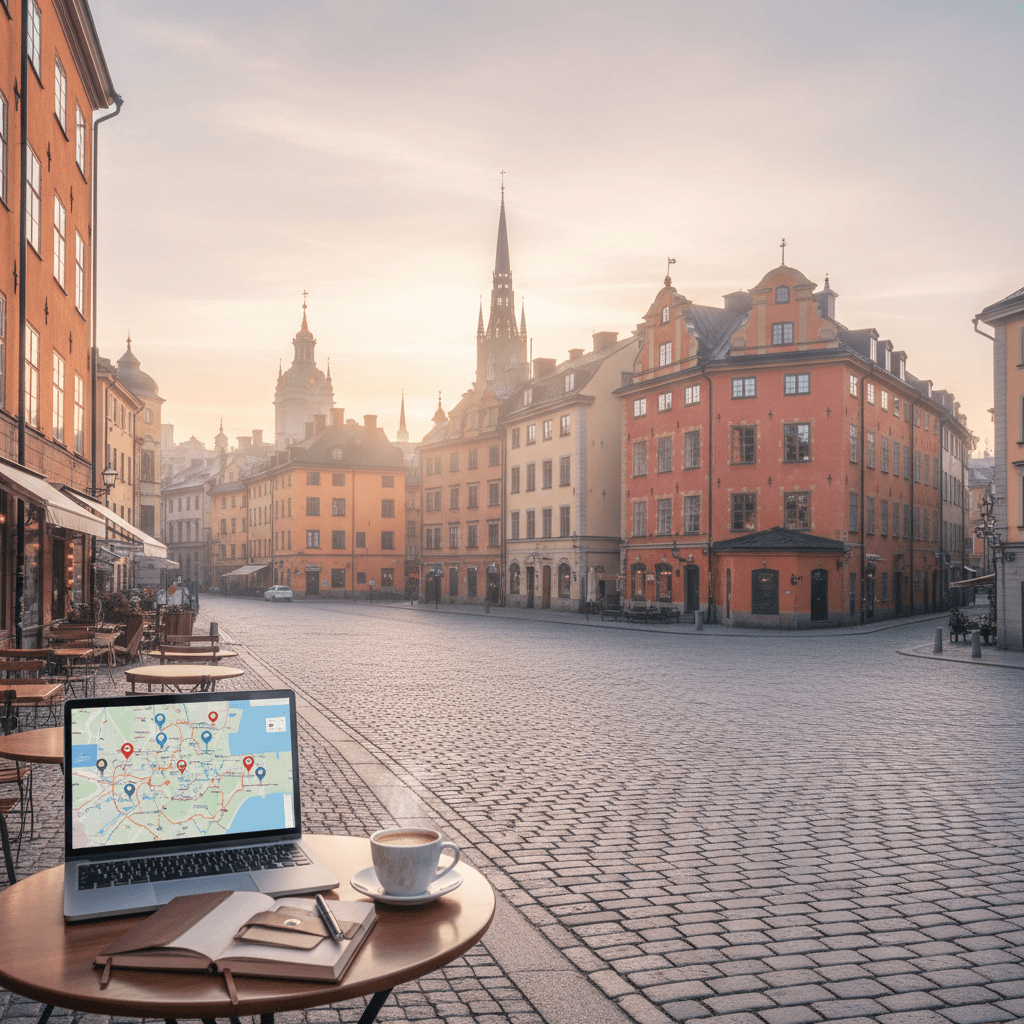
Stockholm
🇸🇪 Sweden
Stockholm is, honestly, one of those cities that makes you question your entire budget the moment you land. It's gorgeous, functional and genuinely easy to live in, but it doesn't pretend to be cheap and it won't apologize for that. Most nomads who come here fall into two camps: those who budget carefully and stay for months and those who blow through their runway in six weeks and leave slightly bitter.
The city sits across fourteen islands connected by bridges, so water is everywhere, you're never more than a few minutes' walk from a canal or inlet. In summer, that means golden light until 10pm, outdoor seating that actually gets used and a collective mood that's almost aggressively pleasant. In winter, it flips hard. Dark by 3pm, temperatures dipping below freezing and a grey that settles in and stays. That seasonal contrast isn't subtle, it genuinely shapes how people work and socialize here.
What makes Stockholm different from most European nomad hubs is the work-life culture baked into daily life. Swedes aren't workaholics, they leave on time, they take their lunch seriously and that attitude bleeds into the coworking spaces and cafes where you'll spend your days. There's a quiet productivity to the place, no honking, no chaos, just the soft hum of trams and the smell of coffee drifting out of every second doorway on Södermalm.
English is everywhere. Turns out you can live here for months without learning a word of Swedish, which is either convenient or mildly embarrassing depending on how you look at it. Most nomads lean into it and never look back.
The tech and creative scene is real, not just marketing. Stockholm produced Spotify, Klarna and a dozen other names you'd recognize and that startup energy shows up in how the city's coworking spaces are built and who's sitting in them.
The honest summary:
- Best for: Nomads who earn well, value clean infrastructure and want a base that actually functions
- Hardest adjustment: The cost of everything and the winter darkness if you're not prepared for it
- Underrated perk: The silence. Stockholm is weirdly, beautifully quiet for a capital city
- Bottom line: High effort to afford, low effort to actually live in
Stockholm isn't cheap. A realistic monthly budget for a single nomad runs around 27,000 SEK ($2,600 USD) and that's not living lavishly, that's a decent studio, some coworking days and eating out a few times a week. If you're used to Southeast Asia or Eastern Europe pricing, the sticker shock here is, honestly, real.
Rent is the biggest hit. A studio or one-bedroom in central neighborhoods like Södermalm or Norrmalm runs 11,000 to 18,000 SEK per month and the rental market is notoriously tight, turns out Stockholm has some of the longest social housing queues in Europe, so most nomads end up on short-term platforms paying a premium for the convenience. Suburbs like Solna bring it down to 9,000 to 14,000 SEK, though you'll trade walkability for the savings.
Here's how the tiers break down:
- Budget (20,000 SEK/month): Suburb studio, street food and supermarket meals, 30-day SL transit pass at 1070 SEK
- Mid-range (30,000 SEK/month): Central one-bedroom, mixed dining, occasional coworking at United Spaces or Regus
- Comfortable (40,000+ SEK/month): Premium area, upscale meals, full-time coworking membership, no budget anxiety
Food costs are weirdly polarized. A meal at an inexpensive restaurant is around 169 SEK, fine, but a mid-range dinner for two jumps to roughly 1,025 SEK. Cooking at home saves serious money and Swedish supermarkets like ICA and Coop are solid, just don't expect the prices to feel normal if you're coming from cheaper cities.
Coworking day passes start around 330 SEK, monthly memberships vary and frankly most nomads find a rhythm of two or three coworking days mixed with cafe work to keep costs reasonable. Transit is straightforward and not outrageously priced relative to everything else, 43 SEK per single ride or 1070 SEK for a monthly pass covering metro, buses and commuter rail.
The honest summary: Stockholm rewards people who plan their budget before they arrive, not after. It's a city that doesn't apologize for its prices and the quality of life generally justifies them, but you need the income to match.
Stockholm's neighborhoods are, honestly, pretty distinct from each other and picking the wrong one will cost you both money and sanity. Here's where different types of people actually land.
Nomads & Solo Travelers: Södermalm
This is the one. Södermalm has that lived-in creative energy you can smell in the coffee shops, vintage stores packed along Götgatan and the low hum of conversation spilling out of wine bars at 10pm when the summer sky is still pale. Most nomads gravitate here because it's walkable, the café culture genuinely supports laptop workers and the crowd skews young without feeling like a tourist trap.
Rent runs 11,000 to 18,000 SEK for a studio, so it's not cheap. Nightlife noise is a real issue if you're a light sleeper and "affordable" is relative when a sit-down lunch costs 169 SEK minimum.
Expats: Östermalm
Östermalm is where Stockholm puts on its best clothes. Wide, clean streets, proximity to Djurgården's green space and some of the city's best grocery stores make it genuinely comfortable for long-term living. Expats with families or those on corporate packages tend to settle here, turns out the school options and safety record are hard to argue with.
You'll pay for all of it. Rent here skews toward the top of the range and the neighborhood has a quietness that can feel isolating if you don't already have a social circle.
Families: Kungsholmen
Kungsholmen doesn't get as much attention, which is frankly its best quality. It's calmer, waterfront and has a family-oriented rhythm without being suburban or dull. The metro connects you to the center in minutes, coworking options are within reach and the parks along Norr Mälarstrand are genuinely lovely in summer.
It sits slightly outside the action, so if you want to walk to Södermalm's bar scene, you won't.
First-Timers: Norrmalm
Norrmalm is central, convenient and weirdly impersonal for a city this size. Transport connections are excellent, the shopping is right there and you'll never feel lost. But it lacks the character of Södermalm or the calm of Kungsholmen, it's more transit hub than neighborhood and most nomads who start here end up moving after the first month.
Stockholm's internet infrastructure is, honestly, one of the better setups you'll find in Europe. Speeds average around 150 Mbps across the city and that holds whether you're in a coworking space or a café in Södermalm. It's fast, it's consistent, it doesn't randomly die at 2pm like in some cities.
The coworking scene is solid but not cheap, which shouldn't surprise anyone who's checked Stockholm's cost of living. Day passes run around 330 SEK ($32) and monthly memberships scale up from there. United Spaces has two good locations, Waterfront and Torsgatan, both with fiber connections and a crowd that's more startup than freelance-blogger. Regus Östermalmstorg is the corporate pick if you need a quieter, more formal setup. Spaces has a few centers scattered around too, all with reliable WiFi and the usual hot-desk setup.
Cafés are genuinely workable here, which isn't always the case in Scandinavian cities where staff give you the look after one coffee. Most nomads find Södermalm's café scene the easiest to work from, the neighborhood has that creative, unhurried energy where nobody's rushing you out, you can sit with a laptop for two hours without feeling like a nuisance.
Top Coworking Options
- United Spaces Waterfront: day pass available, check current rates, fiber WiFi, strong tech community
- United Spaces Torsgatan: ~$53/day, similar setup, slightly more central
- Regus Östermalmstorg: Corporate feel, good for focused work, day passes available
- Spaces (multiple locations): Flexible memberships, reliable connections throughout
SIM Cards & Mobile Data
- Telia: Best overall coverage, worth paying slightly more for
- Tele2 / Tre: Budget-friendly, turns out coverage is decent in the center
- eSIM option: Roafly offers 5GB for around $9.90, good for short stays
Pick up a SIM at the airport or any convenience store, it takes ten minutes. Telia costs a bit more, the coverage difference is real though, especially if you're moving around the archipelago or taking day trips to Uppsala.
One thing Stockholm gets right that a lot of cities don't: residential internet speeds match what you get in coworking spaces. So if you're renting a place for a month, you're not sacrificing much by skipping a coworking membership entirely.
Stockholm's, honestly, pretty safe by global standards, but it's not the crime-free Scandinavian utopia some nomads expect. The city's crime index sits around 50, which is moderate. That means you're unlikely to have problems in central areas like Södermalm, Norrmalm or Östermalm, but the suburban neighborhoods of Rinkeby, Husby and Tensta have real gang activity and are worth skipping at night, full stop.
Petty theft happens around Centralstationen and on busy tourist corridors, keep your bag in front of you and don't leave laptops unattended at cafes. It's the kind of low-level stuff that's annoying rather than dangerous, most nomads go months without any incident.
Healthcare
The public healthcare system here is genuinely good. Sweden runs on a model where emergency care is accessible to visitors and the quality is high without the chaos you'd find in a lot of other countries. Dial 112 for emergencies, same as across the EU.
For non-emergency stuff, walk-in clinics called vårdcentraler handle most things, fees are low by any Western standard, turns out even without Swedish residency you won't face the kind of bill that ruins your month. Pharmacies, called Apotek, are everywhere and well-stocked, the staff almost always speak English, so getting basic medication sorted is straightforward.
- Emergency number: 112
- Non-emergency medical line: 1177 (also has an English-language option)
- Pharmacy chain: Apotek Hjärtat and Apoteket, found in most neighborhoods and shopping centers
- Travel insurance: Get it anyway. Public care is good, but dental and specialist visits without residency can get expensive fast
Practical Safety Notes
Stockholm's metro is weirdly safe even late at night, most nomads use it without a second thought after midnight. The city is well-lit, walkable and the general culture is low-confrontation. That said, the darker winter months, think November through February, can feel isolating and that affects judgment in small ways, staying aware of your surroundings matters more when you're tired and it's been dark since 3pm.
Travel insurance isn't optional here if you're staying longer than a few weeks, dental work especially sits outside the public system for non-residents and the costs are frankly steep.
Stockholm's public transport is, honestly, one of the better systems you'll use as a nomad. The metro (tunnelbana), buses and commuter trains all run under the SL network and the SL app handles everything: tickets, journey planning, real-time departures. A single ride costs 44 SEK, but if you're staying more than a week, the 30-day pass at 1070 SEK pays for itself fast.
The metro stations are clean and frequent, the buses are quiet and most of the inner-city lines run late enough that you won't feel stranded after dinner. That said, service to outer suburbs gets patchy after midnight, so factor that in if you're staying somewhere like Solna.
For shorter trips, the center is walkable in a way that genuinely surprises people. Södermalm to Norrmalm on foot takes maybe 20 minutes and you'll pass water views the whole way, the smell of salt air mixing with whatever's coming out of the bakeries along Götgatan. Bikes and e-scooters from Voi, Lime and Dott are scattered everywhere, turns out they're actually useful here because the cycling infrastructure is solid and drivers respect it.
Ride-hailing exists too. Both Bolt and Uber operate in Stockholm, they're not cheap but they're reliable for late nights or heavy bags.
Getting in from Arlanda Airport is where people get caught out. Two options:
- Arlanda Express train: 340 SEK, 18 minutes to Central Station. Fast, comfortable, no stops.
- Flygbussarna bus: Slower (around 45 minutes), but significantly cheaper. Fine if you don't have a tight schedule.
Most nomads take the Arlanda Express once, decide it's worth it and never look back. The bus is frankly fine though, don't let anyone guilt you into the train.
One thing to know: Stockholm is weirdly cashless even by Scandinavian standards. No one's taking coins at a ticket machine, everything runs through the app or a card tap. Download the SL app before you land, load a card and you won't have to think about transport again. It just works.
Stockholm's language situation is, honestly, one of the easiest you'll encounter anywhere in Europe. Swedish is the official language, but don't stress about it. English proficiency here is extraordinarily high and most locals switch to it the moment they hear an accent, sometimes before you've even finished your first sentence.
You won't need a translation app to order coffee, ask for directions or negotiate a coworking membership. Menus, signage and customer service in central neighborhoods like Södermalm and Norrmalm are almost always bilingual and younger Stockholmers especially are completely fluent, not just conversational. That said, making zero effort with Swedish reads as a little rude to locals, so learning a handful of phrases goes a long way socially.
- Tack (tahk): thanks
- Förlåt (fur-loht): sorry
- Ursäkta mig (oor-sek-tah may): excuse me
- Hej (hey): hello
- Hej då (hey-doh): goodbye
Those five will carry you through most casual interactions, the locals notice and appreciate it, even if they immediately respond in perfect English. It's a small gesture that shifts the dynamic from tourist to someone who's actually trying.
For anything trickier, Google Translate handles Swedish well, turns out the language has enough online presence that the AI translation is genuinely reliable. Menus at older restaurants occasionally lack English versions and some government or housing paperwork is Swedish-only, which can get frustrating fast if you're trying to sort out a lease or a bank account.
Stockholm's communication culture is worth understanding too. Swedes are direct and don't do much small talk with strangers, the silence on the metro isn't unfriendly, it's just normal. Don't expect warm chatter from a cashier or a barista. Expats often describe the initial social layer as weirdly hard to crack, but once you're past it, people are genuinely warm and straightforward.
Business communication is formal by default, punctuality is non-negotiable and written Swedish in professional emails tends to be crisp and short. If you're freelancing with local clients, English is almost always fine, but mirroring that direct, no-filler tone will serve you better than being overly chatty.
Stockholm's seasons aren't subtle. You get long, golden summers where daylight stretches past 10pm and then winters that are, frankly, a slow grind of darkness and cold that wears on you more than you'd expect.
The sweet spot is June through August, when temperatures sit comfortably between 18-22°C (64-71°F) and the city genuinely comes alive. Cafes spill onto cobblestones, the archipelago ferries fill up and Södermalm feels like a different city entirely. Most nomads plan their Stockholm stint around these months for good reason.
September still works well, the crowds thin out, prices soften slightly and the light turns that amber Scandinavian gold that makes everything look better than it probably is. October is, turns out, the tipping point. Rain picks up, daylight drops fast and you'll start to understand why locals talk about the winter like it's a personal adversary.
November through February is genuinely rough. Highs hover around 1°C (33°F) in February, lows dip to -5°C (23°F) and the sun barely clears the rooftops before disappearing again by mid-afternoon. It's not just cold, it's the kind of flat grey darkness that sits on your chest after a few weeks. Expats who've wintered here almost universally recommend a solid vitamin D routine and a coworking space with good lighting, not a dark café corner.
Rain is a year-round reality, it's never torrential, just persistent and drizzly in that way that makes a good waterproof jacket non-negotiable.
Quick seasonal breakdown
- June to August: Best weather, long days, peak prices and crowds
- September to October: Shoulder season, still pleasant, fewer tourists
- November to February: Dark, cold, honestly demoralizing for some; budget flights are cheap though
- March to May: Slow thaw, unpredictable, but the city starts waking up by April
If you're here for a short stay, don't overthink it, just come in summer. If you're planning a longer stretch and winter overlaps, build in a trip somewhere sunnier mid-January. Stockholm in February without a break is, weirdly, one of the most common reasons nomads cut their stays short.
Stockholm runs on cards. Seriously, don't bother hunting for an ATM on arrival because most cafes, transit kiosks and market stalls won't take cash anyway. Download Swish before you arrive if you can, it's the payment app locals use for everything from splitting dinner to paying a landlord and being without it puts you at a slight but real disadvantage.
For a SIM, grab a prepaid from Telia at the airport, it's honestly the most reliable coverage across the city and archipelago. Tele2 and Tre are cheaper if you're mostly staying central. If you'd rather skip the physical card, eSIM options like Roafly offer 5GB for around $17 and work fine for short stays.
Getting around is straightforward once you've set up the SL app on your phone. Single metro tickets run 44 SEK, a 30-day pass is 1070 SEK and it covers metro, buses and commuter trains across the whole system. Bolt and Uber exist for late nights, Voi and Lime scooters are everywhere in summer and the center is walkable enough that you'll often just go on foot.
From Arlanda airport, skip the Flygbussarna if you're in a hurry. The Arlanda Express train gets you to Central Station in 18 minutes for 340 SEK, it's the faster call.
A few things that catch people off guard
- Apartment hunting is brutal: The official rental queue in Stockholm can take years, so most nomads go through second-hand platforms. Expect to move fast when something appears.
- Punctuality matters: Swedes take it seriously. Showing up five minutes late to a coworking event or meeting reads as disrespectful, not casual.
- Allemansrätten: Sweden's right-to-roam law means you can camp or walk through almost any natural land. It's, weirdly, one of the best perks of being here in summer.
- Winters are genuinely hard: November through February brings darkness that, turns out, affects most people more than they expect. A SAD lamp is worth packing.
Google Translate handles the rare moment where English doesn't work, but frankly you'll barely need it. Stockholm's English proficiency is high enough that you can sort a lease, argue a phone bill and order off a handwritten specials board without speaking a word of Swedish.
Need visa and immigration info for Sweden?
🇸🇪 View Sweden Country GuideNomad Haven
Your home away from home