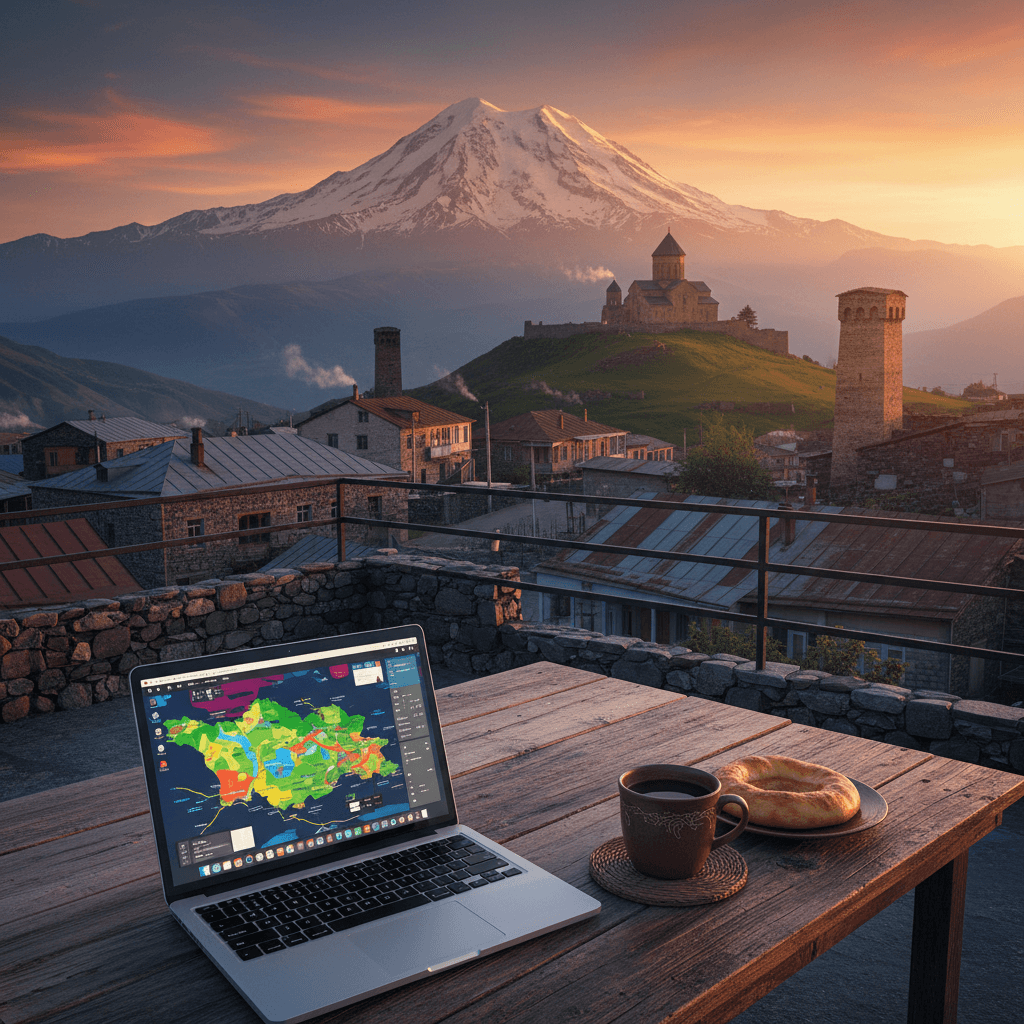
Stepantsminda (Kazbegi)
🇬🇪 Georgia
The High Altitude Trade-Off
Stepantsminda, still locally referred to as Kazbegi, isn't your typical digital nomad hub. It is a rugged, wind-swept mountain outpost sitting at 1,740 meters, dominated by the staggering presence of Mount Kazbek. If you are looking for air-conditioned coworking spaces and a specialty coffee shop on every corner, you will be disappointed. People come here for the silence, the dramatic weather shifts, and the ability to hike to a 14th-century monastery before their first Zoom call of the day.
The vibe is decidedly rustic. You will share the main road with cows, Soviet-era Niva 4x4s, and hikers draped in Gore-Tex. It feels like a frontier town where the modern world is still trying to gain a foothold. While Tbilisi is a tech-forward capital, Stepantsminda remains a place where life is dictated by the seasons and the pass. When the snow hits the Georgian Military Highway, the town feels beautifully isolated from the rest of the world.
The Reality of Remote Work
Let's be realistic about the infrastructure. Most nomads find that Stepantsminda is better suited for a "work-cation" or a short-term retreat rather than a permanent base. Fiber optic internet is rare here. Most guesthouses rely on basic copper lines or 4G routers. If your job requires heavy video uploading or constant high-speed connectivity, you will need a local Magti SIM card with an unlimited data plan as a backup. Even then, mountain storms can occasionally knock out the power for a few hours at a time.
There are no dedicated coworking spaces in town. Instead, the nomad community gravitates toward the lobby of the Rooms Hotel Kazbegi. It is arguably one of the most famous hotels in the Caucasus, and for good reason. The wooden deck offers a front-row seat to the Gergeti Trinity Church, and the communal tables are often filled with people on MacBooks sipping mountain herbal tea. It is the unofficial office for anyone staying more than a few days, though the prices for food and drink are significantly higher than the local taverns down the hill.
The Emotional Draw
What makes this place different is the sheer scale of the landscape. There is a specific kind of clarity that comes from working while looking at a 5,047-meter peak. The air is crisp, the water comes straight from mountain springs, and the pace of life is slow. You won't find a nightlife scene here. Most evenings end with a heavy meal of khinkali and a glass of amber wine by a fireplace. It is a destination for the introverted nomad, the writer, or the hiker who needs to clear their head.
Expats who linger here usually do so because they’ve fallen in love with the surrounding valleys like Juta or Truso. They accept the trade-offs, like the 3.5-hour drive from Tbilisi or the lack of a proper supermarket, in exchange for having the Greater Caucasus as their backyard. It is a place that demands you be present. You can't just "plug in" here; you have to adapt to the mountains.
Quick Logistics Breakdown
- The Commute: Most travelers arrive via Marshrutka (minibus) from Tbilisi’s Didube station for about 15 GEL, though hiring a private 4x4 is recommended if you have a lot of gear.
- The Connectivity: Expect average speeds of 10 to 20 Mbps in most guesthouses. Relying on 4G is the standard move for anyone with deadlines.
- The Seasonality: Summer is peak trekking season, but autumn brings incredible colors and fewer crowds. Winter is quiet, snowy, and requires a serious tolerance for the cold.
- The Language: While younger staff in hotels speak English, knowing a few words of Georgian or Russian goes a long way with the local guesthouse owners.
The Price of Mountain Living
Living in Stepantsminda is a unique trade-off. You're trading the low-cost convenience of Tbilisi for a premium mountain experience where logistics are harder and supply chains are thinner. Because almost everything has to be trucked up the Georgian Military Highway, you'll find that your daily expenses can actually outpace the capital, especially when it comes to groceries and dining out.
Most nomads find that a monthly budget of $1,200 to $1,500 allows for a comfortable lifestyle here. This covers a private guesthouse or apartment, eating out once a day, and the occasional guided excursion. If you're looking to live a more stripped-back life, you could get by on $900, but you'll be doing a lot of your own cooking and staying further away from the town center.
Accommodation and Rent
The rental market in Stepantsminda isn't built for long-term stays. Most properties are listed on short-term booking sites, so you'll need to negotiate directly with guesthouse owners for a monthly rate. Prices fluctuate wildly between the peak summer trekking season and the quieter winter months.
- Central Guesthouses: Expect to pay $600 to $800 per month for a private room with an ensuite and reliable heating.
- Private Apartments: Rare and highly sought after, these usually go for $900+ if they have a view of Mount Kazbek.
- Budget Stays: Staying on the outskirts or in older Soviet-style homes can drop your rent to $400, but be prepared for basic amenities.
Dining and Groceries
Eating out is the primary entertainment in town. A standard meal of Khinkali and a local beer will run you about $12 to $15 at popular spots like Rooms Hotel or Restaurant Kazbegi. If you're sticking to local bakeries for Tonis Puri (bread) and cheese, you can keep your food costs significantly lower.
- Dinner for two: $35 to $50 at a mid-range restaurant.
- Coffee/Latte: $3 to $4 at a modern cafe.
- Local Beer: $2 to $3 at a shop; $5 in a bar.
- Monthly Groceries: $300 to $400, though selection is limited to seasonal produce and staples.
Connectivity and Remote Work Costs
This is where things get tricky. There are no dedicated coworking spaces in Stepantsminda. Most digital nomads set up shop in the lobby of Rooms Hotel, which is famous for its views and stable internet, but they'll expect you to order food and drinks throughout the day. Budget at least $15 per day if you plan to work from cafes.
Since fiber optic hasn't fully reached every corner of the valley, a high-quality SIM card is non-negotiable. Most expats recommend Magti for the best coverage in the mountains. A monthly unlimited data plan will cost you around $12 to $15, and it's often more reliable than the Wi-Fi in older guesthouses.
Transportation and Logistics
The town itself is walkable, but getting in and out requires some planning. Marshrutkas (minibuses) from Tbilisi's Didube station are the cheapest way to arrive at around $6. If you prefer a private car via the Bolt app or a local driver, expect to pay $50 to $70 for the one-way trip.
Local transport for hiking trailheads usually involves hiring a 4x4 Delica. A trip up to Gergeti Trinity Church or out to the Juta Valley will cost between $20 and $40 depending on your negotiation skills. There are no ride-hailing apps operating within the town itself, so you'll be relying on the local taxi stand near the main square.
For Digital Nomads: The West Bank (Gergeti Side)
If you are planning to work while staring at the peaks, the Gergeti side of the river is where you want to be. It sits slightly higher than the town center, providing the most iconic views of the 14th-century monastery and Mount Kazbek. It is quieter here, which is a blessing when you are trying to focus on a Zoom call, though you should be aware that the infrastructure is still catching up to nomad needs.
Most nomads gravitate toward guesthouses like Kazbegi View or Gergeti Hilltop. These spots have invested in better routers, though speeds rarely exceed 20-30 Mbps. You won't find dedicated coworking spaces here, so your "office" will likely be a wooden balcony or the lobby of the Rooms Hotel nearby. Expect to pay around $600 to $800 a month for a decent private room with a view during the peak summer season.
- Pros: Unbeatable views, quiet nights, immediate access to the Gergeti hiking trail.
- Cons: Uphill walk to get anywhere, spotty Wi-Fi during storms, limited grocery options.
- Coworking vibe: The terrace at Rooms Hotel is the unofficial hub for anyone with a laptop.
For Expats and Long-Stayers: The Town Center
The main stretch of Stepantsminda, located along the Georgian Military Highway, is the practical choice for anyone staying more than a week. This is the heart of the "city" where you can actually find a pharmacy, the Liberty Bank branch, and the small Spar supermarket. Living here means you don't have to hike for twenty minutes just to buy a loaf of bread or a SIM card from the Magti dealer.
Expats usually look for apartments or long-term guesthouse deals near the central square. Renting a small house can cost between $400 and $600 if you negotiate in person rather than booking through apps. You are closer to the Marshrutka station, making it easy to hop on a 15 GEL van back to Tbilisi when the mountain isolation starts to feel too heavy. For dinner, you are steps away from Cozy Corner and Shorena's, which are the local staples for khinkali and wine.
- Pros: Best access to shops and transport, flatter terrain, more social interaction with locals.
- Cons: Exhaust fumes from trucks heading to the Russian border, less "mountain retreat" feel.
- Connectivity: This area has the most stable power grid in town, though outages still happen.
For Solo Travelers: Near the Bus Station
If you are traveling alone and want to meet people to split the cost of a 4x4 up to the Gveleti Waterfalls or Juta, stay within a three-block radius of the main square. This area is packed with hostels and small family-run stays where the communal dining table is the center of life. You will find plenty of other hikers planning their routes over breakfast.
Solo travelers often find that staying at various "Mama" guesthouses provides a built-in social life. A bed in a shared room or a basic private room usually runs about $20 to $35 per night. It is the most affordable way to experience the region without feeling isolated in a remote cabin.
- Social Scene: High. This is where everyone meets to organize mountain guides.
- Safety: Very high. The town is small and people generally look out for one another.
- Dining: Easy access to cheap bakeries selling 2 GEL lobiani and khachapuri.
For Families: The Northern Outskirts (Pshaveli Area)
Families often prefer the northern edge of town, heading toward the road to Sno. The houses here are more spread out, offering actual yards for kids to play in without the danger of the main highway traffic. It is significantly more peaceful than the center and feels like a genuine highland village.
You can find larger cottages here for $1,000 to $1,200 a month that offer multiple bedrooms and full kitchens. While you will likely want a car or to use the Bolt app (which has limited but occasional availability) to get into town, the trade-off is a much more relaxed environment. It is the best spot for those who want the mountain air without the constant churn of day-trippers from Tbilisi.
- Space: Larger properties with gardens and mountain views.
- Noise: Minimal. You'll hear cows and sheep more often than car horns.
- Prep: You'll need to stock up on groceries in the center, as there are no shops in this residential pocket.
The Reality of Working from the Mountains
If you are planning to pull forty hour weeks of heavy video calls while staring at Mount Kazbek, you need a reality check. Stepantsminda is a rugged mountain outpost, not a tech hub. While the views are world class, the infrastructure is still catching up. Most nomads treat this as a "work lite" destination where you catch up on emails between hikes rather than a place to run a high stakes launch.
The town lacks dedicated coworking spaces. You won't find a WeWork or a local equivalent with ergonomic chairs and soundproof booths here. Instead, your office will be a hotel lobby, a cafe, or your guesthouse dining table. Power outages happen, especially during winter storms or heavy spring rains, so a laptop with a healthy battery is your best friend.
Connectivity and Internet Speeds
Fiber optic cables haven't quite made it to the private guesthouses tucked away on the hillsides yet. Most accommodation relies on fixed LTE routers or basic ADSL connections. You can generally expect download speeds between 5 Mbps and 15 Mbps. It is enough for basic tasks and Slack, but it will struggle with 4K streaming or large file uploads.
Your lifeline will be a local SIM card. Magti is the undisputed king of coverage in the mountains. You can pick up a SIM in Tbilisi before heading north for about 10 GEL, and unlimited data packages usually cost around 35 GEL per month. In many parts of Stepantsminda, Magti's 4G signal is actually faster and more reliable than the local Wi-Fi. Always check your room's signal strength before you unpack your gear.
Best Places to Set Up Shop
Since there are no formal hubs, nomads gravitate toward a few specific spots that are friendly to laptop users. The Rooms Hotel Kazbegi is the gold standard. It is expensive to stay there, but their massive wooden deck and lounge area are open to visitors. The Wi-Fi is the most stable in town, and the view of the Gergeti Trinity Church is unbeatable. A coffee will set you back about 8 to 12 GEL, but it buys you a few hours of high speed peace.
- Rooms Hotel Kazbegi: Best for reliability and atmosphere. Expect to pay a premium for food and drinks.
- Cozy Corner: A more laid back restaurant with decent speeds and plenty of power outlets near the booths.
- Vitamin Kazbegi: Great for a seasonal outdoor vibe, though more suited for quick tasks than a full day of deep work.
Practical Tips for Staying Online
The lack of infrastructure means you have to be self reliant. Most seasoned travelers in Georgia recommend bringing a power bank and a high quality portable hotspot. If you have a critical meeting, don't rely on your guesthouse Wi-Fi. Test your Magti signal early in the morning and have a backup plan.
If you find the internet in your guesthouse is unusable, don't be afraid to move. Many of the newer builds near the town center have invested in better routers. Ask the host for a speed test screenshot before you book a long stay. Most hosts are happy to oblige if it means securing a monthly guest during the shoulder season.
Digital Nomad Community
You won't find a structured nomad community here like you would in Tbilisi or Batumi. There are no weekly meetups or networking events. People come to Stepantsminda to disconnect from the screen and reconnect with the outdoors. You will meet plenty of other remote workers, but the "coworking" usually happens organically over a bottle of wine in a shared kitchen after a day of trekking.
If you need a community fix, join the Expats in Georgia or Digital Nomads Tbilisi Facebook groups. While they are centered on the capital, members frequently share updates on road conditions, internet outages, and new cafe openings in the Kazbegi region. It is the best way to get real time info before making the 3.5 hour drive up the Military Highway.
Mountain Safety and the Great Outdoors
Stepantsminda is generally very safe, but the biggest risks here aren't related to crime; they're related to geography. Because the town sits at 1,740 meters and the weather can flip in minutes, physical safety is your primary concern. If you are heading up to Gergeti Trinity Church or trekking into the Juta Valley, always check the local forecast on apps like Windy. Sudden fog can make trail markers disappear, and the high altitude means you'll burn through water and energy faster than you expect.
The Georgian Military Highway is the only way in and out. It is a spectacular drive, but it is also a major transit route for heavy trucks moving between Georgia and Russia. The road is prone to closures during winter due to avalanches or heavy snowfall. If you are planning a trip between December and March, keep a buffer of a few days in your schedule. You don't want to miss a flight from Tbilisi because the pass at Gudauri is blocked by a snowdrift.
Stray dogs are part of the landscape here. Most are friendly and will even "guide" you on hikes for a bit of bread, but they are still animals. Give them space, especially if they are near livestock. If you are planning on extensive solo trekking, carrying a personal locator beacon is a smart move since cell service drops to zero once you get behind the big ridges.
Healthcare and Medical Emergencies
Medical facilities in Stepantsminda are extremely limited. There is a small local clinic, the Emergency Medical Center, located near the center of town. It can handle minor issues like stitches, altitude sickness, or basic infections. However, for anything serious, including broken bones or major illnesses, you will be transported to Tbilisi, which is at least a 3 hour drive away under good conditions.
Most nomads keep a robust personal first aid kit. You should include:
- Altitude sickness medication like Acetazolamide if you plan on sleeping at higher elevations.
- Broad spectrum antibiotics and basic painkillers.
- Sunscreen and lip balm with high SPF; the mountain sun is brutal even when it's cold.
- Rehydration salts to combat the effects of the dry mountain air.
Pharmacies in town carry the basics, but specific western brands might be hard to find. If you have a regular prescription, bring a full supply from Tbilisi or your home country. Most pharmacists speak Georgian and Russian, so having a translation app ready is helpful for explaining symptoms.
Daily Security and Practicalities
Property crime is rare in the valley. Most guesthouse owners and locals know each other, and the community is tight knit. You can generally feel comfortable walking alone at night, though the lack of streetlights in some parts of town makes a headlamp or a phone light a necessity to avoid tripping on uneven paths or waking up the local cows.
For digital nomads, the biggest "safety" issue is actually your gear. Power surges can happen during storms, so using a high quality surge protector for your laptop is a wise investment. Since the internet is often beamed via microwave links or basic DSL, having a backup Magti or Silknet SIM card with a large data package is the only way to ensure you don't go offline during a critical meeting.
If you find yourself in a real bind, the emergency number in Georgia is 112. This connects you to police, fire, and ambulance services. Operators usually have English speakers available, but be prepared to give very specific landmarks since many small roads in Stepantsminda don't have formal names.
The Layout of the Valley
Stepantsminda isn't a city; it's a spread out mountain village where the geography dictates how you move. The town is split by the Terek River. On the eastern side, you have the main hub where the marshrutkas (minibuses) drop you off, along with most of the guesthouses and small markets. On the western side, the terrain climbs steeply toward the Gergeti Trinity Church. While the town is technically walkable, the verticality of the landscape means a ten minute stroll on a map can easily turn into a thirty minute uphill hike that leaves you breathless at this altitude.
On Foot
Most nomads living here find that their own two feet are the primary mode of transport. If you're staying near the town center, you can reach the Spar supermarket, the post office, and most cafes within 10 to 15 minutes. Walking is great for the views, but the roads are often unpaved, dusty in the summer, and icy in the winter. You'll want sturdy boots even for a quick trip to get coffee. Keep an eye out for local dogs; they're generally friendly and often act as self appointed guides for hikers, but they can be territorial around livestock.
Local Taxis and Apps
Don't expect to use Bolt or Glovo here. While those apps dominate Tbilisi, they don't operate in the mountains yet. Instead, you'll find a fleet of Mitsubishi Delicas (high clearance 4x4 vans) parked near the main square. These are the lifeblood of Stepantsminda. Drivers congregate near the bus stop and are always ready to take you up to Gergeti or out to the Truso Valley.
- Short trips within town: Expect to pay around 10 to 15 GEL.
- Ride to Gergeti Trinity Church: A round trip usually costs about 40 to 70 GEL depending on your negotiation skills and how long you want the driver to wait.
- Day trips to Juta or Truso: Budget between 100 and 150 GEL for the whole vehicle.
Expats usually keep a few reliable drivers' numbers in their WhatsApp or Viber. It's much more efficient than trying to hail someone on a side street. If you find a driver who doesn't treat the mountain curves like a Formula 1 track, hold onto their contact info.
Marshrutkas and Regional Travel
For getting out of town, the marshrutka is the standard Georgian experience. These vans run between Stepantsminda and Tbilisi (Didube station) roughly every hour from 7:00 AM to 6:00 PM. The fare is 15 GEL, and the journey takes about 3 to 3.5 hours. It's cheap, but it's not comfortable. The vans are often packed, and luggage is strapped to the roof or piled in the back. If you have a lot of gear or a sensitive stomach, consider splitting a private car with other travelers for about 150 to 200 GEL total.
Renting Your Own Wheels
Renting a car in Stepantsminda itself is difficult and expensive. Most people who want their own transport rent a 4x4 in Tbilisi and drive it up. Having a car gives you immense freedom to explore the Sno Valley or the Russian border at your own pace, but the Georgian Military Highway can be intimidating. You'll be sharing the road with massive trailer trucks and locals making aggressive overtakes on blind curves. During winter months, the road often closes due to snow or avalanche risk, sometimes for days at a time, so always check the weather before planning a trip back to the city.
Biking
Mountain biking is popular for sport, but it's not a practical way to get groceries. The inclines are brutal and the infrastructure is nonexistent. If you're an avid cyclist, you can rent a decent bike near the Rooms Hotel for around 50 GEL per day, but treat it as an afternoon activity rather than a commute. For daily life, stick to the 4x4 taxis when your legs are tired.
The Linguistic Landscape
In Stepantsminda, your interactions will mostly fluctuate between Georgian, Russian, and English. Georgian is the primary language, and while it's famously difficult to learn, locals deeply appreciate it when you manage a simple Gamarjoba (hello) or Madloba (thank you). You'll find that the older generation is almost universally fluent in Russian, while the younger crowd, especially those working at places like Rooms Hotel or the various trekking agencies, speaks English quite well.
Communication here is often more about intent than perfect grammar. In the smaller guesthouses or when dealing with local Niva drivers for a lift to Gergeti, a few hand gestures and a translation app go a long way. Don't expect everyone at the local corner store to understand complex English sentences. Keep it simple, be patient, and you'll find the mountain hospitality bridges most gaps.
Digital Connectivity Challenges
If you're planning to log onto a Zoom call with a view of Mount Kazbek, you need a backup plan. Reliable fiber internet is rare in the valley. Most guesthouses rely on standard ADSL or 4G routers, which can be temperamental during heavy snow or thunderstorms. For anyone working remotely, relying on the house Wi-Fi alone is a gamble that rarely pays off.
Most nomads find that a local SIM card is the only way to stay consistently online. Magti is the undisputed king of coverage in the mountains. While Silknet and Beeline (Cellfie) work fine in Tbilisi, their signals tend to drop off once you get deep into the Truso Valley or higher up the slopes. You can pick up a SIM at the airport or in Tbilisi before heading north, as options in Stepantsminda itself are limited to small resellers with inconsistent stock.
Mobile Data and Essential Apps
Data is incredibly cheap compared to Western standards. You can usually get unlimited 4G data for a week for around 7 to 9 GEL, or a 100GB data package for about 25 GEL. Since the town lacks a dedicated coworking space, you'll likely be tethering from your phone while sitting in a cafe. The signal is generally strong enough for emails and Slack, but high definition video streaming might struggle during peak tourist hours in the evening.
- Google Translate: Essential for reading menus and signs. Be sure to download the Georgian pack for offline use, though the "instant camera" feature can sometimes struggle with the curly Mkhedruli script.
- WhatsApp: This is the primary way to communicate with guesthouse owners, mountain guides, and drivers. Almost everyone uses it.
- Bolt: While the app works perfectly in Tbilisi, it's virtually non-existent in Stepantsminda. You'll be back to old school negotiating with drivers in the town square for local trips.
- Magti App: Use this to top up your data balance instantly using a credit card so you don't get cut off in the middle of a workday.
Practical Tips for Staying Online
Power outages aren't frequent, but they do happen, especially during the winter months when the wind picks up. It's a smart move to keep a high capacity power bank charged and your laptop at 100 percent whenever possible. If your accommodation's internet fails, the lobby at Rooms Hotel is the most reliable "unofficial" workspace in town, though the price of a coffee there reflects the premium view and stable connection.
If you're heading out for a trek in the nearby Juta or Sno valleys, tell someone your route before you leave. Cell service disappears quickly once you move away from the main road. For those staying longer than a week, consider getting a dual SIM setup if your phone supports it, keeping a Magti card for data and your home SIM for emergency bank authentications.
High Season: June to September
If you are coming to Stepantsminda to hike and work with a view, this is your window. The summer months bring daytime temperatures between 18°C and 25°C, which is perfect for tackling the trail up to Gergeti Trinity Church without overheating. While Tbilisi swelters in 40 degree heat, the mountain air here remains crisp and manageable.
July and August are the busiest months. You will see plenty of backpackers and day trippers from the capital, so expect prices for guesthouses to peak around 120 to 180 GEL per night. The trails are clear of snow, and the wildflowers in the Juta Valley are in full bloom. Just keep in mind that mountain weather is fickle; even in July, a sunny morning can turn into a thunderstorm by 3:00 PM.
The Shoulder Seasons: May and October
May is a bit of a gamble. The valleys start turning green, but many of the higher trekking routes, like the path to the Kazbek glacier, usually stay blocked by snow until late June. You will find lower prices and fewer crowds, but you should pack for rain and mud. It is a quiet time for nomads who prefer solitude over social scenes.
October is arguably the most beautiful time to visit. The autumn colors in the Sno Valley are spectacular, and the air is incredibly clear. Daytime temperatures hover around 10°C to 15°C, but nights get chilly fast. It is the last call for outdoor work sessions on a terrace before the deep freeze sets in. Most seasonal cafes start winding down their operations by the end of the month.
Winter: December to March
Winter in Stepantsminda is harsh, beautiful, and occasionally isolating. Temperatures frequently drop to -10°C or -15°C at night. If you are a skier, this is a great base for visiting nearby Gudauri, which is about a 40 minute drive away, though the road can often close due to heavy snowfall or avalanche risks.
For digital nomads, winter presents a specific challenge: infrastructure. Power outages happen during heavy storms, and heating in older guesthouses can be hit or miss. You will want to confirm your accommodation has a reliable wood stove or modern electric heaters before booking a long stay. It is the cheapest time to be here, but your social options will be limited to a few hotel bars and the local bakery.
A Note on Connectivity and Planning
Regardless of when you visit, the weather dictates the internet. High winds or heavy snow can occasionally interfere with satellite or fixed line connections. Most remote workers here rely on a Magti SIM card as a backup. A 100GB data package costs about 32 GEL and generally offers better reliability than guesthouse Wi-Fi during a storm.
Always check the status of the Georgian Military Highway before planning your arrival or departure. This is the only road in and out. In winter and early spring, it is common for the pass to close for a day or two, which can turn a weekend trip into a week long stay whether you planned for it or not. Pack layers, bring a sturdy power bank, and always have a few days of flexibility in your schedule.
Connectivity and Workspace Realities
If you are planning to clock forty hours a week of video calls, Stepantsminda will challenge you. While the views are world class, the fiber optic cables haven't quite caught up to the scenery. Most guesthouses rely on standard ADSL or 4G routers. You will likely see speeds hovering around 10 to 15 Mbps, which is fine for emails but risky for heavy uploads.
There are no dedicated coworking spaces in town yet. Most nomads migrate to the Rooms Hotel Kazbegi lobby. It is the unofficial hub for anyone with a laptop. A coffee will set you back about 10 GEL, but the Wi-Fi is the most stable in the region and the mountain views through the floor to ceiling windows are unbeatable. For a more low key vibe, Cozy Corner offers decent speeds and plenty of power outlets near the back tables.
Money and Local Costs
Cash is still king in the mountains. While hotels and larger restaurants like Shorena's take cards, the local marshrutka drivers and fruit stalls definitely won't. There are a few Liberty Bank and Bank of Georgia ATMs near the main square, but they occasionally run out of bills during busy trekking weekends. It is smart to carry at least 100 to 150 GEL in small denominations for emergencies.
- Private Room in a Guesthouse: 60 to 90 GEL per night
- Khinkali (per piece): 1.50 to 2.50 GEL
- Local Beer (0.5L): 5 to 7 GEL
- Dinner for two with wine: 70 to 100 GEL
Getting Around and Staying Safe
The town is small enough to walk everywhere, but the terrain is steep. If you are heading to the Gergeti Trinity Church, don't feel pressured to hike the vertical path. Local Delica drivers congregate in the center and will charge about 15 GEL per person for a round trip. For longer hauls to the Juta Valley or Truso, expect to pay 80 to 100 GEL for a private 4x4 for the day.
Safety is rarely an issue here, though the local livestock can be bold. Cows and sheep frequently block the main roads. The biggest risk is actually the weather. Mountain storms roll in fast, and temperatures can drop 10 degrees Celsius in an hour. Always pack a windbreaker and sturdy boots, even if it looks like a clear July morning.
Logistics and Supplies
For a long term stay, pick up a Magti SIM card before leaving Tbilisi. Their 4G coverage in the mountains is significantly better than Silknet or Beeline. You can top up data via the Magti app or at the yellow PayBox terminals found near the Spar supermarket.
Speaking of groceries, the Spar in the center is the only reliable place for western style snacks and toiletries. For everything else, the small family run shops sell better bread, local honey, and homemade wine. If you need specialized hiking gear or tech repairs, you'll have to make the 3.5 hour trip back to Tbilisi, as the local selection is very limited.
Weather and Timing
The sweet spot for living here is June through September. This is when the trails are clear and the mountain passes are reliably open. If you visit in winter, the town turns into a quiet, snowy fortress. It is beautiful, but the road to Tbilisi often closes due to avalanches, which could leave you stranded for a few days. Most expats suggest avoiding April and May, as the melting snow makes the trails incredibly muddy and difficult to navigate.
Need visa and immigration info for Georgia?
🇬🇪 View Georgia Country GuideOff the Radar
Pioneer territory