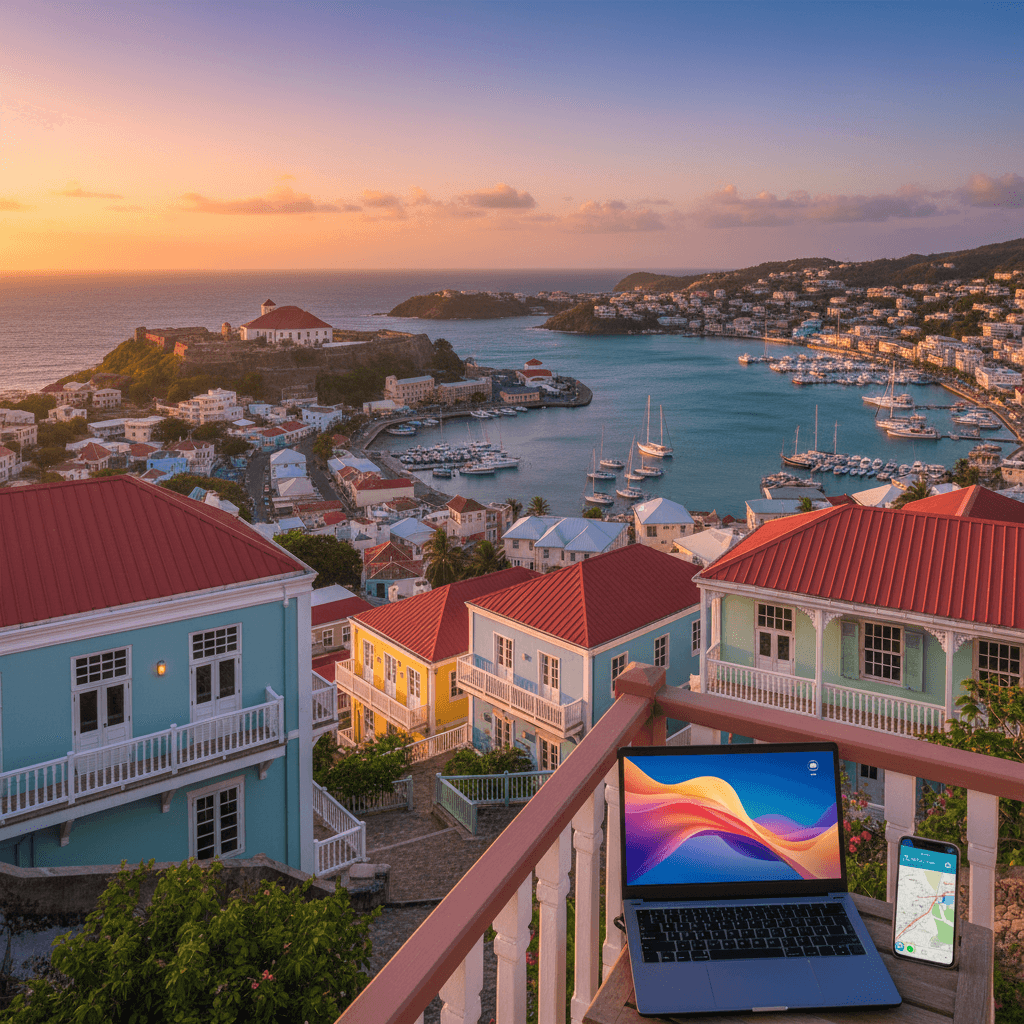
St. George's
🇬🇩 Grenada
St. George's doesn't try to impress you. It just is what it's, a small Caribbean capital that smells like nutmeg and salt air, where the harbor glitters in horseshoe-shaped layers of red-roofed colonial buildings and the pace of life is, honestly, slower than you're probably used to. That's not a complaint. Most nomads who land here find that the decompression happens fast, sometimes within days.
The city's personality is genuinely distinct. Grenada was shaped by French and British colonial hands, so the architecture has this weirdly elegant mash of Caribbean color and European structure, pastel walls, arched doorways, steep hillside streets that'll have your calves burning by day three. The market near the waterfront buzzes on Saturday mornings, vendors calling out over the noise of minibuses, the whole place carrying a low-level hum of productive chaos.
It's not a digital nomad hotspot in the way Medellín or Chiang Mai are. Coworking is limited, WiFi outside LaunchPad Grenada in Belmont can be frustrating and the infrastructure is still catching up. That's the honest version. But the tradeoff is a place that doesn't feel overrun, where locals are genuinely friendly rather than performatively so and where a decent studio in the city center runs $370 to $799 a month.
Grand Anse, about fifteen minutes south, is where a lot of expats and longer-stay nomads end up. It's beachier, more polished and closer to the university crowd, though rents creep up and it can feel touristy in a way St. George's proper doesn't. Lance aux Epines is quieter still, more residential, better for families or anyone who wants to genuinely disappear for a few months.
The emotional experience of being here is harder to quantify. There's something about sitting at a harbor-view cafe in the late afternoon, the heat finally softening, the smell of Creole cooking drifting from somewhere nearby, that makes the limited coworking options feel like a fair trade. Not everyone feels that way, it depends entirely on what you need to function. But if slow mornings and a real sense of place matter to you, St. George's delivers that without much effort on your part.
English is the official language and the dry season from January through May is, frankly, the best time to be here.
St. George's isn't the cheapest Caribbean island you can land on, but it's far from the most expensive. A single person can get by on around $1,000 a month if they're sharing housing, eating street food and taking minibuses everywhere. Live more comfortably, with your own studio and a mix of cooking and eating out and you're looking at $1,300 to $1,500.
Rent is, honestly, the biggest variable. A studio in St. George's proper runs $370 to $500 a month, it's cheaper than Grand Anse but you're trading the beach for harbor views and easier access to markets. Grand Anse pushes rents to $700 to $900 for a furnished one-bedroom and you'll pay for the location every single month. Lance aux Epines is quieter and more upscale, but don't expect to find a deal there.
Food costs stay low if you lean into local eating. Street meals and fast Creole lunches run around $7 to $9, a mid-range sit-down dinner for two at somewhere like BB's Crabback lands around $30 to $40 and an upscale night out at Oliver's can hit $73 to $83 for two people with drinks. Groceries are, turns out, noticeably pricier than the mainland because most food is imported, so cooking at home doesn't always save as much as you'd expect.
Transport is cheap. Minibuses run EC$2.50 to $6.50 per ride depending on the zone, a monthly pass is around $37, taxis via the Haylup app cost more but aren't outrageous for occasional use. Internet runs about $37 a month for a home connection, though speeds can be inconsistent outside the main hubs.
Here's a rough breakdown by budget tier:
- Budget (~$1,000/month): Shared housing, street food, minibuses only
- Mid-range (~$1,500/month): Studio rental, mixed dining, occasional taxis
- Comfortable (~$2,500/month): One-bedroom in Grand Anse, upscale meals, car rental
One thing most nomads don't factor in upfront: the digital nomad visa requirements and fees. Budget accordingly before you book the flight.
St. George's spreads across a handful of distinct neighborhoods and which one suits you depends almost entirely on what you're there to do. The harbor town itself is walkable and alive with the smell of nutmeg and salt air, minibuses honking through narrow colonial streets, vendors calling out from market stalls. Elsewhere, things get quieter fast.
For Digital Nomads
Belmont is the practical choice. It's close to LaunchPad Grenada, the only real coworking space on the island, where 100 Mbps speeds actually hold up and you're not fighting a cafe's shared WiFi that drops to 8 Mbps the moment someone starts a video call. Membership runs $300 to $995 a month, which isn't cheap, but it's reliable and honestly that matters more than anything else when you're on deadline.
St. George's proper works too, especially if you don't mind supplementing with cafe work. You're central, walkable and close to everything. The petty theft risk is real though, don't leave your bag unattended at tourist spots.
For Expats and Long-Term Renters
Grand Anse is where most expats land and it's easy to see why. Studios run $370 to $800 a month, there's a proper beach a short walk away and the concentration of restaurants and shops means you're not constantly commuting into town. The tradeoff is traffic, it backs up badly in the afternoon and the area skews touristy in a way that can feel hollow after a few weeks.
Rents here are, turns out, the highest on the island, so budget accordingly.
For Families
Lance aux Epines is quieter, more residential and genuinely peaceful in a way the other neighborhoods aren't. High-end homes sit close to the coast, the streets feel safe and there's space to breathe. It's farther from the center, so you'll need a car or you'll be dependent on taxis, that's the main friction point for families settling in.
For Solo Travelers
St. George's town is the move. Short stay. It's walkable, social and puts you close to the Wednesday street food lime at Dodgy Dock, where locals and expats mix over music and roti. The harbor views from the upper streets are genuinely worth the uphill walk, weirdly underrated for a town this small.
Connectivity in St. George's is, honestly, a mixed bag. Average speeds sit around 39 Mbps on a solid connection, but in cafes you're more likely to see 15 to 30 Mbps and that's assuming the router isn't being shared with half the terrace. Most nomads find it workable for video calls and async tasks, though anyone doing heavy uploads should have a backup plan.
The main coworking option is LaunchPad Grenada, located in Belmont just outside the St. George's core. It's a proper setup with 100 Mbps dedicated fiber, private desks and a quiet enough atmosphere to actually get things done. Pricing runs roughly $300 to $995 per month depending on the membership tier, which isn't cheap for the Caribbean and spaces are limited so it fills up faster than you'd expect. Worth booking ahead rather than just showing up.
Outside LaunchPad, the coworking scene is thin. That's just the reality. Nomads tend to supplement with cafe spots, particularly in Grand Anse where a few places along the beach strip have decent WiFi and the kind of sea breeze that makes a slow afternoon feel less frustrating. The tradeoff is traffic noise and the occasional power flicker during rainy season.
For mobile data, you've got two carriers: Digicel and Flow. Both sell SIMs at the Maurice Bishop airport and at shops around town for EC$10 to EC$20 (roughly $4 to $7 USD). Digicel tends to get the nod from most expats for coverage consistency outside the capital, a 3-day 1GB roaming bundle runs around EC$40, local data packages are cheaper. Pick one up before you leave the airport, it's easier than hunting down a store later.
- LaunchPad Grenada (Belmont): Dedicated 100 Mbps, desks and private offices, ~$300 to $995/month
- Cafe WiFi (Grand Anse area): 15 to 30 Mbps typical, free with a purchase, inconsistent during peak hours
- Digicel SIM: EC$10 to EC$20 at airport or town stores, data bundles available
- Flow SIM: Same price range, weirdly better in some inland spots but patchier on the coast
Internet costs about $37 USD per month for a home plan, which is reasonable. The infrastructure isn't Singapore, it gets the job done for most remote work, just don't count on seamless 4K streaming during a rainy afternoon in June.
Grenada sits at US Travel Advisory Level 2: Exercise Increased Caution due to crime. That doesn't mean you switch your brain off, it means you apply the same common sense you'd use anywhere unfamiliar.
Petty theft happens in St. George's, mostly around the market and harbor where tourists are obviously tourists. Don't leave your laptop bag unattended at a cafe, don't flash expensive gear on the waterfront at night and honestly, avoid wandering unlit streets solo after dark. The risk isn't dramatic, it's just real.
Isolated beaches and trails deserve more caution than the town center does, most nomads and long-term expats say they've never had a serious incident, but they're also not careless about it. Grand Anse feels relaxed and well-trafficked; Lance aux Epines, turns out, is probably the quietest and most low-key of the main areas.
For emergencies, dial 911 or reach the police directly at 440-4000.
Healthcare
St. George's General Hospital is the main public facility. Staff are, frankly, often genuinely helpful and kind, but the infrastructure is basic and wait times can be long, this isn't a place you'd want to manage anything complicated. A new hospital is being built in Calivigny with a groundbreaking in early 2026, so things should improve, just not yet.
Pharmacies are widespread across St. George's and Grand Anse, stocking most common medications without drama. For anything beyond a minor illness or injury, most expats carry solid travel insurance and factor in medical evacuation coverage to Barbados or Trinidad where facilities are stronger. That's not pessimism, it's just the practical reality of island healthcare.
- Emergency number: 911
- Police direct line: 440-4000
- Main hospital: St. George's General Hospital (public, basic facilities)
- Pharmacies: Available throughout St. George's and Grand Anse
- Recommended: Travel insurance with medical evacuation coverage
Travel insurance isn't optional here, it's the one thing you shouldn't skip budgeting for. Plans covering evacuation to a regional medical hub run roughly $50 to $100 a month depending on your age and provider, which is cheap compared to the alternative.
Getting around St. George's is, honestly, pretty straightforward once you understand how it actually works. The island runs on minibuses, small vans that follow loose routes and cost EC$2.50 to EC$6.50 per ride (roughly $1 to $2.50 USD depending on distance). They run from around 6am to 9pm, they're frequent in the center and they'll stop if you wave one down on the road.
Outside those hours, you're calling a taxi. The Haylup app is the local ride-hailing option and most nomads find it reliable enough for airport runs and late nights out. Expect EC$60 to EC$100 for a transfer from Maurice Bishop International, which isn't terrible, though drivers don't always negotiate so don't bother trying.
St. George's core is walkable, the harbor area and market district are easy on foot and the hills give you a workout you didn't ask for. Grand Anse and Lance aux Epines are a different story. You'll want wheels if you're based there, the distances aren't huge but the heat makes walking unpleasant and buses can be infrequent on quieter routes.
For longer stays, RentMe Grenada does peer-to-peer car rentals, which is often cheaper than traditional agencies. Scooters are available through local operators too, turns out they're the preferred option for a lot of nomads who want flexibility without committing to a full car rental. Just remember Grenada drives on the left.
A few things worth knowing before you go anywhere:
- Minibus routes: Zone-based, not fixed-stop; flag them down, tell the driver your destination before you get in
- Taxis: No meters, agree on the price before you move
- Airport transfer: EC$60 to EC$100 depending on destination
- Car rental: You'll need a local driving permit on top of your license, costs about EC$60 and is issued at the licensing office
- Bikes and scooters: Available locally, weirdly hard to find through formal booking; ask your landlord or a local Facebook group
Traffic around Grand Anse in the late afternoon is genuinely annoying, the main road backs up and there's no real workaround. Build that into your schedule if you're commuting between the beach strip and town regularly.
Good news first: English is the official language and proficiency is genuinely high across the island. You won't struggle to communicate with locals, landlords, shop owners or government offices. That part's easy.
What catches most newcomers off guard is Grenadian Creole English, which you'll hear constantly once you're off the main tourist strip. It's English, technically, but spoken fast with a melodic lilt and peppered with slang that can leave you nodding along while understanding about 60% of what was said. Locals are, honestly, very patient about it, they'll slow down and switch registers the moment they realize you're confused.
A few phrases worth knowing before you arrive:
- "Limin'": hanging out, doing nothing in particular and doing it happily
- "Wha gwarn?": what's going on, used as a casual greeting
- "Dingolay": to dance wildly, usually at a fete or street party
- "Chubble": foolish or acting up, often said with affection
You don't need to use these, but recognizing them helps. Drop a "wha gwarn" at the right moment and you'll, weirdly, get a warmer response than any formal greeting would earn you.
Written communication is straightforward standard English, so emails, contracts and signage won't require any translation. Google Translate works fine if you ever hit a wall, though you'll rarely need it for anything practical in St. George's or Grand Anse.
Phone and data access is simple enough to sort on arrival. Both Digicel and Flow sell SIMs at the airport for roughly EC$10 to EC$20 (about $4 to $7 USD), with data bundles available immediately. Digicel's 3-day 1GB roaming bundle runs around EC$40, it's not generous data by any standard, so grab a local number and a monthly bundle as soon as you're settled.
One thing that turns out to matter more than people expect: greetings. Grenadians take them seriously. Walking into a shop without saying "good morning" first reads as rude, not neutral. Lead with the greeting, every time and the interaction goes smoother from there. It's a small thing, but it signals respect and locals notice.
Grenada sits close enough to the equator that the temperature barely moves. Highs stay between 84 and 86°F (29 to 30°C) all year, the humidity clings to your skin the moment you step outside and the trade winds off the Caribbean are, honestly, the only thing keeping it tolerable some afternoons.
The year splits cleanly into two seasons and the difference matters a lot depending on how you work and travel.
Dry Season: January to May
- Conditions: Low humidity, minimal rain, steady breezes
- Best for: First-timers, beach work setups, outdoor exploring
- Downside: Peak tourist prices and more crowds in Grand Anse
This is the sweet spot. Mornings are clear, the harbor smells like salt and spice rather than wet earth and you can actually sit outside at a Grand Anse cafe without a sudden downpour ruining your laptop. Most nomads who've spent real time here say January through March is the best stretch, the weather's reliable and the island hasn't fully filled up yet.
Rainy Season: June to December
- Conditions: Afternoon downpours, higher humidity, occasional storms
- Hurricane risk: July through November, though Grenada sits south of the main hurricane belt
- Best for: Budget travelers, long-term residents who don't mind it
- Worst months: June and October tend to be the wettest
The rain, turns out, usually comes in hard afternoon bursts rather than all-day grey drizzle, so mornings are often still workable. That said, the humidity gets genuinely oppressive by August, coworking spaces feel more appealing when it's pouring outside and any plans involving the rainforest at Grand Etang should account for slippery trails and reduced visibility.
Grenada is technically outside the main hurricane corridor, which sounds reassuring, it doesn't mean the island is immune. Tropical storms can still cause flooding and knock out power for days, so travel insurance isn't optional during those months.
Skip December if you want quiet. It's technically still rainy season but prices start climbing toward Christmas and the island gets noticeably busier without the dry-season payoff of reliable weather.
Getting a local SIM is the first thing you should do after landing. Digicel and Flow both sell starter SIMs at Maurice Bishop Airport for EC$10-20 and data bundles are cheap enough that you'll want one as a backup even if your accommodation has WiFi. Digicel's 3-day 1GB roaming bundle runs around XCD$40, which is honestly fine for light use while you're still figuring out where you're staying.
WiFi is, turns out, one of the more frustrating parts of daily life here. Speeds average around 39 Mbps on a good connection, but cafes in Grand Anse often drop to 15-30 Mbps during peak hours and it's inconsistent enough that you shouldn't rely on it for anything time-sensitive without a backup plan. LaunchPad Grenada in Belmont offers 100 Mbps coworking from roughly $300 a month and most nomads who need reliable connectivity end up there eventually.
Banking is old-school. Fintech options are limited, international cards work at most ATMs, but carry some cash because smaller vendors and minibus drivers don't do cards. The Grenada Co-operative Bank has an app, it's functional, don't expect anything fancy.
Getting around is cheaper than you'd think. Minibuses run 6am to 9pm and cost EC$2.50 to EC$6.50 per ride depending on your zone, that's roughly $1 to $2.50 USD. The Haylup app handles taxi bookings when you need a direct ride and airport transfers by taxi run EC$60 to EC$100. St. George's center is walkable, everywhere else isn't really.
A few customs worth knowing before you arrive:
- Tipping: 10-18% if it's not already added to your bill, which it sometimes is
- Driving: right-hand drive, left side of the road
- Greetings: always say "Good morning" or "Good afternoon" before asking anyone anything, skipping it reads as rude
The digital nomad visa gives you a full year of legal residency without the hassle of visa runs.
Rainy season runs June through December, with hurricane risk peaking July to November. Afternoons get wet fast, carry a light rain jacket and don't schedule anything important for 3pm outdoors.
Need visa and immigration info for Grenada?
🇬🇩 View Grenada Country GuideEasy Landing
Settle in, no stress