Soufrière
🇱🇨 Saint Lucia
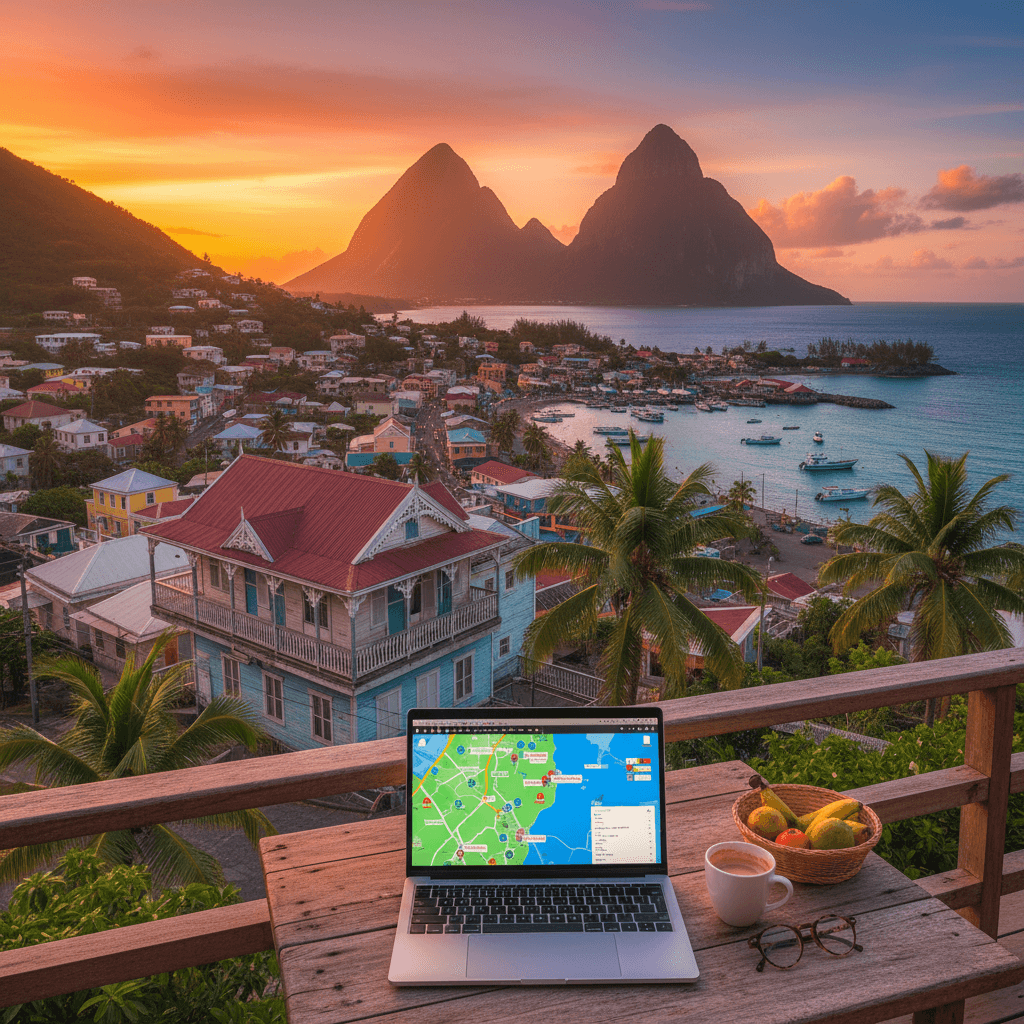
Soufrière isn't trying to impress you. It doesn't have a rooftop bar scene or a coworking space with cold brew on tap, it has two volcanic peaks rising straight out of the Caribbean and a sulphur spring you can drive a car into. That's the pitch and honestly, it's enough.
The town sits on the southwestern coast, tucked between the Pitons and dense rainforest that smells like wet earth and something faintly sweet after rain. The pace here is slow in a way that's, turns out, either deeply restorative or quietly maddening depending on your personality. Minibuses run when they run. Power dips. The internet wobbles. Most nomads who stay longer than two weeks either fall completely in love with the rhythm or quietly book a guesthouse in Rodney Bay.
What makes Soufrière genuinely different from other Caribbean bases is the sensory weight of the place. You're working with the Pitons visible from your window, you're eating roti for $7 on Bay Street, you're hearing Kweyol conversations drift through open shutters while tree frogs start up at dusk. It's not curated. It doesn't feel like a nomad destination, which is exactly why a certain kind of remote worker seeks it out.
The vibe skews local and unpretentious. Tourists pass through on day trips from the north, but they don't linger, so the town retains a realness that places like Rodney Bay have largely traded away. Expats here tend to be the type who've consciously opted out of convenience, they knew what they were signing up for.
Cost-wise, Soufrière is, frankly, one of the more affordable pockets of Saint Lucia. A decent one-bedroom runs around $750 a month, street food keeps daily costs low and you're not paying the resort-area premium that inflates prices further north. Budget-conscious nomads can realistically live here for around $1,030 a month on the low end, though mid-range comfort lands closer to $2,048.
The tradeoffs are real. Healthcare is limited, the nearest well-equipped hospital is 90 minutes away and infrastructure gaps show up at inconvenient moments. Come here for the landscape and the quiet, not the logistics.
Soufrière won't drain your bank account the way Rodney Bay will, but it's not cheap either. A single person can get by on around $1,030 a month if they're sharing a studio and eating street food, though most nomads land closer to $2,048 once you factor in a decent one-bedroom and the occasional sit-down meal.
Rent is, honestly, the biggest variable. A shared studio runs around $420, a private one-bedroom sits at $750 and if you want a villa with AC and Pitons views you're looking at $1,350 or more. Those rates are noticeably lower than the north, which is one of the main reasons nomads end up here instead of Gros Islet.
Monthly Budget Tiers
- Budget ($1,030): Shared studio, street food and roti shops, minibuses everywhere
- Mid-range ($2,048): Private one-bedroom, mix of home cooking and mid-range restaurants, occasional taxi
- Comfortable ($4,310): Villa rental, upscale dining at places like Felicity Rooftop, car rental for flexibility
Food is where Soufrière actually rewards you. A roti or plate of grilled fish from a street stall runs $5 to $10, it fills you up completely and turns out the quality is often better than the sit-down spots charging three times as much. Mid-range meals at somewhere like Mama's Kitchen and Bar land between $15 and $25, upscale dining pushes $40 and up.
Transport adds roughly $100 a month if you're relying on minibuses, which are cheap at $1 to $5 per hop but get unreliable after dark. No Uber here, taxis fill the gap but they're not cheap, a ride to Hewanorra Airport runs $20 to $65 depending on who you ask. Renting a car at $40-plus per day makes sense if you're doing regular day trips.
Broadband through Flow costs $65 to $125 a month and delivers 15 to 40 Mbps on a good day, which is, frankly, workable for most remote jobs. Budget another $10 to $45 for a local SIM with 10 to 30GB of data as backup, because the power and internet here cut out more than you'd like.
The bottom line: Soufrière is genuinely affordable by Caribbean standards. Just don't expect the infrastructure to match the price.
Soufrière doesn't have sprawling districts or a complex neighborhood map. It's a small town and most of where you'll end up living or staying falls into one of three zones, each with a pretty different feel.
For Digital Nomads
Soufrière Town is honestly the default choice. Rents are lower than anywhere in the north, studios start around $420 a month and you're walking distance from the market, a few decent cafés with WiFi and the kind of slow-morning energy that actually lets you focus. The Hummingbird on the waterfront is where most nomads end up working, it's not a coworking space, but the WiFi holds and the view of the Pitons doesn't hurt.
The catch is real, though. Power cuts happen, internet drops without warning and the nearest proper coworking space is Orbtronics in Gros Islet, about 1.5 hours north. If your work requires rock-solid connectivity every day, that's going to get frustrating fast.
For Expats
Long-term expats tend to cluster in and around Soufrière Town for the same reasons nomads do, lower costs and a genuinely local feel, but they also spread into the quieter hillside areas above town where you can rent a small house with a garden for under $1,000 a month. Facebook groups and Expat Exchange are, turns out, the most reliable way to find these listings before they're gone. Belle Plaine sits just outside town and gets a mention from expats who want a bit more space without paying resort prices.
For Families
The Anse Chastanet area is the most practical for families who want safety, space and easy beach access without coordinating minibuses every day. It's pricey, villas run $1,350 and up per month and it's isolated enough that you'll want a rental car. But the tradeoff is direct access to calm water, good snorkeling and the kind of quiet that kids and parents both need.
For Solo Travelers
Solo travelers passing through rarely stay more than a few days and Soufrière Town is the obvious base. Weirdly, the remoteness that frustrates nomads is exactly what solo travelers love, no crowds, cheap street food for $5 to $10 and Pitons views that genuinely stop you mid-sentence. Skip the resort areas unless you're splurging, they're beautiful but isolating when you're on your own.
Soufrière's internet situation is, honestly, workable but not impressive. Flow is your best bet here, pulling 15 to 40 Mbps download speeds in town, which beats Digicel's coverage in this part of the island. Home broadband runs $65 to $125 a month for unlimited plans and most nomads staying longer than a few weeks just grab a local SIM and tether when the villa WiFi acts up.
For SIMs, both Digicel and Flow sell tourist plans at shops in town and at Hewanorra Airport. Expect to pay $10 to $45 for 10 to 30GB, it's not a lot of data but it'll cover video calls and uploads without burning through your budget. If you'd rather sort it before you land, Airalo has eSIM options for Saint Lucia.
No dedicated coworking space exists in Soufrière. None. The nearest proper setup is Orbtronics up in Gros Islet, which is a solid 1.5 hours north and not something you'd do daily unless you're really desperate for a standing desk and fast fiber. Most nomads who base themselves here just work from their accommodation or stake out a table at The Hummingbird on the waterfront, which has WiFi and enough ambient noise (boats, the occasional rooster) to feel alive without being distracting.
Power cuts are the bigger annoyance, turns out, more than the internet speeds. Outages happen, especially during heavy rain and they're not quick. A UPS battery backup and a downloaded copy of whatever you're working on will save you more than once. Expats here almost universally recommend keeping a local SIM hotspot charged as your backup plan, not your last resort.
A few things to know before you set up shop here:
- Best carrier: Flow for Soufrière coverage and home broadband
- SIM cost: $10 to $45 for 10 to 30GB tourist plans
- Home broadband: $65 to $125 per month unlimited
- Nearest coworking: Orbtronics, Gros Islet (1.5 hours north)
- Best cafe option: The Hummingbird, waterfront WiFi
- eSIM: Airalo works before you arrive
If your work demands rock-solid connectivity for eight hours a day, Soufrière will frustrate you, it's that simple. But for async work, writing or anything that doesn't require a live screenshare at 4K, you'll get by fine.
Soufrière is, honestly, one of the safer spots in Saint Lucia for nomads and long-term visitors. Petty crime is low, there's a local police presence and the town's small size means you're rarely anonymous in a bad way. That said, avoid Castries neighborhoods like Wilton's Yard and Conway after dark, they're a different story and common sense applies everywhere.
Healthcare is where things get genuinely frustrating. There's no well-equipped hospital in Soufrière itself, so anything serious means a drive. Your two real options are:
- St. Jude Hospital (Vieux Fort): About 45 minutes away, public, handles acute emergencies, basic equipment.
- Tapion Hospital (Castries): Private, better-equipped, roughly 1.5 hours north. This is where expats go when it counts.
Pharmacies are scattered through town and generally well-stocked for everyday needs, so you won't struggle to find basic medications. Emergency services dial 911, response times vary, it's a small island with limited resources and you should plan accordingly.
Travel insurance isn't optional here, it's the difference between a manageable situation and a financial disaster if you need evacuation or specialist care. Most nomads go with a policy that covers emergency medical evacuation, turns out the distance to proper facilities makes that rider genuinely worth the extra cost.
Life expectancy sits around 74 and emergency training has improved in recent years, but the infrastructure gap is real. If you have a chronic condition or need regular specialist care, Soufrière will test your patience, factor that into your decision before committing to a long stay.
A few practical notes:
- Emergency number: 911
- Nearest private hospital: Tapion, Castries (1.5 hrs)
- Nearest public emergency care: St. Jude, Vieux Fort (45 min)
- Pharmacies: Available in Soufrière town, adequate for routine needs
- Travel insurance: Get it and make sure it covers medevac
The town itself feels safe, frankly more so than many Caribbean destinations of comparable size. Walk at night in the center without much worry, just don't push into unfamiliar areas alone after midnight.
Uber Taxi is now available. That's just the reality of Soufrière and you'll need to adjust your expectations before you arrive.
Minibuses are the backbone of local transport, covering short hops around town for $1 to $5, though they run on island time and get genuinely unreliable after dark. They're loud, they're packed and honestly, they're one of the better ways to feel like you're actually living somewhere rather than just visiting it. For anything further, you're calling a taxi. The ride from Hewanorra International Airport runs $20 to $65 depending on your negotiating skills and how much luggage you're hauling, taking roughly 45 minutes on roads that wind hard through the hills.
Most nomads who stay longer than a week end up renting a car, it's just easier. Rates start around $40 per day and the driving is, frankly, an experience. The roads around Soufrière are narrow, steep in places and occasionally share space with goats. Drive slowly, keep your windows down to hear what's coming around blind corners and you'll be fine.
For shorter distances, Bike St. Lucia rents bikes and scooters for roughly $20 to $50 per day, which works well on flatter stretches near the waterfront. The town center itself is walkable, small enough that you can cover most of it on foot, though the hills leading out toward Anse Chastanet or the Pitons area will test your legs fast.
Taxis can be booked via apps like Allez or Uber Taxi, which is, turns out, more reliable than flagging someone down on the street, especially for early morning airport runs. Save the number of a driver you trust once you find one, expats here swear by having a regular contact rather than starting fresh every time.
- Minibus: $1 to $5, frequent in town, unreliable evenings
- Taxi/Uber: $20 to $65 depending on distance
- Car rental: from $40 per day, recommended for flexibility
- Bike or scooter: $20 to $50 per day via Bike St. Lucia
- Walking: fine for town center, rough on hills
Getting around Soufrière isn't difficult, it just requires patience. Build extra time into anything involving transport and you'll stop being frustrated by it pretty quickly.
English is the official language and everyone speaks it fluently, so you won't have any trouble getting around, ordering food or sorting out practical things like SIM cards and rentals. That said, Saint Lucian Creole, called Kweyol, is what you'll actually hear most of the time. It's spoken by around 95% of the population and in Soufrière especially, where tourism is quieter than up north, locals slip into it constantly.
Kweyol is, honestly, a beautiful language to listen to, warm and rhythmic and learning even a few words goes a long way socially. Locals genuinely appreciate the effort, it signals respect rather than the usual tourist detachment. A few phrases worth knowing:
- Bonjou , hello / good morning
- Mesi , thank you
- Kote pwevit-la? , where's the bathroom?
Don't stress about pronunciation, nobody expects perfection and a mispronounced "bonjou" still gets a smile. Google Translate handles basic Kweyol well enough for written signs or menus, though it stumbles with spoken phrases, so don't rely on it in fast conversations.
Communication infrastructure is where things get more complicated. Flow tends to outperform Digicel for coverage in Soufrière specifically, pulling 15 to 40 Mbps on a decent day, though speeds drop in the hills and during rain. Tourist SIMs run $10 to $45 for 10 to 30GB data packages and you can pick them up at shops in town or at Hewanorra Airport on arrival. If you'd rather skip the hassle of a physical SIM, Airalo sells eSIMs that work fine here.
WiFi at cafes like The Hummingbird is, turns out, functional enough for light work, emails, video calls on a good connection day. Don't count on it for anything deadline-critical, though. Power outages are a real thing in Soufrière, more so than in Rodney Bay and they'll kill your session without warning.
Most nomads who've spent time here say the language barrier is genuinely zero, the communication infrastructure barrier is real. Come prepared with a local SIM, a backup hotspot plan and reasonable expectations about connectivity. The conversations you'll have with locals, once you drop the tourist-bubble instinct, are frankly some of the best parts of being here.
Soufrière sits in the tropics, so the temperature barely moves. Year-round, you're looking at 77 to 86°F, with that particular kind of humidity that makes your shirt stick to you by 9am. What actually changes is the rain.
The dry season runs December through May and that's, honestly, when most people want to be here. The air smells cleaner, the Pitons stay visible instead of disappearing into cloud and you can plan a hike without watching the sky nervously. April and May are a sweet spot, warm water around 82°F, lighter crowds than the peak winter rush and prices that haven't fully inflated yet.
June through November is the rainy season and it shows. Not constant downpours, more like heavy afternoon rain that hammers the tin roofs for an hour and then stops, leaving everything dripping and green and smelling of wet earth. September through November is when it gets genuinely dicey, those are the peak hurricane months and while Saint Lucia sits far enough south to dodge direct hits more often than not, you'll still see storms track close enough to cancel flights and rough up the coast. November, turns out, averages over 12 wet days in the month. That's a lot.
Budget travelers and remote workers who don't mind the rain often come June through August specifically because rates drop and the town quiets down, the tradeoff is slower internet when storms roll through and the occasional power outage that can last hours.
- Best months: April and May (dry, warm, fewer crowds than December to March)
- Peak season: December to March (driest, most expensive, most visitors)
- Shoulder: June to August (cheaper, wetter, quieter)
- Avoid if possible: September to November (hurricane risk, heaviest rain)
One thing worth knowing: Soufrière gets more rainfall than the north because of the mountains, the rainforest doesn't stay lush by accident. Even in the dry season, keep a light rain jacket within reach, a short squall can appear out of nowhere, soak you completely and be gone before you've found shelter.
Soufrière runs on island time and honestly, that's not always charming. Power cuts happen, internet drops mid-call and the nearest well-stocked pharmacy or private hospital is over an hour away in Castries. Go in with clear eyes.
Money: ATMs in town accept foreign cards, but bring backup cash. Use Wise or Revolut to avoid brutal conversion fees at local banks. Republic Bank is the main option if you need branch services.
Getting a SIM: Pick up a Flow or Digicel SIM at the airport or in Soufrière town. Flow tends to win on coverage down south, pulling 15 to 40 Mbps when it's cooperating. Tourist data plans run $10 to $45 for 10 to 30GB or grab an eSIM through Airalo before you fly.
Internet for work: Home broadband costs $65 to $125 a month. There's no dedicated coworking space in Soufrière, the nearest is Orbtronics up in Gros Islet, about 90 minutes north. The Hummingbird cafe works fine for a few hours, it's not a WeWork, but the WiFi holds and the view doesn't hurt.
Getting around: Minibuses cover short hops for $1 to $5, they're frequent during the day and unreliable after dark. Uber Taxi is now available. Call-a-Ride or local taxis handle longer trips, airport transfers from Hewanorra run $20 to $65. Renting a car ($40 plus per day) makes a real difference if you're staying more than a week.
Healthcare: St. Jude Hospital in Vieux Fort is 45 minutes away and handles emergencies. For anything serious, Tapion in Castries is better equipped but 90 minutes out. Get travel insurance. This isn't optional.
Weather and timing: Dry season runs December through May. April and May are, weirdly, the sweet spot, warm water, fewer crowds, manageable rain. September through November brings hurricane risk, plan accordingly.
Cultural basics:
- Greetings: Say "bonjou" when you walk into a shop. Skipping it reads as rude, locals notice.
- Tipping: 10 to 15 percent is standard at restaurants.
- Dress: Cover up at churches and markets. It's a small community.
- Visa: Remote workers should check the current Saint Lucia digital nomad visa (Live It program).
Need visa and immigration info for Saint Lucia?
🇱🇨 View Saint Lucia Country GuideHidden Gem
Worth the effort