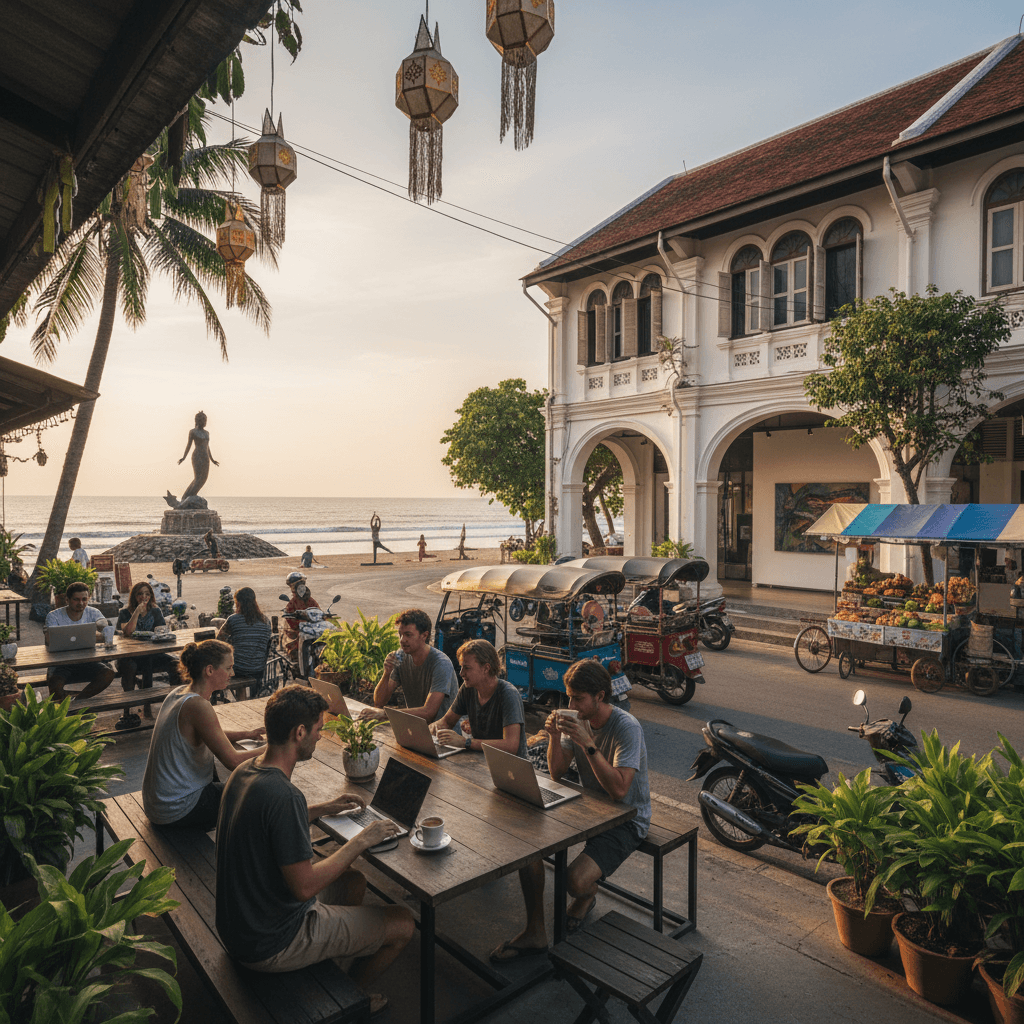
Songkhla
🇹🇭 Thailand
The Vibe: Southern Soul Without the Hype
Songkhla is where you go when you're tired of the "nomad bubble" and want to remember why you fell in love with Thailand in the first place. It doesn't feel like a polished tourist product; it feels like a lived-in, coastal community that just happens to have stunning Sino-Portuguese architecture and a world-class food scene. While Chiang Mai is for networking and Phuket is for partying, Songkhla is for those who want a slower, "sanuk" pace of life where the locals are genuinely curious to meet you.
The city has a distinct dual personality. You have the Old Town, with its narrow alleys, vintage cafes like Hup Seng, and walls adorned with street art that tells the story of the local fishing industry. Then there’s the breezy, pine-lined Samila Beach, where the famous Golden Mermaid statue overlooks the Gulf of Thailand. Many nomads find that the lack of massive crowds allows for a much deeper connection with the community, though you'll need to brush up on your Thai or keep a translation app handy, as English is less common here than in the capital.
What Makes It Unique?
What sets Songkhla apart from other Thai hubs is its unfiltered authenticity. You won't find rows of Western salad bars or overpriced avocado toast here. Instead, you'll find roti mutabak, spicy southern curries, and khao man gai for ฿40, ฿60. Travelers often note the city’s creative energy; it’s a place where young Thai artists are moving back to their roots to open boutique galleries and coffee shops in century-old buildings.
The geography is also a major draw. Songkhla sits on a peninsula between the Songkhla Lake and the sea, meaning you're never more than a few minutes from the water. Experienced expats recommend grabbing a scooter and crossing the bridge to Koh Yo Island for a weekend. It’s a peaceful escape where you can watch the sunset over the lake while eating fresh seafood at a stilted restaurant like Ko Yor Bar.
The Practical Reality for Nomads
Living here is incredibly easy on the wallet, even by Thai standards. You can snag a studio apartment for around $230 (฿8,100) a month, and a comfortable lifestyle rarely exceeds $1,000 a month. However, it’s important to manage expectations regarding infrastructure. While the internet is reliable, typically ranging from 50, 150 Mbps, dedicated coworking spaces are sparse. Most remote workers settle into the "cafe office" lifestyle, frequenting spots like Blue Smile Cafe or Lyn's The Shanghai Cafe.
Safety is a common question for newcomers. While the city center and the neighboring hub of Hat Yai are safe and peaceful, travelers should stay informed about the deeper southern provinces near the Malaysian border. Stick to the Mueang Songkhla and Hat Yai districts, and you’ll find a welcoming environment. The most significant recent challenge has been the recovery of the healthcare system in Hat Yai following regional flooding, so it's wise to ensure your insurance covers private facilities like Bangkok Hospital Hat Yai for any major needs.
Neighborhood Breakdown
- Songkhla Old Town: The heart of the creative scene. Best for those who want to walk to street food markets and work from historic cafes. It's quiet, charming, and very affordable.
- Hat Yai: Located about 30 minutes away, this is the commercial powerhouse. It’s better for those who need modern malls, large hospitals, and a more established expat community.
- Samila Beach: Ideal for those who want to wake up to the sound of the ocean. It’s more laid-back and resort-focused, though long-term rentals are harder to find right on the water.
- Koh Yo Island: A tranquil island in the lake connected by bridges. It's perfect for a quiet retreat or a weekend getaway to see the Southern Thai Folklore Museum.
Ultimately, Songkhla is for the nomad who values work-life balance over hustle culture. It’s a place where you can finish a project in the morning, spend the afternoon exploring a local temple, and top off the night with ฿100 ($2.85) worth of the best street food you've ever tasted.
Cost of Living in Songkhla
Songkhla remains one of the most affordable corners of Thailand for long-term stays. While popular hubs like Phuket or Bangkok have seen prices climb, this southern coastal city offers a high quality of life for a fraction of the cost. Digital nomads often find their monthly expenses here are 30% to 50% lower than in the country's more famous digital nomad hotspots.
Accommodation Breakdown
Housing is where you'll see the biggest savings. Most expats choose between the historic charm of the Old Town or the modern conveniences of Hat Yai. In the city center, a modern one-bedroom apartment typically costs around $282 (฿9,137) per month. If you're willing to live just outside the central district, prices drop significantly to roughly $182 (฿5,875).
- Mid-Range 1-Bedrooms: Expect to pay between $230 and $350 for places with air conditioning and reliable WiFi.
- Family-Sized Rentals: A three-bedroom house or large apartment in the city center averages $601 (฿19,400), while suburban options go for about $424 (฿13,700).
Food and Dining Prices
The food scene is a major draw, and it's incredibly easy on the wallet. You'll find that many nomads rarely cook at home because eating out is so convenient. A standard meal of pad thai or khao man gai at a street stall usually costs between $0.85 and $2.30 (฿30, ฿80).
For a sit-down experience at a mid-range local restaurant or a seafood spot by the lake, you'll likely spend $2.30 to $5.70 (฿80, ฿200). Even at "splurge" spots like Blue Smile Cafe or local garden cafes, it's difficult to spend more than $15 per person unless you're ordering premium imported drinks.
Transport and Connectivity
Getting around is straightforward and cheap. Most long-termers recommend renting a motorbike to navigate the narrow streets of the Old Town. Daily rentals sit around $4.30 to $7.15 (฿150, ฿250), but you can negotiate much lower monthly rates. For quick trips, the Grab and Bolt apps are the go-to choices, with most city rides costing between $0.85 and $2.85 (฿30, ฿100).
Internet is a non-negotiable for remote work, and Thailand's infrastructure doesn't disappoint here. You can pick up a 5G SIM card from providers like AIS or True Move with unlimited data for about $10 to $12 (฿350, ฿400) per month. While dedicated coworking spaces are available, many nomads prefer working from cafes for the price of a $1.50 (฿50) iced coffee.
Monthly Budget Estimates
To help you plan, here is a breakdown of what you can expect to spend based on your lifestyle preferences. These figures include rent, food, transport, and basic entertainment.
- The Budget Traveler ($360, $560/month): This covers a basic studio apartment, eating primarily at street markets, and using a bicycle or local buses for transport.
- The Mid-Range Nomad ($640, $1,070/month): This is the "sweet spot" for most. It includes a nice one-bedroom apartment, frequent cafe visits, several meals at mid-range restaurants, and a motorbike rental.
- The Comfortable Expat ($1,450+/month): This budget allows for a premium apartment or small house, frequent upscale dining, weekend trips to nearby islands, and private healthcare coverage.
Experienced expats recommend keeping some extra "buffer" cash for visa runs to the Malaysian border, which is conveniently close. Overall, Songkhla offers a rare balance where you don't have to sacrifice comfort to maintain a very lean budget.
For the Culture-Focused Nomad: Songkhla Old Town
If you're looking for the soul of the city, Old Town is where you'll want to drop your bags. It’s a walkable grid of streets like Nakhon Nok and Nakhon Nai, where the architecture feels like a mix of Southern Thai and Chinese heritage. Many nomads find this area perfect because it feels lived-in and authentic rather than a manufactured tourist zone.
You'll spend your mornings working from character-filled spots like Blue Smile Cafe or the Hup Seng vintage cafe. The internet is surprisingly reliable for such an old district, with many cafes offering speeds around 50, 150 Mbps. Travelers often note that while English isn't universal, the locals are incredibly patient and welcoming to long-term guests.
Accommodation here tends to be smaller guesthouses or renovated heritage buildings. For monthly stays, look toward the Karnjanavanit Road area on the periphery. You can find budget-friendly apartments starting as low as ฿3,700 to ฿9,000 ($105, $255) per month, making it one of the most affordable creative hubs in Thailand.
For the Modern Expat: Hat Yai (Koh Hong District)
Expats who need modern infrastructure, shopping malls, and better healthcare usually settle in Hat Yai, specifically the Koh Hong area. It’s the commercial heart of the province and sits about 30 kilometers from Songkhla’s coast. It’s the best choice if you need to be near Bangkok Hospital Hat Yai or the university facilities.
The vibe here is much faster than the Old Town. You’ll have access to Central Festival Mall and a wider variety of international food. Experienced expats recommend this area because it simplifies logistics like visa runs to Malaysia and provides more consistent 5G coverage and high-speed fiber internet.
Living costs are slightly higher here than in the coastal town. A one-bedroom apartment outside the immediate city center typically runs between $180 and $350 per month. For a more established feel, the Koh Hong neighborhood offers mid-range apartments in the ฿6,750, ฿8,678 range.
For Families and Nature Seekers: Koh Yo Island
If you prefer a backyard over a balcony, Koh Yo is a unique island in the middle of Songkhla Lake. It’s connected by the Tinsulanonda Bridge, so you aren't isolated, but the atmosphere is worlds apart from the mainland. Families often appreciate the quiet lanes, fruit orchards, and the famous local weaving industry.
The island is famous for its seafood restaurants and the Southern Thai Folklore Museum. It’s a peaceful retreat, though you'll definitely need your own transport, either a car or a motorbike, to get into the city for supplies. Nomads often head to Ko Yor Bar for a relaxed sunset work session with a view of the lake.
While long-term rental listings are harder to find online for Koh Yo, many travelers find success by scouting the area in person. It’s the kind of place where you’ll find a traditional house or a lakeside bungalow rather than a modern condo block.
For Solo Travelers and Beach Lovers: Samila Beach
Living near Samila Beach offers a coastal lifestyle that’s hard to beat for the price. This area is defined by its long stretches of white sand, pine trees, and the iconic Golden Mermaid Statue. It’s popular with solo travelers who want to be able to walk from their apartment to the sand in five minutes.
The neighborhood has a distinct "resort" feel but remains very affordable. You’ll find plenty of seafood stalls and cafes along the promenade. Tuber Coworking Space is located in this general vicinity, providing a dedicated professional environment with fast WiFi and a collaborative community when you need to get serious work done.
One thing to keep in mind is that this area can get busy with local tourists on weekends. However, during the week, it’s a tranquil place to live. You can find comfortable studio apartments in this district for roughly ฿8,100 ($230) per month, giving you beach access at a fraction of the cost of Phuket or Samui.
Connectivity & Speeds
You'll find that Songkhla's digital infrastructure is surprisingly robust for a city that feels so tucked away. While it doesn't always hit the blistering 300 Mbps speeds common in Bangkok high-rises, most modern apartments and cafes comfortably provide between 50 and 150 Mbps. Fiber optic connections are the standard for long-term rentals, and many nomads find that a basic 5G backup is more than enough for video calls.
Mobile data is incredibly cheap and reliable here. Experienced expats recommend picking up a SIM card from AIS or True Move at any 7-Eleven or the airport. You can get unlimited data plans starting around ฿300 to ฿400 ($10, $12 USD) per month. If you're staying longer than a few weeks, it's worth getting a post-paid plan or a long-term top-up to avoid the higher "tourist SIM" rates.
Dedicated Coworking Spaces
Songkhla isn't a massive nomad hub like Chiang Mai, so the coworking scene is intimate rather than corporate. Tuber Coworking Space is the primary go-to for serious deep work. It offers super-fast WiFi and a collaborative atmosphere that travelers often note is great for networking with the small local startup community. They even provide a free minibar to keep you fueled through afternoon slumps. Prices for daily passes in the region typically hover between ฿200 and ฿400 ($6, $12 USD).
The Cafe Office Culture
If you prefer a more relaxed environment, you'll likely end up joining the "cafe office" crowd in the Old Town. The local cafe culture is welcoming to laptops, provided you aren't camping out for six hours on a single espresso. Many nomads find the aesthetic of the restored Sino-Portuguese buildings provides the perfect creative backdrop.
- Blue Smile Cafe: A favorite for its quiet upstairs area and consistent connection.
- The Secret Garden: Great for those who need a bit of greenery and fresh air while they type.
- Hup Seng: This vintage spot is perfect for light admin work, though it can get lively during the lunch rush.
Expect to pay between ฿40 and ฿80 for a high-quality coffee. Most of these spots have plenty of power outlets, but seasoned nomads recommend bringing a multi-plug adapter just in case the nearest socket is already claimed.
Practical Tips for Remote Work
Power outages are rare in the city center but can happen during the peak of the monsoon season. Travelers often suggest keeping your laptop fully charged and having a personal hotspot ready as a failover. If you need to take high-stakes international calls, the morning hours are usually the quietest in the Old Town before the weekend day-trippers arrive.
While English is widely understood in the coworking spaces, it’s less common in the smaller neighborhood cafes. Using a translation app or learning basic Thai phrases for "WiFi password" (rahut wifi) and "plug" (pluk) will make your workday much smoother. Most nomads find the locals are incredibly patient and happy to help you get settled at a table near a power source.
Safety in Songkhla
Songkhla is generally a very safe and welcoming city for foreigners. Most travelers find the atmosphere in Songkhla Old Town and around Samila Beach to be incredibly relaxed. You'll likely notice a strong police presence, which many expats find reassuring rather than intimidating.
While the city center is peaceful, it's important to be aware of the regional context. Experienced nomads recommend staying within the northern and central parts of the province. Avoid traveling to the deep southern districts near the Malaysian border, as these areas have a history of civil unrest. Stick to the main hubs of Mueang Songkhla and Hat Yai, and you'll find the security situation mirrors most other parts of Thailand.
Petty crime like bag snatching is rare here compared to Bangkok or Phuket, but it's still smart to stay vigilant. Travelers often note that the biggest daily safety concern isn't crime, but rather getting around on the roads. If you're renting a motorbike for ฿150, 250 per day, always wear a helmet and keep an eye out for unpredictable driving patterns on the main roads connecting Songkhla and Hat Yai.
Healthcare Facilities
If you need medical attention, you'll likely head to Hat Yai, which serves as the medical hub for Southern Thailand. Bangkok Hospital Hat Yai is the top choice for most expats and digital nomads. It's a private facility where the staff usually speaks excellent English, and the equipment is world-class.
For specialized care or emergencies, Songklanagarind Hospital is a massive university-affiliated facility with a strong reputation. While it can be more crowded than private clinics, it offers some of the most advanced medical technology in the region. Many nomads find that out-of-pocket costs for minor consultations are very affordable, often ranging from ฿500 to ฿1,500 for a basic visit.
Recent Infrastructure Challenges
Keep in mind that the region can be prone to heavy monsoon rains toward the end of the year. Travelers should be aware that extreme flooding has previously disrupted the healthcare system in Hat Yai. During these rare events, access to certain hospitals can be limited. If you're staying during the rainy season, keep an eye on local weather apps and have a basic first-aid kit and a supply of any personal medications on hand.
Pharmacies & Minor Ailments
For everyday health needs, Songkhla is dotted with well-stocked pharmacies. You'll find that pharmacists in Thailand are highly trained and can often provide consultations for minor issues like stomach upsets or skin rashes. Many common medications that require a prescription in the West are available over-the-counter here at very low prices.
- Emergency Number: Dial 191 for general emergencies or 1155 for the Tourist Police.
- Health Insurance: Most long-term residents recommend a policy that includes medical evacuation, just in case you need to be moved to Bangkok for complex procedures.
- Water Safety: Like the rest of Thailand, don't drink the tap water. Stick to bottled water, which is available at every 7-Eleven for about ฿10.
Personal Wellbeing
The "sanuk" lifestyle in Songkhla promotes a great sense of wellbeing. The air quality is generally much better than in Bangkok or Chiang Mai, especially during the "burning season" that affects the north. Many expats find the proximity to the ocean and the abundance of fresh, affordable seafood contributes to a much healthier lifestyle than they had back home.
Getting Around Songkhla
Navigating Songkhla is a distinct experience compared to the frantic pace of Bangkok. The city is split into two main hubs: the historic Old Town and the modern commercial center of Hat Yai. While the Old Town is compact enough to explore on foot, you’ll need a set of wheels or a reliable app to move between districts or head out to the coast.
Ride-Hailing & Local Apps
Experienced expats recommend downloading Grab and Bolt as soon as you arrive. These apps are the most reliable way to secure a fair price without the need for haggling. A typical ride across town usually costs between ฿30 and ฿100 ($0.85, $2.85) depending on the distance and vehicle type.
Many nomads find that Bolt often offers slightly lower rates in the Songkhla area, though Grab remains the go-to for food delivery and more consistent driver availability during off-peak hours. Always check both apps if you're heading from the city center out to Samila Beach, as prices can fluctuate during sunset hours.
Public Transport: Songthaews & Tuk-Tuks
For a more local experience, you can hop on a Songthaew (blue or red pickup trucks with benches in the back). These run set routes between Songkhla and Hat Yai for a fraction of the cost of a private taxi. You’ll typically pay around ฿20 to ฿40 for longer legs of the journey. To catch one, simply wave it down from the roadside and ring the buzzer when you're ready to get off.
Tuk-tuks are also available, particularly around the markets and the Hat Yai Railway Station. Travelers often note that these are more expensive than ride-hailing apps, so you should agree on a price before you sit down. Expect to pay a premium for the convenience of an immediate ride.
Motorbike Rentals
If you’re planning on staying for more than a week, renting a motorbike is the easiest way to explore the area. It allows you to cross the bridges to Koh Yo Island or cruise the pine-lined roads of the coastline at your own pace. Daily rentals generally range from ฿150 to ฿250 ($4.30, $7.15).
Long-term residents often negotiate monthly rates as low as ฿3,000 to ฿4,000. Just keep in mind that Southern Thai traffic can be unpredictable. You’ll need an International Driving Permit and a helmet is mandatory, local police do set up checkpoints, particularly on the main roads leading toward Karnjanavanit Road.
Walking & Cycling in the Old Town
The Songkhla Old Town is one of the few places in the region where walking is genuinely enjoyable. The grid-like streets are filled with street art and heritage buildings, making it easy to wander between cafes like Hup Seng and the local museums. Many nomads find that a bicycle is perfect for this area, though you'll want to finish your outdoor activities before the midday heat peaks.
Intercity Travel
To get further afield, the Hat Yai Bus Terminal is the primary gateway. Minivans and buses depart regularly for the Malaysian border, which is incredibly convenient for those needing to do a visa run. For travel to Bangkok or other northern hubs, the Hat Yai Junction offers reliable train services, including the popular sleeper trains that save you a night of accommodation costs.
If you're heading to the airport, a private car via Grab is the most stress-free option, usually costing around ฿250 to ฿350 from the city center. Give yourself extra time if traveling during the rainy season, as local roads can occasionally experience localized flooding which slows down the flow of traffic significantly.
The Linguistic Landscape
In Songkhla, you'll find a linguistic environment that feels far more authentic and less "touristy" than Phuket or Bangkok. The primary language is Thai, specifically the Southern Thai dialect (Pak Tai), which is known for being faster, sharper, and more clipped than the central Thai spoken in the capital. Many nomads find that while the locals are incredibly patient, English proficiency is notably lower here than in Thailand's major digital nomad hubs.
In Songkhla Old Town, younger cafe owners and boutique hotel staff usually speak enough English to help you navigate daily life. However, once you step into the local wet markets or smaller street food stalls near Karnjanavanit Road, you'll likely need to rely on translation apps or basic Thai phrases. Experienced expats recommend learning your numbers and basic food vocabulary early on, as it goes a long way in building rapport with the community.
If you're looking for an environment where English is more common, travelers often note that Hat Yai is a better bet. Due to its status as a commercial center and its proximity to the Malaysian border, many business owners and medical staff at facilities like Bangkok Hospital Hat Yai speak English fluently. You'll also encounter Mandarin and Hokkien speakers within the Thai-Chinese community in the city center.
Essential Communication Tools
Navigating Songkhla without a smartphone is a challenge most nomads don't want to take on. Digital nomads living here suggest downloading Google Translate with the Thai offline dictionary immediately. The "camera translate" feature is a lifesaver for reading menus at local spots like Hup Seng or interpreting signs at the weekend night markets.
For getting around and ordering food, Grab and Bolt are the standard apps. They remove the language barrier entirely by allowing you to input your destination and see the price upfront. Most travelers find that Bolt is often cheaper in the Songkhla area, with local rides starting as low as ฿30 to ฿50.
To stay connected, you'll want a local SIM card from AIS, DTAC, or True Move. You can pick these up at any 7-Eleven or at the airport. Unlimited data plans are incredibly affordable, often costing around ฿300 to ฿400 ($10, $12) per month. This ensures you have access to maps and translation tools even when you're exploring the more remote parts of Koh Yo Island.
Social Etiquette & Non-Verbal Cues
Because English isn't universal, non-verbal communication is vital. The "Wai" (placing your palms together in a prayer-like gesture) is the standard greeting. A polite smile and a Wai can smooth over almost any linguistic misunderstanding. Travelers often find that Southerners are direct but exceptionally kind; if you're struggling to find a location, showing a photo on your phone will usually result in a local personally walking you to the right street.
If you plan on staying for more than a month, nomads recommend a few key phrases to make life easier:
- Sawatdee-khrap (male) / Sawatdee-kha (female): Hello.
- Khop khun (khrap/kha): Thank you.
- Mai phet: Not spicy (Southern food is famously fiery, so you'll use this often).
- Tao rai?: How much?
- Check bin: The bill, please.
Digital Nomad Connectivity
Communication for work is rarely an issue if you're based in the right spots. While the city has a relaxed pace, the internet infrastructure is modern. You'll find reliable speeds of 50, 150 Mbps in most Old Town cafes. For those who need a professional environment for calls, local cafes with dedicated work zones provides the high-speed stability and quiet zones that are harder to find in the open-air cafes along the lake.
Most expats use Line as their primary messaging app for everything from talking to landlords to ordering water delivery. It’s the "everything app" of Thailand, and having a local account will make your integration into the Songkhla community much smoother.
Understanding Songkhla’s Tropical Rhythm
Songkhla follows a tropical monsoon climate, but it’s distinct from the rest of Thailand. While Bangkok and Chiang Mai are drying out in November, Songkhla is often in the thick of its heaviest rains. Experienced expats recommend paying close attention to the northeast monsoon, which shapes life here from late October through January.
The temperature remains fairly consistent year-round, usually hovering between 25°C (77°F) and 32°C (90°F). You won’t need a sweater here, but you’ll definitely need a high-quality raincoat and a tolerance for humidity that rarely dips below 70%.
The Best Time to Visit: February to June
Many nomads find that February to June is the "sweet spot" for living in Songkhla. During these months, the heavy monsoon rains have subsided, and the scorching heat of the late summer hasn't fully peaked. The skies are generally clear, making it the perfect time for sunset scooter rides along Samila Beach or working from the outdoor patios in Old Town.
Travelers often note that the sea is calmest during this window. If you're planning to spend time on Koh Yo Island or take boat trips across the lake, this is when you'll get those glassy water views and the best photography lighting for the Sino-Portuguese architecture.
The Monsoon Season: October to January
Unlike the Andaman coast (Phuket/Krabi), which sees rain from May to October, Songkhla’s wet season hits late in the year. November and December are statistically the wettest months. During this time, it’s common to see flash flooding in low-lying areas of Hat Yai and Mueang Songkhla.
Digital nomads living here during the monsoon suggest choosing accommodation on higher floors and checking that your favorite coworking spots, like local workspaces, have backup power. While the rain brings a lush, green beauty to the province, it can disrupt transport and outdoor markets. If you don't mind the "cozy" vibe of working from a cafe while it pours outside, you'll find the city much quieter and even more affordable during these months.
The Hot Season: April to August
By April, the heat turns up. This coincides with Songkran (the Thai New Year), where the water fights provide a welcome relief from temperatures that can climb to 35°C (95°F). Travelers often retreat to air-conditioned malls in Hat Yai or the shade of the pine groves near the Golden Mermaid Statue during the afternoons.
Expats recommend shifting your schedule during these months. Start your outdoor explorations at 7:00 AM, head to a cooled workspace like a local cafe during the midday heat, and wait until 5:00 PM to head back out for street food and evening walks.
Seasonal Highlights for Nomads
- February - April: Ideal for beach living and outdoor cafe hopping. The humidity is manageable, and the "burning season" smoke that plagues Northern Thailand rarely reaches this far south.
- September - October: The Vegetarian Festival is a major cultural event in Songkhla and Hat Yai. You'll find incredible food stalls, though the weather starts becoming unpredictable.
- November - December: Peak rain. Great for deep-focus work phases and lower monthly rental rates, but expect disruptions to travel plans and occasional flooding in Hat Yai.
What to Pack
Because the weather is consistently tropical, nomads recommend lightweight, breathable fabrics like linen or moisture-wicking synthetics. If you’re visiting during the monsoon, a sturdy umbrella is better than a cheap plastic poncho, which can feel like a sauna in the 85% humidity. Don't forget a pair of waterproof sandals or "crocs" for navigating the puddles in Old Town after a sudden downpour.
Getting Around
Navigating Songkhla is straightforward once you understand the local transport hierarchy. For quick trips within the Old Town or to Samila Beach, motorcycle taxis are the fastest option, usually costing between ฿30 and ฿60. Look for riders in colorful vests at street corners.
For longer distances, especially between Songkhla and Hat Yai, travelers frequently use van taxis or songthaews (converted pickup trucks). A songthaew ride generally costs around ฿20 to ฿40 depending on the distance, while a shared van to Hat Yai is approximately ฿35. Many nomads prefer using the Grab or Bolt apps for transparent pricing, with most city rides averaging ฿60 to 120.
If you're staying long-term, experienced expats recommend renting a motorbike. Expect to pay between ฿150 and ฿250 per day, or roughly ฿3,000 to ฿4,500 per month for a standard scooter like a Honda Click. Just ensure you have an International Driving Permit, as police checkpoints are common on the main roads between districts.
Connectivity & Power
Internet reliability is high, though speeds in Songkhla's historic buildings can be slightly lower than in the modern high-rises of Hat Yai. Most cafes in the Old Town offer speeds between 50 and 150 Mbps. For a dedicated workspace, Tuber Coworking Space is the local go-to, offering high-speed fiber and a professional environment.
Digital nomads often recommend picking up a local SIM card immediately upon arrival. AIS and TrueMove H have the best coverage in the south. You can get an unlimited data plan for around ฿350 to ฿450 per month. Power outlets are the standard Thai Type A and B (two flat or round pins), and the voltage is 220V, so bring a surge protector if you're working on sensitive equipment.
Health & Safety Essentials
While Songkhla is generally peaceful, travelers should stay informed about the local context. Stick to the main hubs of Mueang Songkhla and Hat Yai. These areas are well-policed and popular with international visitors. It's wise to avoid non-essential travel to the districts bordering the deep south provinces due to long-standing regional friction.
For medical needs, Bangkok Hospital Hat Yai is the top choice for expats due to its English-speaking staff and international standards. If you're in the city center, Songkhla Hospital is reliable for minor ailments. Always carry travel insurance that covers medical evacuation, just in case you need to be transferred to Bangkok for specialized care.
Money & Logistics
Songkhla remains a cash-heavy society, especially at the weekend night markets and smaller family-run eateries in the Old Town. While larger hotels and upscale spots like The Secret Garden accept credit cards, you'll need Thai Baht for almost everything else. ATMs are everywhere, but they charge a standard ฿220 fee for foreign cards, so it's better to withdraw the maximum amount (usually ฿20,000 to ฿30,000) at once.
For grocery shopping, expats usually head to Lotus’s or Makro for bulk items and international brands. For fresh produce, the Songkhla Central Market is much cheaper and offers a better look at local life. If you need a visa run, the proximity to the Padang Besar border with Malaysia makes it a convenient base for managing your stay.
- Daily Budget (Budget): ฿600 - ฿900
- Daily Budget (Mid-range): ฿1,500 - ฿2,500
- Best SIM Provider: AIS for 5G coverage
- Emergency Number: 1155 (Tourist Police)
- Language Tip: Learn "Phed Nit Noi" (a little spicy) unless you're prepared for Southern Thai heat levels.
Need visa and immigration info for Thailand?
🇹🇭 View Thailand Country GuideEasy Landing
Settle in, no stress