São Paulo
🇧🇷 Brazil
The Energy of Sampa
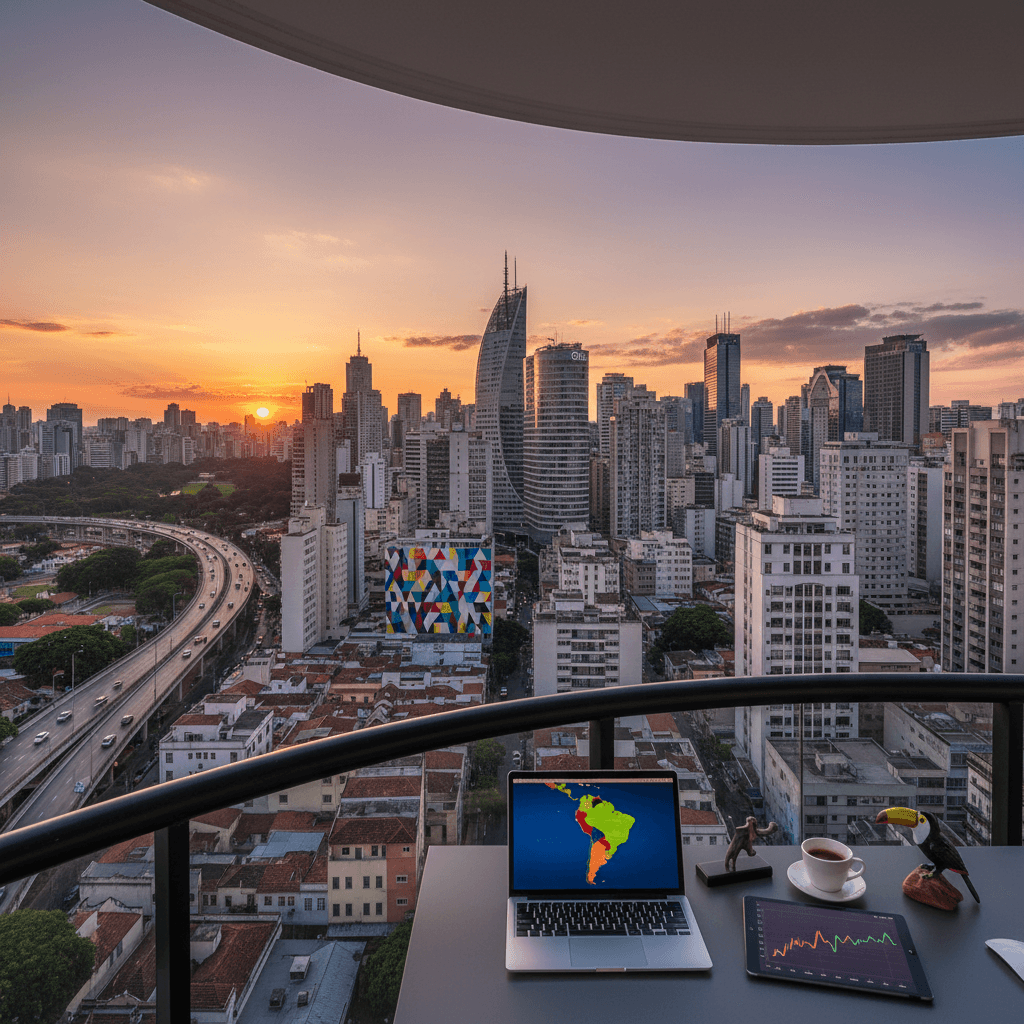
São Paulo isn't a city that tries to charm you with postcard beaches or colonial ruins. It's a concrete behemoth that wins you over through sheer, unadulterated momentum. Think of it as the New York of South America, but with a tropical pulse and a much better coffee scene. With 12 million residents, it’s a place where startup founders, street artists, and corporate titans collide in a high speed dance that travelers often find both exhilarating and exhausting.
The vibe here is "always on." You'll feel it the moment you step onto Paulista Avenue, where the skyline is a jagged forest of glass and steel. Most nomads find that while the pace is relentless, the rewards are massive. It’s a city of subcultures; one minute you’re at a high end gallery like MASP, the next you’re drinking a $3 pastel on a street corner or dancing to indie rock in a basement club. It’s the kind of place where you come for the networking but stay for the 300 Mbps fiber internet and the world class food.
The Cost of Living
Living in São Paulo is a "choose your own adventure" experience when it comes to your wallet. While the local average salary sits around $900 USD, digital nomads typically spend between $1,225 and $1,700 USD per month to maintain a comfortable lifestyle. Credit cards and Apple Pay are accepted almost everywhere, from high end boutiques to tiny juice bars.
- Budget Tier ($1,200 to $1,500 USD): This covers a room in a shared apartment, heavy use of the metro, and sticking to delicious street food like coxinhas or local diners called lanchonetes.
- Mid-Range Tier ($1,700 to $2,200 USD): The sweet spot for most. You'll get a private 1BR in a trendy area, frequent Ubers, and plenty of dinners out in the $15 to $20 USD range.
- Comfort Tier ($2,500+ USD): This gets you a luxury apartment in Jardins, a dedicated desk at a top tier coworking space, and regular visits to Michelin starred spots where meals start at $50 USD.
Where to Plant Your Flag
Choosing a neighborhood is the most important decision you'll make here. The city is too big to "wing it," and traffic can turn a five mile trip into a ninety minute ordeal.
Vila Madalena
- Best for: Creative professionals and solo nomads who want to be near the action.
- The Vibe: Street art covers every inch of Batman Alley, and the hills are packed with cafes that don't mind you camping out with a laptop.
- Rent: Expect to pay $800 USD or more for a decent 1BR.
- Note: It gets loud. If you value silence on a Tuesday night, look elsewhere.
Jardins
- Best for: Families and those who want a polished, safe, and walkable experience.
- The Vibe: Leafy streets, high end shopping, and the city’s best fine dining. It feels more like Paris or Madrid than the rest of São Paulo.
- Rent: Prices are steep, often starting at $1,200 USD.
Paulista & Downtown
- Best for: Business travelers and those who want to be at the center of the transit hub.
- The Vibe: Intense, crowded, and culturally dense. You have museums and theaters at your doorstep, but you need to be vigilant about pickpockets.
- Rent: Highly variable, usually $700 to $1,000 USD.
Work, Safety, and Logistics
The work culture in São Paulo is serious. Coworking spaces like WeWork and Selina are social hubs where deals actually get done. If you prefer cafes, the baristas are used to the "laptop lifestyle," just remember to keep ordering and tip with a friendly "obrigado." For connectivity, grab a Claro or Vivo SIM card at the airport for about $20 USD; the 5G coverage in the main hubs is excellent.
Safety is a common concern, but most nomads find the reality is manageable with basic street smarts. Stick to well lit areas in Vila Madalena or Jardins, and avoid the "Cracolândia" district downtown at night. If you get sick, the private healthcare here is world class. Hospitals like Albert Einstein are among the best in Latin America, and 24/7 pharmacies like Drogasil are on almost every corner.
Getting around is best done via the Metro (about $1 USD per ride) or Uber, which is incredibly cheap for short hops. If you're staying long term, the Brazil Digital Nomad Visa is a great option if you can prove a monthly income of $1,500 USD. It’s a straightforward way to trade your current view for the chaotic, beautiful, and endlessly rewarding skyline of Sampa.
The Bottom Line
Living in São Paulo is a choose your own adventure experience when it comes to your wallet. While it’s the most expensive city in Brazil, it remains remarkably affordable for anyone earning USD or Euros. Most nomads find they can live a high quality life on $1,225 to $1,700 USD per month. If you’re looking to live like a local in a simple studio, you might get by on $900 USD, but most remote workers opt for a bit more comfort.
The city is heavily card-based. You’ll rarely need physical cash as even the smallest street vendors accept credit cards or Pix, the local instant payment system. It’s smart to set up a Wise or Nubank account to handle transfers without getting hammered by bank fees.
Monthly Budget Tiers
- The Budget Traveler ($1,200 to $1,500 USD): You’ll likely be looking at shared housing or a studio in more residential neighborhoods. You’ll eat plenty of $3 USD pastels and coxinhas from street stalls and rely on the metro for getting around.
- The Mid-Range Nomad ($1,700 to $2,200 USD): This is the sweet spot. It covers a private 1-bedroom apartment in a trendy spot like Vila Madalena, daily coworking at Selina, and plenty of dinners at mid-range spots where a meal costs about $15 USD.
- The High-End Expat ($2,500+ USD): This buys you a luxury apartment in Jardins, a dedicated desk at WeWork, and frequent visits to the city’s world-class fine dining scene where a meal can easily top $50 USD.
Rent and Neighborhood Costs
Rent is your biggest variable. Prices fluctuate wildly based on how close you are to a metro station and the perceived safety of the block. Most digital nomads favor Vila Madalena for its creative energy, though it’s noisy and prices for a 1-bedroom start around $800 USD.
Jardins is the upscale choice, favored by expats who prioritize safety and walkability. Expect to pay at least $1,200 USD for a decent apartment here. If you want to be in the thick of the action, Paulista Avenue offers central access for $700 to $1,000 USD, but the constant noise and crowds can be draining.
Food, Drink, and Socializing
You can eat very well here without breaking the bank. A standard "Prato Feito" (a massive plate of rice, beans, and protein) usually costs under $10 USD. If you’re grabbing a quick snack, a street pastel is about $3 USD. Coffee culture is huge; a latte in a nomad-friendly cafe will run you about $3 to $4 USD.
Groceries are affordable if you stick to local brands. Apps like Rappi or iFood are life-savers for delivery, though the service fees add up. For a night out, a caipirinha in a local bar is usually $5 to $7 USD, while a craft beer might be slightly more.
Transport and Connectivity
The metro is your best friend. At roughly $1.03 USD per ride (R$5.40 as of January 2026), it's the fastest way to beat the city's legendary traffic. If you prefer door-to-door service, Uber and 99 are the dominant apps. Short trips usually cost between $5 and $10 USD. For those staying longer, a monthly transit pass is around $40 USD.
Staying connected is cheap. You can grab a prepaid SIM card from Vivo or Claro at the airport or a local shop for $10 to $20 USD, which usually includes 30GB of data. Fiber internet is standard in most Airbnbs, with speeds frequently hitting 100 to 300 Mbps.
The Digital Nomad Visa
Brazil has made it much easier for remote workers to stay long-term. The Digital Nomad Visa requires proof of a remote job and a monthly income of at least $1,500 USD. You can apply online or at a consulate, and it grants you a year of residency, which is renewable. It’s a straightforward process that many travelers say is worth the effort to avoid the "border hop" every 90 days.
For Digital Nomads: Vila Madalena
If you want to be in the heart of the creative scene, head straight to Vila Madalena. It is the city's bohemian pulse, famous for the street art at Batman Alley and a dense concentration of cafes where opening a laptop is the norm. Most nomads find the energy here infectious, though it gets loud on weekends when the samba bars spill into the streets.
- Rent: Expect to pay between $800 and $1,000 USD for a decent one bedroom apartment.
- Workspace: Selina São Paulo is the go to spot for a work play vibe, featuring a rooftop bar and pool.
- Vibe: Trendy, artistic, and social. It is perfect for networking over a caipirinha after work.
For Expats and Professionals: Jardins
Jardins is the choice for those who want a polished, high end experience. It is arguably the safest part of the city and feels more like a European capital than a tropical metropolis. You will find global tech workers here who enjoy being walking distance to luxury shopping on Rua Oscar Freire and some of the world's best restaurants.
- Rent: Comfort comes at a price, usually $1,200 USD or more for a modern studio.
- Food: Home to Michelin starred dining and upscale grocery stores, though a mid range meal will still run you about $20 USD.
- Vibe: Sophisticated, quiet, and very walkable. It lacks a gritty local feel but makes up for it in convenience.
For Solo Travelers and History Buffs: Paulista Avenue and Downtown
Living near Paulista Avenue puts you at the center of everything. It is the city's main artery, home to the iconic MASP museum and incredible transport links. While the Old Downtown (Centro) has stunning architecture and a raw energy, travelers often say it requires more vigilance regarding pickpockets, especially after dark.
- Rent: Highly variable, but you can find central apartments for $700 to $900 USD.
- Workspace: WeWork has a massive presence here with hot desks ranging from $150 to $400 USD per month.
- Vibe: Hectic, business oriented, and culturally dense. It is the best place to feel the true scale of São Paulo.
For Families and Nature Lovers: Ibirapuera Park Area
São Paulo can feel like a concrete jungle, but the area around Ibirapuera Park is the green exception. Families and those who prioritize morning runs over late night clubs tend to settle in Moema or Vila Nova Conceição. It is relaxed and offers a much needed breather from the city's "always on" pace.
- Rent: Similar to Jardins, expect to pay a premium for the proximity to green space, often $1,100 USD and up.
- Transport: You will likely rely more on Uber, which costs about $0.50 per kilometer, as it is a bit further from the main nightlife hubs.
- Vibe: Residential, calm, and outdoorsy. It is the best spot for anyone who needs to disconnect from the hustle.
Quick Comparison for New Arrivals
Choosing the right base depends on your budget and how much noise you can handle. São Paulo is massive, so your neighborhood choice will define your daily experience.
- Budget Seekers: Look at areas slightly outside the main hubs where rent drops to $400 or $600 USD, though you will spend more time on the Metro.
- Safety First: Stick to Jardins or the gated pockets of Itaim Bibi.
- Nightlife Addicts: Vila Madalena or Pinheiros are non negotiable.
- Connectivity: Everywhere mentioned offers fiber internet with speeds between 100 and 300 Mbps, so your Zoom calls are safe regardless of where you land.
Connectivity and Speed
São Paulo is the powerhouse of Brazil, and its digital infrastructure reflects that. You aren't going to struggle with sluggish speeds here. Most apartments and workspaces utilize ultra fast fiber optics, with speeds typically ranging between 100 and 300 Mbps. If you're out and about, 5G coverage is excellent across the central districts, making it easy to tether your laptop in a pinch.
For mobile data, don't rely on international roaming. Pick up a prepaid SIM card from Claro, Vivo, or TIM. You can find these at GRU airport or at branded shops in malls like Shopping Patio Paulista. Expect to pay between $10 and $20 USD per month for a plan with plenty of data. You'll usually need your passport to register the chip as a foreigner.
The cafe culture in neighborhoods like Vila Madalena and Pinheiros is very welcoming to remote workers. Baristas are used to the "laptop lifestyle," and it's common to see people camped out for a few hours. Just remember to keep ordering coffee or a snack, and a polite "Wi-Fi senha?" will get you the password. Most nomads find the connection in local cafes stable enough for video calls, though the background noise can get lively during the afternoon rush.
Top Coworking Spaces
If you need a dedicated desk or a professional environment for deep work, the city has a massive variety of spaces. Costs for a hot desk generally land between $100 and $300 USD per month, depending on the perks and location.
- WeWork São Paulo: With multiple locations across Paulista Avenue and Faria Lima, this is the go-to for many tech pros. It's predictable, high quality, and great for networking with locals working for companies like Google or Meta. Monthly hot desks start around $150 USD.
- Selina Madalena: Located in the heart of the creative district, Selina offers a work play vibe that's hard to beat. It features a rooftop bar and a community of international travelers. It's less corporate than WeWork, with monthly passes often ranging from $100 to $300 USD.
- State Innovation Center: This is a massive hub for startups and creators. It's a bit more industrial and gritty but offers an incredible atmosphere if you want to be around the city's top tech talent.
Practical Work Style
The city operates on an "always on" energy. Most coworking spaces are accessible 24/7, which is a lifesaver if you're working for clients in European or North American time zones. While the pace is fast, the social side of work is huge. It's common for the workday to bleed into "happy hour" where caipirinhas and networking go hand in hand.
When choosing where to set up, consider your commute. Traffic in São Paulo is legendary and can eat your afternoon alive. Most nomads recommend living within walking distance of your preferred coworking spot or staying near the Metro Green Line for easy access to the business hubs. If you're staying in Vila Madalena, you'll have dozens of work friendly cafes within a ten minute walk of almost any apartment.
Digital Nomad Visa Basics
Brazil has made it much easier to stay long term with their dedicated Digital Nomad Visa. To qualify, you'll need to show proof of remote employment and a monthly income of at least $1,500 USD. You can apply online or at a consulate, and it grants you a one year stay that can be renewed. It's a straightforward process that has turned São Paulo into a primary base for remote workers in South America.
Keeping Your Cool in Sampa
São Paulo is a massive, high energy machine, and like any mega city, it requires a bit of street smarts. Most nomads find that the city is actually safer than its reputation suggests, provided you stay in the right pockets. Areas like Jardins and Vila Madalena are generally relaxed and secure for walking around during the day. However, even in these upscale spots, you should keep your phone out of sight while walking on the sidewalk. It's a common habit for locals to duck into a shop or cafe if they need to check a map or send a text.
The city center and Paulista Avenue are fantastic for culture but require extra vigilance. Pickpocketing is the main concern here, especially in crowded metro stations or during street festivals. Travelers often say that Cracolândia in the downtown district is the one area to strictly avoid, particularly after dark. If you're heading out for a late night at a samba club, stick to Uber or the 99 app rather than wandering the streets. Rideshares are incredibly cheap, usually costing between $5 and $10 for most cross neighborhood trips, and they provide a reliable safety net when you're unfamiliar with your surroundings.
If something does go wrong, keep these emergency numbers stored in your phone:
- 190: Military Police (for immediate emergencies)
- 192: SAMU (Ambulance and medical emergencies)
- 197: Civil Police
World Class Healthcare
One of the biggest perks of living in São Paulo is the quality of its private healthcare. The city is a medical hub for all of South America, boasting facilities that rival the best in Europe or the US. Hospital Albert Einstein and Hospital Sírio-Libanês are world renowned institutions where you'll find English speaking staff and cutting edge technology. Expats recommend getting a solid international private insurance plan, as the public system (SUS) can be slow and overwhelmed despite being free.
For minor issues, you'll find a pharmacy on almost every corner. Chains like Drogasil and Droga Raia are often open 24/7 and carry everything from high end skincare to standard over the counter meds. Many pharmacists can give basic advice, though you'll need a local prescription for antibiotics or specialized maintenance drugs. If you're working from a coworking space like Selina or WeWork, the community managers usually have a list of nearby English speaking clinics if you need a quick consultation.
Practical Safety Checklist
- Use ATM's inside buildings: Stick to machines located inside malls, banks, or supermarkets. Avoid street side ATMs, especially at night, to minimize the risk of skimming or being followed.
- Digital Banking: Most nomads use Wise or Nubank for daily transactions. Carrying a backup card in a separate bag or your apartment safe is a smart move.
- Dress down: While São Paulo is a fashion capital, wearing flashy jewelry or expensive watches in public transit or busy markets makes you an unnecessary target.
- Stay connected: Grab a local SIM card from Claro or Vivo for about $15. Having a live GPS and the ability to call an Uber at any moment is your best safety tool.
Ultimately, the "always on" energy of the city is its greatest draw, but it can be exhausting. Taking care of your health here means knowing when to step back from the hustle. Whether that's a Saturday morning walk in Ibirapuera Park or a quiet afternoon in a Vila Madalena coffee shop, balancing the city's intensity with some downtime is the key to a successful long term stay.
The Pulse of the Transit System
Moving through a city of 12 million people requires a strategy. São Paulo is famous for its gridlock, but the underground rail system is surprisingly sleek and efficient. Most nomads rely on the Metro and CPTM trains to bypass the sea of cars above. It's clean, safe, and covers the major hubs like Paulista Avenue and Pinheiros.
You'll need a Bilhete Único card. You can pick one up at metro stations and load it with credit. Each ride costs about $1.03 USD (R$5.40 as of January 2026). If you're hopping between a bus and the metro within a three hour window, the card gives you a significant discount on the second leg. It's the most reliable way to keep your schedule when the afternoon rains turn the streets into parking lots.
Ride-Hailing and the Traffic Factor
When the metro doesn't reach your destination or you're heading home after a few caipirinhas in Vila Madalena, Uber and 99 are the go to apps. They're incredibly affordable compared to US or European prices. A short ten minute trip usually runs between $5 and $10 USD. Travelers often recommend opting for "Uber Comfort" or "Black" during peak hours; the slight price bump is worth it for the air conditioning and higher quality vehicles.
Always factor in the "Sampa factor" when booking a car. A 5km trip that takes ten minutes at noon might take forty five minutes at 6:00 PM. If you have a meeting in Itaim Bibi or a flight at GRU Airport, leave much earlier than you think you need to. For the airport run, expect to pay between $20 and $40 USD depending on the surge.
Two Wheels and Foot Power
São Paulo isn't traditionally a walkable city because of its sheer scale and hilly terrain, but neighborhoods like Jardins and Vila Madalena are great for exploring on foot. For everything else, the bike sharing culture is growing. Look for the bright orange Bike Sampa stations operated by Tembici. You can grab a day pass for about $5 to $10 USD via their app.
The city has been expanding its cycle lanes, especially along Paulista Avenue, which closes to cars on Sundays. It's a local ritual to bike or skate down the avenue when it turns into a massive pedestrian park. It's easily the best way to see the city's architectural scale without the stress of exhaust fumes.
Practical Transit Tips
- Download 99: This local ride-hailing app often has better rates than Uber and more drivers available in certain zones.
- Avoid the Rush: Try not to use the metro between 8:00 AM to 9:00 AM and 5:00 PM to 7:00 PM. It gets incredibly packed, and pickpockets occasionally target crowded cars.
- Moovit App: While Google Maps is decent, Moovit is often more accurate for real time bus schedules and platform changes in São Paulo.
- Safety First: If you're using your phone for navigation on the street, duck into a shop or cafe to check your map. Snatch and grab thefts are common, especially near busy intersections.
Getting to and from GRU Airport
Guarulhos (GRU) is about 30km from the city center. While the Airport Express train is a budget friendly $1.03 USD (R$5.40 as of January 2026) and connects to Luz Station, most nomads arriving with luggage prefer an Uber. It's safer and drops you directly at your Airbnb. If you're on a tight budget, the Airport Bus Service is a comfortable middle ground for around $5 USD, stopping at major hotels and Paulista Avenue.
While Portuguese is the undisputed king of the streets in São Paulo, the city's status as a global financial powerhouse means you won't be stranded if your schoolbook Portuguese is rusty. In business heavy neighborhoods like Jardins or the Paulista Avenue corridor, English is common among the tech and finance crowd. However, once you step into a local padaria for your morning pão de queijo, the linguistic landscape shifts quickly.
The Real World Reality
In the creative bubble of Vila Madalena, baristas at nomad favorites like Coffee Lab or the staff at Selina usually speak excellent English. You can comfortably manage your work day, order a flat white, and ask for the Wi-Fi senha (password) without breaking a sweat. Most nomads find that while they can survive on English in these hubs, the city truly opens up once they learn the basics.
Outside of the expat and nomad circles, English proficiency drops. If you're heading to a local pharmacy like Drogasil or catching a ride to Ibirapuera Park, don't expect the driver or clerk to be fluent. Brazilians are incredibly patient and will usually try to understand you through a mix of mime, smiles, and "Portunhol," but having a translation app ready is a smart move.
Essential Phrases for Your Kit
Brazilians are famously warm, and making even a tiny effort in Portuguese goes a long way in terms of hospitality. Here are the staples you'll use every day:
- Olá / Tudo bem?: Hello / How are you?
- Obrigado (m) / Obrigada (f): Thank you.
- Quanto custa?: How much does it cost?
- A conta, por favor: The bill, please.
- Desculpe: Sorry or excuse me.
- Com licença: Excuse me (when passing through a crowd).
Digital Safety Nets
Technology is your best friend for communication here. Most locals use WhatsApp for everything from booking a hair appointment to ordering water delivery. It is the primary way to communicate with landlords or networking groups like Digital Nomads São Paulo. If you are stuck on a menu, the Google Translate camera feature is a lifesaver, especially for those long lists of exotic fruit juices you've never heard of.
Expats recommend downloading an offline Portuguese pack for your translator app. While 4G and 5G coverage from providers like Claro or Vivo is excellent in the city, you don't want to be caught without a signal when you're trying to explain a specific allergy at a restaurant downtown.
Cultural Nuances
Communication in São Paulo is often more about the vibe than the grammar. People are expressive and use a lot of hand gestures. If someone tells you they'll be there "em cinco minutinhos" (in five little minutes), they likely mean fifteen or twenty. It is a relaxed social pace that contrasts sharply with the city's frantic work energy.
When it comes to tipping, a 10% service charge is usually included in your restaurant bill, so you don't need to negotiate that verbally. For everything else, a simple "valeu" (an informal thanks) and a thumbs up cover a lot of ground in daily Paulistano life.
The Sweet Spot: When to Touch Down
São Paulo is a year round destination, but the city's subtropical climate means your experience will shift drastically depending on the month. Most nomads find the window from May to September to be the absolute prime time to visit. During these months, the weather is mild and the heavy tropical rains take a breather. You'll see daily highs sitting comfortably between 15°C and 22°C (59°F to 72°F), which is perfect for walking between meetings in Jardins or hunting for street art in Vila Madalena without breaking a sweat.
If you're looking for that iconic Brazilian heat, December through February delivers. This is peak summer, with temperatures often climbing toward 30°C (86°F). It is also the most humid time of year. Be prepared for the "chuva de verão," the sudden late afternoon downpours that can turn streets into rivers for an hour before the sun pops back out. While the energy is high and the caipirinhas are cold, the humidity can make the city feel a bit heavy if you aren't used to it.
Navigating the Rainy Season
The wet season spans from October to March. It doesn't usually rain all day, but you should expect daily showers. This is the time to lean into the city's indoor culture. São Paulo has some of the best museums in the world, like MASP on Paulista Avenue or the Pinacoteca. If you're working from a laptop, this is also when the city's massive coworking scene becomes your best friend. Places like Selina or WeWork provide a dry, air conditioned refuge when the sky opens up.
Avoid January and February if you hate being damp. These are statistically the wettest months, and the heat combined with the rain can make the city's famous traffic even more unpredictable. However, if you're here for Carnival in late February or early March, you probably won't mind the rain. The street parties, known as blocos, carry on regardless of the weather.
Seasonal Breakdown for Nomads
- Best for Work/Life Balance (May to September): Dry skies and cool air. You can actually walk to your favorite cafe in Pinheiros without needing a change of clothes.
- Best for Socializing (December to March): It's hot, loud, and festive. Prices for Airbnbs in trendy spots like Vila Madalena will spike, so book early.
- The Shoulder Season (April and October): These are transition months. You'll get a mix of everything, but usually at a lower price point than the mid summer rush.
What to Pack
Paulistanos are known for being more formal than their counterparts in Rio. Even in the summer, you'll see people in smart casual attire. Travelers often say the "layers" approach is the only way to survive a day here. Because the city sits on a plateau, the temperature can drop 10 degrees as soon as the sun goes down. A light jacket is a must, even in the "hot" months. If you're visiting in the winter, don't be fooled by the "tropical" label; 15°C (59°F) feels much colder when you're walking between concrete skyscrapers.
Make sure you have a solid pair of walking shoes and a reliable umbrella. If you're planning on hitting the nightlife in Vila Madalena or fine dining in Jardins, bring something a bit sharper. You don't need a suit, but a nice pair of jeans and a button down will help you blend in at the rooftop bars and networking events.
Getting Connected
Grab a SIM card immediately at GRU airport or any shopping mall. Claro and Vivo have the best coverage, and you can get 30GB of data for about $10 to $20 USD. For banking, most nomads use Wise or Nubank to handle local transfers and avoid heavy ATM fees.
The city's internet is surprisingly fast, often hitting 100 to 300 Mbps on fiber connections. If you need a dedicated desk, WeWork has several locations near Paulista Avenue for $150 to $400 USD a month. For a more social vibe, Selina São Paulo in Vila Madalena charges $100 to $300 USD and features a rooftop bar that’s great for networking after hours.
Cost of Living Tiers
Your monthly budget depends entirely on your lifestyle, but most digital nomads spend between $1,225 and $1,700 USD. Here is how the numbers usually break down:
- Budget ($1,200 to $1,500 USD): You'll stay in a shared house or a studio in outer neighborhoods, eat plenty of $3 USD pastels from street markets, and rely on the metro.
- Mid-range ($1,700 to $2,200 USD): This covers a private one bedroom in a trendy area, frequent Uber rides, and dining out at mid-range spots where meals cost $10 to $20 USD.
- Comfortable ($2,500+ USD): You're looking at a luxury apartment in Jardins, high-end coworking memberships, and Michelin-starred dinners that start around $50 USD.
Where to Base Yourself
Choosing the right neighborhood defines your experience here. Traffic is heavy, so you'll want to live near where you plan to work or play.
Vila Madalena
- Best For: Creative types and solo travelers.
- Rent: $800+ USD for a one bedroom apartment.
- The Vibe: It's the heart of the nightlife scene with Batman Alley's street art and endless cafes. It can be noisy on weekends, but the energy is unmatched.
Jardins
- Best For: Expats and those prioritizing safety.
- Rent: $1,200+ USD for a one bedroom apartment.
- The Vibe: Upscale, walkable, and filled with high-end boutiques. It feels less gritty than the rest of the city but comes with a higher price tag.
Safety and Health
Stick to well lit areas in Jardins or Vila Madalena and you'll likely have a smooth trip. Downtown and Paulista Avenue are great during the day, but pickpocketing is common, so keep your phone out of sight. Avoid the area known as Cracolândia at night. If you do get sick, Hospital Albert Einstein is world class and pharmacies like Drogasil are open 24/7. In an emergency, dial 192 for an ambulance or 190 for police.
Moving Around
The metro system is clean and efficient at $1 USD per ride. Get a Bilhete Único card at any station to load credit for buses and trains. For longer trips or late nights, Uber and 99 are the go to apps; a short cross town trip usually costs between $5 and $10 USD. If you're heading to the airport, an Uber from the city center will run you $20 to $40 USD depending on the notorious São Paulo traffic.
The Digital Nomad Visa
Brazil makes it relatively easy to stay long term. The Digital Nomad Visa requires proof of a remote job and a monthly income of at least $1,500 USD. You can apply online or at a consulate. Once you're here, the best way to meet people is through the Digital Nomads São Paulo Facebook group or by grabbing a caipirinha at a local samba club.
Need visa and immigration info for Brazil?
🇧🇷 View Brazil Country GuideNomad Haven
Your home away from home