Siwa Oasis
🇪🇬 Egypt
Siwa isn't for everyone. It's remote, it's slow and if you need reliable internet or a proper espresso machine, you'll be frustrated within a week. But if you can lean into the pace, honestly, there's nowhere quite like it in Egypt.
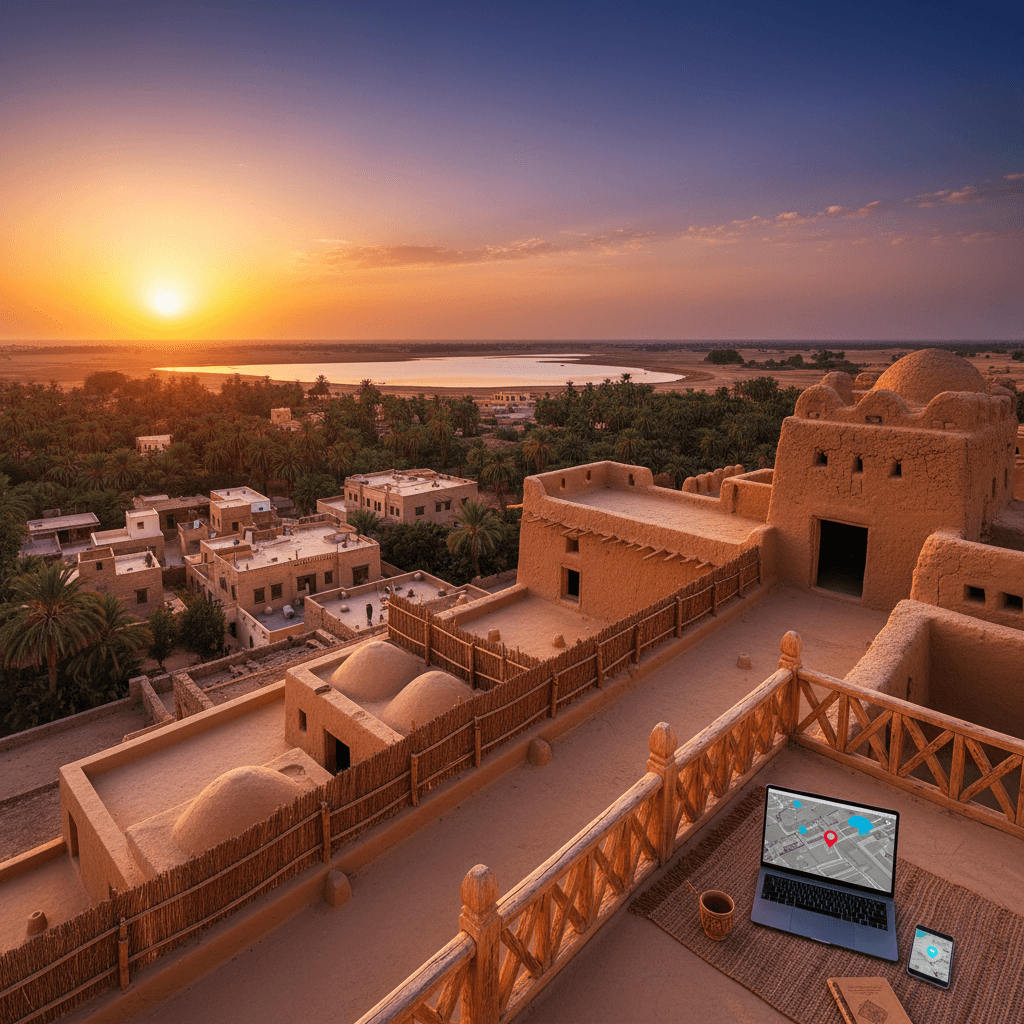
The oasis sits about 50 kilometers from the Libyan border, surrounded by the Great Sand Sea and that isolation is the whole point. The air smells of date palms and dust, the evenings go quiet fast and the loudest thing you'll hear most mornings is a donkey cart clattering down a sandy lane. The old mud-brick Shali Fortress crumbles dramatically over the town center and the salt lakes shimmer at the edges of everything, turning pink and silver depending on the light.
The culture here is Berber first, Egyptian second. Locals speak Siwi, a language that's, turns out, closer to Tamazight than Arabic and the customs reflect that distinct identity. Dress modestly, it's not a suggestion and ask before pointing a camera at anyone. Travelers who ignore this get cold shoulders fast.
Most nomads who end up here aren't really working. They're detoxing. WiFi at places like Cafour Camp near the salt lakes is intermittent at best, maybe 7 Mbps on a generous day and there's no coworking space to speak of. Vodafone SIMs from town kiosks give you the best shot at mobile data, but remote spots drop signal entirely. Download everything before you arrive.
What Siwa does offer is genuinely cheap living, a rare kind of quiet and a pace that forces you to recalibrate. Tuk-tuks cost about $1 a ride, a solid meal at Abdu Restaurant runs $5 to $8 and you can float in mineral-rich salt pools that feel, weirdly, like sensory deprivation tanks in the middle of the desert. Sunsets from Fatnas Island are the kind that make you put your phone down without thinking about it.
It's not a base for heads-down productivity. It's a place to breathe out after months of grinding elsewhere, then figure out what comes next. Nomads who get that leave reluctantly, the ones who don't get it leave early.
Siwa is, honestly, one of the cheapest places you'll find in Egypt. The national average runs around $418 a month for a single person and Siwa undercuts that. Most nomads land somewhere between $300 and $700 a month depending on how comfortable they want to be.
Rent is negotiated in person, there are no Zillow listings here. Eco-lodges like Sleep in Siwa or Cafour Camp run roughly $150 to $250 a month if you work out a longer stay and that's for a private setup near the salt lakes or Shali. Expect basic facilities, gritty desert wind through the windows and not much else. That's the trade-off.
Food is where Siwa really gets cheap. Street dates, olives and flatbread cost almost nothing, a full sit-down meal at Abdu Restaurant with pasta gariya or a tagine runs $5-8 (300-400 EGP) and you'd struggle to spend more than $15 anywhere in town. There's nowhere upscale to drain your budget, which turns out to be a feature, not a bug.
Getting around costs almost nothing too. Tuk-tuks charge around 30 EGP (roughly $1) for a short hop, bike rentals run $3 to $5 a day and the flat sandy streets make cycling genuinely practical. The bus to Cairo is $8 to $18, though after 10 hours on that road you'll want to block it from memory.
Budget Tiers
- Budget ($300 to $400/month): Shared eco-camp bunk, street food daily, biking everywhere, minimal extras
- Mid-range ($500 to $700/month): Private room or small lodge, meals at Abdu or Ola Restaurant, tuk-tuks for longer trips
- Comfortable ($800+/month): Garden lodge like Spellbound in Siwa, desert safari day trips, eating out every meal without thinking about it
One thing that catches people off guard: there's basically one ATM in town and it's unreliable, bring Egyptian pounds in cash from Cairo because you won't find a fix locally. Wise works fine for managing money before you arrive, just don't count on accessing it once you're there.
Siwa isn't for nomads who need a lot. It's weirdly perfect for those who don't.
Siwa doesn't really have "neighborhoods" the way a city does. It's compact, sandy and organized around one central landmark: the crumbling mud-brick Shali Fortress. Everything radiates out from there and depending on where you stay, your daily experience changes pretty dramatically.
Solo Travelers & Nomads: Central Siwa (Around Shali)
This is where you'll want to be. Abdu Restaurant is a short walk away, the souk is right there and you can actually get somewhere on foot without flagging down a tuk-tuk every time. The streets smell like dust and woodsmoke in the evenings and there's a low hum of activity that feels alive without being overwhelming.
- Rent: $150-250/month for a basic studio or negotiated eco-lodge room
- Food: $2-8/meal, street food to sit-down
- Downside: Day-trippers pass through here; it's, honestly, the least private part of town
Expats & Long-Stay Visitors: Salt Lakes Area
Out near the salt lakes, places like Cafour Camp give you something central Siwa doesn't: silence. Real silence, the kind where you can hear the wind moving through the palms. The floating pools are right there, the views are genuinely stunning, it's about ten minutes by tuk-tuk from town though, so factor that into every grocery run.
- Rent: Negotiable; eco-lodge rates around $200-300/month long-stay
- WiFi: Spotty at best, turns out even Vodafone struggles out here
- Best for: Anyone prioritizing peace over convenience
Families: Palm Grove Outskirts (Near Fatnas Island)
Farther from the center, places like Spellbound in Siwa sit among dense palm groves with garden spaces and natural springs nearby. It's quieter, the facilities are basic and you're weirdly far from everything, but families tend to find the trade-off worth it. Kids can actually roam, sunsets over the palms are absurd and the pace slows down even further out here.
- Rent: $250+ for garden lodges; negotiate directly
- Transport: Tuk-tuk or bike rental non-negotiable; no walking to town
- Downside: Frankly, the facilities are the most basic of any area
Whichever area you pick, bring cash. The one ATM in town is unreliable and nobody wants to discover that on an empty stomach.
Siwa's internet situation is, honestly, bad. Not "slow day in a café" bad, more like "you'll refresh your email and go make tea and it still hasn't loaded" bad. Most accommodations offer WiFi in name only and spots like Cafour Camp are notorious for intermittent connections that drop the moment you actually need them.
Mobile data is your best backup, Vodafone has the strongest signal in town and you can grab a SIM with a data package from kiosks near the central market for around $5 to $10. Etisalat is noticeably worse, skip it. Once you're out toward the salt lakes or the palm grove outskirts, even Vodafone gets patchy, so don't plan a client call from the middle of the desert.
Speeds in cafés cap out around 7 to 10 Mbps on a good day, which is workable for emails and Slack but won't survive a video call without freezing mid-sentence. Oasis Nomad cafe in town has free WiFi and a relaxed enough atmosphere to park yourself for a few hours, the date smoothies help. Cafés near Cleopatra's Pool are another option, though they're more for tourists than focused work.
There are no coworking spaces in Siwa. None. Most nomads who come here aren't trying to grind through a full workload anyway, the place naturally pulls you toward digital detox whether you planned for it or not.
Practical steps before you arrive:
- Download everything offline: Google Maps, Translate, any documents or tools you'll need.
- Get a Vodafone SIM: Available at town kiosks, roughly $5 to $10 for a data bundle.
- Test your hotspot setup: Your phone's mobile data will likely outperform the hotel WiFi, turns out that's just the reality here.
- Schedule calls before arrival: Book client meetings for when you're back in Cairo or Marsa Matruh, not mid-Siwa.
If your work genuinely requires reliable, fast internet, Siwa will frustrate you, that's not a flaw in your expectations, it's just what the place is. Come here to decompress between work sprints, not to run them.
Siwa is, honestly, one of the safer places you can be in Egypt. The community is small and tight-knit, crime is low and travelers consistently report feeling more relaxed here than in Cairo or Alexandria. Military checkpoints on the road in are normal, don't be alarmed, just have your passport ready and answer questions calmly.
That said, don't confuse safe with medically equipped. It isn't.
The local clinic can handle minor things like stomach bugs, cuts and mild infections and pharmacies in town stock basics including antidiarrheal tablets, rehydration salts and mosquito repellent. But anything serious means a four-hour bus ride to Marsa Matruh, which is the nearest hospital with real capacity. Most nomads who've spent time here recommend coming with a solid travel insurance policy that covers medical evacuation, because the logistics of getting out quickly are genuinely complicated if something goes wrong.
Drink bottled water. Always. The tap water here isn't filtered to a standard most stomachs handle well and getting sick in a place four hours from a hospital is, turns out, a lot more stressful than it sounds.
- Police emergency: 122
- Ambulance: 123
- Nearest hospital: Marsa Matruh, roughly four hours by road
- Local pharmacies: Available in central Siwa town, stock standard medications
For women traveling solo, Siwa is generally fine, it's conservative though and modest dress isn't just appreciated, it changes how people interact with you. Covering shoulders and knees is the baseline expectation, a loose linen shirt and long trousers work well in the heat and sidestep any awkwardness entirely.
One thing that catches people off guard: the desert wind. It rolls in gritty and fast and if you wear contacts, bring solution and consider switching to glasses on bad days. The dust gets into everything.
Pack a basic first aid kit before you leave Cairo, including blister plasters if you're planning to walk the sandy paths around Shali, antihistamines for dust or insect reactions and any prescription medication you need for at least the full duration of your stay plus a buffer. Resupply options here are limited, weirdly more so than you'd expect for a town that sees regular tourists.
Siwa's center is, honestly, small enough to walk end to end in twenty minutes. The sandy lanes around Shali Fortress are flat and calm, there's almost no traffic to dodge and most restaurants, markets and springs sit within easy reach of each other.
That said, once you're heading out to the salt lakes or the palm grove outskirts near Fatnas Island, you'll need wheels. Bike rentals run $3 to $5 a day and are the go-to for most nomads, the terrain is forgiving and the pace suits it perfectly. Tuk-tuks are everywhere too, a short ride costs around 30 EGP (roughly $1) and if you're doing a full day of exploring you can hire one with a driver for 200 to 400 EGP.
Donkey carts still weave through the streets, which sounds charming until one clips your elbow on a narrow lane. No Uber, no Careem, none of that. It's purely local transport here, so get comfortable flagging down tuk-tuks and negotiating the fare upfront.
For desert excursions out to Bir Wahed hot spring or the Great Sand Sea, you'll need a 4x4 safari, those typically run $65 to $80 and are booked through local operators in town or via your accommodation. Don't attempt the open desert without a guide, the dunes are disorienting and the heat is brutal.
Getting to and from Siwa is the part that tests your patience. There's no local airport, the nearest one is in Marsa Matruh, about four hours away by bus. Most people arrive via the West Delta or Siwa Bus from Cairo, a 9 to 12 hour overnight ride that costs 900 to 1350 EGP ($17 to $25). It's, turns out, not that bad if you grab a night bus and sleep through it.
- Walking: Central Siwa town, fully walkable
- Bike rental: $3 to $5 per day, best for salt lakes and grove areas
- Tuk-tuk: 30 EGP short ride; 200 to 400 EGP for a full day
- Desert safari (4x4): $65 to $80, book locally
- Bus to Cairo: 900 to 1350 EGP, 9 to 12 hours
Siwa moves slowly, the transport reflects that, adjust your expectations accordingly.
Siwa runs on two languages: Siwi, a Berber dialect spoken nowhere else in Egypt and Arabic. English exists, but don't count on it outside the handful of spots catering to tourists. At a local market or a tuk-tuk negotiation, you're on your own and honestly, that's part of what makes the place feel genuinely remote rather than performatively rustic.
Most travelers find that a few Arabic phrases go surprisingly far here, farther than in Cairo where locals are used to tourists pointing and gesturing. Siwans are, turns out, quite warm when you make even a clumsy attempt at their language. Don't stress about mastering Siwi; just knowing basic Arabic pleasantries signals respect and that matters in a tight-knit community like this one.
- Shukran: Thank you (use constantly)
- Min fadlak: Please (min fadlik if you're addressing a woman)
- Bikam? How much? (your most-used phrase at the souk)
- La, shukran: No, thank you (genuinely useful for persistent vendors)
- Wahid / Itnein: One / Two (for ordering food without a menu in English)
Download Google Translate's Arabic offline pack before you leave Cairo, mobile data in Siwa is weirdly patchy even in the town center and you won't always have a signal when you need it most. The app's camera translation feature is genuinely useful for handwritten signs and menus that haven't seen an English word in years.
At restaurants like Abdu or Ola, someone usually speaks enough English to take your order, the salt lake eco-lodges are similar. Venture further out toward the palm groves or into the old Shali medina and that safety net disappears fast.
One thing to know: communication in Siwa carries cultural weight beyond just words. Asking permission before photographing locals, greeting shopkeepers before launching into a transaction and keeping your voice low in residential areas all read as basic respect here, not optional politeness. Skip that and you'll notice the difference in how people respond to you, it's a small town and word travels.
Frankly, the language barrier is real but manageable. Come prepared, stay patient, lean on translation apps and you'll be fine.
Siwa runs on desert extremes. Summers are, honestly, brutal: July temperatures hit around 104°F, the air carries a gritty, mineral-tinged dust that coats everything and most sensible travelers clear out entirely. Don't plan a long stay between June and August unless you enjoy sitting very still under a fan, sweating through your shirt before 9am.
The sweet spots are March through May and September through November, when daytime temperatures sit between 59°F and 86°F and the light over the salt lakes turns everything gold. Those windows are when Siwa actually feels like the place people describe: cool enough to bike between the palm groves, warm enough to float in Cleopatra's Pool without flinching.
Winter is more complicated than it sounds. Days in December and January can be pleasant, around 59°F, but nights drop sharply and some eco-lodges like Cafour Camp aren't insulated well enough to make that comfortable. Turns out, a lot of nomads who plan a "quiet winter retreat" end up layering every piece of clothing they packed by 8pm. Rare winter rains, mostly in January and February, can also briefly turn the sandy paths into mud, which the donkey carts handle better than your sandals will.
Spring is the most popular window for good reason. March and April bring wildflowers to the groves, the desert air smells faintly of date blossom and the crowds haven't arrived yet. Weekends see day-trippers from Alexandria and Marsa Matruh, they thin out fast by Sunday evening though, leaving the place genuinely quiet.
A few practical notes on timing:
- Best overall months: October and April, the temperature and crowd balance is nearly perfect
- Avoid: June, July and August unless you're specifically chasing the desert heat experience
- Ramadan: Restaurants close during daylight hours and the pace slows further; some travelers love the atmosphere, others find it limiting for a work-focused stay
- Sandstorms: Can hit any time, weirdly common in spring; keep electronics in bags and download everything offline before you arrive
Most nomads who've done a stint here agree: get the timing wrong and Siwa feels punishing, get it right and it's one of the more quietly remarkable places you'll work from in the region.
Cash is king here. There's one ATM in town and it's, honestly, unreliable enough that you shouldn't count on it; bring a solid stack of Egyptian pounds from Cairo before you board the bus. Wise works well for topping up when you're back in a city with decent banking, but in Siwa itself, you're operating on whatever you carry.
Get a Vodafone SIM from one of the kiosks near the central market, it's around $5-10 for a data package and it's your best shot at a signal. Etisalat is poor out here, don't bother. Download Google Maps offline, Google Translate's Arabic pack and anything else you need before you leave Cairo, because the WiFi at most lodges is the kind that loads half a webpage and then gives up.
Dress modestly and not just in the obvious tourist sense. Siwa is a tight Berber community with its own social codes, women especially should keep shoulders and knees covered and both men and women will get noticeably warmer treatment from locals if they make the effort. It's a small thing that turns out to matter a lot.
A few other things worth having sorted before you arrive:
- Medical: The nearest real hospital is in Marsa Matruh, four hours away. Pack antidiarrheal meds, mosquito repellent and any prescriptions you need. The local pharmacy handles basics, that's about it.
- Water: Drink bottled only. Always.
- Transport: Tuk-tuks run about 30 EGP for a short ride, weirdly fun once you get used to the sandy roads. Renting a bike for $3-5 a day is genuinely the best way to move around the flat central area.
- Photography: Ask before pointing a camera at people, especially women. Locals are friendly, they're not a backdrop.
- Bus to Cairo: West Delta runs the route for 420-925 EGP depending on class; it's a 9-12 hour overnight ride, book it a day or two ahead during busy season.
Summers are brutally hot, 104°F in July with gritty desert wind that coats everything in fine dust. March through May and September through November are the windows that make sense. Nights get cold in winter, frankly colder than most people expect, so pack a layer even if you're coming in spring.
Need visa and immigration info for Egypt?
🇪🇬 View Egypt Country GuideOff the Radar
Pioneer territory