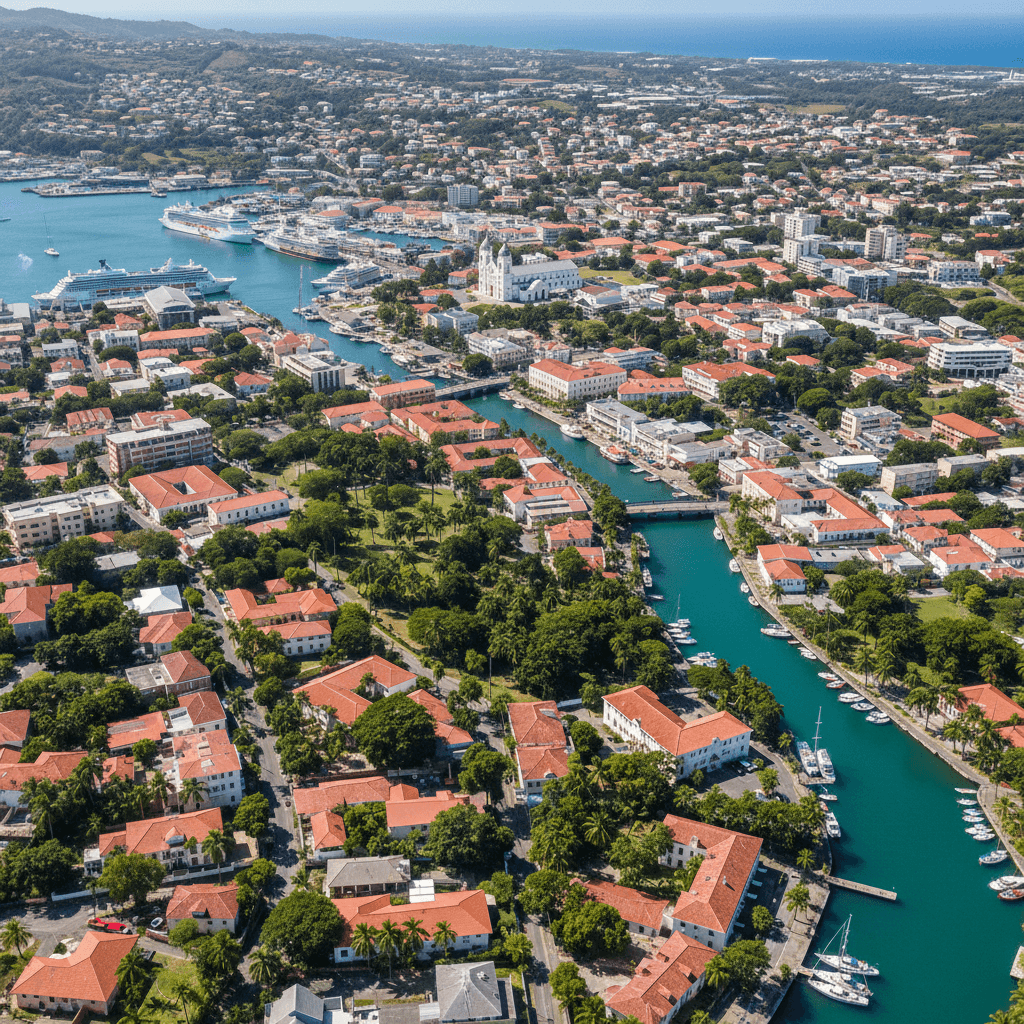
Saint John's
🇦🇬 Antigua and Barbuda
Saint John's doesn't try to impress you. It's a small Caribbean capital that moves at its own pace and if you're expecting the polished infrastructure of Lisbon or the coworking density of Chiang Mai, you'll need to recalibrate your expectations pretty fast.
What you get instead is a city that's, honestly, kind of charming in its imperfection. The harbor smells like salt and diesel in equal measure, the market vendors at the public dock call out to you whether you want them to or not and the painted wooden storefronts along St. Mary's Street look like they haven't changed much since the colonial era. That's not a complaint. It's the whole point.
The pace here is genuinely slow, not performatively slow and most nomads either fall into it within a week or spend their entire stay fighting it. Afternoons get quiet. Buses run when they run. The cathedral bells carry across downtown and there's something almost disorienting about how unbothered everyone seems.
The tradeoffs are real, though. Services are basic, late-night options are thin outside of English Harbour on weekends and some streets in the city center collect litter in ways that'll surprise you if you're coming from a tidier destination. It's safe enough in central areas, petty theft happens in tourist spots, don't flash expensive gear around the market.
What makes Saint John's work for nomads isn't the city itself so much as what surrounds it. Dickenson Bay is twenty minutes away, Nelson's Dockyard is a forty-minute drive south and the locals are, turns out, some of the friendliest you'll encounter anywhere in the Eastern Caribbean. That friendliness isn't a tourism-industry performance, it's just how people are here.
The expat and nomad scene is small. Weirdly small, actually, for a capital city. There's a Facebook group, a handful of cafes where you'll see the same faces and Wadadli Spaces if you need a proper desk. That's about it. If you need a buzzing nomad community, this isn't your city, if you want a quiet base with beaches nearby and genuinely warm interactions every single day, Saint John's delivers that without much fuss.
Saint John's isn't cheap. Most nomads are surprised by that, honestly, because the Caribbean conjures images of budget travel, but Antigua sits in a different price bracket than, say, Southeast Asia or even parts of Latin America. Expect to spend somewhere between $1-500 and $4,000+ a month depending on how you want to live.
Rent is the biggest hit. A studio or one-bedroom in central Saint John's runs $1,000 to $1,500 USD a month and if you want a beach view out in Jolly Harbour, you're looking at $2,000 or more for a two-bedroom. Airbnb fills some gaps, though longer-term deals come through local agencies like JMVI Realty or Chestertons.
Monthly Budget Tiers
- Budget ($1,500,2,500): Shared housing, street food from spots like Roti King ($5-10 a meal), public buses at $1-2 per ride
- Mid-range ($2,500,4,000): Your own one-bedroom, mix of local and mid-range dining ($15-25 a meal), taxis when needed
- Comfortable ($4,000+): Beach apartment in Jolly Harbour or English Harbour, upscale resort dining, car rental for the freedom to actually explore
Food, turns out, is where you can actually save some money. Street food is genuinely good here, roti and pepperpot from local spots keep costs low and the smells drifting out of the market stalls near the harbor are worth following. Mid-range seafood restaurants sit around $15-25 per meal, upscale resort dining pushes $40 and beyond, skip it unless someone else is paying.
Transport is cheap but annoying. Public buses run $1-2 a ride and cover most routes from the East and West bus stations, but the schedules are, frankly, more of a suggestion than a timetable. There's no Uber or Bolt; Swyft is emerging as a ride-hailing option, taxis are reliable at around $15 from the airport to the city center.
ATMs from RBC and CIBC are easy to find downtown and Wise works well for transfers without getting gouged on exchange fees. Tap water is technically safe, it's desalinated, but most people here drink bottled out of habit, that's a small recurring cost worth factoring in.
Saint John's isn't a big city, so neighborhood choice matters more than you'd think. Three areas do most of the heavy lifting and each one attracts a pretty different crowd.
For Nomads and Solo Travelers: Downtown St. John's
This is, honestly, the only neighborhood where you can live without a car and not lose your mind. Banks, pharmacies, the market and a handful of working cafes are all walkable, which saves you the $15 taxi fare every time you need to run an errand. The smell of roti from street stalls hits you around lunchtime, vendors call out from the market stalls and the whole place has a low-level hum that's energizing without being exhausting.
The downsides are real, though. Traffic through the center gets genuinely chaotic in the mornings, petty theft happens around the market area, don't leave a bag unattended. Rent runs $1,000 to $1,900 a month for a studio or one-bedroom, which is steep for what you get.
For Expats: Jolly Harbour
Jolly Harbour is a gated marina community about 30 minutes from the capital and it's where most long-term expats end up because the infrastructure is, turns out, significantly better than anywhere else on the island. There's a proper supermarket, a marina, a golf course and the kind of reliable security that makes people feel comfortable enough to actually relax.
The trade-off is isolation. You're far from everything, the drive into Saint John's gets old fast and the community can feel weirdly insular after a few weeks.
For History Lovers and the Yacht Scene: English Harbour
English Harbour pulls a specific type: people who want lively evenings, Nelson's Dockyard within walking distance and a social scene that actually exists on weeknights, not just weekends. Seasonal crowds are a real issue, though, the place swells during sailing events and then goes quiet, so the energy isn't consistent year-round.
For Families: Jolly Harbour or English Harbour
- Safety: Gated communities in Jolly Harbour offer the most controlled environment
- Schools: Limited locally; most expat families factor in private schooling costs
- Space: Larger rentals and outdoor space are far more accessible outside downtown
- Commute: Budget 30 minutes each way to Saint John's from either area
Connectivity in Saint John's is, honestly, functional rather than impressive. Speeds vary, typically 10-50 Mbps in cafes and coworking, check current speeds. That's fine for video calls and Slack, it falls apart the moment you're pushing large uploads or jumping between multiple tabs on a deadline.
The main dedicated workspace is Wadadli Spaces in downtown Saint John's, which has WiFi, AC and a proper lounge setup. Day passes run roughly $8-20 USD, which puts it in line with regional coworking spots. It's not a buzzing hub of nomads, turns out there just aren't enough of them here yet, but it's quiet, air-conditioned and gets the job done when your Airbnb WiFi decides to quit on you.
Most nomads end up working from cafés more than anywhere else. The scene is small but workable and a few spots around downtown have reliable enough connections for a morning of deep work. Don't expect fast cold brew and standing desks; expect ceiling fans, the smell of fresh bread drifting in from the street and a connection that's surprisingly stable on a slow Tuesday morning.
For mobile data, your two options are Digicel and Flow. Both sell SIMs at the airport and in-town stores, you'll need your passport. Digicel's 15GB/30-day plan runs ~$54 USD; Flow's 10GB/30 days is higher, check current rates. Digicel has slightly better coverage across the island, most expats recommend it if you're planning day trips outside the capital.
A few things to keep in mind:
- Backup connection: Get a local SIM immediately. Café WiFi drops without warning and there's no redundancy if you don't have mobile data ready.
- Power: Outages are rare but happen; a small UPS or fully charged laptop battery is worth having.
- Wadadli Spaces day pass: $8-20 USD, AC, WiFi, lounge seating.
- Digicel SIM: ~$7-18 USD for the SIM, 15GB/30 days for ~$54 USD.
- Flow SIM: ~$7-18 USD for the SIM, 10GB/30 days is higher, check current rates.
The infrastructure here isn't going to wow anyone coming from Lisbon or Medellín, it's a small Caribbean capital and the internet feels like it. Plan around the limitations, not against them.
Saint John's is, honestly, a moderate-risk destination. Petty theft and pickpocketing happen, especially around the market area downtown and anywhere tourists cluster with bags and cameras. It's not dangerous in the way some Caribbean capitals are, but you shouldn't switch your brain off either.
Homicide rate peaked around 10.7 per 100,000 in 2022; recent 2025 stats show overall crime down 10%, which is worth keeping in your back pocket as context. That said, most nomads here go months without any incident, the risk tends to concentrate in specific spots and late-night situations rather than being a general background hum. Avoid unlit streets after dark, don't flash expensive gear at the waterfront and you'll be fine the vast majority of the time.
A few practical rules that expats recommend:
- Downtown Saint John's: Fine during the day, stay alert around the market and bus stations where pickpockets work the crowds.
- Jolly Harbour: Gated community setup, genuinely low hassle, it's where families and longer-term expats tend to land for a reason.
- Isolated areas at night: Skip them. This isn't paranoia, it's just common sense on any island.
Mount St. John's Medical Centre is the main hospital, a 185-bed facility with an ICU and surgical capacity. It's not a Johns Hopkins-level operation, turns out, but it handles emergencies competently and is far better than what you'd find on many smaller islands in the region. Pharmacies are easy to find across the capital, stocked well enough for most everyday needs.
For anything serious, like a complex surgery or specialist treatment, medical evacuation to Barbados or Miami is the realistic plan. Travel insurance with solid evacuation coverage isn't optional here, it's the one thing you genuinely can't skip. Dial 911 for emergencies, same as home.
Tap water is desalinated and technically safe, most nomads still drink bottled water out of habit and honestly the taste difference is noticeable enough that you probably will too. The sun is stronger than it feels, heat exhaustion catches visitors off guard faster than any crime statistic. Sunscreen, hydration and a decent insurance policy cover about 90% of the real risks here.
Getting around Saint John's is, honestly, more of a patience exercise than a logistics problem. The infrastructure works, it just works on island time and that gap between expectation and reality trips up a lot of first-timers.
Public buses cost $1-2 USD per ride and leave from two main stations: East Bus Station and West Bus Station, both near the market in downtown. They run roughly 5:30AM to 6PM, hitting villages across the island, but "schedule" is a generous word for what's actually a loose suggestion. If you're catching a bus, build in extra time, missing one can mean a 30-minute wait with no shade.
There's no Uber or Bolt here. Taxis fill that gap, with airport-to-city runs running about $15 USD and drivers are generally easy to find at stands near the harbor or outside major hotels. Swyft, a local ride-hailing app, is starting to show up, it's not widely adopted yet, but worth downloading if you're staying longer than a week.
Outside downtown, walkability drops off fast. English Harbour and Jolly Harbour are both 30-plus minutes from the capital by car and there's no reliable way to reach them without a taxi or your own wheels. Bike and scooter rentals aren't really a thing here, which is frustrating when you just want to get to the beach without negotiating a fare.
Most nomads staying more than two weeks end up renting a car. It's, turns out, the only way to move freely between neighborhoods without burning time and money on taxis. Drive on the left, roads are narrow in places and goats occasionally have the right of way.
- Public bus: $1-2 USD, runs to most villages, stops by 6PM
- Taxi (airport to city): ~$15 USD, no meter, confirm price first
- Swyft app: emerging ride-hailing, limited coverage currently
- Car rental: recommended for Jolly Harbour, English Harbour, beach access
- Walking: fine in downtown, impractical almost everywhere else
Downtown St. John's itself is walkable, compact enough that most errands, the market, ATMs, a quick roti from Roti King, are on foot. Just watch for the traffic noise and exhaust fumes near the bus stations; it gets loud and smoky around midday.
Good news first: you won't have a language barrier here. English is the official language and everyone speaks it, from market vendors at the Public Market to the staff at Mount St. John's Medical Centre. Conversations flow easily and locals are, honestly, some of the more approachable people you'll meet in the Caribbean.
That said, don't expect textbook English all the time. Antiguan Creole is woven into daily life and when two locals get talking fast, you'll catch maybe half of it. Nobody's being rude, that's just how conversation sounds here. The rhythm is quick, the vowels shift and phrases compress in ways that take a few days to tune into.
A few phrases go a long way.
- "Wah gwaan?" The standard casual greeting. Use it and you'll get a warmer response than any formal "hello" would earn you.
- "Good morning / Good afternoon" Still expected in shops, banks and anywhere with a counter. Walking in without one feels abrupt to locals and they'll notice.
- "All right?" Both a greeting and a check-in, depending on tone. Weirdly versatile once you get used to it.
Google Translate is mostly unnecessary, but keep it on your phone anyway for the odd handwritten menu or sign in a local rum shop. It handles the region well enough for basics.
Phone communication is straightforward. Digicel and Flow both sell SIMs at the airport and in stores downtown, you'll need your passport and plans run around $54 USD for 15GB with Digicel or check current Flow rates for 10GB over 30 days. Coverage is decent in Saint John's and Jolly Harbour, thinner once you push toward the island's more remote eastern stretches.
WhatsApp is, turns out, the real communication backbone here. Locals use it for everything: coordinating taxis, confirming restaurant reservations, staying in touch with landlords. If someone gives you their number, assume WhatsApp first. Calling a local number cold without messaging ahead can feel oddly formal, most people won't pick up from an unknown number anyway.
Expats recommend joining a few local Facebook groups early on. They're active and that's where housing leads, event notices and general island intel actually live.
Antigua sits in the southern Caribbean, which, surprisingly, puts it just outside the main hurricane belt. That doesn't make it immune, but it does mean the island gets less direct hits than islands further north. The climate is tropical and pretty consistent year-round, hovering between 78 and 83°F (26 to 28°C), so you're not going to freeze or melt depending on when you book your flight.
The dry season runs December through April and that's honestly the sweet spot. Days are sunny, humidity is manageable and the trade winds keep things from feeling suffocating. You'll step outside in the morning and actually enjoy it rather than immediately regretting the decision.
The rainy season kicks in around July and builds through November, peaking hard in September and October. Those two months average around 130mm of rain and roughly 20 rainy days, the kind of downpours that arrive fast, pound the tin roofs loud enough to make a video call impossible and then disappear just as quickly. September and October are also when tropical storms and hurricanes are most likely, so most nomads planning longer stays tend to avoid that window or at least price in some flexibility.
May and June sit in a middle ground, warmer and a bit stickier than peak dry season but not yet into the heavy rain pattern. It's quieter, prices on accommodation drop noticeably and the island feels less crowded. Turns out, that trade-off works well for nomads who don't need perfect beach weather every single day.
- Best months: December to April, sunny and dry with comfortable temperatures
- Shoulder season: May to June, warmer and wetter but cheaper and quieter
- Avoid if possible: September and October, peak hurricane risk and the most rain
- Year-round temperature: 78 to 83°F (26 to 28°C)
One thing nomads don't always account for is the humidity, it clings even on "dry" days and if you're sensitive to that, you'll want a place with decent AC rather than assuming a ceiling fan cuts it. Factor that into your apartment search, not just your packing list.
Pick up a SIM card at the airport before you leave arrivals. Both Digicel and Flow have desks there, you'll need your passport and a 15GB/30-day plan runs around $46 USD with Digicel or $39 USD with Flow. Don't wait until you're in town to sort this, it's genuinely easier to handle while you're still in arrival mode.
ATMs are, honestly, straightforward. RBC and CIBC both have branches in downtown Saint John's and they'll dispense Eastern Caribbean dollars or USD depending on the machine. If you're moving larger amounts, Wise works fine here, transfers are clean and the fees don't sting the way traditional wire transfers do.
Power runs on 230V, so EU and UK devices plug straight in. US travelers need an adapter. Tap water is desalinated and technically safe, but most nomads just buy bottled, it's cheap and the taste is noticeably better.
Tipping is expected. Ten to fifteen percent is standard at restaurants and skipping it entirely will be noticed, it's not a tourist-optional thing here. Antiguans drive on the left, which catches out a lot of visitors on rental cars, especially on the tighter rural roads where turns come fast.
Dress conservatively if you're heading away from the beach or tourist zones. Shorts and a tank top are fine in Jolly Harbour or along Dickenson Bay, but wandering into a local neighborhood or a church in the same outfit reads as disrespectful. It's a small adjustment, takes zero effort.
For day trips, Nelson's Dockyard in English Harbour is worth the 45-minute drive south, especially on a quieter weekday when the yacht crowd thins out. Dickenson Bay is the go-to beach closest to Saint John's, calm water, a few vendors, easy to reach by taxi for around $15 USD.
A few things that turn out to catch people off guard:
- Bus hours: Public buses stop running around 6PM, plan accordingly or budget for taxis after dark
- Ride-hailing: No Uber here; the Swyft app is emerging but coverage is patchy
- Pharmacy access: Widespread in Saint John's, stock up before heading to English Harbour or rural areas
- Emergency number: 911, same as the US
The pace here is slow, weirdly slow if you're used to a city that moves. That's not a complaint, it's just the adjustment.
Need visa and immigration info for Antigua and Barbuda?
🇦🇬 View Antigua and Barbuda Country GuideOff the Radar
Pioneer territory