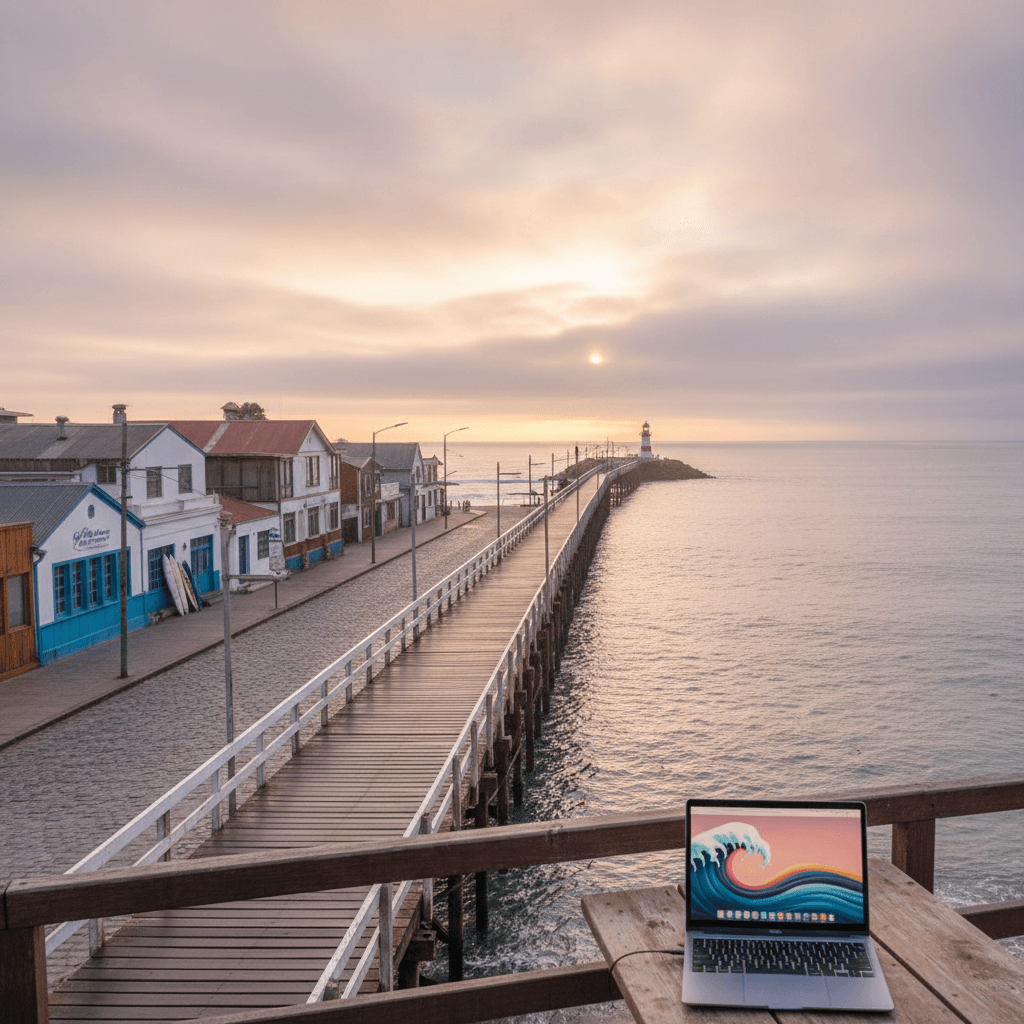
Pichilemu
🇨🇱 Chile
The Soul of the Chilean Coast
Pichilemu doesn't care about your deadlines, and that is exactly why nomads are starting to flock here. While Santiago is a high speed metropolis just 3 hours away, this coastal town operates on a completely different frequency. It is the surf capital of Chile, but you don't need to be a pro to appreciate the raw, Pacific energy that defines the atmosphere. It feels like a mix of a rugged frontier town and a laid back bohemian retreat.
The air here smells like a sharp mix of salt spray and the surrounding pine forests. It's a place where you'll see people walking down the main street in wetsuits with surfboards under one arm and a laptop bag over the other. The vibe is unpretentious and deeply tied to the ocean. If you are looking for a highly polished resort town, this isn't it. Pichilemu is dusty, windy, and authentic, attracting a crowd that prefers campfires and sunset sessions over glitzy nightclubs.
The Nomad Experience
Living here means trading the convenience of a big city for a lifestyle that prioritizes mental clarity and outdoor movement. Most nomads find that their productivity actually increases because the distractions are so wholesome. Instead of scrolling through apps, you're watching the tide charts. You'll likely spend your mornings working from a cafe overlooking the cliffs and your afternoons at Punta de Lobos, the iconic point break located about 6 kilometers south of the town center.
The community is a tight knit blend of local "Pichileminos," hardcore surfers from around the globe, and a growing number of remote workers from Santiago who decided they never wanted to go back to an office. It is easy to meet people at the local breweries or during a weekend beach cleanup. There is a shared respect for the environment here that creates an instant bond among those who choose to call it home, even if only for a few months.
What Sets It Apart
- The Pacific Power: The waves here are world class, particularly at Punta de Lobos. Even if you don't surf, the sight of 20 foot swells hitting the rocks is a humbling daily spectacle.
- Affordable Coastal Living: Compared to European or North American surf towns, your budget goes much further. You can maintain a comfortable lifestyle on roughly $1,200 to $1,500 USD per month.
- The Microclimate: It is rarely hot and never truly freezing. The cool Humboldt Current keeps things refreshed, making it the perfect escape from the sweltering Santiago summers.
- Slow Living: Everything moves slower. You'll learn to appreciate the "mañana" attitude, which is a great antidote to burnout.
The Emotional Landscape
There is a specific kind of peace that comes with being at the edge of the continent. Watching the sun sink into the Pacific every evening becomes a mandatory ritual for everyone in town. It creates a sense of perspective that is hard to find in more traditional nomad hubs. You aren't just here to work; you're here to recalibrate.
Expats often say that Pichilemu has a way of stripping away the unnecessary. You don't need a fancy wardrobe or a car. A sturdy pair of boots, a warm fleece for the evening chill, and a reliable bike are the only status symbols that matter. It is a place that rewards the curious and the hardy, offering a rugged beauty that stays with you long after you've packed your bags.
The Monthly Budget
Living in the surf capital of Chile is significantly more affordable than staying in Santiago, but you'll still find it's one of the pricier coastal towns in the region due to its popularity with weekenders. A solo nomad can live comfortably here on $1,100 to $1,400 USD per month. This budget covers a private apartment, eating out a few times a week, and plenty of sessions on the waves.
If you're looking to stretch your pesos, sticking to the local markets and avoids the tourist heavy restaurants near the main beach will keep your costs closer to the $950 USD mark. Most nomads find that the biggest variable is whether they choose to stay right on the point at Punta de Lobos or closer to the town center.
Accommodation Breakdown
Rent is your largest expense, and prices fluctuate wildly between the high summer season in January and the quieter winter months. In the off season, you can snag a decent one bedroom cabin or "cabaña" for a steal, but expect those prices to double during the surf competitions or summer holidays.
- Punta de Lobos: This is the premium area. Expect to pay $700 to $1,000 USD for a modern studio with a view of the rocks. You're paying for the proximity to the best breaks and a quieter, more upscale vibe.
- Pichilemu Centro: More convenient for groceries and local life. You can find comfortable apartments for $500 to $650 USD. It's noisier, but you won't necessarily need a car to get around.
- Infiernillo: A middle ground with a more local feel. Smaller houses or shared spaces often go for $450 to $600 USD per month.
Food and Dining
Groceries in Chile are generally affordable, especially if you buy seasonal produce from the local ferias. A weekly grocery run for one person usually hits around $40 to $60 USD. Seafood is the star here; you can buy fresh reinforcement directly from the fishermen for a fraction of the cost you'd find in a city restaurant.
Eating out is a mixed bag. A "menú del día" at a local spot in the center will cost you about $7 to $10 USD and usually includes a starter, main, and a drink. If you head to the trendy cafes near the beach for an avocado toast and a flat white, you'll likely spend $12 to $15 USD. A dinner for two with wine at a nice place overlooking the ocean typically lands around $45 to $60 USD.
Connectivity and Utilities
Most rentals include basic utilities, but if you're staying long term and paying your own, set aside about $70 USD for electricity, water, and gas. Heating is a major factor in the winter; many places use wood stoves or gas heaters, which can add $30 to $50 USD to your monthly costs when the coastal chill sets in.
Internet is surprisingly reliable for a surf town. A solid fiber optic connection will cost you about $25 to $35 USD per month. Mobile data is cheap and fast; a prepaid SIM card with a generous data package from Entel or WOM costs roughly $12 USD for thirty days.
Transportation and Extras
Pichilemu is small enough that many people get by with a bicycle or just walking. However, if you want to explore the surrounding coastline, a car is helpful. Local "colectivos" (shared taxis) are a staple here, costing about $1 USD for a ride within the town limits.
- Surfboard Rental: $15 to $25 USD per day, though monthly rentals are negotiable.
- Gym Membership: $35 to $50 USD per month for a basic local setup.
- Beer at a Bar: $4 to $6 USD for a local craft brew or a standard pilsner.
- Yoga Class: $10 to $15 USD for a drop in session at a beachside studio.
For the Surf-Focused Nomad: La Puntilla
If you are moving to Pichilemu to be in the water every morning, La Puntilla is the place to plant your flag. It sits right at the edge of the main town area where the waves are consistent and the community is tight. You will find a mix of older beach houses and newer, modern apartments that cater specifically to the remote work crowd. It is the most walkable part of town, so you can ditch the car and rely on your feet for everything from grocery runs to post-surf coffee.
- Estimated Monthly Rent: $750 to $1,100 USD for a one bedroom apartment.
- Vibe: High energy, athletic, and social.
- Internet: Most rentals here use fiber optic now, reaching speeds of 100 Mbps.
For Families and Long-Term Expats: Playa Hermosa
Just a few kilometers south of the town center, Playa Hermosa offers a much quieter, residential feel. It is the preferred choice for expats who are staying for six months or longer and want a yard or a bit more privacy. The beach here is wider and less crowded than the main town beach, making it ideal for afternoon walks or letting the kids run around. You will need a car or a bike to get into the center for major errands, but the peace and quiet are worth the short commute.
- Estimated Monthly Rent: $900 to $1,400 USD for a small house.
- Vibe: Peaceful, suburban, and coastal.
- Local Tip: Look for properties on the hills side of the main road for better views and protection from the coastal wind.
For Solo Travelers and Social Seekers: El Centro
Living in the center of Pichilemu puts you within a two minute walk of the bus terminal, the main supermarkets, and the best empanada shops. It is a bit noisier than the other neighborhoods, especially during the peak summer months of January and February, but it is the best spot for meeting people. Solo travelers often prefer this area because everything is accessible and well lit at night. You are never more than a few steps away from a local bar or a shared workspace.
- Estimated Monthly Rent: $500 to $850 USD for a studio or shared loft.
- Vibe: Practical, lively, and convenient.
- Food Costs: Expect to spend about $15 to $25 USD for a solid dinner with a drink in this area.
For Digital Nomads Seeking Inspiration: Punta de Lobos
This is the iconic heart of the region, located about 6 kilometers south of the main town. It is home to the famous big wave surf break and some of the most stunning cliffs in Chile. While it used to be just a day trip spot, there is now a growing community of nomads living here year round. It is more expensive than the center, but the views are unbeatable. Many of the newer eco-lodges and cabins here have been outfitted with high speed internet specifically to attract the tech crowd.
- Estimated Monthly Rent: $1,200 to $1,800 USD for premium cabins.
- Vibe: Upscale, rugged, and creative.
- Commute: A local "colectivo" (shared taxi) runs frequently between here and the center for about $1.50 USD.
Connectivity in the Surf Capital
Pichilemu is a world away from the high rise bustle of Santiago, but that doesn't mean you have to sacrifice your Zoom calls. While the town is famous for its massive waves and chilled out vibe, the infrastructure has caught up with the growing number of remote workers moving south from the capital. Most accommodations and cafes now offer stable fiber optic connections that can handle heavy workflows.
You can expect average download speeds between 30 Mbps and 70 Mbps in the center of town and the Punta de Lobos area. While this is slightly lower than the 100 Mbps you might find in a Santiago apartment, it is more than enough for most digital nomads. The biggest hurdle isn't the speed, it is the occasional power flicker during the winter storm season from June to August. If you are working on a deadline, having a charged laptop and a local SIM card is a smart move.
Top Coworking Spots
The coworking scene in Pichilemu is intimate and community focused. You won't find massive corporate offices here; instead, you will find shared spaces that feel like an extension of the local surf culture. These spots are the best way to meet other nomads and get some focused work done away from the beach distractions.
- Cardumen Café: While primarily a specialty coffee shop, it has become a de facto hub for the remote work community. They offer reliable internet and a focused atmosphere, making it a go-to spot for those needing to get through a morning of emails.
Mobile Data and Backup Plans
If the Wi-Fi at your surf hostel fails, a local SIM card is your best friend. The signal strength in Pichilemu is surprisingly strong, especially near the town center. Most nomads suggest using Entel or WOM for the best coverage in the O'Higgins region. You can pick up a SIM card at any small "almacen" or pharmacy for about $5 USD.
Prepaid data plans are very affordable in Chile. You can get a 20GB data bag for roughly $10 USD to $12 USD. Tethering to your phone works well as a backup, and you will often find 4G+ speeds that rival the local Wi-Fi. Just keep in mind that the signal can get spotty as you move further south toward the more remote cliffs of Punta de Lobos.
Work Friendly Cafes
Sometimes you just need a change of scenery and a decent latte. Pichilemu has several cafes where nobody will give you a side eye for opening a laptop, provided you keep the coffee orders coming. These spots are perfect for clearing out your inbox before heading out for a sunset surf session.
- Cardumen Café: A favorite for its specialty coffee and reliable internet. It gets busy around lunch, so try to snag a table early in the morning.
- La Cevichería: While primarily a restaurant, their patio area is a great spot for afternoon work with a view. The Wi-Fi is decent, but it is better suited for low bandwidth tasks.
Digital Nomad Budget for Tech & Work
- Monthly Coworking Membership: $150 to $200 USD
- Mobile Data Plan (Prepaid): $10 to $15 USD
- Average Coffee Price: $3.50 to $5 USD
- Fiber Internet (if renting long term): $30 to $40 USD per month
Most travelers find that the cost of staying connected here is significantly lower than in North America or Europe. The trade off is a slower pace of life and the occasional need to reboot a router after a coastal breeze. If you can handle a little bit of rustic charm, Pichilemu provides a perfect balance of productivity and Pacific swell.
Staying Safe in the Surf Capital
Pichilemu is generally one of the safer spots for nomads in Chile. It has a small town feel where people look out for one each other, especially compared to the grit of Valparaíso or the hectic pace of Santiago. Most of the crime here is opportunistic petty theft, usually targeting tourists who leave their valuables unattended on the sand while they go out for a surf session.
The main area around Playa Principal and the Puntilla stays active well into the night. You'll feel comfortable walking home from the bars, but it's always smarter to stay on the main lit roads like Avenida Comercio. If you're staying further out in Punta de Lobos, the roads can get pitch black at night. Most expats recommend using local "colectivos" (shared taxis) after dark rather than walking the dirt shoulders of the highway.
Natural safety is actually a bigger conversation here than crime. Pichilemu is a high risk zone for tsunamis. You'll notice green "Vía de Evacuación" signs posted everywhere. Take a minute when you check into your Airbnb to see which way is uphill. If you feel a quake that lasts long enough to make it hard to stand, don't wait for a siren; just head to high ground immediately.
- Emergency Number: Dial 133 for the Carabineros (Police).
- Ocean Safety: The Pacific here is powerful with massive swells and strong undertows. Only swim in designated areas like the main beach where lifeguards are present during the summer months.
- Personal Belongings: Never leave bags in your car or on the beach. Even a $10 pair of sunglasses can be a temptation if left in plain sight.
Healthcare and Medical Services
For a town of its size, medical options are relatively basic. There is a local hospital, Hospital de Pichilemu, located on Errázuriz 151. It's fine for minor stitches, flu symptoms, or basic prescriptions, but it isn't equipped for major surgeries or specialized care. For anything serious, you'll likely be stabilized and then transported to Santa Cruz or Rancagua, which are about 2 to 3 hours away.
Most nomads prefer using private clinics for non-emergencies. There are a few "Centros Médicos" in the center of town where you can book a consultation with a GP for around $30,000 to $45,000 CLP (roughly $32 to $48 USD). You'll usually pay out of pocket and then file a claim with your travel insurance or nomad health provider later.
Pharmacies are easy to find. Large chains like Cruz Verde and Farmacias Ahumada are located on the main drag. They carry most standard medications, though you should bring your own supply of specific prescriptions as brands can vary. Many common items that require a prescription in the US or Europe, like certain inhalers or creams, can often be bought over the counter here.
- Health Insurance: Most digital nomads here use SafetyWing or Genki. Make sure your policy specifically covers "adventure sports" if you plan on surfing, as some standard plans exclude injuries sustained in the water.
- Tap Water: The water is technically safe to drink, but it has a very high mineral content that can upset sensitive stomachs. Most long term residents buy 20-liter jugs of purified water for about $3,500 CLP.
- Dental Care: There are several private dentists in town that offer high quality cleanings and fillings for a fraction of US prices. A standard cleaning usually runs about $40,000 CLP.
If you have a pre-existing condition that requires regular specialist visits, Pichilemu might feel a bit isolated. However, for the average healthy nomad, the local facilities are perfectly adequate for day to day needs. Just keep a local taxi number saved in your phone in case you need a lift to the ER in the middle of the night.
Orientation and Foot Traffic
Pichilemu is a town where your own two feet do most of the heavy lifting. The layout is relatively compact, especially if you are staying in the central area or near the main beach, Playa Principal. Most nomads find that they can walk between their surf sessions, the local grocery stores, and the cafes along Avenida Ortúzar without much trouble. It is a laid back coastal pace, and you will quickly realize that rushing is not really part of the local vocabulary.
If you are heading out to the world class waves at Punta de Lobos, walking becomes less practical. It is about 6 kilometers south of the town center. While some hardy souls make the trek along the coastal road, the dust and the sun usually make other options more appealing. The terrain is generally flat in the town center but gets rolling and hilly as you move toward the residential outskirts and the cliffs.
The Colectivo System
The most authentic and efficient way to get around like a local is via the colectivo. These look like standard four door sedans but function as shared taxis following set routes. You will spot them by the signs on their roofs indicating their destination. They are incredibly frequent and far cheaper than a private cab. Most rides within the town limits or out to the nearby beaches cost between $1.00 and $2.00 USD (roughly 900 to 1,800 Chilean Pesos).
- How to catch one: Just stand on a main road and wave when you see one approaching. If they have space, they will pull over.
- Payment: Cash is king here. Have small bills or coins ready, as drivers rarely have change for large denominations like 20,000 peso notes.
- The Route: The most popular route for nomads runs between the town center and Punta de Lobos. It is a constant shuttle of surfers and remote workers.
Cycling and Scooters
Renting a bike is a popular move for those staying a month or more. It gives you the freedom to explore the dirt roads leading to quieter beaches like Infiernillo without waiting for a colectivo. You can usually find daily rentals for around $15 USD, but you can negotiate much better rates for long term stays. Just be aware that the coastal wind can be a beast when you are pedaling against it on your way back from a morning session.
Electric scooters are starting to pop up in the paved central areas, but they aren't great for the sandy or gravel side streets. If you want motorized wheels without the hassle of a car, a small 125cc scooter is a great investment for the season. It makes grocery runs and checking the surf conditions at multiple spots much faster.
Arriving and Leaving
Most travelers arrive via Santiago, which is about a 3 to 4 hour journey depending on traffic. If you aren't renting a car at the airport, the bus is your best friend. Buses Nilahue and Pullman del Sur run regular routes from the Pajaritos or San Borja terminals in Santiago. A one way ticket usually sets you back about $10 to $15 USD.
For those who prefer a private ride, a transfer from Santiago can cost anywhere from $150 to $200 USD. It is pricey, but if you are traveling with a stack of surfboards and a workstation, the convenience is often worth the splurge. Once you are in town, you won't find Uber or Cabify operating with any reliability, so stick to the local taxi numbers or the colectivos.
Car Rentals
Having a car is definitely not a requirement for living in Pichilemu, but it is a massive plus if you want to explore the O'Higgins region. There are several spots within an hour's drive, like the salt flats of Cahuil or the quiet forests of Pañul, that are hard to reach via public transport. Rental options in town are limited, so most expats recommend picking up a vehicle in Santiago or Rancagua if you plan on driving yourself for the duration of your stay. Expect to pay around $40 to $60 USD per day for a basic manual transmission vehicle.
The Local Lingo
In Pichilemu, you are going to encounter the famous Chilean Spanish, which is widely considered the fastest and most slang-heavy dialect in South America. Locals often drop the "s" at the end of words and speak with a rhythmic, melodic speed that can catch even fluent speakers off guard. You will hear the word "cachai" (meaning "you get it?") and "po" (an emphasis particle) at the end of almost every sentence. If you are coming here with textbook Spanish, give yourself a week or two to tune your ears to the coastal frequency.
While the surf community is international, English is not widely spoken outside of the main surf schools and higher-end boutique hotels. In the local markets or when dealing with landlords for a long-term cabaña, you will definitely need a functional level of Spanish. Most nomads find that a quick "hola" followed by a few polite phrases goes a long way with the locals, who are generally patient but straightforward. If you are struggling, keep the Google Translate app downloaded for offline use, as cell service can sometimes dip when you are tucked away in the pine forests of the hills.
Staying Connected
Internet reliability in Pichilemu has improved significantly over the last few years. While it used to be a gamble, many modern rentals now offer fiber optic connections. You can typically expect speeds between 50 Mbps and 100 Mbps in the town center and the Playa Hermosa neighborhood. If you are staying further out in Punta de Lobos, speeds can be more inconsistent, so always ask for a speed test screenshot before booking a long-term stay.
For mobile data, Entel and WOM are the most reliable providers in the area. Entel generally has the best coverage if you plan on heading to more remote beaches or hiking trails nearby. You can pick up a SIM card at any small "tabaquería" or pharmacy for about $5 USD and load it with data packages. A 20GB plan usually costs around $10 to $15 USD per month. Most expats recommend keeping a local SIM even if you have an international roaming plan, as the local towers prioritize Chilean carriers during the busy summer months when the town population triples.
Digital Nomad Workspots
Pichilemu does not have a massive selection of dedicated coworking spaces like Santiago, but the infrastructure is catching up. Most nomads work from their accommodations or frequent laptop-friendly cafes. The vibe is very relaxed, so as long as you are ordering coffee and food, most places won't mind you staying for a few hours. Just be mindful of the "almuerzo" (lunch) rush between 1:30 PM and 3:30 PM when tables are in high demand.
- Waitara: Located near the main beach, this spot offers a decent connection and a view of the waves, perfect for checking emails before a midday surf session.
Communication Essentials
- Primary Messaging: WhatsApp is the lifeblood of Chile. You will use it for everything from booking surf lessons to communicating with your landlord or ordering delivery.
- Emergency Numbers: Dial 133 for Police (Carabineros), 132 for Fire (Bomberos), and 131 for Ambulance.
- Peak Season Congestion: During January and February, the influx of tourists can occasionally slow down the local 4G networks. If you have a deadline, try to get your heavy lifting done early in the morning.
Overall, communicating in Pichilemu is about being adaptable. The town moves at a slower pace than the capital, and people value face-to-face interaction. If you approach locals with a smile and a "buena onda" (good vibe) attitude, you will find it easy to integrate into the community, even if your Spanish is still a work in progress.
The Seasonal Rhythm
Pichilemu follows a distinct cycle that dictates everything from your rent prices to the size of the waves at Punta de Lobos. Because it sits on the Pacific coast about three hours southwest of Santiago, the Humboldt Current keeps things cool and crisp. You won't find tropical humidity here; instead, expect a maritime climate where a sturdy windbreaker is your most important piece of gear.
The high season runs from late December through February. This is when the town transforms from a quiet surf outpost into a high energy beach resort. Temperatures hover between 20°C and 25°C (68°F to 77°F), and the sun stays out late. While the weather is at its best, this is also when prices for short term rentals peak and the main streets get crowded with domestic tourists from the capital.
The Sweet Spot for Nomads
Most long term nomads prefer the shoulder seasons, specifically March to May and October to November. During these months, you get the best of both worlds. The summer crowds have thinned out, making it much easier to snag a window seat at a cafe or find a quiet corner to work. The weather remains mild, usually sitting around 15°C to 18°C (59°F to 64°F), which is perfect for a midday hike or a surf session without the lineup being packed.
Fall (March to May) is particularly special because the wind often dies down, leaving glassy water and clear, blue skies. It's the most stable time for your workday routine. Spring (October to November) brings blooming wildflowers along the cliffs, though the "Surazo" wind starts to pick up, which can make the afternoons feel much chillier than the thermometer suggests.
Winter and the Big Waves
Winter in Pichilemu, from June to August, isn't for everyone. It’s damp, overcast, and temperatures often drop to 8°C or 10°C (46°F to 50°F). Rainfall is frequent, and because many local houses lack central heating, you’ll find yourself relying on wood burning stoves (boscas) or electric heaters. If you don't mind the gray skies, this is when the legendary swells hit. Pro surfers flock here during these months to tackle the massive breaks, and you can often find the best deals on monthly accommodation, sometimes as low as $500 to $700 USD for a decent bungalow.
Monthly Climate Breakdown
- January to February: Peak summer. Dry, sunny, and windy. Expect highs of 25°C (77°F). This is the most expensive time to visit.
- March to May: The nomad favorite. Calm winds and mild temperatures around 18°C (64°F). Great for productivity and outdoor activities.
- June to August: The rainy season. Expect cold nights and heavy swells. Many shops and seasonal restaurants might close their doors.
- September: Fiestas Patrias month. The town wakes up for the national holidays in mid September, though the weather can be unpredictable.
- October to December: Spring transition. Windy afternoons but increasing sunshine. Prices start to climb toward the end of the year.
Packing Essentials
Even in the height of summer, the Pacific breeze is cold. You'll want to pack layers regardless of when you arrive. A 4/3mm wetsuit is the standard if you plan on getting in the water; anything thinner and you'll be shivering within twenty minutes. For your workspace, bring a good pair of noise cancelling headphones, as the sound of the ocean and the wind can be surprisingly loud if your rental is right on the coast.
Digital nomads should also prepare for power fluctuations during the stormy winter months. While the internet infrastructure is generally solid for a town of this size, a heavy winter storm can occasionally knock out the grid for a few hours. Having a backup power bank and a mobile hotspot via a local SIM card like Entel or WOM is a smart move for anyone with tight meeting schedules.
Getting Connected
Internet reliability in Pichilemu has improved significantly, but it still doesn't match the fiber speeds you will find in Santiago. Most rentals and cafes offer speeds between 20 and 50 Mbps. If you are handling heavy video calls, ask your host for a speed test screenshot before booking. Mobile data is your best backup; Entel generally has the strongest coverage along the coast, while WOM is a cheaper alternative that works well in the town center.
You can pick up a SIM card at any farmacia or small corner store called a almacén. A prepaid plan with plenty of data will usually cost you around $10 to $15 USD per month. For dedicated work sessions, head to Punto de Lobos where a few surf-focused lodges have started offering day passes for nomads who need a stable desk and a view of the waves.
Money and Budget
While Chile is one of the more expensive countries in South America, Pichilemu offers a bit of a break compared to the high-end neighborhoods of Santiago. A solo nomad should budget roughly $1,200 to $1,500 USD per month for a comfortable lifestyle. This covers a private studio, eating out a few times a week, and plenty of surf lessons.
- Monthly Rent (One-bedroom): $600 to $900 USD
- Daily Menu del Día: $8 to $12 USD
- Local Beer (Escudo or Cristal): $3 to $4 USD
- Surfboard Rental (Full day): $15 to $20 USD
Cash is still king for small purchases at the local markets or for paying your surf instructor. Most restaurants and larger shops accept credit cards, but keep a stash of Pesos (CLP) for everything else. Use ATMs at major banks like Banco Estado or Banco de Chile in the town center to avoid high third-party fees.
Moving Around
The town is relatively spread out, so your transport strategy depends on where you stay. If you are in the Pueblo area, you can walk to the grocery stores and the main beach. However, the best surf breaks at Punta de Lobos are about 6 kilometers away. Most nomads prefer to rent a bike or use the colectivos, which are shared taxis that run fixed routes for a flat fee of about $1 USD.
Getting to Pichilemu from Santiago is straightforward. You can catch a bus from the Terminal Alameda or Terminal San Borja. The ride takes about 3 to 4 hours and costs roughly $10 to $15 USD. If you plan on exploring the nearby vineyards of the Colchagua Valley, renting a car is a better move, though it will set you back about $40 USD per day.
Visas and Logistics
Most travelers enter Chile on a 90-day tourist visa, which is free for many nationalities. For stays longer than 90 days, apply for a Temporary Residence Visa via Servicio Nacional de Migraciones, proving income from abroad. You will need to prove a consistent monthly income from outside Chile, usually around $1,500 USD or more.
For healthcare, there is a local clinic for minor issues, but for anything serious, you would likely head back to the private hospitals in Santiago. Make sure your travel insurance covers "adventure sports" if you plan on tackling the bigger swells at Lobos. The water is cold year-round, typically between 12 and 15 degrees Celsius, so a 4/3mm wetsuit is a non-negotiable piece of gear for anyone spending time in the Pacific.
Need visa and immigration info for Chile?
🇨🇱 View Chile Country GuideHidden Gem
Worth the effort