Ouarzazate
🇲🇦 Morocco
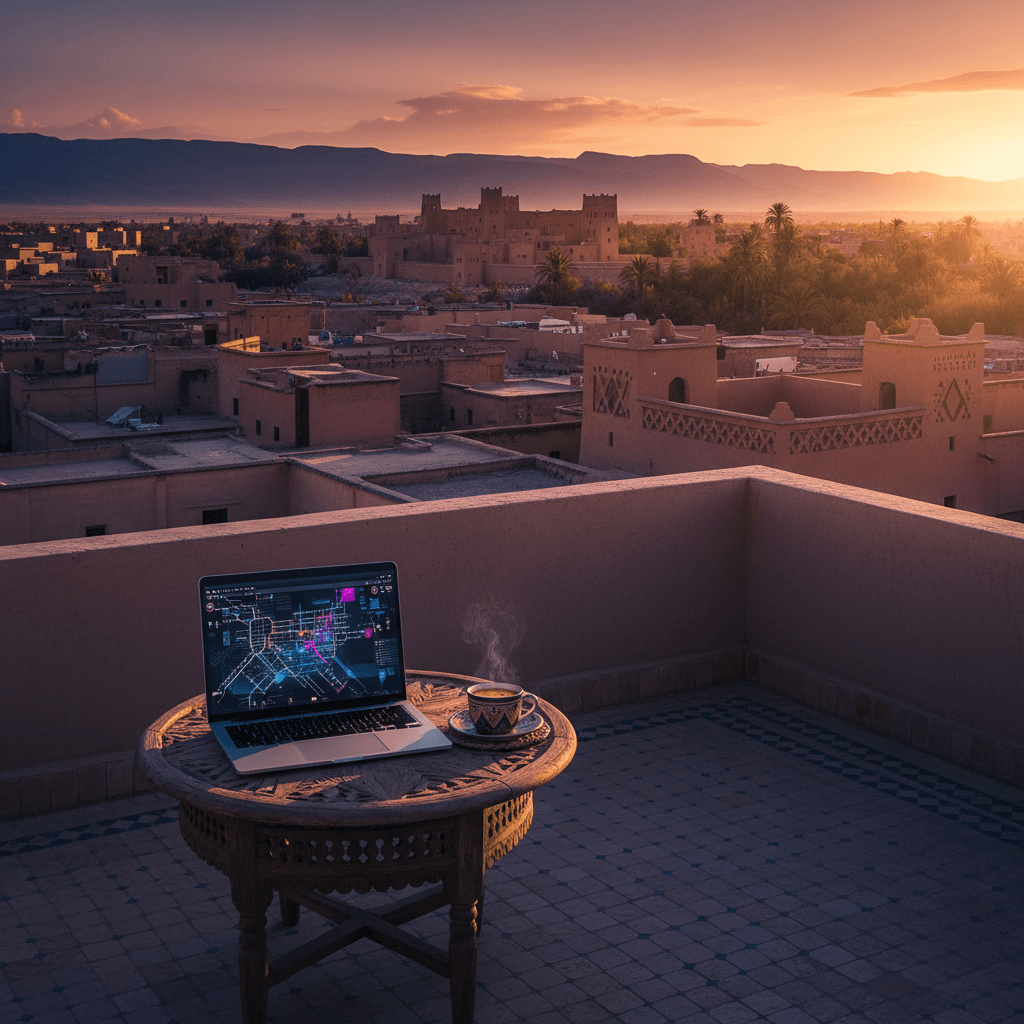
Ouarzazate is small. Like, genuinely small, 60,000 people small and that's the whole point. This isn't a city that's trying to compete with Marrakech or Casablanca, it's a place that's settled into its own quiet rhythm and honestly doesn't care if you keep up.
The vibe is desert-slow. Mornings smell like bread baking and diesel, afternoons carry the faint grit of wind coming off the mountains and evenings belong to the call to prayer echoing across flat rooftops while locals drag plastic chairs outside their front doors. There's a stillness here that either resets you completely or drives you up the wall within two weeks, depending on your personality.
What makes it genuinely different from other nomad spots is the cinematic weirdness of it all. Gladiator was filmed nearby, the Draa Valley looks like a film set anyway and the Taourirt Kasbah sits right in the middle of town like it's always been there, because it has. You're working remotely in a place that doubles as a backdrop for Hollywood epics, that's a strange and specific pleasure.
The locals are, turns out, some of the friendliest you'll encounter in Morocco. Berber and Darija mix in every conversation, French gets you far, English gets you almost nowhere outside tourism. Most nomads find the language gap charming for the first month, then mildly frustrating when they're trying to sort out a lease or a pharmacy after hours.
Summers here are brutally hot. July highs push 37°C, the kind of heat that makes your laptop fan scream and your motivation evaporate by noon. March through May and September through November are the sweet spots, mild temperatures around 20 to 25°C, clear skies, manageable crowds.
The honest tradeoffs look like this:
- Love it for: Affordability, safety, fiber internet at Dar Digital Nomad, Ait Benhaddou day trips, genuine calm
- Hate it for: Almost no nightlife, isolation from bigger cities, summer heat that's genuinely oppressive, limited dining variety
- Best fit: Solo nomads and couples who want to work hard, spend little and disappear into something slower for a few months
It's not for everyone, it doesn't pretend to be.
Ouarzazate is, honestly, one of the cheapest places you can base yourself in North Africa. Rent for a decent one-bedroom in the city center runs around 2,250 MAD a month (roughly €200) and if you're okay living outside the center, that drops to 1,200 MAD. That's not a typo.
Street food tagines go for 35-42 MAD, which is about €3 and they're filling enough that you won't need much else. A sit-down meal for two at a mid-range spot costs around 100 MAD total, Jardin Des Arômes is the splurge option if you want French-Moroccan fusion and a proper table. Most nomads eat a mix of both, it keeps the food budget low without getting boring.
Transport is almost laughably cheap. Petit taxis start at 5 MAD for short hops around the center, local buses run 6 MAD a ride, the city's compact enough that you'll walk a lot anyway. If you need a car for day trips to Ait Benhaddou or the Dades Gorges, Budget has rentals at the airport.
Monthly Budget Tiers
- Budget (5,000-8,000 MAD / ~€450-720): Shared housing outside center, street food daily, buses and taxis only
- Mid-range (10,000-15,000 MAD / ~€900-1,350): One-bedroom in center, mixed dining, occasional taxis and coworking access
- Comfortable (20,000+ MAD / ~€1,800+): Private villa, upscale meals, car rental, Dar Digital Nomad coliving package
Speaking of Dar Digital Nomad, their coliving and coworking bundle runs around 340€ a month and includes a room plus 100 Mbps fiber. For solo nomads, turns out that's often cheaper than renting separately and hunting down reliable internet, which isn't guaranteed in a standard apartment. Home fiber plans do exist at around 225 MAD a month, but installation timelines can drag.
The summers will cost you in other ways. July and August hit 37°C regularly, fans aren't enough and air conditioning spikes your electricity bill fast. Budget for that if you're staying through the heat. March through May and September through November are the sweet spots, mild temperatures, no surprises.
Overall, a comfortable mid-range life here costs frankly less than a budget existence in Lisbon or Tbilisi. That's the real draw.
Digital Nomads
Hay Al Mansour is where most nomads land and honestly, it makes sense. Dar Digital Nomad sits here, offering fiber at 100 Mbps down with coliving bundled in for around 340€ a month, which is frankly one of the better deals you'll find in North Africa. The community is small but real, people actually talk to each other at dinner.
The downside? Facilities are basic, the neighborhood itself isn't much to look at and you're dependent on taxis to reach anything worth seeing. Still, for focused work sprints with zero distraction, it delivers.
Solo Travelers
The center, around Avenue Mohammed V, is the obvious choice. Walkable. Safe. You're close to Taourirt Kasbah, the better cafes and the ATMs you'll inevitably need. Petit taxis start at 5 MAD for short hops, so getting around is cheap even when your feet give out.
It's turns out noisier than people expect, the calls to prayer echo off the walls at dawn and the street traffic picks up fast, but most solo travelers adjust within a few days. Rent here runs around 2,250 MAD a month for a one-bedroom, that's roughly €200, which is hard to argue with.
Expats
There isn't really an expat enclave here. Ouarzazate is too small for that, don't come expecting a ready-made community of familiar faces. A handful of longer-term foreigners cluster near the center or out toward the Skoura road, drawn by lower rents and quieter streets, but you'll be building your social life from scratch mostly through Dar Digital Nomad events or chatting up locals at neighborhood cafes.
French helps enormously here, English won't get you far outside tourist spots. Learn a few words of Darija and people warm up fast.
Families
Skip the center. The Skoura outskirts, about 40 kilometers east, offer space, palm oases and villas at a fraction of city prices. It's quieter in a way that's genuinely pleasant rather than just empty, the air smells like dust and date palms and kids actually have room to move. You'll need a car, there's no getting around that, but rentals are available at the airport and daily rates are reasonable.
Healthcare is basic across the board. Clinic Chifa handles most routine needs, anything serious means a trip to Marrakech.
Ouarzazate's internet situation is, honestly, better than you'd expect for a city this size and this remote. Fiber-optic is available, home connections run around 60 Mbps for roughly 225 MAD a month and most nomads working here don't run into the connectivity headaches that plague other small Moroccan cities.
The one dedicated coworking option is Dar Digital Nomad, out in the Hay Al Mansour neighborhood. It's a coliving and coworking setup bundled together, 340€ a month gets you a room plus workspace access with speeds hitting 100 Mbps down and 12 Mbps up, which is solid enough for video calls, uploads, large file transfers, whatever you need. The catch is that it's a package deal, you can't just rent a hot desk by the day, so it only makes sense if you're staying for a stretch.
Cafe working is possible but limited. The central area around Avenue Mohammed V has a handful of spots where you can set up with a coffee, though don't expect dedicated power strips or reliable WiFi passwords that actually work, it's more of a "get out of your room for a few hours" option than a real productivity setup.
For mobile data, Maroc Telecom is the clear pick in this region. Coverage holds up better than Orange or Inwi once you start heading toward Ait Benhaddou or the Draa Valley and at 10 MAD per gigabyte it's cheap enough that you won't stress about burning through data. Grab a SIM at the airport when you land, around 60 MAD for the card and top up at any tabac in the center.
- Home fiber: 60 Mbps+, ~225 MAD/month
- Dar Digital Nomad: 100 Mbps down / 12 Mbps up, bundled at ~340€/month with coliving
- Mobile data: Maroc Telecom, 10 MAD/GB, SIM ~60 MAD
- Cafe WiFi: Available in the center, unreliable, treat it as a backup
There's no coworking scene here in the traditional sense, Dar Digital Nomad is it. If you need a full-service workspace with community and fast internet, that's your only real option and turns out most nomads who come through end up staying there for exactly that reason.
Ouarzazate is, honestly, one of the safer places you can land in Morocco. Petty theft is rare, violent crime against tourists is basically unheard of and solo travelers, including women traveling alone, consistently report feeling comfortable walking at night in the city center. That said, don't push your luck on remote desert roads after dark, the terrain is unforgiving and help is far away.
The emergency numbers are simple: 19 for police, 15 for ambulance. Save them before you need them, not after.
Healthcare is functional, not impressive. Clinique Chifa and Clinique Ouarzazate handle routine issues, cuts, stomach bugs, minor injuries and the central hospital covers more serious cases, though anything genuinely complicated means a transfer to Marrakech, about three hours by road. Most nomads who've spent time here recommend getting solid travel insurance before arriving, because the local system works fine for basics but isn't where you want to be for anything complex.
Pharmacies are genuinely useful here, turns out they're often your first and best stop for minor ailments. Pharmacie ElKaram is well-stocked and staff are used to pointing at things when French fails. Many pharmacies operate on a 24-hour rotation, so there's usually one open somewhere in the center, ask at your accommodation which one is on duty that night.
- Police: Dial 19
- Ambulance: Dial 15
- Clinique Chifa: Handles general consultations and minor emergencies
- Clinique Ouarzazate: Similar scope, central location
- Pharmacies: Widespread in the center, 24-hour rotation system in effect most nights
The desert environment creates its own health considerations. Summers are brutally hot, 37°C highs in July with a dry, gritty wind that coats everything in fine dust, dehydration sneaks up fast if you're out shooting photos at Ait Benhaddou in the afternoon heat. Winters flip the other way, cold tile floors and frigid nights that catch visitors off guard. Pack layers, drink more water than you think you need and carry a basic first aid kit because the nearest well-stocked pharmacy might be twenty minutes away if you're staying outside the center.
Overall though, Ouarzazate doesn't demand paranoia. Basic awareness is enough.
Ouarzazate is small enough that you won't need much. The city center is walkable, honestly more walkable than most Moroccan cities its size and if you're staying near Avenue Mohammed V you can reach the Taourirt Kasbah, the main cafes and the ATMs on foot without breaking a sweat (except in July, when everything is a sweat).
Petit taxis are the default for anything beyond a 15-minute walk. Short trips run 5 to 10 MAD, cash only and you'll want to agree on the price before you get in, that's not negotiating, that's just how it works here. Careem and InDrive exist in Morocco, they're barely functional in Ouarzazate though, so don't count on them.
Local buses cover a few routes for 6 MAD a ride, they're infrequent and the schedules are, turns out, more of a suggestion than a timetable. Most nomads skip the buses entirely after the first week and stick to taxis.
Airport Transfers
- Taxi to/from OZZ: ~50 MAD for the 3 to 4km ride into the center
- Walking: Technically possible, not recommended with luggage in summer heat
- Car rental: Budget operates at the airport for day trips to Ait Benhaddou or the Dades Gorges
Day Trips & Longer Distances
Renting a car is, frankly, the move if you want to explore beyond the city. Ait Benhaddou is only 30 minutes out and the Draa Valley stretches south through some genuinely dramatic desert scenery. Shared taxis (grand taxis) run to nearby towns and are cheaper than private rentals for single destinations, you'll share the ride with locals and the conversation is worth it even if your Darija is nonexistent.
Bikes and scooters are rentable through some hotels and tour operators, good for reaching the oases around Skoura without the cost of a full car rental. Weirdly underused option, most visitors don't think to ask.
Getting Your Bearings
- Central area: Walkable, taxis everywhere, no car needed
- Hay Al Mansour / Dar Digital Nomad area: Short taxi ride from center, ~10 MAD
- Skoura and outskirts: Grand taxi or rental car, plan ahead
The city doesn't demand much logistically. That's part of the appeal, it's simple to get around, costs almost nothing and you'll figure out the rhythm within a day or two.
Ouarzazate runs on three languages: Darija (Moroccan Arabic), Tamazight (Berber) and French. English exists, but barely and mostly around the film studio and a handful of tourist spots near Taourirt Kasbah. Don't expect to get far on English alone once you step outside those zones, it'll frustrate you fast if you're not prepared.
French is, honestly, your most practical tool here. Most shopkeepers, pharmacists and guesthouse owners have at least functional French, so even rusty high school vocabulary goes a long way. Darija is trickier because it diverges significantly from Modern Standard Arabic, but locals light up when you try even a few words, the effort genuinely matters in a small city like this.
Phrases Worth Knowing
- Hello: Salam (informal) or Salam Alaikum (respectful)
- Thank you: Shukran (Arabic) or Merci (French, totally fine)
- How much?: Bshhal? (essential for any market visit)
- Yes / No: Na'am / Laa
- No problem: Mashi mushkil (you'll use this constantly)
Berber phrases are harder to learn systematically because Tamazight has regional variations, but "Azul" as a greeting lands well and signals genuine respect for local culture. People notice. In a city this size, that kind of thing travels.
For translation on the go, Google Translate handles French and Arabic well and the offline download works reliably without burning mobile data. Download both packs before you leave the airport. The camera translation feature is, turns out, surprisingly useful for menus and pharmacy labels written entirely in Arabic script.
Communication at Dar Digital Nomad is mostly English, French and Spanish depending on who's staying there, so that's your soft landing if you need a break from the language gap. Outside of it, though, you're on your own. Most nomads find that a basic French refresher before arriving makes the first two weeks dramatically less awkward, the alternative is a lot of pointing and hoping.
One thing to know: communication here is warm but indirect. Pushing hard for a direct "no" in negotiations or service situations won't work the way you expect, patience and a bit of small talk first gets you much further.
Ouarzazate sits in a high desert basin at around 1,150 meters, so the climate is more extreme than people expect. Summers are brutally hot. July averages hit 37°C (99°F) and the sun reflects off the pale stone streets in a way that makes midday genuinely unpleasant, most locals just disappear indoors until late afternoon.
Winters are the other surprise. Nights in January drop to near freezing, the cold tile floors of a riad feel it immediately and heating in budget accommodation is, honestly, an afterthought. Days are mild and clear, but pack layers if you're coming between November and February.
The rainy season is short and mild. February sees the most rainfall, around 40mm for the month, which sounds minor and mostly is. What you get instead of rain is wind, a dry gritty wind that carries fine dust off the desert and coats everything.
The sweet spots are March through May and September through November. Temperatures sit between 20 and 25°C, the light is extraordinary and the kasbahs and desert landscapes look their best without the heat haze that blurs everything in summer. Most nomads who've spent time here agree: spring is the better of the two windows, the almond trees are flowering around Skoura and the Draa Valley is green in a way it won't be by June.
- March to May: 20-25°C, low rainfall, ideal for day trips to Ait Benhaddou and the Dades Gorges
- September to November: Similar temperatures, slightly more wind, fewer tourists than spring
- June and July: 35-37°C highs, turns out productivity suffers badly without reliable AC
- December to February: Cold nights (near 0°C), clear skies, very few visitors
If you're planning a short trip, avoid July and August entirely, the heat isn't a vibe issue, it's a practical one. If you're staying longer term, winter is workable and weirdly peaceful, the city slows down even further, the cafes on Avenue Mohammed V are quiet and you'll have the Taourirt Kasbah almost to yourself.
Get a Maroc Telecom SIM at the airport the moment you land. It's around 60 MAD, data runs 10 MAD per gigabyte and coverage out here is, honestly, better than you'd expect for a desert city this size. Orange and Inwi work too, they just don't match Maroc Telecom's reach once you're heading toward Ait Benhaddou or the gorges.
ATMs line Avenue Mohammed V, Banque Populaire being the most reliable. Wise works well for international transfers, most nomads use it to avoid the conversion fees that add up fast over a long stay.
For accommodation, skip Airbnb for anything longer than a week. Facebook groups and local agents get you much better rates, a 1BR in the center runs around 2,250 MAD per month, negotiated directly. If you want coworking baked into your rent, Dar Digital Nomad in Hay Al Mansour bundles coliving with 100 Mbps fiber for around 340€ monthly, it's the closest thing to a nomad infrastructure this city has.
Weather shapes everything here. March through May and September through November are genuinely pleasant, 20 to 25°C with sun and no drama. July and August are brutal, 37°C highs, gritty desert wind, the kind of heat that makes you question your decisions, most long-term visitors plan around it or leave entirely.
Getting around is simple. Petit taxis start at 5 MAD for short hops, just agree on the price before you get in. The airport is only 3 to 4 km from the center, a taxi runs about 50 MAD. Rent a car at the airport if you're doing day trips, Ait Benhaddou is 30 minutes out and turns out it's far more satisfying without a group tour breathing down your neck.
A few cultural basics that actually matter:
- Dress: Modest clothing gets you noticeably warmer treatment from locals.
- Greetings: Lead with "Salam," it opens doors, weirdly more than any amount of French will.
- Tipping: 10% is standard at restaurants, not optional.
- Haggling: Expected in souks, keep it light and good-natured.
- Homes: Shoes off at the door, always.
English proficiency is low outside tourist spots. Download Google Translate offline before you go, French gets you further than you'd think and a few words of Darija go further still.
Need visa and immigration info for Morocco?
🇲🇦 View Morocco Country GuideEasy Landing
Settle in, no stress
Monthly Budget Estimates
More cities in Morocco
Imsouane
🇲🇦 Morocco
Essaouira
🇲🇦 Morocco
Agadir
🇲🇦 Morocco