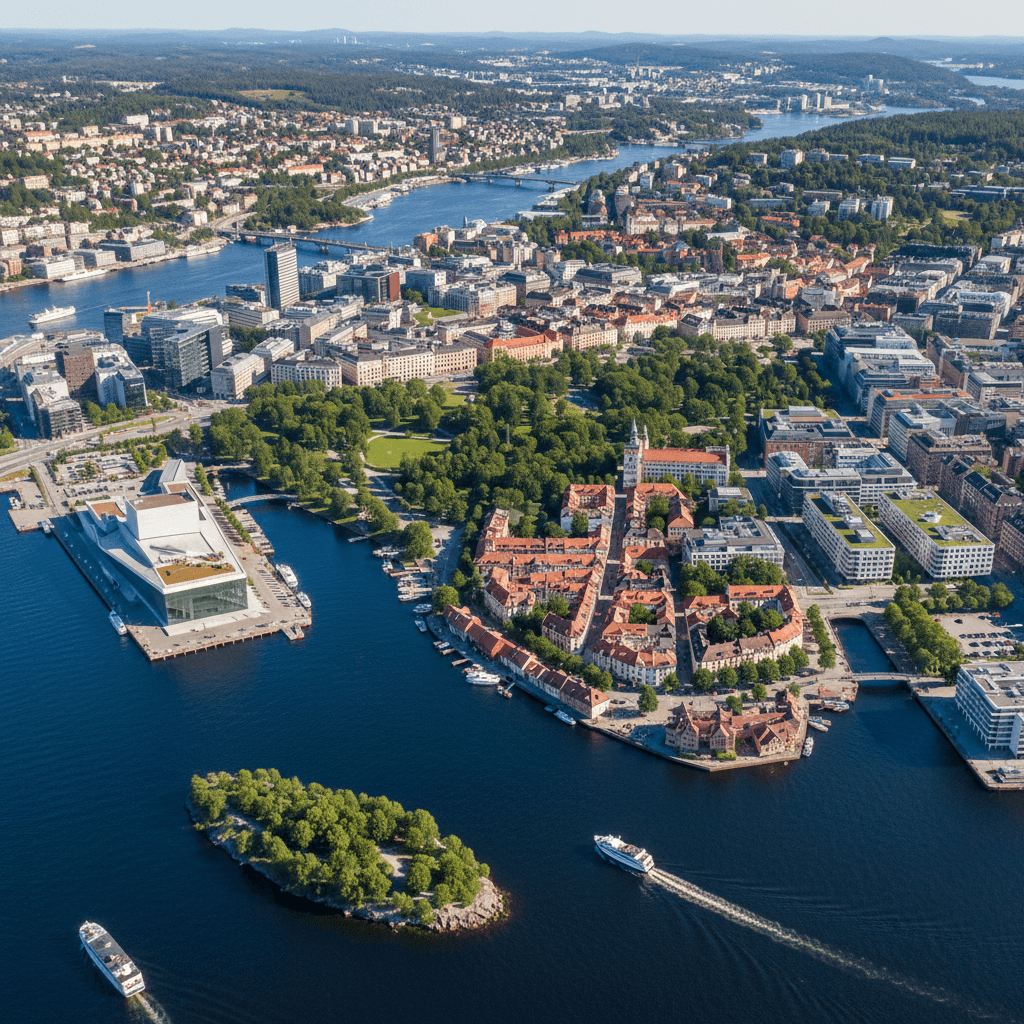
Oslo
🇳🇴 Norway
Oslo doesn't ease you in gently. You step off the train at Sentrum and it hits you immediately: the quiet, the clean air, the almost unsettling orderliness of everything. Streets that smell like pine and rain. Trams that actually run on time. It's a city that functions so well it can feel slightly unreal, especially if you're coming from somewhere louder and more chaotic.
The vibe is, honestly, Scandinavian minimalism made physical. People here work hard but leave the office at 4pm without guilt, spend weekends hiking in Nordmarka and take the concept of friluftsliv (outdoor life) seriously enough that it shapes the whole rhythm of the city. As a nomad, you feel that. There's no grinding hustle culture to absorb you, which is either refreshing or disorienting depending on your personality.
What makes Oslo genuinely different from other European nomad bases is the combination of natural access and urban infrastructure. You can take the T-bane to Sognsvann lake in 20 minutes, then be back working from a well-lit Grünerløkka cafe by afternoon, the kind of cafe where the WiFi actually works and nobody's going to rush you out. That daily rhythm, turns out, is what keeps nomads here longer than they planned.
The downsides are real and shouldn't be glossed over. Expensive doesn't cover it. A mid-range dinner for two runs 800 to 1,800 NOK, a monthly transit pass is 778 NOK and a studio in the city center will cost you 15,000 to 21,000 NOK before you've bought a single coffee. Most nomads find that budgeting under 25,000 NOK a month means shared accommodation and cooking most meals, there's no way around it.
The social scene takes adjustment too. Norwegians aren't unfriendly, they're just reserved in a way that can read as cold until you understand it. Breaking in takes effort, coworking spaces and Meetup events are genuinely your best entry points early on.
But here's what stays with you: the light in summer, long and golden well past 10pm, the smell of the fjord on a warm July evening, the weirdly specific pleasure of a city that simply works. Oslo's not for everyone. For the right nomad, it's quietly addictive.
Oslo is, honestly, one of the most expensive cities on the planet for digital nomads. Not a little expensive. Genuinely, eye-wateringly costly in ways that catch most people off guard even after they've done their research.
A single person spending carefully can expect to burn through roughly 20,000 to 25,000 NOK per month (around $1,900 to $2,400) on a budget setup: shared accommodation, groceries cooked at home and a monthly transit pass at 778 NOK. That's the floor, not the average. Mid-range living with a one-bedroom outside the city center, some coworking time and the occasional dinner out pushes you to 30,000 to 40,000 NOK and a comfortable setup in the city center with gym access and regular restaurant meals will run 45,000 NOK or more.
Rent is where it hits hardest. A studio or one-bedroom in Grünerløkka, which is where most nomads want to be, runs 13,000 to 17,000 NOK a month and that's considered the more affordable end of central Oslo. Frogner and Majorstuen are pricier and, frankly, feel more suited to expats on corporate packages than solo remote workers watching their margins. Search on Finn.no or Hybel.no and don't expect much flexibility in the asking price.
Food costs add up fast. A quick lunch from a street spot or fast-casual place runs 150 to 250 NOK, a sit-down dinner for two at a mid-range restaurant is typically 800 to 1,800 NOK, self-catering is the obvious workaround and most long-term nomads lean heavily on it. Alcohol, turns out, is taxed into another dimension, so drinking at home before heading out is basically a local tradition.
Coworking is solid but not cheap:
- Epicenter: ~290 USD/month, 300 Mbps
- 657 Oslo: ~250 USD/month, 150 Mbps
- Day passes (Spaces Kvadraturen): 200 to 400 NOK
Public libraries and Grünerløkka cafes are genuinely work-friendly and free, many nomads skip coworking entirely and do just fine. City WiFi averages 44 to 166 Mbps depending on the spot, it's reliable enough that connectivity isn't really a concern here.
Oslo's neighborhoods are, honestly, pretty distinct from one another, so where you land matters a lot. The city isn't huge, but the difference between a quiet residential street in Nordstrand and a graffiti-lined block in Grünerløkka is bigger than the map suggests.
For Digital Nomads
Grünerløkka is the obvious pick and for good reason. The trams run constantly, the cafes have reliable WiFi and actual plug sockets and you'll hear English at every third table. Rent runs 13,000 to 17,000 NOK for a one-bedroom, which sounds steep until you realize it's cheaper than the city center, it's also genuinely walkable to coworking spaces like 1MESH and Epicenter if you want a proper desk setup.
Tøyen and Vulkan are worth a look too. More affordable, turns out and the Munch Museum and diverse food scene make it feel less like a laptop farm. The vibe's a bit edgier, some nomads love that, others don't.
For Expats
Frogner and Majorstuen are where most long-term expats end up and it's easy to see why. Frogner Park is right there, the streets are clean and quiet and there's a density of international schools and embassies that makes the admin side of expat life easier. Expensive. Full stop. But if you're on a company package or a solid remote salary, the trade-off is quality of life that's, frankly, hard to beat in northern Europe.
For Families
Nordre Aker and Nordstrand are the go-to family neighborhoods, green, calm and genuinely community-oriented in a way the central areas aren't. You're farther from the action, the commute adds up, but the schools are good and kids actually play outside here, which feels almost radical in a major European capital. Rent drops noticeably once you're outside the center, think 12,000 to 17,500 NOK for a one-bedroom.
For Solo Travelers
Stay in Grünerløkka. Don't overthink it. The craft beer bars, the street art smell of cold concrete and fresh paint on a November morning, the noise spilling out of restaurants on Thorvald Meyers gate on a Friday, that's the Oslo solo travelers actually remember. It's not the cheapest option in the city, but it's where things happen.
Oslo's internet infrastructure is, honestly, one of the better setups you'll find in Europe. Citywide WiFi averages between 44 and 166 Mbps, 5G rollout is well underway and most cafes, especially in Grünerløkka, have connections reliable enough to run calls without a second thought. Public libraries work fine too, no membership required.
The coworking scene is solid, though it'll cost you. Prices sit at the higher end of what you'd expect even for a Scandinavian capital, so budget accordingly before you commit to a desk.
- 1MESH: Around $280/month, 200 Mbps, popular with tech-adjacent nomads
- Epicenter: Around $290/month, 300 Mbps, more of a startup-community feel
- 657 Oslo: Around $250/month, 150 Mbps, smaller and quieter
- Spaces Kvadraturen: Day passes run 200 to 400 NOK, good for short stays
Most nomads who stay longer than a few weeks end up picking Grünerløkka cafes for their daily work sessions, it's cheaper than a coworking membership and the coffee is genuinely good. The hum of an espresso machine, the smell of fresh pastry, the clatter of ceramic on wood, it's a decent office when your budget's already stretched thin by Oslo's rents.
For mobile data, grab a SIM from Telia at the airport or any convenience store. Starter kits run around 100 NOK and data bundles go from 269 to 649 NOK depending on how much you need. If you're only here for a few weeks, an eSIM through Airalo is, turns out, the cleaner option since you skip the in-store hassle entirely.
One thing that catches people off guard: Norway offers an Independent Contractor Permit for digital nomads with a Norwegian client (up to 2 years), so your options are tourist entry (90 days Schengen), a job seeker visa or sorting out longer-term arrangements before you arrive. Don't assume you'll figure it out on the ground.
Connectivity here isn't a problem. Cost is. A hot desk alone runs 3,000 to 6,000 NOK per month, which, weirdly, feels almost reasonable once you've seen Oslo's grocery bills. Factor it into your monthly budget early and you won't be scrambling later.
Oslo is, honestly, one of the safest cities you'll ever work from. Pickpockets exist near tourist spots like Karl Johans gate and the waterfront, but serious crime is rare enough that most nomads stop thinking about it after the first week. Normal street awareness is all you need, there's no neighborhood you genuinely need to avoid.
Healthcare here is excellent. Oslo University Hospital runs two main campuses, Ullevål and Rikshospitalet and both have English-speaking staff who won't make you feel like an inconvenience for showing up. For non-emergencies, walk-in clinics called legevakt are scattered across the city and handle everything from infections to minor injuries without an appointment.
Pharmacies are everywhere. Apotek 1 and Vitusapotek locations are on almost every main street and they're well-stocked, the staff speaks English and they'll give you real advice rather than just pointing at a shelf.
The catch and it's a real one, is cost. As a non-EU visitor without a Norwegian national insurance number, you're paying out of pocket for most care and Oslo's medical fees reflect the city's broader pricing reality. Travel insurance with solid medical coverage isn't optional here, it's the difference between a manageable situation and a genuinely painful bill.
Emergency numbers are straightforward:
- Police: 112
- Ambulance: 113
- Fire: 110
Save those before you need them, not during.
Mental health and general wellbeing are, turns out, something Oslo takes seriously at a cultural level. The city's obsession with friluftsliv, getting outside regardless of weather, means you'll find yourself walking fjord trails or skiing Nordmarka in winter almost by default. It sounds like a cliché until you're actually doing it and realizing it genuinely helps with the isolation that remote work brings.
The one thing that catches people off guard is the winter. Not dangerous, just relentlessly grey and cold from October through February and that darkness is weirdly oppressive in a way that photos don't capture. Pack a UV lamp if you're staying more than a month or two. Locals swear by them and they're right.
Oslo's public transport system is, honestly, one of the better ones you'll use in Europe. The Ruter app covers everything: trams, the metro (T-bane), buses and ferries to the fjord islands. A single ride costs ~44 NOK (app) to 64 NOK (on-board), a monthly pass runs 655 NOK and that pass covers the whole network, so you're not paying extra every time you hop between lines.
The T-bane is the backbone. It's frequent, clean and quiet in that particular Oslo way, no honking, no chaos, just the soft hiss of doors and the smell of damp wool coats in winter. Most nomads find it covers everything they actually need, Grünerløkka to the center in under 15 minutes, Tøyen to Majorstuen without thinking twice.
The center is walkable, genuinely so. Skip the tram for anything under 20 minutes on foot, you'll see more and the streets are easy to read. Bolt handles ride-hailing if you need it, Uber's presence is turns out pretty limited here, so don't rely on it.
For bikes, Oslo Bysykkel is the city's docked bike-share, it's cheap and the network is solid in summer, though cycling in January when the paths are iced over is its own kind of miserable. Electric scooters are scattered around too, useful for short gaps between transit stops.
Getting to and from the airport: the Vy airport train runs every 10 minutes from Oslo Central Station and takes about 22 minutes, it's the obvious choice. Flybussen is slower but cheaper, fine if you're not in a hurry. The Oslo Pass includes the airport train, which, weirdly, makes it worth doing the math before buying individual tickets.
Day trips are straightforward. Sognsvann lake is a single metro ride away on the T-bane line 5. The fjords are reachable by regional train or bus. None of it requires a car and frankly, renting one in the city would be more hassle than it's worth given parking costs and the one-way street logic that seems designed to confuse.
- Single ride: ~44 NOK (app) to 64 NOK (on-board)
- Monthly pass: 655 NOK
- Airport train (Vy): ~22 minutes from Central Station
- Ride-hailing: Bolt (preferred), Uber (limited)
- Bikes: Oslo Bysykkel city bike-share
Good news first: you won't need Norwegian to get by in Oslo. English proficiency here is, honestly, about as close to universal as it gets, especially among younger locals and anyone working in hospitality, retail or tech. Most nomads are surprised by how seamlessly conversations switch to English the moment someone hears an accent, it happens without any awkwardness or hesitation.
The official language is Norwegian, specifically the Bokmål written standard you'll see on signs and menus. Don't stress about it. A few phrases go a long way socially and Norwegians genuinely appreciate the attempt even if they immediately respond in perfect English.
Useful Phrases to Know
- Hei: Hello (used constantly, for everything)
- Ha det: Goodbye
- God morgen: Good morning
- Takk: Thank you
- Hvor er...?: Where is...?
- Unnskyld: Excuse me / Sorry
Google Translate handles Norwegian well, turns out, so it's a solid backup for menus or apartment listings on Finn.no. The app's camera mode is particularly useful for older signage that hasn't caught up with the city's bilingual reality.
One thing that trips people up isn't the language, it's the communication style. Norwegians are reserved. Not rude, just quiet. Don't mistake silence for coldness, small talk with strangers isn't really a cultural norm here the way it's in, say, the US or Australia. Interactions in shops and cafes tend to be efficient and pleasant, just not particularly chatty.
In coworking spaces like Epicenter or 1MESH, the working environment is weirdly formal for somewhere so design-forward, people have headphones in and they mean it. Expats consistently say the social barrier softens over time, especially through structured settings like Meetup events or InterNations gatherings, but don't expect Oslo to warm up to you immediately.
For written communication, most official forms, lease agreements and government correspondence will be in Norwegian. Google Translate gets you most of the way there, though for anything legally significant, a professional translation is worth the extra cost. Frankly, it's one of the few friction points in an otherwise smooth city to operate in.
Oslo's seasons aren't subtle. Winters are genuinely cold and dark, with January averaging highs of -4°C and lows of -9°C, short daylight hours and a grey dampness that settles into everything. It's not brutally arctic, but it's enough to make working from a cafe feel less charming when you're trudging through slush to get there.
Summer, though, is a different city entirely. June through August brings long, warm days where the sun barely sets, temperatures climbing into the mid-teens to low twenties Celsius and a collective exhale from the entire population. Locals flood the fjord, parks fill up and Grünerløkka's outdoor cafe terraces, honestly, become some of the best places in Europe to work from a laptop with a coffee in hand.
That said, "warm" is relative here. Even July averages around 17°C at its peak, so pack a layer regardless of what month you're visiting. Rain is a year-round companion, peaking in July and August with 88 to 108mm, it doesn't storm dramatically so much as drizzle persistently. You'll want a decent waterproof jacket no matter when you go.
When to Visit
- Best overall (June to August): Long daylight hours, warmest temperatures, outdoor activities at their peak. Peak tourist prices apply, book accommodation early.
- Shoulder season (May, September): Fewer crowds, still manageable temperatures, turns out this is when a lot of experienced nomads prefer to come. Cheaper flights too.
- Winter (October to February): Cold, dark and rainy. Not unlivable, but the novelty of Christmas markets fades fast and the social scene gets quieter than it already is.
For digital nomads specifically, May and September are, weirdly, the sweet spot. You get decent weather, the city isn't overrun and coworking spaces like Epicenter or 1MESH aren't competing with summer tourists for day passes. Flights and short-term rentals on Finn.no tend to drop noticeably outside peak season too.
Winter isn't a write-off if you're chasing the Northern Lights or genuinely love that hygge-in-the-dark aesthetic, but don't romanticize it too much. Frankly, four months of grey skies and 6-hour days will test anyone's productivity.
Oslo runs on a few unspoken rules and the sooner you know them, the smoother things go. Punctuality isn't optional here, it's the baseline expectation. Show up late to anything and you'll notice it, even if nobody says a word.
For a SIM card, grab one from Telia at the airport or any convenience store. Starter packs run 100 NOK, with data bundles between 269 and 649 NOK depending on how much you need. If you'd rather skip the physical card, Airalo's eSIM works well and, honestly, saves the hassle of hunting down a store when you first land.
Payments are, turns out, almost entirely cashless. The Vipps app dominates everyday transactions, from splitting dinner to paying at markets. Get it set up early, because some local vendors don't accept cards the way you'd expect. DNB is the go-to bank for expats who need a Norwegian account.
For housing, most nomads use Finn.no or Hybel.no to find apartments. The listings move fast, competition is real and landlords here aren't going to chase you down. Have your documents ready before you reach out.
Getting around is straightforward. The Ruter app covers trams, metro, buses and ferries; a monthly pass is 655 NOK, which is weirdly good value given how reliable the network actually is. Bolt handles ride-hailing when you need it, Uber's presence is limited. For airport transfers, the Vy train is faster and cheaper than the bus.
A few customs worth knowing:
- Recycling: Taken seriously. Sort your waste correctly or expect a look from your neighbors.
- Tipping: Optional and minimal, rounding up is plenty.
- Friluftsliv: The outdoor ethos is genuine, not a marketing angle. Locals head to Sognsvann lake via metro even on cold days.
- English: Near-universal, especially among younger people. You won't need Norwegian to function, though a "Hei" and "Ha det" go a long way socially.
Emergencies: police is 112, ambulance 113, fire 110. Oslo University Hospital has English-speaking staff and the quality is genuinely good, walk-in clinics called legevakt handle non-emergency care without an appointment.
One last thing. Oslo doesn't reward spontaneity much, plan ahead, book ahead and you'll have a far better time.
Need visa and immigration info for Norway?
🇳🇴 View Norway Country GuideEasy Landing
Settle in, no stress