Negril
🇯🇲 Jamaica
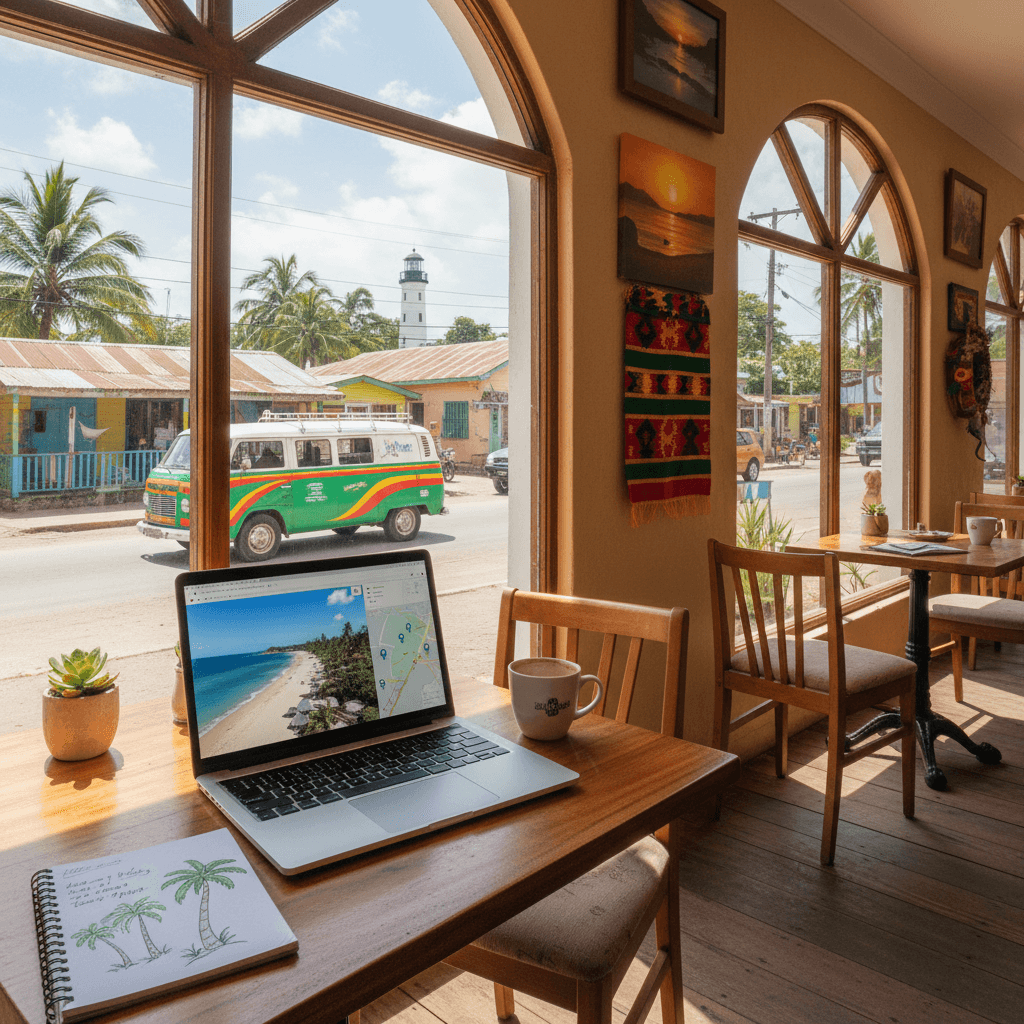
Negril doesn't rush you. That's the whole point. Where other destinations sell themselves on productivity and hustle, Negril sells you barefoot mornings, the smell of jerk smoke drifting off a roadside grill and sunsets over the West End cliffs that, honestly, make it hard to open your laptop at all.
The town splits into two distinct personalities. Seven Mile Beach is the social, walkable strip where most nomads land, lined with bars, restaurants and the low hum of reggae bleeding out of open-air spots every evening. The West End is quieter, stranger, a little rougher around the edges, with dramatic limestone cliffs dropping into turquoise water and Rick's Café drawing cliff-divers and tourists every afternoon. Different crowds, different energy, same impossibly blue ocean.
What makes Negril different from, say, Playa del Carmen or Chiang Mai is that it hasn't been fully optimized for remote workers yet. Coworking is thin on the ground. WiFi is generally fine for calls and email, but it can be frustrating if you're pushing large files or need rock-solid reliability. Most nomads end up working from hotel lobbies, Rituals Coffee House or Levi's Business Hub, which charges around $16 USD for a day pass. It works, it's just not seamless.
The cost of living is, turns out, higher than people expect. Budget around $1,500 USD a month if you're watching every dollar, closer to $2,500 for a comfortable mid-range setup with decent accommodation near the beach. Rent in tourist zones isn't cheap, street food keeps your grocery bill sane though, jerk chicken at Kool Vybes runs $5 to $8 and it's genuinely good.
The emotional experience of Negril is weirdly specific. It's the sound of waves at 7am before the vendors set up, the way the humidity clings to everything by noon, the locals greeting you with "Wah Gwaan?" like they mean it. There's real warmth here, it's not performative hospitality.
The downsides are real too. Petty crime happens, infrastructure is inconsistent and the vendor hustle on the beach gets old fast. Negril rewards people who can slow down and adapt, it doesn't bend to accommodate people who can't.
Negril isn't cheap and anyone who tells you otherwise is probably comparing it to Montego Bay resorts. The honest baseline for a comfortable month here lands around $2,500 USD, though you can scrape by on $1,500 if you're eating jerk chicken off the street and sharing a place in Negril Square.
Rent is, honestly, the biggest variable. A studio or 1BR near Seven Mile Beach runs roughly $1,400 to $4,500 USD per month, with tourist-adjacent spots in the West End pushing toward the top of that range. Budget nomads tend to find better deals in Negril Square or Long Bay, though Long Bay's the smarter pick because you're not dodging sketchy corners after dark.
Monthly Budget Tiers
- Budget: ~$1,500 USD (shared housing, street food, route taxis)
- Mid-range: ~$2,500 USD (private 1BR, mix of cooking and dining out, occasional taxi)
- Comfortable: $4,000+ USD (beachside apartment, dining at Rockhouse or Ivan's, private transfers)
Food costs are manageable if you eat like a local. Kool Vybes Jerk Centre will feed you for $5 to $8, the smell of scotch bonnet and charcoal smoke hits you from half a block away and it's genuinely good. Sit-down spots like Rockhouse climb to $30 to $50 a head, which adds up fast if you're doing it three times a week.
Transport is, turns out, one of the more annoying budget leaks. There's no Uber here, so you're negotiating with JUTA taxis or squeezing into route taxis that run on no particular schedule. A single taxi trip around Negril runs $25 to $30 USD, it adds up quickly if you're not walking or renting a scooter from your hotel.
Coworking is limited. Levi's Business Hub charges around $16 USD for a day pass or roughly $3 per hour, which is fine for occasional use. Most nomads, weirdly, end up working from hotel lobbies or Rituals Coffee House because the options are just that thin.
A Digicel or Flow SIM costs about $6 USD for a data bundle, which helps when the cafe WiFi drops to nothing mid-call. And it will drop. Budget for that frustration too.
Negril doesn't really have neighborhoods in the traditional sense. It's more like a long stretch of coastline with distinct personalities as you move along it and where you land shapes your entire experience.
For Digital Nomads: Seven Mile Beach
Most nomads end up here and honestly, it makes sense. You've got restaurants, pharmacies, coworking at Levi's Business Hub and enough foot traffic that you won't feel stranded. Walkable. Lively.
The downside is real though: vendor pressure on the beach gets exhausting fast, crowds peak hard from December through April and monthly rent for a studio runs $1,400 to $4,500 USD depending on how close you want to be to the water. WiFi is, turns out, inconsistent even in the tourist corridor, so don't assume your hotel connection will hold up for a video call.
For Expats and Long-Term Stays: West End
The cliff side of Negril has a completely different energy. Quieter, more dramatic, the smell of salt spray hits differently up here than it does on the flat beach. Rick's Café draws the sunset crowd every evening, but outside of that the West End is, weirdly, more residential feeling than Seven Mile.
Roads are rough, some genuinely bad, so a scooter rental is less optional here than elsewhere. Expats who've been in Negril a while tend to prefer it, they get more space for the money and the vibe is less performatively touristy.
For Families: Bloody Bay
Calm water. Fewer vendors. Less noise. Bloody Bay is the quietest pocket of Negril's coastline and families consistently say it's the right tradeoff even though you'll need wheels to get anywhere useful.
It's isolated, that's the honest summary, but if you've got kids and want a beach where you can actually relax without someone trying to sell you a bracelet every ten minutes, this is it.
For Budget Travelers and Solo Nomads: Negril Square
Downtown Negril is, frankly, an acquired taste. It's cheap, it's authentic and it's disorganized in a way that some people find charming and others find maddening. Street food at Kool Vybes Jerk Centre runs $5 to $8 USD, the local pulse is real here, skip it after dark though.
Negril's internet situation is a key consideration for working here. WiFi is generally fine for emails and video calls but can struggle when you're uploading large files or jumping between multiple browser tabs. It's workable, it's just not reliable.
Most cafes and hotels on Seven Mile Beach have decent enough connections, Rituals Coffee House being the go-to spot for nomads who want decent WiFi with a cold drink in hand. The signal drops off fast once you leave the main tourist strip, so don't count on working from a quiet side street or a clifftop rental in the West End without a backup plan.
Coworking options are limited; check current listings on Google Maps or Facebook groups for spaces like hubs or cafes with desks. Most nomads treat these as a backup for heavy work days rather than a daily base.
For mobile data, grab a SIM from Digicel or Flow, both are sold at the airport and around town from about J$1,000 ($6 USD) for a data bundle. Digicel tends to get better reviews for coverage in Negril specifically, turns out Flow's signal gets patchy along parts of the West End cliffs. If you'd rather skip the SIM swap, Airalo and Holafly both sell eSIMs that work before you land.
A few things to keep in mind:
- Digicel/Flow SIM with data: J$1,000+ (~$6 USD)
- eSIM (Airalo/Holafly): $8+ per day
The honest reality is that Negril wasn't built for remote work. Power outages happen, speeds fluctuate and there's no real coworking community to plug into. If your work demands rock-solid connectivity every day, you'll spend a lot of time frustrated, a mobile data plan isn't a luxury here, it's non-negotiable.
Negril's tourist zones are, honestly, pretty safe by Jamaican standards. Seven Mile Beach and the West End cliff areas see enough foot traffic and tourist presence that petty crime stays relatively low during the day. At night, though, the calculus changes fast, stick to lit streets and don't wander past the edges of the main strips alone.
Petty theft is the real concern here, not violent crime. Don't leave laptops or cameras unattended on the beach, don't flash expensive jewelry and keep your phone in your pocket when you're walking through quieter stretches. Negril Square downtown feels authentic and cheap, but most expats skip it after dark, that's not paranoia, that's just the local consensus.
A few practical rules that travelers learn quickly:
- Stick to lit areas at night, especially outside the main beach strip
- Don't carry more cash than you need; ATMs are available in crowded areas near the beach
- Ignore drug offers. They're frequent, the penalties in Jamaica are serious and it's not worth it
- Vendor pressure on Seven Mile can feel relentless, a firm "no thanks" and eye contact usually works better than ignoring people
Healthcare is, weirdly, more accessible than you'd expect for a town this size. Check current healthcare options like local clinics or hospitals near Negril; serious cases transfer to Montego Bay, about 90 minutes away. Pharmacies are spread around town and stock most common medications without much hassle.
Travel insurance isn't optional here. Turns out even a minor scooter scrape or a bad bout of food poisoning can get expensive fast if you're paying out of pocket. Get coverage that includes medical evacuation before you arrive.
Emergency numbers to save before you land:
- Police: 110
- Ambulance: 112
The vibe in Negril is relaxed, people genuinely look out for tourists here because the local economy depends on it. Still, basic awareness goes a long way, don't let the beach lull you into leaving your bag unzipped.
There's no Uber here. No Bolt, no Lyft, nothing like that, so don't land at Montego Bay expecting to tap an app and sort yourself out. Getting to Negril from the airport takes about 90 minutes and your options are, honestly, a JUTA taxi at around $30 USD per person or a pre-booked private transfer that can run closer to $16 USD if you plan ahead through a local operator.
Once you're in Negril, taxis are still your main option for anything beyond walking distance. Route taxis and minibuses exist and they're cheap, but the schedules are erratic, the routes aren't always obvious to newcomers and you'll spend more time figuring them out than they're worth, especially in the heat. Most nomads just negotiate fares directly with local taxi drivers and keep a few numbers saved in their phone.
Seven Mile Beach is walkable. That's its biggest practical advantage over the rest of Negril, you can get to most restaurants, bars and shops on foot without thinking twice. The West End is a different story. The roads there are rougher, distances between spots are longer and walking at night on unlit clifftop paths isn't something you want to do casually.
Bike and scooter rentals are available through most hotels and a handful of roadside shops. A scooter gives you real freedom here, turns out it's the preferred way for longer-term expats to get around without bleeding money on taxis every day. Just know that road conditions vary wildly and traffic moves with a confidence that doesn't always match the infrastructure.
A few practical things worth knowing:
- Airport transfer: JUTA taxis ~$30 USD/person from Montego Bay; private transfers from ~$16 USD booked in advance
- Local taxis: No meters, negotiate the fare before you get in
- Route taxis/buses: Cheap but unreliable; fine for short hops, frustrating for anything time-sensitive
- Scooter/bike rental: Available at most hotels; best option for West End exploration
- Walkability: Good along Seven Mile Beach, poor almost everywhere else
Bottom line: Seven Mile Beach keeps you mobile without a vehicle, but if you're staying in the West End or planning to explore beyond the tourist corridor, rent a scooter early and don't rely on taxis to show up on any kind of schedule.
English is the official language and in tourist-heavy Negril, you'll have no trouble communicating. Hotel staff, restaurant workers and most vendors speak clear, functional English, it's genuinely easy to get around without any language prep.
Then there's Patois. Jamaican Patois is, honestly, a whole different experience and you'll hear it constantly once you're outside the resort bubble. It's English-rooted but moves fast, drops syllables and reshapes grammar in ways that can catch you completely off guard the first few times someone greets you at full speed.
A few phrases go a long way socially:
- "Wah Gwaan?" What's up? Use it freely, locals genuinely appreciate it.
- "Mi deh yah" I'm here, I'm good. Standard response to Wah Gwaan.
- "Irie" Everything's good, peaceful, no problem.
- "Respect" Acknowledgment, gratitude, general goodwill. You'll hear this constantly.
- "No problem, mon" Self-explanatory and not just a tourist cliche, people actually say it.
Google Translate has a Jamaican Patois option, it's imperfect but useful when a conversation gets genuinely confusing. Don't rely on it for anything time-sensitive though, the translations can be weirdly clunky and occasionally wrong in ways that matter.
One thing that trips up nomads: communication style in Negril runs indirect. If you ask "is the WiFi working?" and someone says "yeah, man, no problem," that doesn't always mean yes. It sometimes means they don't want to disappoint you, frankly. Learn to ask twice or just test it yourself before committing to a workspace or cafe for the day.
Tone matters more here than in most places. Locals respond warmly to patience and humor, they don't respond well to impatience or a transactional attitude. Raising your voice or pushing hard in a negotiation tends to shut conversations down completely, not open them up.
Expats who've spent real time here say the adjustment isn't the language, it's the rhythm. Negril moves slowly, turns out that's not a flaw, it's the whole point and once you stop fighting it, communication gets a lot easier.
Negril's weather is, honestly, one of its strongest selling points. Temperatures sit between 82 and 86°F year-round, the kind of warm that feels like a permanent exhale after months in a cold-climate city. There's not much seasonal variation in heat, so what actually drives the calendar here is rain.
The dry season runs December through April and that's when Negril is at its best. Days are sunny, the sea is calm and the sunsets over the West End cliffs turn genuinely absurd shades of orange. Most nomads who've spent time here agree: book January or February if you can, the crowds are manageable and the weather rarely disappoints.
May through August gets muggier. Afternoon showers roll in fast, soak everything, then vanish before dinner, it's not unbearable, but the humidity clings to you in a way that makes working from a non-air-conditioned spot genuinely unpleasant. You'll feel it the moment you step outside, that thick, wet air that doesn't let go.
Then there's September and October. Skip them. Hurricane season peaks right there, October alone averages over five inches of rain and the threat of serious storms is real enough that travel insurance becomes less optional. Infrastructure in Negril doesn't handle heavy weather gracefully, power cuts and flooding aren't rare and if a storm hits, you're not in a city with backup systems to absorb it.
- Best months: December through April (dry, sunny, calm seas)
- Shoulder season: May through August (warm, occasional afternoon rain, fewer crowds than peak)
- Avoid: September and October (hurricane risk, heavy rain, infrastructure strain)
- Year-round temperature: 82 to 86°F
One thing travelers underestimate: even in the dry season, a sudden downpour can shut down an outdoor work session fast. The rain here doesn't build slowly, it arrives loud, hammering corrugated rooftops with zero warning, then stops. Plan your coworking days accordingly and keep a backup spot in mind.
If your schedule's flexible, late November is a genuinely underrated window. Prices drop after peak summer, the worst of hurricane season is fading and you'll often get dry sunny days without the December crowds.
Cash is king here, more than you'd expect. ATMs exist in the tourist zones along Seven Mile Beach, but they run out on weekends and charge fees that'll make you wince, so pull out more than you think you need. The Cashb app works for some transactions, but don't count on it for everything.
For a SIM, grab a Digicel or Flow card at the airport, they're around $6 USD for a basic data package and honestly, it's one of the easier things you'll do on arrival. If you want to skip the physical card entirely, Airalo and Holafly both offer eSIMs that work fine in Negril, though speeds are, turns out, pretty humbling island-wide. Expect around 15 Mbps on a good day. That's it.
Finding a place to stay longer-term means digging through Facebook expat groups and VRBO rather than relying on standard booking sites. Realtor.com has some listings, but the real deals circulate in local groups where landlords post directly. Monthly studio rentals in the Seven Mile Beach area start around $1,400 USD, though anything decent closer to the beach creeps toward $3,000 fast.
Weather shapes everything here, so time your trip deliberately. December through April is dry, sunny and genuinely comfortable at around 82 to 86°F. September and October are hurricane season, the rain is relentless, some roads flood and a few businesses quietly close up. Most nomads who've done both say the difference is stark.
A few customs worth knowing before you land:
- Tipping: 10 to 15% is standard at restaurants, skip it and you'll be remembered.
- Pace: Things move slowly here, that's not inefficiency, it's the actual culture, fighting it's exhausting and pointless.
- Drugs: Despite the reggae stereotype, getting caught with anything illegal creates serious problems. Don't.
- Vendor pressure: Beach vendors are persistent. A firm but calm "no thanks" works, engaging at all just prolongs it.
Day trips are worth planning. Mayfield Falls and YS Falls are both about 90 minutes out and run through proper tour operators for around $50 to $80 USD. Weirdly, these are often more memorable than the beach days people fly in specifically for.
Need visa and immigration info for Jamaica?
🇯🇲 View Jamaica Country GuideOff the Radar
Pioneer territory