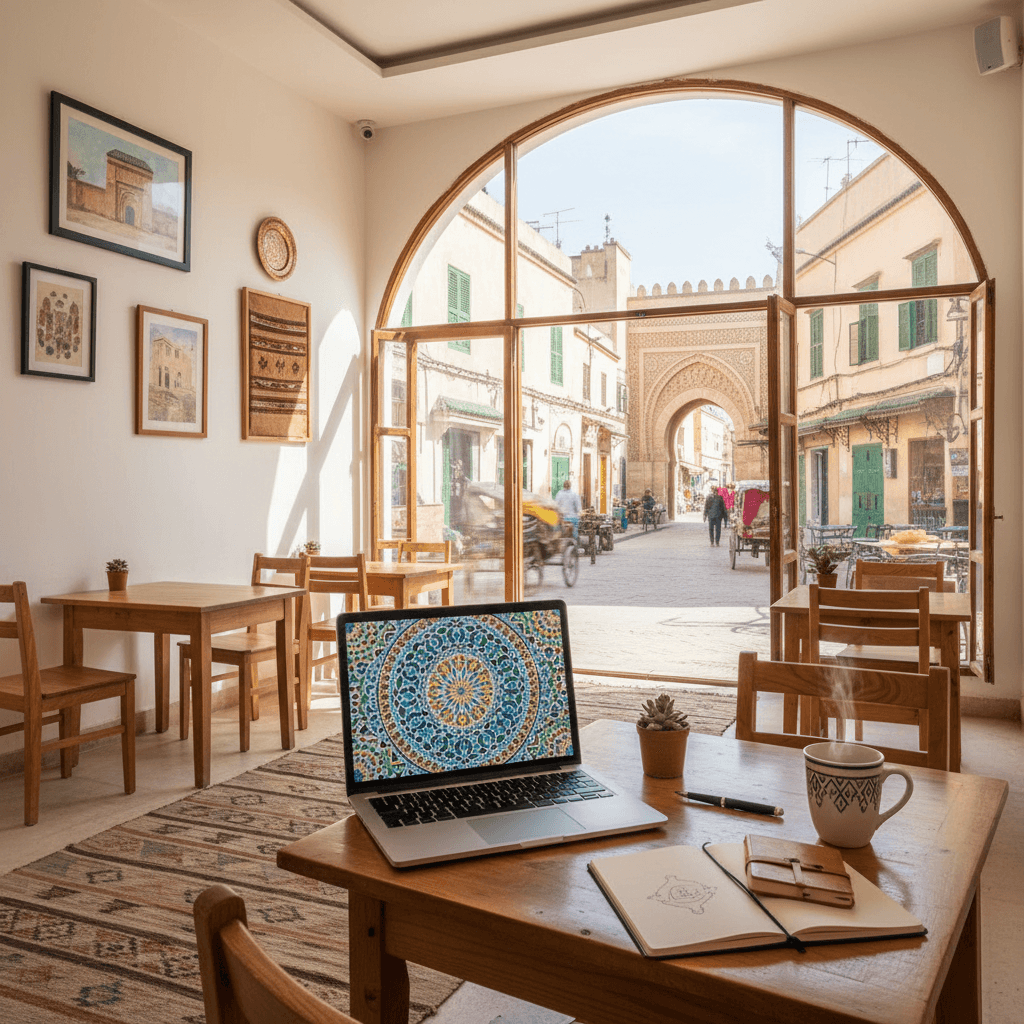
Meknes
🇲🇦 Morocco
Meknes doesn't try to impress you. That's honestly what makes it work. While Fez performs for the cameras and Marrakech sells you a version of itself, Meknes just exists and that's a genuinely rare thing in Morocco's tourist circuit.
It's one of the country's four imperial capitals, with a UNESCO-listed medina, crumbling palace walls the size of city blocks and souks that smell like cumin and motor oil in equal measure. The call to prayer echoes off stone that's been standing since the 17th century, it hits differently when there aren't tour groups jostling around you for a photo.
Most nomads who land here do so by accident, a day trip from Fez that turns into a week. The pace is slower, the touts are fewer (though they're still there, don't mistake that for none) and a full month of rent, food and transport can come in around $589. That's not a typo.
The tradeoffs are real, though. English is scarce outside a handful of Ville Nouvelle cafes, nightlife is low-key to the point of nonexistent and if you need the energy of a city that never sleeps, Meknes will frustrate you within a week. Summers are brutally hot, the kind of dry, gritty heat that makes you question your own judgment and the medina's unlit alleys aren't somewhere you want to be wandering after midnight.
What you get instead is focus. Expats who've stayed longer than planned often say the same thing: there's something about the absence of spectacle that lets you actually work. The Ville Nouvelle has wide boulevards, decent WiFi and cafes where nobody's rushing you out. The medina has harira soup for under a dollar and a kind of ambient chaos that's weirdly grounding once you stop fighting it.
Meknes suits a specific type of traveler. Not someone chasing rooftop bars and Instagram moments, but someone who wants to sit in a tiled courtyard, drink mint tea that's too sweet and hear the city go about its actual life around them. If that sounds appealing, turns out you've found your city, if it sounds dull, Marrakech is three hours south.
Meknes is, honestly, one of the cheapest places you can base yourself in North Africa. Most nomads land here expecting Morocco prices and still end up surprised by how far their money goes. The city rewards people who stay long enough to figure it out.
A realistic monthly budget for one person runs around $589 including rent, with food at roughly $233, transport at $44 and utilities plus internet coming in around $56. That's not a backpacker-scraping-by number, that's a comfortable, eat-well, live-decently number.
Rent
- Budget (shared housing or outskirts): $120 to $200 per month
- Mid-range (studio or 1BR in city center): $163 to $257 per month
- Hamria furnished studios: 2,500 to 4,000 MAD, central location, easier to lease short-term
Food
- Street food: $1 to $3, harira soup and msemen near the medina souks, the smell of cumin and charcoal hits you before you even see the stalls
- Mid-range lunch: around $2.88; dinner for two at a sit-down spot runs about $16.50
- Upscale: places like Le Murano push prices higher, still cheap by Western standards
Transport
- Single bus ticket: 4 MAD (about $0.44)
- Monthly pass: roughly $16.30
- Taxi (8km): about $5.22 via inDrive, where you bid the price
Coworking
- Day pass: around 25 MAD
- Monthly open space: 480 to 1,690 MAD depending on the setup
The three spending tiers break down simply. Budget living sits around $500 a month, shared housing and street food, doable but tight. Mid-range at $800 to $1,000 gets you a decent 1BR and cafe lunches without thinking twice. Comfortable, meaning a central apartment and regular dinners out, runs $1,200 or more, still cheaper than most European cities on a bad day.
Summers get brutally hot, which turns out affects your spending too, cafes with AC become non-negotiable, taxis replace walking. Factor that in. The base costs are low, the lifestyle tax is real.
Meknes has three neighborhoods worth knowing. They serve different needs and picking the wrong one will genuinely affect your day-to-day life here.
For Digital Nomads: Ville Nouvelle
This is where most nomads land and honestly, it makes sense. Wide boulevards, reliable WiFi in the cafes and a general sense that things work the way you'd expect them to. Rent for a decent 1BR runs around 2,500 MAD a month, internet holds steady at 46 to 90 Mbps, it's not glamorous but it gets the job done.
It's quieter than the medina, which is either a feature or a bug depending on why you came to Morocco. You won't smell cumin and charcoal smoke every time you step outside, but you also won't spend twenty minutes arguing your way past a souk tout when you just want coffee.
For Expats and Families: Hamria
Hamria sits close to Hassan II Avenue and the Hôpital Med V, which matters more than people admit when they're choosing a neighborhood. Furnished studios here run 2,500 to 4,000 MAD a month, mid-range but genuinely central and the area's quieter than Ville Nouvelle without feeling isolated.
Families, turns out, do well here specifically because the amenities are practical rather than pretty. Pharmacies everywhere, decent transport links and enough space to actually live rather than just crash between sightseeing. Traffic gets annoying around rush hour, that's the real tradeoff.
For Solo Travelers and Culture Seekers: The Medina
The medina is loud, layered and frankly a little overwhelming at first. The smell of harira from street carts, the call to prayer bouncing off stone walls, vendors who've clocked you as a tourist before you've even stopped walking. That's the texture of it.
Rent is cheaper here, sometimes under 1,600 MAD for a basic studio and you're walking distance from Place Al Hedim and Bab Mansour. But don't wander unlit streets after dark, keep your phone in a front pocket and accept that modern amenities are sparse. It's worth it for short stays, most long-termers eventually migrate to Ville Nouvelle or Hamria for sanity.
Meknes won't blow you away with coworking infrastructure. It's not Lisbon, it's not even Casablanca. But for a city this size, the internet situation is, honestly, more solid than most people expect before they arrive.
Average speeds run between 46 and 90 Mbps on a good connection, which is enough for video calls, large uploads and everything else remote work throws at you. Café WiFi in Ville Nouvelle is generally reliable and most furnished apartments in Hamria come with decent broadband already set up. The Medina is spottier, it depends entirely on your riad and landlord, so don't assume you'll have a stable connection just because the listing says WiFi.
There are a handful of coworking spaces listed in Meknes, around three on major platforms, though the scene is still young. Pricing follows the Fes-Meknes regional standard: roughly 25 MAD for a day pass and 480 to 1,690 MAD monthly depending on whether you want a hot desk or a dedicated spot. Those prices are, turns out, some of the cheapest you'll find in any Moroccan city. Most nomads working here end up in cafés rather than formal coworking spaces, which works fine if you're not on calls all day and don't mind the background noise of espresso machines and Arabic pop.
For SIM cards, pick one up before you leave the airport if you're flying in regionally or grab one at any phone shop in Ville Nouvelle within the first hour of arriving. Three networks to know:
- Orange: Best data speeds in urban areas, good for Meknes day-to-day
- Maroc Telecom: Strongest rural coverage if you're day-tripping to Volubilis or Moulay Idris
- Inwi: Cheapest plans, weirdly competitive on data volume
Startup costs run 50 to 100 MAD, data plans are cheap, it's not something you'll stress about. Wise works well for transferring money in, ATMs are everywhere in Ville Nouvelle and most coworking or café payments are cash anyway.
The honest summary: Meknes isn't built for nomads yet, the infrastructure is functional rather than impressive. If you need a polished coworking setup with meeting rooms and networking events, you'll be frustrated. If you just need fast internet and a quiet place to work, you'll be fine.
Meknes is, honestly, one of the safer cities in Morocco for travelers and nomads. That doesn't mean you switch your brain off. Petty theft around Place Al Hedim and the souks is real, pickpockets work crowds and the unlit back alleys of the Medina after dark aren't somewhere you want to be testing your confidence.
Stick to well-lit streets at night, keep your phone in your front pocket and don't flash cash in the markets. Most people who get into trouble here weren't robbed so much as they were distracted, a tout pulls your attention one way, your wallet goes another. It's an old trick, it still works.
For emergencies, dial 15 for an ambulance or 19 for police. Save both before you need them.
Medical Care
Hôpital Med V in the Hamria neighborhood is your main public hospital option. Care is decent for routine issues, not where you'd want to be for anything serious. Expats and long-term nomads almost universally recommend carrying solid travel insurance because private clinics, while better equipped, add up fast without coverage.
Pharmacies are everywhere, turns out there are over 80 in the city and pharmacists are genuinely helpful for minor ailments. They'll often diagnose and recommend on the spot, which is useful when your French or Darija is shaky. For anything beyond a cold or stomach issue, get yourself to a private clinic in Ville Nouvelle rather than waiting in the public system.
Practical Safety Tips
- Valuables: Leave your passport in your accommodation; carry a photo copy instead.
- Touts: In the Medina souks, a firm "la shukran" (no thank you) and keeping walking is your best tool, engaging even briefly invites pressure.
- Cash: ATMs are widespread, but limit how much you carry in the markets.
- Night movement: Ville Nouvelle feels safe after dark; the Medina, less so once the main drag quiets down.
- Transport: Use inDrive or Yassir apps for fixed-price rides rather than negotiating with street taxis at night.
Solo women travelers find Meknes manageable, frankly more so than Marrakech or Fez, though persistent attention in the Medina is annoying rather than threatening. Dressing modestly cuts most of it down considerably.
Meknes is, honestly, one of the more walkable cities in Morocco. The medina and Ville Nouvelle are both compact enough to cover on foot and most of what you need day-to-day sits within a 20-minute walk of wherever you're staying. That said, the two zones aren't adjacent, so you'll find yourself crossing between them more than you'd expect.
For longer trips, public buses are cheap. A single ticket runs 4 MAD (about $0.44) and the routes cover most of the city, though the schedules can be unpredictable and the stops aren't always obvious to newcomers. Most nomads skip the buses after the first week.
Ride-hailing is the smarter move. inDrive is the dominant app here and it works on a bidding system where you propose a fare and drivers accept or counter, which keeps prices honest and usually lands you an 8km ride for around $5. Yassir also operates in Meknes with fixed pricing and 24/7 availability, it's worth having both apps installed because driver availability varies by time of day. Petit taxis (the small beige ones) are everywhere too, just agree on a price before you get in or insist on the meter.
There's no bike or scooter rental scene to speak of. Don't plan around it.
Getting in and out of the city takes a bit of planning because Meknes doesn't have its own commercial airport. Your two realistic options are Rabat (about a 2-hour bus ride for roughly 120 MAD) or Fes Saiss Airport, which is closer and reachable by train and bus for 26 to 50 MAD or by taxi for around 500 MAD if you're splitting the cost or just tired. Most travelers coming from Europe fly into Fes, it's the cleaner connection.
Navigation inside the medina is, turns out, genuinely confusing even with GPS. Streets don't always appear correctly on Google Maps, so download Maps.me before you arrive and save your key locations offline. The call to prayer echoing off the old walls helps you orient yourself more than you'd think, but it won't stop you from getting turned around near the souks at least once.
- Local bus ticket: 4 MAD (~$0.44)
- Ride-hailing apps: inDrive (bid-based), Yassir (fixed fare, 24/7)
- Taxi estimate (8km): ~$5
- Airport transfer to Fes Saiss: 26-50 MAD by train/bus; ~500 MAD by taxi
- Navigation app: Maps.me (offline medina maps)
Darija is what you'll hear everywhere. It's Moroccan Arabic and it sounds nothing like the Modern Standard Arabic you might have studied, so don't expect your Duolingo streak to save you. French fills in most of the gaps, especially in Ville Nouvelle shops, restaurants and any formal context like pharmacies or banks.
English is, honestly, pretty thin on the ground here. You'll find basic English at a few cafes in Ville Nouvelle and occasionally at hotels, but in the Medina souks or with taxi drivers, you're working with gestures and Google Translate. Most nomads say this is actually one of the bigger daily friction points compared to Fez or Marrakech, where the tourist economy has pushed English further into everyday interactions.
That said, locals are genuinely patient, communication gaps don't tend to turn hostile, they're usually resolved with a smile and some pointing. A few Darija phrases go a surprisingly long way toward warming people up:
- Yes: Na'am or Wakha
- No: Laa
- How much?: Bchhal?
- Thank you: Shukran
- Good / OK: Mzyan
Learn "Bchhal" before you set foot in the souks near Place Al Hedim. You'll use it constantly and it signals you're not completely clueless, which, turns out, does actually affect the opening price you get quoted.
For apps, download Google Translate and set Darija to offline mode before you arrive. It's imperfect, the dialect is weirdly underrepresented in most translation tools, but it handles enough to get you through a pharmacy visit or a landlord conversation without total disaster.
French is genuinely useful here, more so than in coastal cities where English has taken over. If you have even intermediate French, Meknes will feel noticeably easier to navigate, especially for anything administrative or medical. Expats who speak French consistently say it opens doors that English simply doesn't.
One practical note: written signage in the Medina is often Arabic-only. Frankly, even with Maps.me loaded and a solid sense of direction, you will get turned around in the narrower derbs. Ask a local, they'll point you right, no shared language required.
Meknes has a Mediterranean climate, which sounds pleasant until you experience a July afternoon when the heat sits at 100°F and the air smells like hot dust and exhaust baking off the medina walls. Summers are brutally hot. Most nomads who stay long-term time their arrival for September or October, when temperatures drop into the mid-80s°F, the light turns golden and you can actually walk the souks without sweating through your shirt before noon.
Spring, honestly, is the most seductive season. March through May brings temperatures in the 60s and 70s°F, wildflowers outside the city walls and the smell of orange blossom drifting through Ville Nouvelle in the evenings. Rain is possible, sometimes more than possible, but it tends to come in short bursts rather than grey weeks of drizzle.
Winter is underrated. December through February sees highs around 60°F, cold tile floors in the morning and rain that drums on the tin roofs of the medina in a way that's, weirdly, one of the more atmospheric things about the city. It's not cold by European standards, it's genuinely chilly though, especially at night when temperatures dip into the low 40s°F. Cafes in Ville Nouvelle fill up fast, the pace slows down even more than usual and accommodation prices drop.
The sweet spots are September through November and March through May. You get manageable temperatures, low rainfall and the city feels alive without being overwhelmed by summer heat.
- Best months overall: October and April, mild temperatures, low rain, good light
- Avoid if heat-sensitive: June through August, highs regularly hit 95 to 104°F
- Winter (Dec to Feb): Cool and rainy, turns out it's a solid budget season with fewer tourists and lower rents
- Spring (Mar to May): Warm days, occasional rain, the medina smells incredible
- Rainfall peak: November through January, around 50 to 70mm per month
One thing travelers don't always account for is the wind. Meknes sits inland on a plateau, so a gritty, dry wind can roll through in spring, it's not dangerous, just annoying if you're working from a rooftop cafe. Pack a layer regardless of the season, mornings and evenings shift fast.
Cash is king in the souks, full stop. ATMs are easy to find in Ville Nouvelle and around the medina, but vendors in the market stalls won't touch a card and honestly, most smaller restaurants don't either. Bring more dirhams than you think you'll need before heading into the old city, because running back out to find a machine mid-haggle is a genuine pain.
For your SIM, Orange is the move. You can pick one up at the airport or at any of the phone shops clustered near Avenue Hassan II, startup costs run around 50 to 100 MAD and you'll get reliable 4G across Ville Nouvelle and most of the medina. Maroc Telecom covers rural areas better if you're planning day trips out to Volubilis or Moulay Idris, Inwi is cheapest but the coverage, turns out, is spottier than advertised.
Dress modestly in the medina, this isn't optional and it isn't just about blending in. Women especially will have a noticeably easier time moving through the souks near Place Al Hedim without attracting attention if shoulders and knees are covered. Men in shorts get stares. It's a small adjustment, worth making.
- Haggling: Start at roughly half the asking price and work up slowly. The first number you hear isn't a real number, arguing aggressively won't help though, a relaxed back-and-forth works better.
- Greetings: Lead with "Salam Alaikum" and you'll get a warmer response almost everywhere. English is limited outside tourist-facing cafes, so download Google Translate's offline Darija pack before you arrive.
- Navigation: Maps.me handles the medina's winding lanes better than Google Maps, which frequently loses the plot around the older derbs.
- Getting around: inDrive lets you bid on fares, which keeps costs down, Yassir runs 24/7 and is slightly more predictable. Local buses cost 4 MAD a ticket.
- Apartments: Masaken.ma lists furnished studios in Hamria and Ville Nouvelle, most landlords expect a month upfront plus a deposit, so budget accordingly.
Summers are brutally hot, June through August regularly hits 95°F and above with a dry, gritty wind that gets into everything. The sweet spot is September through November, warm enough to sit outside, cool enough to actually walk around without feeling wrecked by noon. Plan around that if you can.
Need visa and immigration info for Morocco?
🇲🇦 View Morocco Country GuideEasy Landing
Settle in, no stress