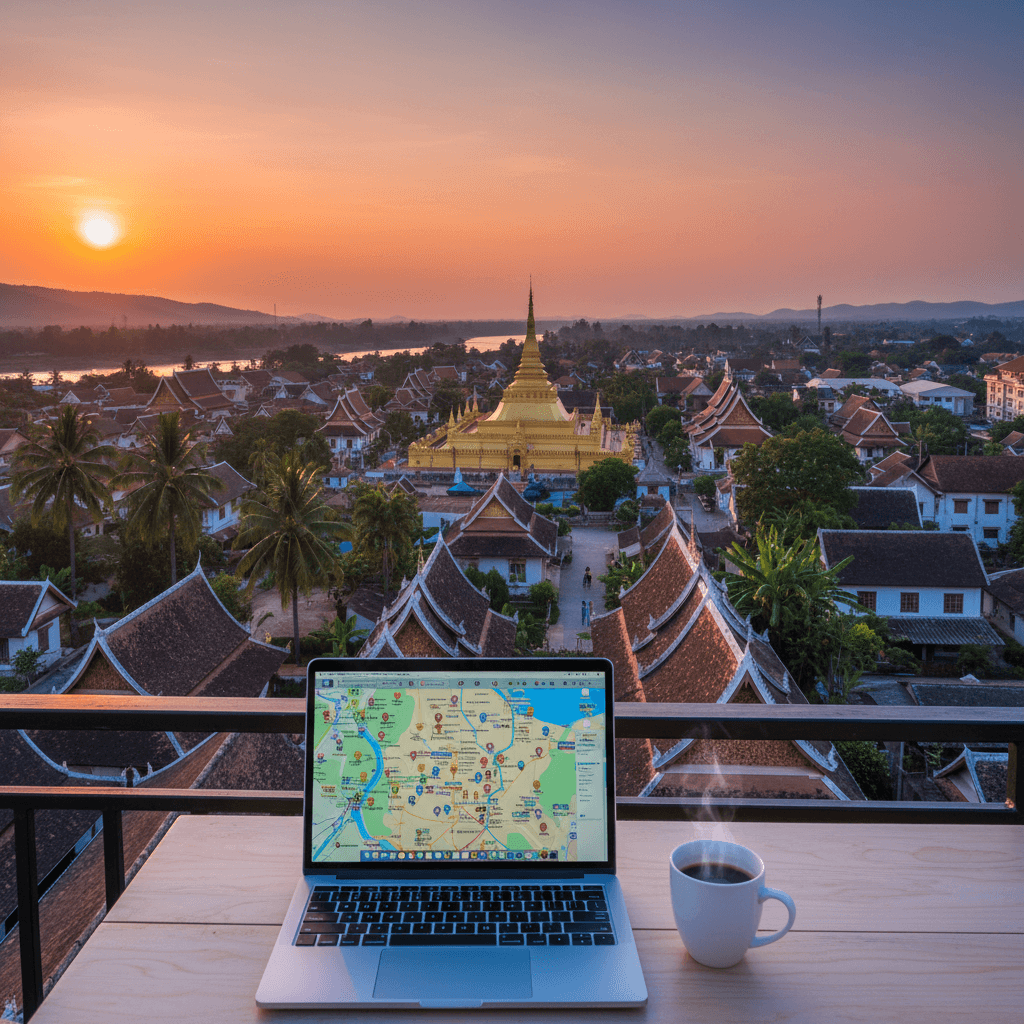
Luang Prabang
🇱🇦 Laos
The Vibe: Asia at Half Speed
Luang Prabang doesn't just ask you to slow down; it demands it. While nomads in Bangkok are dodging motorbikes and those in Chiang Mai are hopping between networking events, the community here is built around the rhythm of the Mekong. You'll wake up to the sound of temple bells and the sight of saffron robed monks collecting alms, a daily ritual that sets a meditative tone for the workday ahead. It's a place where the French colonial architecture feels lived in rather than preserved, and the humidity is best managed with a cold Beerlao by the river.
Most nomads find that this isn't the spot for a high energy hustle. It's the destination for the "deep work" phase of a project or a restorative 1 to 3 month stay. The energy is organic and unforced. You'll likely meet fellow remote workers over a pour over at Saffron Coffee or while cooling off at Kuang Si Falls rather than at a formal meetup. It’s quiet, safe, and incredibly walkable, though the occasional power flicker or "Lao time" service reminds you that you're deep in Southeast Asia.
Cost of Living Breakdown
Your budget goes a long way here, though it's slightly pricier than rural Laos due to its UNESCO status. Most solo nomads spend between $767 and $1,254 per month depending on their craving for air conditioning and Western comforts.
- Budget ($550 to $700/month): Living in social hostels like La Casa, eating primarily $1 to $2 street food like khao soi, and working from free cafe WiFi.
- Mid-range ($1,000 to $1,200/month): A private room in a guesthouse, regular cafe meals at $5 to $7, and a dedicated hot desk at a coworking space.
- Comfortable ($1,500+ /month): A high end apartment or boutique hotel, upscale dining at spots like Avani+, and frequent weekend trips.
Where to Plant Your Flag
The town is small, but the neighborhood you choose dictates your daily noise levels and social access.
Old Town: This is the heart of the action. You're steps away from the night market and the best cafes. It's the most walkable area, but it gets crowded with tourists and can stay noisy until the evening curfew. Expect to pay $476 to $800 for a decent studio here.
Mekong Riverside: Ideal for expats or those staying longer. It’s quieter and offers stunning sunset views. Rent is often cheaper, ranging from $400 to $600, but you'll likely want a bicycle or scooter to get to the main laptop friendly cafes.
Nam Khan Riverside: This area has a younger, more social energy. It’s home to yoga studios and popular hostels like Mad Monkey. It feels a bit more peripheral but offers a great balance of affordability and social life.
Connectivity and Workspace
Internet reliability has improved significantly, but it’s still wise to have a backup. The Desk Co-Working is the gold standard for stability, with monthly memberships costing between $75 and $181. If you prefer the "cafe hopping" lifestyle, Aromdee Nature and Saffron Coffee offer speeds around 65 Mbps, which is plenty for video calls.
For mobile data, grab a Unitel SIM card at the airport. It costs about $6 to $12 for a 30 day plan with 7GB of data. It has the most reliable coverage when you're exploring the outskirts of town.
Logistics and Safety
Getting around is simple. The peninsula is only 2km by 1km, so your own two feet are usually enough. For longer trips, tuk-tuks are everywhere and usually cost $1 to $2 for a short hop. If you’re staying a while, renting a scooter for $4 to $8 a day gives you the freedom to chase waterfalls whenever the humidity peaks.
Safety is rarely a concern. Violent crime is almost nonexistent, though you should keep an eye on your bag at the night market. Healthcare is basic; the Provincial Hospital can handle a flu or a scrape, but for anything serious, expats almost always head to Thailand. Make sure your insurance covers medical evacuation, as a flight to Bangkok can easily top $10,000.
The Social Scene
Nightlife is mellow. Don't expect clubs; instead, expect riverside bars and late night bowling. To find your tribe, join the Luang Prabang Expats Facebook group or volunteer for an afternoon at Big Brother Mouse, where you can help local students practice their English. It’s a great way to give back and meet people who actually live in the community rather than just passing through.
The Price of Serenity
Luang Prabang is one of those rare places where your bank balance can actually relax. It is significantly more affordable than regional hubs like Bangkok or Singapore, but it offers a much higher quality of life than the price tag suggests. Most nomads find that a monthly budget between $1,000 and $1,200 buys a very comfortable lifestyle with a private room, daily cafe visits, and plenty of Lao beer by the river.
If you are on a strict budget, you can get by on $550 to $700 per month. This usually involves staying in social hubs like La Casa or Mad Monkey and sticking to the incredible street food at the Morning Market. On the flip side, if you want a luxury villa and high end dining at spots like Avani+, you should plan for $1,500 or more.
Monthly Budget Breakdowns
- Budget Tier ($550 to $700): Expect to spend $400 to $500 on a hostel or basic guesthouse. Your food budget will hover around $200, mostly spent on $1 to $2 bowls of khao soi. You will likely work from free cafes rather than paying for a desk.
- Mid-range Tier ($1,000 to $1,200): This covers a private studio in the Old Town for $476 to $800. You will have $269 for mid-range meals, $43 for transport, and a $75 to $181 membership at a dedicated workspace.
- Comfortable Tier ($1,500+): This allows for a premium apartment or a riverside house for $800 to $1,200. You can eat out at upscale restaurants every night and easily afford weekend trips to Kuang Si Falls.
Where to Plant Your Roots
The peninsula is small, but each pocket has a distinct flavor. Most first timers head straight for the Old Town. It is incredibly walkable and puts you steps away from Saffron Coffee and the night market. You will pay a premium here, with rents ranging from $476 to $800, and it can get a bit noisy during peak tourist season.
Expats and families often prefer the Mekong Riverside. It is quieter and feels more authentic, with scenic views that never get old. Rents are softer here, typically $400 to $600, though you might find yourself needing a scooter to get to the main coworking spots.
If you want a social scene without the Old Town price tag, look at Nam Khan Riverside. It is popular with the yoga crowd and younger nomads. It is affordable and has a few more nightlife options, though it feels a bit more peripheral to the main sights.
Connectivity and Workspace
The internet in Luang Prabang has improved. You can expect average speeds of 34-35 Mbps for fixed broadband. For those with heavy video call schedules, The Desk Co-Working is the gold standard for stability. They offer hot desks for roughly $75 to $181 per month.
The cafe culture is the real winner for remote work. Saffron Coffee is a nomad favorite with reliable WiFi, while Aromdee Nature offers a peaceful garden vibe with reliable WiFi. For mobile data, pick up a Unitel SIM at the airport. It costs between $6 and $12 for 7GB of data valid for 30 days.
Practical Spending Tips
Cash is still king in Luang Prabang. While hotels might take cards, they often tack on a 3% fee. ATMs are everywhere, but they charge per withdrawal, so using a fintech card like Wise can help minimize the hit. For getting around, the town is tiny enough to walk, but a bicycle rental for $1 to $2 a day is a great investment. If you need a lift, apps like inDrive or KOKKOK are much cheaper than hailing a tuk-tuk on the street, which usually costs $1 to $2 per ride.
The Solo Traveler: Old Town (The Heritage Peninsula)
If you want to step out of your door and be seconds away from the morning alms ceremony or a world class espresso, the Old Town is your best bet. This UNESCO protected peninsula is the heart of Luang Prabang, characterized by its preserved French colonial villas and gold roofed temples. It is the most walkable part of the city, making it easy to hit the Night Market or grab a croissant at Le Banneton without needing a bike.
- Rent: expect to pay between $476 and $800 for a decent studio or guesthouse room.
- Vibe: central, historic, and undeniably charming, though it gets crowded when the tour groups arrive.
- Best for: those who want to be in the middle of the action and don't mind a bit of evening noise from the night market area.
The Digital Nomad: Nam Khan Riverside
Just across the bamboo bridge or further down the banks of the Nam Khan river, you'll find a neighborhood that leans into a younger, more social energy. This area is a magnet for nomads who prioritize community. It's home to social hubs like Mad Monkey and La Casa, and it feels a bit more "lived in" than the polished Old Town. You're close enough to the The Desk Co-Working space to stay productive, but far enough from the main tourist drag to find a quiet corner.
The WiFi here is generally solid at spots like Aromdee Nature. Most nomads find the balance of yoga studios, riverside bars, and affordable cafes makes this the easiest place to stay for a month or two. It’s also where you’ll find the best deals on $4 to $8 daily scooter rentals to explore the outskirts.
- Rent: mid range guesthouses and apartments typically run $450 to $700 per month.
- Vibe: social, active, and budget friendly.
- Best for: remote workers looking for community, fast internet, and a sunset beer by the river.
The Long Term Expat: Mekong Riverside
For those planning to stay through the 2025 to 2026 season, the Mekong side of town offers a slower, more residential pace. Expats often prefer this area because it feels less like a museum and more like a neighborhood. The views of the Mekong are spectacular, and the prices for long term rentals are significantly lower than the peninsula. You'll find more traditional Lao houses for rent here, often with gardens and big porches.
While it’s a bit further from the main cluster of cafes, apps like inDrive or KOKKOK make it easy to get into town for a few dollars. Most expats recommend this area if you want to cook your own meals using produce from the local markets and avoid the "backpacker" noise. It’s the quietest part of the city, perfect for those who have a 9 to 5 schedule and need a reliable night’s sleep.
- Rent: comfortable apartments or small houses range from $400 to $600.
- Vibe: peaceful, scenic, and authentic.
- Best for: slow travelers and expats who want a local feel and a lower cost of living.
Families: The Southern Outskirts
Families often find the tight streets of the Old Town a bit restrictive. Moving just south of the main center, near the Provincial Hospital or toward the road to Kuang Si Falls, offers more space for the money. You’ll find larger villas that can accommodate children, often at a fraction of the price of a cramped hotel room downtown. It is a safer, quieter environment where kids can have a bit of yard space, though you will definitely need to rent a car or a few scooters to get around comfortably.
- Rent: $800 to $1,200 for larger, multi bedroom homes.
- Vibe: suburban, quiet, and spacious.
- Best for: families or groups who need multiple bedrooms and don't mind a 10 minute commute.
Connectivity and Speed
You won't find fiber optics on every street corner, but Luang Prabang's internet has improved significantly. Average speeds in Laos hover around 34-35 Mbps for fixed broadband, which is plenty for video calls and standard remote work. That said, the infrastructure can be temperamental. Power outages happen, especially during the monsoon season from May to October, so a backup power bank and a solid data plan are non-negotiable.
Most nomads rely on Unitel for mobile data. It has the most reliable coverage across the peninsula. You can grab a SIM card at the airport or at various shops in town for about $6 to $12, which usually nets you 7GB of data for 30 days. If you're planning a longer stay, look for the unlimited monthly packages that typically run between $6 and $9. Just remember to bring your passport for registration.
The Coworking Scene
For a dedicated professional environment, The Desk Co-Working is the primary player in town. It's the go-to spot if you need stability and high speed. They offer hot desks starting around $75 a month, though more premium setups can go up to $181. It's a quiet space where you'll actually see people getting deep work done rather than just scrolling social media.
If you prefer a more social atmosphere, the hostel scene often doubles as a workspace. La Casa and Mad Monkey are popular with the younger crowd, though they can get noisy. For a more balanced vibe, Sabaidee Guesthouse offers decent speeds of 29 Mbps down and 25 Mbps up, making it a favorite for those who want to live and work in the same spot.
Best Cafes for Deep Work
Luang Prabang excels at the "work cafe" lifestyle. The French influence means the coffee is excellent and the seating is usually comfortable enough for a few hours of laptop time. Most cafes don't mind if you linger, provided you keep the lattes coming.
- Saffron Coffee: This is arguably the most popular nomad hub. It offers reliable WiFi suitable for video calls and is right on the Mekong, so you get a breeze with your workflow.
- Aromdee Nature: If you need a change of scenery, this spot offers a peaceful environment with reliable WiFi. It's great for clearing your head when you've hit a wall.
- Common Grounds: A reliable staple in the Old Town with plenty of power outlets and a menu that caters to Western tastes if you're craving a break from sticky rice.
Digital Nomad Community
Unlike Chiang Mai, the community here is small and organic. You won't find a calendar packed with formal networking events. Instead, people meet up through the Luang Prabang Expats or Digital Nomads Laos Facebook groups. Many nomads also spend their afternoons volunteering at Big Brother Mouse to help locals practice English, which is a fantastic way to actually meet the community rather than staying in a digital bubble.
Most people find that a 1 to 3 month stay is the sweet spot. It's enough time to get into a rhythm without the slow pace of life becoming a hindrance to your productivity. If you're a night owl or someone who needs high-energy urban networking, you might find the 11:00 PM town curfew a bit stifling, but for those focused on a healthy work-life balance, it's nearly perfect.
Keeping it Safe on the Peninsula
Luang Prabang is one of those rare places where the biggest threat to your safety is usually a slippery sidewalk after a monsoon downpour or a stubborn tuk tuk driver overcharging you by a couple of dollars. Most nomads find the city incredibly secure. You can walk home from a late dinner in the Old Town or along the Mekong Riverside without looking over your shoulder. Violent crime is remarkably low, which is part of why the "slow life" vibe here actually feels authentic rather than forced.
That said, don't let the spiritual atmosphere make you careless. Petty theft happens, particularly around the night market or in crowded hostels. Keep an eye on your phone and bag when you're distracted by the silk scarves and street food. If you're heading out of town for a trek, stick to the well worn paths. Laos is still dealing with Unexploded Ordnance (UXO) from past conflicts, and while the main tourist areas and waterfalls are clear, rural off-roading isn't the place to play explorer.
- Emergency Number: Dial 119 for police assistance.
- Common Scams: Always negotiate your tuk tuk fare before getting in, though using apps like inDrive or KOKKOK is a better way to ensure you're paying the local rate of $1 to $2.
- Night Safety: Street lighting can be dim in the Nam Khan Riverside area, so keep a small flashlight or your phone handy.
Healthcare and Medical Realities
If you come down with a standard stomach bug or a mild fever, you'll be fine. The city is dotted with pharmacies that stock most basic Western medications, and the Provincial Hospital can handle minor ailments or basic stitches. Most expats recommend the local clinics for quick blood tests if you're worried about tropical bugs like Dengue, which can occasionally crop up during the wet season from May to October.
For anything serious, the local infrastructure reaches its limit quickly. If you have a major accident or a complex medical emergency, you don't want to be treated in Luang Prabang. The standard protocol for nomads and expats is a medical evacuation to Thailand, specifically to Udon Thani or Bangkok, where the hospitals are world class. This is not a place to skip out on travel insurance. An emergency medevac can easily run $10,000 or more out of pocket.
Practical Health Tips
- Drinking Water: Never drink the tap water. Stick to bottled water or the large refillable jugs provided by most guesthouses.
- Insurance: Ensure your policy covers "medical evacuation" specifically. SafetyWing or World Nomads are popular choices here.
- Pharmacies: Look for the larger pharmacies near the morning market; they usually have staff who speak enough English to help you find what you need.
- Vaccinations: Most travelers arrive with shots for Hepatitis A and Typhoid. Check with a travel clinic at least a month before you land.
While the healthcare isn't what you'd find in a major capital, the lifestyle in Luang Prabang tends to keep people healthy. The air is generally cleaner than in Vientiane, the food is fresh, and the lack of a heavy partying culture means you're more likely to spend your mornings at Saffron Coffee than nursing a hangover. Just keep your insurance active and your wits about you in the markets, and you'll find it's a very easy place to live a low stress life.
The Peninsula on Foot
Luang Prabang is one of those rare places where your own two feet are the most efficient mode of transport. The main peninsula, which holds the UNESCO heritage core, is roughly 2km by 1km. You can walk from the morning market in Old Town to the tip of the Mekong confluence in about 20 minutes. Most nomads find that staying central means they rarely need a motor for daily life.
The sidewalk quality varies, and the tropical heat is no joke, especially in April. If you are walking between cafes like Saffron Coffee and your guesthouse during the day, stick to the shaded sides of the French colonial buildings. At night, the town is well lit and feels remarkably secure for solo strolls.
Bicycles and Scooters
If you are staying slightly further out in the Nam Khan Riverside area, a bicycle is the expat's best friend. Most guesthouses offer them for free, or you can rent a decent cruiser for $1 to $2 a day. It is the perfect pace for the town's slow rhythm, and parking is never an issue.
For trips to the outskirts or just more freedom, scooters are available for $4 to $8 per day. While the traffic is nothing like the chaos of Hanoi or Bangkok, you still need to be cautious. Local police occasionally check for international driving permits, and wearing a helmet is a must to avoid fines. Keep in mind that gas stations are scarce in the center of town, so keep an eye on your tank before heading out to the waterfalls.
Tuk-Tuks and Ridesharing
You won't find a public bus system here, but tuk-tuks are everywhere. A standard hop within the city limits usually costs between $1 and $2. Drivers often start with a higher "tourist price," so a bit of polite haggling is expected. If you are heading to the airport, expect to pay around $2 to $3 for a tuk-tuk or $7 for a more comfortable private taxi.
Digital nomads who prefer fixed pricing and less negotiation use apps like inDrive or KOKKOK. These are the local equivalents to Uber or Grab. They are particularly useful for late night rides or when you need a car with air conditioning to get to a meeting at The Desk Co-Working without arriving drenched in sweat.
Getting to the Sights
Most travelers head to Kuang Si Falls or the Pak Ou Caves at least once. For these trips, you have a few options:
- Shared Tuk-Tuks: You can find these near the night market. They cost about $5 to $7 per person and leave once they are full.
- Private Minivans: Best for groups, usually costing $25 for a half day trip.
- Electric Boats: For a more scenic route to the caves, riverside piers offer slow boat trips that let you soak in the Mekong views.
Arrival and Logistics
When you land at Luang Prabang International Airport (LPQ), you are only 4km from the city center. The 15 minute journey is a breeze. There is a fixed price taxi stand at the exit, but walking just outside the airport gate can often save you a few dollars if you flag down a passing tuk-tuk. If you are arriving via the new high speed railway, the station is further out, so pre-arranging a pickup with your guesthouse is a smart move to avoid the initial scramble for transport.
The Communication Landscape
Lao is the heart of daily life here. It is a tonal, melodic language that shares some DNA with Thai, though it has its own distinct script and rhythm. In the central peninsula and tourist hubs, you will find that English is widely understood by cafe owners, hotel staff, and younger locals. However, proficiency levels drop off quickly once you step into the local markets or residential outskirts.
Expats and long term nomads often find that the locals are incredibly patient. Even if you only know a few words, the effort is met with a smile. If you are looking to bridge the gap, many nomads spend their afternoons at Big Brother Mouse. It is a local literacy project where you can volunteer for an hour or two to help students practice their conversational English. It is the most organic way to meet people and understand the local perspective without a commercial filter.
Key Phrases and Etiquette
While you can get by with gestures and a smile, mastering the basics goes a long way in building rapport. The Wai, a traditional greeting where you press your palms together near your chest and bow slightly, is standard. Use it when saying hello or thank you to show respect.
- Sabaidee: Hello (the universal greeting).
- Khob chai: Thank you.
- Khob chai lai lai: Thank you very much.
- Bor pen yang: No problem or you are welcome (the unofficial national motto).
- Sabaidee bor?: How are you?
Digital Tools for the Road
Don't rely solely on your data plan for real time translation. While Google Translate is a standby, the English Lao Translator app and the Lao English Dictionary are popular among the expat community because they offer offline pronunciation features. These are lifesavers when you are negotiating a monthly rate on a scooter or trying to explain a specific dietary restriction at the Morning Market.
For navigating and booking rides, apps have changed the game in the last year. Most nomads use inDrive or KOKKOK to get around. These apps remove the language barrier of explaining a specific alleyway to a driver and ensure you are paying the fair local rate rather than the tourist markup.
Connectivity and SIM Cards
Communication is only as good as your signal. For the best coverage, head straight for a Unitel booth at the airport or a shop in the Old Town. You will need your passport to register. Most nomads opt for the 30 day unlimited data packages which typically cost between $6 and $9. While Saffron Coffee and The Desk Co-Working provide the most stable fiber connections for Zoom calls, having a Unitel SIM ensures you stay connected while wandering the riverside.
Social Circles and Community
Networking in Luang Prabang happens more in person than through apps. The community is small and tight knit. You will find most of the digital nomad chatter on Facebook groups like Luang Prabang Expats or Digital Nomads Laos. These groups are the best place to find info on everything from visa runs to the best spot for a Friday night beer by the Nam Khan. If you are looking for a more social vibe, the common areas at La Casa or Mad Monkey are the go to spots for meeting fellow remote workers between tasks.
The Seasonal Rhythm
Luang Prabang follows a distinct tropical pattern that dictates the flow of nomad life. Most people find the sweet spot between November and February. This is the cool, dry season where the mornings are crisp enough for a light sweater and the afternoons hover around a comfortable 26°C to 28°C. It is the peak time for outdoor work sessions at riverside cafes, though you will be sharing the sidewalk with more tourists during these months.
The heat starts cranking up in March and April. April is the hottest month on the calendar, with highs regularly hitting 34°C. While the humidity can be intense, April also hosts the Lao New Year (Pi Mai) celebrations. If you don't mind getting soaked by water fights in the streets, it is an incredible cultural experience, but the high temperatures make air conditioning a non negotiable requirement for your workspace.
The Monsoon Shift
The rainy season arrives in May and lingers through October. August is notoriously the wettest month, seeing about 289mm of rain over roughly 19 rainy days. While the downpours are heavy, they usually happen in short, predictable bursts rather than constant drizzle. The upside for long term stayers is the lush, neon green landscape and significantly lower prices on boutique accommodation. The downside is the occasional power flicker and a bit of isolation as the social scene thins out.
When to Plan Your Stay
If you are looking for the perfect balance of weather and social activity, aim for these windows:
- The Prime Window (November to January): Best for those who want to explore Kuang Si Falls and enjoy the night markets without breaking a sweat. Lows can dip to 14°C in January, so pack accordingly.
- The Shoulder Season (October and February): Great for finding mid range housing deals before the crowds arrive or right as they leave. The weather is generally pleasant and the internet bandwidth is less taxed.
- The Quiet Season (June to September): Ideal for deep work phases. You will spend more time in places like The Desk Co-Working or Saffron Coffee to avoid the rain, but the misty Mekong views are unbeatable for focus.
What to Pack for the Climate
The local culture is conservative, so your wardrobe needs to balance the heat with respect. Light, breathable fabrics like linen or moisture wicking tech gear are your best friends here. You will need to cover your shoulders and knees for temple visits, which are a daily occurrence if you are living in the Old Town. During the cool season, a windbreaker or hoodie is necessary for morning scooter rides. If you arrive during the monsoon, don't bother bringing a heavy raincoat from home; just buy a cheap poncho locally and use the inDrive app to snag a car when the skies open up.
Making the Move
Luang Prabang operates on a different clock than the rest of Southeast Asia. Laos has a nationwide midnight curfew. In practice, most bars and establishments close by 11:00-11:30 PM due to police enforcement, though this primarily applies to locals. It is a town where the morning begins with the silent procession of monks at sunrise. For nomads looking to settle in for a month or two, the rhythm is easy to catch, provided you aren't looking for a high octane party scene. You will find a community that values slow mornings at riverfront cafes and productive afternoons before the night market takes over the main road.
Cost of Living Breakdown
Your budget here goes surprisingly far, though the influx of tourism in the Old Town keeps prices higher than in Vientiane. Most nomads find that a monthly spend of $1,000 to $1,200 covers a comfortable mid range lifestyle including a private room and daily cafe visits.
- Budget Tier ($550 to $700): Stick to hostels like La Casa, eat $1 to $2 street food meals, and work from free cafe WiFi.
- Mid Range Tier ($1,000 to $1,200): Expect a private guesthouse room between $476 and $800, frequent mid range meals at $5 to $7, and a dedicated coworking membership.
- Comfortable Tier ($1,500+): High end apartments or boutique hotels at $800+, upscale dining at spots like Avani+, and private transport for weekend trips.
Where to Set Up Base
The town is small and walkable, but each pocket has a distinct personality. Expats recommend choosing based on your noise tolerance and how often you want to see other travelers.
Old Town: This is the heart of the UNESCO zone. It is perfect for solo nomads because everything is walkable, from the night market to Saffron Coffee. Rent usually hits $500 to $800 here. The downside is the tourist crowds and the lack of quiet during peak season.
Mekong Riverside: Located just a few minutes from the center, this area is a favorite for long term expats and families. It is much quieter with beautiful views and cheaper guesthouses starting around $400. You will need a bike or scooter as it is less walkable than the center.
Nam Khan Riverside: This is the social hub. If you stay near the hostels or yoga studios, you will find a younger, more active crowd. It is affordable and has a bit more energy after dark, though it feels a little more peripheral to the main sights.
Internet and Productive Spaces
WiFi can be hit or miss, and power outages happen occasionally during the rainy season. For serious work, The Desk Co-Working is the gold standard in town with stable speeds and memberships ranging from $75 to $181 a month. If you prefer the cafe circuit, Saffron Coffee offers reliable 65 Mbps speeds and great views. Aromdee Nature is another solid choice for those who need a quiet atmosphere for calls.
As soon as you land at LPQ airport, grab a Unitel SIM card. It has the best coverage across the province. Expect to pay about $6 to $12 for a 30 day data plan with 7GB or more. You will need your passport for registration.
Getting Around and Staying Safe
The peninsula is only about 2km by 1km, so you can walk almost everywhere. For longer trips, rent a bicycle for $1 to $2 a day or a scooter for $4 to $8. If you are renting a scooter, make sure you have an international license and always wear a helmet to avoid fines. For quick hops, use apps like inDrive or KOKKOK to avoid haggling with tuk-tuk drivers who often overcharge tourists.
Safety is rarely an issue here. Violent crime is extremely low, and nomads generally feel secure walking home after dinner. Just keep an eye on your belongings at the night market and avoid wandering into rural areas off the marked paths due to unexploded ordnance risks from past conflicts. If you have a medical emergency, the local Provincial Hospital handles basics, but anything serious requires a trip to Thailand.
Cultural Etiquette
Laos is deeply conservative. When visiting temples, keep your shoulders and knees covered. Remove your shoes before entering homes or sacred spaces. The Wai greeting, a small bow with hands pressed together, is the standard way to show respect. While the town is laid back, public drunkenness is frowned upon and can lead to issues with locals or authorities.
Weather Realities
The best time to visit is from November to April when the weather is dry and temperatures stay between 26°C and 34°C. April is the hottest month and can be quite oppressive. The rainy season runs from May to October, with August being the wettest month. During this time, some rural roads become impassable and the humidity spikes, but the landscape turns incredibly green and lush.
Need visa and immigration info for Laos?
🇱🇦 View Laos Country GuideHidden Gem
Worth the effort
Monthly Budget Estimates
More cities in Laos
Muang Xay
🇱🇦 Laos
Vang Vieng
🇱🇦 Laos
Paksong
🇱🇦 Laos