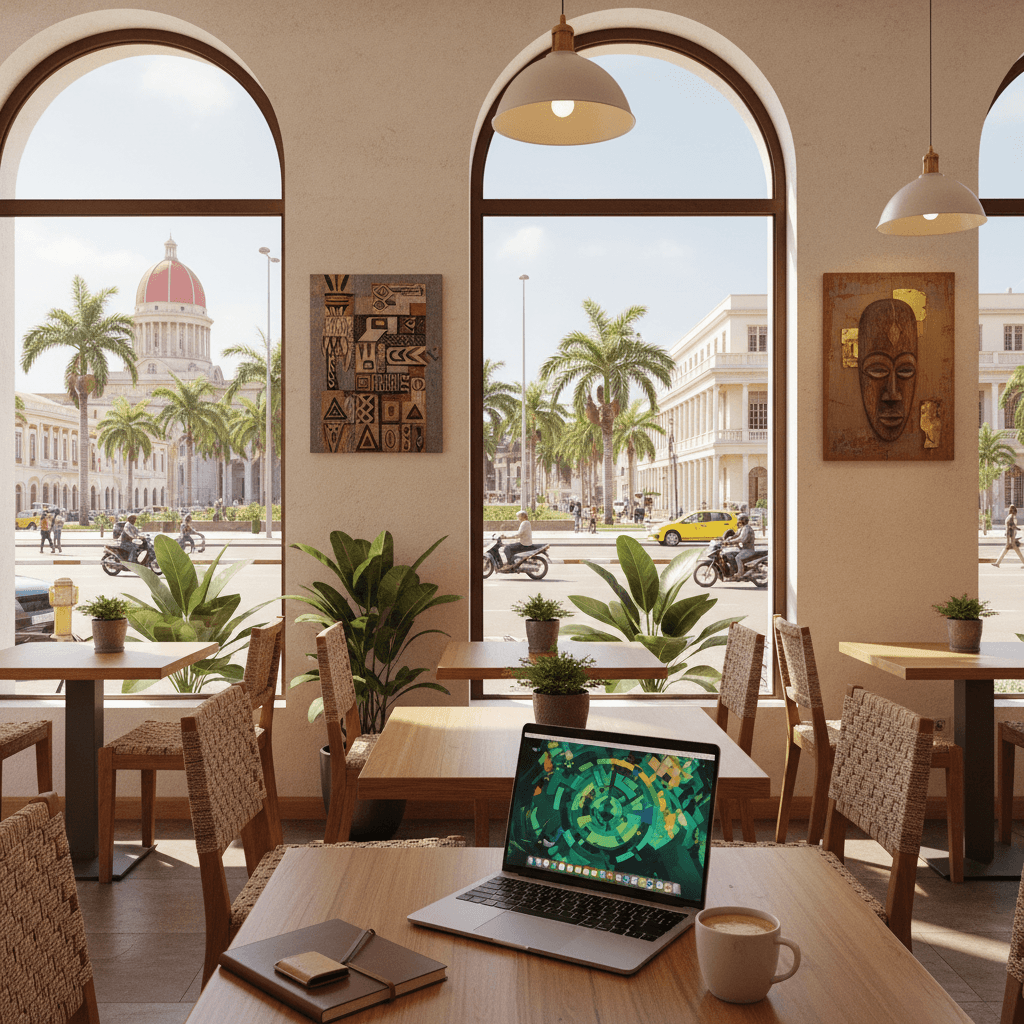
Libreville
🇬🇦 Gabon
The Coastal Capital with a French Twist
Libreville doesn't feel like your typical West African capital. It’s a city where the Atlantic breeze meets manicured boulevards, glass skyscrapers, and a lingering French influence that’s visible in everything from the architecture to the morning’s fresh baguettes. It is arguably one of the most developed and organized cities in the region, making it a soft landing for nomads who want to explore Central Africa without sacrificing basic comforts.
The vibe here is surprisingly laid back for an economic hub. While the city is the heartbeat of Gabon's oil and timber industries, it moves at a rhythmic, coastal pace. You’ll find locals and expats alike strolling along the Bord de Mer, the long waterfront promenade, as the sun dips below the horizon. It’s a place where you can spend your morning on a Zoom call in a modern office building and your afternoon watching waves crash against the shore.
The Nomad Experience
Living here is a lesson in contrast. Most nomads find that Libreville is an expensive playground. It consistently ranks as one of the priciest cities in Africa, and your budget will feel it. You aren't coming here for the $15 hostels or cheap street food circuits; you're coming for the stability, the safety, and the access to some of the world's most pristine rainforests just outside the city limits.
- The Pros: The infrastructure is reliable. Unlike many neighboring capitals, you won't constantly worry about the power cutting out mid-meeting. The city is relatively safe, the 4G speeds are decent at around 42 Mbps, and the French-Gabon fusion cuisine is world-class.
- The Cons: The cost of entry is high. A monthly budget for a single nomad usually hovers around $2,883. If you don't speak a bit of French, you'll find the social barrier quite steep, as English isn't widely used in daily life.
What It Feels Like
There is a polished, almost elite energy to the prime districts, but the city’s soul is found in its markets and seaside stalls. It feels like a city on the cusp of something big. It’s not a "digital nomad hub" in the sense of Bali or Lisbon; you won't find cafes overflowing with MacBooks. Instead, you’ll find a small, tight-knit community of international professionals and adventurous remote workers who value the "off the beaten path" status.
Travelers often say the city feels like a gateway. It’s the comfortable base camp you use before heading out to Loango National Park to see surfing hippos. It’s a place for the nomad who is tired of the same old circuit and wants a base that is modern, expensive, slightly mysterious, and deeply connected to the natural world. You’ll need a healthy bank account to enjoy it fully, but the reward is a unique slice of African urban life that few people ever get to experience.
The Real Cost of Libreville
Libreville holds a unique position in West Africa. It is often cited as one of the most expensive cities on the continent, largely because so much of its high quality goods and produce are imported from Europe. If you are coming from Southeast Asia or even parts of Southern Europe, the price tags here might give you a bit of a shock. However, the cost varies wildly depending on how much you are willing to live like a local versus sticking to an expat lifestyle.
For a solo digital nomad who wants a comfortable, middle of the road experience, you should budget roughly $2,883 per month. This allows for a decent apartment in a safe area, regular meals out, and enough data to stay productive. If you are traveling on a strict budget and sticking to local markets and basic guesthouses, you might squeeze by on $800 to $1,400 per month, but it requires a lot of discipline and a willingness to forgo certain western comforts.
Monthly Budget Breakdown
- Single person (Estimated total): $2,039
- Single traveler (Short term): $3,692
- Family of four: $3,978
- Average nomad spend: $2,883
Housing and Neighborhoods
Rent is your biggest hurdle. Prime areas are where you will find the most reliable electricity and water, which are non-negotiable for remote work. Most expats and high earning nomads congregate in these zones because they offer proximity to international schools and better shopping centers. Expect to pay a premium for these spots. While the city infrastructure is better than much of the surrounding region, you are paying for that stability.
If you choose to live outside the central hubs, prices drop significantly. However, you will likely spend the difference on transportation or a beefed up mobile data plan to compensate for spotty home internet. Most nomads find that paying more for a central location saves them time and frustration in the long run.
Food and Dining
Eating out in Libreville is a tale of two cities. If you sit down at a restaurant in a prime district that serves French cuisine or imported steaks, you can easily spend $40 to $60 for a meal. On the flip side, grabbing local staples like grilled fish or manioc from a street vendor is very affordable. Most expats recommend a hybrid approach: shop at the local markets for fresh fruit and fish, but prepare to pay high prices at supermarkets for imported items like cheese, wine, or specific snacks from home.
Transport and Connectivity
Getting around is surprisingly streamlined if you use the right tools. The Gozem app is a lifesaver for nomads. It works like Uber or Bolt, calculating your fare by distance so you don't have to haggle with drivers. This adds a layer of safety and predictability to your daily budget. Buses are the cheapest way to move, costing very little on major routes, though they don't follow a strict timetable.
For your work setup, internet speeds average around 42 Mbps, but this is highly localized. You might get great speeds in a modern apartment block and almost nothing three streets over. Always test the Wi-Fi before signing a lease. Mobile data is a reliable backup, and having a local SIM card is a necessity for navigating and using ride hailing apps safely.
Financial Practicalities
Cash is still very important here. While the network of ATMs is relatively good and you can usually find a place to withdraw money, many smaller vendors and taxis only take cash. Online banking exists for local transfers and bill payments, but the interfaces are often clunky. Most travelers suggest keeping a healthy amount of local currency on hand and using your cards primarily for larger hotels or high end restaurants.
For the High End Expat: La Sablière
If you want the most seamless transition to life in Gabon, La Sablière is the neighborhood where most diplomats and oil industry executives land. It is located north of the city center, right along the coast. You are paying for the proximity to the beach and a level of quiet that is hard to find elsewhere in the city.
Living here means you are close to the airport and several international schools, making it the top choice for families. Expect to pay a premium for security and reliable infrastructure. $2,500 to $4,000 a month is a standard range for a high quality villa or modern apartment in this area. You will find paved roads and consistent power, which are not always guaranteed in other districts.
- Rent: $2,500+ per month
- Vibe: Secluded, quiet, and affluent
- Best for: Families and corporate expats
For the Social Nomad: Louis
Louis is the heartbeat of Libreville nightlife and dining. For a solo traveler or a nomad who does not want to rely on a car for every single meal, this is the place to be. It is packed with restaurants, bars, and patisseries. You can find everything from high end French bistros to local spots serving grilled fish.
The energy here is higher than in the residential north, and it feels much more integrated. While it is not a "budget" area, you can often find smaller apartments or guesthouses that are more affordable than the mansions in La Sablière. The Gozem app is your best friend here, as traffic can get tight during the evenings when everyone heads to the bars.
- Rent: $1,200 to $2,000 for a decent apartment
- Vibe: Energetic, walkable, and social
- Best for: Solo travelers and foodies
For the Central Worker: Quartier Batterie IV
Batterie IV sits comfortably between the madness of the city center and the luxury of the northern suburbs. It hosts many embassies and government buildings, which keeps the area well maintained and relatively safe. Most nomads find this a strategic base because it is central enough to reach meetings quickly but residential enough to actually get work done.
Internet reliability tends to be better here than in the city outskirts. While there are not many dedicated coworking spaces in Libreville yet, the cafes in Batterie IV are common unofficial offices for remote workers. You are also close to the Mbolo Shopping Mall, which is the main spot for groceries and essentials.
- Rent: $1,500 to $2,500
- Vibe: Professional and convenient
- Best for: Remote workers and business travelers
For the Long Term Resident: Akanda
Technically a commune just north of Libreville, Akanda is where people go when they want more space for their money. It is a rapidly developing area that feels less cramped than the city core. It is the gateway to the Akanda National Park, so it is perfect if you want to escape to the mangroves or go birdwatching on the weekends.
The downside is the commute. If you have daily meetings in the city center, the traffic can be a nightmare. However, for a nomad who only needs to head into town once or twice a week, the lower rent and fresher air make it a strong contender. You can find newer builds here for around $1,000 to $1,500 if you look locally.
- Rent: $800 to $1,500
- Vibe: Suburban and green
- Best for: Long term stays and nature lovers
Connectivity and Speeds
Libreville serves as the digital heartbeat of Gabon, and while it isn't a high speed tech hub like Nairobi or Cape Town, it holds its own for most remote work needs. You can expect average speeds around 42 Mbps, which is plenty for Zoom calls and standard cloud uploads. However, consistency is the name of the game here. Speeds can fluctuate between 2 Mbps and the higher 40s depending on how close you are to the city center and which neighborhood grid you're plugged into.
Most nomads find that the prime residential areas offer the most stable infrastructure. If you're staying in a high end apartment or a modern hotel, the Wi-Fi is usually reliable enough to get through a workday. That said, it's smart to have a backup plan. Local power outages can happen, and when the electricity drops, so does your router. A dedicated mobile hotspot is a lifesaver for those "just in case" moments.
Coworking Spaces and Where to Work
The coworking scene in Libreville is still finding its feet, so don't expect a WeWork on every corner. Most expats and digital nomads tend to work from their apartments or frequent upscale hotel lobbies and cafes. If you need a professional environment, look into Ogooue Labs. It is one of the more established spots in the city where you can find a desk, decent internet, and a community of local entrepreneurs and tech enthusiasts.
For a more relaxed vibe, many travelers head to the cafes in the northern parts of the city. While "cafe culture" for working isn't as ingrained as it is in Europe, several spots are welcoming to laptop users if you're buying coffee and food. Just keep an eye on your battery levels, as accessible power outlets aren't always guaranteed in every seating area. Prices for a day pass at a formal space aren't widely standardized, so it's best to message them directly on social media for the latest rates before you show up.
Mobile Data and SIM Cards
Getting a local SIM card is the first thing you should do after landing. It's the most affordable way to stay connected and often more reliable than public Wi-Fi. The main players in the market are Moov Africa and Airtel Gabon. Both offer various data packages that you can top up easily at small kiosks found all over the city.
- Airtel: Generally praised for having the widest coverage across the city and better 4G stability in residential pockets.
- Moov: Often runs competitive data promotions that can be cheaper for heavy users, though coverage can be spotty in certain buildings.
- Registration: You will need your passport to register a SIM card. Don't skip this step, or the line will be deactivated within a few hours.
Pro Tips for Remote Workers
If your work requires heavy data lifting or 24/7 uptime, consider the Gozem app for more than just rides. Since the app is a staple for local tech users, drivers and local fixers you meet through the service often know the best spots for a strong signal. Also, remember that Libreville is a French speaking city. While you can get by with English in tech circles, knowing a few French terms for "Wi-Fi password" or "power outlet" will make your life much easier when scouting for a new "office" for the day.
Most nomads recommend a budget of $50 to $80 per month for a high quality mobile data plan if you intend to use it as your primary hotspot. It sounds steep compared to some neighboring countries, but the peace of mind of having a stable connection in your pocket is worth the extra few dollars.
Staying Aware and Alert
Libreville feels more relaxed than many West African hubs, but you still need to keep your wits about you. Petty crime like bag snatching and pickpocketing happens, especially in crowded spots like Marché Mont-Bouët or along the beach after dark. Most nomads stick to well lit, populated areas when the sun goes down. If you're heading out for dinner or drinks, it's smarter to take a car rather than walking, even for short distances.
The local police can be reached at 1722 for general emergencies. In the city, you can also try 011-76-55-85 or 011-45-05-09. While you'll see a visible police presence, interactions can sometimes be slow. Always carry a color photocopy of your passport and visa; keeping the originals locked in a safe at your accommodation is a standard move for long term residents.
Getting Around Safely
How you move through the city is a big part of your safety strategy. While you can hail a yellow taxi on the street, it's not always the best experience for a newcomer. You'll often find yourself sharing the ride with strangers and haggling over the price. Most expats and digital nomads have swapped traditional street hailing for the Gozem app. It works like Uber or Bolt, providing a digital paper trail of your driver and a fixed price before you get in. It's much more secure and removes the "foreigner tax" haggling.
Healthcare Infrastructure
Libreville has the best medical facilities in Gabon, but they might not meet the standards you're used to in Europe or North America. For anything serious, you'll want to head to a private clinic. Clinique El Rapha is frequently cited by the expat community as the top choice for emergency care and specialized consultations. Hôpital d'Instruction des Armées Omar Bongo Ondimba is another reliable option with modern equipment.
Public hospitals often face shortages of supplies and long wait times. If you have a complex medical condition, Libreville might feel a bit limiting. Most nomads ensure their travel insurance includes medical evacuation coverage to South Africa or Europe just in case of a major emergency.
Health Precautions and Pharmacies
Malaria is a real factor here. You'll want to use repellent, sleep under a net if your AC isn't strong, and talk to a doctor about prophylaxis before you arrive. Water safety is another big one; stick to bottled water like Andza, which is available in every corner shop. Don't forget that the equatorial sun is brutal. Even on cloudy days, the humidity and heat can lead to dehydration or heatstroke faster than you'd expect.
- Pharmacie du Centre: Located in the city center, this is a reliable spot for finding imported French medications.
- Pharmacie d'Oloumi: A good backup if you're staying in the industrial or business districts.
- Emergency Police (Libreville): Dial 011-76-55-85.
- Vaccinations: A Yellow Fever certificate is a mandatory requirement for entry and you'll be asked for it at the airport.
Pharmacies in Libreville are generally well stocked with essentials, but if you rely on a very specific brand of prescription medication, bring a full supply with you. Many local drugs are imported from France, so knowing the French name of your medication helps immensely when talking to the pharmacist.
Getting the Lay of the Land
Libreville is a city where the infrastructure is surprisingly modern for Central Africa, but it still requires some patience to master. The layout follows the coast, meaning you'll often find yourself moving in a linear fashion between the upscale northern hubs and the administrative center. While the city is undergoing significant road improvements, traffic congestion during peak hours is a reality that every nomad needs to plan around.
The Gozem Revolution
The biggest game changer for getting around Libreville is Gozem. Before this app arrived, you had to rely on flagging down shared taxis and haggling over "clandos" (clandestine taxis) or private hires, which was often exhausting for newcomers. Gozem works just like Uber or Bolt, allowing you to book a car or a motorcycle taxi with a transparent, distance based fare. It eliminates the "foreigner tax" and provides a layer of safety because every trip and driver is registered in the system.
- Convenience: High. You can book from your phone and see the driver's location in real time.
- Cost: Competitive. Fares are calculated by the app, so there's no need to negotiate.
- Safety: Most expats and solo travelers prefer this over street hailing for the accountability it provides.
Public Buses and Shared Taxis
If you're on a tighter budget or want to experience the city like a local, the public bus system is the way to go. These buses are relatively affordable and cover the major arteries of the city. They don't follow a strict, printed timetable, so you'll need to ask around or wait at designated stops. Most nomads find the buses useful for long hauls across town but rely on other methods for the "last mile" to their destination.
Shared taxis are another staple. You'll see them everywhere; they operate on set routes and you simply hop in if there's a spare seat. Just be prepared to share personal space. If you want the car to yourself, you must specify you want a "course," which means you're paying for the entire vehicle to take you directly to your door.
Walkability and Biking
Libreville isn't exactly a walkable city in the European sense. The heat and humidity, with temperatures often hitting 33°C (91°F), make long walks a sweaty endeavor. While some coastal areas and prime neighborhoods have decent sidewalks, many parts of the city lack pedestrian infrastructure. It's best to walk within your immediate neighborhood for errands but use wheels for anything further than a few blocks.
Biking and scooters aren't very common yet. The combination of aggressive traffic and the tropical climate means most people stick to four wheeled transport. If you do decide to walk, stick to the well lit main roads and keep an eye on the weather, as sudden tropical downpours can turn a stroll into a swim in minutes.
Practical Transit Tips
- Cash is King: Even with apps like Gozem, keep small bills on you. Finding change for large notes in a taxi is a perennial struggle.
- ATM Access: There's a good network of ATMs throughout the city center and prime areas, so you can usually top up your cash reserves easily before a trip.
- Peak Hours: Avoid moving between 7:30 AM to 9:00 AM and 4:30 PM to 6:30 PM if you can help it. The traffic can turn a fifteen minute hop into an hour long crawl.
- Airport Transfers: Most high end hotels offer shuttles. If yours doesn't, booking a Gozem upon arrival at Leon M'ba International Airport is your most reliable bet.
The French Connection
If you're planning a stint in Libreville, your first priority should be brushing up on your French. It isn't just the official language; it's the heartbeat of the city. Unlike some other African hubs where English might get you by in tech circles, Libreville remains deeply Francophone. Everything from government forms and street signs to the menu at a local maquis will be in French.
Most nomads find that while high-end hotel staff and some corporate professionals speak English, the average person on the street likely won't. If your French is rusty, expect to rely heavily on translation apps. It's a good idea to download the French offline dictionary on Google Translate before you land, as data can be spotty when you're out exploring the markets.
Local Dialects and Slang
While French is the lingua franca, you'll hear a variety of indigenous languages like Fang, Myene, and Punu. You aren't expected to learn these, but picking up a few words of Fang can go a long way in building rapport with locals. It shows you're making an effort to move beyond the expat bubble.
Keep an ear out for Gabonese French, which has its own unique rhythm and slang. You might hear locals use specific expressions that don't quite align with what you learned in a Parisian textbook. Don't be afraid to ask for clarification; Gabonese people are generally patient and appreciate the interest in their specific way of speaking.
Effective Communication Tips
- Greeting is Mandatory: Never jump straight into a question. Always start with a polite "Bonjour" or "Bonsoir." Skipping this is considered incredibly rude and will make your interactions much harder.
- The Handshake: Physical greetings are important. A light handshake is standard, and among friends, you'll often see the "double kiss" on the cheeks, a clear nod to French influence.
- Patience is Key: Communication often happens at a slower pace. Whether you're negotiating a taxi fare or ordering a meal, keep your tone relaxed and friendly. Getting frustrated rarely speeds things up here.
- Use WhatsApp: This is the primary way people communicate. Whether you're booking a tour or talking to a landlord, skip the email and send a WhatsApp message. It's the fastest way to get a response.
Essential Phrases for Your First Week
You'll want these tucked away for daily life. Even if your accent is terrible, the effort is what counts in Libreville.
- Mbolo: A common Fang greeting used by everyone. It's a great icebreaker.
- Ça coûte combien?: How much does this cost? You'll use this constantly in the markets.
- C’est bon: It’s good/okay. Useful for everything from finishing a meal to agreeing on a price.
- Où est...?: Where is...? Essential for finding your way around when the GPS gets confused.
- Je ne comprends pas: I don't understand. Use this early and often to avoid awkward misunderstandings.
Living here as an English speaker is definitely a challenge, but it's also an incredible opportunity for full immersion. Many expats recommend taking a few weeks of intensive French classes upon arrival if you plan to stay for more than a month. It transforms the experience from "getting by" to actually feeling like part of the city.
The Equatorial Rhythm
Living in Libreville means embracing the humidity of the Gulf of Guinea. Since the city sits almost directly on the equator, you won't find traditional seasons here. Instead, your life will be dictated by the transition between the heavy rains and the dry, misty intervals. The temperature stays fairly consistent, usually hovering between 23°C (73°F) and 33°C (91°F), but the moisture in the air makes it feel significantly hotter.
Most nomads find that the humidity is the biggest adjustment. It's the kind of heat that makes a short walk to a cafe feel like a workout. You'll want to prioritize accommodation with reliable air conditioning, as the sticky nights can be tough if you're only relying on a ceiling fan.
The Best Window: June to August
If you have the flexibility to choose your window, aim for the "Grande Saison Sèche" or the long dry season. From June through August, the torrential downpours take a break. While the sky often stays overcast and grey, the lack of rain makes it the best time for exploring the coast or taking weekend trips to nearby Akanda National Park.
This is also the peak season for wildlife enthusiasts. If you're looking to see humpback whales breaching off the coast, July and August are your best bets. The air is slightly cooler during these months, often dipping to a comfortable 24°C (75°F), which makes the city much more walkable than during the sweltering peak of summer.
Navigating the Rainy Seasons
Libreville sees two distinct rainy periods. The "Petite Saison des Pluies" hits in October and November, followed by the "Grande Saison des Pluies" from February to May. When it rains here, it doesn't just drizzle; it pours with an intensity that can bring traffic to a standstill and knock out the internet for an hour or two.
- February to May: Expect heavy afternoon thunderstorms and high humidity. April is often the wettest month of the year.
- December and January: This is a "short dry season." It's a popular time for expats to travel, though the heat can be intense.
- September: The transition month where the rains begin to return, often characterized by unpredictable evening storms.
What to Pack
Since the weather is tropical year round, your wardrobe should focus on natural, breathable fabrics. Think linen and light cotton. Even during the dry season, the air remains damp, so clothes can take a long time to air dry. Travelers often recommend bringing a high quality, lightweight raincoat for the shoulder seasons, though most locals just wait out the heavy bursts under a nearby awning.
Don't forget that "dry season" doesn't mean "sunny season." In Libreville, the dry months are actually the cloudiest. You might go weeks without seeing a clear blue sky in July, but you'll appreciate the cloud cover when it keeps the equatorial sun from beating down on you while you work from a terrace.
Summary of Monthly Conditions
- June to August: The sweet spot. Minimal rain, cooler temperatures, and the best time for whale watching.
- December to January: Hot and humid but relatively dry. Great for beach days at Pointe-Denis.
- February to May: The most challenging time for remote work due to frequent storms and peak heat reaching 33°C (91°F).
Banking and Cash
While Libreville is more modernized than much of Central Africa, cash is still king for daily transactions. You will find a decent network of ATMs throughout the city center and in major shopping areas, but they can be finicky with international cards. It is smart to carry a backup card and withdraw larger sums when you find a machine that works. Most local banks offer online portals, though they are often clunky and primarily in French. Don't expect the seamless fintech experience you might find in Europe or North America.
Staying Connected
Internet speeds average around 42 Mbps, which is surprisingly capable for video calls and remote work. However, consistency is the trade off. High end apartments in prime districts usually have the most stable connections. If you are heading out to a cafe, don't always count on free Wi-Fi. Most nomads rely on local SIM cards with heavy data packages as a fail safe. Look for providers like Moov Africa or Airtel Gabon to get set up shortly after you land.
Visas and Paperwork
Gabon hasn't jumped on the digital nomad visa trend yet. You won't find a specific remote work permit here. Most freelancers and long term travelers enter on a standard 30 day or 90 day tourist visa. You will need to keep an eye on your expiration date, as overstaying can lead to significant headaches with local authorities. Always check the latest entry requirements for your specific nationality before booking your flight, as rules for e-visas can change without much notice.
Safety and Local Logistics
Navigating the city safely is mostly about being smart with your transport. Hailing a random car on the street is common but not always the safest bet for newcomers. Download the Gozem app immediately. It works just like Uber or Bolt, providing registered drivers and transparent pricing based on distance. This removes the need for haggling and gives you a digital trail of your journey. For emergencies, keep these numbers programmed into your phone:
- National Police: Dial 1722
- Libreville Police: 011-76-55-85
- Alternative Police Lines: 011-45-05-09 or 011-45-05-08
Housing and Utilities
Finding a place to stay requires a bit of strategy. Prime areas are expensive because they guarantee the basics: reliable electricity, running water, and better security. If a deal looks too good to be true, it likely means you will be dealing with frequent power cuts or spotty water pressure. Expect to pay a premium for "Western style" amenities. Most expats recommend securing a short term rental first and then scouting neighborhoods in person to get a feel for the local infrastructure before signing anything long term.
Daily Essentials
Libreville is one of the more expensive cities in Africa, so your budget needs to be flexible. A single person can easily spend over $2,000 per month if they prefer imported goods and air conditioned apartments. If you are on a tighter budget, shopping at local markets and using public buses can bring your costs down to the $800 to $1,400 range, but this requires a much more local lifestyle. Pharmacies are generally well stocked in the city center, but it is always wise to bring a supply of any specific prescription medications you need.
Need visa and immigration info for Gabon?
🇬🇦 View Gabon Country GuideWild Card
Expect the unexpected