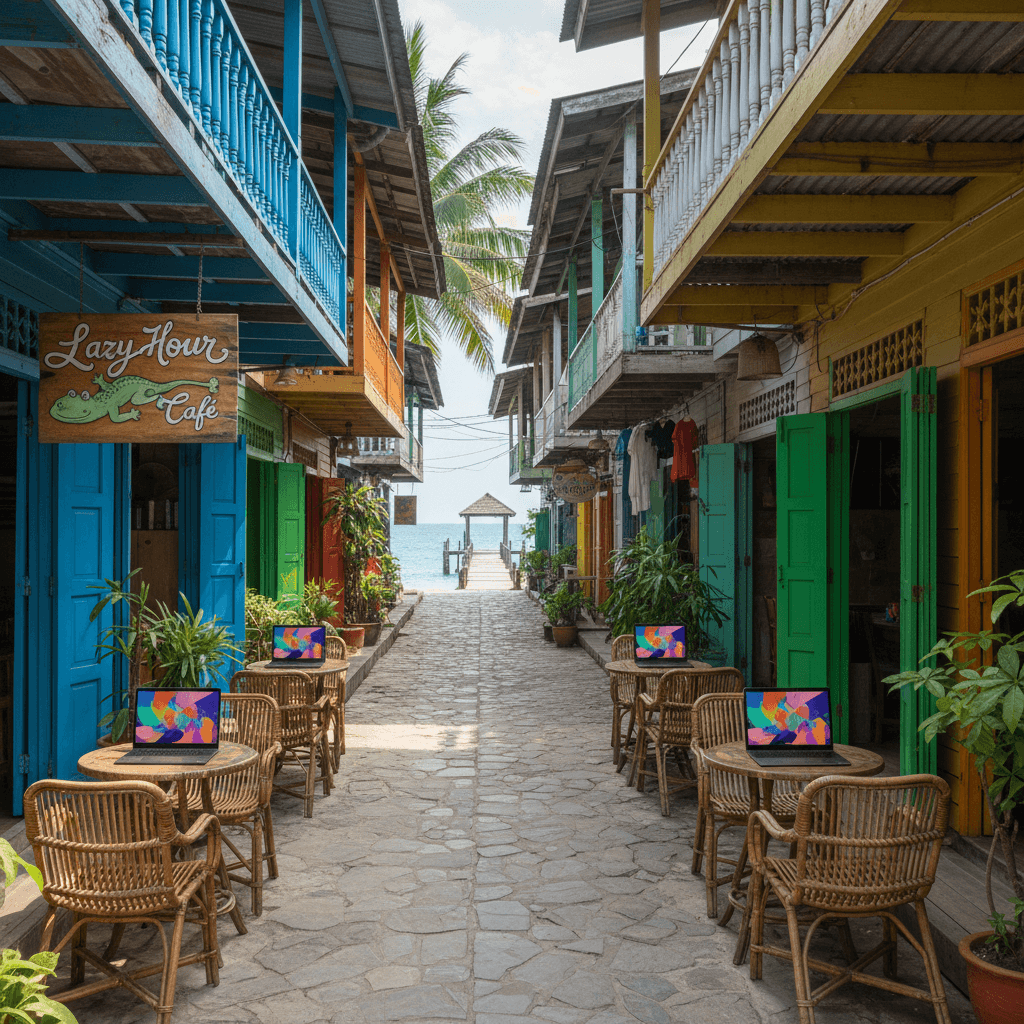
Koh Rong (Koh Touch/Saracen Bay)
🇰🇭 Cambodia
The Untamed Island Reality
Koh Rong isn't your typical digital nomad hub with high-speed fiber and air-conditioned coworking spaces. It is a raw, rustic escape that feels like stepping back into the Southeast Asia of twenty years ago. The island is defined by two distinct personalities: the gritty, social energy of Kaoh Touch and the serene, postcard-perfect stretch of Saracen Bay on the neighboring island of Koh Rong Samloem. Most nomads treat this as a place to close the laptop and actually live, rather than a place to grind out a 40-hour work week.
The vibe here is heavy on "backpacker paradise" and light on infrastructure. You will spend your days walking barefoot between wooden guesthouses and beachfront bars where the line between locals and travelers blurs over cheap Angkor beers. It is the kind of place where you come for a three-day weekend and realize a week later that you haven't worn shoes once. However, the emotional high of the island's beauty is often balanced by the reality of salt-crusted skin, sand fly bites, and the constant hum of generators.
The Connectivity Struggle
If your job requires Zoom calls or uploading heavy files, Koh Rong will be a source of immense stress. WiFi is notoriously flaky and often nonexistent when the power dips. Even the spots that claim to have "high-speed" internet usually struggle to load a basic email. Most experienced remote workers in Cambodia finish their deadlines in Kampot or Siem Reap before heading to the islands to truly unplug.
Electricity is now connected to the mainland, but outages are still a regular part of island life. You'll find that the best way to survive here is to rely on a local Cellcard or Smart SIM card with a heavy data plan, though even 4G signals can be spotty depending on which side of the hill you're on. Don't expect to find a dedicated coworking space; your "office" will be a hammock or a wooden table at a beach bar like Tamu Koh Rong, where the views are world-class but the productivity is low.
Logistics and Survival
Living here requires a bit of old-school preparation. The most critical rule is to bring enough cash to last your entire stay. There are no ATMs on the islands, and while some high-end resorts might offer a "cash out" service via credit card, they will charge you a massive percentage for the privilege. Everything from your $5 scooter transfer to your evening fish BBQ is a cash-only transaction.
- Transport: Renting an automatic scooter is the only way to see the island on your own terms. Roads are mostly flat and manageable, but watch out for sandy patches.
- Negotiation: If you take a tuk-tuk, never accept the first price. Drivers at the piers often quote double; aim to pay around $5 to $10 for most local trips.
- The Itch Factor: Coconut oil is a local secret for warding off sand flies, which are the primary downside to the pristine white sands of Long Set Beach.
The Cost of Disconnecting
While specific monthly rentals are hard to pin down because most people stay in guesthouses, the daily cost of living remains low for those who avoid the luxury "glamping" sites. You are paying for the location and the atmosphere rather than the amenities.
Typical Island Expenses
- Scooter Rental: Roughly $10 to $15 per day, though you can negotiate for weekly rates.
- Ferry Transfers: Expect to pay around $25 for a round-trip speed ferry from Sihanoukville.
- Independent Tours: Most boat operators charge $30 or more for plankton tours, but you can often find the bioluminescence yourself for free just by swimming in dark spots after sunset.
- Food: Local Khmer dishes at the village shacks start around $3 to $5, while western-style meals at the resorts will run you $10 to $15.
Ultimately, Koh Rong is for the nomad who needs a digital detox. It is a place to trade your standing desk for a kayak and your Slack notifications for a trek through the jungle to find hidden waterfalls. It isn't a place to build a startup, but it is the perfect place to remember why you chose a nomadic life in the first place.
A Reality Check on the Island Budget
Koh Rong isn't your typical digital nomad hub with tiered pricing and luxury serviced apartments. It's a place where your biggest expense will likely be the $25 round-trip ferry from Sihanoukville and the amount of cash you managed to stuff into your bag before leaving the mainland. Since there are no ATMs on the island, your cost of living is strictly dictated by what you bring in your wallet.
Most nomads find that a daily budget of $30 to $50 allows for a comfortable lifestyle. This covers a private room with a fan, three solid meals, and a few Angkor beers at sunset. If you want air conditioning and a pool, like the setups at Tamu Koh Rong, expect those costs to double instantly. Expats recommend keeping a stash of small US dollar bills, as larger denominations are hard to break in the smaller villages.
Monthly Expenses and Neighborhoods
Prices fluctuate based on which pier you land at. Kaoh Touch is the backpacker central where everything is cheaper but louder. Saracen Bay on neighboring Koh Rong Samloem is more pristine and significantly pricier.
Kaoh Touch (The Budget Hub)
- Guesthouse Room: $15 to $25 per night. Monthly deals can sometimes be negotiated down to $350 or $400.
- Local Meal: $3 to $5 for fried rice or amok at a village shack.
- Beer: $0.50 to $1 during happy hour.
Saracen Bay & Long Set (The Mid-Range)
- Bungalow/Ensuite: $40 to $80 per night. Monthly stays are rare and expensive.
- Western Meal: $8 to $12 for pizza or pasta at a resort restaurant.
- Coffee: $2.50 to $4 for a decent latte.
The Infrastructure Tax
Living here comes with "hidden" costs that aren't financial, but they impact your productivity. The internet is notoriously flaky. While a local Metfone or Smart SIM card is cheap, around $5 to $10 for a month of data, the speeds rarely support video calls. You aren't paying for coworking spaces here because they don't exist; you're paying for the extra mobile data you'll burn through trying to find a signal.
Electricity is another factor. While the island is now connected to the mainland grid, outages are still part of daily life. Travelers often say that the cost of living feels lower because there is simply less to buy, but you'll spend more on "convenience" items like bug spray and sunscreen, which carry a heavy island premium. A bottle of sunscreen that costs $8 in Phnom Penh might be $15 here.
Getting Around for Less
Transport is where you can easily get ripped off. Scooter rentals are the smartest way to keep costs down, usually running about $10 to $15 per day. The roads are mostly flat and manageable for anyone with basic riding experience. If you rely on tuk-tuks, be prepared to haggle hard. A trip from the pier to a distant resort might start at $20, but savvy travelers know they can usually negotiate this down to $5 or $10 by walking away from the main pier crowd and hailing a passing driver.
To keep your entertainment budget at zero, stick to the natural perks. You can hike through the jungle to Long Beach or swim with bioluminescent plankton at night for free, rather than paying a tour operator $30 for a packaged experience. If you're looking to get certified, Koh Rong remains one of the cheapest places on earth for scuba diving, with PADI Open Water courses often priced around $300.
The Digital Nomad: Long Set Beach (4K Beach)
If you are trying to balance a laptop and a coconut, Long Set Beach is your best bet. It sits just far enough from the main pier to escape the constant bass of party hostels, but close enough that you can still walk to get supplies. Nomads usually gravitate toward the boutique resorts here because they have the most stable generators and slightly better satellite internet than the village shacks.
Don't expect a dedicated coworking space with ergonomic chairs. You'll be working from open air cafes like those at Tamu Koh Rong, where the trade-off for a spotty connection is a view of white sand and turquoise water. Most remote workers treat this as a "slow week" destination where they only handle emails and light tasks rather than heavy video calls.
- Living Cost: Budget around $40 to $80 per night for a room with decent power and a desk.
- Connectivity: Highly variable. Buy a local Cellcard or Smart SIM at the airport before you arrive, as the island Wi-Fi will fail you during a storm.
- Vibe: Peaceful, scenic, and professional enough that you won't feel like the only person not doing tequila shots at noon.
The Social Solo Traveler: Koh Touch Village
Koh Touch is the heartbeat of the island. It is a cluster of wooden guesthouses, dive shops, and bars built right over the water. If you are traveling alone and want to meet people instantly, this is where you stay. The village is loud, chaotic, and smells like a mix of salt air and grilled squid, but it is the only place on the island with a true community feel.
You can find the cheapest beds here, often in basic fan rooms or dorms. Since there are no ATMs, keep your cash tucked away in a dry bag. Solo travelers often spend their days at the local dive shops or joining $10 boat trips to see the bioluminescent plankton at night. It is the easiest place to find a group for a jungle hike or a shared boat taxi to the quieter bays.
- Living Cost: You can get by on $20 to $35 a day including food and a basic room.
- Food: Plenty of cheap local spots and Western cafes. Expect to pay $3 to $6 for a solid meal.
- Vibe: High energy, backpacker heavy, and perfect for those who hate being alone.
The Peace-Seeking Expat: Saracen Bay (Koh Rong Samloem)
Technically on the sister island, Saracen Bay is where expats go when they want to escape the Koh Touch madness. It is a long, crescent shaped beach with calm, shallow water and a much more upscale feel. There are no roads here, just a sandy path connecting the resorts. It attracts a crowd that prefers a glass of wine and a book over a bucket of cheap gin.
The infrastructure is slightly better managed in terms of waste and noise, making it a favorite for those staying a month or more. You won't find many long term apartment rentals, so most expats negotiate monthly rates with mid range resorts. It is the place to be if your priority is meditation, paddleboarding, and silence after 10 PM.
- Living Cost: Expect to spend $1,200 to $1,800 per month for a comfortable lifestyle.
- Transport: Mostly by foot or longtail boat. A boat ride to the main island usually costs around $5 to $10.
- Vibe: Sophisticated, quiet, and visually stunning.
Families and Couples: Sok San Village
Located on the western side of Koh Rong, Sok San offers a glimpse of authentic Cambodian village life combined with a massive, pristine beach. It is much quieter than Koh Touch and feels safer and more secluded for those traveling with kids. The water is calm, and the beach is wide enough that you'll never feel crowded.
There are a few high end resorts and private bungalows that offer more "mainland" amenities like consistent air conditioning and better plumbing. Families appreciate the ability to rent scooters for $10 a day to explore the flat, paved roads nearby. It is the best spot for those who want a "vacation" feel without the party pulse of the eastern side.
- Living Cost: Mid range bungalows go for $50 to $100 per night.
- Practicality: Bring all your medicine and snacks from the mainland, as the local shops have very limited stock.
- Vibe: Authentic, spacious, and relaxed.
If you are coming to Koh Rong expecting a seamless remote work setup, you might want to rethink your itinerary. This island is a backpacker paradise first and a digital nomad destination a distant second. While the scenery is world class, the infrastructure still feels like a work in progress. It is the kind of place where you close your laptop and grab a Beer Cambodia rather than trying to hop on a Zoom call.
The Reality of Island Wi-Fi
Internet on Koh Rong is famously temperamental. Most guesthouses around Kaoh Touch and Saracen Bay advertise free Wi-Fi, but "available" rarely means "functional." Speeds are usually barely enough for sending a WhatsApp message or checking an email. If your job involves uploading video, managing large files, or stable video conferencing, you are going to struggle. Most experienced nomads treat their time on the island as a forced digital detox.
Even though electricity is now connected to the mainland, power outages are still a regular occurrence. When the power goes out, the local routers go down with it. If you absolutely must get a few hours of work done, your best bet is to use a local SIM card with a heavy data plan. Smart and Cellcard typically offer the most reliable coverage, though even then, signals can drop significantly once you move away from the main piers or into the more remote luxury tents like Tamu Koh Rong.
Coworking and Work-Friendly Cafes
There are no dedicated coworking spaces on Koh Rong or Koh Rong Samloem. You won't find ergonomic chairs, silent zones, or guaranteed high speed fiber here. Instead, you will be working from beach bars and cafe terraces where the humidity and sand are your constant companions.
- Kaoh Touch Village: This is the main hub where you will find the highest concentration of cafes. It is noisy and social, which is great for meeting people but terrible for deep focus.
- Saracen Bay: Located on the sister island, this area is much quieter. You can find several upscale resorts with decent seating, but you will still be at the mercy of the island's inconsistent signal.
- Long Set Beach: A middle ground between the two, offering a few newer builds that occasionally have better infrastructure, though it is still far from a professional environment.
Connectivity Survival Tips
Most travelers who stay here long term have learned to adapt to the limitations. Since ATMs do not exist on the islands, make sure you bring more cash than you think you need. Some hotels can provide cash back on a credit card, but they will often charge a 7% to 10% fee for the privilege. If you run out of money or your internet fails completely, you are looking at a $20 to $25 round trip ferry back to Sihanoukville just to get back online or find a bank.
The general consensus among the nomad community is to handle your heavy lifting in Phnom Penh or Siem Reap before heading south. Use your time on Koh Rong for its intended purpose: diving, exploring the bioluminescent plankton, and enjoying some of the cheapest scuba certifications in the world. If you find yourself desperately needing a workspace, it is better to take the boat back to the mainland and head to Kampot, where the coffee is better and the Wi-Fi actually works.
Connectivity Quick Guide
- Best SIM Provider: Smart (buy your SIM on the mainland first)
- Average Data Cost: $5 to $10 for a generous weekly or monthly plan
- Power Stability: Improving, but expect 1 to 2 outages per week
- Workable Hours: Early morning before the tourist crowds and heat peak
Stay Smart and Stay Healthy
Koh Rong is a rugged paradise, but it doesn't have the infrastructure of the mainland. You're trading convenience for white sand, which means you need to be self-reliant. Most nomads find that a bit of preparation goes a long way here, especially since you can't just run to a 24 hour pharmacy or a bank when things go wrong.
Medical Care and Emergencies
Healthcare on the island is extremely basic. There are small clinics in Koh Touch and near Saracen Bay that can handle minor scrapes, sea urchin stings, or stomach bugs. However, they aren't equipped for serious trauma or complex illnesses. For anything significant, you'll need to take a speedboat back to Sihanoukville or, better yet, head to Phnom Penh for international standard hospitals.
Expats recommend keeping a robust first aid kit in your bungalow. Make sure it includes:
- Antiseptic cream for coral cuts, which infect quickly in the humidity
- Rehydration salts to combat heatstroke or food poisoning
- Broad-spectrum antibiotics if you're prone to infections
- Hydrocortisone cream for the notorious sand fly bites
Travel insurance is non-negotiable here. Ensure your policy covers emergency medical evacuation by boat and ambulance. If you're planning on scuba diving or renting a scooter, double check that these specific activities are covered, as many standard plans exclude them.
Personal Safety and Island Scams
Koh Rong is generally safe and violent crime against foreigners is very rare. The island has a tight knit community where everyone knows everyone. That said, petty theft can happen, especially in the more crowded backpacker dorms in Koh Touch. Use a small padlock on your bags and don't leave your phone or wallet unattended on the beach while you go for a swim.
The biggest "scams" are usually just aggressive overcharging. When you arrive at the pier, tuk-tuk drivers will often quote $10 to $15 for short trips. Experienced travelers know to walk away from the pier and hail a passing driver to get the price down to $5 or $7. Always agree on the price before the wheels start turning.
The Cash Situation
This is the most important safety tip for the island: bring more cash than you think you need. There are no ATMs on Koh Rong or Koh Rong Samloem. While some upscale resorts like Tamu might accept credit cards, they often charge a 3% to 5% transaction fee. Some businesses offer "cash out" services where they charge your card and give you USD, but the fees can be as high as 10%. Carry small denominations of US Dollars in crisp condition, as torn bills are often rejected.
Environmental Hazards
The most common "injury" on the island isn't from a crime, it's from the sun or the sand flies. The sand flies on Long Set Beach and parts of Saracen Bay are brutal. Their bites don't itch immediately but will flare up a day later. Locals swear by coconut oil as a repellent; it's thick enough that the flies can't land and bite through it. Standard DEET bug spray works for mosquitoes but is less effective against these tiny midges.
If you're renting a scooter to explore the interior roads, wear a helmet and closed-toe shoes. The main roads are decent, but the tracks leading to private beaches are often loose sand or gravel. "Koh Rong Tattoos" (scooter exhaust burns or road rash) are the most common sight at the local clinics. Renting a bike will usually cost you around $10 to $15 per day, and you should check the brakes before heading out.
The Island Logistics
Moving around Koh Rong is a lesson in patience and basic physics. There are no paved highways or traffic lights here. Instead, you'll find a mix of dirt tracks, jungle paths, and a few concrete stretches connecting the main hubs. If you are staying in the Kaoh Touch area, you can reach most guesthouses and bars on foot. However, the island is larger than it looks, and getting to the more secluded spots like Long Set Beach or the luxury resorts on the northern coast requires a bit more planning.
Most travelers rely on a mix of scooters and water taxis. While the island is relatively flat, the heat and humidity make long treks exhausting. If you are arriving by ferry, pay close attention to which pier you select. Landing at Kaoh Touch Pier when your bungalow is actually near Long Set Pier can result in a $10 tuk-tuk ride or a long, sweaty hike through the sand with your luggage.
Renting a Scooter
For those who want total independence, renting a scooter is the most practical move. It is generally the cheapest way to explore the island's interior and visit the quieter beaches away from the main village. You can usually find automatic bikes for rent through your guesthouse or small shops along the main strip. They are easy to operate, even if you aren't an expert rider, as the traffic is minimal compared to the mainland.
- Daily Rental: Expect to pay between $5 and $10 depending on your haggling skills and the season.
- Fuel: Gas is often sold in glass bottles on the side of the road. It's slightly more expensive than on the mainland, but a few liters will last you all day.
- Road Conditions: While many roads are in decent shape, watch out for sandy patches and occasional construction debris.
Taxis and Tuk-Tuks
Tuk-tuks have become more common as the island develops, but they aren't the bargain they are in Phnom Penh. Drivers at the main piers often quote inflated prices to arriving tourists. If a driver asks for a high fee, try to negotiate the price down by half. A common trick among savvy nomads is to walk a few minutes away from the pier and hail a passing taxi or tuk-tuk, which often results in a better rate. A short hop between nearby beaches should cost roughly $5 per person if you negotiate well.
Water Taxis and Boats
Sometimes the easiest way to get from one bay to another is by water. Long-tail boats act as the island's bus system. These are particularly useful if you want to visit Saracen Bay on the neighboring Koh Rong Samloem. You can often find boat captains willing to take you on a private trip for a set fee, or you can join a scheduled shuttle. If you are feeling adventurous, you can also rent a kayak to hop between the smaller coves, though this is more for recreation than actual commuting.
Walking and Hiking
Walking is the default mode of transport within the villages. The paths are narrow and often made of sand or wooden planks. If you are heading into the jungle for a hike to a waterfall or a remote beach, wear actual shoes. Flip-flops won't cut it on the uneven terrain, and you'll want protection from the local insects. Many of the best snorkeling spots and viewpoints are accessible via these jungle trails, and they won't cost you a cent to explore on your own.
Island Hopping Basics
- Ferry Connections: Most boats from Sihanoukville stop at multiple piers. Double-check your destination before jumping off.
- Cash is King: There are no ATMs on the island. Always carry enough cash to cover your transport, as drivers and boat captains do not accept cards.
- The "Nomad" Walk: Since the internet is spotty, download offline maps before you leave the mainland. You won't want to be stuck in the middle of the island without a signal trying to find your way back to your bungalow.
The Khmer Connection
You'll find that Khmer is the heartbeat of Koh Rong, but the island's history as a backpacker haunt means English is widely spoken in the main hubs. In Koh Touch and Saracen Bay, most guesthouse owners, bartenders, and dive instructors speak enough English to handle anything from booking a ferry to explaining the spice level of your amok. However, as you move toward the quieter northern villages like Daung Kloeung, the English levels drop significantly. Learning a few Khmer basics like "Arun Sour Sdei" (Good morning) or "Orkun" (Thank you) goes a long way with the locals who keep these villages running.
The island attracts a very international crowd of long term travelers and seasonal workers. It is common to hear a mix of French, German, and Spanish at the beach bars. While the local staff are generally proficient in English, don't expect deep philosophical conversations in the smaller family run spots. Most communication is functional and friendly. If you're heading into the jungle or remote beaches, having a translation app that works offline is a smart move since signals can vanish without warning.
Digital Connectivity Hurdles
Let's be realistic about the "nomad" part of the lifestyle here. If your job involves heavy video calls or uploading massive files, Koh Rong will be a challenge. Most cafes and guesthouses offer free WiFi, but it's notoriously temperamental. Speeds typically range from 10-30 Mbps on mobile data, though WiFi remains variable and unreliable, and even those connections can drop when a storm rolls in or the power flickers. Many seasoned travelers suggest doing your heavy lifting on the mainland in Kampot or Phnom Penh before heading to the island for a "light work" week.
Cellular data is your best bet for a backup, but it's not a silver bullet. Smart and Cellcard are the two main providers with the best coverage on the islands. You can pick up a SIM card at the airport or in Sihanoukville for about $5 to $10, which usually includes a generous data package. Just keep in mind that the signal is strongest in Koh Touch and gets progressively weaker as you move toward the more secluded resorts. Even with a local SIM, 4G speeds are inconsistent and often feel more like 3G.
Essential Communication Tips
- Download Offline Maps: Don't rely on a live connection when exploring the interior trails. Google Maps or Maps.me with offline data will save you from getting turned around in the heat.
- Power Management: Power outages are common. If you're planning to work from a beach bungalow, keep your devices charged and carry a high capacity power bank.
- The Cash Language: Communication isn't just about words; it's about transactions. There are no ATMs on Koh Rong or Koh Rong Samloem. You need to communicate your budget clearly and bring plenty of USD or Cambodian Riel from the mainland. Some high end spots like Tamu might take cards, but they often charge a 3% to 5% transaction fee.
- Negotiating Rides: When talking to tuk-tuk or boat taxi drivers, always agree on the price before you get in. If they quote you $20 for a short trip, it's standard practice to politely counter with $10 and meet somewhere in the middle.
Most expats and business owners use Telegram or WhatsApp for bookings and inquiries. If you want to check if a specific bungalow has "good" internet before you trek across the island, messaging them on these platforms is usually faster than an email. Just remember that their definition of "good" internet might be different from yours if you're used to fiber optics and 5G speeds.
Timing Your Island Escape
Timing a trip to Koh Rong is all about balancing clear skies with the reality of tropical heat. The island follows a classic Southeast Asian monsoon cycle, meaning you'll want to aim for the window between November and March. During these months, the humidity drops to a manageable level and the Gulf of Thailand stays calm, which is vital since the ferry ride from Sihanoukville can get famously choppy during the shoulder seasons.
Most nomads aim for January and February as the sweet spot. You'll get consistent sunshine and the best visibility for diving or snorkeling. The downside is that Koh Touch becomes quite crowded, and the limited supply of air-conditioned rooms gets snapped up fast. If you're looking for a quieter vibe, the early part of November is a great gamble; the rains are tapering off, the jungle is lush, and you can often negotiate better rates on long-term bungalow stays.
The heat starts to crank up in April and May. Expect temperatures to hover around 35°C (95°F). Since power outages are still a part of island life, relying on a fan alone during these months can make sleeping a challenge. If you're sensitive to heat, this is the time to ensure your guesthouse has a reliable backup generator.
Navigating the Monsoon
The rainy season typically runs from June through October. While the island is much cheaper during this time, it isn't always the best for remote work. Heavy downpours often knock out the already spotty satellite internet and cellular signals. Some of the smaller piers on the western side of the island may close entirely if the swells get too high, making it difficult to reach more secluded spots like Sok San Beach.
That said, the rain usually comes in short, intense bursts rather than a week-long drizzle. If you don't mind the occasional tropical storm, you'll find the island nearly empty and the prices for luxury tents at places like Tamu Koh Rong significantly discounted. Just be prepared for the sand flies; they are particularly active when the ground is damp, so keep your repellent handy.
Seasonal Highlights
- Low Season (June to October): Expect lower prices and fewer crowds, but be ready for boat cancellations and humidity.
- Peak Season (December to February): The best weather for trekking and diving, but the main village of Koh Touch can feel a bit like a frat party.
- Plankton Season: While you can see the bioluminescent plankton year-round, the best viewing happens during the New Moon when the sky is darkest.
Expats usually recommend avoiding the island during Khmer New Year in mid-April. The island gets flooded with domestic tourists, prices for transport and food spike, and the quiet beach atmosphere disappears under the weight of massive speakers and celebrations. Unless you're looking to join the party, it's a good time to head back to the mainland.
Packing for the Climate
Given the humidity and the lack of paved roads in many areas, leave the heavy luggage behind. Most travelers stick to lightweight, breathable fabrics. You'll spend most of your time in swimwear and flip-flops, but a light rain shell is a must if you're visiting between May and October. Since there are no ATMs on the island, the most important thing you can "pack" is a dry bag filled with enough USD or Cambodian Riel to last your entire stay, plus a 20 percent buffer for emergencies.
Money and Connectivity
The most important thing you need to know before stepping off the ferry is that cash is king. There are no ATMs on Koh Rong or Koh Rong Samloem. If you run out of money, you are looking at a long boat ride back to Sihanoukville or paying a massive commission (often 7% to 10%) to a hotel that will charge your card and give you USD. Bring more than you think you need, especially since prices for food and drinks are higher than on the mainland.
For remote work, manage your expectations. The internet is notoriously flaky. Most guesthouses offer WiFi, but it is rarely stable enough for video calls or uploading large files. Power outages happen often, even though the island is now connected to the mainland grid. If you have a deadline, get it done in Kampot or Phnom Penh before you arrive. If you must stay connected, buy a Smart or Cellcard SIM card on the mainland; the 4G signal is usually more reliable than hotel WiFi, but even that can be spotty during storms.
Getting Around the Island
Koh Rong is bigger than it looks and getting from one bay to another can be a mission. Renting a scooter is the most common way to explore. You can usually find a bike for about $10 to $15 per day. The main roads are in decent shape, but the island is hilly. Only rent one if you are comfortable on two wheels; the dirt paths to the more remote beaches can get messy after rain.
Tuk-tuks are available for shorter hops, but drivers will start with high prices. A typical ride from the pier to a nearby beach might start at $10, but you should haggle. Most seasoned travelers aim for about half the initial quote. If you are staying at a place like Tamu Koh Rong on Pagoda Beach or something in Saracen Bay, check if they provide a private boat shuttle. It is often cheaper and much faster than a bumpy land transfer.
Island Basics and Survival
The sand flies are the real bosses of Koh Rong. These tiny midges live in the sand and their bites itch far worse than mosquitoes. They are most active at dawn and dusk. Locals recommend using coconut oil on your legs; it creates a barrier that prevents them from biting. Standard DEET bug spray works for mosquitoes but is less effective against the sand flies.
You can save a lot of money by doing activities independently. While tour operators charge $30 or more for island hopping, you can often hike to spots like the Koh Rong Waterfalls or Long Set Beach for free. For the bioluminescent plankton, you don't necessarily need a boat tour. Walk to a dark patch of beach away from the village lights at night, wade in waist-deep, and agitate the water to see the glow.
Daily Costs and Budgeting
While Koh Rong is a backpacker favorite, it is not as cheap as the rest of Cambodia. Expect to pay a premium for the logistics of getting supplies to an island.
- Local Meal: $4 to $7 for fried rice or amok at a village shack.
- Western Meal: $8 to $15 at a beachfront resort.
- Beer: $1 to $2 during happy hour; slightly more at upscale spots.
- Diving: $80 to $100 for a two-tank dive, making it one of the most affordable spots in Southeast Asia to get underwater.
- Private Boat Taxi: $15 to $30 depending on the distance and your negotiation skills.
If you are looking for a quieter experience, head to Saracen Bay on Koh Rong Samloem. It is more expensive than Koh Touch but offers a much more relaxed pace without the constant party vibe. Most nomads find that three or four days is the sweet spot for the islands before the lack of high-speed internet starts to become a problem.
Need visa and immigration info for Cambodia?
🇰🇭 View Cambodia Country GuideOff the Radar
Pioneer territory