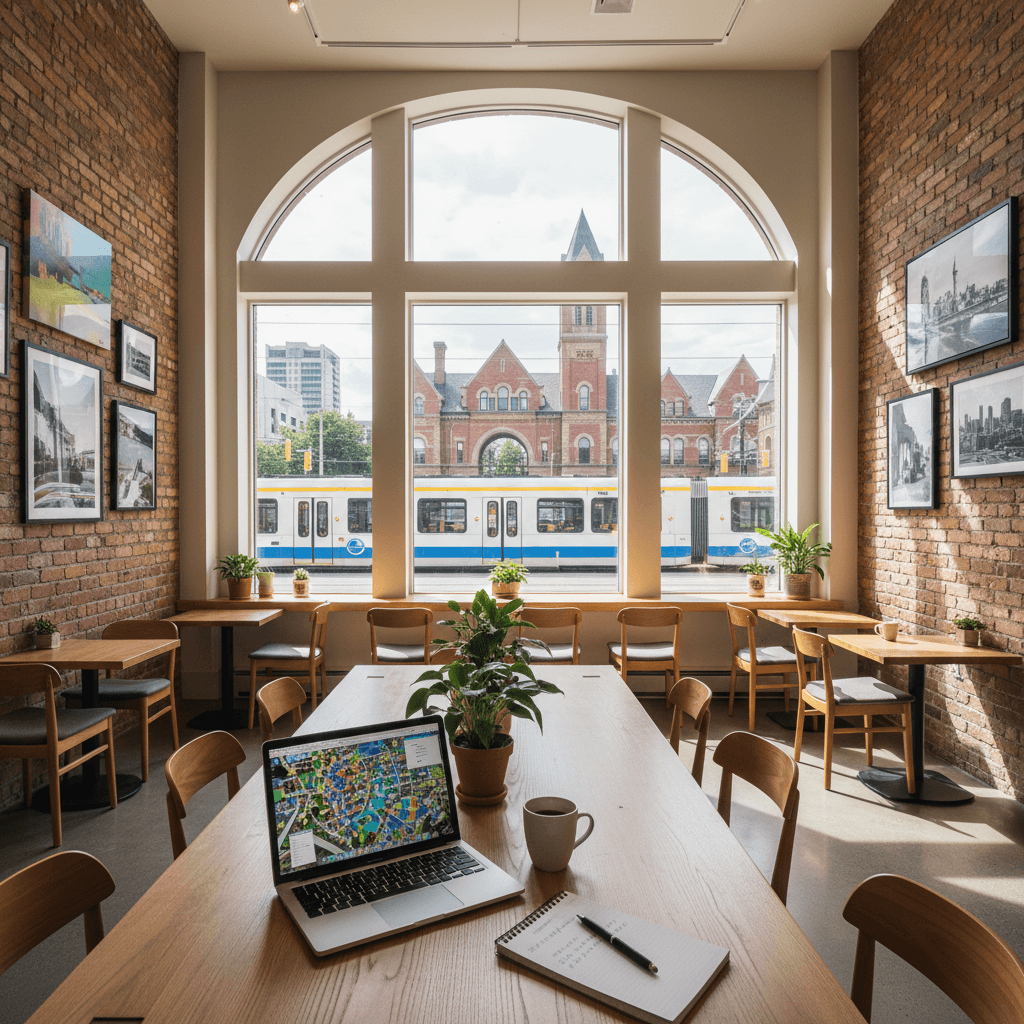
Kitchener-Waterloo
🇨🇦 Canada
Kitchener-Waterloo feels practical, techy and a little understated, with more laptop bags than party crowds and more bike lanes than late-night chaos. It’s safer and cheaper than Toronto, the internet is strong and the whole place has this suburban hum, car doors slamming, buses hissing at stops, students spilling out of cafés and winter slush that hangs around too long. Not flashy. Definitely functional.
Most nomads settle in DTK or Uptown Waterloo because that’s where you can actually work and walk around without needing a car every five minutes. Downtown Kitchener has the best mix of coworking, cafés and transit, while Uptown leans a bit cleaner, pricier and more university-adjacent, with a steady stream of tech workers and students who are, honestly, already living the remote-work rhythm before they even call it that. Nightlife is thin, though, so if you want big-city energy after 9 p.m., this place will feel sleepy.
Where people stay
- Downtown Kitchener: Best for solo nomads, walkable, noisy at times, one-bedroom rents usually start around $1,750.
- Uptown Waterloo: Best for expats and tech folks, pricier near the university, often $1,900+ for a 1BR.
- Doon South: Better for families, quieter, more car-dependent, with trails and schools nearby.
- Huron South: Modern and calm, still filling out, good if you want space and don’t mind driving.
Money-wise, KW sits in that awkward middle ground, not cheap enough to feel like a bargain, not expensive enough to punish you every month. A studio or 1BR downtown usually runs about $1,650 to $1,950, GRT passes are $104 and coworking at Workhaus starts around $283 a month, which sounds fair until you add groceries, winter boots and the occasional Uber when the bus timing gets weird. That’s the tradeoff.
The upside is everyday life feels easy once you’re set up. WiFi is fast, cafés like Smile Tiger are used to people lingering with laptops and the city’s size means you can get from a meeting to a trail in minutes, then hear leaves crunch under your shoes instead of traffic roar. KW works best for people who want calm, decent infrastructure and a strong tech scene, not people chasing nonstop excitement.
KW isn’t cheap anymore, but it’s still kinder to your wallet than Toronto and that gap matters when you’re paying rent, grabbing lunch and trying to keep a sane monthly budget. A studio or 1BR downtown Kitchener usually lands around $1,650 to $1,950 and newer places near Station Park or around Uptown Waterloo can push past that fast, honestly.
Food costs are mixed. A coffee or quick street-food bite runs about $5.50 to $6.50, a decent date night can hit $100 to $120 and a craft beer at a local spot like a brewery on King Street is usually $8.50 to $10, so eating out here adds up faster than people expect, especially if you’re doing it three or four times a week.
Groceries are manageable if you shop smart and the Kitchener Market still helps, weirdly enough, with produce and better-than-supermarket basics. A couple can expect around $700 a month if they cook most meals at home, though that climbs quickly if you rely on prepared food or imported items.
Budget snapshots
- Budget solo: About $2,500 a month, shared housing, groceries, GRT pass, not much nightlife.
- Mid-range couple: Around $3,500 a month, one-bedroom downtown, some dining out, two transit passes.
- Comfortable family: $5,000+ a month, a 2BR or suburban rental, car costs and weekend entertainment.
Transit is affordable enough, but the system feels a little half-finished and that’s the truth. A GRT monthly pass is $96 per person, so if you’re living downtown Kitchener or Uptown Waterloo, you can skip a car for a while, though suburbs like Williamsburg, Doon South and Huron South still make driving the easier choice.
Coworking isn’t dirt cheap either. Workhaus Market in downtown Kitchener starts around $283 to $295 a month or about $40 a day and internet at home is usually solid, with providers like TekSavvy or Start.ca in the $65 to $110 range and speeds that are, frankly, good enough for heavy video calls.
If you’re moving here, pick your neighborhood carefully. Downtown Kitchener gives you walkability and ION access, Uptown Waterloo costs more but keeps you close to cafes and tech people and the suburbs buy you space, quiet and a bigger commute, which, surprisingly, is the trade-off most families accept without much debate.
Car costs matter too. Insurance for a family vehicle can run about $130 to $160 a month, then there’s gas, winter tires and the lovely little pain of scraping ice off your windshield in January while the whole city smells like salt, slush and exhaust. Not glamorous. Still practical.
KW splits pretty neatly by how you live, not just where you land. Downtown Kitchener and Uptown Waterloo are the obvious picks if you want cafés, coworking and transit within walking distance, while the suburban edges start making more sense once you’ve got kids, a car and patience for quiet streets. Not fancy. Still practical.
Nomads
Downtown Kitchener is the easiest place to base yourself if you work online, because you’ve got the ION, Workhaus Market, the Kitchener Market and enough coffee shops to keep your laptop charged and your caffeine intake slightly unhinged. Rent for a 1BR usually starts around $1,750, newer towers can run higher and the tradeoff is noise, sirens and the odd weekend crowd drifting past with takeout and beer.
- Best for: Walkability, coworking, transit
- Watch for: Higher rent, street noise
- Good fit if: You don't need a car
Uptown Waterloo feels a bit sharper and more student-heavy, with tech folks, expats and university energy mixing in the cafés and patios, though it can get crowded and the rents push even higher, often around $1,900+ for a 1BR. The upside is simple, fast WiFi, plenty of events and a day-to-day pace that doesn't feel sleepy.
Solo Travelers
If you’re here alone and want easy social contact, pick DTK first, then head to Uptown if you want a cleaner, more polished feel. The social scene runs through breweries, markets, Meetup groups and random chats at Smile Tiger and honestly, that’s where KW works best, because the city isn’t built for wild nightlife, it’s built for repeat coffees and familiar faces.
- Best for: Meeting people without forcing it
- Watch for: Limited late-night action
- Good fit if: You like routine, but not boredom
Families
Doon South, Huron South and Williamsburg are the safer bets for families, with newer homes, schools, parks and trails, though you’ll feel the car dependence fast, especially on wet winter days when slush sticks to boots and everything smells like road salt. Doon and Huron give you better access out toward the highway, while Williamsburg feels more settled and community-minded, just don’t expect downtown convenience.
- Doon South: Trails, schools, newer housing
- Huron South: Quiet, modern, good highway access
- Williamsburg: Parks, shopping, family feel
My take, skip the suburbs unless you actually want the suburban routine and pick DTK or Uptown if you’re here to work, meet people and live without driving everywhere. KW can feel slow, but that’s the point and if you choose the right neighborhood, it feels calm instead of dull.
KW’s internet is, honestly, one of the nicer parts of living here. Median download speeds sit above 100 Mbps, Bell and Telus tend to lead and even a plain apartment connection usually feels quick enough for video calls, big uploads and a couple of people streaming at once.
Not cheap. A home internet plan usually runs about $65 to $110 a month, depending on speed and promos and if you’re shopping around, TekSavvy and Start.ca get mentioned a lot because the pricing can be a little saner than the big-name bundles. In older buildings, though, you’ll sometimes get weirdly spotty wiring or a lobby setup that makes install day feel longer than it should.
Best coworking bets
- Workhaus Market, Kitchener: The main name people bring up, right near DTK at 290 King St E, with memberships around $295 a month or $40 for a day pass.
- Nomad List options: There are 50-plus spaces in the region and some day passes start around $15, which is handy if you only need a desk once or twice a week.
- Cafes: Smile Tiger is a common pick for laptop work, though you’ll want to buy drinks and keep calls short because nobody likes the person doing Zoom therapy over the espresso machine hiss.
The coworking scene, turns out, is better than the nightlife. Workhaus gives you a proper work setup, but if you’re in downtown Kitchener or Uptown Waterloo, a lot of nomads just bounce between cafes, library corners and home, because the city isn’t built for late-night lingering, it’s built for getting things done.
What people actually use
- SIM cards: Rogers, Bell and Telus are easy to grab at the airport or malls, with prepaid plans starting around $30 a month for unlimited data.
- Best areas to live: Downtown Kitchener and Uptown Waterloo if you want walkability and fast access to desks, suburbs if you need space and don’t mind driving.
- Backup plan: If your building WiFi flakes out during a storm, tethering from a Canadian prepaid plan usually saves the day.
Honestly, the real annoyance isn’t speed, it’s the suburban sprawl and the fact that some great units still come with clunky internet setups, so ask about the provider before you sign anything. In DTK, you’ll hear the ION glide past, smell coffee from the market and see a lot of laptops open by noon, which is basically the local work rhythm in one scene.
Safety & Healthcare
KW feels safe, honestly safer than most people expect for a region this size. Violent crime stays low, families use the parks late and the usual advice is simple, stay alert in quiet stretches after dark, especially around empty lots, underpasses and the edges of industrial areas. Not thrilling. Still, it works.
Day to day, you’ll hear bike bells on the ION, kids yelling in schoolyards and the hiss of coffee machines in Uptown Waterloo, not the constant edge you get in bigger cities. The tradeoff is that some pockets get deserted fast at night, so don’t assume every well-lit street feels lively, because it often doesn’t.
Healthcare
Grand River Hospital in Kitchener and St. Mary’s General are the main hospitals and both handle routine care, emergencies and specialist referrals for the region. Wait times can be painful, frankly, so check current queues when you can and bring ID, insurance details and a charger if you’re heading in for anything that might take hours.
- Grand River Hospital: 835 King St W, Kitchener, 519-742-3611 or 519-749-4300
- St. Mary’s General: 519-744-3311
- Pharmacies: Shoppers Drug Mart locations are everywhere, so picking up basics is easy
- Emergency: 911 for urgent medical help or police
Practical Safety Notes
Most nomads treat downtown Kitchener and Uptown Waterloo as straightforward, but they still avoid isolated paths after midnight, especially in winter when the wind cuts through empty streets and the sidewalks feel dead quiet. Weirdly, that’s when the city feels safest and most awkward at the same time, because there’s little chaos but also not many people around.
For prescriptions or over-the-counter stuff, pharmacies are easy to find and walk-in clinics do the job for minor issues, though appointment booking can be annoying if you need something fast. If you’re uninsured or waiting on coverage, ask about pricing before treatment, because billing surprises here are very real.
What Locals Actually Do
- At night: Stick to DTK, Uptown and main transit corridors
- In suburbs: Plan on a car or rideshare, sidewalks thin out fast
- For comfort: Keep winter boots, gloves and ice cleats handy, sidewalks get slick
- For peace of mind: Save hospital and pharmacy numbers in your phone before you need them
If you’re used to Toronto, KW feels calmer and less on edge, which is a relief until you need late-night options or urgent care at a busy hour. Then the slow pace shows up and honestly, that’s the part people complain about most.
KW is easy to live in once you get a feel for it, but don’t expect Toronto-style transit density or late-night chaos. Downtown Kitchener and Uptown Waterloo are the places where you can mostly ditch the car, while the suburbs get frustratingly spread out, honestly and you’ll hear that same complaint from plenty of long-stay visitors.
GRT is the main backbone. A cash fare is $3.75 and a monthly pass runs about $104, with the ION light rail doing the heavy lifting between DTK and Uptown. The trains are clean, the bus stops are straightforward and the whole system works fine for workdays, but service can feel thin once you’re off the main corridor or trying to get somewhere after dark.
For airport runs, Route 78 and 79 connect to Region of Waterloo International Airport, though most people still grab Uber or Lyft if they’ve got luggage, because dragging a suitcase onto a bus in February is a miserable idea. A ride from the core to YKF usually lands around $30 to $40, depending on traffic and surge pricing. Not cheap.
Ride-hailing is widely available. Uber and Lyft both work well in KW and drivers usually show up faster than you’d expect for a city this size. That said, if you’re living in Williamsburg, Huron South or Doon South, you’ll probably still want a car for grocery runs, weekend errands and anything that finishes after the buses get sparse.
Best ways to get around
- Walk: Best in Downtown Kitchener and Uptown Waterloo, especially near cafes, coworking spaces and the market.
- Transit: GRT plus ION is the budget pick, reliable enough for daily commuting if you live near the line.
- Bike or scooter: Neuron e-bikes and scooters are handy for short hops, with pricing around $1 plus $0.39 a minute.
- Car: Makes life easier in the suburbs and frankly, that’s what most families end up doing.
Bike lanes are improving and the trails can be genuinely pleasant in warm weather, with tree cover, damp pavement after rain and that faint mix of cut grass and exhaust near busy intersections. Still, winter changes everything, the cold bites hard, slush piles up and even a five-minute walk can feel like a small argument with the weather.
For nomads, the simplest setup is DTK or Uptown, a bus pass and a backup rideshare app. If you’re staying longer, pair that with a cheap coworking membership or a place near the ION, because otherwise you’ll spend too much time waiting at stops while traffic hums past.
English gets you through almost everything in Kitchener-Waterloo and then some. Most people sound near-native, especially in DTK, Uptown Waterloo and around the universities, so you won’t be fighting for basic errands, transit info or a landlord who suddenly forgets your email.
There’s some French on signs and in school settings, plus pockets of Spanish and other languages from international students and immigrants, but honestly you probably won’t need a phrasebook unless you’re dealing with something niche. That said, if you’re coming from a big global city, the accent here can feel plain and a bit clipped, with lots of quick small-town politeness, a soft “sorry,” and the sound of bus brakes hissing at the curb.
What to expect
- Language: English is the default almost everywhere.
- Secondary languages: Some French, Spanish and other community languages, especially near universities.
- Translation apps: Handy for rare situations, though you’ll barely touch them.
- Local style: Direct, polite and a little reserved.
Customer service is usually clear, but people here don’t always do the extra chatty thing, which, surprisingly, some newcomers read as cold. It isn’t cold, just efficient and if you’re making small talk in a café, you’ll get better results than if you fire off a rushed request while the espresso machine is grinding in the background.
A few local habits help. “Sorry” shows up a lot, “please” goes a long way and tipping 15 to 20 percent at restaurants is the norm, so don’t try to negotiate that away. People also tend to reply by email quickly and cleanly, which is nice, though the tone can feel dry if you’re used to more warmth or emoji-heavy messages.
Useful communication tips
- Phone support: Use Google Translate only if you hit a rare language barrier.
- Texting: Straightforward messages work best.
- In person: Polite, brief and calm gets better responses.
- At home: Remove your shoes indoors, that’s standard.
If you’re living here for work, the bigger adjustment isn’t language, it’s tone. People often keep things practical and matter-of-fact, so don’t expect long explanations or a lot of hand-holding, especially with rentals, telecom or banking. Still, that clarity can be refreshing and once you get used to it, communication in KW is pretty painless.
Kitchener-Waterloo has proper seasons and they don’t mess around. Winter gets cold fast, with January often sitting around -5°C to -12°C and the wind can slice right through a parka if you’re waiting for the ION or crossing King Street with slush underfoot. Summer flips the script, warm and sticky, with July highs around 27°C, plus that humid air that clings to your shirt the second you leave a cafe.
Best months: May, June and September. Those are the sweet spots, honestly, with milder temperatures, decent walking weather and far less misery than the deep freeze of December through February.
Spring is a mixed bag. You’ll get sunny patio days, then a cold rain that smells like wet pavement and mulch and weirdly, that’s part of KW’s charm if you like a slower pace. Fall is my pick, because the trees around the trails and university areas turn gold, the air feels cleaner and you can still get around without sweating through your clothes or skating down the sidewalk.
What each season feels like
- Winter: Cold, snowy and car-heavy, with icy sidewalks and short days.
- Spring: Unpredictable, muddy and better for indoor cafes than long walks.
- Summer: Warm, humid and good for patios, markets and the trail network.
- Fall: Cool, clear and the easiest time to actually enjoy the city.
If you’re a digital nomad, late spring and early fall are the safest bets, because you can work from Workhaus Market in downtown Kitchener, grab coffee at Smile Tiger, then still bike or walk home without freezing or melting. Families and long-stay visitors usually like those months too, since the city feels easier, less gritty and a bit more social once the weather stops fighting you.
Worst stretch: December to February. It’s not just the cold, it’s the gray skies, salt-streaked boots, noisy snowplows at dawn and that constant calculation about whether a bus will show up on time, which, surprisingly, becomes a daily hobby here.
July can be rough too, just in a different way. The heat isn’t Toronto-level brutal, but the humidity gets into everything and a mid-afternoon walk through downtown can leave you looking for shade, cold water or both.
If you’re planning around events, aim for the shoulder seasons and skip the dead of winter unless you actually want snow, hockey weather and fewer crowds. That’s the real tradeoff in KW, cheaper than Toronto, quieter than Toronto, but in January, absolutely colder than you’d like.
KW runs on comfort, not chaos. That’s great if you like clean streets, fast WiFi and a city where the bus comes roughly when it says it will, but it can feel sleepy if you’re chasing late-night noise and constant spectacle.
Money first: a studio or 1BR in downtown Kitchener usually lands around $1,650 to $1,950 and Uptown Waterloo runs pricier, especially near the universities, where $1,900+ isn’t unusual. Groceries for two can sit around $700 a month if you shop smart at Kitchener Market and a GRT monthly pass is $104, which is decent until winter makes every trip feel twice as long.
Food is pretty manageable, honestly. Coffee or street food can be $5.50 to $6.50, a craft beer is often $8.50 to $10 and a mid-range dinner for two can hit $100 to $120, which, surprisingly, isn’t far off Toronto once you add drinks and tax.
Best areas to look
- Downtown Kitchener: Best for solo nomads, walkable, close to Workhaus and the ION, but it can get noisy and rent isn’t soft.
- Uptown Waterloo: Good for expats and tech workers, lots of cafes and events, though student crowds and higher prices can wear you down.
- Doon South: Better for families, with trails and schools, but you’ll want a car.
- Huron South and Williamsburg: Quiet, suburban, newer homes and frankly, much easier if you’re raising kids than if you want walkable nightlife.
Internet’s solid. Bell, Telus and TekSavvy are common, speeds are usually strong enough for remote work and cafes like Smile Tiger do support laptop hours without glaring at you, which matters when you’re stuck on calls all day.
The transit is fine for the core, then gets annoying fast once you drift outward. GRT, the ION, Uber, Lyft and Neuron scooters cover most daily needs, but suburbs are car country and the ride from YKF into town can cost around $30 to $40 if you don’t want to wait around with your bags.
Safety is good. KW feels calm at street level, with low violent crime and a family-first vibe, though you still shouldn’t wander empty areas at night. For healthcare, Grand River Hospital and St. Mary’s General are the main names to know and pharmacies are everywhere, so getting basic care usually isn’t a drama.
For day-to-day life, get a prepaid SIM from Rogers, Bell or Telus at the airport or Walmart, expect about $30 for 20GB and open an account with a big bank or Wealthsimple if you want less paperwork. People here tip 15 to 20 percent, take off their shoes indoors and say sorry a lot, even when nobody’s really at fault.
Good day trips are easy, too. St. Jacobs Market, Guelph and Toronto are all workable, though winter roads can be grim and cold tile floors in older apartments will remind you fast that Canadian seasons don’t mess around.
Need visa and immigration info for Canada?
🇨🇦 View Canada Country GuideEasy Landing
Settle in, no stress
Monthly Budget Estimates
More cities in Canada

Vancouver
🇨🇦 Canada
Toronto
🇨🇦 Canada
Canmore
🇨🇦 Canada