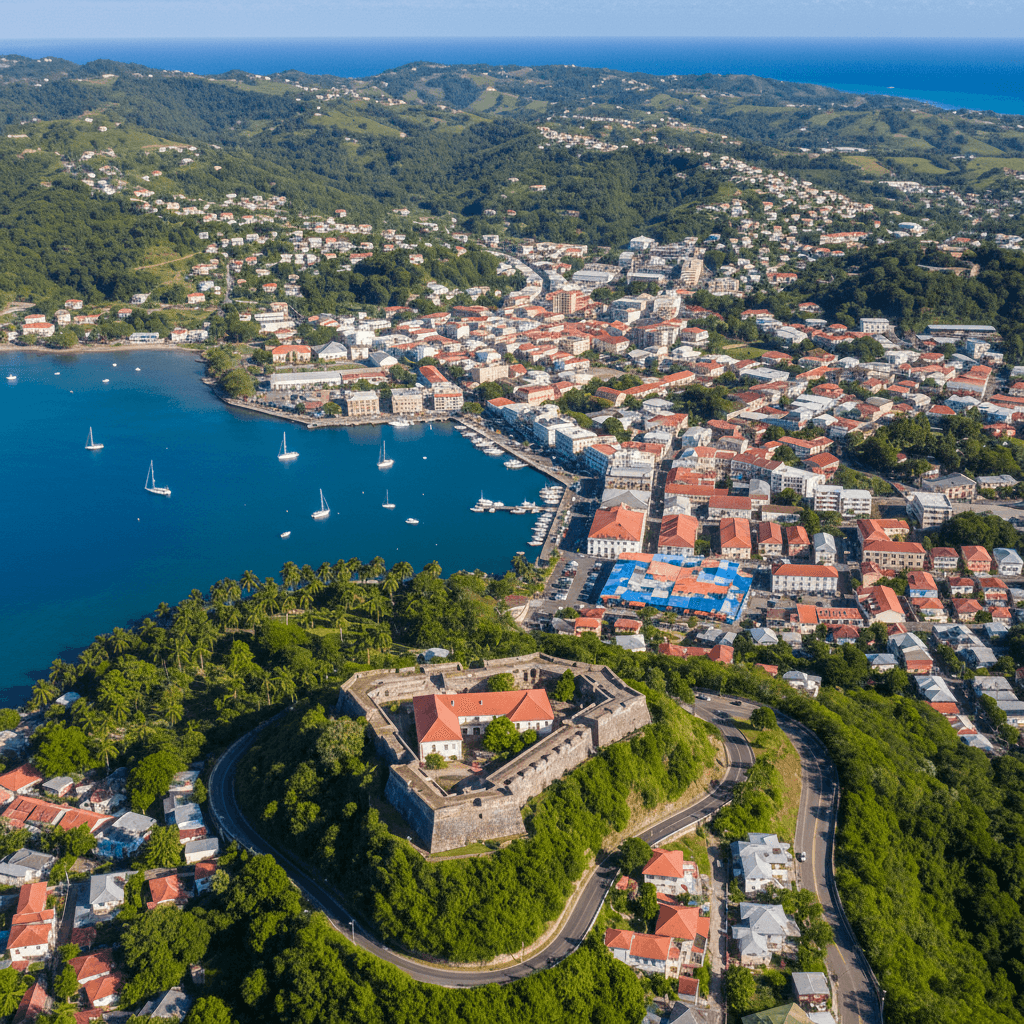
Kingstown
🇻🇨 Saint Vincent and the Grenadines
Kingstown doesn't try to impress you. It just exists, at its own pace, on its own terms and honestly that's exactly what makes it interesting. The capital of Saint Vincent and the Grenadines is small, a little rough around the edges and completely unbothered by what you think of it.
The sensory experience hits immediately. Minibuses honk through narrow streets, the smell of fried jackfish drifts out of the market on Bay Street and somewhere down the block someone's playing calypso loud enough that you feel it in your chest. It's not polished. It's not trying to be.
What you get here is a genuinely local Caribbean city, not a resort town dressed up for tourists. The colonial stone architecture sits next to rum shops and produce stalls piled with breadfruit and dasheen, the volcanic hills loom over everything, green and steep and the whole place runs on what locals call "island time." That's not a marketing phrase, it's a real operating mode and if you're someone who gets frustrated when things don't move fast, Kingstown will test you.
For digital nomads and long-stay travelers, the appeal is real but specific. Monthly costs average around $988 USD all-in, which is genuinely affordable by Caribbean standards and the natural access is hard to beat: black sand beaches, waterfall hikes and ferry connections to the Grenadines are all within reach. The flip side is that dedicated coworking doesn't really exist here, internet in certain spots is unreliable and petty crime around the waterfront and market areas is a legitimate concern after dark.
Most nomads who stay more than a few weeks settle into the southern neighborhoods like Villa and Indian Bay, where the vibe is calmer, the housing is better and there's an expat social scene built around beachside restaurants. Central Kingstown is fine for daytime errands and cheap eats, it just isn't somewhere you'd want to linger at night without knowing where you're going.
Kingstown works best for travelers who want authenticity over convenience, who don't mind figuring things out without much infrastructure and who can slow down enough to actually enjoy the pace. It's not for everyone, turns out that's kind of the point.
Kingstown is, honestly, one of the more affordable Caribbean capitals you'll find. The average monthly cost for one person runs around $988 USD including rent, which sounds reasonable until you factor in that salaries here are low and remote income stretches significantly further than it would in Barbados or the USVI.
Budget travelers can get by on $600 to $800 a month if they're sharing housing, eating roti and fried jackfish from Kingstown Market (around $7 to $10 a meal) and hopping minibuses at $1.20 a trip. Mid-range living, a studio in Villa or near Indian Bay, decent meals out, the occasional taxi, lands you between $900 and $1,200. Comfortable means $1,500 or more, beachfront rent, upscale dinners, car rental.
Rent is where the real variation kicks in. Central Kingstown studios run $254 to $291 USD per month, quieter suburban spots like Ratho Mill and Cane Garden come in at 400 to 800 XCD (roughly $150 to $300 USD) and the expat-favored Indian Bay area climbs to $800 to $1,200 USD for anything with a sea view. Not cheap, for the Caribbean.
Food costs, turns out, depend almost entirely on how local you're willing to eat. Street food and market meals keep groceries and dining under $200 a month for most people, mid-range seaside restaurants push that to $400 or more, the difference is stark. Utilities and internet together run about $100 USD monthly, which is fine for the price but the speeds (15 to 35 Mbps on a good day) won't thrill anyone running large uploads.
Here's a quick breakdown by tier:
- Budget ($600 to $800/mo): Shared housing, market meals, minibuses only
- Mid-range ($900 to $1,200/mo): 1BR studio in Villa or Ratho Mill, mix of cooking and dining out, occasional taxis
- Comfortable ($1,500+/mo): Beachfront 1BR in Indian Bay, regular restaurant meals, car or app-based rides via BeamX
Most nomads find $1,100 to $1,300 hits the sweet spot, comfortable without overpaying, local without roughing it. Transport is weirdly cheap here, $65 a month average, so that's rarely what breaks the budget. Rent and eating out are where costs quietly add up.
Kingstown's neighborhoods vary wildly in character, safety and price, so where you land matters more than in most cities. The good news is the southern corridor is, honestly, where most people end up wanting to be anyway.
Nomads: Villa and Indian Bay
This is the go-to stretch for remote workers. You're close to the airport, the Caribbean smells like salt and sunscreen rather than diesel and the expat café scene gives you somewhere to actually open a laptop. Rent runs $500 to $1,200 USD a month for a one-bedroom with sea views, which is steeper than the rest of Kingstown but you're paying for walkable beaches and reliable 4G LTE. It's touristy, sure, but that also means better WiFi at the guesthouses and restaurants that understand you might need a corner table for three hours.
Expats: Cane Garden, Ratho Mill and Sion Hill
Families and long-term expats tend to drift toward these quieter residential pockets south and east of the center. Rents drop noticeably, turns out you can find a decent place for 400 to 900 XCD a month, which is roughly $150 to $333 USD. The trade-off is real, you'll need minibuses or a car for everything and the hills make walking impractical most days. Still, the local vibe is genuine, neighbors greet you, kids play in the street and the pace is slower in a way that actually sticks.
Solo Travelers: Kingstown Central
The market area is loud, chaotic and smells like roti frying in oil and overripe fruit baking in the afternoon heat. It's cheap and well-connected, meals run $7 to $10 USD at street stalls and minibuses leave from here to everywhere. Petty theft around the waterfront and bus terminal is a real issue though, don't leave bags unattended and skip the area after dark.
Neighborhoods to Avoid
Paul's Avenue and Edinboro aren't areas to wander into, frankly. Gang activity and violence make them genuinely risky, especially at night. Ottley Hill and Redemption Sharpes carry similar warnings. These aren't exaggerated cautions, locals say the same thing.
- Villa/Indian Bay: Best all-around for nomads, $500 to $1,200/month rent
- Cane Garden/Ratho Mill: Affordable family living, $150 to $333/month
- Kingstown Central: Budget solo travel, walkable but watch your pockets
- Paul's Avenue/Edinboro: Skip entirely
Kingstown's internet situation is, honestly, better than you'd expect for a small Caribbean capital. Speeds run 15 to 35 Mbps on 4G LTE in the city center and Villa, which handles video calls, uploads and most remote work without much drama. Step outside those areas into the hills or more rural spots, though and it gets patchy fast, test your connection before you commit to any accommodation.
Dedicated coworking spaces don't really exist here. That's the honest answer. What most nomads do instead is stake out a cafe table or negotiate day-use access at a hotel, which typically runs 30 to 60 XCD (roughly $11 to $22 USD) and gets you a desk, WiFi and usually air conditioning. It's not a formal coworking setup, it's just how things work on island time.
For mobile data, you've got two main options:
- Digicel: Widest coverage across SVG, including the Grenadines; solid 4G in Kingstown and Villa.
- FLOW (formerly Karib Cable): Comparable speeds, 10 to 30 Mbps typically; good for fixed home broadband if you're staying a while.
Both carriers sell SIMs at the airport and in Kingstown and plans with 25 to 30GB per month are available for around $25 to $30 USD. eSIM support exists too, so you can set things up before you land, which, surprisingly, a lot of travelers skip and then regret on arrival when the airport queue is slow.
If you're working full-time remotely, the Villa and Indian Bay area is where most nomads end up, because the accommodation there tends to have more reliable broadband than central Kingstown's older buildings. Ratho Mill and Cane Garden are cheaper but the connectivity is, frankly, more of a gamble.
A backup mobile hotspot is worth carrying. Power outages happen, they're not constant but they're not rare either and having your phone as a fallback means you don't lose a morning of work over it. Most days the infrastructure holds up fine, don't let that stop you from having a plan B.
Kingstown is, honestly, a moderate-risk destination. Petty crime is the main concern, not violent crime and it concentrates in specific spots: the waterfront, the main market and the bus terminal, especially after dark. Most nomads who stay in Villa or Indian Bay barely notice it, the trouble tends to stay in the center.
After sunset, avoid Paul's Avenue, Edinboro, Richmond Hill, Ottley Hill and Redemption Sharpes entirely. These aren't just "a bit rough," they have real gang activity and aren't worth testing. Stick to taxis at night rather than walking, even short distances, it's cheap enough that there's no reason to risk it.
Daytime in central Kingstown is fine for most people. Keep your phone in your pocket near the market, don't flash expensive gear and you'll move through without incident. Expats recommend the usual: walk with purpose, don't wander unlit streets after 9pm, use BeamX or a known taxi driver for late-night trips.
For emergencies, the main number is 999 or you can reach police directly at 784-457-1211.
Healthcare
Milton Cato Memorial Hospital in Kingstown handles emergencies, trauma, X-rays and surgery. It's the only public hospital on the island, so it gets stretched thin, waits can be long and the facilities are functional but basic compared to what most Western nomads are used to. For anything non-urgent, private GPs are available and turns out they're genuinely quick to see you, usually same-day.
Pharmacies are widespread across Kingstown, you won't struggle to find common medications. That said, specialty prescriptions are harder to source, bring a solid supply of anything you take regularly.
- Emergency services: 999 (police, fire, ambulance)
- Police direct line: 784-457-1211
- Milton Cato Memorial Hospital: 784-456-1185
- Private GPs: Available in Kingstown; same-day appointments common
- Pharmacies: Widespread; stock up on specialty meds before arrival
Travel insurance with medical evacuation is worth having. Serious cases often get transferred to Barbados or Trinidad and that flight isn't free. Don't skip the coverage thinking you'll be fine, it's a small island with limited specialist care.
Getting around Kingstown is, honestly, pretty straightforward once you stop expecting it to work like anywhere else. The pace is slow, the routes are informal and "island time" isn't just a saying , it's how the transport system actually operates.
Minibuses are the backbone of local transit. These are private vans, not official city buses and they run from the main terminals in central Kingstown along fixed routes for around $1.20 USD per trip. They're cheap and frequent, they're also loud, packed and leave when the driver decides they're full enough. Travelers often say it's the fastest way to feel like a local, for better or worse.
Taxis fill the gap when you need reliability. No Uber or Lyft here, so you'll use taxis (flag down registered cabs or use local ride options if available). Expect to pay around $26 for an 8km ride, which adds up fast if you're commuting daily. The airport at Argyle sits about 9km from central Kingstown, taxis and minibuses both cover the route, there's no dedicated shuttle.
Walking works fine in the center, but Kingstown is hilly and the heat is real , 29 to 30°C most of the year, with humidity that clings to you by mid-morning. Most expats concentrate in Villa and Indian Bay to the south, which means a short taxi or minibus ride into the center for errands or markets.
- Minibus: ~$1.20 USD per trip, departs from Kingstown terminals, covers most of the island
- Taxi: ~$26 per 8km, no meter standard so confirm the price first
- Car rental: Common and worth it for exploring beyond Kingstown, local agencies operate in the city and at Argyle airport
- Bike and scooter rentals: Limited options, turns out most people don't bother given the hills
- Ferries: If you're heading to the Grenadines, ferries depart from the Kingstown terminal
Bike infrastructure is basically nonexistent, so don't plan around it. For most people, a mix of minibuses for daily runs and the occasional taxi ride covers everything, car rental makes sense only if you're planning serious day trips into the interior or up the volcanic north.
English is the official language here and proficiency is genuinely high across the island. You won't struggle to communicate, not at markets, not with landlords, not at government offices. That part's easy.
What takes some adjustment is Vincentian Creole, locally called Vincy, which you'll hear constantly once you're off the tourist strip. It's not a barrier, it's just a different rhythm, faster and more melodic than standard Caribbean English, with French-rooted phrases woven in from the island's colonial history. Most Vincentians code-switch naturally, so when they realize you're not local, they'll shift toward standard English without making a thing of it.
Still, knowing a few Creole phrases goes a long way. Locals, honestly, respond warmly when you make the effort, it signals respect rather than just tourist politeness. A few worth learning:
- "Bonjou": Good morning, used as a standard greeting
- "Sa ka fèt?": How are you? (roughly "what's happening?")
- "Koté... ye?": Where is...? Useful for directions
Proverbs come up in everyday conversation more than you'd expect. "Pot ah tell kettle e batty black" is one you'll hear, it means something close to the pot calling the kettle black and it reflects how community accountability works here. Don't be caught off guard when someone drops one mid-conversation at the market.
Google Translate handles basic Creole reasonably well, though it stumbles on regional expressions. Honestly, it's more useful for written signage than spoken phrases. For day-to-day life in Kingstown, you won't need it much, the English baseline is solid enough.
One thing to calibrate: communication style here is indirect by habit. Turns out, a flat "no" is considered blunt to the point of rude, so you'll often get a soft deflection instead. If someone says "I'll check on that," that can mean anything. Expats who've been here a while say the trick is asking follow-up questions rather than taking the first answer at face value, especially when dealing with housing agents or service providers.
Tone matters more than vocabulary. Greet people warmly before asking anything, that single habit will smooth over more friction than any phrase guide.
Kingstown sits at roughly 29-30°C (84-86°F) year-round, so the temperature itself isn't really the variable. Rain is. The island splits cleanly into a dry season and a wet season and that distinction matters more than any other factor when you're planning your trip.
The dry season runs December through May, the wet season June through November. Simple enough, but the nuance is that "dry" doesn't mean bone-dry, it just means the rain comes in short bursts rather than all-day downpours. January through April is, honestly, the sweet spot: low humidity, reliable sunshine and the air has this clarity to it that makes the volcanic ridges look almost close enough to touch.
April and May push warmer, around 30°C, still dry but you'll feel the heat building. Worth it for the lower crowds and cheaper accommodation rates compared to peak January.
June through November is a different story. The rain gets serious, October and November are genuinely relentless and hurricane season runs through this entire window. Kingstown doesn't get direct hits often, but tropical storms roll through, trails close and ferry schedules to the Grenadines get disrupted without warning. Travelers often say they underestimated how soggy October actually feels, the humidity clings to everything and the sound of rain hammering tin roofs at 3am gets old fast.
That said, wet season has its defenders. Prices drop noticeably, the island turns an almost aggressive shade of green and you'll have beaches largely to yourself. If you're budget-conscious and flexible, June or July can work, the rain is still manageable then and the worst of it hasn't arrived yet.
Quick breakdown by travel style:
- Best overall: January to April, dry, comfortable, peak visibility for hikes and sailing
- Best for budget travelers: June to July, wetter but cheaper, crowds are thin
- Avoid if possible: October and November, turns out these months are genuinely grim, heavy rain, storm risk, limited activities
- Shoulder season: May and December both offer a decent middle ground on price and weather
There's no bad time to visit in an absolute sense, but October through November will test your patience, plan around it if you can.
Pick up a SIM card the moment you land at Argyle International Airport. Digicel and FLOW both have airport coverage, sell high-data plans in the 25-30GB range and support eSIMs if you'd rather sort it before you fly. Speeds in Kingstown and Villa run 15-35 Mbps on 4G LTE, which is, honestly, fine for video calls and uploads. Remote spots are another story, speeds drop fast once you're up in the hills or out toward the black sand beaches.
ATMs cluster along Halifax Street in central Kingstown and at the airport, cash is still king here, fintech options are basically nonexistent. Budget travelers will find minibuses handle most of their transport needs at around $1.20 a trip, just flag one down near the Kingstown terminals. For anything after dark or off-route, use the BeamX app for ride-hailing. Taxis exist but they're not metered, agree on a price before you get in.
Weather shapes your whole trip. December through April is dry, warm and genuinely pleasant at around 29-30°C. June through November brings rain and, turns out, real hurricane risk peaking in October and November. If you're staying longer term, plan around that window or at least have a flexible departure option.
On safety: Kingstown's waterfront, market area and bus terminal get sketchy after dark. Stay alert there, don't flash gear and move in groups at night. Some neighborhoods aren't worth the risk at any hour.
- Avoid entirely: Paul's Avenue, Edinboro, Richmond Hill, Ottley Hill and Redemption Sharpes after sundown
- Medical emergencies: Milton Cato Memorial Hospital handles trauma and surgery; call 784-456-1185
- Police and fire: 911 or 784-457-1211
- Apartments: Check local Facebook groups and Airbnb for rentals
- Day trips: Dark View Falls and the Pirates of the Caribbean film set are worth booking through a local guide
One last thing: "island time" is real. Appointments run late, services move slow and getting frustrated about it won't change anything. Greet people warmly, smile first and you'll get a lot further than the traveler who's visibly annoyed at the pace.
Need visa and immigration info for Saint Vincent and the Grenadines?
🇻🇨 View Saint Vincent and the Grenadines Country GuideHidden Gem
Worth the effort