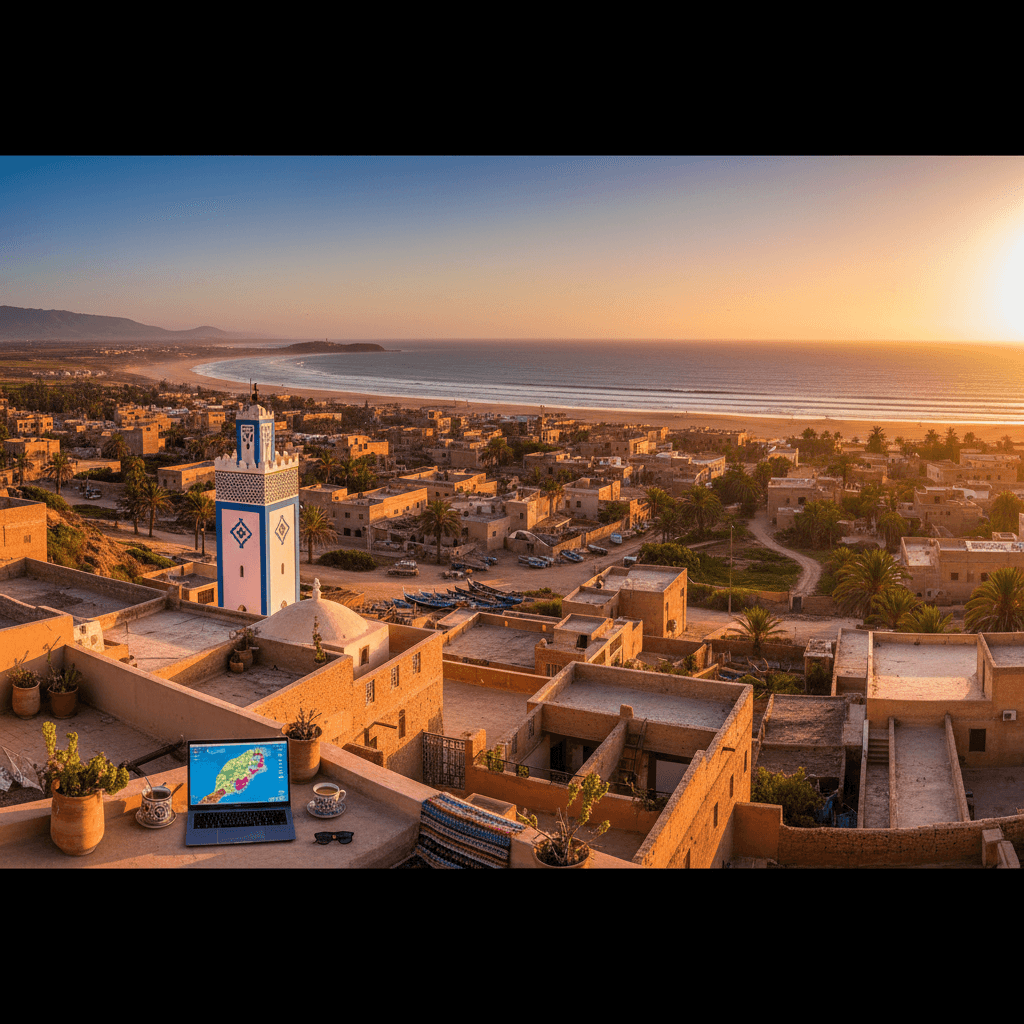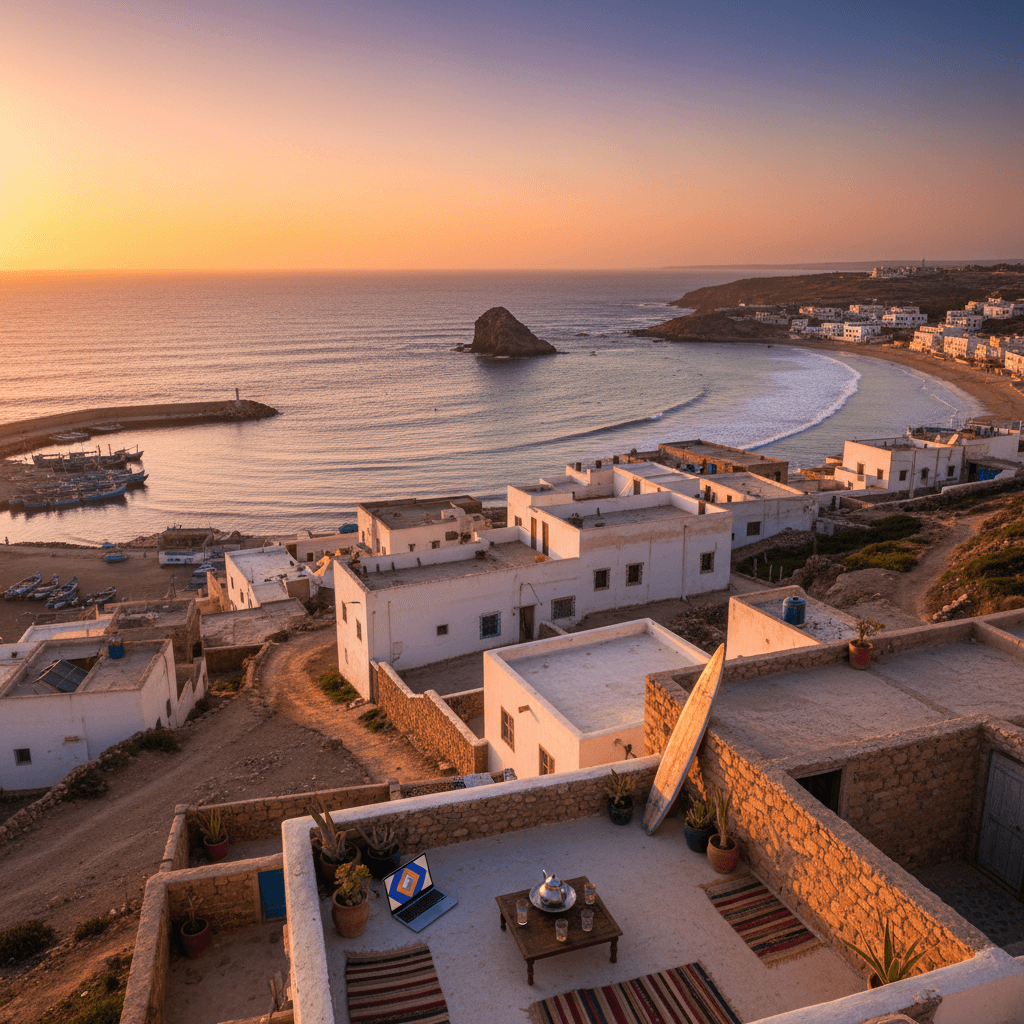
Imsouane
🇲🇦 Morocco
Imsouane isn't trying to impress you. It's a small fishing village on Morocco's Atlantic coast and it's stayed that way despite the slow trickle of surfers and remote workers who've been quietly moving in for years. The smell of grilled sardines drifts up from the port most mornings, cats outnumber tourists and the loudest thing you'll hear before 9am is the ocean.
The town sits about 45 minutes north of Agadir, tucked between two breaks: the Bay, which draws beginners and longboarders with its long, forgiving waves and Cathedral Point, a faster reef break that draws the more experienced crowd. Most nomads, honestly, end up spending more time watching the surf than working, which is either a selling point or a warning depending on your deadlines.
What makes Imsouane different from other "nomad towns" is that it hasn't been packaged yet. There's no digital nomad visa program here, no co-working district with neon signs, no influencer trail to follow. The community that's formed around spaces like Coworksurf at Cathedral Beach and KAZA Wave in the town center is genuinely self-organizing, people find each other at communal dinners, at the lineup, at the one bar that serves alcohol. It's small enough that you'll recognize faces within a week.
The pace is slow. Genuinely slow, not "slow for a city" slow. If you need urban stimulation, restaurants past 9pm or reliable access to anything beyond the basics, this place will, frankly, grind you down inside of a month. The town's compact enough to walk everywhere, which is great until you realize there isn't much to walk to.
But that's also the point. Most nomads who stay more than two weeks describe a kind of decompression that's hard to find elsewhere, the gritty Atlantic wind, the rhythm of tides replacing meeting schedules, the surprising ease of a place that doesn't perform for visitors. Budget travelers can get by on under €800 a month all-in; mid-range comfort runs closer to €1,000 with a private room and coworking included.
It's not for everyone, it's not trying to be. That's exactly why it works.
Imsouane is, honestly, one of the more affordable coastal spots you'll find anywhere in the Mediterranean or Atlantic world. That doesn't mean it's dirt cheap, but your money goes further here than almost anywhere with reliable surf and decent internet.
Rent is the biggest variable. A basic shared room in a guesthouse runs €600 to €900 a month, while a private setup at a coliving space like Coworksurf or KAZA Wave lands you somewhere between €600 and €900. Oceanfront spots with coworking included push toward €1,800, which sounds steep until you factor in that WiFi, workspace and often community dinners are bundled in.
Food is where Imsouane really shines. Fresh grilled fish at the port costs 30 to 50 MAD, that's roughly $3 to $5 and it smells like the ocean because it basically just came out of it. Sit-down meals at places like Chez Karim or Café Restaurant La Paix run 70 to 150 MAD, you won't leave hungry. Upscale beachfront dining tops out around 250 MAD, which isn't really upscale by any global standard.
Transport costs are, turns out, almost negligible. The town is walkable, most nomads don't bother with taxis at all and if you need to get to Agadir a shared grand taxi runs 30 to 50 MAD each way. Bikes rent for €5 to €10 a day if you want to explore further up the coast.
Coworking is usually folded into your accommodation cost, standalone coworking runs €50 to €100 a month if you need it separately. SIM cards from Maroc Telecom or Orange Maroc cost next to nothing, around 50 to 100 MAD for 10GB of data.
Here's what all-in looks like by tier:
- Budget: €800 to €1,000 a month, shared accommodation, street food, minimal extras
- Mid-range: €1,200 to €1,500 a month, private room, mixed dining, coworking included
- Comfortable: €1,500 to €1,800 a month, oceanfront coliving, restaurants, surf lessons
Most nomads land comfortably in that mid-range bracket, it's genuinely livable without feeling like you're cutting corners. The one thing that'll quietly drain your budget is surf lessons, they add up fast if you're learning from scratch.
Imsouane is small. We're talking genuinely, honestly tiny, a place where you'll walk end-to-end in twenty minutes and recognize the same faces at the port every morning. That compactness means "neighborhoods" is a generous word, but there are three distinct zones and which one suits you depends entirely on why you're here.
Digital Nomads
Cathedral Beach is where you want to be. It's quieter than the town center, sits right on Cathedral Point surf break and hosts the two best coliving setups in town, Tasra Surf and Flow with Coworksurf, which pulls 180 Mbps fiber and has an oceanview terrace that makes video calls feel like a flex. The tradeoff is you're a short walk from most restaurants, which gets old fast when you're hungry at 9pm and don't feel like hiking uphill.
Still, most nomads here don't regret choosing Cathedral. The WiFi holds, the community dinners are real, the surf is literally outside the door.
Solo Travelers and Social Surfers
The Bay and Town Center is where the action is, such as it's in a village this size. The fishing port smells like salt and diesel in the mornings, the cafes fill up by 9am and KAZA Wave runs a hostel here with reliable internet and a social scene that, turns out, punches well above its weight for a place with one bar. Prices are slightly lower here, street food is more accessible and you're walking distance from everything.
It does get noisier during peak season, it's not a dealbreaker, but light sleepers should know.
Expats and Longer-Term Stays
The Olo Surf and Imi Bay zone sits on the cliffs above the bay and it's weirdly underrated for people settling in for a month or more, with better sunset views than anywhere else in town and a slightly more relaxed pace than the hostel energy of the center. Restaurants here run 70 to 150 MAD a meal, which is mid-range by local standards and the DJ events at Olo Surf draw a mixed crowd of locals and long-term visitors.
Prices creep up a bit in this zone. Not dramatically, but enough to notice on a tight monthly budget.
Families
Frankly, Imsouane isn't built for families with young children. There's no international school, healthcare beyond basic clinics means a 45-minute taxi to Agadir and the town's entire social infrastructure is oriented around surf and remote work. Families who do come tend to rent private apartments in the town center for walkability and stick to short stays rather than full relocations.
Imsouane's internet situation is, honestly, better than it has any right to be for a small fishing village with one road in and out. Most coliving spaces run fiber connections and the speeds are real, not the "fiber" that means 15 Mbps in practice.
KAZA Wave provides reliable WiFi suitable for remote work, which is more than enough for video calls, large uploads, whatever you're throwing at it. This is included with your stay rather than charged separately, which is how it should work.
Cafes are a different story. Spots like Isli Slab and Café Restaurant La Paix will let you sit with a laptop, the coffee's cheap and the views are genuinely good, but the WiFi is inconsistent. Some days it's fine, some days it drops mid-call and you're staring at a frozen screen. Most nomads who actually need to get work done stick to their coliving space and treat the cafes as a change of scenery, not a reliable office.
For mobile data, grab a SIM on arrival. Both Maroc Telecom and Orange Maroc have coverage in town, 10GB runs around 50 to 100 MAD ($5 to $10) and 4G holds up reasonably well within Imsouane itself. Go further out toward the cliffs or the more remote breaks and the signal gets patchy, turns out the surrounding hills don't help.
- KAZA Wave: Reliable fiber WiFi, hostel vibe, social events, from €79 for four nights
- Cafe working: Available at Isli Slab and La Paix; speeds vary, don't count on it for anything time-sensitive
- Mobile data: Maroc Telecom or Orange Maroc; ~50 to 100 MAD for 10GB; 4G reliable in town
There's no standalone coworking space you pay drop-in rates for, the model here is coliving or nothing. If you're staying somewhere without a workspace, you'll feel that gap quickly, the cafe WiFi won't save you.
Imsouane is, honestly, one of the safer places you can base yourself in Morocco. It's a small town where everyone knows everyone, the police presence is steady and serious crime is rare. General Morocco travel advisories flag terrorist threats, but those warnings are aimed at major cities and tourist hubs, not quiet fishing villages on the Atlantic coast.
Standard precautions still apply. Don't flash expensive gear on the beach, be cautious walking unfamiliar paths after dark and keep your laptop bag close in crowded spots near the port. That's about as complicated as it gets.
Healthcare is where things get more complicated and you should plan for it before you arrive. The town has basic clinics that can handle minor cuts, stomach bugs and the occasional surf injury, but anything serious means a 45-minute drive to Agadir. Most expats don't find this particularly stressful day-to-day, though it does mean a broken bone or bad infection turns into a half-day ordeal rather than a quick trip down the street.
- Emergency number: 15 for ambulance
- Nearest hospital: Agadir, roughly 45 minutes by taxi
- GP visit cost: $10 to $20 at private clinics
- Pharmacies: Available in town; medications are affordable and many are sold without a prescription
International health insurance is, frankly, non-negotiable here. Public healthcare has real limitations and you don't want to find that out mid-crisis. Most nomads pay $50 to $150 a month for solid coverage, which is cheap peace of mind given the nearest proper hospital is in another city.
Pharmacies in town are well-stocked and the staff are used to travelers, you can often describe symptoms and walk out with something useful for $3. For anything beyond basic first aid, expats recommend sorting a good insurer before you land rather than scrambling for options once you're already here.
The ocean itself is worth mentioning. Cathedral Point has powerful surf and wipeouts happen, especially for beginners. Surf schools here take safety seriously, but the Atlantic doesn't care about your skill level. Respect the conditions and you'll be fine.
Imsouane is, honestly, one of the easiest places in Morocco to get around without thinking about it. The town is compact enough that most people walk everywhere, from Cathedral Beach to the fishing port, without ever needing a taxi. Your legs will cover it.
That said, when you do need to leave town, grand taxis are the standard move. Shared rides to Agadir run 30 to 50 MAD and take around 45 minutes, which is cheap enough that most nomads don't bother planning around them. You just show up, wait for the car to fill and go. Local buses exist too, they're even cheaper at 10 to 20 MAD, but the schedules are infrequent enough that you shouldn't count on them if you're catching a flight.
For airport runs to Agadir Al Massira, budget 200 to 400 MAD for a private taxi. Coliving spaces like Coworksurf often organize transfers, which is worth asking about when you book because coordinating with other guests cuts the cost down further.
Within town, short taxi rides run 20 to 40 MAD. Uber and Bolt don't operate here, so you're negotiating directly with drivers, it's straightforward once you know the going rates and don't second-guess yourself at the door.
Bikes and scooters are available through most coliving spaces and a few local shops. Expect to pay around 5 to 10 MAD per day for a bike and 15 to 25 MAD for a scooter. For exploring the cliffs above the bay or getting between Cathedral Beach and the town center without sweating through your shirt, a scooter makes sense. For everything else, turns out walking is genuinely faster than you'd expect.
- Grand taxi to Agadir: 30 to 50 MAD, shared, around 45 minutes
- Local bus: 10 to 20 MAD, infrequent schedules
- In-town taxi: 20 to 40 MAD per ride
- Airport transfer (private taxi): 200 to 400 MAD
- Bike rental: 5 to 10 MAD per day
- Scooter rental: 15 to 25 MAD per day
Ride-hailing apps are a dead end here. Don't waste time downloading anything, just learn the taxi rates on day one and you'll be fine for the entire stay.
Imsouane is a small Moroccan fishing village, so don't expect a cosmopolitan language environment. You'll get by fine, but communication takes some adjustment.
Darija (Moroccan Arabic) is what locals actually speak day-to-day. It's honestly quite different from Modern Standard Arabic, so if you studied Arabic elsewhere, turns out a lot of it won't transfer cleanly. Tachelhit Berber is also spoken widely in this part of the Souss-Massa region, especially among older residents and fishing families who've been here for generations.
French is your most reliable second language here. Most shop owners, restaurant staff and coliving hosts speak it well enough to handle transactions, give directions and hold a real conversation, if you push through the occasional gap. Spanish also carries surprising weight this close to the Atlantic coast and you'll find surfers and hostel staff at places like KAZA Wave or Coworksurf who switch between French and Spanish without blinking.
English is workable in nomad-facing spaces. Staff at coliving operations and surf schools speak enough to get you sorted, the deeper you go into local life though, the more it drops off. The guy grilling fish at the port at 7am probably doesn't speak it and he doesn't need to.
A few practical notes on getting around the language gap:
- Learn basic Darija greetings: "Labas?" (how are you?) and "Shukran" (thank you) go a long way, locals genuinely appreciate the effort and it changes the tone of interactions fast.
- French is your workhorse: Even broken French gets you further than fluent English in most local shops and taxis.
- Google Translate works: Cell coverage in town is reliable enough on Maroc Telecom or Orange Maroc for real-time translation, lean on it without shame.
- Negotiating taxi fares: Agree on a price before you get in, this isn't a cultural tip, it's just how it works.
Written signage is mostly in Arabic and French, sometimes Tifinagh script for Berber. Menus at tourist-facing spots usually have French translations, occasionally English. Don't count on English menus at Chez Karim or the port-side grill spots, those are local joints and proudly so.
Imsouane runs on two seasons and knowing which one suits you changes everything. The Atlantic keeps temperatures surprisingly mild year-round, so you're rarely dealing with the brutal heat that punishes inland Morocco. Still, the difference between peak surf season and shoulder season is, honestly, stark enough to affect your daily life in ways that go beyond just the waves.
October through April is the sweet spot. Swells roll in consistently, the air smells like salt and woodsmoke from the port and the nomad community is at its thickest. Daytime temperatures sit around 18 to 22°C, cool enough that you'll want a light jacket for evenings when the wind picks up off the water. Rain does happen, mostly between November and February, short and sharp rather than prolonged. Most long-term nomads and expats time their arrivals for October or March, when prices are reasonable and the town feels alive without being overrun.
July and August are a different story. Families and Moroccan tourists flood in, accommodation prices climb noticeably and the normally quiet Cathedral Beach area gets crowded and loud. The heat is manageable compared to Marrakech, but the gritty coastal wind that blows in from the south can get genuinely annoying after a few days. If you're here to work remotely, summer is, turns out, the hardest time to find the quiet focus that makes Imsouane worth choosing.
- October to December: Best swell, thickening nomad scene, mild temps around 20°C, occasional rain that clears fast
- January to March: Coldest nights (can dip to 12°C), strong surf, fewer tourists, best rates on longer-term rentals
- April to June: Warming up, lighter crowds, good for beginners as swells mellow out, pleasant for outdoor work
- July to September: Peak tourist season, higher prices, weaker surf, busiest beaches
The shoulder months, April through June, don't get enough credit. Surf lessons at Coworksurf fill up but don't overflow, restaurants like Chez Karim aren't packed and you can actually hear the waves from your terrace instead of other people's conversations. If flexibility is your thing, that's the window worth targeting, it's quieter than it has any right to be.
Imsouane is small, walkable and genuinely low-stress to navigate day-to-day. Most nomads don't bother with transport at all, the town's compact enough that you're on foot for almost everything and a grand taxi to Agadir costs 30 to 50 MAD if you actually need the city. Bikes and scooters rent through coliving spaces for €5 to €25 a day, which, surprisingly, most people only use once before reverting to walking.
For SIM cards, grab a Maroc Telecom or Orange Maroc prepaid at any local shop. Around 50 to 100 MAD gets you 10GB, honestly one of the better data deals you'll find anywhere. 4G holds up fine in town, though it gets patchy once you're out on the headland or hiking above the bay.
Healthcare is basic here. There are pharmacies in town and medications are cheap, often available without a prescription, but anything serious means a 45-minute drive to Agadir. Get private health insurance before you arrive; it runs $50 to $150 a month and you'll be glad you have it. Emergency number is 15 for an ambulance.
Money is straightforward. Bring cash or plan to make ATM runs in Agadir, because local options are limited and card acceptance is inconsistent at smaller spots. Most restaurants and markets are cash only, so don't arrive on a Friday night with an empty wallet.
A few things that catch people off guard:
- Alcohol: There's currently one bar in town. If that's a dealbreaker, adjust expectations before you book.
- WiFi outside colivings: Cafe speeds vary wildly. Coworksurf at Cathedral Beach runs 180 Mbps fiber, KAZA Wave sits around 94 Mbps. Anywhere else, turns out, is a gamble.
- Peak season noise: The Bay area gets genuinely crowded and loud from December through March. Cathedral Beach is quieter, that's the tradeoff for being slightly further from restaurants.
- Airport transfers: Agadir Al Massira is 45 km out. Coliving spaces often arrange direct pickups, a taxi runs 200 to 300 MAD. Don't assume you'll find a driver at midnight.
Safety isn't a real concern here. It's a small, tight-knit community, standard common sense applies, don't flash valuables, be sensible after dark. That's it.
Need visa and immigration info for Morocco?
🇲🇦 View Morocco Country GuideEasy Landing
Settle in, no stress
Monthly Budget Estimates
More cities in Morocco
Ouarzazate
🇲🇦 Morocco
Essaouira
🇲🇦 Morocco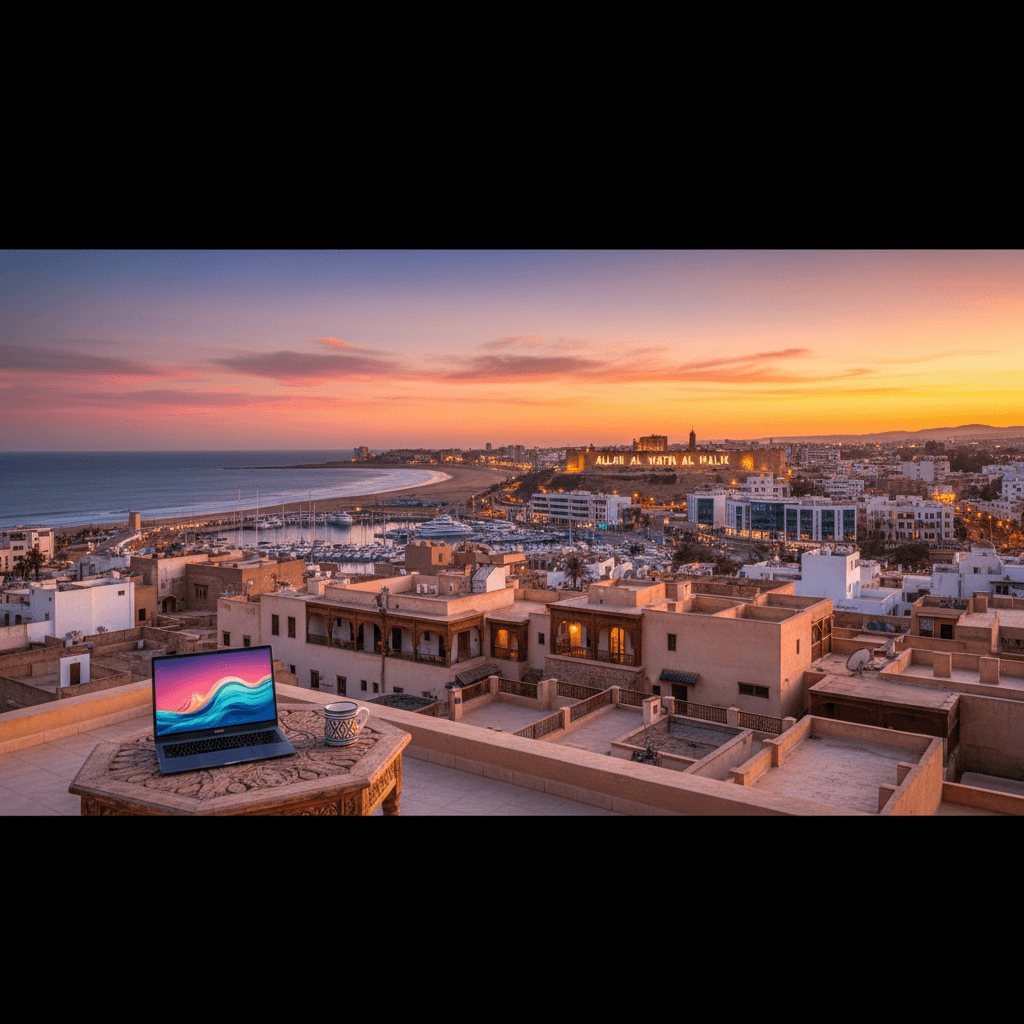
Agadir
🇲🇦 Morocco