Huay Xai
🇱🇦 Laos
The Gateway Vibe
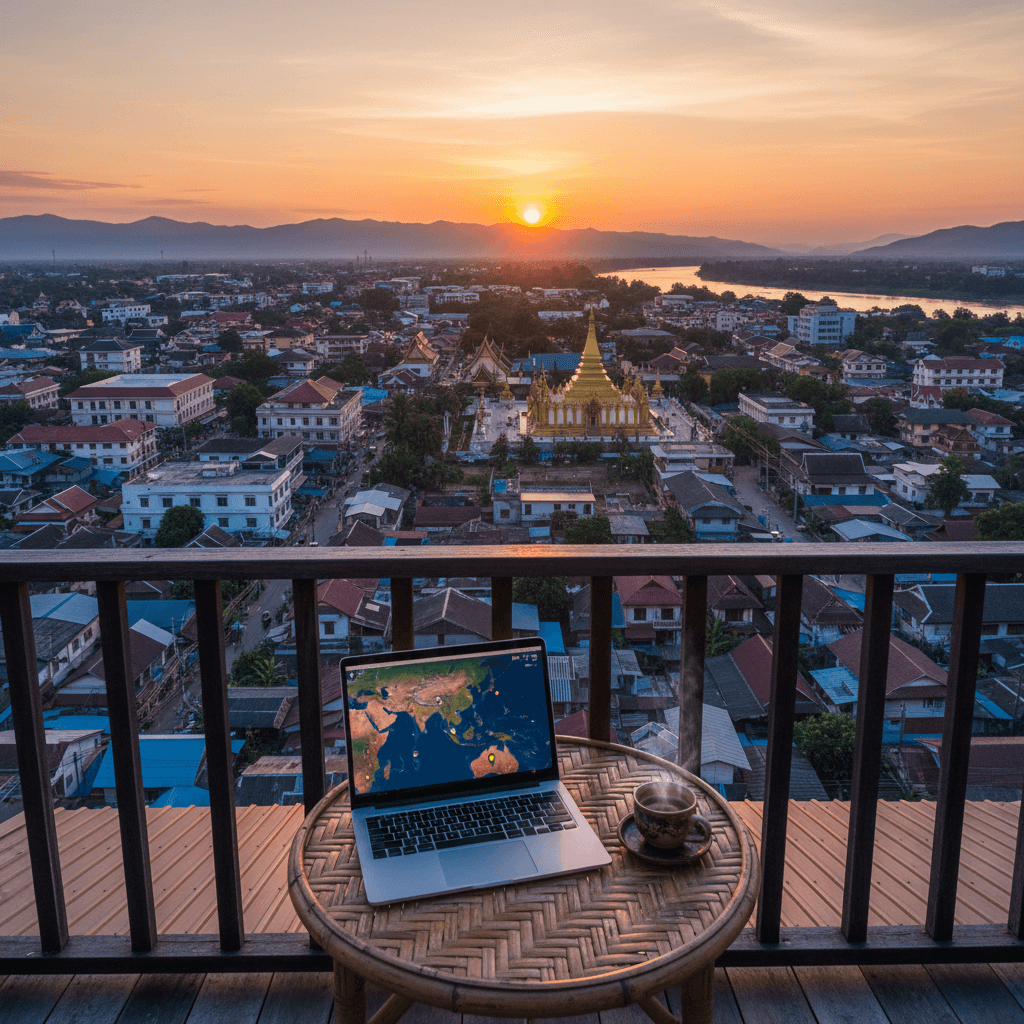
Huay Xai isn't a place you visit to "grind" or scale a startup. It is a dusty, charming riverside outpost that breathes at the pace of the Mekong. For most, it’s a 48 hour pitstop before boarding a slow boat or heading into the jungle for the Gibbon Experience, but for the patient nomad, it offers a rare, low cost reset. You’ll spend your afternoons watching the sun dip behind the Thai hills across the water, Beerlao in hand, listening to the low hum of longtail boats.
The personality of the town is split between its rugged transit hub energy and a sleepy Lao village. It feels honest and unpretentious. You won't find the polished "digital nomad" infrastructure of Chiang Mai here. Instead, you get French colonial ruins like Fort Carnot, local markets selling fresh mangos for $1, and a sense of being truly off the beaten path. It’s quiet, a bit rough around the edges, and perfect if you need to disconnect from the world while staying within a tight budget.
Cost of Living
Your dollars go incredibly far here. While the average monthly cost for a single person in Laos hovers around $1,065, Huay Xai is significantly cheaper than the capital. Most nomads find they can live comfortably on $1,200 to $1,800 a month, though a budget traveler can easily survive on $800 if they stick to guesthouses and street food.
- Housing: Expect to pay $200 to $400 for a private guesthouse room or a basic Airbnb. There are no luxury high rises, just teak wood balconies and tile floors.
- Food: A bowl of noodles at the morning market is $1 to $2. A mid range dinner with drinks at Nine Cafe or Terrasse Restaurant will run you $5 to $10. If you’re craving Western comfort, a wood fired pizza at Daauw Home costs about $10 to $15.
- Transport: The town is small enough to walk, but a tuk tuk ride is usually $0.50 to $2.50 depending on your negotiation skills.
The Living Situation
Huay Xai doesn't have distinct neighborhoods so much as one long main street that hugs the river. Everything happens within a 2km stretch between the border crossing and the slow boat pier.
The Main Strip (Near the Pier)
- The Draw: This is the heart of the action. You’re walkable to every cafe and the pier. Spots like 1 Min to Slow Boat Guesthouse are popular for their river views.
- The Downside: It can get noisy with backpacker crowds and boat engines. WiFi is notoriously spotty in these older buildings.
Central Huay Xai
- The Draw: Slightly quieter and closer to the local markets. Guesthouses like Thadan or Little Hostel offer a more stable, communal feel.
- The Downside: Rooms are often basic and lack the "work from home" desk setups nomads usually crave.
Connectivity & Work
This is the dealbreaker for many. High speed fiber is a rarity. You can expect speeds between 10Mbps and 50Mbps, which is fine for emails but risky for high stakes video calls. There are no coworking spaces. Most nomads set up shop at Dream Bakery or Cloud 9 Kitchen. The coffee is cheap, around $1 to $2, and the staff generally don't mind if you linger.
Pro tip: Get a local Lao Telecom (M-phone) SIM card at the market. 30GB of data costs roughly $5 to $10. Many travelers find that tethering to their phone is more reliable than the guesthouse WiFi. If you’re desperate, Thai SIM cards often still pick up a signal from across the river.
Safety & Health
The town is very safe, and violent crime is almost unheard of. However, travelers should be cautious near the Golden Triangle Special Economic Zone, which has a reputation for scams and casinos; it's best to avoid that area after dark. For healthcare, local clinics are fine for a bandage or a basic prescription, but for anything serious, you’ll want to cross back into Thailand to Chiang Rai. Always have travel insurance that covers medical evacuation just in case.
Weather & Timing
Timing is everything in northern Laos. The "Cool Season" from November to February is spectacular, with temperatures between 13°C and 33°C. March to May is the "Burning Season," where heat hits 37°C and the air quality drops significantly due to agricultural fires. The monsoon season from May to October brings heavy rains that can turn the dirt roads into mud and occasionally disrupt boat travel, with July and August being the wettest months.
Practical Logistics
Cash is king. While some spots use the Loca app for QR payments, you’ll mostly be using Kip. ATMs like BCEL usually have a 20,000 Kip fee and a 2 million Kip limit. When it comes to etiquette, remember to remove your shoes before entering any home or temple. A simple "Sabaidee" (hello) and a "Khob chai" (thank you) go a long way with the locals, who are famously soft spoken and kind.
The Price of Tranquility
Huay Xai is one of the most affordable corners of Southeast Asia, largely because it remains a transit town rather than a developed digital hub. While Laos as a whole averages around $1,065 a month for a single person, your Kip will go significantly further here. Most travelers find that $800 to $1,200 per month covers a comfortable budget lifestyle including hostel dorms and plenty of street food. If you want a private guesthouse and daily cafe meals, expect to spend between $1,200 and $1,800.
Rent is straightforward because the town is essentially one long main street. You can snag a decent studio or a one bedroom guesthouse room near the slow boat pier for $200 to $400 a month. There aren't distinct luxury districts, so your "upscale" options are mostly just the newer guesthouses with better Mekong views. You won't find traditional apartments here; instead, nomads usually negotiate monthly rates directly with spots like 1 Min to Slow Boat Guesthouse or Thadan Guesthouse.
Daily Expenses and Dining
Eating out is where Huay Xai really shines for the budget conscious. A morning trip to the local market yields fresh fruit and snacks for $1 or $2. For a proper sit down meal, local favorites like Nine Cafe serve Lao BBQ for $5 to $10. If you're craving Western comfort food, Daauw Home does solid pizzas in the $10 to $15 range. Beerlao is the local currency of social life, and a large bottle at a riverside sunset spot usually costs less than $2.
- Street food meal: $1 to $3
- Mid-range dinner for two: $15 to $20
- Domestic beer: $1.50 to $2.50
- Scooter rental: $5 to $10 per day
Digital Infrastructure
This is the trade off for those low prices. Huay Xai is a "work from a cafe" kind of town, as dedicated coworking spaces don't exist yet. Internet speeds hover between 10 and 50Mbps, which is fine for emails but risky for heavy video conferencing. Most nomads head to Dream Bakery or Cloud 9 Kitchen for the most reliable signals and a $1 coffee. Many travelers recommend buying a local Lao Telecom SIM for about $5 to $10 at the market to use as a hotspot when the guesthouse WiFi inevitably dips.
Getting Around and Staying Safe
You won't spend much on transport because the town is incredibly walkable. The main strip is less than 2km from end to end. If it's too hot to trek, a shared tuk-tuk ride is usually 10,000 to 50,000 kip, roughly $0.50 to $2.50. There are no ride-hailing apps like Grab here, so you'll need to brush up on your negotiation skills. For longer stays, renting a scooter from a guesthouse near Sabaydee is the best way to explore the outskirts like Ban Muangkeo.
Safety is rarely a concern in the center of town, though locals suggest avoiding the Golden Triangle Special Economic Zone after dark due to reports of scams and trafficking. Healthcare is very basic; the local clinics can handle a cold or a minor scrape, but for anything serious, you'll want to cross the border into Chiang Rai, Thailand. Make sure your insurance covers medical evacuation just in case.
The Social Scene
The expat community is small and transient. Most social interaction happens at "Bar How?" or over communal dinners at guesthouses like Little Hostel. It's a fantastic place for a "digital detox" or a slow paced month of deep work, but it lacks the networking events and meetups you'd find in Vientiane. Life here revolves around the river's rhythm, the arrival of the slow boat, and the occasional adventure into Nam Kan National Park for the Gibbon Experience.
The One-Street Town
Huay Xai isn't a city of sprawling districts or complex zip codes. It is essentially a single main road that hugs the Mekong River, stretching from the Thai-Lao Friendship Bridge down to the slow boat pier. Most of the action happens within a 2-kilometer strip where the guesthouses, cafes, and markets cluster together.
Life here moves at the speed of the river. You won't find high-rise apartments or dedicated tech hubs, but you will find a quiet, village-like atmosphere that works well for a short-term "digital detox." While the infrastructure is basic, the low cost of living and scenic sunsets over Thailand make it a functional pitstop for those crossing the border.
Digital Nomads
If you're working remotely, you'll want to stay as close to the Slow Boat Pier as possible. This northern end of the main strip has the highest concentration of cafes with semi-reliable WiFi. It's walkable, social, and puts you near the best coffee in town.
- Best Area: Northern Riverside (near 1 Min to Slow Boat Guesthouse).
- Rent: $200 to $400 for a monthly Airbnb or private guesthouse room.
- Workspace: No coworking spaces exist. Nomads usually set up at Cloud 9 Kitchen or Dream Bakery. Expect speeds between 10 and 50Mbps; it's enough for emails but risky for high-stakes video calls.
- Pros: Stunning river views from balconies, easy access to the morning market, and the lowest prices in the region.
- Cons: Internet can be spotty. Many nomads recommend tethering to a Lao Telecom SIM card for backup.
Expats and Long-Termers
The small expat community usually drifts slightly south of the pier toward the central market area or the quieter outskirts like Ban Muangkeo. This area feels less like a transit hub and more like a local neighborhood. It's further from the backpacker noise but still within a 10-minute walk of everything.
- Best Area: Central Main Street (near Thadan Guesthouse).
- Rent: Long-term deals can drop below $200 if you negotiate locally.
- Lifestyle: Most expats eat at Terrasse Restaurant for a mix of Lao and European food or grab $10 pizzas at Daauw Home.
- Pros: Quieter nights, closer to local life, and better access to fresh produce at the morning market.
- Cons: You'll likely want to rent a scooter for $5 to $10 a day since the walk to the main cafes can get hot and dusty.
Solo Travelers
For those traveling alone, staying near the Little Hostel area is the move. This is the heart of the social scene where people gather before heading off on the Gibbon Experience or the two-day boat trip to Luang Prabang. It's the easiest place to find a Beerlao partner or a group for dinner.
- Best Area: Mid-strip near the ferry terminal.
- Budget: $800 to $1,200 per month covers a dorm bed, plenty of street food, and the occasional excursion.
- Social Scene: Bar How? is the go-to for evening drinks. It's one of the few places with a consistent backpacker vibe.
- Pros: Very safe, easy to meet people, and staff usually speak decent English to help with transport.
- Cons: Rooms are basic and can get noisy with the constant flow of travelers arriving from the border.
Families
Huay Xai is a tough sell for long-term family stays because there are no playgrounds, international schools, or specialized amenities. However, for a short stay, the central area near Fort Carnot offers a bit of history and a hill to climb for a view, which can keep kids occupied for an afternoon.
- Best Area: Central Main Street.
- Comfort Tier: $1,800+ per month for a larger private guesthouse suite and mid-range meals.
- Healthcare: Very limited. For anything serious, you'll need to cross back into Thailand to Chiang Rai.
- Pros: Safe environment with very little crime. Local markets offer plenty of fresh fruit for picky eaters.
- Cons: No sidewalks, making it difficult to push a stroller. The heat can be intense, especially from March to May.
Getting Around
Since the town is so small, you'll mostly be on foot. If you need a lift, a tuk-tuk or songthaew ride usually costs between $0.50 and $2.50. There are no ride-hailing apps like Grab here. For those staying more than a few days, renting a scooter is the best way to see the surrounding hills or visit the Nam Kan National Park. Just remember that the "burning season" in March and April can make outdoor activity uncomfortable due to smoke and heat.
The Connectivity Reality
Huay Xai is a place where you come to disconnect rather than power through a heavy sprint. Most digital nomads find the infrastructure here a bit of a throwback. You won't find fiber optics or enterprise grade networks; instead, you're looking at basic ADSL and 4G that fluctuates with the weather. Speeds typically hover between 10Mbps and 50Mbps, which is plenty for Slack and emails but might leave you sweating during a high stakes Zoom call.
Most travelers recommend using a VPN at all times. While Laos doesn't have the same level of censorship as some neighbors, the security on open guesthouse networks is questionable. If you need rock solid reliability, local expats often suggest tethering to your phone. It's often faster and more consistent than the shared routers at the budget guesthouses along the main strip.
Coworking and Work-Friendly Cafes
If you're looking for a dedicated coworking space with ergonomic chairs and free flow espresso, you're in the wrong town. There are zero formal coworking hubs in Huay Xai. Instead, the nomad scene here revolves around a few key cafes where the staff don't mind if you linger with a laptop for an hour or two.
- Cloud 9 Kitchen: This is a favorite for its relaxed atmosphere and decent WiFi. The coffee is around $1 to $2, and the views help take the edge off a long workday.
- Dream Bakery: A reliable spot for a morning session. The internet is free for customers, and the tables are large enough for a laptop and a notebook.
Mobile Data and SIM Cards
Since guesthouse WiFi can be hit or miss, getting a local SIM is your first order of business. You can pick these up at the morning market or at Little Hostel. Lao Telecom (M-phone) is the most reliable provider in the region. A typical data package of 30GB will cost you between $5 and $10, which is a steal compared to Western prices.
A unique quirk of Huay Xai is its proximity to Thailand. Because the town sits right on the Mekong, Thai mobile signals often bleed across the river. If you're coming from Chiang Khong, don't toss your Thai SIM immediately. You can often catch a strong 4G or 5G signal from the Thai towers while sitting at riverside cafes, which can be a lifesaver if the Lao networks are acting up.
Practical Work Strategies
Most nomads who stay here for more than a night or two choose their accommodation based specifically on the desk situation. Spot like 1 Min to Slow Boat Guesthouse or Thadan Guesthouse are popular because they offer private balconies or common areas that stay relatively quiet during the day. Just don't expect the "digital nomad community" you'd find in places like Chiang Mai; here, you're mostly working solo between Beerlao sunsets and boat trips.
If you have a massive upload or a critical meeting, consider finishing it before you cross the border. Huay Xai is fantastic for clearing your head and catching up on admin, but it's not the place to host a webinar or manage a server migration. Plan your workload accordingly and enjoy the slower pace.
A Safe Haven with a Caveat
Huay Xai is remarkably safe, even by Southeast Asian standards. The vibe is more "sleepy village" than "border town chaos." You can walk the main riverside strip at night without looking over your shoulder, and violent crime against foreigners is almost unheard of. Most travelers find the local community welcoming and the atmosphere laid back.
The only real red flag is the Golden Triangle Special Economic Zone (SEZ) located further out. It is notorious for casinos and human trafficking scams. While it doesn't spill over into central Huay Xai, expats recommend avoiding that specific area entirely, especially after dark. Stick to the town center and the riverside where the guesthouses cluster, and you'll be fine.
Healthcare Realities
Don't expect much from the local medical infrastructure. Huay Xai has basic pharmacies where you can buy generics like ibuprofen or basic antibiotics without a prescription, and there are small clinics for minor scrapes or stomach bugs. However, the local hospital is extremely limited in its capabilities.
If you have a serious medical emergency or need specialized care, the standard move is to cross the border into Thailand. Chiang Rai is just a few hours away and has high quality private hospitals that meet international standards. Most nomads keep a stash of basic meds and ensure their travel insurance covers emergency evacuation to Thailand just in case.
- Police: Dial 1195 for emergencies, though English proficiency will be low.
- Ambulance: There is no formal paramedic service; most people use a tuk-tuk for quick transport to a clinic.
- Pharmacies: Located along the main road near the morning market.
Staying Healthy on the Ground
The biggest health risks here are common tropical issues rather than crime. Mosquitoes can be a nuisance, especially during the rainy season from May to October, so use repellent to avoid Dengue. The heat can also be brutal between March and May, with temperatures hitting 37°C, making hydration vital.
Tap water is a no-go. Stick to bottled water, which is cheap and available at every "mom and pop" shop for about $0.50. When it comes to food, the local markets and spots like Nine Cafe are generally safe, but use your best judgment with street stalls that don't have a high turnover of customers.
Practical Safety Tips
- Road Safety: If you rent a scooter for about $5 to $10 a day, wear a helmet. The roads are quiet but can be dusty and uneven.
- Digital Security: Since you'll be using public WiFi at places like Cloud 9 Kitchen or Dream Bakery, always use a VPN to protect your data.
- Border Scams: Be wary of "helpers" at the border offering to fast track your visa for a fee. Just handle it yourself at the official window to avoid overpaying.
Getting Around Huay Xai
Huay Xai is remarkably small and compact. Most travelers find they can cover the entire central strip on foot in about 20 minutes. The town is essentially one long main road that hugs the Mekong River, stretching from the Thai-Lao Friendship Bridge area down to the slow boat pier. Because the infrastructure is basic, you won't find the polished transport systems of Vientiane or Luang Prabang here.
Walking and Tuk-Tuks
Walking is the default mode of transport for almost everyone staying near the riverside. The distance from the immigration office to the main cluster of guesthouses like 1 Min to Slow Boat is less than 2 kilometers. If you are carrying heavy gear or heading to the outskirts, grab a jumbo (a large three-wheeled tuk-tuk). Expect to pay between 10,000 and 50,000 kip (roughly $0.50 to $2.50) depending on your haggling skills and the distance.
Be aware that ride-hailing apps like Grab or Loca don't operate here yet. You'll need to flag down drivers on the street or ask your guesthouse to call one for you. If you are arriving from Thailand via the Friendship Bridge, there is a mandatory shuttle bus across the bridge that costs about 20 baht or the equivalent in kip.
Scooter Rentals
For those wanting to explore the surrounding hills or visit Fort Carnot without the uphill hike, renting a scooter is the best move. A few guesthouses near the Sabaydee office rent bikes for $5 to $10 per day. The roads in town are paved but can be dusty and narrow. Once you head toward the Nam Kan National Park or local villages like Ban Muangkeo, the terrain gets rugged quickly. Always check the brakes before you head out, and remember that local traffic can be unpredictable.
Regional Connections
Most people use Huay Xai as a jumping-off point rather than a final destination. The most iconic way to leave is the slow boat to Luang Prabang, a two day journey that departs from the northern end of town. If you prefer the road, minivans and buses depart for Luang Namtha and Oudomxay, though the mountain roads are notoriously winding and slow.
- Slow Boat Pier: Located at the north end of the main strip. Arrive early to snag a seat with a cushion.
- Huay Xai Airport: Huay Xai Airport has limited or no commercial flights; most nomads fly into Chiang Rai in Thailand and take a $10 to $20 shuttle to the border instead.
- Cross-Border Travel: The ferry for locals still runs, but international travelers must use the Friendship Bridge 4, located about 10 kilometers south of the town center.
Navigation Tips
Don't rely on Google Maps for perfectly updated business hours in Huay Xai. Many small shops and rental spots operate on "Lao time." Travelers recommend using Maps.me for offline navigation, as it often has better trail markers for the hike up to the fort or finding smaller guesthouses. If you're heading out for the day, stocking up on snacks and water at the morning market is a smart play, as convenience stores become scarce once you leave the riverside strip.
The Linguistic Landscape
In Huay Xai, your linguistic experience depends entirely on how close you are to the Mekong riverbank. While Lao is the official language, the town functions as a cultural bridge. Because of the constant flow of people across the Friendship Bridge, almost everyone in the service industry understands Thai. If you have spent time in Bangkok or Chiang Mai, you will find your basic Thai phrases get you quite far here since Lao and Thai are linguistically cousins.
English proficiency is hit or miss. At established traveler hubs like Little Hostel or 1 Min to Slow Boat Guesthouse, the staff speak enough English to handle bookings and logistics without a hitch. However, once you step into the morning market or smaller noodle shops away from the pier, communication shifts to gestures and smiles. Most nomads find that a few polite Lao words open doors much faster than speaking louder in English.
Key Phrases for Your Kit
Don't expect the polished English you find in Luang Prabang. Learning the basics shows respect and usually results in better service at the local stalls. Start with these:
- Sabaidee: Hello (The universal greeting)
- Khob chai: Thank you
- Tao dai?: How much? (Vital for the morning market)
- Bo phet: Not spicy (Lao food can be surprisingly fiery)
- Baw pen nyang: No problem or you're welcome
Staying Connected
Communication isn't just about talking; it's about your data. Since the town is literally a stone's throw from Thailand, your Thai SIM card (like AIS or DTAC) will often still catch a signal along the riverside. This is a lifesaver for nomads because the local Lao WiFi can be temperamental. If you are staying more than a couple of days, grab a Lao Telecom (M-phone) SIM. You can find them at the market or have the staff at Little Hostel help you set one up. Expect to pay around 10,000-20,000 kip (~$0.50-$1) for 1GB; larger tourist bundles like 15GB for ~80,000 kip (~$4) or 30GB for ~125,000 kip (~$6) if you plan to tether your laptop.
Digital Tools & Etiquette
Google Translate is your best friend here, but make sure you download the Lao dictionary for offline use. The script is beautiful but impossible to read for the uninitiated, so the camera translation feature helps immensely with menus at spots like Phutsaraphone. For navigation, Maps.me often proves more accurate for the small dirt side streets than Google Maps.
Socially, the "Nop" is the standard greeting. Place your palms together in a prayer like gesture and give a slight bow. It is a silent but powerful form of communication that signals you understand the local customs. Avoid touching anyone on the head and always remove your shoes before entering a home or a temple; these non verbal cues often communicate more than words ever could in this quiet border town.
When to Go
Timing your stay in Huay Xai is less about avoiding crowds and more about managing the heat and the Mekong's water levels. Most travelers find the window between November and February the sweet spot. During these months, the air is crisp, the skies are clear, and temperatures hover comfortably between 13°C and 33°C. It is the peak season for the Gibbon Experience and the slow boat to Luang Prabang because the river is high enough for smooth sailing but the humidity hasn't hit its peak yet.
If you arrive between March and May, prepare for the "burn season." Farmers in the surrounding hills clear land, which can lead to hazy skies and poor air quality. Temperatures often spike to 37°C, making the uphill walk to Fort Carnot a sweaty ordeal. While prices might drop slightly, the oppressive heat makes it difficult to work from cafes that lack strong air conditioning.
The monsoon season runs from June to October. While the landscape turns a brilliant emerald green, the rain is intense. July and August are the wettest months, often seeing up to 24 rainy days. Heavy downpours can occasionally disrupt boat schedules or turn the dirt roads leading to remote villages into mud pits. If you don't mind the rain, you'll have the riverside bars to yourself, but the humidity will be your constant companion.
Seasonal Breakdown
- The Dry Season (November to February): The gold standard for visiting. Expect cool mornings and perfect sunset weather. This is when the town feels most alive with travelers crossing from Thailand.
- The Hot Season (March to May): Best avoided if you are sensitive to heat or smoke. It is the quietest time in town, but the haze can obscure those famous Mekong views.
- The Rainy Season (June to October): Great for photographers who want lush scenery, but bring a dry bag for your electronics. You will likely spend a lot of time tucked away in spots like Dream Bakery waiting for storms to pass.
Digital Nomad Considerations
For those trying to maintain a meeting schedule, the dry season is non-negotiable. Power outages are more frequent during heavy summer storms, which can kill your WiFi mid-call. Since Huay Xai lacks dedicated coworking spaces, you'll be relying on guesthouse routers or mobile tethering. During the cooler months, you can comfortably work from a balcony at a place like 1 Min to Slow Boat Guesthouse without needing the AC to blast all day.
Expats usually suggest syncing your visit with the Lao New Year (Pi Mai) in mid-April if you want to see the town at its most festive. Just be ready to get soaked; the water-throwing celebrations are a welcome relief from the 36°C April heat. If you are here for the Gibbon Experience ziplines, aim for late October or November when the jungle is still lush but the trails have started to dry out.
The Nomad Reality
Huay Xai is a classic transit town that most travelers treat as a 24 hour pitstop before the slow boat to Luang Prabang or the Gibbon Experience. For nomads, it is a quiet, low cost retreat where you can reset by the Mekong, but the infrastructure is undeniably thin. You will find a charming, village like atmosphere with French colonial echoes at Fort Carnot, but the lack of dedicated workspaces and reliable high speed internet makes it a tough sell for more than a week.
Expats who stick around appreciate the rock bottom prices and the slow pace. You are looking at a monthly cost of living between $800 and $1,200 if you are sticking to a budget, or up to $1,800 for a more comfortable setup with private Airbnbs and frequent cafe meals. It is a town of one main street, so you will never be far from the action, even if that action is just watching the sunset with a $1.50 Beerlao.
Neighborhoods & Where to Stay
There are no formal neighborhoods here. Everything revolves around the 1km stretch of road connecting the immigration office to the slow boat pier. Most nomads gravitate toward the riverside for the views and the cooling breeze.
The Main Strip (Near the Pier)
- Best for: Digital nomads and short term stays.
- The Vibe: Walkable, convenient, and close to the best cafes.
- Rent: Studio or 1BR guesthouse rooms run $200 to $400 per month.
- Pros: You are steps away from the slow boat and spots like 1 Min to Slow Boat Guesthouse.
- Cons: Basic amenities and older rooms; WiFi is often hit or miss.
Central Main Street
- Best for: Solo travelers and budget seekers.
- The Vibe: Authentic and close to the morning market.
- Rent: Budget guesthouses like Thadan or Little Hostel offer rooms for $10 to $20 a night.
- Pros: Easy access to $1 street food and English speaking staff.
- Cons: Can be noisy and lacks the privacy needed for deep work.
Internet & Working Remotely
Do not expect fiber optic speeds. Most guesthouses offer 10 to 50Mbps, which handles email fine but struggles with heavy video calls. There are no coworking spaces in town, so you will be hopping between cafes. Cloud 9 Kitchen and Dream Bakery are the reliable favorites, where a $2 coffee buys you a seat for a few hours. If the cafe WiFi fails, many travelers use Thai SIM cards, which often pick up signals from across the river, or Lao Telecom (M-phone) packages that cost about $2.50 for 1GB.
Getting Around
The town is small enough that you will rarely need wheels. Walking the entire main strip takes less than 20 minutes. If you are heading further out, tuk tuks and songthaews are everywhere, usually charging between 10,000 and 50,000 kip depending on your negotiation skills. Scooter rentals are available for $5 to $10 a day near Sabaydee if you want to explore the outskirts. Remember that the airport is currently undergoing upgrades, so most people arrive via a $15 to $20 shuttle from Chiang Rai, Thailand.
Food, Social, & Safety
The food scene is surprisingly decent for a small town. You can grab fresh fruit or Lao snacks at the morning market for $1, or sit down for a Lao BBQ at Nine Cafe for under $10. Daauw Home is the go to for wood fired pizzas and a social atmosphere. For a sunset drink, Bar How? is the main backpacker hub, though the "nightlife" usually wraps up early.
Safety is rarely an issue, though you should be cautious near the Golden Triangle Special Economic Zone due to reported scams. For healthcare, stick to local pharmacies for minor issues, but for anything serious, cross the border to Chiang Rai. Most nomads find the locals incredibly welcoming, though learning a few phrases like "Sabaidee" (hello) and "Khob chai" (thank you) goes a long way.
Best Time to Visit
The window from November to February is the sweet spot. The weather is cool and dry, with temperatures ranging from 13°C to 33°C. Avoid July and August if you can; the heavy rains make the Mekong muddy and can frequently disrupt boat travel and outdoor plans.
- Dry Season (Nov to Feb): 2 rainy days, perfect for trekking.
- Hot Season (Mar to May): Temperatures hit 37°C, making the lack of AC in budget spots a real problem.
- Rainy Season (Jun to Oct): Expect up to 24 rainy days in peak months.
Need visa and immigration info for Laos?
🇱🇦 View Laos Country GuideOff the Radar
Pioneer territory