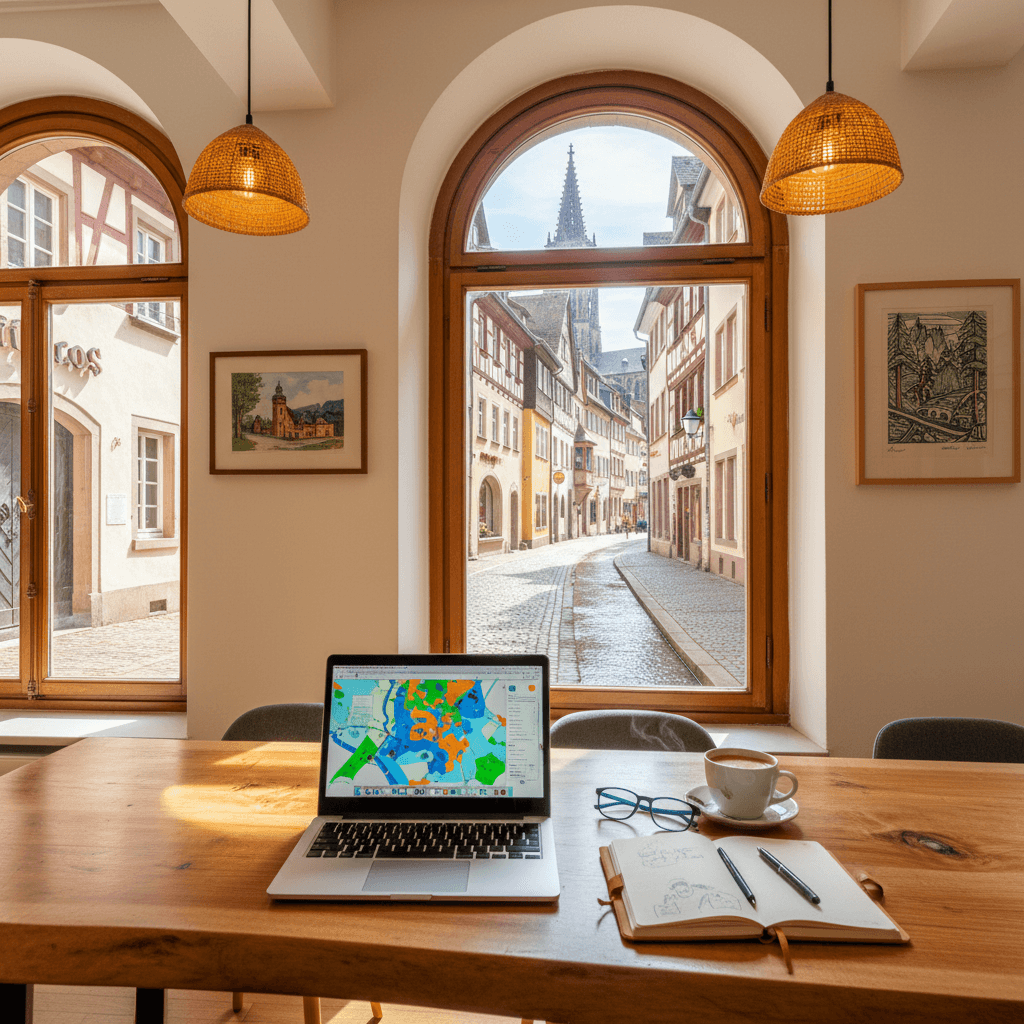
Freiburg im Breisgau
🇩🇪 Germany
The Eco-Capital of the Black Forest
If you're tired of the relentless concrete and grey skies of Berlin or London, Freiburg feels like a deep, pine-scented breath of fresh air. It's often called Germany's eco-capital, and that isn't just marketing fluff. This is a place where sustainability is baked into the DNA. You'll see it in the solar panels glinting on rooftops and the Bächle, those tiny medieval water canals that crisscross the cobblestone streets of the Old Town. Locals joke that if you accidentally step in one, you're destined to marry a Freiburger.
The vibe here is sun-drenched and slow-paced. As the sunniest city in Germany, the lifestyle revolves around the outdoors. It's common to see nomads finishing a deep-work session by 3:00 PM and heading straight for a hike in the Black Forest or a bike ride through the vineyards. It's a university town through and through, meaning there's a constant hum of academic energy and a youthful, progressive spirit that keeps the city from feeling too "sleepy," even if it lacks the 24/7 chaos of a major metropolis.
What Nomads Love (and What They Don't)
Remote workers are drawn here for the balance. You get the efficiency of German infrastructure without the cold, corporate edge. Everything is reachable by bike, and the air quality is some of the best in Europe. It's a safe, community-oriented bubble where you can actually get to know your neighbors at the local weekly market.
However, it's not all sunshine and forest bathing. The city is smaller, so the tech networking scene is more niche, focusing heavily on green tech and environmental sciences. If you're looking for a massive startup incubator, you might find the pace a bit frustrating. Housing is also notoriously tight. Because everyone wants a piece of this high quality of life, finding a flat can feel like a competitive sport, especially in the 2025-2026 window as more people flee the big cities for greener pastures.
Cost of Living Breakdown
Freiburg sits comfortably in the mid-range for Germany. It's more affordable than Munich or Frankfurt, but you'll pay a premium compared to places in the east like Leipzig. Most solo nomads find they need between €2,000 and €3,000 per month to live well here.
- Budget Tier (€1,500 to €2,000): This usually means a room in a shared flat (a WG), eating mostly from local markets or street stalls where a Lange Rote sausage costs about €5 to €8, and relying on your bike instead of a car.
- Mid-range Tier (€2,000 to €3,000): This covers a private studio or one-bedroom apartment, regular coworking access, and dining out a few times a week at mid-range spots where a meal costs €15 to €25.
- Comfortable Tier (€3,000+): You'll be looking at a modern flat in a prime area like Vauban, frequenting high-end Black Forest restaurants, and perhaps taking weekend trips to nearby Switzerland or France.
The Neighborhood Personality
Where you park your laptop matters. Freiburg's neighborhoods have distinct identities that cater to different styles of remote work.
Vauban
- The Vibe: The ultimate eco-utopia. It's mostly car-free, filled with community gardens and sustainable architecture.
- Best For: Nomads who want a quiet, green environment and families who value safety.
- Rent: High demand means studios typically go for €1,000 to €1,500.
Altstadt (Old Town)
- The Vibe: Medieval charm with a side of student energy. You're steps away from the cathedral and the best cafes.
- Best For: Solo travelers who want to be in the thick of the action and close to the Friday markets.
- Rent: Expect to pay €1,200+ for central, short-term furnished spots.
Wiehre
- The Vibe: Elegant, leafy streets with beautiful old villas. It's quieter and feels more "grown-up" than the Altstadt.
- Best For: Long-term expats and those who want a peaceful home office near nature trails.
- Rent: Generally ranges from €900 to €1,400 for a one-bedroom.
The emotional reality of living here is a sense of belonging to something bigger than yourself. You'll find yourself caring about your carbon footprint, buying your vegetables from the Münsterplatz market, and enjoying the fact that the most stressful part of your day is deciding which forest trail to explore after work. It's a city that invites you to slow down and actually enjoy the life you're working so hard to build.
The Price of Sustainable Living
Living in Germany's sunniest city comes with a price tag that reflects its high quality of life. While it's significantly more affordable than Munich or Frankfurt, Freiburg sits comfortably in the mid-range for German cities. You'll find that your biggest hurdle isn't the daily cost of a coffee, but the competitive housing market in a town where everyone wants to live sustainably.
Most nomads find that a monthly budget of €2,200 to €2,800 allows for a comfortable lifestyle without constant penny-pinching. If you're looking to keep things lean, you can get by on €1,600 by opting for a shared flat (WG) and making use of the city's incredible farmers' markets.
Monthly Budget Tiers
- The Budget Nomad (€1,500 to €2,000): This covers a room in a shared apartment, plenty of home cooking with occasional street food from the Münsterplatz market, and a monthly transit pass. You'll be working mostly from cafes or the university library.
- The Mid-Range Professional (€2,000 to €3,000): This tier secures a private studio or a small one-bedroom apartment, regular meals out at local Brauhauses, a dedicated coworking desk, and weekend trips into the Black Forest.
- The High-End Resident (€3,000+): You'll likely be living in a modern, eco-friendly apartment in Vauban, dining at upscale spots like Wolfshöhle, and maintaining a car or high-end e-bike subscription.
Housing and Rent
Rent is your primary expense, and the market is tight. Expats recommend starting your search on platforms like WG-Gesucht or ImmobilienScout24 well before you arrive. Prices vary wildly by neighborhood, but the eco-conscious design of the city means even further-out areas are well-connected.
Vauban and Wiehre
- Studio/1BR Rent: €900 to €1,400
- Vibe: These are the most sought-after spots. Vauban is world-famous for its sustainable architecture and car-free streets, while Wiehre offers beautiful old-world villas and a quieter, leafy atmosphere.
Altstadt (Old Town)
- Studio/1BR Rent: €1,000 to €1,500
- Vibe: You're paying for the charm of cobblestones and proximity to the university. It can be noisy on weekends, and short-term rentals here carry a significant premium.
Dining and Groceries
Eating out in Freiburg is a highlight, especially if you enjoy farm-to-table ingredients. A quick lunch at a market stall, like the famous "Lange Rote" sausage, will set you back about €5 to €8. A mid-range dinner for two with local Baden wine typically lands between €45 and €70.
Grocery shopping is a local pastime. While discounters like Aldi or Lidl are available, many residents prefer the organic markets (Bio-Markt) or the daily market at the Cathedral. Expect to spend about €300 to €450 per month on high-quality groceries if you're cooking most meals at home.
Connectivity and Transport
Freiburg is built for bikes. If you aren't buying a second-hand frame for €100, you can use the Frelo bike-sharing system for just a few euros per trip. For rainy days, the VAG transit network is excellent. A monthly pass costs roughly €50, but many nomads find they rarely need it if they stay central.
Coworking is still a growing scene here. You'll find community-focused hubs like Grünhof, where a monthly hot desk runs between €180 and €250. Internet is generally rock-solid, with high-speed fiber common in most modern apartment buildings. For mobile data, grabbing a local SIM from Telekom or O2 will cost about €20 to €30 for a generous data package.
For Sustainability Seekers and Remote Nomads: Vauban
If you're moving to Freiburg to embrace its reputation as Germany's eco-capital, Vauban is where you'll want to drop your bags. This neighborhood is world famous for its sustainable urban design and car-free streets. It's a dream for nomads who want a quiet, community-focused environment where the air is clean and the buildings are literally covered in solar panels.
Most nomads find the vibe here incredibly peaceful, though the "car-free" aspect means you'll be relying heavily on your bike or the tram. Living here feels like being part of a giant social experiment in green living. You'll find plenty of sustainable co-ops and organic markets like Alnatura to keep your kitchen stocked with local produce.
- Average Rent: €800 to €1,500 for a studio or one-bedroom apartment.
- Atmosphere: Ultra-green, quiet, and cooperative.
- The Trade-off: Housing is in high demand, and the car-free lifestyle can be a hurdle if you frequently travel out of the city with heavy gear.
For Families and Long-Term Expats: Wiehre
Wiehre is arguably the most beautiful residential district in the city, characterized by its stunning Altbau (old building) architecture and tree-lined streets. Expats recommend this area because it strikes a perfect balance between being sophisticated and family-friendly. It’s safe, walkable, and sits right at the foot of the Black Forest, giving you instant access to hiking trails and forest schools.
The neighborhood has a slightly more upscale feel than the student-heavy center. It's home to many professionals and young families who appreciate the proximity to the university hospital and high-quality playgrounds. While it's quieter than the Altstadt, you're never more than a ten-minute bike ride from the action.
- Average Rent: €900 to €1,600 for family-sized apartments.
- Atmosphere: Prestigious, leafy, and serene.
- The Trade-off: It's one of the pricier districts, and finding a vacancy requires quick action on sites like WG-Gesucht or Immowelt.
For Solo Travelers and Short-Term Nomads: Altstadt (Old Town)
If you want to be in the thick of it, the Altstadt is your best bet. This is the medieval heart of Freiburg, famous for its "Bächle" (tiny water canals) and the towering Minster cathedral. Solo travelers often choose this area to be close to the student energy of Albert Ludwig University and the best coworking cafes.
You'll spend your mornings working from local favorites like Filipe Coffee or one of the many cafes near the Augustinerplatz. The social scene is easiest to tap into here, with traditional beer gardens and student bars just a few steps away. Since it's the tourist hub, English proficiency is exceptionally high, making it an easy landing spot for those who don't speak German yet.
- Average Rent: €1,000 to €1,400 for short-term furnished rentals.
- Atmosphere: Historic, lively, and walkable.
- The Trade-off: It can get noisy during the weekends and during the Christmas market season. Space is tight, so apartments are often smaller and more expensive per square meter.
Pro Tips for Your Search
Freiburg's housing market is notoriously competitive. Whether you're looking for a shared room (WG) for €500 or a private flat, travelers often say that having a "Bewerbermappe" (applicant folder) ready with your ID and proof of income is the only way to secure a spot. Don't overlook the smaller surrounding areas like Stühlinger if you want a more "gritty" and artistic vibe with slightly lower price tags and great proximity to the main train station.
Connectivity and Speed
Freiburg reflects Germany's high standards for infrastructure, and you'll find the internet is generally rock solid. Most apartments and cafes offer fiber or high speed cable connections. If you're staying in the Altstadt or the eco-conscious Vauban, expect download speeds ranging from 50 Mbps to 250 Mbps. It’s plenty for video calls with clients or uploading large files while looking out over the Black Forest hills.
For mobile data, 5G is widely available across the city center. Local providers like Telekom and Vodafone offer the best coverage, though they can be pricey for short-term stays. Most nomads grab a prepaid SIM from O2 or use an eSIM through Holafly to get connected the moment they step off the train. Public WiFi, known as Münsterplatz WiFi, covers the main square and surrounding streets, though it's better for a quick map check than a full work session.
Coworking Spaces
The coworking scene here is more intimate and community-driven than the corporate hubs you'll find in Berlin. It’s less about "grind culture" and more about sustainable productivity. You won't find a massive WeWork, but the local spaces are friendly and often host evening networking events for the city's green-tech crowd.
- Kreativpark Lokhalle: Located in a refurbished industrial hall near the main station, this is a prominent hub for startups and creatives. It has a high-ceiling, airy vibe and a very collaborative community. Visitors should check their website directly for the most up-to-date information on day passes and monthly membership tiers.
- Gruenhof: With multiple locations including one at Augustinerplatz, this is the heart of the local innovation scene. It’s where the eco-entrepreneurs hang out. They offer various tiers, with "Hot Desks" starting around €160 per month.
The Laptop-Friendly Cafe Scene
If you prefer the hum of a milk steamer over a quiet office, Freiburg’s cafe culture is fantastic. The Altstadt is packed with spots, though some of the smaller, traditional bakeries might give you the side-eye if you stay for four hours on a single espresso. Stick to the student-heavy spots for the best experience, particularly around the university buildings where remote work is more common.
Practical Tips for Remote Work
Germans value their "Feierabend" (the end of the work day) and their Sundays. While coworking spaces usually offer 24/7 access for monthly members, many cafes close earlier than you might expect, and almost everything except restaurants shuts down on Sundays. If you have a big deadline on a Monday, make sure your home setup or your coworking badge is ready to go by Saturday night.
Most nomads find that a hybrid approach works best here. Use a dedicated coworking space for your heavy lifting and meetings during the week, then take your laptop to a cafe in Vauban for a casual Friday afternoon. The city's compact size means you're never more than a 15 minute bike ride from a reliable connection and a good cup of coffee.
Peace of Mind in the Eco-Capital
Freiburg is widely considered one of the safest cities in Germany, which is saying a lot in a country already known for its low crime rates. Most nomads find they can walk or bike through any neighborhood at 2:00 AM without a second thought. The city's student-heavy population and family-oriented districts like Vauban create a community-watch atmosphere where people actually look out for one another.
Violent crime is nearly non-existent here. The most common "danger" you'll face is likely a bicycle being swiped if it isn't locked properly. Expats recommend investing in a heavy-duty U-lock and avoiding leaving your bike overnight near the main train station (Hauptbahnhof), which is the only area that feels even slightly gritty. Even then, it's mostly just crowded and loud rather than genuinely unsafe.
- Emergency Numbers: Dial 112 for fire and medical emergencies; dial 110 for police.
- Solo Travel: Women traveling alone consistently report feeling comfortable in Freiburg's public spaces and on the tram network.
- The Bächle: Watch your step along the sidewalks in the Altstadt. These narrow, water-filled runnels are charming but easy to trip into if you're staring at your phone. Local legend says if you accidentally step in one, you'll marry a Freiburger.
World-Class Healthcare Access
The healthcare standard in Freiburg is exceptionally high, largely thanks to the University Medical Center Freiburg. It's one of the largest and most prestigious medical institutions in Europe, meaning you have access to world-leading specialists right in town. Most doctors speak excellent English, though the administrative staff at smaller clinics might prefer German.
If you're here on a digital nomad visa or residency permit, you'll be integrated into the German insurance system. For short-term nomads, private providers like Feather or Cigna are popular choices that are widely accepted by local practitioners. A standard consultation without insurance usually starts around €50 to €80, but costs can climb quickly for specialized tests.
Pharmacies and Daily Wellness
You won't find aspirin or cold medicine in a supermarket here. For any medication, you'll need to head to an Apotheke, recognizable by a big red "A" sign. These are everywhere in the city center. Pharmacists in Germany are highly trained and can often give better medical advice for minor ailments than a quick Google search.
- After-hours Care: If you get sick on a Sunday or late at night, look for the Notdienst (emergency service) schedule posted on any pharmacy door. It will tell you which local pharmacy is open 24/7 on that specific day.
- Drinking Water: The tap water in Freiburg is some of the best in the country, sourced directly from the Black Forest. It's perfectly safe and tastes better than most bottled brands.
- Air Quality: Since the city is heavily pedestrianized and surrounded by forest, the air quality is fantastic. It's a massive draw for nomads who struggle with the pollution in larger hubs like Berlin or Frankfurt.
For routine check-ups, try to book a few weeks in advance. While emergency rooms are efficient, getting a non-urgent appointment with a GP (Hausarzt) can take some time due to the city's popularity. Most expats suggest using the Doctolib app to find available slots and filter for English-speaking doctors nearby.
The Pedal-First Lifestyle
In Freiburg, the bicycle isn't just a way to get around; it's a statement. As Germany's eco-capital, the city has designed its entire infrastructure to prioritize two wheels over four. You'll find wide, dedicated bike lanes everywhere, and in neighborhoods like Vauban, cars are actively discouraged or restricted to the outskirts. Most nomads find that renting a bike through services like Nextbike (locally branded as Frelo) is the smartest move for daily commutes. A long term rental or buying a used bike for around 100 to 150 EUR is even better if you're staying for a few months.
The city is famously compact. You can cycle from the medieval gates of the Altstadt to the edge of the Black Forest in under fifteen minutes. If you prefer your own two feet, the historic center is almost entirely pedestrianized. Just keep an eye out for the Bächle, the small water-filled runnels lining the streets. Local legend says if you accidentally step in one, you'll end up marrying a Freiburger.
Public Transit and the 49-Euro Factor
When the weather doesn't cooperate or you're heading further out, the VAG (Freiburg's transit authority) runs a seamless network of electric trams and buses. The trams are the backbone of the city, connecting the main train station (Hauptbahnhof) to residential hubs like Wiehre and Rieselfeld. They run frequently, usually every 7 to 10 minutes during the day.
- The Deutschland-Ticket: For 49 EUR a month, you get unlimited travel on all local and regional transport across Germany. It is the gold standard for nomads who want to explore the Black Forest on weekends.
- Short-term fares: If you aren't committing to the monthly pass, a single ride within the city costs about 2.50 to 3.00 EUR.
- VAG Mobil App: This is the best way to buy digital tickets and check live connections. It's much more reliable than following the printed schedules at the stops.
Ride-Hailing and Taxis
While Freiburg is tech-forward in its environmentalism, ride-hailing isn't as dominant here as in Berlin or London. Uber and Bolt operate but can be sparse during off-peak hours. Taxis are clean and reliable but expensive, with short hops across town often landing in the 15 to 25 EUR range. Most expats recommend sticking to the trams after a late night out, as they run on a reduced schedule through the early hours of the morning.
Regional Connections
Freiburg serves as a perfect base for exploring the "border triangle" where Germany, France, and Switzerland meet. The EuroAirport Basel-Mulhouse-Freiburg (BSL) is your primary gateway for international flights. It's about a 55-minute ride on the FlixBus or the dedicated airport shuttle, which usually costs around 20 to 25 EUR.
For high-speed travel, the ICE (InterCity Express) trains connect you to Frankfurt or Zurich in roughly two hours. If you're planning a weekend trip to the mountains, look for the Höllentalbahn. It's one of the most scenic train routes in Germany, climbing from the city into the heart of the Black Forest, and it's included in your 49-Euro monthly ticket.
The Linguistic Landscape
As a prominent university hub with a heavy international student population, Freiburg is one of the more English-friendly cities in Germany. You'll find that most people under 40 speak English quite well, especially in the Altstadt or around the Albert Ludwig University campus. If you're working from a cafe or ordering a flat white in a trendy spot, you can usually get by without a lick of German.
That said, the city's green, community-focused vibe means locals appreciate it when you make an effort. While the official language is High German (Hochdeutsch), you might hear older residents or those from the surrounding Black Forest villages speaking Badisch, a local dialect. It's melodic and a bit softer than the German you'd hear in Berlin, but don't worry about learning it; everyone switches to standard German for outsiders.
Navigating Daily Interactions
While the "Nomad" life is easy in English, the "Expat" life involves more paperwork. If you're dealing with the Bürgeramt (Citizens' Office) for your residence registration or trying to navigate a rental contract in Vauban, the language barrier becomes real. German bureaucracy is famously rigid and almost exclusively conducted in German. Most expats recommend bringing a German-speaking friend or hiring a translator for these formal appointments to avoid any "lost in translation" headaches.
In social settings, the dynamic shifts. Freiburg's nightlife is more about cozy wine taverns and craft beer gardens than loud clubs. In these settings, people are generally open and happy to practice their English with you. If you're heading to the Münstermarkt to grab a Lange Rote (the local grilled sausage), a simple "Hallo" and "Danke" will suffice, but knowing your numbers in German helps when the market stalls get busy.
Learning the Local Tongue
If you're staying for more than a month, picking up some German is a smart move for your social life. Freiburg has several high-quality language schools that cater to different schedules:
- Goethe-Institut Freiburg: The gold standard for intensive learning, located right near the main station. It's pricey but very effective.
- Volkshochschule (VHS) Freiburg: The budget-friendly choice for long-termers. Classes are affordable and a great way to meet other expats living in neighborhoods like Wiehre.
- Language Cafes: Keep an eye on Meetup or Facebook groups for "Sprachcafés," where locals and foreigners swap languages over drinks.
Essential Digital Tools
You won't need to carry a dictionary, but a few apps will make your life significantly easier. DeepL is widely considered superior to Google Translate for German, as it handles the complex grammar and formal vs. informal nuances much better. For public transit, the VAG Mobil app is indispensable for checking tram times and buying tickets, and it has a solid English interface.
Quick Reference Phrases
- Guten Tag: Good day (Standard greeting)
- Hallo / Servus: Hi (Casual)
- Tschüss: Bye (The most common way to say goodbye)
- Ein großes Bier, bitte: A large beer, please (Self-explanatory)
- Sprechen Sie Englisch?: Do you speak English?
- Die Rechnung, bitte: The bill, please
- Entschuldigung: Excuse me / Sorry
Most nomads find that a B1 level of German is the "sweet spot" here. It's enough to handle the grocery store, understand the signs on the hiking trails in the Black Forest, and make small talk with your neighbors in the eco-coops. Anything less is manageable, but anything more will truly open up the city's tight-knit community to you.
The Sunny Side of Germany
Freiburg is famously the sunniest city in Germany, averaging around 1,700 to 2,000 hours of sunshine per year. While much of the country deals with grey, overcast skies for months on end, Freiburg feels like a Mediterranean pocket tucked into the edge of the Black Forest. This climate is what drives the city's outdoor culture, from the open air markets at Münsterplatz to the groups of students lounging along the Dreisam river.
The weather here is generally mild, but it has distinct seasons that change how you'll use the city. Summertime brings heat that can occasionally push past 30°C (86°F), while winters are crisp and cool without the bone chilling dampness found in northern German cities like Hamburg or Berlin.
When to Arrive
If you're looking for the sweet spot between perfect weather and social activity, aim for May through September. This is when the city truly comes alive. The beer gardens are full, the Bächle (the city's iconic small water canals) are flowing, and the hiking trails in the surrounding hills are in peak condition.
- Spring (April to June): This is arguably the most beautiful time. The cherry blossoms are out, and the "Spargelzeit" (asparagus season) is in full swing. Temperatures sit comfortably between 15°C and 22°C, perfect for cycling to coworking spots without breaking a sweat.
- Summer (July to August): It gets hot, but the proximity to the forest provides a natural escape. Nomads often spend their afternoons working from shaded cafes in the Altstadt before heading to the Schlossberg for sunset drinks. Expect plenty of local wine festivals during these months.
- Autumn (September to October): The wine harvest season is a big deal here. The air gets crisp, the forest turns gold, and the crowds thin out. It's a great time for deep work and long weekend hikes.
- Winter (November to March): It's quieter and gloomier, but Freiburg serves as a fantastic base for skiers. You can take a 40 minute train to Feldberg for a day on the slopes. The Christmas markets in December provide a much needed boost of light and social energy.
Seasonal Practicalities
Expats recommend checking your apartment's insulation and cooling situation before signing a summer lease. Because Freiburg is so eco-conscious, air conditioning is rare in residential buildings. In July and August, you'll want a place with thick stone walls or a shaded balcony in neighborhoods like Wiehre to stay comfortable.
Rain is a factor year round, though it's rarely a total washout. Most locals don't let a drizzle stop them from biking. If you're moving here in 2025 or 2026, invest in a high quality rain shell and a waterproof pannier bag for your laptop. You'll see everyone from university professors to tech freelancers pedaling through a light shower without a second thought.
The Nomad's Peak Window
For the best balance of cost and lifestyle, travelers often suggest arriving in late August or early September. You catch the tail end of the warm weather, avoid the peak summer tourist prices in the Old Town, and arrive just as the student energy returns for the winter semester. This timing makes it easier to find short term sublets before the mid winter housing crunch begins.
Getting Around Like a Local
Freiburg is the cycling capital of Germany, and you'll feel it the moment you step outside. Most nomads skip the car entirely and grab a bike from Nextbike or buy a cheap second hand frame from a local student shop. The city is designed for two wheels, with dedicated paths that often get priority over cars.
If the weather turns, the tram system is incredibly efficient. A monthly pass usually runs around 50 EUR, covering you for the city and surrounding suburbs. For longer trips, the Basel Mulhouse Freiburg Airport is your main gateway, located about an hour away by shuttle or train. If you're heading deep into the Black Forest for a weekend hike, the regional trains are reliable and surprisingly scenic.
Budgeting for the Eco-Capital
While Freiburg isn't as pricey as Munich, it's not a budget basement like some spots in the east. You'll want to plan your monthly spend based on your lifestyle tier:
- The Budget Nomad (1,500 to 2,000 EUR): Stick to a shared room in a "WG" (Wohngemeinschaft) for 400 to 600 EUR. You'll eat mostly at home or grab 8 EUR bratwursts and market snacks at the Münsterplatz.
- The Mid-Range Professional (2,000 to 3,000 EUR): This covers a private studio or a one bedroom apartment in areas like Wiehre for 800 to 1,200 EUR. You can afford regular dinners out at 20 EUR per person and a dedicated desk at a local workspace.
- The High-End Expat (3,000+ EUR): This allows for a premium apartment in the sustainable Vauban district, which can easily top 1,500 EUR, plus frequent upscale dining and weekend trips across the border to France or Switzerland.
Staying Connected
Internet speeds are generally rock solid across the city. Most cafes in the Altstadt (Old Town) are friendly to laptop users, though it's polite to keep the coffee flowing if you're staying for a few hours. For a more professional setup, look for community driven coworking hubs where a daily pass costs between 15 and 20 EUR.
For your phone, don't overcomplicate things. Pick up a local SIM from Telekom or Vodafone for the best 5G coverage. If you're only staying a month or two, an eSIM from Holafly is the easiest way to get data the second you land without hunting for a physical shop.
Language and Social Life
You can get by with English in the university areas and the city center, but learning a few German basics goes a long way with the locals. A simple "Guten Tag" or "Danke" is expected in shops. Most expats find that the best way to meet people is through activity groups rather than bars. Join a hiking club or look for Meetup groups focused on green tech and sustainability, as that's the heartbeat of the local professional scene.
Health and Safety
Freiburg is one of the safest cities you'll ever visit. You can walk through almost any neighborhood at night without a second thought. If you do run into trouble, the emergency number is 112. For minor health issues, look for an Apotheke (pharmacy). They are everywhere, but remember they almost all close on Sundays, so keep some basic supplies at your apartment just in case.
Finding a Place to Stay
The housing market is competitive because everyone wants to live here. Don't rely solely on Airbnb, as prices are inflated for tourists. Local expats recommend using WG-Gesucht for shared housing or Immowelt for long term apartments. Vauban is the go to for eco-conscious living, while Wiehre offers a more classic, quiet residential feel that's still close to the action.
Need visa and immigration info for Germany?
🇩🇪 View Germany Country GuideNomad Haven
Your home away from home