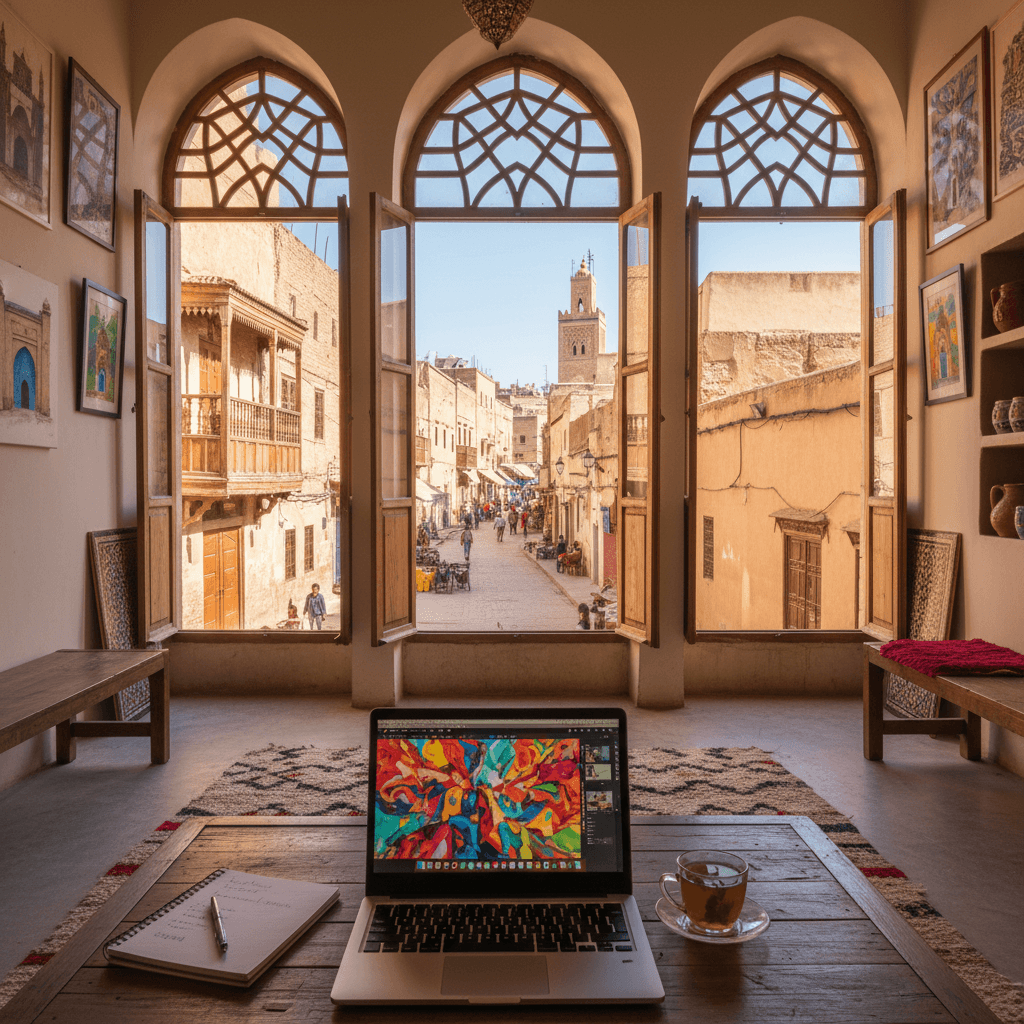
Fez
🇲🇦 Morocco
The Soul of Morocco
If Marrakech is Morocco’s glamorous, high energy stage, Fez is its quiet, intellectual library. Founded in the 8th century, this city doesn't just display history; it lives it. It serves as the country’s spiritual and cultural heart, home to the world’s oldest university and a medieval medina that feels like a portal to another era. For nomads, the vibe here is a slow burn. It’s a place that demands your presence and rewards your patience with a depth of character you won't find in more polished tourist hubs.
The emotional experience of Fez is defined by sensory contrast. One moment you are standing in the world’s largest pedestrianized urban zone, surrounded by the scent of cedarwood, raw leather, and cumin. The next, you step behind a heavy wooden door into a riad where the sound of the fountain and the cool tile floors offer instant sanctuary. It is a city of layers, where the chaos of the souks eventually gives way to a profound sense of calm. Most nomads find that Fez reshapes their perspective on time, forcing a shift away from the frantic pace of digital life toward something more grounded and ancient.
The Daily Grind and the Digital Life
Working from Fez is an exercise in choosing your own adventure. If you want the authentic, moody atmosphere of the old world, you’ll likely base yourself in Fes el Bali (the medina). It is a maze of over 9,000 alleys where GPS often fails. You’ll get lost, but that’s part of the initiation. Expats recommend downloading Maps.me for offline navigation, as it tends to be more reliable than Google in the narrowest corridors.
For those who need a more modern setup, the Ville Nouvelle is the move. This area offers wider boulevards, French style cafes, and a growing coworking scene. While the medina is where the magic happens, the Ville Nouvelle is where the productivity lives. You’ll find stable internet speeds ranging from 20 to 45 Mbps, which is plenty for most remote work. When you need a break from your screen, a 20 MAD (about $2) street food meal of spicy sausages or fresh bread is always within reach.
What to Expect on the Ground
- The Sensory Barrage: The medina is intense. You will share narrow paths with donkeys, dodge aggressive shopkeepers, and navigate a literal wall of sound and scent. It’s exhilarating but can be exhausting for the uninitiated.
- Affordability: Fez is significantly cheaper than Marrakech. A comfortable life here is easily achievable on $1,000 a month, while budget conscious travelers can get by on $500 to $800.
- Connection: While English isn't as widespread as in the north or the coast, a little bit of French or basic Arabic (Darija) goes a long way. Use translation apps and lean on the local shopkeepers; they are often the best source of info and community.
- Safety: It’s generally safe, but pickpocketing in crowded souks or on local buses is a reality. Keep your wits about you and hire a guide for your first few days to learn how to navigate the social landscape without being constantly hassled.
The Neighborhood Breakdown
Fes el Bali (The Medina)
- Vibe: Total cultural immersion, historic, and chaotic.
- Rent: $400 to $700 for a room in a traditional riad or a small apartment.
- Best For: Short stays, history buffs, and those who don't mind a lack of cars.
Ville Nouvelle
- Vibe: Modern, accessible, and more "European" in layout.
- Rent: $300 to $600 for a modern 1BR apartment.
- Best For: Long term nomads, expats, and anyone who needs easy access to coworking and supermarkets.
Fez isn't a city that tries to please you. It doesn't cater to the typical "digital nomad" aesthetic of avocado toast and beach clubs. Instead, it offers something rarer: a chance to disappear into a living history book. It’s a city for the curious, the patient, and those who want their travel to leave a mark on them.
The Cost of Living in Fez
Fez is arguably the best value for your money in Morocco. While Marrakech has seen prices climb alongside its popularity, Fez remains a place where you can live well on a modest budget. You're trading some of the modern conveniences and high-end nightlife for a much lower burn rate and a level of cultural immersion that's hard to find elsewhere. Most nomads find that their money goes about 20% further here than in the bigger hubs.
For a solo traveler living a modest lifestyle, you can get by on $400 to $600 USD per month. If you want a bit more comfort, perhaps a private riad in the medina and frequent meals out, $1,000 USD will let you live quite luxuriously. The city doesn't have the same "tourist tax" intensity as other regions, though you'll still need to sharpen your haggling skills for anything without a price tag.
Typical Monthly Budgets
- Budget Nomad: $400 to $550 USD. This covers a basic room in the medina, plenty of street food, and local transport.
- Mid-Range: $700 to $950 USD. Includes a nicer apartment in Ville Nouvelle or a renovated riad, regular cafe visits, and occasional guided tours.
- High-End: $1,200+ USD. This buys you a premium traditional home, upscale dining, and private drivers for weekend trips.
Housing and Neighborhoods
Your living costs will shift depending on whether you choose the ancient heart of the city or the modern outskirts. Renting through Airbnb is the easiest route for short stays, though locals often find better deals by asking around once they arrive.
Fes el-Bali (The Medina)
- The Vibe: The world's largest car-free urban zone. It is loud, sensory, and incredibly historic.
- Typical Rent: $350 to $600 USD per month for a decent riad or apartment.
- Pros: You are steps away from the souks and history; no need for transport.
- Cons: Easy to get lost; can be noisy; groceries require carrying bags through narrow alleys.
Ville Nouvelle (The New City)
- The Vibe: Built during the French protectorate, this area has wide boulevards, modern cafes, and malls.
- Typical Rent: $300 to $500 USD for a modern 1-bedroom apartment.
- Pros: Better internet; closer to coworking spaces; easier to navigate.
- Cons: Lacks the "Old World" charm of the medina.
Food and Dining
Eating in Fez is a highlight for most travelers. If you stick to where the locals eat, you'll find it incredibly cheap. A bowl of harira soup or a street snack like maaqouda (fried potato cakes) usually costs between 20 and 50 MAD ($2 to $5 USD). Sit-down meals in mid-range restaurants typically run between 50 and 100 MAD ($5 to $10 USD) for a tagine and bread.
If you're looking for something more upscale, especially in the renovated riads of the medina, expect to pay 150 MAD ($15 USD) or more. Alcohol is the biggest budget-killer; it's only served in specific hotels and licensed bars, and you'll pay a premium for it. Most nomads save money by shopping at local markets for fresh produce, which is exceptionally affordable and high quality.
Connectivity and Working
The digital nomad infrastructure is growing, particularly in Ville Nouvelle. While you won't find a coworking space on every corner, the scene is emerging. Expect to pay around 100 to 200 MAD ($10 to $20 USD) for a day pass at local hubs. Many nomads prefer working from spots like Café Clock, which offers reliable WiFi and a great atmosphere for the price of a coffee.
For mobile data, grab a SIM card from Inwi or Maroc Telecom at the airport or a local kiosk. 100 MAD ($10 USD) will usually get you 10GB of data, which is stable enough for hotspots if your riad's thick stone walls block the WiFi signal. Speeds generally range from 20 to 45 Mbps, which is plenty for video calls and standard remote work tasks.
Transport and Extras
Within the medina, your only cost is a good pair of walking shoes. For trips between the old and new cities, local buses are a steal at 2 to 5 MAD ($0.20 to $0.50 USD) per ride, though they can be crowded. Petit taxis are also available; just make sure they turn the meter on. A typical cross-city trip shouldn't cost more than a few dollars.
Don't forget to budget for "the guide tax." Even if you use Maps.me or GPS, you might occasionally pay a local a few dirhams to help you find a specific door in the medina labyrinth. It's just part of the local economy and helps keep your stress levels down.
Fes el-Bali (The Medina)
Best for: Solo Travelers and Culture Seekers
Fes el-Bali is the historic soul of the city and the world's largest car free urban zone. It is a labyrinth of over 9,000 narrow alleyways where you'll share the path with donkeys, spice merchants, and artisans. For solo travelers, this is the place to be if you want to walk out of your door and immediately feel like you've stepped back into the 11th century.
- The Vibe: High energy, sensory, and deeply traditional. You'll hear the call to prayer echoing off ancient walls and smell the distinct aroma of the tanneries.
- Pros: You are steps away from the best street food, the Al-Attarine Madrasa, and the famous leather tanneries. It's incredibly walkable, though you'll definitely get lost at least once.
- Cons: The navigation is a nightmare without Maps.me or a local guide. It can be loud, and the persistent shopkeepers might wear you down after a few days.
- Rent: Expect to pay $30 to $60 per night for a room in a traditional Riad. Monthly rates for a modest traditional house can range from $400 to $700 depending on the level of renovation.
- Food: Street food is king here. You can grab a hearty meal for 20 to 50 MAD. Sitting down at a mid range spot like Cafe Clock will run you about 100 MAD.
Ville Nouvelle (The New City)
Best for: Digital Nomads and Long Term Expats
If you need reliable fiber internet and a desk that isn't a low Moroccan coffee table, the Ville Nouvelle is your spot. Built during the French protectorate era, this neighborhood features wide boulevards, modern apartment blocks, and plenty of cafes where you can open a laptop without feeling out of place. It's much more functional for those trying to maintain a 9 to 5 schedule.
- The Vibe: Modern, European influenced, and significantly more relaxed than the chaos of the Medina. It feels like a standard Mediterranean city with a Moroccan twist.
- Pros: Better infrastructure, easier access to supermarkets, and the city's emerging coworking scene. You'll find more stable 20 to 45 Mbps internet speeds here.
- Cons: It lacks the "Old World" magic of the Medina. It can feel a bit generic if you came to Morocco specifically for the history.
- Rent: Modern 1BR apartments typically cost between $350 and $550 per month.
- Coworking: Day passes at local spots or laptop friendly cafes generally cost between 100 and 200 MAD.
Fes el-Jdid
Best for: Budget Travelers and History Buffs
Often overlooked in favor of its older sibling, Fes el-Jdid was the "New Fes" back in the 13th century. It houses the Royal Palace and the old Jewish Quarter, known as the Mellah. It is a bit more spacious than the ancient Medina but still retains a very local, unpolished feel. It's a great middle ground for those who want authenticity without the extreme claustrophobia of the deeper souks.
- The Vibe: Residential and historic. It feels less like a tourist attraction and more like a living neighborhood.
- Pros: Proximity to the beautiful Jnane Sybil gardens and the stunning gold doors of the Royal Palace. Prices for groceries and everyday items are often lower here than in the heart of the tourist souks.
- Cons: Fewer accommodation options compared to the other two main areas. It can feel a bit dark and quiet at night.
- Transport: A Petit Taxi to the Ville Nouvelle or the main Medina gates will only cost about 10 to 15 MAD.
Practical Navigation Tips
Most travelers find that staying in a Riad within the Medina for the first few days is the best way to soak in the atmosphere. However, if you're staying for a month or more, expats recommend moving to the Ville Nouvelle for the sake of your sanity and your WiFi connection. Use Inwi or Maroc Telecom for a local SIM card; you can get 10GB of data for about 100 MAD at the airport or various kiosks. If you're feeling overwhelmed in the Medina, hire a guide for your first afternoon to help you find your bearings. A typical tip for a half day tour is around 50 MAD.
Connectivity on the Ground
Working from Fez requires a bit more strategy than the digital nomad hubs of Marrakech or Taghazout. While the city is modernizing quickly, your experience will vary wildly depending on whether you’re staying in a thousand year old stone riad or a contemporary apartment in the newer part of town. Generally, you can expect WiFi speeds between 50 to 100+ Mbps with 5G availability. This is plenty for video calls and standard remote work, but stability can be finicky inside the thick walls of the Medina.
The first thing you should do after landing at Fez Airport (FAZ) is grab a local SIM card. Don’t rely on your home roaming plan. Look for Maroc Telecom or Inwi kiosks right in the arrivals hall. You can usually get 10GB of data for about 100 MAD (roughly $10 USD). If you hit a dead zone in the Medina, having a backup hotspot on your phone is a lifesaver. Most nomads recommend Maroc Telecom for the most consistent coverage when you’re deep in the alleyways.
Coworking and Laptop-Friendly Cafes
The coworking scene in Fez is still finding its feet, but the Ville Nouvelle (New City) is where the action is happening. This neighborhood is the go-to for long term expats because it offers a more predictable, modern environment. You’ll find emerging shared offices here with daily rates hovering around 100 to 200 MAD ($10 to $20 USD). It’s a much better bet for a focused eight hour workday than trying to find a quiet corner in the chaotic old city.
If you prefer the atmosphere of a cafe, Café Clock is the undisputed headquarters for travelers and remote workers in the Medina. It’s famous for its camel burgers, but nomads love it for the reliable WiFi and the cross-cultural vibe. It can get loud during peak lunch hours, so bring noise-canceling headphones.
- Ville Nouvelle: Best for high speed fiber and professional environments.
- Medina (Fes el-Bali): Best for short bursts of work between exploring, though signal can be patchy.
- Café Clock: The most reliable "office" in the heart of the old city.
Practical Workflow Tips
Navigating Fez while trying to stay productive has a learning curve. The Medina is the world’s largest pedestrian zone, and it’s easy to lose an hour just trying to find your way back to your riad. Download Maps.me or use GPS religiously; Google Maps often struggles with the tiny, covered streets. Many nomads find that their productivity peaks in the morning before the heat and the crowds reach a fever pitch around noon.
If you’re planning a longer stay, look for accommodation in the Ville Nouvelle for better infrastructure, then commute into the Medina for your cultural fix. It’s a cheap 2 to 5 MAD bus ride or a quick "petit taxi" trip between the two worlds. Just remember that while the internet is generally good, Fez operates on a slower, more traditional rhythm. Embrace the occasional outage as a sign to go grab a mint tea and people-watch until the pings return.
Cost of Staying Connected
- Daily Coworking Pass: 100 to 200 MAD ($10 to $20 USD).
- Prepaid Data (10GB): 100 MAD ($10 USD).
- Coffee in a laptop-friendly spot: 15 to 30 MAD ($1.50 to $3 USD).
- Average Home WiFi Speed: 50 to 100+ Mbps with 5G availability.
Staying Safe in the Labyrinth
Fez is generally a safe city for nomads, but its unique layout requires a different kind of awareness than you might use in Lisbon or Mexico City. The Fes el Bali medina is the world's largest pedestrian zone, and its 9,000 plus alleyways can feel overwhelming. While violent crime is rare, petty theft like pickpocketing is common, especially in crowded souks or on the local buses where fares are only 2 to 5 MAD. Keep your phone and wallet tucked away in internal pockets rather than your back pocket.
You'll likely encounter "faux guides" or persistent shopkeepers. Most nomads find that a polite but firm "No, thank you" (or "La, shukran" in Darija) and continued walking is the best approach. If you truly get lost, it's better to ask a shopkeeper for directions rather than someone following you on the street. Travelers often recommend using the Maps.me app, which tends to be more accurate than Google Maps within the high stone walls of the old city.
For solo female travelers, harassment can occur but is usually limited to catcalling. Wearing modest clothing that covers shoulders and knees helps you blend in and typically reduces unwanted attention. In the modern Ville Nouvelle, the vibe is much more relaxed and mirrors a European city, making it a popular home base for those staying longer than a week.
Healthcare and Wellness
Healthcare in Fez is functional but varies in quality between public and private sectors. For anything beyond a minor scrape, expats and nomads usually head to private clinics in the Ville Nouvelle. Pharmacies are everywhere, marked by a green neon cross, and pharmacists are highly trained to help with minor ailments or "traveler’s tummy" without a doctor's visit.
- Water Safety: Never drink the tap water. Stick to bottled water for drinking and even for brushing your teeth if you have a sensitive stomach. Avoid ice in your drinks unless you're at a high end hotel.
- Food Hygiene: Stick to busy stalls where you can see the food being cooked at high heat. Street food prices are great, usually 20 to 50 MAD, but look for high turnover to ensure freshness.
- Emergency Contacts: Keep the local police (19) and ambulance (15) numbers saved, though your first call should usually be to your travel insurance provider’s 24 hour assistance line.
Practical Precautions
The biggest health risk for most nomads is the summer heat. From June to September, temperatures can spike well above 40 degrees Celsius. If you're visiting during these months, plan your deep medina explorations for the early morning and stay near a fan or AC during the mid afternoon. Dehydration is a real risk when you're walking miles through the car free streets.
If you need a SIM card for safety and navigation, grab one from Inwi or Maroc Telecom at the airport. You can get 10GB of data for about 100 MAD. Having a working data connection is your best safety tool when you're trying to find your way back to your riad after dark. Most riads have thick walls that block signals, so don't rely on finding an open Wi-Fi network while you're out wandering the souks.
Mastering the Maze
Fez is home to the world's largest pedestrian urban zone, which means your primary mode of transport will be your own two feet. The medina, Fes el-Bali, is a labyrinth of over 9,000 narrow alleys where cars simply cannot go. You'll share these lanes with handcarts, donkeys, and thousands of locals. It's exhilarating but can be overwhelming for the uninitiated.
Navigation is the biggest hurdle for nomads. Google Maps often struggles with the high walls and tight corners of the ancient city. Most travelers rely on Maps.me, which tends to be more accurate for offline navigation in the deep medina. If you truly get turned around, look for a local shopkeeper rather than someone following you; a small tip of 20 to 50 MAD is standard for a guided walk back to your riad or a main gate.
Public Transport and Taxis
When you need to leave the old city for the modern Ville Nouvelle, you'll likely use a Petit Taxi. These are small, red cars that operate within city limits. They are metered, and you should always insist the driver turns it on. Rides usually cost between 10 and 25 MAD depending on the distance. Note that they can legally pick up other passengers heading in the same direction, so don't be surprised if you share your ride.
For those on a strict budget, the local bus system is incredibly cheap at 2 to 5 MAD per ride. It's a great way to see how the city functions, but keep a close eye on your belongings. Pickpocketing is rare but does happen on crowded routes. Buses are reliable for getting between the major gates like Bab Boujloud and the train station, though they aren't the most comfortable option during the summer heat.
Arriving and Departing
Fez-Saïss Airport (FEZ) is located about 15 kilometers from the city center. You have a few options to get to your accommodation:
- Grand Taxis: These are larger, white vehicles that charge a flat rate of around 120 to 150 MAD to the city center. They don't use meters for airport runs.
- Airport Bus (Line 16): The cheapest option at 4 MAD. It runs every 30 to 60 minutes and drops you near the train station in the Ville Nouvelle.
- Private Transfers: Many riads in the medina offer pick-up services. While they might charge 200 MAD, it’s often worth it to have someone meet you and guide you through the alleys to your door.
Regional Travel
Fez is a major hub for the ONCF national rail network. The train station in the Ville Nouvelle is modern and efficient. You can reach Rabat in about 3 hours or Casablanca in about 4 hours. For destinations not served by rail, like the blue city of Chefchaouen, the CTM bus station is your best bet. It's much more comfortable than the local "souk buses" and offers air conditioning and reserved seating.
Practical Transport Tips
- Walking: Wear sturdy, closed-toe shoes. The medina floors can be slippery and are often shared with livestock.
- Grand Taxis: These operate on fixed routes between cities or neighborhoods. You pay for a "seat" (there are usually six), or you can pay for the whole car to leave immediately.
- Apps: While ride-hailing giants aren't active here, digital hailing services have very limited availability in Fez.
- Night Travel: Taxis add a 50 percent surcharge to the meter price after 8:00 PM.
The Local Linguistic Landscape
In Fez, language is more than a tool for communication; it's a bridge between the medieval grit of the medina and the modern pulse of the Ville Nouvelle. You'll primarily hear Darija, the Moroccan Arabic dialect. It's a colorful, fast paced blend of Arabic, Berber, and French. While it sounds intimidating at first, locals are incredibly patient with foreigners who try to pick up the basics.
French remains the unofficial second language of the city. It's used in business, menus, and most administrative settings. If you have a working knowledge of French, you'll find navigating Fez significantly easier than those relying solely on English. Most shopkeepers in the tourist heavy Fes el-Bali speak enough English to haggle, but once you step into residential areas or local markets, that proficiency drops off quickly.
Essential Tools for Navigating
Don't expect to rely on your ears alone. Digital nomads in Fez usually keep a few specific apps pinned to their home screens to bridge the gap. Since English is less common here than in Marrakech, these are non negotiable for a smooth stay:
- Google Translate: Download the Arabic and French packs for offline use. The camera feature is a lifesaver for deciphering handwritten signs or menus in the souks.
- Maps.me: This is the gold standard for the medina. Standard GPS often fails in the narrow, high walled alleys, but Maps.me tends to be more accurate for finding specific stalls or riads.
- Voice-to-Text: Many travelers find that playing a translated audio snippet is much more effective than trying to pronounce Darija words themselves.
Communication Etiquette
Communication in Fez is deeply social. You'll find that a simple "Salam Alaikoum" (Peace be upon you) opens doors that a blunt "Hello" won't. If you're invited for tea by a shopkeeper, it's often a genuine gesture of hospitality, though in the high traffic tourist zones, it can be a prelude to a sales pitch. If you aren't interested, a polite "La, Shokran" (No, thank you) with a hand over your heart is the most respectful way to decline.
When you're dealing with "faux guides" or persistent touts in the medina, keep your communication firm but calm. Over explaining or apologizing often invites more persistence. A short, direct response in French or Darija usually signals that you aren't a first day tourist, which often ends the interaction faster.
Practical Phrases for Your First Week
Learning just a handful of words will change how locals perceive you. It shifts you from a "passing tourist" to a "guest." Try to keep these in your back pocket:
- Salam: Hello (Informal)
- Labas?: How are you? / Everything good?
- Shokran: Thank you
- Bbezzaf: A lot (Useful when someone offers you too much food or a high price)
- Afak: Please
- Mn fadlak: Excuse me / Please
- Iyeh / La: Yes / No
Connecting with the Nomad Community
Since Fez doesn't have the massive, centralized nomad hubs you'll find in Taghazout, communication with other remote workers happens in pockets. The Ville Nouvelle is your best bet for meeting people in a modern setting. Cafes like Café Clock act as cross cultural hubs where English is the lingua franca and the staff are used to helping expats find their footing. If you're looking for a more formal work environment, head to the emerging coworking spaces in the new city where you can find stable 20 to 45 Mbps speeds and a community that speaks your professional language.
For everything else, your best "translator" is a local guide. For your first few days, many nomads recommend booking a Guru Walk or a similar free tour. Tipping your guide 20 to 50 MAD is standard, and they can provide the cultural context that an app simply can't, especially regarding the unwritten rules of the medina's social hierarchy.
The Sweet Spot: When to Book Your Flight
Timing your stay in Fez is all about balancing the intense North African sun with the city's unique architectural layout. Most nomads and long term travelers find that October through April is the golden window. During these months, the air is crisp, the crowds in the medina are manageable, and you won't break a sweat just walking to a cafe.
Spring, specifically March to May, is arguably the best time to arrive. The surrounding Middle Atlas mountains are green, and the temperature usually sits comfortably between 18°C and 25°C (65°F to 77°F). It’s perfect for spending long afternoons on a rooftop terrace in Fes el-Bali without needing a heavy coat or a high powered fan.
Winter in the Medina
If you’re planning to be here between November and February, don't let the "Africa" label fool you. Fez gets surprisingly chilly once the sun goes down. Because the ancient stone walls of medina riads are designed to keep heat out during the summer, they can feel like refrigerators in the winter.
Expect daytime highs around 15°C (59°F), but nights can drop toward 5°C (41°F). Most local apartments don’t have central heating, so you’ll want to pack layers and check that your Airbnb or rental includes a space heater or a fireplace. This is also the rainy season, so bring a pair of sturdy shoes that can handle the slick, narrow limestone alleys of the old city.
Surviving the Summer Heat
If you can avoid it, skip Fez from June through September. The city turns into a furnace, with temperatures regularly soaring past 35°C (95°F) and often hitting 40°C (104°F) in July and August. The stone walls of the medina trap the heat, and the lack of airflow in the narrow streets can make exploration feel exhausting.
If you find yourself here during the summer, do what the locals do: get your errands and sightseeing done before 10:00 AM, then retreat to a darkened room or a cafe with strong AC until the sun starts to dip. The Ville Nouvelle is generally more comfortable during these months because the wider streets allow for more breeze and modern buildings are better equipped with air conditioning.
Cultural Timing: Ramadan and Festivals
Beyond the thermometer, the lunar calendar should play a big role in your planning. During the holy month of Ramadan, the city's rhythm shifts entirely. Many cafes and restaurants close during the day, and the energy level is low until sunset, when the city explodes into life for the Iftar meal. It’s a beautiful cultural experience, but if you’re trying to maintain a standard 9-to-5 work schedule, you might find the daytime silence and limited food options a bit challenging.
For those into the local scene, keep an eye out for the Fez Festival of World Sacred Music, typically late May to early June. Even though it's hot, the city fills with incredible musicians and a global crowd, making it one of the most intellectually stimulating times to be in town. Just make sure to book your riad months in advance, as prices for the best spots tend to spike.
Seasonal Cheat Sheet
- Peak Season (March to May, September to October): Best weather for walking and working; expect moderate prices and lively atmospheres.
- Low Season (June to August): Intense heat; many expats head to the coast or the mountains; great for finding deals if you can handle 40°C days.
- Shoulder Season (November to February): Cool days and cold nights; fewer tourists; perfect for writers or those who prefer a quiet, moody aesthetic.
Living Like a Local
Fez is a city that demands a different pace. Unlike the polished tourist tracks of Marrakech, life here is anchored in the 8th century. Most nomads find the cost of living surprisingly gentle on the wallet. If you are sticking to a budget, you can get by on $300 to $500 a month. Most remote workers opting for a comfortable riad stay and frequent dining out find $1,000 more than enough to live well.
The Neighborhood Breakdown
- Fes el-Bali (The Medina): This is the historic heart. It is the world's largest car-free urban zone, meaning you will do a lot of walking. It is perfect for short stays and total immersion, but the 9,000 winding alleys can be a headache for long-term productivity.
- Ville Nouvelle: This is the "New City" built during the French protectorate. It is where you will find wider boulevards, modern apartments, and the city's emerging coworking scene. It is the preferred choice for expats who need reliable infrastructure and a break from the medina's sensory intensity.
Staying Connected
Internet speeds in Fez generally hover between 20 and 45 Mbps. While most riads offer WiFi, the thick stone walls of the medina can turn your signal into a ghost. For a solid backup, grab a SIM card at the airport. Inwi or Maroc Telecom are the reliable choices; expect to pay about 100 MAD ($10 USD) for 10GB of data.
The coworking scene is still finding its feet, mostly concentrated in the Ville Nouvelle. If you need a change of scenery, Café Clock in the medina is a famous haunt for nomads. It is not a formal office, but the WiFi is decent, the coffee is strong, and the atmosphere is built for creative work.
Cost of Daily Life
- Street Food: 20 to 50 MAD ($2 to $5) for local staples like bissara or sandwiches.
- Mid-range Dinner: 50 to 100 MAD ($5 to $10) for a solid tagine and tea.
- Public Transport: Local buses are cheap at 2 to 5 MAD per ride, though they get crowded.
- Taxis: Look for the red "petit taxis." Always ask to use the meter or agree on a price before you get in.
Practical Navigation and Safety
Getting lost in the medina isn't a possibility; it is a guarantee. Download Maps.me before you arrive, as it handles the narrow alleys better than Google Maps. If you feel overwhelmed, look for a Guru Walk guide to help you find your bearings during your first few days. It is customary to tip your guide between 20 and 50 MAD depending on the length of the tour.
Fez is generally safe, but pickpockets operate in crowded souks and on buses. Keep your phone tucked away and be wary of "faux guides" who offer unsolicited directions and then demand payment. A polite but firm "No, thank you" usually does the trick. Regarding health, stick to bottled water and avoid ice in your drinks. The street food is delicious, but choose stalls with a high turnover of local customers to ensure everything is fresh.
Cultural Nuances
The local language is Darija (Moroccan Arabic), though French is widely spoken. English is less common once you step away from the main tourist gates, so having a translation app handy is a lifesaver. Keep in mind that Fez is the spiritual soul of Morocco. Dress modestly, especially when wandering near mosques, and remember that alcohol is mostly restricted to licensed hotels and specific bars. Public drinking is a major faux pas.
The best time to visit is between October and April. The summer months from June to September can be punishingly hot, making the unventilated alleys of the medina feel like an oven. If you visit during the winter, bring a heavy sweater; those beautiful stone riads are built to stay cool and can get quite chilly at night.
Need visa and immigration info for Morocco?
🇲🇦 View Morocco Country GuideHidden Gem
Worth the effort