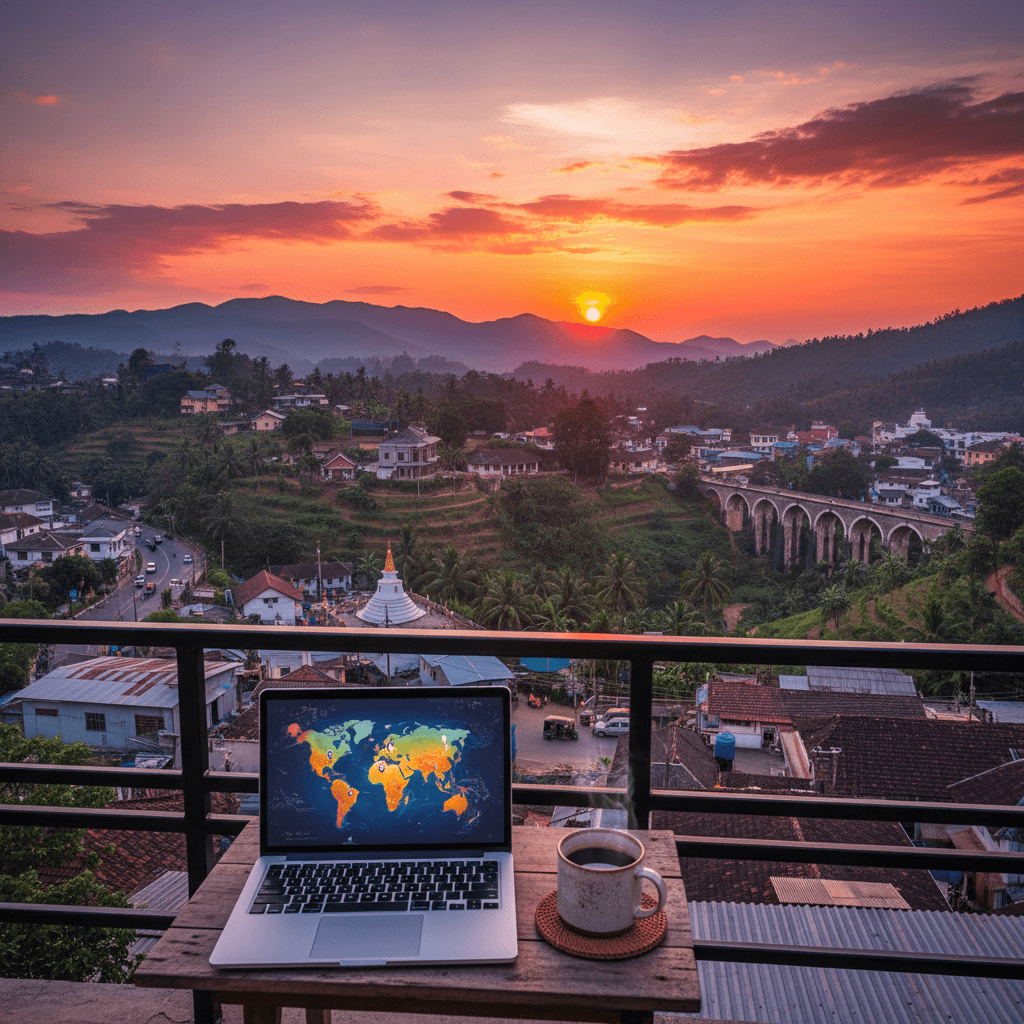
Ella
🇱🇰 Sri Lanka
Ella feels like a hill town that never fully wakes up and that’s the charm. Mist hangs over the tea slopes in the morning, trains groan past the viaduct and by late afternoon the whole place smells like rain, cardamom and frying roti.
It’s laid-back, a little scruffy and frankly better for people who like slow days with a hike at the end of them. The town has a bohemian streak, with hippie cafes, backpacker guesthouses and enough scenery that you’ll still get annoyed when your WiFi drops during a call, which, surprisingly, happens a lot.
Most nomads base themselves in Ella town because it’s walkable and social, though it can get noisy, crowded and a bit touristy around the famous viewpoints. If you want more quiet, the 98 Acres side feels calmer and more polished, while the train track areas are cheaper but steep, slippery in the rain and rough on tired knees.
What it feels like to live here
- Best for: Hikers, solo travelers, budget nomads, couples who want scenery over nightlife
- Daily rhythm: Slow mornings, late lunches, sunset walks, then early nights when the rain starts hammering tin roofs
- Annoyances: Power cuts, patchy internet, tuk-tuk markups and bridge crowds that clog up the same photo spots again and again
Budget-wise, Ella is cheaper than most Western hubs, but it’s not dirt cheap once you add in rent, tuk-tuks and the occasional Western brunch. A comfortable month usually lands around $800 to $1,200, while budget travelers can scrape by from about $575 if they keep things simple and eat local.
The food scene is easy to like. You’ve got rice and curry for a few dollars, kottu from street stalls and cafes like One Love Café if you want smoothie bowls, coffee and a hammock while the humidity clings to your skin.
Cost and setup
- Budget rent: $200 to $400 for a local room or small house
- Mid-range rent: $400 to $800 for a bungalow or nicer guesthouse
- Transport: $1 to $3 tuk-tuk rides in town, more if you’re heading uphill after dark
- Internet: Cafe speeds can be 20 to 70 Mbps, though monsoon weather and outages can wreck that fast
Safety is fairly relaxed in the center and violent crime isn’t the issue here, petty theft and overcharging are. Use PickMe when you can, keep cash handy and don’t wander around isolated stretches late at night unless you really want to test your luck.
Ella looks cheap at first glance, then the little costs creep in. A budget month can start around $575, mid-range usually lands in the $800 to $1,200 band and if you want a villa, a private driver and regular dinners out, you’re in $1,500+ territory pretty fast.
Rent is the biggest swing factor and honestly it depends more on view and access than on the building itself. A simple local house or studio near town might run $200 to $400, bungalows usually sit around $400 to $800 and nicer villas outside the centre can jump above that once you add space, quiet and a decent hill view.
Typical Monthly Spend
- Rent: $200 to $400 for basic places, $400 to $800 for bungalows, $800+ for villas.
- Food: Street roti and curry can be $2 to $5, while a modest monthly food bill often stays around $100 to $200 if you eat local.
- Transport: Short tuk-tuk rides are usually $1 to $3, with a monthly local budget around $60 to $100 if you’re moving around a lot.
- Work: Cafe WiFi can cost nothing, though dedicated desk setups, weirdly, are rare and remote-friendly day passes usually start around $50.
Food’s still manageable if you lean into rice and curry, kottu and the cheap lunch buffets that smell like cardamom, fried onions and coconut milk. Western cafes, frankly, are where the bill climbs, because a smoothie, eggs and coffee at a hill-town brunch spot can eat through what you’d spend on two local meals.
Where Your Money Goes
- Town centre: Best for walkability, cafes and social life, but you’ll pay more for convenience and hear more tuk-tuk horns, train whistles and evening music.
- Around 98 Acres: Quieter and prettier, with higher rents and extra tuk-tuk fares into town.
- Train track areas: Usually cheaper guesthouses, though the steep lanes get slippery when the rain starts hammering the tin roofs.
Internet doesn’t blow the budget, but it can still annoy you. Local SIMs from Dialog, Mobitel or Hutch are cheap enough and eSIMs help when the power cuts out, because Ella’s cafes can be fine one hour and patchy the next, which, surprisingly, is just part of the deal.
If you want value, stay in town, eat local and use PickMe for the occasional ride. Skip the polished resort pricing unless you really want the quiet, because Ella’s charm is the view and the slow pace, not the luxury markup.
Ella is tiny, but your base still changes the feel of the trip. Pick the wrong spot and you’ll hear tuk-tuks, train horns and backpacker karaoke at 11 p.m., pick the right one and you get mist, bird calls and a view that makes your coffee taste better.
Nomads
- Best area: Ella Town
- Why: Cafes, social energy, easy walks to Nine Arch Bridge and the train station
- Watch for: Noise, crowds, patchy power and cafes that look laptop-friendly but slow to a crawl when the rain hits
If you want to work and still meet people, this is the spot. The center has the highest concentration of decent WiFi, roti shops and late-afternoon hangouts and honestly, that beats staying somewhere pretty but isolated when you need to send files or jump on calls.
Expats
- Best area: Around 98 Acres Resort
- Why: Quieter streets, big views, more space, less foot traffic
- Watch for: You’ll need a tuk-tuk into town, usually $1 to $3 and that adds up if you go out a lot
Expats who stay longer usually prefer this side because it feels calmer, the air smells like wet tea leaves after rain and you’re not tripping over day-trippers every time you leave the house. The downside is simple, you’re trading convenience for space, so if you want dinner, groceries or a spontaneous beer, you’ll be haggling for a ride.
Families
- Best area: The outskirts near 98 Acres or other hillside bungalows
- Why: More room, better views, fewer scooters buzzing past the door
- Watch for: Steep driveways, slippery paths in rain and the fact that kid-friendly facilities are limited
Families usually do better outside the core, where the cold tile floors feel good in the afternoon heat and there’s enough space to breathe. You’ll still be close to town, but the quieter setting makes naps, remote work and slower mornings much easier, which, surprisingly, matters more than the postcard view.
Solo Travelers
- Best area: Train track areas near guesthouses and hostels
- Why: Cheap rooms, scenic walks, easy hostel social life
- Watch for: Steep climbs, muddy steps after rain and the occasional overfriendly tuk-tuk driver
Solo travelers tend to land here because it’s easy to meet people, grab a cheap curry, then wander down to the tracks for sunset. It’s not polished and that’s the point, the area feels lived-in, with damp earth, engine rumble and a little chaos, so if you want quiet luxury, skip it.
Internet & Coworking
Ella’s internet is decent, not dreamy. In town, cafes and hostels usually give you 20 to 70 Mbps, so calls work most of the time, but monsoon rain, power cuts and a flaky router can knock everything sideways without warning and honestly that’s the part that annoys nomads most.
Bunk Station has been one of the stronger spots for speed, with travelers clocking around 69 Mbps, while One Love Café is more about the vibe than the bandwidth, usually hovering at 2 to 5 Mbps, with vegan plates, hammocks and that slow hill-country hum of ceiling fans and rain on tin roofs. Use cafes for light work, not big uploads.
There isn’t a proper coworking scene here, which, surprisingly, suits some people fine because Ella is built for half-work, half-hike days. If you want a real desk setup, most nomads either book a long-stay place with reliable WiFi or pay for a room and work from the terrace, then move to a cafe when the power gets weird.
Where people actually work
- Ella Town: Best for cafe hopping, easy walks and meeting other remote workers, though the noise, tuk-tuk honks and tourist foot traffic can get old fast.
- Around 98 Acres: Quieter, better views and nicer for focus, but you’ll need a tuk-tuk into town, usually $1 to $3 each way.
- Train Track Areas: Cheap guesthouses and scenic mornings, but the hills are steep and rain makes the steps slick, so don’t drag a heavy laptop bag around here if you can help it.
For a backup connection, buy a local SIM the moment you arrive. Dialog, Mobitel and Hutch are the main options and a data-heavy plan usually runs about $10 to $20 a month for 50GB or more, while eSIMs from Airalo or Nomad can save you when the local network goes down, which happens more than you'd like.
Frankly, that backup matters. Ella is gorgeous, the air smells like wet earth and tea leaves after rain, but a sudden outage can turn your “work morning” into staring at a dead router and listening to generator rattle from the next house.
Best setup for remote work
- Use a hostel or guesthouse with confirmed WiFi: Ask for a speed test before you book, because “good internet” means very different things here.
- Carry a data SIM and power bank: Power cuts happen and you don’t want your laptop dying at 3 p.m. because the grid blinked out.
- Keep calls to mornings: Speeds tend to be steadier earlier in the day, before the cafes fill up and the network starts dragging.
If you need a polished coworking room every day, Ella’ll frustrate you. If you can handle spotty service, a decent coffee and the occasional delay while mist rolls over Little Adam’s Peak, it’s a lovely place to work, just don’t expect Colombo-level reliability.
Ella feels safe in the day, mostly because it’s small, walkable and full of other travelers, but petty theft and tuk-tuk price games do happen, so keep your phone zipped away and agree on fares before you get in. Nighttime gets quieter fast, then the lanes go dark, the frogs start up and the last thing you want is wandering back alone after a long dinner.
Police, ambulance and local response are decent enough for a hill town. The emergency numbers you’ll see repeated are 118, 119 and 110 and if something serious happens, people usually head toward Badulla or Kandy rather than trying to make do in Ella itself. That’s the reality, not a panic button and it’s why travel insurance still matters here.
Healthcare basics
- Nearest serious care: Teaching Hospital Kandy, about 1 to 2 hours away by road, plus Asiri Kandy for private care.
- Local support: Small pharmacies in town stock the basics, so you can grab painkillers, bandages and stomach meds without a drama.
- What to bring: Any prescription meds you rely on, because replacing them in a pinch can be annoying, slow and weirdly vague.
- Water: Drink bottled water, tap water’s fine for some locals, but travelers get caught out by it often enough to make the caution worth repeating.
Doctors in Sri Lanka are generally solid and healthcare has been improving, but Ella itself stays fairly low-key, so don’t expect a polished expat medical scene with English-speaking specialists around every corner. You’ll get the usual stuff, fever clinics, pharmacies and basic consultations, then a transfer if the issue gets bigger, which, surprisingly, is how a lot of mountain towns work.
How to stay out of trouble
- Use apps: PickMe is the easiest bet for tuk-tuks and cars, especially when you don’t want to haggle in the rain.
- Avoid solo late walks: The roads are narrow, dark and slick after rain and one bad step on a steep verge can ruin a trip.
- Watch your bag: Keep cash split up, use a crossbody bag and don’t leave your daypack on café chairs while you wander off for photos.
- For headaches and stomach bugs: Pharmacies can sort a lot, but if you’re getting worse fast, head out early instead of waiting around.
Honestly, the main risks in Ella are boring ones, an upset stomach, a twisted ankle on a wet path, a wallet gone missing after a crowded bridge stop. It’s not a dangerous place, it just feels casual enough that people get lazy and that’s when they get stung.
Ella looks tiny on a map, but the hills make everything feel farther apart and your calves will remind you fast. The center is walkable if you don’t mind steep lanes, sudden drizzle and the occasional scooter buzzing past with a bag of roti and a horn that sounds twice as angry as it should. Short hops are easy. Long uphill walks, honestly, get old.
Most nomads end up mixing walking, tuk-tuks and the odd bus. Tuk-tuks usually cost $1 to $3 for short rides inside town, though drivers sometimes quote more to tourists if you look unsure, so ask the price before you climb in and don’t be shy about walking away. PickMe works best for tuk-tuks and cars in Ella and it’s the app I’d trust first, because it cuts down on haggling and weird late-night detours.
What locals and nomads actually use
- Walking: Best for Ella town, the train tracks area and the approach to cafes, though the roads are narrow, slippery when wet and not friendly to flip-flops.
- Tuk-tuks: Ideal for Little Adam’s Peak, 98 Acres, Ravana Falls and dusk runs back from dinner, when the air smells like exhaust, frying oil and wet earth.
- PickMe: The most reliable app for short rides, especially when you want a set price and don’t feel like negotiating in the rain.
- Buses: Cheap for intercity trips, but they’re crowded, bumpy and slow, so don’t expect comfort, just a seat if you’re lucky.
Scooter rentals run about $50 to $100 a month and they sound appealing until you hit a steep hill in pouring rain with trucks behind you and tea-scented mist in your face. Self-drive tuk-tuks are possible through local rental outfits, but I’d only do that if you’re already confident on Sri Lankan roads, because the curves are tight and the traffic has its own logic.
For arriving from farther out, travelers often go by train or bus to Bandarawela, then finish with a tuk-tuk into Ella, which usually lands around $50 to $100 total depending on where you start. It’s not a hard transfer, but delays happen, especially when rain hammers the tracks and the whole hill country moves at a slower, soggier pace. Plan buffers. Ella hates rushed schedules.
Smart moves
- Save a couple of PickMe drivers you like, because repeat rides are easier than explaining your guesthouse every time.
- Carry cash for tuk-tuks, since card readers aren’t part of the routine.
- Don’t rely on a late-night walk home if it’s raining, the lanes get dark fast and the footing turns sketchy.
English gets you pretty far in Ella. Cafes, guesthouses and tour desks usually handle it fine, so you can order a flat white, book a tuk-tuk or ask about a hike without much drama. Sinhala is the local language, Tamil is also widely used in Sri Lanka and a few words go a long way when you’re chatting with drivers or shop owners.
Most people know the tourist basics, though accents can be thick and replies can come fast, especially when the rain starts hammering tin roofs and everyone’s trying to move under cover. Ayubowan is the standard hello, Kohomada? means how are you and Istouti means thank you, which, surprisingly, gets a warmer smile than you’d expect in a place that’s already pretty friendly.
What actually helps
- Google Translate: handy for menus, pharmacy labels and the occasional awkward negotiation.
- Dialog, Mobitel or Hutch: useful if you want quick clarification over text or WhatsApp.
- PickMe: the app drivers understand it and it cuts down on price haggling.
Don’t expect flawless English everywhere, because some younger staff speak it well and older locals may keep things simple, then you end up pointing at a map and smiling like a child. Honestly, that works more often than not. If you stay in Ella town near the cafes, communication is easy; if you’re out near tea estates or on the road to Bandarawela, you’ll hit more gaps and a bit more patience is needed.
How people talk here
- Cafes and hostels: usually easy for bookings, work requests and daily needs.
- Tuk-tuk drivers: understand destinations, but agree the fare first.
- Shops and markets: basic English is common, though prices can still shift.
Mobile signal is decent around town, but internet can dip during power cuts or heavy rain, so a local SIM or eSIM saves you when WiFi starts crawling. I’d keep your key addresses saved offline, because once you’re on a slippery hill in a misty downpour, arguing with a dead screen gets old fast. Frankly, Ella feels easy to communicate in, but only if you’re prepared for a little friction and a lot of hand gestures.
Ella sits in that sweet spot where the air feels cool enough for a jumper at night, then turns humid and sticky by afternoon, with mist rolling over tea fields and rain drumming on tin roofs without much warning. The climate stays spring-like most of the year, but the hills still punish sloppy planning, because a sunny breakfast can turn into a soaked hike by lunch.
Best months: December to March. Worst stretch: May and October, when the rain gets ugly and the trails get slick, muddy and frankly annoying.
If you’re here for Ella Rock, Nine Arch Bridge or long lazy café days, aim for the dry season, when views are clearer, trains don’t vanish into wall-of-white fog and you’re less likely to spend a morning waiting out a downpour with wet socks and a cold roti. July to September is workable, honestly, but you’ll still get showers, low cloud and the occasional power wobble that makes remote work feel like a gamble.
Month by Month
- Jan to Mar: 27 to 30°C, drier air, best visibility for hikes and train shots.
- Apr to May: 27 to 28°C, heavy monsoon rain, slippery paths and lots of washed-out afternoons.
- Jun to Sep: 24 to 28°C, cooler and more manageable, with scattered showers.
- Oct to Dec: 23 to 27°C, wettest run and October gets the worst of it.
Most nomads do best in December through March, because the weather is calmer, the train line looks beautiful in the morning mist and you can actually plan hikes without checking the sky every ten minutes. That said, it gets crowded around Nine Arch Bridge and the main cafés, so if you hate selfie traffic and tuk-tuk horns, go early or stay a little outside town.
My take: skip May unless you really love rain. July and August are decent compromise months, with cooler air and fewer total washouts, though you’ll still hear thunder cracking over the hills and smell that wet-earth, tea-leaf scent after a storm. Bring a light jacket, quick-dry shoes and a backup SIM, because Ella’s weather can knock out plans faster than you’d think.
Ella is easy to like and a little annoying to live in. The views are ridiculous, the air smells like wet tea leaves and wood smoke and then a rain shower can knock out your plans, your tuk-tuk and sometimes your internet all at once.
SIMs first. Buy Dialog at the airport if you can, 50GB for about $15 is a decent starter pack, then top up through the app when you’re sitting in a cafe with a cold Lion and patchy WiFi. Airalo or Nomad eSIMs are handy backups, because signal in Ella can be weirdly patchy during storms or power cuts.
Money: ATMs are around, but cash still rules in small shops, guesthouses and tuk-tuks. Wise works well for transfers, PayPal is patchier and if you’re trying to split a bill at a rice and curry spot, bring small notes or you’ll get that long, blank stare.
For housing, most nomads start with ikman.lk or Facebook groups and Agoda long-stays can work if you want speed over bargaining. Town is noisy, with train whistles, scooter revs and café chatter, while the 98 Acres side is calmer, pricier and more spaced out, so pick your headache.
Good areas to base yourself
- Ella Town: Best for cafes, social life and easy walks to the bridge.
- Around 98 Acres: Quieter, greener, pricier and better if you hate traffic noise.
- Train track areas: Cheaper guesthouses, steep hills and slippery paths when it rains.
Getting around is simple, just not always cheap in the tourist core. Short tuk-tuk rides usually run $1 to $3, PickMe is the app locals and travelers actually use and if you’re doing day trips to Nine Arch Bridge, Ravana Falls or a Pekoe Trail section, negotiate before you get in the vehicle.
Safety is decent, petty theft and overcharging are the main gripes, honestly, not anything dramatic. Don’t wander around alone late at night on quiet roads, keep your bag close in crowded photo spots and if you need help, the emergency numbers are 118, 119 and 110.
Dress modestly at temples, take your shoes off before you go in and don’t assume people want to discuss your sandals. Right-hand driving can feel chaotic if you rent a scooter or car, with buses coughing past and horn blasts bouncing off the hills, so drive slow and defensive.
Locals are usually friendly and a few Sinhala words help, especially Ayubowan and Istouti. Most travelers say Ella works best when you stop pretending it’s a city break, because once you lean into the slower pace, the rain, the mist and the train noise start to make sense.
Need visa and immigration info for Sri Lanka?
🇱🇰 View Sri Lanka Country GuideOff the Radar
Pioneer territory