Douala
🇨🇲 Cameroon
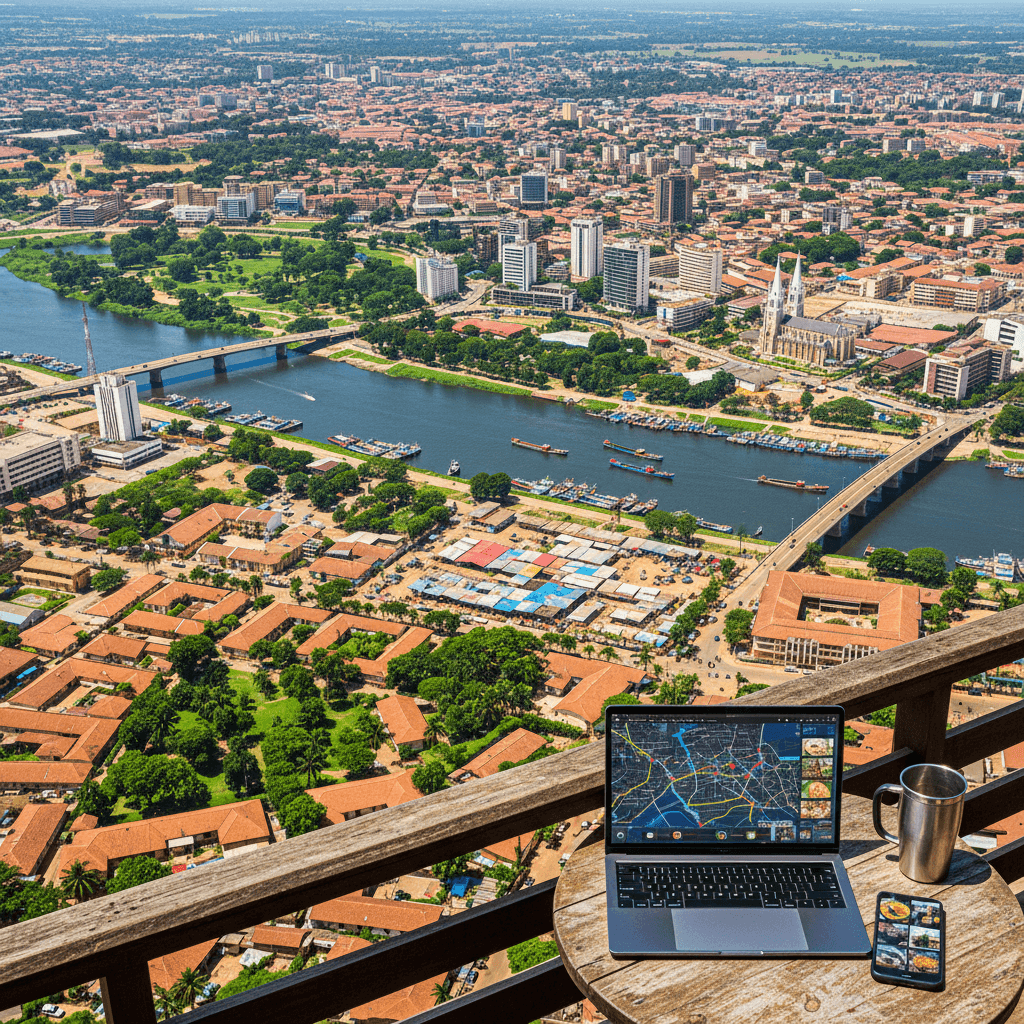
Douala isn't pretty. It's loud, sweaty and moves at a pace that doesn't care whether you've adjusted yet. The air smells like diesel exhaust and frying plantains, motorbikes weave through gridlocked intersections with total confidence and the humidity hits you the moment you step off the plane, the kind that clings to your shirt within minutes and doesn't let go until December.
But there's something, honestly, magnetic about it. Cameroon earns its "Africa in miniature" nickname and Douala is where that diversity collides most visibly. Over 200 languages filter through one port city, French dominates the streets and the energy in a place like Eko Market is unlike anything in a quieter, more "nomad-friendly" African capital.
That said, don't come expecting a polished remote work destination. Douala isn't Cape Town or Nairobi. Power cuts happen without warning, traffic can turn a 3km trip into a 45-minute ordeal and security requires constant low-level awareness. Most nomads who stick around longer than a week find their rhythm, but the infrastructure friction is real and it doesn't smooth out.
What keeps people here is, turns out, the cost and the culture. A comfortable solo lifestyle runs around 1.2 million FCFA a month, roughly $2,000 USD and that gets you a proper apartment in Bonapriso, meals out and taxis without stressing. Drop your expectations on amenities and you can live well for significantly less.
The city rewards short-to-medium stays more than long-term planting. Expats recommend it as a base for exploring the region, with Kribi beaches and Limbé both reachable in under two hours. Nightlife in Bonapriso and Akwa runs genuinely late, the food scene punches above its weight and the social scene around expat bars is tighter than you'd expect from a city this chaotic.
Douala suits a specific type of traveler: someone who doesn't need everything to work perfectly, finds the chaos at least a little interesting and wants West and Central Africa on their doorstep without paying East African prices. If that's you, it clicks surprisingly fast, if it isn't, you'll know by day three.
Douala isn't cheap, at least not by West African standards. A single expat spending carefully lands around 656,000 FCFA (~$1,100 USD) per month, though that number climbs fast once you factor in a decent apartment, reliable generator backup and eating somewhere that won't wreck your stomach.
Housing is the biggest variable. Studios in Bonapriso, which is honestly where most nomads end up, run 200,000 to 300,000 FCFA a month, utilities and generator costs sometimes included, sometimes not. Ask before you sign anything. A proper one-bedroom with reliable power can hit 400,000 to 650,000 FCFA, landlords typically want six to twelve months upfront, that's just how it works here.
Food is where Douala actually rewards you. Street stalls serving ndolé or grilled fish cost 1,000 to 2,000 FCFA a plate, the smoke and palm oil smell hits you before you even see the food. Mid-range restaurants, think somewhere with AC and a printed menu, run 5,000 to 10,000 FCFA. Upscale spots like Piccola Venezia or Peche Mignon push 15,000 FCFA and up, turns out there's a solid expat dining scene if you're willing to pay for it.
Getting around adds up quietly. Yellow taxis run 1,000 to 3,000 FCFA per ride, use Yango if you don't want to negotiate, it's genuinely less stressful. If you're renting a car with a driver, budget around 40,000 to 60,000 FCFA per day.
Here's a rough monthly breakdown by lifestyle:
- Budget: ~500,000 FCFA, shared housing, street food, walking distance errands
- Mid-range: ~800,000 FCFA, studio in a decent neighborhood, mix of cooking and eating out, regular taxis
- Comfortable: 1.2 million FCFA and up, one-bedroom with generator, dining out freely, car or daily Yango use
Coworking at MANKISLLC starts at 45,000 FCFA a month, which is, frankly, reasonable for a space with AC, WiFi and lockers. A local SIM with data runs about 5,000 FCFA to set up at the airport, MTN and Orange both work fine.
The infrastructure frustrations are real. Power cuts, generator fuel and backup data costs quietly inflate every budget tier here.
Douala doesn't have a neighborhood for every budget and lifestyle so much as it has a handful of livable pockets surrounded by areas you'll want to avoid after dark. Pick the right one and you're fine, pick wrong and you're dealing with daily stress that compounds fast.
Nomads and Expats: Bonapriso
This is, honestly, the default answer for anyone working remotely. Bonapriso has the supermarkets, the decent restaurants, the bars where other foreigners congregate and a security level that lets you walk around in the daytime without constantly watching your back. Studios start around 200,000 FCFA per month, which isn't cheap by local standards, but you're getting generator backup and proximity to cafes that can handle a laptop.
It gets noisy on weekends, the rent reflects the demand, there's no getting around that. Still, most nomads who've spent time in Douala say Bonapriso is the only neighborhood where the tradeoffs actually make sense for remote work.
Business Expats and Families: Bonanjo and Bonamoussadi
Bonanjo is the city's commercial center, so if your work involves offices, banks or government contacts, you'll want to be close. It's secure, parking is manageable and the infrastructure tends to be more reliable than other areas. Not exciting. Functional.
Families, turns out, tend to migrate toward Bonamoussadi, Logpom or Denver instead. These are quieter residential zones with villas and larger apartments and they're close enough to the American School of Douala to make the school run bearable. Expect 1BR apartments in the 300,000 to 450,000 FCFA range, though you'll need a car because these neighborhoods are genuinely far from the center.
Solo Travelers on a Budget: Makepe and Akwa
Makepe is up-and-coming in the way that phrase actually means something here: mid-range hotels, a few decent cafes and rents that won't wreck your monthly budget. Safety is variable, it's not a place to be careless, but it's workable for short stays.
Akwa has central location going for it and not much else. The busy blocks attract pickpockets and persistent touts, frankly more than most solo travelers want to deal with. Stick to the quieter streets, don't walk alone at night and treat it as a daytime-only zone rather than a base.
- Skip entirely after dark: Marché Central and any poorly lit streets in Akwa
- Best all-around base: Bonapriso
- Best for families: Bonamoussadi or Logpom
- Best budget option: Makepe
Douala's internet situation is, honestly, a study in managed expectations. The 4G coverage from MTN and Orange is decent in Bonapriso and Bonanjo, fiber exists in upscale apartments, but outages hit without warning and they hit often. Most nomads who stay longer than a week end up running a dual-SIM router setup just to stay sane.
SIM cards are easy. Pick one up at Douala Airport from MTN, Orange or Nexttel for around 5,000 FCFA, staff there speak enough English to walk you through data bundles and the daily 1GB plans run roughly 10,000 FCFA per month if you're buying consistently. That's not bad, it won't replace a stable fiber line though.
For actual work, MANKISLLC is the main coworking option nomads mention. It's got AC, free WiFi, lockers, showers and event space and 24/7 access is included in the monthly rate starting at 45,000 FCFA. That's roughly $75 USD, which is reasonable given the generator backup means you're not sitting in the dark when the grid drops, which it will.
Outside dedicated coworking, cafes in Bonapriso are workable during the day. The neighborhood has the density of restaurants and coffee spots that make it easy to post up for a few hours, the WiFi is patchy in places though, so don't count on it for a video call without testing first.
A few things to plan around:
- Power backup: Prioritize housing with a generator. It's not optional here, it's the difference between a productive day and a lost one.
- Best SIM: MTN tends to edge out Orange for 4G stability in the city center, though expats recommend keeping both active.
- Coworking cost: MANKISLLC from 45,000 FCFA per month, with daily and weekly passes also available.
- Data bundles: Daily 1GB plans via MTN or Orange, roughly 10,000 FCFA per month at regular use.
- Cafe work: Bonapriso is your best bet; Akwa has options but the noise and foot traffic make concentration harder than you'd expect.
Douala isn't built for nomads the way Nairobi or Cape Town are, turns out the infrastructure gaps are real and frequent. But if you come prepared with backup data and generator-equipped housing, you can absolutely get work done here.
Douala sits at a high caution level for safety and that's not bureaucratic language, it's the practical reality on the ground. Violent crime, carjacking and opportunistic theft are real concerns here, not background noise. Most expats don't let it stop them, they just adjust fast.
Stick to Bonapriso and Bonanjo during the day and at night, those neighborhoods are genuinely safer, well-lit and where most of the expat community clusters anyway. Akwa is fine for daytime errands, it gets sketchier after dark though, especially near the market areas where touts and pickpockets work the crowds. Don't walk alone at night anywhere outside the expat zones, full stop.
A few habits expats drill into newcomers quickly:
- Taxis: Use Yango for ride-hailing or ask your hotel/guesthouse to call a trusted driver. Random street taxis are, honestly, a gamble you don't need to take.
- Valuables: Don't wear visible jewelry or flash your phone on the street. Sounds obvious, turns out it still catches people off guard.
- Motorcycle taxis: Skip them entirely. The traffic alone makes them dangerous, the safety risk isn't worth the 500 FCFA you'd save.
- Documents: Carry a passport copy, keep the original locked up.
Healthcare is the other thing to sort before you arrive, not after. Private clinics like Douala General Hospital are functional and the staff are competent, but they'll want cash upfront, typically 10,000 to 30,000 FCFA per visit and the equipment is frankly limited compared to what most Western travelers are used to. Public hospitals are, weirdly, often worse despite being larger.
Evacuation insurance isn't optional here. If something serious happens, you want a plan to get to South Africa or Europe, not a gamble on local surgical capacity.
- Yellow fever vaccine: Mandatory for entry, get it before you fly.
- Pharmacies: Widespread and well-stocked for basics; most staff speak French only.
- Malaria: It's present year-round, prophylactics and mosquito repellent aren't optional.
None of this should scare you off Douala, plenty of nomads and expats live here comfortably. You just can't be passive about it, the city rewards preparation and punishes carelessness.
Getting around Douala is, honestly, an exercise in patience. The city doesn't have reliable public buses, the minivans are overcrowded and chaotic and cycling is a non-starter given the potholes and aggressive traffic. Most expats settle into two options pretty quickly: yellow taxis or the Yango app.
Yellow taxis are everywhere, you'll spot them idling on every corner, but you need to negotiate the fare before you get in. Expect to pay 1,000 to 3,000 FCFA per ride depending on distance, don't accept the first number they throw at you. Yango is the smarter move for most trips, transparent pricing, no haggling and you're not stuck arguing over 500 FCFA while exhaust fumes pour through the window.
For airport transfers, skip the touts outside arrivals entirely. They're aggressive and the pricing is arbitrary, pre-booking through a service like Trip Master runs 10,000 to 20,000 FCFA and gets you to the center in 10 to 15 minutes without the drama.
If you're planning to move around the city regularly, a car with a driver is worth the splurge. Around 40,000 to 60,000 FCFA per day, it sounds steep until you've sat in Douala traffic for two hours on a Tuesday afternoon. Carjacking is a real concern here, so a trusted driver who knows the routes and the neighborhoods matters more than it would in most cities.
Walking is fine in Bonapriso and parts of Akwa during the day, the streets are lively, there's street food frying on every corner and the noise of honking and vendors is almost rhythmic once you get used to it. After dark, though, you don't want to be on foot. Stick to trusted taxis or Yango once the sun drops.
A few practical notes on getting around:
- Yango app: Download before you arrive, it works well across most central neighborhoods
- Yellow taxis: Always negotiate upfront, 1,000 to 3,000 FCFA is the standard range
- Airport transfers: Pre-book only, avoid arrivals touts
- Car with driver: 40,000 to 60,000 FCFA per day, the safer option for frequent travel
- Walking: Bonapriso and Akwa are fine by day, not after dark
French runs this city. About 80% of daily life in Douala happens in French and outside of business circles or the anglophone expat bubble, English gets you almost nowhere. Most nomads find this out fast, usually while trying to haggle at a market or explain a taxi destination to a driver who's already losing patience.
You don't need fluency, but a handful of phrases will honestly change your experience here. Locals respond warmly when you make the effort, even badly pronounced French beats standing there with a translation app open. A few to memorize before you land:
- "Bonjour, ça va?" Hello, how are you? Always greet first. Skipping this reads as rude.
- "Combien?" How much? You'll use this constantly.
- "Merci" Thank you. Basic, but it matters.
- "C'est trop cher" That's too expensive. Useful at markets, taxis, pretty much everywhere.
Beyond French, there's a whole other layer. Douala has its own local language, also called Douala and Cameroon as a country has over 200 languages across ethnic groups. You won't need any of them day-to-day, but you'll hear them constantly, layered under the street noise and generator hum of the city.
Google Translate handles French well, it's not perfect but it's good enough to get through a menu or a landlord conversation without embarrassing yourself too badly. Download the French language pack offline before you arrive, connectivity in Douala is, turns out, unpredictable enough that you can't count on a live connection when you actually need it.
One thing expats consistently flag: business contacts and coworking spaces like MANKISLLC tend to have English-speaking staff, so your professional life won't be derailed. It's the everyday stuff, the pharmacist, the electrician, the woman selling ndolé outside your building, where French gaps actually sting.
SIM cards from MTN and Orange come with English-language setup support at the airport, that's genuinely helpful on arrival when your brain's still adjusting to the heat and the noise. After that, you're mostly on your own, so brush up before the flight. Even a week of Duolingo French will pay off here.
Douala is hot. Humid, sticky, relentlessly tropical, the kind of heat that soaks through your shirt before you've walked half a block, with exhaust fumes and the smell of grilled plantain mixing in the air around you. Temperature sits between 26 and 30°C year-round, so there's no cool season to save you, just degrees of wet.
The real variable here is rain. Douala gets a lot of it, honestly more than most people expect, with a long rainy stretch running from March through November that peaks brutally in June, July and August. June alone can dump over 350mm in a single month, streets flood, traffic (already maddening) grinds to a halt and the noise of rain hammering tin rooftops makes calls nearly impossible.
December through February is the sweet spot. Rain drops to almost nothing, around 35mm in January, the air feels marginally less suffocating and getting around the city is far less chaotic. Most expats who have a choice plan their arrivals around this window, it's not a dramatic transformation but the difference is real.
Month-by-Month Breakdown
- Dec to Feb: Best time to visit. Low rainfall, slightly cooler mornings, easier to move around.
- Mar to May: Rain starts building. Still manageable, though you'll want a rain jacket on standby.
- Jun to Aug: Peak rainy season. Flooding is common, especially in lower-lying neighborhoods. Avoid if you can.
- Sep to Nov: Rain tapers off slowly. October can still surprise you, turns out the transition is rarely clean.
If your trip is flexible, skip July and August entirely. The flooding isn't just inconvenient, it genuinely disrupts daily life, coworking commutes become ordeals and some roads near Akwa and the port areas become, frankly, impassable without a high-clearance vehicle.
Pack light, breathable clothes regardless of when you go, a compact umbrella lives in every local's bag year-round. Sunscreen matters even when it's overcast, the UV index stays high. And don't underestimate the psychological weight of sustained humidity; most short-term visitors find the first week the hardest, your body does adjust, just slower than you'd hope.
Douala runs on cash. ATMs exist, but international cards get declined more often than not and fintech options are, honestly, almost nonexistent compared to other African cities. Withdraw what you need, keep small bills handy and don't expect to tap your way through a transaction.
For a SIM, grab MTN or Orange the moment you land at Douala International. Staff there speak enough English to get you sorted, cards run about 5,000 FCFA and data bundles are cheap. Pick up a dual-SIM router if you're staying longer than a week, because outages hit without warning and they hit often.
Yellow fever vaccination isn't optional. It's required entry and they do check. Beyond that, pack a basic kit because public hospitals are genuinely rough and even the better private clinics like Laquintinie want cash upfront, typically 10,000 to 30,000 FCFA per visit. Medical evacuation insurance isn't paranoia here, it's just sense.
French is the operating language. Most people you'll deal with outside of a few business districts won't speak English, learn a handful of phrases before you arrive. "Bonjour, ça va?" goes a long way, people notice when you make the effort, skipping it reads as rude.
Getting around is, turns out, more manageable than the traffic suggests. Yellow taxis are everywhere; negotiate before you get in, 1,000 to 3,000 FCFA covers most rides. The Yango app is cleaner if you'd rather skip the haggling, pricing is upfront and drivers are generally reliable. Skip the motorcycle taxis entirely, they're cheap for a reason.
For housing, expect to pay six to twelve months upfront. That's standard, not a scam, arguing about it won't change anything. Airbnb works for short stays, Bonapriso studios run around 20,000 FCFA per night. Generator-equipped apartments aren't a luxury, they're a baseline requirement.
- Best time to visit: December to February, low rain, manageable heat
- Worst months: July and August, flooding is real and roads get bad
- Customs: Always greet before asking anything, respect elders, avoid public affection
- Day trips: Kribi beaches and Limbé are both under two hours by car, worth it
One last thing. Don't walk alone after dark, even in Bonapriso. That's not overcaution, that's just Douala.
Need visa and immigration info for Cameroon?
🇨🇲 View Cameroon Country GuideWild Card
Expect the unexpected