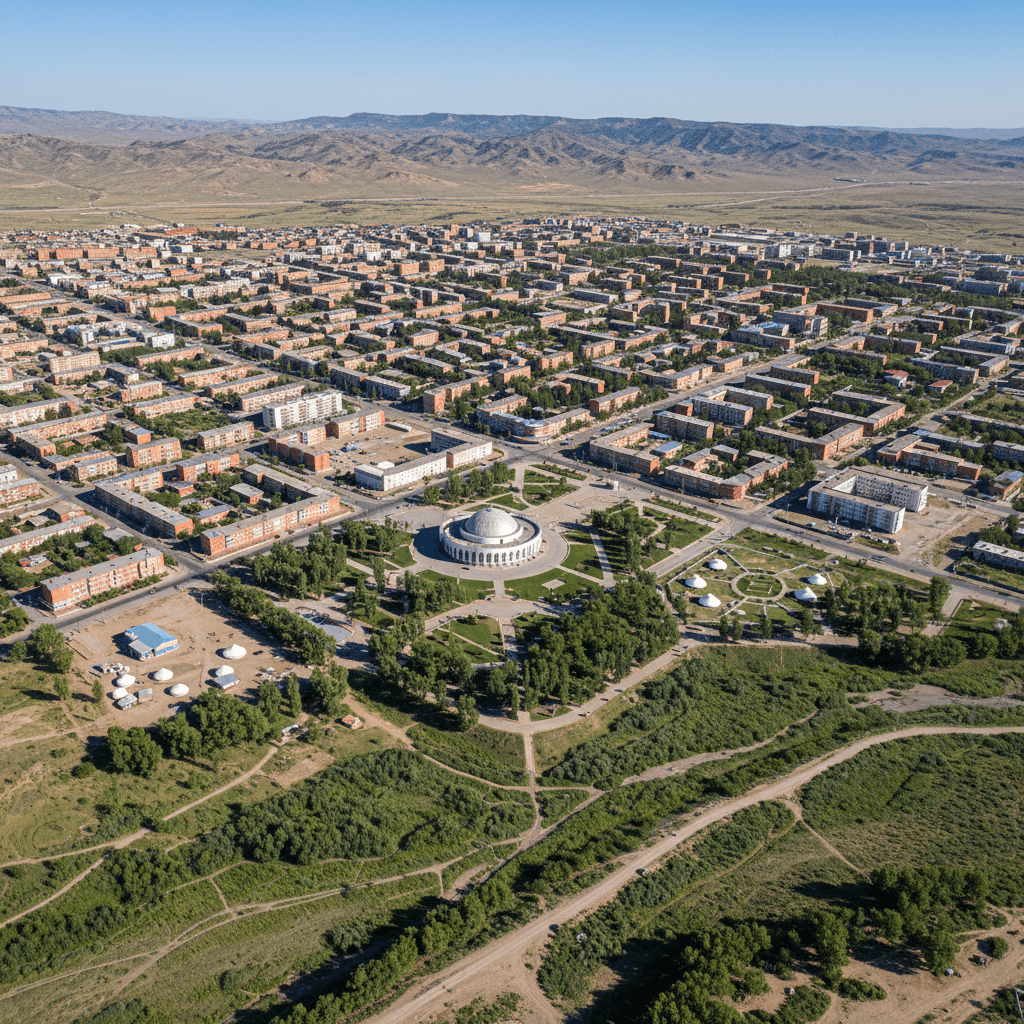
Dalanzadgad
🇲🇳 Mongolia
The Edge of the Infinite
Dalanzadgad isn't your typical digital nomad hub. In fact, calling it a "hub" might be a stretch. It's a dusty, low-slung frontier town that serves as the gateway to the Gobi Desert. If you’re coming here, you aren't looking for artisanal oat milk lattes or high-speed fiber optics. You're coming for the silence, the staggering scale of the Mongolian steppe, and a chance to work from the literal edge of the world.
The vibe is slow, utilitarian, and deeply quiet. Life revolves around the central market and the arrival of tour vans heading into the wilderness. It feels like a place where time has stalled; you'll see Soviet-era trucks parked next to modern SUVs, and herders in traditional deels popping into shops for supplies. It’s raw and unapologetic, but the hospitality is legendary. If you can handle the dust and the isolation, the emotional payoff is a sense of clarity you won't find in Bangkok or Lisbon.
Cost of Living
Your biggest challenge won't be your budget, it'll be finding ways to spend it. Dalanzadgad is significantly cheaper than Ulaanbaatar, though the lack of traditional "nomad" infrastructure means you'll often be staying in guesthouses rather than modern apartments.
- Housing: A basic guesthouse or room in a local lodge like Dream Gobi will run you $300 to $450 a month if you negotiate a long-term rate. High-end eco-lodges further out can easily top $500.
- Food: Local eateries serve up mutton dumplings (buuz) and hearty stews for $2 to $4. A mid-range meal at a guesthouse usually costs about $8. Monthly, you're looking at $200 to $300 for food.
- Connectivity: A local SIM from Mobicom or Unitel costs $7 to $10 for 5-20GB depending on plan.
- Total Monthly Budget: Most nomads can live comfortably here on $800 to $1,000, including occasional weekend trips into the desert.
The Neighborhood Layout
Dalanzadgad doesn't have "districts" so much as it has a center and a periphery. Everything is walkable if you don't mind the wind and the dust.
- The Town Center: This is where you'll find the provincial government buildings, the main market, and most of the shops. It’s the most practical place to stay if you want to be near food and the few reliable ATMs in town.
- The Outskirts: As you move toward the edge of town, the buildings thin out into "ger districts" and eventually the open desert. It's incredibly scenic and quiet, but you'll be reliant on local taxis to get anywhere.
The Reality of Remote Work
Don't expect coworking spaces. They don't exist here. You'll be working from your guesthouse or a handful of local cafes. Internet speeds generally hover between 10 and 20 Mbps in town, which is fine for emails and basic tasks but might struggle with 4K video calls. Most seasoned travelers recommend tethering to a Unitel SIM, as the mobile data is often more reliable than hotel Wi-Fi.
The best time to visit is between June and August, when temperatures are a pleasant 20°C to 30°C. Avoid the winter at all costs; from December to February, the mercury regularly drops to -20°C, and the town enters a deep, frozen hibernation.
Safety and Logistics
Safety is rarely an issue in terms of crime, but the environment itself requires respect. Healthcare is basic, with only a provincial hospital for emergencies. For anything serious, you'll need to head back to Ulaanbaatar. Most nomads use Mobicom for the best coverage and keep plenty of cash (Mongolian Tugrik) on hand, as international cards are hit-or-miss at smaller shops.
Getting around is informal. There are no apps like Uber here. You'll flag down a local taxi for a $2 ride across town or arrange a private 4x4 if you're heading to the Yol Valley or the Khongor Els sand dunes. It’s a place for the self-sufficient, but for those who want to trade the digital grind for the Great Wide Open, it’s an experience that stays with you long after you’ve left.
The Gobi Discount
Living in Dalanzadgad is a lesson in extreme affordability, provided you can handle the trade-off in infrastructure. Since it functions more as a provincial outpost than a metropolitan hub, your dollars stretch significantly further here than in Ulaanbaatar. Most nomads find they can live comfortably on roughly $800 to $1,000 a month, though a minimalist budget can easily dip toward $500 if you're staying in local guesthouses and eating like a resident.
The local currency is the Mongolian Tugrik (MNT), and while the exchange rate hovers around 3,500 to 3,600 MNT to $1 USD, cash is the undisputed king. You'll find a few ATMs near the central market, but they aren't always reliable with international chips. Expats recommend keeping a stash of crisp USD for emergencies or large exchanges at the provincial banks.
Monthly Budget Breakdowns
The lack of a formal rental market means prices are fluid. You won't find many listings on international sites, so most long-term stays are negotiated directly with local lodges or via Mongolian-language Facebook groups.
Budget Tier
- Total: $400 to $600 per month
- Housing: $150 to $250 for a basic studio or a room in a local guesthouse.
- Food: $150. This relies heavily on street food like Khuushuur (mutton dumplings) for $2 and shopping at the central market.
- Transport: $20. Dalanzadgad is compact enough to walk, supplemented by the occasional $1 informal taxi ride.
Mid-Range Tier
- Total: $700 to $1,000 per month
- Housing: $300 to $450 for a more modern apartment or a long-term rate at a place like Dream Gobi Lodge.
- Food: $250. This covers a mix of home cooking and daily meals at guesthouse restaurants where a solid dinner costs about $7.
- Transport: $50. Includes more frequent taxi use and the occasional shared van trip to nearby sites.
Comfortable Tier
- Total: $1,200+ per month
- Housing: $500+. At this price point, you're looking at premium lodge stays or renting a larger house on the outskirts near the Gobi edge.
- Food: $400. You'll be eating the best the region offers, including camel specialties and imported snacks from the larger grocery stores.
- Transport: $100+. This budget allows for private drivers to take you into the Yol Valley or the Khongor Els dunes on weekends.
The Connectivity Tax
Internet isn't a guaranteed utility here. Since there are no dedicated coworking spaces, you'll spend a bit extra on mobile data to stay online. A 10GB monthly plan from Mobicom or Unitel is cheap, usually under $10, but you'll want a dual-SIM setup to ensure coverage when the signal dips. Travelers often find that the "cost" of living here isn't just monetary; it's the time spent hunting for a stable 20 Mbps connection in a hotel lobby or a quiet cafe near the town center.
Daily Essentials
Prices for everyday items are low, but variety is limited. A liter of milk or a loaf of bread will rarely cost more than $1.50. If you're heading out for a drink, don't expect a cocktail bar. A local beer will set you back about $2, though social life here usually revolves around shared meals rather than nightlife. For health needs, the provincial hospital handles basics for a few dollars, but any serious hardware requires a flight back to Ulaanbaatar, so comprehensive travel insurance is a non-negotiable expense.
The Central District
If you're coming to Dalanzadgad to work, you'll want to stay as close to the town center as possible. It isn't a "neighborhood" in the Western sense, but rather a cluster of provincial government buildings, the main market, and a few paved roads. This is the only part of town where you can reliably walk to a pharmacy or grab a 6,500 MNT bowl of mutton dumplings without needing a 4x4.
Most nomads set up shop in the lobbies of established spots like the Dream Gobi Lodge or local guesthouses. Since there aren't any dedicated coworking spaces, your best bet is a Unitel or Mobicom SIM card with a heavy data plan. Expect to pay about $10 for 10GB. The connection is decent enough for emails and basic calls, but don't expect to hop on a high-definition video stream without some lag.
- Rent: $150 to $300 per month for a basic apartment or long-term guesthouse room.
- Vibe: Dusty, functional, and surprisingly quiet after the sun goes down.
- Best for: Solo nomads and short-term remote workers who need proximity to the few reliable Wi-Fi signals in town.
The Gobi Edge
For those who care more about the view than the ping rate, the outskirts of town offer immediate access to the desert. This area is less about streets and more about clusters of ger camps and newer tourist lodges. It's incredibly peaceful, but you're trading away almost all urban convenience. You'll need a driver or a rental to get into the center for supplies, which usually costs about $5 for a quick taxi ride.
Living out here feels like true Mongolian immersion. You'll wake up to the sound of livestock and have the Yol Valley or the "Singing Sands" within a few hours' drive. The downside is the infrastructure; electricity can be fickle and water is often delivered rather than piped. It's a rugged lifestyle that suits people who want to disconnect while they knock out a creative project.
- Rent: $400 to $600 for higher-end tourist lodges; cheaper if you're staying in a traditional ger.
- Vibe: Wide-open horizons and total silence.
- Best for: Adventurous expats and travelers who prioritize nature over high-speed internet.
Family-Friendly Pockets
Families visiting Dalanzadgad usually stick to the small residential blocks near the provincial schools and parks. While the town doesn't have "suburbs," these areas are slightly more shielded from the main transit dust. There's a basic provincial hospital nearby, though for anything serious, you'll be looking at a flight back to Ulaanbaatar. Most families find the local hospitality incredible, as neighbors often look out for one another in the harsh desert environment.
- Cost of Living: A comfortable family setup usually runs around $1,200 a month, including a private driver.
- Vibe: Safe and community-oriented, but very basic in terms of entertainment.
- Best for: Families on an extended slow-travel journey through Central Asia.
Solo Traveler Hubs
If you're solo, you'll likely gravitate toward the guesthouses near the airport or the central market. These are the informal social hubs of the city. Since there isn't much of a nightlife scene, these common rooms are where you'll meet other travelers to split the $100 daily cost of a private Gobi tour. It's a transient atmosphere, but it's the easiest way to find English speakers and share tips on which local cafes currently have the best signal.
- Daily Meal Cost: $10 to $15 for three meals at local eateries.
- Vibe: Social and utilitarian; everyone here is planning their next move into the dunes.
- Best for: Solo backpackers and budget-conscious travelers.
If you are coming to Dalanzadgad expecting the glass-and-steel coworking hubs of Ulaanbaatar, you need to adjust your expectations before you land. This is the edge of the Gobi. People come here to disconnect from the grid, not to find a dedicated desk with ergonomic chairs and free-flowing kombucha. There are no formal coworking spaces in town, so your "office" will likely be a hotel lobby, a guesthouse common area, or the small desk in your room.
The Connectivity Reality
Internet speeds in town are generally 30 to 80 Mbps, check local conditions in the center of town, but this drops off sharply the moment you head toward the outskirts or the ger camps near the national parks. If you have a high-stakes Zoom call, do not rely on guesthouse WiFi. It is often spotty and prone to cutting out during the afternoon wind storms.
The smartest move is to bring your own connection. Local SIM cards are incredibly cheap and offer better reliability than most public routers. Pick up a Unitel or Mobicom SIM card at the central market or the airport. For about $5 to $10, you can get a 10GB monthly data plan that works surprisingly well within the city limits. Just keep in mind that once you head out toward the Khongor Els dunes or Yol Valley, your signal will vanish into the dunes.
Where to Work
Since there are no dedicated hubs, nomads usually gravitate toward the larger lodges and hotels. Dream Gobi Lodge and similar establishments are your best bet for a stable environment. They are used to travelers and won't mind you sitting with a laptop for a few hours if you are staying there or buying a few coffees.
The cafe culture here is still in its infancy. You won't find many "laptop-friendly" spots with power outlets at every table. If you decide to work from a local eatery, make sure your devices are fully charged. Power outages are rare but not unheard of, especially during the peak summer months when the grid is under more pressure.
Digital Nomad Logistics
- Mobile Data: $5-10 for a 10GB monthly plan. Stick with Mobicom for the best provincial coverage.
- Hardware: Bring every adapter and backup battery you own. If your charger dies here, you are looking at a long wait for a replacement from Ulaanbaatar.
- VPN: While the Mongolian internet is generally open, a VPN is still recommended for security on public guesthouse networks.
- Backup: Starlink is becoming a popular conversation piece among tour operators in the region, but it is not yet a standard amenity you can count on in every camp.
Most nomads find that Dalanzadgad is better suited for "deep work" phases where you don't need constant high-speed interaction. It is a place to write that book or finish that coding project while the vast silence of the desert sits outside your door. If your job requires eight hours of flawless video conferencing a day, you might find the infrastructure here more stressful than it is worth.
Dalanzadgad is a town where the safety concerns aren't about pickpockets or urban crime, but rather the sheer vastness of the environment. It's an incredibly safe place by international standards. Violent crime is rare, and the local community is tight knit. Most nomads find the biggest risk is simply getting lost or being unprepared for the Gobi's isolation once they leave the town limits.
Personal Safety and Security
You can generally walk around the town center at all hours without much worry. Unlike the capital, Ulaanbaatar, where petty theft and street harassment can be issues in crowded areas, Dalanzadgad feels like a quiet provincial outpost. However, it's smart to avoid wandering into unlit, isolated outskirts alone after dark. The lack of street lighting in some areas makes it easy to trip or lose your bearings.
For solo female travelers and LGBTQ+ nomads, the vibe is conservative but generally respectful. You won't find a "scene" here, and discretion is the norm. The local culture prioritizes hospitality, so if you're ever in a bind, asking a local shopkeeper or guesthouse owner for help usually yields quick results. Just keep in mind that English is sparse, so having a translation app ready is a lifesaver.
- Police (Emergency): Dial 105
- Local Tip: Strays and shepherd dogs can be aggressive on the outskirts. If you're hiking or walking near the edge of town, keep your distance from livestock and any dogs guarding them.
- Winter Risks: From December to February, the main safety threat is the cold. Temperatures can plummet to -20°C (-4°F). If you're driving out to the dunes, never go without a local guide and a vehicle stocked with emergency supplies.
Healthcare and Medical Facilities
Healthcare in Dalanzadgad is basic. There is a provincial hospital that can handle minor injuries, infections, or basic diagnostics, but it isn't equipped for complex surgeries or specialized care. If you have a chronic condition, you need to bring a full supply of your medications from home or Ulaanbaatar, as local pharmacies have limited stock and mostly carry Russian or Mongolian brands.
For anything serious, you'll be looking at a flight or a long drive back to Ulaanbaatar. Most expats and long term travelers in Mongolia carry high end evacuation insurance for this very reason. If you're heading out to the Yol Valley or the Khongor Els dunes, remember that you are hours away from even basic medical help. Always carry a robust first aid kit with rehydration salts, as the desert heat and dry air can sneak up on you.
- Ambulance: Dial 103
- Pharmacy: Look for signs saying Эмийн сан (Emiin san) near the central market.
- Water Safety: Do not drink the tap water. Stick to bottled water, which is cheap and available at every small grocery store (guanz) for about $0.50 to $1.00 per liter.
Emergency Contacts and Practicalities
Since there are no dedicated nomad hubs or expat enclaves, your best point of contact for any health or safety issue will be your guesthouse manager. Places like the Dream Gobi Lodge or local guesthouses in the center are used to helping foreigners navigate the local systems. Make sure you have a local SIM card from Mobicom or Unitel; data is cheap, usually around $5 to $10 for a 10GB monthly plan, and it's your primary lifeline if you get stuck in a remote area where the signal is surprisingly decent near the towns.
The Logistics of the Gobi
Moving through Dalanzadgad feels less like navigating a city and more like managing a base camp. The town is compact and centered around a few provincial government buildings and the central market. Most of your daily needs are within a 20-minute walk, but the infrastructure is raw. Expect dusty, unpaved side streets and a lack of traditional sidewalks once you step off the main drag.
Getting Into Town
The Dalanzadgad Airport (DLZ) is your primary lifeline to the capital. Domestic flights from Ulaanbaatar are frequent during the summer months and take about 90 minutes. Once you land, don't look for a bus. You'll need to grab one of the unofficial taxis waiting outside. The ride into the center takes roughly 15 minutes and should cost between $5 and $10. If you're coming by land, the paved road from Ulaanbaatar is a 7 to 9-hour haul in a private vehicle or a public bus, which is cheap but notoriously bumpy.
Daily Transport and Taxis
You won't find Uber or any specialized ride-hailing apps here. Transport is informal. If you need a lift, you generally stand by the side of the main road and stick your hand out. Most locals acting as "taxis" will stop. A short trip across town usually runs between $1 and $3 (roughly 3,500 to 10,000 MNT). It helps to have your destination written in Mongolian or pinned on a map, as English proficiency among drivers is almost zero.
- Informal Taxis: No meters, negotiate the price before you get in.
- Minibuses: These WAZ-style vans serve the surrounding rural districts but don't follow a strict schedule. They leave when full.
- Walking: Feasible in the town center, but the desert wind and dust make it less than pleasant for long distances.
Venturing into the Gobi
The real reason to be here is the landscape beyond the city limits. Dalanzadgad is the jumping-off point for the Yol Valley and the Khongor Els sand dunes. You cannot reach these via public transport. Most nomads and travelers hire a 4WD vehicle with a driver through a local guesthouse like Dream Gobi. Budget around $50 to $100 per day for a private tour, which usually includes the driver, fuel, and sometimes basic meals. If you're looking to save, check the bulletin boards at local lodges to split costs with other travelers.
Connectivity on the Move
Don't rely on finding open Wi-Fi while you're out and about. Your best bet is to pick up a local SIM card at the central market as soon as you arrive. Mobicom and Unitel are the two major players. Data is incredibly affordable, often around $5 to $10 for a 10GB monthly plan. Coverage is surprisingly solid within the town limits, but it will drop to nothing the moment you head into the deeper dunes or rocky canyons of the National Park.
Practical Transit Tips
- Cash is King: Drivers do not take cards. Keep small denominations of Tugrik (MNT) on you at all times.
- The Dust Factor: If you're walking, a light scarf or buff is helpful. The Gobi wind can kick up sand even on clear days.
- Winter Limits: From December to February, transport slows down significantly. Some domestic flights are canceled, and vehicles require extra preparation for the -20°C temperatures.
- Offline Maps: Download the Google Maps offline area for Ömnögovi. Local signage is sparse once you leave the three or four main paved roads.
The Linguistic Landscape
Expect a steep learning curve when you touch down in Dalanzadgad. Unlike the international bubble of Ulaanbaatar, English is a rare commodity here. Most locals speak Khalkha Mongolian, and while the younger generation might have a few words of English, your primary interactions at the market or with taxi drivers will happen through gestures and translation apps. It is a place where a smile and a patient attitude go much further than a loud voice.
The Cyrillic alphabet is used for signs and menus, which can make even a simple grocery run feel like a puzzle. Most nomads find that learning the Cyrillic characters before arriving is the single best time investment they can make. Being able to sound out "Дэлгүүр" (shop) or "Зочид буудал" (hotel) saves a lot of wandering around in the Gobi dust.
Digital Tools for the Desert
Since you won't find many English speakers outside of the staff at spots like Dream Gobi Lodge, your smartphone is your lifeline. Download the offline Mongolian language pack on Google Translate before you leave the capital. It is not perfect, but it handles basic nouns and verbs well enough to get you a meal or a room.
For actual communication with guesthouse owners or tour drivers, Facebook Messenger is the king of apps in Mongolia. Almost every small business in Dalanzadgad has a Facebook page, and they are much more likely to respond to a message there than to an email. If you are trying to coordinate a trip to the Yol Valley or Khongor Els, ask for their Facebook details early on.
Essential Phrases to Keep Handy
The locals deeply appreciate any effort to speak their tongue. Since the culture revolves around hospitality, a few polite words open doors that remain closed to the average tourist. Keep these in your back pocket:
- Sain baina uu? (Hello): Use this for everyone, from the person selling you mutton dumplings to the herder you meet on the steppe.
- Bayarlalaa (Thank you): Use it often.
- Zaa (Okay/Sure): You will hear this constantly. It is the universal filler word for agreement or acknowledging you have heard someone.
- Khotol buyu? (Where is the hotel?): Helpful when your GPS decides the desert is just one big empty square.
- Yamar unetei ve? (How much is it?): Prices are usually fixed, but it is good to confirm.
Cultural Nuances in Communication
Communication in the Gobi is as much about what you do as what you say. If you are invited into a ger, there is a specific non-verbal etiquette to follow. Always step over the threshold, never on it. If someone offers you a bowl of airag (fermented mare's milk) or a snack, accept it with your right hand, often supporting your right elbow with your left hand as a sign of respect. Even if you only take a tiny sip or a small bite, the gesture is what matters.
Nomads in this region are famously direct but incredibly kind. If you are working from a local cafe or guesthouse, don't be surprised if people are curious about what you are doing on your laptop. While the concept of a digital nomad is still relatively new here, the tradition of welcoming travelers is centuries old. A little bit of patience with the language gap will reward you with some of the most genuine human connections you will find anywhere in Asia.
The Desert Rhythm
Dalanzadgad doesn't play by the same rules as Ulaanbaatar. Down here in the Gobi, the weather dictates everything from your morning coffee to whether or not you can actually get work done. It is a land of extremes where the mercury swings wildly, and the wind can turn a clear afternoon into a dust-blown haze in minutes.
Most travelers and the few nomads who venture this far south aim for the window between June and August. This is when the Gobi is at its most hospitable. You'll see daytime highs averaging around 30°C (86°F), which is perfect for exploring the Yol Valley ice field before it melts or trekking the Khongor Els dunes. The nights stay cool and comfortable, usually hovering around 15°C (59°F), making it the only time of year when a standard guesthouse without heavy-duty heating feels cozy.
Seasonal Breakdown
- Summer (June to August): This is peak season for a reason. The skies are impossibly blue, and while you might get a stray July shower, it's rarely enough to ruin your plans. It's the best time for reliable solar power if you're staying at a remote ger camp and the most active time for local festivals.
- Shoulder Seasons (May and September): These months are for the hardy. May brings unpredictable dust storms that can ground domestic flights and coat everything you own in a fine layer of grit. September is beautiful but fleeting; the air turns crisp, and by the end of the month, you'll feel the first bite of the coming freeze. Daytime temps usually sit around 15°C to 20°C (59°F to 68°F).
- Winter (November to March): Unless you're here to document the extreme isolation of the desert, winter is tough. Temperatures frequently plummet to -20°C (-4°F) or lower at night. Most tourist infrastructure, including the better ger camps like Dream Gobi, shuts down or operates on a skeleton crew. Heating becomes your primary expense and obsession.
The Nomad's Sweet Spot
If you're planning to hunker down and get some work done, aim for late August or early September. The summer crowds have thinned out, the heat has lost its aggressive edge, and the internet connection at local spots tends to be slightly more stable when the town isn't packed with tour groups. You'll avoid the spring dust storms and the brutal winter lockdown, giving you the best chance to enjoy the Gobi's silence without freezing.
Keep in mind that even in the "best" months, the desert is fickle. Experienced nomads recommend bringing layers even in July. A sudden wind shift can drop the temperature by ten degrees in an hour. It's also worth checking the domestic flight schedule from Ulaanbaatar early; flights to Dalanzadgad Airport (DLZ) fill up fast in the summer, and the $110 to $130 tickets are much easier to stomach than a ten-hour bumpy van ride across the steppe in the heat.
Practical Climate Tips
- Hydration is non-negotiable: The Gobi air is incredibly dry. You'll find yourself drinking twice as much water as usual. Budget about $1 to $2 a day for large jugs of purified water from the central markets.
- Tech Protection: If you're working outside or in a ger, use a keyboard cover. The fine Gobi dust is notorious for getting into laptop hinges and ports during the windy season.
- Sun Safety: The UV index here is brutal. High-quality sunscreen is hard to find locally, so pack plenty from home or Ulaanbaatar.
Survival Basics: Money and Connectivity
Living in Dalanzadgad requires a shift in mindset. You won't find the high speed fiber optic lines of Ulaanbaatar here. Most nomads rely on Mobicom or Unitel SIM cards for data. A 10GB monthly plan usually runs between $5 and $10. While speeds in town hover around 20 to 50 Mbps, expect them to drop significantly as you head toward the dunes.
Cash is still king in the Gobi. While some shops in the center take cards, you'll need Mongolian Tugrik (MNT) for almost everything else. ATMs are sparse, so keep a stash of $50 to $100 worth of MNT on you at all times. If you're bringing foreign currency to exchange, stick to crisp USD bills; the local banks can be picky about tears or folds.
The Cost of Gobi Living
Your budget will stretch much further here than in the capital. Expect to spend 30% to 50% less on daily essentials compared to Ulaanbaatar. Since there aren't dedicated nomad neighborhoods, most people set up base in the town center to stay near the markets.
- Budget Living: Plan for about $400 to $600 per month. This covers a basic apartment for $150 to $250 and local meals.
- Mid-Range: Around $700 to $1,000 per month. This allows for better housing and frequent trips into the desert.
- Comfortable: $1,200+ per month. This usually involves staying at places like Dream Gobi Lodge or high end guesthouses that cater to international travelers.
Navigation and Getting Around
The town is small enough to walk, but the dust and wind often make that a chore. There aren't any ride hailing apps here. Instead, you'll rely on informal taxis that cost roughly $1 to $3 per trip. If you're heading to the Yol Valley or the Khongor Els dunes, you'll need to hire a private driver or join a tour, which typically costs between $50 and $100 per day.
The Dalanzadgad Airport (DLZ) is just a 15 minute drive from the center. Domestic flights from Ulaanbaatar are the most reliable way to get here, though adventurous souls sometimes take the long, bumpy bus ride across the steppe.
Food, Social Life, and Language
Don't expect a craft coffee scene or coworking hubs. Most remote work happens from hotel lobbies or quiet corners of guesthouses. Dining is functional and heavy on mutton and camel. A plate of traditional dumplings (buuz) will only set you back about $2 to $4. For a more social atmosphere, travelers usually head to the ger camps on the outskirts where you can swap stories with other explorers over a beer.
English isn't widely spoken. You'll get by in the main lodges, but at the market, you'll need the basics. Download an offline Mongolian pack on Google Translate. Learning "Sain baina uu?" (Hello) and "Bayarlalaa" (Thank you) goes a long way with the locals.
When to Go
The Gobi is a land of extremes. June through August is the sweet spot, with daytime temperatures between 20°C and 30°C (68°F to 86°F). Avoid the winter months from December to February unless you're prepared for -20°C (-4°F) nights and total isolation. Spring can be beautiful but is notorious for sudden, blinding dust storms that can ground travel for days.
Safety and Health
Dalanzadgad is generally very safe, though it's wise to avoid wandering the unlit outskirts alone at night. The biggest risks are environmental, like dehydration or getting lost in the desert. The local provincial hospital handles basics, but for anything serious, you'll be looking at a flight back to Ulaanbaatar. Always carry a personal first aid kit and any specific medications you need, as pharmacies here have limited stock.
Need visa and immigration info for Mongolia?
🇲🇳 View Mongolia Country GuideOff the Radar
Pioneer territory