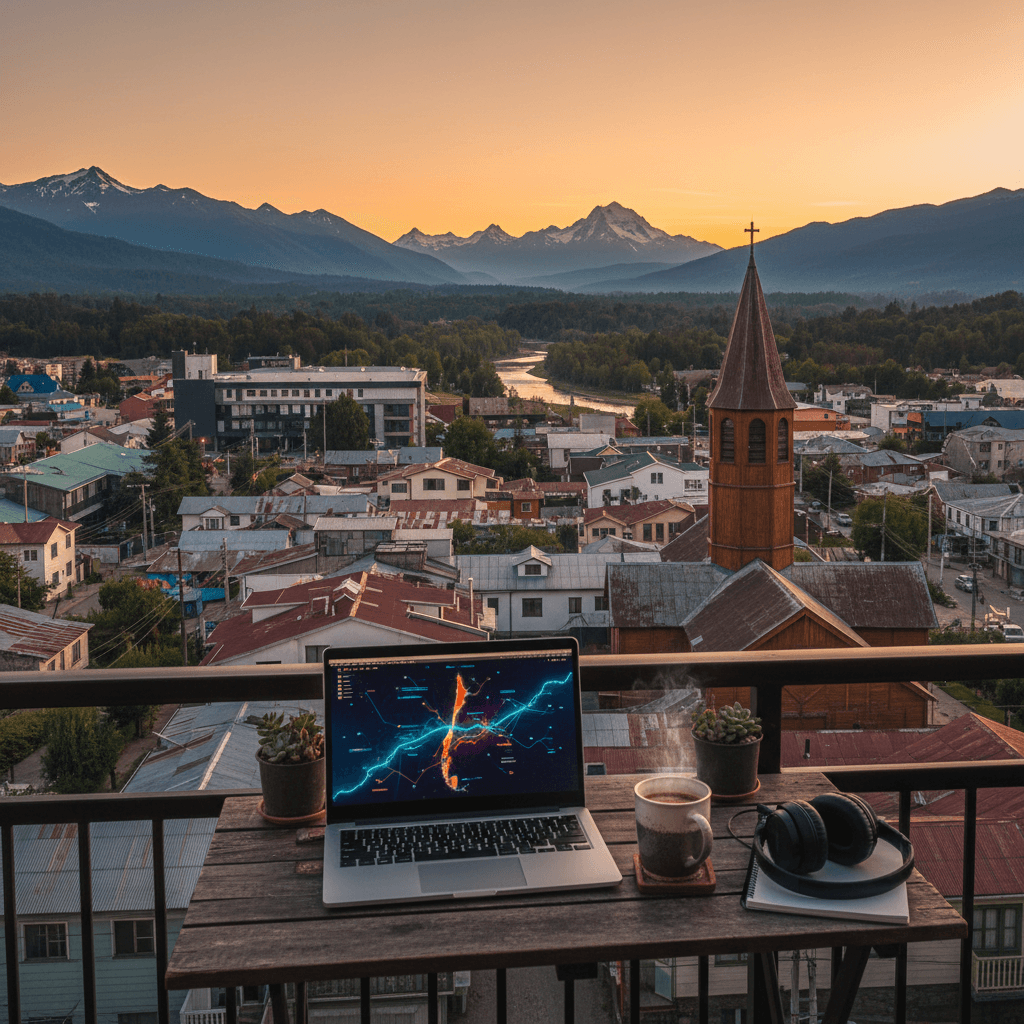
Coyhaique
🇨🇱 Chile
The Patagonian Basecamp
Coyhaique doesn't feel like a typical nomad hub, and that's exactly why people are starting to flock here. Tucked into the heart of the Aysén Region, it serves as the rugged capital of Chilean Patagonia. While Santiago is all about high rises and fast paced tech, Coyhaique operates on "Patagonia time." It's a place where the morning fog clings to Cerro McKay and the air smells like woodsmoke and rain. You come here if you want your desk to be a short walk from world class fly fishing on the Simpson River or if you want to spend your weekends driving the Carretera Austral.
The vibe is a mix of frontier grit and cozy mountain town. You'll see gauchos in traditional berets rubbing shoulders with outdoor gear testers and digital nomads. It’s small, intimate, and feels incredibly safe. The emotional payoff here is the silence; once you step away from the Plaza de Armas, the deep stillness of the surrounding forests takes over. It’s the perfect spot for a "deep work" season where nature is the primary distraction.
The Cost of Living
While Patagonia is notoriously more expensive than northern Chile, Coyhaique remains surprisingly manageable for those earning in stronger currencies. Most nomads find they can live comfortably on about $1,200 to $1,500 per month. If you're on a tighter budget, you can squeeze by on $800 to $1,000 if you stick to local markets and shared housing.
- Budget Tier ($800-$1,000): Expect a simple room or small studio for $400, eating $5 street food like empanadas, and relying on the local bus system.
- Mid-range Tier ($1,200-$1,500): This covers a nice 1BR apartment for $600, frequenting cafes for work, and dining out at mid-range spots where a meal costs about $12.
- Comfortable Tier ($2,000+): This budget allows for a premium rental with mountain views for $800+, car rentals for weekend expeditions, and upscale dinners at $25 per person.
Where to Set Up Shop
The city is compact, so choosing a neighborhood is more about your proximity to the hills versus the cafes. Most nomads choose to stay near the Plaza de Armas. It’s the pentagonal heart of the city where you'll find the most reliable fiber optic internet, artisan markets, and the best coffee shops. It's walkable and social, though it can get a bit loud during the peak summer tourist season in January and February.
For those who prefer a view, the area near Cerro McKay is popular. You'll be about 20 minutes from the center, but you'll have immediate access to hiking trails and a much quieter atmosphere. Just keep in mind that the walk back from the center is uphill. Most expats recommend avoiding the rural outskirts unless you have a dedicated vehicle, as public transport becomes spotty once you leave the main grid.
Connection and Productivity
Don't let the remote location fool you. Chile has some of the fastest internet in South America. In the center of Coyhaique, fiber optic connections typically deliver 50 to 100 Mbps. While there aren't dedicated "big brand" coworking spaces yet, the cafe culture is welcoming. You'll find nomads working from spots around the main square, often fueled by local pastries. For mobile data, grab a SIM card from Entel or WOM for about $10; they offer the most reliable coverage when you're heading out toward the mountains.
The Reality Check
The biggest hurdle here is the weather. It is cold, windy, and rainy for much of the year. Even in the height of summer (December to March), temperatures rarely climb above 20°C (68°F). Winters are long and snowy, with temperatures hovering near freezing. If you're someone who needs constant sunshine, the gray Patagonian winters might feel isolating. Additionally, getting here requires a flight from Santiago or Puerto Montt followed by a shuttle from the Balmaceda Airport, so it’s not a place for weekend trips. You come to Coyhaique to settle in and stay a while.
The Patagonian Price Tag
Living in Coyhaique feels like a strategic trade-off. While it's the capital of the Aysén Region, it lacks the inflated price tags of Santiago or the high-end tourist traps of Torres del Paine. Most nomads find they can maintain a high quality of life for roughly US$1,200 per month. It’s a place where your money goes toward experiences rather than status; you might spend less on a fancy cocktail and more on a sturdy pair of hiking boots or a fly fishing guide for the Simpson River.
Local salaries hover around US$600, so if you're earning in USD or Euros, you'll have significant purchasing power. However, keep in mind that "Patagonia cheap" is different from "Southeast Asia cheap." Because of its remote location at the heart of the Carretera Austral, some imported goods and fuel can carry a premium. You're paying for the logistics of getting supplies to the edge of the world.
Monthly Budget Breakdowns
- Budget Tier: US$800 to US$1,000. This covers a modest room or studio outside the immediate center, cooking most meals at home with occasional US$6 street food stops, and using the local bus system.
- Mid-range: US$1,200 to US$1,500. The sweet spot for most digital nomads. This includes a comfortable 1-bedroom apartment near the Plaza de Armas, daily cafe visits, and several dinners out at mid-range spots where a meal costs about US$12.
- Comfortable: US$2,000+. At this level, you’re looking at a premium house with mountain views, frequent upscale dining at US$25 per plate, and a weekend car rental for exploring the marble caves or Puyuhuapi Hotsprings.
Housing and Neighborhoods
The city is compact, but where you plant your flag changes your daily rhythm. Most expats and short-term travelers gravitate toward the Plaza de Armas. It is the heart of the action, surrounded by artisan markets and the best cafes for working. Expect to pay between US$400 and US$700 for a decent apartment here. It’s walkable and social, though it can get a bit loud during the peak summer months of December to March.
If you prefer a quieter, more rugged vibe, look toward the Cerro McKay area. It's about 20 minutes from the center and puts you right at the trailhead for some of the region's best hiking. Prices are often slightly lower, but you’ll likely want a bike or an Uber account to get into town for groceries and social events. Avoid the far rural outskirts unless you have a dedicated vehicle; the isolation is real once the sun goes down.
Daily Expenses and Connectivity
Connectivity is surprisingly solid for such a remote outpost. While there aren't dedicated coworking franchises yet, the cafe culture around the main square is welcoming to laptops. Fiber optic internet in the city center typically hits 50 to 100 Mbps, though it gets spotty as you head into the hills. For mobile data, travelers recommend picking up a SIM card from Entel or Movistar for about US$5 to US$12; they offer the most reliable coverage across the Aysén region.
- Cheap Meal: US$5 to US$8 for a local empanada or a "completo" (Chilean hot dog).
- Mid-range Dinner: US$10 to US$15 for Patagonian lamb or fresh seafood.
- Transport: Local buses are roughly US$1 per ride, while airport transfers from Balmaceda cost between US$10 and US$20.
- Groceries: A weekly shop for one person usually runs about US$50 if you stick to local produce.
Practical Survival Tips
Cards are widely accepted in shops and restaurants, but always keep some Chilean Pesos for small artisan stalls or rural buses. Apps like Wise or Revolut are perfect for avoiding hefty bank fees at the ATMs located around the Plaza. If you're planning on staying through the winter, budget an extra US$50 to US$100 for heating; those Patagonian winds are no joke between June and August, and insulation in older buildings can be hit or miss.
For Nomads: Plaza de Armas (The City Center)
If you are working remotely, the area surrounding the pentagonal Plaza de Armas is where you want to be. It is the only part of town where you can reliably hop between cafes with decent WiFi and stay within walking distance of the artisan markets. While there are no dedicated coworking franchises like Selina here yet, nomads usually set up shop at local spots near the square. You can expect to pay around $400 to $700 for a one bedroom apartment in this central core.
- The Vibe: Walkable, social, and the primary hub for craft beer and Patagonian lamb.
- Internet: Most fiber connections here hit 50 to 100 Mbps, though it can dip during heavy rain.
- Daily Life: You are steps away from the Feria Artesanal where you can buy high quality woolens for the cold winters.
For Solo Travelers: Downtown and the Simpson River Fringe
Solo travelers often prefer the streets just a few blocks south of the main plaza. This area puts you close to the trailheads for the Piedra del Indio and the Simpson River walks. It is slightly more affordable than the immediate square, with budget meals available for $5 to $8. It is the best spot to meet other travelers planning trips down the Carretera Austral.
Safety is rarely an issue here; Coyhaique feels like a small town where everyone knows their neighbor. Most solo residents find that the best way to socialize is through fly fishing groups or local trekking meetups. Since there are no formal expat enclaves, you will be rubbing shoulders with locals at the grocery stores and pharmacies along the main drags.
For Active Nomads: Cerro McKay Foothills
If you came to Patagonia for the views rather than the coffee shops, look toward the Cerro McKay area. It is about a 20 minute walk or a quick $1 bus ride from the center. This neighborhood is significantly quieter and offers direct access to hiking trails. It is perfect for those who follow a "work mornings, hike afternoons" schedule.
- Pros: Fresh air, incredible mountain vistas, and less noise from the summer tourist crowds.
- Cons: It is uphill, so carrying groceries back from the Unimarc supermarket can be a workout.
- Cost: Rents are often lower here, sometimes landing in the $400 range for modest local houses.
For Families and Long Term Expats: The Quiet Residential Belts
Families usually move toward the outskirts of the grid where houses come with more yard space. These areas are peaceful but require a car rental or a steady reliance on taxis, which cost about $10 to $20 for airport transfers. The pace of life here is slow, dictated by the weather and the seasons.
Expats recommend sticking to the established neighborhoods rather than the rural outskirts to avoid isolation during the snowy months of July and August. While the city is small, the lack of urban amenities like large malls or international schools means most families focus their time on outdoor excursions to nearby lakes or the Puyuhuapi Hotsprings.
Neighborhood Comparison at a Glance
- Plaza de Armas (Best for Work): Monthly budget of $1,200; high walkability; best access to Entel and Movistar kiosks for SIM cards.
- Cerro McKay (Best for Nature): Monthly budget of $1,000; quiet environment; requires more planning for errands.
- Simpson River Area (Best for Budget): Monthly budget of $800 to $900; great for fly fishing enthusiasts; authentic local feel.
Connectivity in the Heart of Aysén
While Chile is a global leader in fiber optic speeds, Patagonia presents a more rugged reality. In the center of Coyhaique, you can expect reliable fiber connections, but the signal tends to drop off quickly as you head toward the Simpson River or the foothills of Cerro McKay. Most nomads find that the fixed broadband in local Airbnbs and guesthouses clocks in between 50 and 100 Mbps, which is plenty for video calls and heavy uploads.
If you're planning to work from the road or while waiting for a bus to Puerto Aysén, your mobile data will be your lifeline. Entel generally offers the best coverage in this remote region, followed closely by Movistar. You can pick up a prepaid SIM card at most pharmacies or small kiosks near the Plaza de Armas for US$3 to US$12. For those who prefer a digital-first approach, Holafly eSIMs work well here, though they are more expensive than local physical cards.
The Coworking Scene
Coyhaique doesn't have the dedicated, high-tech coworking hubs you'll find in Santiago or Valparaíso. Instead, the local community relies on a "work from cafe" culture. The lack of a formal coworking space is actually part of the charm for many; it forces you to integrate with the locals and move at a slower pace. If you need a professional environment for a few weeks, some expats look for Selina coliving options in other parts of Chile, but here, your best bet is to find a rental with a dedicated desk and supplement it with local coffee shops.
- Digital Nomad Hubs: Look for cafes around the Plaza de Armas. These spots are accustomed to people staying for an hour or two with a laptop, provided you keep the coffee and kuchen orders coming.
- Public Spaces: The local library and some community centers offer free WiFi, though the speeds are better suited for emails than streaming.
- Data Backup: Always have a local SIM with a generous data plan. Power outages are rare but can happen during the heavy winter storms between June and August.
Best Cafes for Deep Work
Since you won't find a WeWork here, you'll need to scout the best tables near power outlets. The artisan markets and galleries near the center often house small, quiet cafes that are perfect for a morning deep-work session. Most nomads recommend starting your workday early, around 8:00 AM or 9:00 AM, to take advantage of the quietest hours before the lunch rush begins at 1:00 PM.
The local culture is incredibly welcoming, but it's polite to ask "¿Tienen WiFi?" before you sit down, as some smaller family-run spots might not have a public network. Expect to pay about US$3 to US$5 for a quality coffee. Many travelers find that the "work hard, play hard" mentality applies perfectly here; get your tasks done by noon, then spend the afternoon hiking the trails at Cerro Castillo or fly fishing in the river.
Practical Tech Tips
- VPN: Use a high-quality VPN if you're accessing sensitive work data over public cafe networks.
- Offline Maps: Download Google Maps for the entire Aysén region. Once you leave the city limits for a weekend trip, cellular service is non-existent.
- Power Adapters: Chile uses Type C and Type L plugs. If your gear is from North America, you'll need a converter for the 220V system.
- Backup Power: A portable power bank is a smart investment if you plan on working from more remote lodges or during long bus rides along the Carretera Austral.
A Safe Haven in the Wild
Coyhaique is one of those rare places where the ruggedness of the landscape doesn't translate to a rough social environment. While Santiago deals with the typical big-city petty crime, this Patagonian hub feels more like a tight-knit mountain town. Most nomads find the safety levels here refreshing. You can walk around the Plaza de Armas or the Cerro Mirador trails with your gear without much worry, though the usual common sense still applies.
The primary safety concerns here aren't people; they're the elements. The weather can turn from sunshine to a freezing downpour in twenty minutes. If you're heading out to Cerro McKay for a hike after a morning of deep work, tell someone where you're going. The rural roads outside the city aren't well-lit, so avoid driving or walking long distances between towns after dark. Stick to the central grid where the streetlights and local businesses keep things visible.
- Emergency Numbers: Dial 133 for the Carabineros (Police), 131 for an ambulance, and 132 for the fire department.
- Walking at Night: The city center is generally safe, but stay alert in poorly lit areas near the river outskirts.
- Solo Travel: It's a very welcoming spot for solo nomads, and the local community is used to seeing backpackers and fly fishers passing through.
Healthcare and Medical Facilities
Chile has some of the best healthcare infrastructure in South America, but Coyhaique is a remote outpost. You'll find a solid regional hospital and several private clinics that can handle most routine issues, stomach bugs, or minor hiking injuries. For anything extremely specialized or life-threatening, patients are often stabilized and flown to Santiago or Puerto Montt.
Expats recommend keeping a basic first-aid kit, especially if you're staying in a cabin further from the Plaza de Armas. Pharmacies (farmacias) are plentiful in the center. Look for chains like Cruz Verde or Ahumada; they're well-stocked with everything from altitude sickness meds to high-quality sunblock, which you'll need given the thin ozone layer in the south.
Practical Health Tips
The tap water in Coyhaique is generally safe to drink, which is a huge plus for long-term stays. It's crisp and cold, coming straight from the surrounding mountains. Food safety is also high; you can eat at the local markets or street stalls near the artisan galleries without much fear of the "traveler's tummy" issues common in other parts of the continent.
- Health Insurance: Most nomads use Genki or SafetyWing here. Make sure your policy covers "adventure activities" if you plan on fly fishing the Simpson River or trekking Cerro Castillo.
- Pharmacies: Most are open until 8:00 PM or 9:00 PM, with at least one "farmacia de turno" (on-call pharmacy) open 24/7 on a rotating schedule.
- Air Quality: During the winter months (June to August), the city can get a bit smoky because many locals rely on wood-burning stoves for heat. If you have asthma, keep this in mind when booking your stay.
Overall, your biggest "medical" threat is likely a sunburn or a blister from a long trek. As long as you respect the Patagonian climate and have a backup plan for remote excursions, Coyhaique is a very low-stress environment for maintaining your well-being.
Navigating the Hub of the Carretera Austral
Coyhaique is the kind of place where you'll find yourself walking to the grocery store with a view of snow-capped peaks in the background. It's compact and rugged, reflecting its status as the gateway to the wilder parts of Patagonia. While it's the largest city in the region, the pace is decidedly slow, and the infrastructure is built more for utility than for high-speed urban living.
Walking and Biking
If you're staying near the Plaza de Armas, you won't need much more than a sturdy pair of boots for your daily errands. The city center is highly walkable, with most cafes, markets, and supply stores clustered within a few blocks of the pentagonal main square. Most nomads find that they can handle 90% of their city life on foot.
- Cerro Mirador: A popular walking destination from the center that provides a panoramic view of the city.
- Simpson River: Accessible via a brisk walk or a short bike ride, perfect for a midday break from the laptop.
- Cycling: You can rent mountain bikes at local shops for about $15 to $25 per day. It's a great way to reach the trails around Cerro McKay, though the hilly terrain and occasional gravel roads mean you'll get a real workout.
Public Transport and Ride-Hailing
For trips that go beyond the central core or to reach the outskirts where some of the quieter cabins are located, you'll rely on the local bus system. These buses are cheap and reliable, usually costing around $1 per ride. They aren't fancy, but they get the job done if you're heading toward the regional museum or the edges of town.
Uber operates in a bit of a legal gray area here, as it does in much of Chile. It's usable and often more convenient than hunting down a taxi, but don't be surprised if your driver asks you to sit in the front seat to keep things low-key. For guaranteed rides, especially during odd hours or for airport runs, local taxis are the safer bet. Expect to pay between $10 and $20 for a trip to the local airfield or nearby transit points.
Car Rentals for Exploration
If you really want to see Patagonia, you're going to want four wheels. Many nomads choose to rent a car for weekend trips along the Carretera Austral. Having your own vehicle is the only way to comfortably reach spots like the Puyuhuapi Hotsprings or Cerro Castillo on your own schedule. Agencies like Discover Cars or local outfits near the airport are the go-to options.
- Daily Rates: Typically range from $50 to $90 depending on the vehicle type.
- Vehicle Choice: If you're planning on hitting the backroads, a 4x4 isn't just a luxury; it's often a necessity due to the "ripio" (loose gravel) roads that define the region.
- Fuel: Gas is more expensive here than in Santiago due to the remote location, so factor that into your excursion budget.
Regional Connections
Getting in and out of Coyhaique requires some planning. Most travelers fly into Balmaceda Airport (BBA), which is about 50 kilometers away from the city. From there, you can catch a shuttle bus or a private transfer for roughly $10 to $15. Flights usually connect through Santiago or Puerto Montt via carriers like LATAM or Sky Airline.
For the more adventurous, hitchhiking is a common sight and generally considered safe-ish in this part of the world. Locals are used to seeing "mochileros" (backpackers) on the side of the road. However, the weather can turn in minutes, so if you're planning to thumb a ride to a remote trailhead, always carry a tent and enough layers to survive a cold, rainy night if a car doesn't show up.
The Local Linguistic Landscape
In Coyhaique, Spanish isn't just the primary language; it's the only one you'll hear in most daily interactions. While Chileans are known for their rapid-fire speech and unique slang, the pace in the Aysén region feels a bit more relaxed. You'll encounter the famous Chilean "Chilenismos," like using "po" at the end of every sentence or "cachái?" to ask if you understand. Don't be surprised if people call you "gringo" or "gringa" regardless of where you're actually from; it's generally used as a friendly catch-all for foreigners.
English proficiency varies significantly depending on where you hang out. Around the Plaza de Armas, you'll find plenty of tour operators, fly fishing guides, and upscale craft shop owners who speak enough English to handle complex requests. However, once you step into a local feria (market) or hop on a bus toward Puerto Aysén, the English safety net disappears. Most nomads find that while they can survive with basic phrases, having a functional level of Spanish makes life significantly easier and more affordable.
Digital Tools and Translation
Since you'll likely be out exploring Cerro McKay or the Simpson River, you can't always rely on a live data connection for translation. The remote nature of Patagonia means signal drops are common once you leave the town center. Local expats recommend a few specific setups to keep communication smooth:
- Google Translate: Download the Spanish offline dictionary immediately. The camera feature is a lifesaver for translating menus at local picadas (small, cheap eateries) that don't have English versions.
- WhatsApp: This is the lifeblood of communication in Chile. Whether you're booking a fly fishing excursion or messaging a landlord about an apartment near Cerro Mirador, nobody uses email. Use it for everything.
- SpanishDict: This app is often better than Google for specific Chilean idioms and regional Patagonia terms you might hear from local gauchos.
Key Phrases for the Patagonian Nomad
You don't need to be fluent to get a smile from the locals, but showing effort goes a long way in this part of the world. Beyond the standard "Hola" and "Gracias," these phrases will help you navigate daily life in Coyhaique:
- "¿A cuánto está?" (How much is it?): Use this at the artisan markets when prices aren't listed on the leather goods or wool sweaters.
- "La cuenta, por favor" (The check, please): Remember that a 10% tip is standard in sit-down restaurants, often added automatically as a "sugerido."
- "¿Tienen Wi-Fi?" (Do you have Wi-Fi?): Essential when scouting cafes around the plaza for a morning work session.
- "¿Dónde está el baño?" (Where is the bathroom?): A classic, but always necessary.
Social Nuances and Etiquette
Communication in Coyhaique is often warm but traditional. A firm handshake is the standard greeting for most situations. If you're invited to a local's home for an asado (barbecue), it's polite to arrive 15 to 30 minutes after the stated time; showing up exactly on time can actually be seen as a bit awkward. Physical space is also different here; Chileans tend to stand closer when speaking than North Americans or Northern Europeans might be used to.
If you're looking to practice your Spanish, the best places to strike up a conversation are the craft galleries or the Museo Regional de la Patagonia. Locals are generally proud of their rugged landscape and are happy to give recommendations for hiking trails or the best cordero al palo (spit-roasted lamb) in town if you lead with a friendly "permiso" (excuse me).
The Patagonian Reality Check
Living in Coyhaique means embracing the unpredictable. This isn't the Mediterranean; it's the heart of Aysén, where the weather dictates your work schedule and your weekend plans. Most nomads who settle here for a few months describe the climate as rugged and temperamental, but that's exactly what keeps the crowds away and the landscapes so impossibly green.
You'll quickly learn the local phrase about Patagonian weather: if you don't like it, wait five minutes. While the rain is a constant companion, the dramatic shifts in light over Cerro McKay make for a spectacular backdrop to a morning Zoom call. Just make sure your rental has decent heating, as the damp cold can seep into your bones if you're not prepared.
When to Base Yourself Here
The sweet spot for a productive stay is the shoulder season. March through May and October through November are favorites for expats who want to avoid the peak summer winds and the high prices of the tourist rush. During these months, the town feels more authentic, and you won't be fighting for a table at the cafes around Plaza de Armas.
- Summer (December to February): This is the high season. Expect temperatures between 10°C and 20°C (50°F to 68°F). It's the driest time of year, but also the windiest. If you're here to trek the Carretera Austral or fly fish the Simpson River, this is your window.
- Autumn (March to May): The landscape turns fiery red and orange. Prices start to dip, and the wind dies down, though the rain begins to pick up. It's arguably the most beautiful time for photographers.
- Winter (June to August): It gets quiet. Temperatures hover between 0°C and 10°C (32°F to 50°F), and snow is common. Many outdoor tour operators shut down, but if you enjoy cozying up in a wood-fired cabin with a laptop, the solitude is unmatched.
- Spring (September to November): The region wakes up. It's still chilly, but the wildflowers start blooming and the rivers are high from snowmelt.
Seasonal Survival Tips
If you're planning a visit during the peak summer months of January and February, book your accommodation well in advance. Even though Coyhaique is more affordable than Santiago, the influx of domestic tourists can drive up short-term rental prices and fill up the best Airbnbs quickly. Nomads often find that December to March offers the best balance of daylight hours and outdoor accessibility.
For those staying through the winter, be aware that air quality can occasionally dip in the valley because of the widespread use of wood-burning stoves. It's a trade-off for the low-cost living and the stunning, snowy views of the surrounding peaks. Most long-term travelers recommend bringing high-quality waterproof gear regardless of when you arrive; a solid rain shell is more important than a fancy wardrobe here.
Climate by the Numbers
- Warmest Months: January and February, with average highs of 18°C.
- Coldest Months: July and August, where highs rarely top 6°C and nights frequently drop below freezing.
- Rainy Season: While it rains year-round, May to August sees the highest volume of precipitation.
- Daylight Extremes: Expect nearly 16 hours of light in mid-December, shrinking to about 9 hours in late June.
The worst time for a visit is generally mid-winter (July) if you're looking for social activity, as the town goes into a bit of a hibernation mode. However, if your goal is deep work and absolute quiet, you'll find the winter months incredibly peaceful and even more budget-friendly.
Getting Settled and Staying Connected
Coyhaique is the gateway to the Carretera Austral, but for a digital nomad, it's more of a home base where the pace slows down significantly. You won't find a massive tech scene here. Instead, you'll find a community of outdoor enthusiasts who happen to work online. Chile has some of the fastest fixed broadband in South America, and while Coyhaique is remote, the fiber optic coverage in the town center is surprisingly reliable. Expect speeds between 50 and 100 Mbps in most modern apartments and cafes.
There aren't many dedicated coworking spaces yet, so most nomads set up shop in the cafes surrounding the Plaza de Armas. If you need a stable mobile backup, grab a SIM card from Entel or Movistar at a local pharmacy or kiosk. A prepaid plan usually runs between US$3 and US$12. For those who prefer an easy setup, Holafly eSIMs work well here, though they’re pricier than local chips.
Cost of Living Breakdown
Living here is notably cheaper than Santiago, but Patagonia's remoteness means certain imported goods can be pricey. Most nomads find a monthly budget of US$1,200 to US$1,500 allows for a very comfortable lifestyle including weekend trips. Local income averages around US$600, so your purchasing power goes quite far.
Budget Tier (US$800 to US$1,000)
- Rent: US$400 for a modest studio outside the immediate center.
- Food: US$200 by sticking to street food (US$5 per meal) and local markets.
- Transport: US$50 using local buses and walking.
- Work: US$100 for cafe visits and data plans.
Mid-Range Tier (US$1,200 to US$1,500)
- Rent: US$600 to US$700 for a well located 1BR near the Plaza.
- Food: US$300 including several mid-range dinners (US$12 to US$15 per meal).
- Transport: US$100 for occasional taxis or bike rentals.
- Extras: US$200 for guided fly fishing or hiking gear.
Where to Stay
The town is compact, so choosing a neighborhood is mostly about how much quiet you want. Most nomads prefer staying near the Plaza de Armas because it's the heart of the action. You're steps away from artisan markets, the best coffee, and the few bars that stay open late. It can get a bit noisy during the high season, but the convenience is hard to beat.
If you want a view and don't mind a bit of a climb, look toward the Cerro McKay area. It's about 20 minutes from the center on foot. It’s much quieter and puts you right at the trailhead for morning hikes. Just keep in mind that services like grocery stores are thinner on the ground up there. Avoid the rural outskirts unless you plan on renting a car, as public transport becomes spotty once you leave the main grid.
Navigating the City
Coyhaique is very walkable if you stay central. For longer trips to the Simpson River or the Piedra del Indio, local buses are reliable and cost about US$1 per ride. Uber exists in a legal grey area; it works, but don't be surprised if the driver asks you to sit in the front seat. To truly explore the region, you'll want to rent a car through a service like Discover Cars for weekend runs to Cerro Castillo or the Puyuhuapi Hotsprings.
Weather and Timing
The weather is the biggest hurdle for most people. It's Patagonia, so it rains often and the wind can be fierce. The best time to visit is between December and March when temperatures hover between 15°C and 18°C. This is the peak season for trekking and fishing. If you don't mind the cold, May to October offers fewer crowds and lower prices, but many tourist services shut down and temperatures rarely climb above 6°C.
Safety and Health
This is one of the safest parts of Chile. Violent crime is extremely rare. Your biggest concerns will be the elements and the occasional stray dog. Healthcare is decent for a town of this size, with a regional hospital and plenty of well stocked pharmacies. In an emergency, dial 131 for an ambulance or 133 for the police. Most locals speak only Spanish, so having Google Translate downloaded for offline use is a smart move before you head into the mountains.
Need visa and immigration info for Chile?
🇨🇱 View Chile Country GuideHidden Gem
Worth the effort