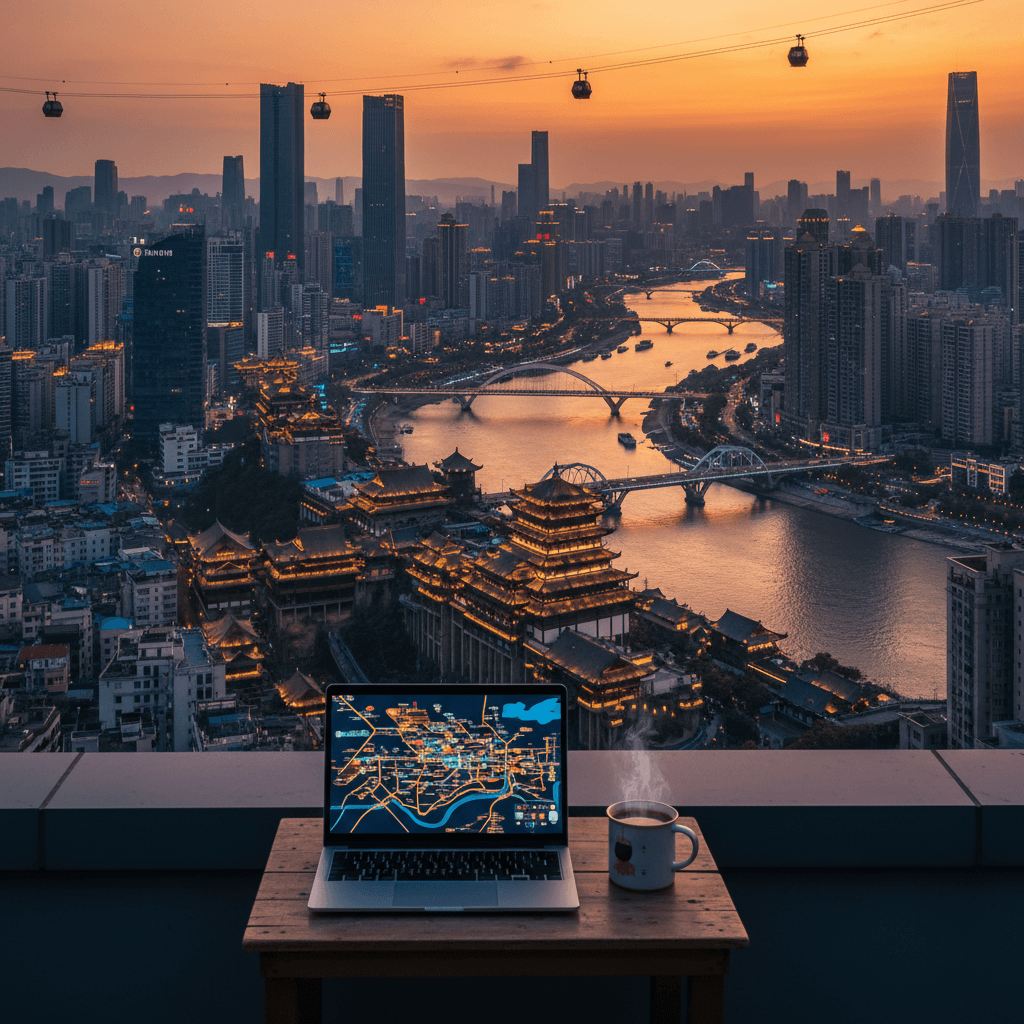
Chongqing
🇨🇳 China
The 8D Cyberpunk Reality
Stepping out of a train station in Chongqing feels less like arriving in a city and more like entering the set of a high budget sci-fi film. This is China's vertical metropolis, a place where the ground floor is a relative concept. You might enter a building on the 10th floor, walk across a skybridge, and realize you are still at street level. It is chaotic, humid, and visually overwhelming in the best possible way.
While nomads flock to the coastal tech hubs of Shenzhen or the polished streets of Shanghai, Chongqing offers a raw, moody alternative. It is famously nicknamed the 8D City because of its impossible topography. Monorails slice through the middle of apartment buildings, and neon lights reflect off the Yangtze and Jialing rivers through a perpetual mountain mist. It is a city that rewards the curious and punishes those who rely too heavily on Google Maps, which often fails to grasp that your destination is actually sixty feet directly above your head.
The Daily Grind and Hyper-Tech Life
Living here means embracing a hyper-connected lifestyle. The infrastructure is staggering. You will use Alipay or WeChat Pay for everything from a $2 bowl of spicy noodles to your monthly rent. Most nomads find the city's tech-forward nature makes up for the language barrier. If you can use a QR code, you can survive. The internet speeds are solid, averaging around 139 Mbps download, though you will definitely need a reliable roaming SIM or a high quality VPN to access your usual suite of western work tools.
The pace of life is a strange mix of frantic energy and slow-motion relaxation. You will see delivery drivers weaving through traffic on electric scooters while elders spend hours playing mahjong in the shade of a brutalist overpass. It is loud, the air smells like Sichuan peppercorns, and the local "mountain city" grit is a far cry from the sanitized tourist zones of Europe.
Where You'll Hang Your Hat
Choosing a neighborhood in Chongqing depends on whether you want to be in the thick of the neon or tucked away in the hills. Most expats and long term visitors gravitate toward a few key hubs:
- Guanyinqiao: This is the heartbeat of modern Chongqing. It is a massive commercial district north of the river, packed with malls, underground snacks, and high rise apartments. It feels less like a tourist trap and more like the actual center of gravity for local young professionals.
- Nanbin Road: If you want the "billion dollar view" without the 24/7 noise, this riverside stretch in Nan'an District is the move. It is flatter, more walkable, and offers a panoramic look at the skyline across the water.
- Jiefangbei: The literal center of the city. It is dense, expensive, and iconic. Great for a few days, but many nomads find the constant crowds a bit much for a month-long stay.
The Cost of Living
Your budget will go significantly further here than in Beijing or Hong Kong. A comfortable lifestyle for a digital nomad typically lands between $900 and $1,800 per month. This covers a modern high-rise apartment, plenty of eating out, and daily transport. A massive bowl of the city's famous Xiao Mian (spicy noodles) will set you back about $1.50 to $3, while a high end hotpot dinner for two usually costs around $30 to $40.
Why Chongqing Hits Different
Chongqing isn't a "relaxing" destination in the traditional sense. It's an assault on the senses. The climate is notoriously "spicy" just like the food, with hot, humid summers and foggy winters. But there is a soul here that you won't find in more westernized Chinese cities. Whether you are hiking the Shancheng Stepway to find a hidden coffee shop or taking the Yangtze River Cableway at sunset, the city feels alive in a way that is genuinely cinematic. It is the perfect spot for a nomad who is bored of Bali and wants to feel like they are living in the year 2077.
The Price of Living in China's Cyberpunk Capital
Chongqing is arguably one of the best value-for-money propositions in China right now. While Beijing and Shanghai prices have soared to match major European capitals, Chongqing remains remarkably grounded. You can live a high-tech, high-convenience lifestyle here for a fraction of what you would spend in the coastal tier-one cities. Most digital nomads find they can live comfortably on a budget ranging from $900 to $1,800 per month, depending on how much they prioritize luxury housing and international dining.
The city's 8D topography means your cost of living is often tied to how much vertical climbing you're willing to do. Staying near a metro station is the ultimate life hack here, saving you both time and the physical toll of the city's endless stairs. You'll find that your phone is your most important financial tool; from ordering street snacks to paying your water bill, everything runs through Alipay or WeChat Pay. Make sure you have these set up with your international card before you start spending.
Housing and Neighborhoods
Rent will be your biggest variable. Because the city is so massive and spread across rivers and mountains, your choice of district dictates your daily overhead. Most expats and remote workers gravitate toward these three areas:
- Guanyinqiao: This is the modern heartbeat of the city. It's packed with malls and high-rise apartments. A modern one-bedroom apartment here typically runs between $450 and $700 per month. It's the best spot if you want everything within walking distance.
- Nanbin Road: If you want those famous "Blade Runner" skyline views across the river, this is the place. It's slightly quieter and more residential. Expect to pay $500 to $800 for a premium unit with a river view.
- Shapingba: This is the university district. It's much cheaper and has a younger, more academic energy. You can find decent studios here for as low as $300 to $400, though the buildings might be a bit older.
Food and Drink
Eating out is a sport in Chongqing. You can survive on delicious street food for very little, or blow your budget on high-end fusion restaurants in the glitzy malls. The local obsession is hotpot, which is surprisingly affordable when shared with a group. A typical meal at a local "fly restaurant" (small, hole-in-the-wall spots) costs about $3 to $6. If you're heading to a mid-range restaurant in a mall like those in Guanyinqiao, expect to pay $12 to $20 per person.
- Bowl of Xiao Mian (Local Spicy Noodles): $1.50 to $2.50
- Street Food Snacks: $1 to $3 per item
- Large Hotpot Dinner (for two): $25 to $40
- Local Beer (600ml bottle): $1.50 to $3
- Specialty Coffee: $3.50 to $5
Transport and Connectivity
Getting around is incredibly cheap if you stick to the rails. The Chongqing Rail Transit (CRT) is world-class, and most trips across the city cost less than $1. For late nights or when you're tired of climbing hills, Didi is your best friend. A 20-minute cross-town ride usually costs between $4 and $7. It's much more efficient than traditional taxis because you can input your destination in English on the app, avoiding any language barriers with the driver.
Internet speeds are generally excellent, with nomads reporting averages around 62 Mbps. Most modern apartments come with fiber connections included or available for a small monthly fee of about $15. Just remember that you'll need to factor in the cost of a high-quality roaming service or a reliable VPN to access international sites and tools, which usually adds about $10 to $15 to your monthly digital overhead.
For the High-Energy Nomad: Guanyinqiao
If you want to be in the middle of the neon-soaked, 8D chaos that makes Chongqing famous, Guanyinqiao is your best bet. Located in the Jiangbei District, it feels more like a lived-in city center than the tourist traps across the river. It is a massive commercial hub where you can find high-speed fiber internet and modern apartments that actually have elevators, which is a big win in this vertical city.
Most nomads find this area perfect because everything is reachable by the Chongqing Rail Transit lines 3 and 9. You can grab a spicy bowl of Xiaomian for about $2 on a side street and then walk five minutes to a high-end mall for a $5 latte. It is a tech-heavy neighborhood where you will rely on your phone for everything from Didi rides to scanning QR codes for restaurant menus.
- Estimated Rent: $450 to $700 for a modern 1BR.
- Vibe: Cyberpunk, fast-paced, and incredibly convenient for shopping.
- Connectivity: Excellent; home to several "internet celebrity" cafes with solid 60+ Mbps speeds.
For the Long-Term Expat: Nanbin Road
Expats who plan to stay for more than a few months often gravitate toward Nanbin Road in the Nan'an District. It runs right along the Yangtze River and offers a much needed breather from the claustrophobic skyscrapers of the central business district. The sidewalks are wider here, the air feels slightly clearer, and the nighttime views of the skyline are the best in the city.
Living here feels more residential and less like a movie set. You will find more western-style amenities and a growing community of international residents. It is quieter at night, but you are still just a quick cab ride across the bridge from the nightlife in Jiefangbei. The Yangtze River Cableway is nearby, though you will likely use it more for the view than as a daily commute.
- Estimated Rent: $550 to $900 for a riverside apartment.
- Vibe: Relaxed, scenic, and slightly more upscale.
- Best for: People who need a clear physical separation between work and home.
For Creative Souls and Solo Travelers: Ciqikou and Shapingba
If you prefer history over high-rises, the areas around Shapingba and the Ciqikou Ancient Town offer a different rhythm. While the main street of Ciqikou is packed with tourists buying ginger candy, the back alleys are full of tea houses and small craft shops. It is a great spot if you want to soak in the traditional "Mountain City" architecture without the constant hum of construction.
Shapingba is also the student hub of the city, which means the cost of living drops significantly. You will find the cheapest street food here and a younger, more artistic crowd. It is less "8D" and more walkable than the central districts, making it easier for solo travelers to navigate on foot without getting lost in a literal maze of staircases.
- Estimated Rent: $300 to $500 for a local-style flat.
- Vibe: Traditional, academic, and budget-friendly.
- Local Tip: Use the Shancheng Stepway nearby to explore the hidden stone pathways that connect the different elevations of the city.
For Families: Yubei District
Families usually head north to the Yubei District. This is where the city starts to flatten out a bit, offering more gated communities and green spaces. It is close to the international schools and the airport, making it a practical choice for those moving with kids. The infrastructure is newer, the roads are wider, and there is less of the frantic "city that never sleeps" energy found in the core.
- Estimated Rent: $800 to $1,500 for larger 3BR family units.
- Vibe: Suburban, quiet, and organized.
- Amenities: Large parks, newer hospitals, and proximity to international grocery stores.
Connectivity and Speed
Chongqing is a tech heavy powerhouse where the digital infrastructure matches its futuristic skyline. You can expect reliable internet speeds, with averages around 139 Mbps download [1], which is plenty for video calls and heavy uploads. Most mid range hotels and modern apartments come equipped with high speed fiber, though you should always ask for a speed test before signing a long term lease.
The real challenge isn't the speed, it's the access. You'll need a solid VPN or a roaming SIM card to access Western sites like Google, Slack, or Instagram. Many nomads prefer using an eSIM from providers like Airalo or Holafly for immediate data, but for the long haul, getting a local China Unicom or China Mobile SIM is the way to go. You'll need your passport for registration, and it's best to do this at a main branch in a district like Guanyinqiao where staff are more likely to have seen an international passport before.
Coworking Spaces and Desk Culture
While Chongqing doesn't have the massive nomad hubs you'll find in Chiang Mai or Bali, the coworking scene is growing rapidly to support the local startup boom. Most spaces are concentrated in the commercial centers of Jiefangbei and Guanyinqiao. You won't find many "digital nomad" specific hangouts, but you will find professional, sleek environments shared with local tech entrepreneurs.
The Cafe Office Scene
If you prefer the "laptop and a latte" lifestyle, Chongqing has a massive coffee culture. The city is built vertically, so some of the best work spots are tucked away on the 20th floor of an unassuming apartment building with a view of the Yangtze River. The Nanbin Road area is particularly good for this, offering quieter spots with panoramic views that beat any office cubicle.
In the Guanyinqiao district, you'll find plenty of modern cafes with fast Wi-Fi and power outlets. Just keep in mind that many local cafes expect you to order via a QR code on the table, which usually requires WeChat Pay or Alipay. Make sure your payment apps are set up and linked to your international card before you head out for a work session.
Living Digitally
Living here means embracing the "everything app" lifestyle. Alipay and WeChat aren't just for chatting; they are how you pay for street food, unlock shared bikes, and book your Didi rides. The city is incredibly tech enabled, and you'll rarely need physical cash. Even the most basic fruit stall in a back alley will have a QR code for payment.
For getting around, the Chongqing Rail Transit is world class. It's affordable and covers almost every major district, though the 8D topography means you'll often be walking through a mall or taking a public elevator just to get from the station to your actual destination. Most nomads find the $881 to $1,823 monthly budget allows for a very comfortable lifestyle, including a modern apartment and plenty of spicy hotpot dinners.
A Safe Bet in the 8D City
Chongqing is widely considered one of the safest major cities in Asia, even with its chaotic, cyberpunk aesthetic. You'll often see people walking alone at 2:00 AM in areas like Guanyinqiao or Jiefangbei without a second thought. Violent crime is extremely rare; your biggest concern will likely be getting turned around in the city's vertical maze or tripping on a steep stone staircase in the Shancheng Stepway.
The local police presence is visible but generally hands-off with foreigners. If you run into trouble, there are 24-hour police kiosks (often marked in English) in high-traffic zones like Hongyadong. Most nomads find the "big brother" aspect of the city, like the heavy use of CCTV, actually contributes to the high sense of personal safety, even if it feels a bit dystopian at first.
Navigating the Healthcare System
If you get sick, you'll find that healthcare in Chongqing is tiered. For minor issues like a cold or the "hotpot stomach" many newcomers experience, local pharmacies are everywhere. Most staff won't speak English, so have your Alipay translation tool ready. For anything more serious, you'll want to head to a "Grade A" hospital.
- The First Affiliated Hospital of Chongqing Medical University: This is the heavy hitter. They have an International Medical Department specifically designed for expats and travelers. You'll pay a premium, but you get English-speaking doctors and much shorter wait times.
- Raffles Hospital Chongqing: Located in the Liangjiang New Area, this is a private, international-standard facility. It feels more like a hotel than a clinic. It's the go-to for many Western expats because they handle direct billing with international insurance providers.
- Chongqing Health Center for Women and Children: The top choice for prenatal care or pediatric needs, though it can get incredibly crowded.
Practical Tips for Medical Visits
Don't expect to walk into a public hospital and find a receptionist who speaks English. Always bring your passport; it's required for registration. Most public hospitals use a system where you pay for each step of the process (consultation, blood work, then medicine) separately via WeChat Pay or Alipay.
For emergencies, dial 120 for an ambulance. Be aware that traffic in Chongqing is notoriously bad due to the river crossings and tunnels, so in some cases, taking a Didi might actually be faster if you aren't in a life-threatening situation. Most nomads recommend carrying a physical card with your blood type and any allergies written in Mandarin, just in case.
Staying Healthy in the Humidity
The "Fog City" moniker is real. From late autumn through spring, air quality can dip, which might bother those with asthma or respiratory sensitivities. It's common to see locals wearing masks on high-pollution days. On the flip side, the summer heat is intense, often hovering around 40°C (104°F) with high humidity. Dehydration is a frequent visitor for unprepared expats, so keep those electrolytes handy during July and August.
While the tap water is technically treated, nobody drinks it. Stick to bottled water or high-quality filters. When it comes to the famous spicy cuisine, ease into it. The numbing Sichuan peppercorn (ma la) is a literal anesthetic for your tongue, but your digestive system might need a week or two to adjust to the oil levels in a standard Chongqing hotpot.
The 8D Challenge
Navigating Chongqing is less like walking through a city and more like moving through a giant, vertical puzzle. Locals call it the 8D City because a map that says your destination is 100 meters away doesn't account for the fact that it might be 20 stories above your head. You can enter a building on the first floor, take an elevator to the tenth, and walk out onto another street level entirely. It is disorienting at first, but once you get the hang of the layers, it is one of the most visually stunning commutes you will ever experience.
The Lifeblood: Chongqing Rail Transit (CRT)
The metro system is your best friend here. It is fast, incredibly clean, and covers almost everywhere a nomad would want to go. With 14 lines (11 main + 3 suburban) and the longest monorail network on the planet, it is a feat of engineering. The Line 2 monorail is a tourist attraction in its own right, especially the Liziba Station where the train literally travels through the middle of a high rise apartment building.
Fares are cheap, usually ranging from 2 to 7 RMB ($0.30 to $1.00) depending on the distance. You can pay by scanning a QR code through Alipay or WeChat Pay at the turnstiles, so there is no need to fumble with physical tokens. Trains usually run from 6:30 AM to 11:00 PM, though some lines start winding down slightly earlier. If you are staying in Guanyinqiao or Nanbin Road, the metro will be your primary way to bypass the city's notorious surface traffic.
Ride Hailing and Taxis
When the metro closes or you are tired of climbing stairs, Didi is the go to move. Download the international version of the Didi app before you arrive. It allows you to use an international credit card and features an in app translator that converts your English messages to Chinese for the driver. It is a lifesaver when you are trying to explain exactly which street level you are standing on.
Official taxis are bright yellow and everywhere. They are metered and very affordable, but most drivers won't speak English. If you use them, have your destination written in Chinese characters or pinned on a map. Keep in mind that during rush hour or heavy rain, grabbing a car can be a nightmare. Because of the river crossings and narrow mountain roads, traffic jams in Chongqing are legendary. If you have a meeting in a different district, always give yourself an extra 20 to 30 minutes of buffer time.
Walking the Stepways
Chongqing is not a city for the faint of heart or the weak of calf. Walking is often the only way to get between different elevations. The Shancheng Stepway is a famous network of stone stairs and pathways that connects the upper and lower sections of the city. It is a great way to see the older, "living" side of Chongqing away from the neon malls. Just remember that what looks like a short walk on a flat map might actually be a 300 step uphill climb. Wear shoes with good grip; the humidity often makes the stone steps slippery.
Crossing the Rivers
Since the city is split by the Yangtze and Jialing rivers, bridges are the literal connectors of daily life. The Qiansimen Bridge is a favorite for nomads because you can walk across the top level while the metro trains roar along the level beneath you. For a more "cyberpunk" experience, the Yangtze River Cableway is a functional piece of transit that locals used for decades. It is mostly a tourist draw now, costing about 20 RMB ($2.80) for a one way trip, but the view of the skyline at night is worth the queue.
Connectivity and Payment
You cannot survive Chongqing without Alipay or WeChat Pay. The city is almost entirely cashless. From the smallest street food stall in Ciqikou to the high end malls in Jiefangbei, you will scan a code for everything. Most nomads find that a local SIM card from China Unicom or China Mobile is necessary for reliable data, as public Wi-Fi often requires a Chinese phone number to authenticate. Expect to pay around 100 to 200 RMB ($14 to $28) for a solid monthly data plan.
The Language Barrier is Real
If you are coming to Chongqing expecting a high level of English proficiency, you are in for a reality check. Unlike Shanghai or Beijing, where you can often get by with a smile and a few basic phrases, Chongqing is a deep dive into the heart of China. English is rarely spoken fluently outside of high end hotel lobbies or international schools. You will find that most locals are incredibly friendly and eager to help, but the conversation will likely happen through a screen.
The local dialect, Chongqinghua, is a variant of Southwestern Mandarin. It is known for being loud, rhythmic, and a bit gruff. Even if you have studied standard Mandarin (Putonghua), you might struggle to understand the locals at first. They tend to swap 's' sounds for 'sh' and have a distinct tonal shift that makes everyday banter sound like a friendly argument. Don't take it personally; it is just the local vibe.
Survival Apps are Non-Negotiable
To live here as a nomad, your smartphone is your lifeline. You cannot rely on verbal communication for daily tasks. Download these before you land:
- WeChat: This is not just a chat app. It is your wallet, your translator, and your way to join local expat groups. The built in translation feature for text messages is surprisingly accurate.
- Baidu Translate or Google Translate: If you use Google, you will need a reliable VPN to make it work. The camera translation feature is a lifesaver when you are staring at a spicy hotpot menu with zero pictures.
- Didi: The international version of this ride hailing app allows you to type destinations in English and automatically translates your messages to the driver. It takes the stress out of getting lost in the 8D city layout.
- Apple Maps or Amap: While Amap is in Chinese, it is much more accurate for Chongqing's complex vertical layers than Western alternatives.
The Tech Driven Communication Loop
Chongqing is a high tech city where QR codes rule the world. You will rarely need to speak to a waiter; you will scan a code on the table, order on your phone, and pay via Alipay or WeChat Pay. This tech dependency actually makes life easier for non Chinese speakers because it removes the need for complex verbal exchanges. If you do need to talk to someone, like a landlord or a repairman, most nomads find that recording a voice note in English and letting a translation app play it back in Chinese is the most efficient way to get things done.
Connecting with the Community
Since the language barrier is high, the expat community tends to be tight knit. Most communication happens in WeChat groups rather than on platforms like Facebook or Slack. You will find groups for everything from "Chongqing Buy and Sell" to "Friday Night Drinks." To get invited, you usually have to meet one person who is already in the "inner circle" and have them add you. Guanyinqiao is a popular spot to meet other internationals, as it is a major commercial hub with a slightly more global feel than the older parts of the city.
If you want to make local friends, look for Language Exchange meetups. Many young locals are desperate to practice their English and will happily trade a few hours of tutoring for a tour of the best street food stalls in Ciqikou. Just remember that patience is a requirement here. Between the thick local accent and the reliance on translation software, things will get lost in translation. Smile, stay patient, and keep your power bank charged.
Survival of the Fittest: The Three Furnaces
Chongqing is famously known as one of China's Three Furnaces. If you arrive between July and August, you'll understand why. Temperatures regularly soar past 40°C (104°F) with humidity that makes the air feel thick enough to chew. During these months, the city retreats underground into its air conditioned malls and metro stations until the sun sets. If you're a digital nomad who wilts in the heat, avoid mid summer at all costs.
The winter months from December to February are the polar opposite. While it rarely drops below freezing, the humidity creates a damp, bone chilling cold that seeps through your layers. The city is often blanketed in a thick, cinematic fog during this time. It fits the cyberpunk aesthetic perfectly, but the lack of sunlight can be a drain if you're staying long term. Most local apartments don't have central heating, so you'll be relying on AC units or space heaters to keep warm.
The Sweet Spots: Spring and Autumn
For the best balance of workable weather and outdoor exploring, aim for March to May or September to November. Spring brings a brief window of pleasant greenery before the humidity spikes. Autumn is arguably the best time to be here. The temperatures hover between 18°C and 25°C, making it actually possible to tackle the city's legendary stairs without needing a second shower by lunchtime.
Keep in mind that Chongqing is one of the least sunny cities in China. Even in the "good" months, expect overcast skies. Locals joke that when the sun finally comes out, the dogs bark at it because they don't recognize it. If you need blue skies to stay productive, this might not be your primary base.
Timing Your Arrival
Beyond the thermometer, you need to watch the calendar. China's Golden Week (the first week of October) and Lunar New Year (usually late January or February) turn Chongqing into a logistical gauntlet. This city is a massive domestic tourism draw. During these holidays, the Hongyadong area and Jiefangbei become so packed that authorities often have to close bridges to cars just to manage the pedestrian flow. Prices for short term rentals and hotels will triple, and getting a seat at a popular hotpot joint becomes a three hour ordeal.
What to Pack for a Nomad Stint
- The Humidity Kit: High quality moisture wicking clothing is a lifesaver. Cotton stays wet forever in this climate, which is a recipe for discomfort.
- Footwear: This is a vertical city. You will walk more than you ever have in your life. Bring broken in sneakers with excellent grip; those stone Shancheng Stepways get incredibly slippery when it drizzles.
- Tech Protection: A waterproof bag or sleeve for your laptop is non negotiable. Sudden downpours are common, and the ambient moisture is high.
- Small Bills: While 99% of your life will run on Alipay or WeChat Pay, keep a little cash tucked away for the rare moment a system goes down or you find a truly old school street vendor.
Most nomads find that a three month stay starting in September offers the best experience. You'll catch the tail end of the heat, enjoy a beautiful autumn, and leave just as the gray, damp winter starts to settle in for the long haul.
Survival of the Steepest
Chongqing is famously called the 8D city, and you'll understand why the moment you try to follow a map. What looks like a two minute walk on your screen might actually be a 200 step vertical climb or a hidden elevator ride between two different street levels. Don't trust your eyes or your step counter here; trust the locals and the elevators.
The city is a high tech marvel where cash is practically extinct. You'll need Alipay or WeChat Pay linked to your international card before you even leave the airport. From buying a single spicy skewer on the street to booking a Didi (the local Uber equivalent), everything happens through a QR code. Download the international version of Didi; it has a built in translation feature that makes communicating with drivers much less stressful.
Connectivity and Remote Work
Internet speeds in the city center are impressive, often averaging around 139 Mbps download. However, the Great Firewall is very much a reality. You'll need a reliable roaming SIM or a high quality VPN service installed and tested before you cross the border. Most digital nomads find that hotel Wi-Fi is more stable than the public networks found in malls.
While dedicated coworking spaces are still a relatively niche concept for foreigners here, the Guanyinqiao district is your best bet for finding laptop friendly environments. It's a massive commercial hub north of the river that feels more local and less like a tourist trap than the central business district. You'll find plenty of modern cafes with strong signals and power outlets if you look in the upper floors of the shopping complexes.
Cost of Living Breakdown
Living here is significantly more affordable than in Shanghai or Beijing. Most nomads report a monthly burn rate between $880 and $1,800, depending on how much they indulge in the upscale nightlife. Here is a rough breakdown of what to expect:
- Monthly Rent: A modern 1BR apartment in a decent area like Nanbin Road or Guanyinqiao typically runs between $450 and $750.
- Street Food: You can grab a bowl of famous Chongqing noodles or a variety of snacks for $2 to $5.
- Mid-range Dinner: A full hotpot feast for two usually costs around $25 to $40.
- Transportation: The metro is incredibly cheap, usually under $1 per trip, while a 20 minute Didi ride rarely exceeds $6.
Navigation and Logistics
The Chongqing Rail Transit is the backbone of the city. It's the longest monorail network in the world, and it's often faster than sitting in the notorious bridge traffic. If you're heading to the Liziba station to see the train that famously passes through an apartment building, try to go on a weekday morning to avoid the massive crowds of influencers.
Most museums and major galleries are closed on Mondays. Even if an attraction is free, you almost always need to book a time slot through a WeChat mini program. If your Chinese is non existent, keep a translation app like Pleco or Google Translate (with offline packs) ready at all times. Most younger locals in districts like Shapingba speak some English, but taxi drivers and street vendors generally won't.
Where to Base Yourself
For a short stay of 3 to 5 days, the choice of neighborhood changes your entire experience. Nanbin Road is the favorite for those who want a view, as it sits right across the water from the neon skyline. If you prefer being in the thick of the action, Guanyinqiao offers the best balance of shopping, food, and transport links without the "Instagram museum" feel of the Hongyadong area. Avoid staying directly next to Hongyadong unless you enjoy constant crowds and noise well past midnight.
Need visa and immigration info for China?
🇨🇳 View China Country GuideEasy Landing
Settle in, no stress