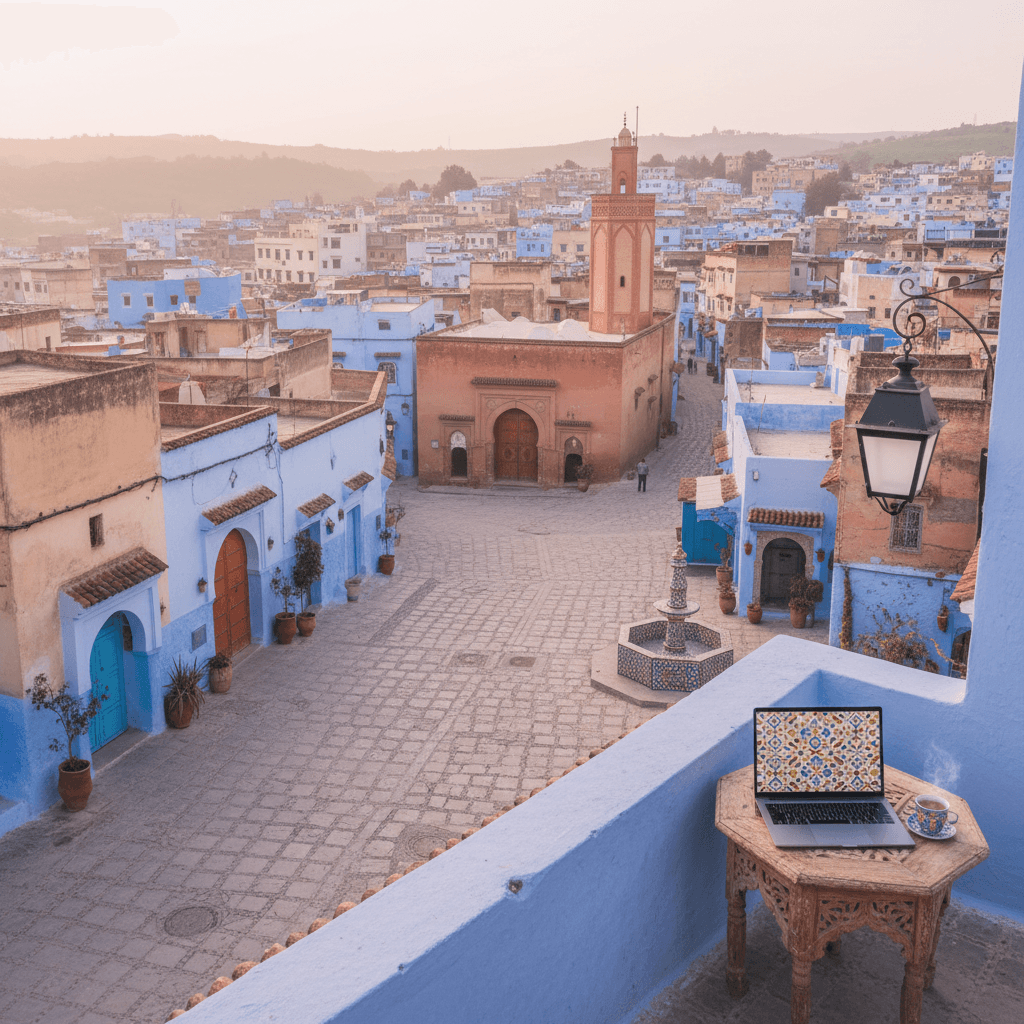
Chefchaouen
🇲🇦 Morocco
Chefchaouen doesn't look real. The medina's blue-washed walls, the Rif Mountains stacked behind the rooftops, the smell of cumin and charcoal drifting through narrow alleys at dusk , it hits you immediately and honestly, the photos don't oversell it. This is one of those rare places where the reality matches the hype.
The pace here is slow. Not inconveniently slow, just genuinely unhurried in a way that's hard to find anywhere close to Europe at this price point. Most nomads describe it as a reset, somewhere to decompress after months of grinding in louder cities. The call to prayer echoes off stone walls five times a day, cats sleep in doorways and the main square fills with mint tea and cigarette smoke by mid-afternoon.
What makes Chefchaouen distinct isn't just the aesthetic, it's the cultural layering. Berber, Arab and Jewish histories all left marks here and you feel it in the architecture, the food, the way locals greet you. It's not a cosmopolitan city, it's a small mountain town with a surprisingly international visitor base, which creates a weirdly specific social atmosphere: backpackers, couples on Instagram pilgrimages and a handful of remote workers who found it and never quite left.
That said, it's not frictionless. Touts near the medina entrance are persistent, the WiFi is, frankly, unreliable enough that you shouldn't plan a client-heavy week without a solid SIM backup and nightlife is basically nonexistent. If you need a coworking scene or a buzzing social calendar, this isn't your city.
What it does offer is this: affordability that still shocks people coming from Western Europe, mountains you can hike into within twenty minutes of your front door and a medina small enough to actually feel like you belong in it after a few days. The blue walls stop being a backdrop and start being just where you live, which turns out to be a genuinely strange and lovely thing.
Best suited for solo travelers, couples and nomads who want to slow down without fully disconnecting. Not ideal for anyone who needs fast infrastructure or urban energy. Know what you're coming for and Chefchaouen delivers.
Chefchaouen is, honestly, one of the more affordable places you can base yourself in the Mediterranean world. A single person spending moderately lands around $795/month all-in, though budget travelers who cook occasionally and rent outside the Medina can get by closer to $380. Those numbers aren't aspirational, they're what people are actually reporting.
Rent is where your choices matter most. The Medina is the obvious pick for atmosphere, the blue walls, the smell of cumin drifting from the souks, the call to prayer bouncing off stone, but you'll pay for it. Studios there run $210 and up and peak-season demand has pushed prices 10-20% higher than they were a few years ago. Bouzaafar and Ras El Ma are the smarter budget play, $110-$210/month for a decent place, quieter streets and landlords who aren't pricing for Instagram tourists.
Food is cheap, full stop. Street tagines and chickpea stew run $2-5, a sit-down meal at somewhere like Aladdin Palace costs $6-12 and you'd have to actively try to spend more than $15 on dinner. Most nomads eat street food most days, it's good enough that there's no reason not to.
- Rent (Medina): $210-$390/month
- Rent (Bouzaafar/Ras El Ma): $110-$210/month
- Street food: $2-5 per meal
- Mid-range restaurant: $6-12 per meal
- Transport: $32-$170/month (petit taxis, 15-30 MAD per trip)
- Broadband: $20-$45/month
- Mobile data: $10-$23/month
Getting around is cheap because you mostly don't need to. The Medina is walkable, taxis are negotiable and rarely expensive and the bus to Tangier or Fes costs under $12. Transport, turns out, is almost a non-issue unless you're commuting to Tetouan regularly for coworking.
The one thing that catches people off guard is healthcare. There's no real hospital in Chefchaouen, pharmacies handle minor stuff without a prescription, but anything serious means a trip to Tetouan or Tangier. Budget accordingly, travel insurance isn't optional here.
Chefchaouen is small enough to walk end-to-end in twenty minutes, which means neighborhood choice is less about commute and more about the kind of daily life you want. The medina smells like cumin and cedar smoke, the streets are narrow enough to touch both walls with your arms out and the light at 7am is, honestly, unlike anywhere else in Morocco. But each pocket of the city has a genuinely different feel.
For Digital Nomads
Bouzaafar is where most nomads quietly land after a week in the medina. It's cheaper, calmer and close to the bus station, so day trips to Akchour or Tetouan don't require an early-morning scramble. Rent runs around 110 to 210 MAD per month for a basic studio, WiFi is patchy but workable for calls and async tasks, cafes like Cafe Clock fill the gaps. The blue walls aren't here, the aesthetic crowd isn't either, that's the whole point.
For Expats
Long-termers tend to gravitate toward the medina, even knowing the trade-offs. Rents are creeping up, 10 to 20 percent higher in peak seasons than a few years ago and navigating the souks with a grocery bag gets old fast. Still, the community feel is real, the architecture earns it and expats who've tried both say the medina's social energy keeps them rooted. Expect to pay 210 MAD or more per month for a decent 1BR, sometimes significantly more if it's got a terrace view.
For Families
Skip the medina if you've got kids in tow. Ras El Ma sits along the river at the city's eastern edge, it's quieter, greener and the sound of running water replaces the call-to-prayer echo bouncing off stone walls at 5am. The trade-off is fewer restaurants within walking distance, you'll cook more than you expected.
For Solo Travelers
Solo travelers do fine in Bouzaafar or the medina, both are safe during the day. Nights near the bus station edges are dim and a little uncomfortable, don't linger there after dark. Solo women consistently rate Chefchaouen as one of Morocco's more manageable cities, modest dress helps, a firm "la shokran" handles most touts. Start in the medina for a few nights to get your bearings, then decide if the quiet of Bouzaafar is worth the trade.
Let's be direct: Chefchaouen doesn't have a single dedicated coworking space. None. If you're arriving with visions of a slick open-plan office with standing desks and cold brew on tap, adjust your expectations now, because what you'll actually find is a loose network of cafes, patchy WiFi and the occasional surprisingly productive afternoon on a rooftop terrace.
WiFi in the medina runs 8 to 25 Mbps on a decent day, though it dips frustratingly during peak hours when every guesthouse guest is simultaneously streaming something. Most nomads gravitate toward Cafe Clock, which has become the de facto work spot, good seating, free access and staff who won't side-eye you for nursing one coffee for three hours. It's not fast, it's not always reliable, but it works for async tasks and Slack.
For video calls or anything that demands consistent bandwidth, you'll want a local SIM. Maroc Telecom is, honestly, the only sensible choice here, it has the best rural and mountain coverage in the Rif region by a wide margin. Starter kits run 30 to 50 MAD at any tobacco shop, data packs add another 10 MAD per GB. Inwi and Orange are cheaper on paper, the signal drops the moment you leave the main square though. If you want to skip the SIM hunt entirely, pick up a Saily eSIM before you land.
4G outside the center gets patchy fast, walking ten minutes toward the Ras El Ma river area can drop you to 2 bars, which is fine for audio calls but not much else. Plan accordingly.
If you have a serious deadline or a heavy-bandwidth week, take the bus to Tetouan, about an hour away. There are proper coworking spaces there with dedicated desks around 100 MAD per day, fast fiber and the kind of quiet that's hard to find in a medina full of cats and call-to-prayer echoes.
- Best cafe for work: Cafe Clock, central medina, free WiFi, reliable enough for email and Slack
- Best SIM: Maroc Telecom, 30 to 50 MAD starter, 10 MAD per GB data
- Nearest coworking: Tetouan, roughly 100 MAD per day for a dedicated desk
- eSIM option: Saily, buy before arrival to skip the tobacco shop queue
Chefchaouen is, honestly, one of Morocco's safer cities for tourists. Crime is low, solo female travelers consistently rate it well and the medina during the day feels relaxed rather than predatory. That said, pickpockets work the souks, touts cluster near the main square and the edges around the bus station get genuinely sketchy after dark. Modest dress helps, it signals respect and tends to reduce unwanted attention considerably.
At night, stick to lit streets. Bouzaafar is fine for getting home, just don't wander the unlit fringes alone, the vibe shifts fast once the cafes close.
Emergency number: 112. Save it before you land.
Healthcare is where things get real. There's no proper hospital in Chefchaouen, just pharmacies, identifiable by the green cross signs, which are genuinely useful for minor stuff and stock basics without a prescription. Night pharmacies exist too, so a stomach bug at 2am isn't a crisis. Anything serious, though and you're looking at a taxi to Tetouan or Tangier, private clinics there are reliable but expect to pay cash upfront, they won't bill your insurer directly.
Travel insurance isn't optional here, it's the whole plan. Make sure yours covers emergency evacuation and private clinic fees, standard policies sometimes don't, check the fine print before you leave home.
A few practical safety notes worth knowing:
- Medina navigation: The blue alleys look identical, getting lost is genuinely easy, keep Google Maps downloaded offline before you go in.
- Touts: Persistent but rarely aggressive. A firm "la shokran" (no thanks) and keep walking, that's all it takes.
- Pharmacies: Stock rehydration salts, antidiarrheal meds and sunscreen early, tourist-area prices are inflated.
- Nearest serious care: Tetouan, roughly 60km away; Tangier for anything requiring surgery or specialist attention.
Weirdly, the thing most travelers don't prepare for isn't crime, it's the hiking terrain around Akchour. The trails to the waterfalls are uneven and poorly marked, a twisted ankle an hour from the trailhead is a real problem when there's no evacuation infrastructure nearby.
Wear proper shoes. Bring water. Tell someone where you're going. That's genuinely the safety advice that matters most here.
Chefchaouen's medina is, honestly, one of the most walkable urban spaces in Morocco. The streets are narrow and tangled, but that's the point. You'll get lost, you'll find a cat sleeping in a blue doorway, you'll smell cumin and charcoal drifting from somewhere you can't quite locate. Most of it's on foot.
For anything beyond the medina, petit taxis are your main option. They're orange, they're everywhere and short trips run 15 to 30 MAD. Negotiate before you get in, not after. There's no meter culture here, that's just how it works. Uber exited Morocco in 2018, though Careem, Yassir and InDrive technically exist. Coverage in Chefchaouen is patchy at best, don't count on them.
Bike and scooter rentals don't exist here in any meaningful way. Weirdly, nobody seems to have filled that gap despite the tourist volume. If you want to explore beyond the city, you're either hiking or arranging a grand taxi.
Getting Out of the City
- Tangier (TNG airport): Shared grand taxi runs 100 to 150 MAD; private transfer via AirportTransfer.com or a negotiated ride costs 500 to 700 MAD for the roughly 2.5-hour trip
- CTM bus to Tangier: 80 MAD, about 2.5 hours, departs from near Bouzaafar
- CTM bus to Fes: 110 MAD, around 4.5 hours
- Day trips to Akchour Waterfalls or Tetouan: Grand taxi is the standard move, agree on a price before departure
The bus station sits on the Bouzaafar edge of town, turns out it's a bit grim after dark, so time your arrivals accordingly. Daytime it's fine, just loud and chaotic in the way Moroccan transport hubs always are.
One thing travelers consistently underestimate: the medina's terrain. It climbs. The blue walls look flat in photos but the streets pitch upward toward the kasbah and your legs will know it by day two, especially if you're hauling a backpack. Comfortable shoes aren't a suggestion. Grand taxis can drop you at the medina entrance, which saves the uphill slog when you're arriving with luggage.
Getting around Chefchaouen is genuinely simple, it just requires adjusting to a pace that isn't optimized for efficiency.
Chefchaouen runs on Darija (Moroccan Arabic) and Tamazight (Berber), with French filling gaps in formal settings and Spanish popping up more than you'd expect this far from the border. English? Honestly, it's thin. Cafe staff near the main square will manage basic orders, shopkeepers in tourist-heavy lanes have learned enough to sell you something, but venture a block off Uta el-Hammam and you're largely on your own.
That's not a dealbreaker, it's just the reality. Most nomads find that a handful of Darija phrases opens more doors than any translation app, because locals genuinely light up when a visitor tries. The effort lands differently here than in bigger cities.
A few phrases worth memorizing before you arrive:
- Shokran: Thank you
- Afak: Please
- Wakha: OK / got it
- La shokran: No thanks (use this confidently with touts, it works better than ignoring them)
- Hadshi bneen: Delicious (say this after a tagine and watch the cook's face)
- Bshal: How much?
Download Google Translate's offline Darija pack before you land, cellular data in the medina is patchy enough that you don't want to depend on a live connection mid-conversation. It's imperfect with Darija, turns out the dialect is tricky to parse algorithmically, but it'll get you through a pharmacy or a negotiation without too much embarrassment.
French is your backup for anything administrative, a doctor's visit in Tetouan, a bank question, a formal complaint. Spanish is, weirdly, more useful in Chefchaouen than in most Moroccan cities because of the region's historical ties to the Spanish protectorate. Older residents especially.
Non-verbal communication carries a lot of weight here. A hand to the heart means genuine thanks, a slow headshake with eye contact means a firm no, a smile with open palms means you're not looking for trouble. Smiles bridge gaps, frankly, more reliably than any app. Don't underestimate that.
One practical note: bargaining in the souks is expected, but tone matters more than vocabulary. Stay calm, stay friendly and don't treat it like a battle. It isn't one.
Chefchaouen sits in the Rif Mountains, which means the weather is, honestly, more temperamental than you'd expect for Morocco. The yearly average high hovers around 23°C, but that number flattens out a story that swings from bitter January nights at 5°C to July afternoons that push 34°C with a dry, gritty heat that makes the blue walls look almost bleached.
Summers are brutally hot. Most nomads who arrive in July expecting a cool mountain escape leave disappointed, the medina's narrow alleys trap heat and the tourist crowds peak simultaneously, so you're sweating through both.
April, May, September and October are the sweet spots. Temperatures sit in the low-to-mid 20s, the light is soft and the mountains smell faintly of cedar and wild herbs after the last of the spring rains. April gets around 10 rainy days, which sounds like a lot, it's really not, the showers tend to be short and the air clears fast.
Winter is the other season to think twice about. November through March brings the bulk of the rainfall and cold, damp evenings in the medina feel sharper than the numbers suggest, stone floors, uninsulated riads and rain drumming on tin roofs make for cozy evenings if you're prepared and miserable ones if you're not.
- January: 15°C high, 5°C low, 8 rainy days. Cold nights, thin crowds, cheap rates.
- April: 20°C high, 9°C low, 10 rainy days. Best month overall, flowers out, light perfect.
- July: 34°C high, 19°C low, 1 rainy day. Dry and hot, peak tourist season.
- November: 20°C high, 9°C low, 7 rainy days. Quiet, cool, underrated.
If you're planning around photography, go in spring. The blue walls pop against green mountain slopes, the morning light before 9am is turns out genuinely extraordinary and you'll have the stairways mostly to yourself before tour groups arrive.
Skip August entirely. The heat, the crowds and the inflated Medina rents make it the worst value month by a wide margin. November is the underrated pick, cool enough for hiking to Akchour Waterfalls, quiet enough to actually enjoy the place.
Get a local SIM on arrival. Maroc Telecom is, honestly, the only one worth buying in Chefchaouen since it holds signal in the mountains where Inwi and Orange drop out completely. Starter kits run around 40 MAD at any tobacco shop, then grab a data pack (10 MAD per GB) as you need it. If you want to skip the hassle, load an eSIM like Saily before you fly, it works fine and saves you hunting for a shop while jet-lagged.
ATMs are easy to find. Attijariwafa and BMCE are the most reliable, though they charge 20-40 MAD per withdrawal and cap you at around 3,000-5,000 MAD per transaction, so plan accordingly. Wise is worth setting up before you arrive for transfers and card spending, the exchange rates are genuinely better than anything you'll find at a bureau de change.
For finding a place to stay longer-term, skip the booking platforms and go straight to Facebook groups. Search "Digital Nomads Chefchaouen Morocco" and you'll find current listings, honest landlord reviews and people subletting short-term.
Day trips are worth building into your schedule. Akchour Waterfalls and God's Bridge are the standout hikes, both are within an hour of town and the trails are, turns out, far less crowded than the medina on a busy weekend. Talassemtane National Park is right on the doorstep too. Viator has guided options if you don't want to sort your own transport.
A few customs that'll make daily life smoother:
- Eating: Use your right hand, it matters to locals more than most travelers expect.
- Dress: Modest clothing is the norm, shoulders and knees covered in the medina.
- Tipping: Around 10% at restaurants is standard, not optional.
- Shoes: Remove them before entering homes. Always.
- Bargaining: Fine in the souks, pointless and weirdly rude at restaurants with printed menus.
Basic Arabic phrases go a long way. Shokran (thank you), Afak (please), La shokran (no thanks) and Wakha (OK) will get you through most interactions, locals genuinely warm up when you try. Download the Google Translate offline Darija pack before you land, WiFi in the medina isn't always there when you need it.
Need visa and immigration info for Morocco?
🇲🇦 View Morocco Country GuideHidden Gem
Worth the effort