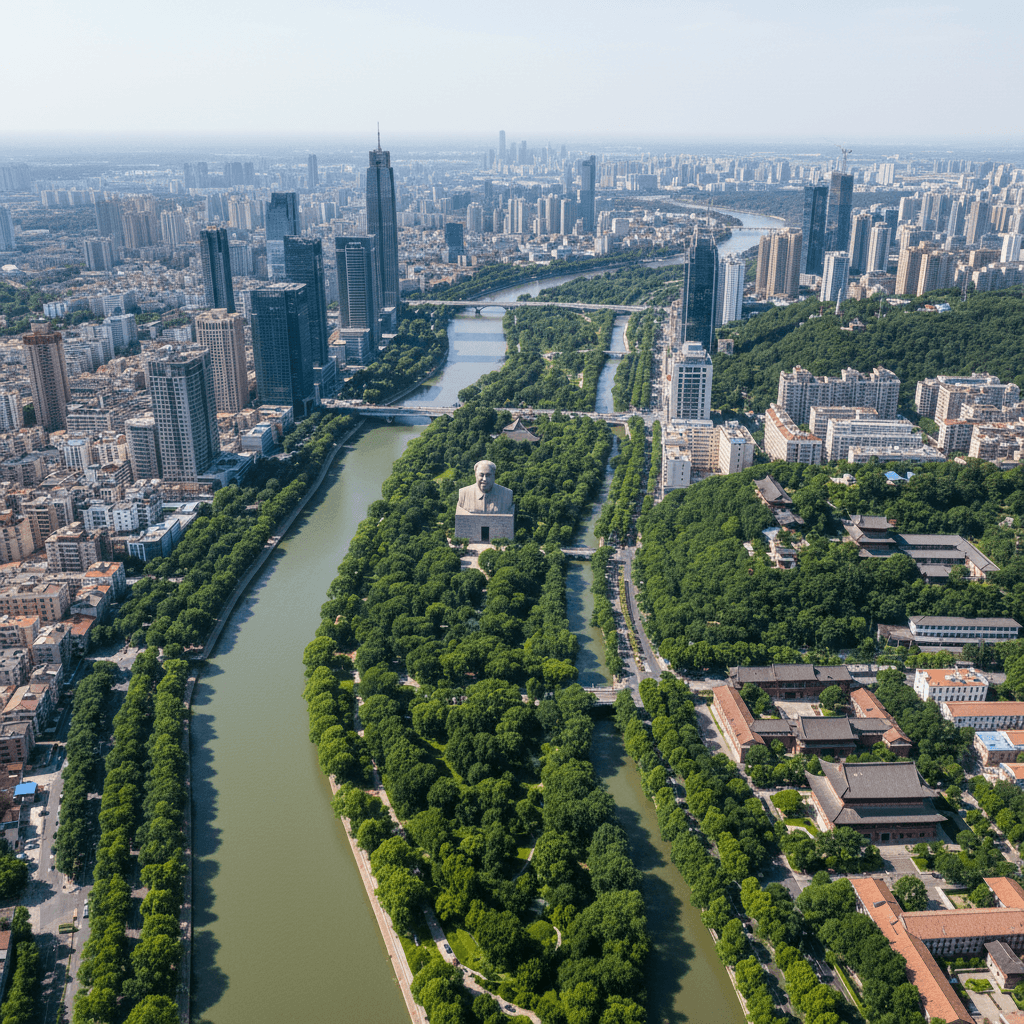
Changsha
🇨🇳 China
The Spicy Soul of Central China
Changsha doesn't do "quiet." If Shanghai is the polished corporate office and Chengdu is the relaxed tea house, Changsha is the loud, neon-soaked street party that smells like chili oil and stinky tofu. It is a city that thrives on sensory overload. Most nomads arrive expecting a standard tier 2 Chinese city but find themselves swept up in a "city that never sleeps" energy fueled by Hunan TV's massive entertainment industry and a local obsession with late night dining.
The vibe here is unapologetically youthful. You'll see it at the IFS skyscraper, where crowds gather under the massive KAWS sculpture, or along Jiefang West Road, where the nightlife feels like a blend of cyberpunk aesthetics and gritty rock clubs. It is a place where 1,000 year old history at the Yuelu Academy sits just a short metro ride away from digital billboards and high speed trains. You aren't just visiting a city; you're stepping into a high energy hub that feels more "real" and less curated than the coastal megacities.
The Nomad Reality Check
Living here is an exercise in trade-offs. On one hand, your cost of living will plummet. You can live a comfortable life on $1,200 to $1,500 a month, eating world class street food for 15 RMB ($2) and taking the efficient metro for pocket change. On the other hand, the "Great Firewall" is a constant hurdle. You will need a rock solid VPN strategy before you land, as Google, Slack, and WhatsApp are blocked, and effective speeds often hover around 5 to 8 Mbps once you're tunneled out.
Language is the other big hurdle. English proficiency is low, rating around a 1 out of 5. You’ll be leaning heavily on WeChat for everything from paying for a bottle of water to translating menus. It’s not a "plug and play" destination like Chiang Mai; it’s for the nomad who wants to disappear into a truly Chinese environment and doesn't mind a bit of friction in their daily routine.
Neighborhoods to Call Home
- Wuyi Square: This is the heart of the action. It's crowded and loud, but you're steps away from the best cafes and the Line 1 and 2 metro interchange. Rent for a central studio here typically runs 2,500 to 4,500 RMB ($350 to $630).
- Meixi Lake: For a more "international" and polished feel, this area features the Zaha Hadid designed Arts Center and better air quality. It’s quieter and popular with those who need a break from the downtown chaos.
- Yuelu District: Located near the universities, this area is greener and more affordable. It’s perfect if you want to hike Yuelu Mountain on your lunch break, with rents as low as 1,800 RMB ($250).
Why It’s Different
What sets Changsha apart is the food and the fire. The local cuisine is famous for its heat, and the social life revolves around "da pai dang" (open air food stalls). Travelers often say the city feels most alive at 2:00 AM in Pozi Street or Taiping Old Street, surrounded by locals peeling crayfish and drinking cold beer. There is a grit and a warmth here that's hard to find elsewhere. While the AQI often hits 90 to 166, making masks a necessity in winter, the cultural payoff is a deep dive into the heart of modern China. It’s spicy, it’s chaotic, and for the right kind of traveler, it’s completely addictive.
The Lowdown on Local Living
Changsha is one of those rare tier 2 Chinese cities where your money stretches remarkably far without sacrificing the neon-lit energy of a major metropolis. Most nomads find they can live a high-quality life here for anywhere between $1,143 and $1,960 per month. It is significantly cheaper than Shanghai or Beijing, particularly when it comes to the "fun" stuff like late-night crayfish feasts and metro hops across the Xiang River.
The city operates on a three tier budget system. If you are keeping things lean, you can get by on $800 to $1,100 by sticking to shared housing and the legendary street food stalls on Pozi Street. A mid-range lifestyle, which includes a private one bedroom apartment and plenty of nights out, usually lands between $1,200 and $1,500. If you want the "comfortable" experience with a luxury high-rise near the IFS skyscraper and daily coworking desk rentals, expect to budget up to $2,000.
Breaking Down the Monthly Rent
Rent will be your biggest variable, and the price fluctuates based on which side of the river you choose to call home. Central areas are more convenient for nightlife, while the west bank offers more breathing room.
- Wuyi Square and IFS (Central CBD): This is the heart of the action. A modern studio or one bedroom here typically runs between 2,500 and 4,500 RMB ($350 to $630). You are paying for the proximity to the KAWS sculpture and the best metro connectivity in the city.
- Yuelu District: Popular with students and those who prefer being near Yuelu Mountain. Prices drop here to about 1,800 to 3,000 RMB ($250 to $420) for similar sized apartments.
- Meixi Lake: A newer, more polished area. It is great for a quieter pace, with rents sitting comfortably in the middle of the two extremes.
Food, Drinks, and Daily Spends
Eating is practically a sport in Hunan. You can eat incredibly well on a tiny budget if you have a tolerance for spice. A bowl of famous Changsha rice noodles for breakfast will only set you back about 10 to 25 RMB ($1.40 to $3.50). If you head to a mid-range spot like the retro-themed Super Wenheyou, expect to pay 50 to 100 RMB ($7 to $14) for a full spread of local specialties.
Transportation is almost negligible in your total budget. The metro system is clean and efficient, with rides costing between 2 and 8 RMB. Even if you rely on Didi (the local ride-hailing app), most trips within the city center hover around 20 RMB ($2.80). If you are staying long-term, a coworking desk at a regional space like UrWork generally costs between 500 and 1,000 RMB ($70 to $140) per month.
Connectivity and Practicalities
While the cost of living is low, there is a "productivity tax" in the form of tech requirements. You cannot work here without a high-quality VPN to bypass the Great Firewall, as Google, Slack, and WhatsApp are all blocked. Most nomads recommend setting this up before you land. You will also need to link a foreign card to Alipay or WeChat Pay immediately; Changsha is almost entirely cashless, and trying to pay with physical bills at a convenience store will often result in a confused look from the clerk.
Expats recommend budgeting a little extra for high-quality air masks during the winter months. Since the AQI can often climb between 90 and 166, having a stash of N95s is a basic health expense you shouldn't overlook. Aside from that, your biggest "hidden" cost will likely be the weekend trips to nearby spots like Orange Isle or the high-speed rail journeys to the mountains, which are too affordable to pass up.
For Digital Nomads: Wuyi Square and the CBD
If you need to be in the center of the action, Wuyi Square is the undisputed heart of Changsha. It is a high energy district where the city's massive LED screens and the iconic KAWS sculpture atop the IFS tower create a backdrop that feels like a scene from a cyberpunk film. For nomads, this is the most practical home base because it serves as the primary metro hub, making it easy to zip across the city for a change of scenery.
- Vibe: Fast paced, neon lit, and unapologetically modern.
- Rent: Expect to pay between 2,500 and 4,500 RMB ($350 to $630) for a decent studio or one bedroom apartment in a high rise.
- Work Spots: While dedicated coworking spaces like UrWork are available, many nomads gravitate toward the "coffee alleys" in Fengying Xili and Sujia Alley. These spots offer better aesthetics and reliable enough Wi-Fi for light tasks, though you will definitely need your VPN ready to go.
For Foodies and Short-Term Expats: Taiping Old Street and Pozi Street
If you are moving to Changsha specifically for the legendary Hunan spice, you want to be near the Old Town. This area preserves the city's traditional architecture with grey brick walls and narrow lanes, but the real draw is the sensory overload of the night markets. It is loud, crowded, and smells like stinky tofu, which is exactly why people love it.
- The Draw: You are steps away from Huogongdian, a massive food temple where you can try dozens of local snacks in one sitting. For a more theatrical experience, the retro Super Wenheyou eatery is nearby, designed to look like a 1980s housing block.
- Pros: Authentic atmosphere and the best street food prices in the city, with snacks often costing just 10 to 25 RMB ($1.40 to $3.50).
- Cons: It is tourist heavy and can be incredibly noisy at night. Most expats find this area better for a one month stint rather than a long term lease.
For Families and Nature Lovers: Yuelu District
Across the Xiang River, the pace slows down significantly. The Yuelu District is anchored by Yuelu Mountain and the ancient Yuelu Academy, one of the oldest universities in the world. It is much greener and quieter than the CBD, making it the top choice for families or anyone who needs a break from the urban grind.
- Rent: Significantly more affordable, with apartments ranging from 1,800 to 3,000 RMB ($250 to $420).
- Lifestyle: You have immediate access to hiking trails and the Orange Isle park, which is perfect for weekend picnics. The air quality tends to be slightly better here than in the congested center, though it still fluctuates.
- Trade-off: It is a bit of a trek to the main nightlife zones, and you will rely heavily on Metro Line 1 or Line 4 to get across the river.
For Relaxed Stays: Meixi Lake
Meixi Lake is the "new" Changsha. It is a planned community built around a massive lake, featuring the stunning Zaha Hadid designed Arts Center. It feels more like a resort town than a provincial capital. Most travelers who find the CBD too frantic end up here for the lakeside walks and the more organized, spacious layout.
- Best For: Remote workers who don't mind being away from the "real" grit of the city in exchange for modern amenities and better walking paths.
- Atmosphere: Clean, upscale, and developing quickly. It lacks the historic soul of Taiping Street but makes up for it with high end malls and international dining options.
- Transport: It is well connected by the metro, but a Didi ride to the city center will take about 20 to 30 minutes depending on traffic.
For Nightlife Seekers: Jiefang West Road
Locals call this the "city that never sleeps." If your priority is being within walking distance of the best bars, live rock venues, and late night crayfish stalls, this is your spot. It is the epicenter of Changsha's entertainment culture, fueled by the nearby Hunan TV studios.
- The Vibe: High decibel and high energy. You will find everything from European style pubs to "cyberpunk" themed markets.
- Safety: Generally very safe, even at 3:00 AM, though the sheer density of people can be overwhelming. Stick to the well lit main drags and use apps like WeChat or Alipay for all your payments to avoid carrying cash in the crowds.
The Connectivity Reality Check
Working from Changsha requires a specific kind of patience. While the city is a high tech hub for Chinese media, the international internet experience is heavily filtered. You can expect raw speeds around 40 Mbps on local fiber, but once you fire up a VPN to access Slack, Google, or WhatsApp, that effective speed often drops to a modest 5 to 8 Mbps. It is enough for emails and basic calls, but you might struggle with heavy video editing or large file uploads.
Before you even land at Changsha Huanghua International Airport, make sure your VPN is installed and tested. Most nomads recommend having two different providers as backups. You will also need WeChat or Alipay immediately. Not just for paying for your 2 to 8 RMB metro ride, but because almost every public WiFi network in cafes or malls requires a Chinese phone number or a WeChat scan to log in.
For mobile data, head to a China Mobile or China Unicom outlet in the city center. A solid data plan usually runs around 100 RMB per month. If you are only staying a few days, some travelers find using an international roaming eSIM easier because it often bypasses the Great Firewall without needing a separate VPN, though it is more expensive.
Coworking Spaces and Where to Sit
Changsha does not have the massive nomad "scene" you will find in places like Bali or even Shanghai. Dedicated coworking spaces are mostly geared toward local startups. Regional giants like Regus have a presence, usually charging between 50 and 100 RMB for a day pass, or roughly 500 to 1,000 RMB for a monthly hot desk. These are your best bet if you need a ergonomic chair and a quiet environment for deep work.
- Wuyi Square / CBD: This is the heart of the action. You will find high end office buildings here with flexible desk rentals. It is the most convenient spot if you want to walk from your apartment to your desk.
- Meixi Lake: A bit further out, this area is more relaxed and modern. It is home to the Zaha Hadid designed Arts Center and several newer tech hubs that offer quieter coworking environments compared to the frantic pace of the city center.
- Yuelu District: Since this is the university district, there are plenty of student focused spaces, though they can be loud and crowded during exam seasons.
The Cafe Culture Alternative
If you prefer the "laptop and a latte" lifestyle, Changsha has a burgeoning cafe scene that rivals larger cities. The Fengying Xili and Sujia Alley areas are packed with independent coffee shops. These spots are great for an afternoon of admin work, though the seating is rarely designed for an eight hour shift.
Expats often frequent the cafes near IFS Tower or the trendy spots in the Chaozong Street historical area. A good coffee will cost you between 20 and 40 RMB. Most baristas are used to people staying for an hour or two, but it is polite to order a second drink if you are camping out. Just remember that English proficiency is quite low here, so have your translation app ready to ask for the "WiFi mima" (password).
Digital Nomad Essentials
- Translation Apps: Download the offline Chinese pack for Google Translate and keep Pleco handy for more complex translations.
- Power: China uses a mix of Type A, C, and I plugs. Most modern coworking spaces have universal outlets, but a small adapter is a smart carry.
- Air Quality: Keep an eye on the AQI. On days when it spikes above 150, you will likely want to work from an indoor space with high quality air filtration rather than an open air cafe.
Staying Safe in the Star City
Changsha is remarkably safe, even by the high standards of major Chinese cities. You can comfortably walk through most neighborhoods at 3:00 AM without a second thought. The city really earns its reputation as a place that never sleeps; you'll find families eating crayfish and groups of friends out on Jiefang West Road well into the early morning hours. Violent crime is extremely rare, and most travelers find the locals to be curious and helpful rather than opportunistic.
That said, the sheer density of crowds in spots like Wuyi Square and the Huangxing Walking Street means you should keep an eye on your phone and wallet. It isn't a hotbed for pickpockets, but in a sea of thousands of people, things can go missing. If you're out late in the clubbing districts, just use common sense. The most common "danger" you'll face is likely a rogue electric scooter zooming silently down a sidewalk or a confusing traffic intersection. Always look twice before crossing, even if you have a green light.
Air Quality and Environmental Health
The biggest health hurdle for most nomads isn't crime or food safety, it's the air. Changsha's air quality index (AQI) often sits between 90 and 166. If you have asthma or sensitive lungs, this can be a real drag. On hazy days, you'll see plenty of locals wearing masks, and it's a good idea to follow suit. Expats usually keep a close eye on apps like AirVisual to decide when to stay indoors or head to the greener, cleaner air around Yuelu Mountain or Meixi Lake.
Water quality is another factor. Don't drink the tap water. Most long term residents buy large 18 liter jugs for their homes or use high quality filters. For shorter stays, bottled water is cheap and available at every "yaodian" (pharmacy) and convenience store for about 2 to 5 RMB.
Healthcare and Hospitals
If you do get sick, Changsha has some of the best medical facilities in central China. The Xiangya Hospital system is prestigious and well equipped. Most expats head straight for the international wings of these hospitals where you're more likely to find English speaking staff, though having a translation app like Pleco or Google Translate (with the offline pack) is still a lifesaver.
- Xiangya Hospital: This is the big one. It's a top tier teaching hospital with modern equipment.
- International Clinics: Expect to pay a premium here, but the wait times are shorter and the paperwork is easier to handle.
- Pharmacies: Look for the green cross or the characters 药店. You can find basic meds easily, but bring your own specific prescriptions from home.
Emergency Contacts and Payments
In a pinch, you need to know which numbers to dial. Keep in mind that operators might not speak English, so having your address written in Chinese characters on your phone is a smart move.
- Police: 110
- Ambulance: 120
- Fire Department: 119
One thing that catches newcomers off guard is how healthcare is paid for. Almost everything is handled through Alipay or WeChat Pay. Even in a hospital, you'll often scan QR codes to pay for your registration, your tests, and your medicine. Make sure your digital wallets are set up and linked to a bank card before you find yourself in a waiting room. Most hospitals will expect payment upfront before treatment begins, so keep your balance topped up.
Food Safety and Spicy Stomachs
Hunan food is famously spicy and oily. If you aren't used to it, "Hunan belly" is a real thing. Start slow with the street food at Pozi Street or Taiping Old Street. While the hygiene standards in Changsha have improved massively, the sheer amount of chili and oil can be a shock to the system. Stick to busy stalls with high turnover, and maybe keep some probiotics or antacids in your travel kit for the first week while you adjust to the local heat.
The Pulse of the City: Metro and Beyond
Changsha is surprisingly easy to navigate once you get your digital ducks in a row. The city's metro system is the backbone of local travel, featuring 7+ lines that run from 6:30 AM to 11:00 PM. It’s the most reliable way to dodge the notorious surface traffic. Most rides will only set you back between 2 and 8 RMB. You can pay by scanning a QR code through Alipay or the local Changsha Metro app, though most nomads find sticking to the transport mini-programs inside WeChat much simpler.
For those arriving by air at Changsha Huanghua International Airport (CSX), Line 6 is your best friend. It’ll get you to the city center in about 45 minutes for a fraction of the cost of a taxi. If you're hauling heavy luggage or arriving late, a Didi (China’s version of Uber) to the Wuyi Square area usually costs around 100 RMB.
Ride-Hailing and Apps
You won't find much luck hailing a cab on the street with a hand wave anymore. Everything happens through Didi. It’s integrated directly into Alipay and WeChat, and since it has an English interface, it’s a lifesaver for anyone whose Mandarin is limited to "hello" and "thank you." A typical cross-town trip in a Didi Premier or Express usually hovers around 20 RMB.
Just a heads up: traffic in the central CBD around IFS and Jiefang West Road can be a nightmare during peak dinner hours. If you're heading out to meet friends for crayfish at 7:00 PM, the metro is almost always faster than a car.
Two-Wheeled Exploration
For short bursts between your apartment and a local cafe, the bright blue or yellow shared bikes (HelloBike or Meituan) are everywhere. They cost about 1.5 RMB per 30 minutes. You just scan the QR code on the handlebars with your phone.
The city is becoming more bike-friendly, especially around scenic spots like Orange Isle and the Meixi Lake area. However, the old town alleys near Taiping Street are better explored on foot because of the dense crowds and narrow paths. If you're staying in the Yuelu District, be prepared for some hills; it's the one part of the city where your legs will definitely feel the burn.
Regional Travel: The High-Speed Hub
One of the biggest perks of basing yourself in Changsha is the High-Speed Rail (HSR) connectivity. The Changsha South Railway Station is a massive hub that connects you to the rest of China at 300 km/h. You can zip to Wuhan in about an hour and a half or hit Guangzhou in under three.
- Metro: Best for daily commutes; 2 to 8 RMB per trip.
- Didi: Essential for late nights or rainy days; roughly 20 RMB for mid-range trips.
- Shared Bikes: Great for "last mile" travel; 1.5 RMB per session.
- Airport Transfer: Line 6 (Cheap/Fast) or Didi (100 RMB).
Practical Transit Tips
Expats usually recommend downloading Amap (Gaode Maps) for the most accurate bus and train timings, even if you can't read all the characters. The UI is intuitive enough to follow the blue line. Also, always keep your power bank charged. Since your Alipay or WeChat acts as your ticket, your wallet, and your map, a dead phone means you’re effectively stranded. Most locals carry a portable charger for this exact reason, and you'll see rental power bank stations in almost every restaurant and convenience store.
Communication Basics
In Changsha, Mandarin is the undisputed king. While the locals speak a thick Hunan dialect among themselves, everyone understands standard Mandarin. Don't expect to find much English outside of high end hotels or the international wing of Xiangya Hospital. On a scale of one to five, most travelers rank the city's English proficiency at a 1 or 1.5. You'll need to be comfortable with mime, patience, and a suite of digital tools to get by.
Most nomads find that WeChat is the only app that truly matters. It isn't just for chatting; it's how you'll pay for crayfish on Pozi Street, scan menus, and book DiDi rides. Expats recommend setting up WeChat Pay or Alipay by linking your home bank card before you even land. Without these, even buying a bottle of water can become a logistical headache since many vendors rarely carry physical change anymore.
The Great Firewall and Connectivity
Working remotely here requires a serious game plan. The Great Firewall blocks Google, Slack, WhatsApp, and most Western social media. You absolutely need a reliable VPN installed on both your laptop and phone before you cross the border. Even with a good one, speeds usually hover around 5 to 8 Mbps for international traffic, though local Chinese sites will fly at 40 Mbps or more.
For mobile data, grab a SIM card from China Mobile or China Unicom at the airport. Expect to pay around 100 RMB for a decent monthly data plan. If you're only staying a few days, some nomads prefer using an international roaming eSIM, which sometimes bypasses the firewall naturally, though it's a pricier long term solution.
Essential Apps and Translation
Since you won't be reading many signs or menus in English, your phone is your lifeline. Travelers often say the camera feature on Google Translate is a lifesaver for deciphering spicy food menus at Huogongdian, but remember it needs that VPN to function. For a more reliable offline option, Pleco is the gold standard for Chinese dictionaries.
- Baidu Maps: Much more accurate than Apple or Google Maps for navigating the alleys of Taiping Old Street.
- DiDi: The local version of Uber. It has an English interface and is built into Alipay.
- Waygo: Great for instant visual translation of Chinese characters without needing a constant data connection.
Social Etiquette and Local Interaction
Changsha has a youthful, high energy vibe thanks to its status as a major media hub, but the expat scene is smaller and less organized than in places like Chengdu or Shanghai. You won't find many dedicated nomad meetups. Instead, the social life happens around food. Joining a crowded table at a night market or a bar on Jiefang West Road is the fastest way to meet locals.
People here are generally curious and friendly toward foreigners, even if there's a language barrier. Learning a few basic phrases will go a long way in your daily interactions:
- Ni hao: Hello
- Xie xie: Thank you
- Duoshao qian?: How much?
- Tai la le: Too spicy! (You will use this often in Hunan)
- Wo bu yao la: I don't want it spicy (Though in Changsha, "not spicy" often still includes a few chilies).
If you're looking for a community, check InterNations or search for local expat groups on WeChat. Most digital nomads find that while the language barrier is high, the "city that never sleeps" energy makes the effort to communicate well worth it.
Seasonal Shifts and the Sweet Spot
Changsha is notoriously moody when it comes to the climate. It sits in a subtropical zone where humidity is the constant companion, making the highs feel hotter and the lows feel sharper than the thermometer suggests. If you're planning a stint here, timing is everything to avoid the swampy summers and the grey, damp winters.
Most expats and seasoned travelers agree that October and November are the golden months. The air clears up, the oppressive humidity of the Yangtze River basin finally breaks, and the temperatures hover around a comfortable 20°C (68°F). This is also when the air quality index (AQI) tends to be at its most manageable, usually sitting between 55 and 97, compared to the hazy spikes you'll see in the peak of summer or winter.
The Four Seasons Breakdown
- Spring (March to May): This is the rainy season. Expect frequent drizzles and heavy downpours, especially from April through June. While the greenery around Yuelu Mountain looks incredible, the dampness can make the 15°C to 22°C range feel quite chilly indoors.
- Summer (June to August): It gets intense. Changsha is often grouped with China's "furnace cities." Temperatures regularly hit 28°C (82°F) or higher, but the humidity makes it feel like a sauna. Nomads usually retreat to air-conditioned cafes in the IFS tower or mall basements during the day. Air quality often dips here, with AQI levels hitting 142 on bad days.
- Autumn (September to November): The absolute best time to visit. It's dry, crisp, and perfect for walking through Orange Isle or the back alleys of Taiping Old Street. You'll get the most "blue sky" days during this window.
- Winter (December to February): It’s a dry cold, but without central heating in many older buildings, you'll feel it in your bones. January stays around 6°C to 14°C (43°F to 57°F). It rarely snows, but the overcast skies can feel a bit relentless.
Air Quality and Health Logistics
Pollution is a reality of life in Hunan. While it’s not as consistently heavy as some northern industrial hubs, the AQI often fluctuates between 90 and 166. Long-term residents usually keep an eye on apps like AirVisual. On high-pollution days, you'll see locals wearing masks, and it’s smart to stick to indoor coworking setups or the higher-end malls in the Wuyi Square area that have better air filtration systems.
Planning Around the Calendar
Beyond the weather, you have to watch the Chinese holiday calendar. Avoid Golden Week (the first week of October) and Lunar New Year (usually February) at all costs. During these times, the "city that never sleeps" becomes impossibly crowded or shuts down entirely as people head home. Prices for short-term rentals in trendy spots like Meixi Lake can double, and train tickets out of the city become impossible to snag.
For those looking for the best value, late March or late October offers the best balance of lower accommodation costs and tolerable weather. You'll avoid the $2,000 high-season monthly burn and likely find a solid mid-range apartment for closer to $1,200 while the weather still permits outdoor dining at the Pozi Street night markets.
Connectivity and Digital Survival
Living in Changsha as a nomad requires a bit of a digital "pre-game." You won't get far without WeChat and Alipay. These aren't just for chatting; they are your wallet, your metro card, and your way to unlock shared bikes. Most expats recommend linking your foreign Visa or Mastercard to these apps before you even land.
The Great Firewall is a real hurdle here. Expect effective speeds to hover around 5 to 8 Mbps once your VPN is active. You'll need to install a reliable VPN (or two) on all your devices before arriving, as the provider websites are blocked within China. If you're staying short-term, using an international roaming SIM can sometimes bypass the firewall, but it gets pricey for long stays.
Money and Cost of Living
Your dollar goes significantly further here than in Beijing or Shanghai. Most nomads find they can live comfortably on $1,200 to $1,500 per month. If you're on a budget, you can easily scrape by on $900 if you stick to street food and shared housing.
- Housing: A modern studio in the Wuyi Square CBD runs between 2,500 and 4,500 RMB. If you head across the river to the Yuelu District, those prices drop to about 1,800 to 3,000 RMB.
- Food: You can grab a bowl of spicy rice noodles or a plate of crayfish at Pozi Street for 15 to 25 RMB. A nicer dinner at the IFS mall usually costs around 150 RMB.
- Transport: Metro rides are cheap, ranging from 2 to 8 RMB. A Didi (the local Uber) across town rarely costs more than 20 to 30 RMB.
Navigation and Language
Don't expect much English. Proficiency is low, even in the trendy areas. You'll want Pleco for dictionary lookups and Google Translate with the offline Chinese pack downloaded for its camera feature. This is a lifesaver for reading menus at places like Huogongdian.
The metro system is excellent and easy to use with English signage. Line 6 is your best bet for getting from Changsha Huanghua International Airport (CSX) to the city center for just a few yuan. For everything else, Didi has an English interface within their app that makes ride-hailing painless.
Health and Environment
The biggest downside to Changsha is the air quality. AQI levels often sit between 90 and 166, which can be tough if you have sensitive lungs. Locals recommend checking the air quality apps daily; if the numbers spike, it's a good day to work from a cafe indoors. October and November are the sweet spots for weather, offering mild temps and clearer skies.
If you do get sick, Xiangya Hospital has an international wing that expats swear by. For minor issues, look for a "yaodian" (pharmacy), which are on almost every corner. Just show them your translation app and they'll help you find what you need.
The Social Scene
Changsha doesn't have a massive, organized nomad community like Bali or Chiang Mai. Socializing happens organically at night markets or the bars along Jiefang West Road. It's a "city that never sleeps," so if you're looking to meet people, head to the neon-lit alleys after 10 PM. For a quieter vibe, nomads often congregate in the coffee shops around Meixi Lake or the creative alleys of Fengying Xili.
Need visa and immigration info for China?
🇨🇳 View China Country GuideHidden Gem
Worth the effort