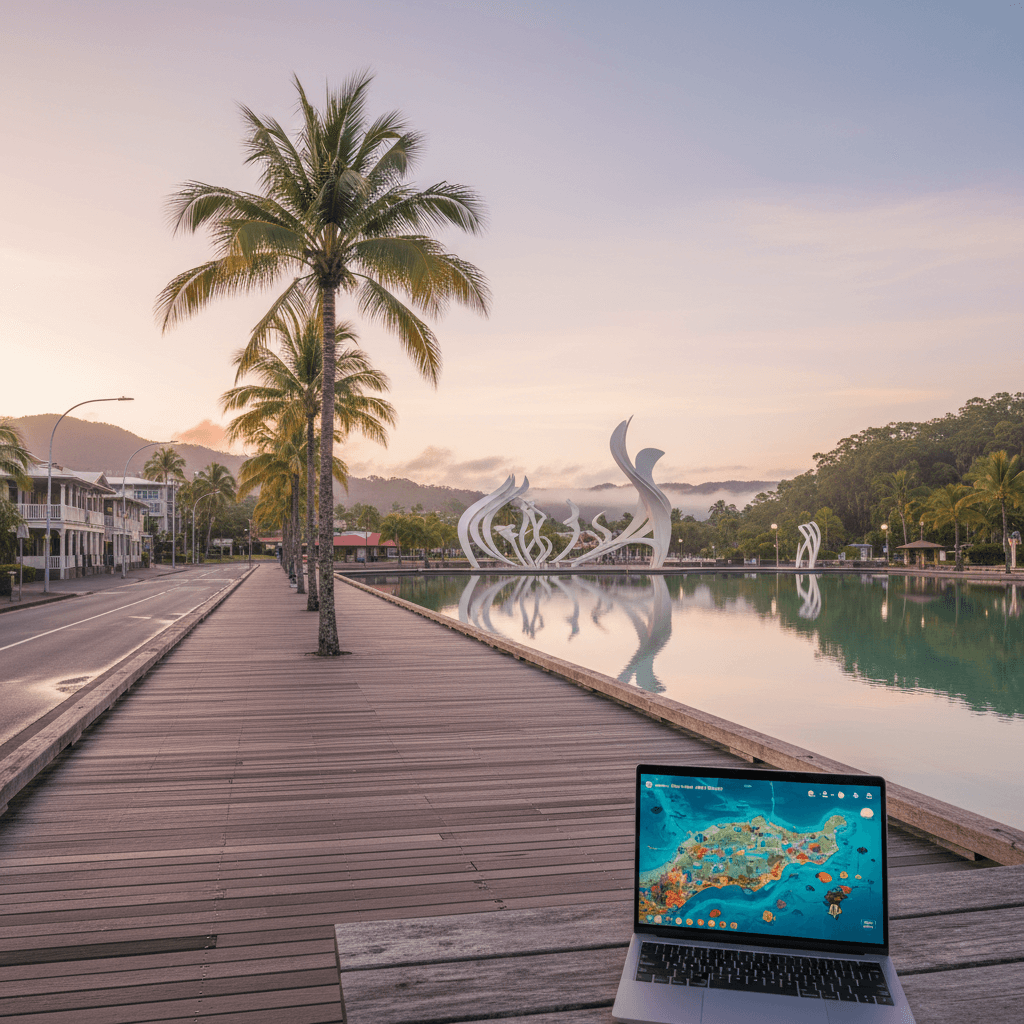
Cairns
🇦🇺 Australia
The Gateway to the Tropical North
Cairns is a place where the humidity feels like a warm hug and the pace of life slows down to match the swaying palm trees. Unlike the high octane energy of Sydney or the moody, coffee obsessed lanes of Melbourne, Cairns is unpretentious and deeply tied to the land. It is a city that doesn't just sit next to nature; it's swallowed by it. Most nomads find themselves here because they want to wake up, answer a few emails, and then spend the afternoon underwater at the Great Barrier Reef or lost in the ancient canopy of the Daintree Rainforest.
The vibe is decidedly barefoot. You'll see locals and travelers alike wandering the Esplanade in board shorts and flip flops, or "thongs" as you'll quickly learn to call them. It is a compact, walkable hub where the salt air follows you into every cafe. While it’s a major tourist destination, there is a gritty, authentic heart to the place, especially once you move away from the souvenir shops and into the artsy pockets of Grafton Street.
The Nomad Experience
Living here means trading the traditional office for a lifestyle focused on the outdoors. Expats often say the city feels like a base camp for adventure. You aren't just here to work; you're here to explore the Atherton Tablelands on weekends or join an Aboriginal cultural tour to learn traditional spearfishing. The community is welcoming and it’s incredibly easy to make friends at the local markets or during a sunset session at the Esplanade lagoon.
- The Weather Factor: The tropical climate is the biggest draw and the biggest challenge. The "dry season" from June to August is paradise, with clear blue skies and manageable temperatures. However, the summer months bring intense humidity and heavy rains that can make the air feel thick enough to chew.
- Connectivity: Within the city center, the internet is reliable enough for video calls, averaging around 21 Mbps. If you head into the deep rainforest or remote campsites, expect your signal to vanish entirely. It's a city that forces a digital detox whether you planned for one or not.
- Safety: Cairns is remarkably safe with a low crime rate. You can walk through most areas at night without a second thought, though common sense applies in the more tourist heavy zones.
What to Expect in 2025-2026
Cairns is evolving into a more sophisticated hub for remote workers. While it used to be seen strictly as a backpacker's stopover, the rise of boutique stays and dedicated work friendly cafes has changed the demographic. You'll find a growing number of professionals who have traded the commute for a van or a central apartment. Prices are rising, but it remains more affordable than the southern capitals.
- Monthly Budget: A comfortable mid range lifestyle usually sits around $3,883 AUD. This covers your housing, dining out, and those essential reef trips.
- Housing: Coliving and shared flats are the go to for many nomads, with prices ranging from $600 to $1,200 AUD per month depending on how close you want to be to the water.
- Daily Life: Most of your social life will revolve around the Cairns Esplanade and Grafton Street. These areas are the pulse of the city, filled with street art, craft breweries, and the Cairns Art Gallery.
The real magic of Cairns is the sense of perspective it gives you. It’s hard to stress about a deadline when you know the world’s oldest rainforest is just a short drive away. It is a destination for those who want to work hard so they can play harder in the wild. If you can handle the heat and the occasional tropical downpour, you'll find a community that values experiences over status symbols.
The Cost of the Tropical Dream
Living in Cairns allows you to experience the Great Barrier Reef on your doorstep without the astronomical price tag of Sydney or Melbourne. However, Australia is rarely "cheap" by global standards. Most digital nomads find they need about $3,883 AUD per month to maintain a comfortable lifestyle that includes a mix of coworking, dining out, and weekend reef trips.
If you are on a tighter budget, you can scrape by on $2,000 to $3,000 AUD by staying in hostels or shared housing and cooking most meals. Those looking for a more seamless experience with private apartments and frequent excursions should budget upwards of $4,500 AUD. Prices fluctuate based on the season, so expect to pay a premium during the cooler, drier months of June through August when the city is at its busiest.
Housing and Accommodation
Finding a short term rental in the city center can be competitive. While specific data for one bedroom apartments in Cairns is often bundled into broader Queensland averages, expect to pay a premium for anything near the Esplanade or Grafton Street. For those staying longer, shared flats are the most popular way to keep costs down.
- Shared Housing/Coliving: Expect to pay between $600 and $1,200 AUD per month for a room in a shared house.
- Central Studio/1BR: While prices vary, central locations usually start around $450 to $550 AUD per week.
- Hostel Dorms: Budget travelers often pay $40 to $60 AUD per night for a bed in a well rated hostel.
Food and Dining
Cairns has a fantastic food scene that ranges from cheap night market eats to high end seafood on the waterfront. Expats recommend shopping at local markets for fresh tropical produce to keep grocery bills manageable. A typical grocery run for one person usually lands between $100 and $150 AUD per week.
- Casual Meal: A quick lunch or street food at the markets will cost about $15 to $25 AUD.
- Mid-range Dinner: A nice meal at a restaurant on Grafton Street usually costs $35 to $60 AUD per person, excluding drinks.
- Coffee: A flat white or latte is standard at $5 to $6 AUD.
- Beer/Wine: Expect to pay $10 to $14 AUD for a pint of craft beer or a glass of wine at a local bar.
Transport and Connectivity
The city center is remarkably walkable, so you won't spend much on transport if you stay central. For exploring further afield like the Atherton Tablelands or the Daintree, renting a van is the preferred nomad method. For digital connectivity, most people use eSIM providers like Holafly or ZetSIM to stay online while moving between cafes.
- Public Transport: Local bus fares are generally $2 to $5 AUD per trip.
- Van Rental: A basic campervan for weekend trips starts around $100 to $150 AUD per day.
- Internet: High speed home internet plans or coworking access usually average $70 to $100 AUD per month.
Lifestyle and Entertainment
Your biggest variable expense in Cairns will be activities. While the Esplanade Lagoon is free, getting out to the reef or taking a guided rainforest tour can eat through a budget quickly. Many nomads find that the 21 Mbps average internet speed is plenty for work, leaving more time and money for the $150 to $250 AUD day trips that make living here worth it.
Safety is a major plus here, as the city maintains a low crime rate. You won't need to budget for extra security or private transport at night, which is a hidden saving compared to other global nomad hubs. Just remember to factor in the cost of a good pair of walking shoes and plenty of high quality sunscreen.
The Urban Core and Esplanade
For digital nomads and solo travelers, the area around the Cairns Esplanade and Grafton Street is the undisputed center of gravity. It is the most walkable part of the city, packed with cafes that double as makeshift offices and plenty of public spaces with reliable WiFi. You are right in the thick of the action here, with easy access to the saltwater lagoon and the night markets.
Most nomads choose this area for the convenience. You can walk to the marina for a reef trip in the morning and be back at your laptop by 2:00 PM. While there are no massive global coworking chains yet, local spots like the space on Grafton Street provide the professional environment you need to hit deadlines. The vibe is decidedly social, making it easy to meet other travelers at the local craft beer bars or art galleries like NorthSite.
- Rent: Budget around $600 to $1,200 AUD per month for a room in a shared apartment or a coliving setup.
- Pros: High-speed internet, no car required, and the best social scene in the city.
- Cons: It can feel touristy during peak season, and the noise from bars might be a distraction if your apartment faces the main drag.
The Northern Beaches
Expats looking for a more permanent, "local" feel usually head north to suburbs like Trinity Beach or Palm Cove. These areas offer a slower pace of life that feels less like a holiday hub and more like a tropical community. You will find more spacious apartments and small houses here, often with better views and a quieter atmosphere than the city center.
Living here requires a car or a willingness to learn the local bus schedules, as it is about a 20 to 30 minute drive from the CBD. Expats appreciate the proximity to local markets and the ability to escape the humidity under the palm trees. It is the kind of place where you get to know your barista and spend your weekends paddleboarding rather than dodging tour groups.
- Rent: Expect to pay $550 to $800 AUD per week for a decent two-bedroom apartment or small house.
- Pros: Relaxed community vibe, beautiful beaches, and more space for your money.
- Cons: Commuting into the city can be a chore, and you will definitely want a vehicle for grocery runs.
The Outskirts and Tablelands
Families often prefer the leafy outskirts or the elevated cool of the Atherton Tablelands. While the Tablelands are technically a drive away from the coast, they offer a temperate climate that is much more manageable for kids than the coastal heat. Suburbs like Edge Hill are closer to the city but feel worlds away, nestled right against the Botanic Gardens and offering plenty of parks and playgrounds.
Edge Hill is particularly popular because it balances lifestyle and logistics. You have trendy cafes and boutiques on Collins Avenue, but the residential streets are quiet and safe. It is the ideal middle ground for parents who work remotely but want their children to have space to run around.
- Rent: Family homes typically start around $700 AUD per week.
- Pros: Close to nature, cooler temperatures in the hills, and excellent local schools.
- Cons: Internet signal can be patchy in the more remote parts of the Tablelands, so check your connection before signing a lease.
The Adventure Seeker's Outposts
If you are a nomad who prefers a van to a villa, the areas surrounding the city offer plenty of freedom. Many travelers spend time in Port Douglas or near the Daintree, balancing work with total immersion in nature. Just keep in mind that the further you go from the Cairns CBD, the more the 21 Mbps average internet speed starts to drop. If your work involves heavy video uploads, stay closer to the city center and save the remote rainforest trips for your days off.
Reliability and Speed
Cairns offers a solid foundation for remote work, though it operates at a tropical pace. You can generally expect average download speeds around 21 Mbps across the city center. While this isn't lightning fast by global standards, it's more than enough for Zoom calls, uploading content, and standard cloud based workflows. Most Airbnbs and hotels along the Esplanade provide complimentary high speed WiFi that holds up well during business hours.
The real challenge begins once you leave the city limits. If you're planning a van trip to the Atherton Tablelands or deep into the Daintree Rainforest, prepare for total dead zones. Digital nomads frequently report that signal drops off entirely in remote campsites and dense jungle areas. If you need to stay connected while exploring the outskirts, a high quality external antenna for your vehicle or a satellite based backup is a smart move.
Coworking Spaces and Community
While Cairns doesn't have the massive coworking hubs you'll find in Sydney or Melbourne, the scene is intimate and professional. Most nomads gravitate toward the area around Grafton Street and the city center for their daily grind. You'll find dedicated desks and meeting rooms that cater to a mix of local entrepreneurs and passing travelers.
- theSPACE Cairns: A popular hub for startups and innovators located near the city center. It's the go to spot if you need a structured office environment and a chance to network with the local tech community.
- Cairns Corporate Tower: Offers more formal serviced office options for those who need a professional boardroom or a quiet, private office for sensitive calls.
- TropicHUB: A versatile workspace that provides a community-focused environment for freelancers and remote workers looking to stay productive in the heart of the city.
Daily rates for a hot desk typically hover around $30 to $45 AUD, while weekly passes can bring that cost down significantly. It's always a good idea to message these spaces a day in advance as they can fill up during the peak winter season from June to August.
The Cafe Culture
If you prefer the hum of a coffee machine to a quiet office, Cairns has plenty of laptop friendly spots. The cafes along the Cairns Esplanade and Abbott Street are used to seeing nomads tucked into corners with their MacBooks. Most owners are relaxed about you staying for a few hours as long as you keep the flat whites and avocado toasts coming.
Many nomads recommend hitting the cafes early in the morning to beat the tropical humidity. By mid afternoon, the heat can make outdoor seating uncomfortable, so you'll want to move to an air conditioned indoor spot. Just keep in mind that public WiFi in cafes can be hit or miss during the lunch rush, so having a backup hotspot is a lifesaver.
Mobile Data and SIM Cards
For the best coverage in Tropical North Queensland, Telstra is the undisputed king. Their network reaches further into the rural areas than any other provider. If you're looking for convenience, many travelers now opt for eSIM providers like Holafly or ZetSIM before they even land. These are great for immediate connectivity, but for long term stays, a local prepaid SIM will usually give you more data for your dollar.
- Telstra: Best for those planning to explore the Tablelands or northern beaches. It's more expensive but has the most reliable signal.
- Optus: A solid middle ground with great speeds in the city center and competitive data packages.
- Vodafone: Often the cheapest option, works perfectly within the Cairns CBD, but signal tends to vanish quickly once you head into the rainforest.
Expect to pay around $30 to $50 AUD per month for a generous prepaid data plan. Most local providers offer easy top ups through their apps, making it simple to manage your budget while you're on the move.
Staying Safe in the Tropics
Cairns is generally a very safe base for digital nomads. The city has a low crime rate and a tight knit community that makes it easy to feel at home quickly. You can walk through the central business district or along the Esplanade at night without much worry, though it's always smart to keep your wits about you after the bars close on Grafton Street.
Most safety concerns here aren't about people; they're about nature. If you're heading into the Daintree or out to the Atherton Tablelands, the biggest risks are getting lost or losing phone signal. Nomads who spend time working from remote campsites often find themselves completely off the grid, so tell someone your plans before you head into the bush. In the city, keep an eye on the sun. The tropical UV levels are intense, even on cloudy days.
Water safety is another local priority. Between November and May, "stinger season" means you should only swim in the netted enclosures at the beach or stick to the Cairns Esplanade Lagoon. If you're heading out to the Great Barrier Reef, follow the instructions of your dive masters and boat crews closely. They're pros at managing the local marine life and current conditions.
Healthcare Infrastructure
If you get sick, you're in good hands. Cairns functions like any other major Australian hub with high quality medical facilities. For emergencies, the Cairns Hospital on the Esplanade is the main public facility. It's well equipped to handle everything from tropical infections to diving accidents. For anything life threatening, the emergency number is 000.
Many nomads use the Cairns GP Superclinic (located at 156 Grafton Street, corner of Florence & Grafton) for appointments, which operates Monday-Friday 7am-9pm and Saturday-Sunday 8am-6pm. Expect to pay around $80 to $100 AUD for a standard consultation if you don't have local Medicare coverage.
- Pharmacies: Chemist Warehouse and TerryWhite Chemmart are everywhere. They're the best spots for affordable prescriptions, high SPF sunscreen, and basic medical supplies.
- Dental: There are several clinics near the city center, though dental work in Australia is notoriously expensive. Most travelers prefer to have major work done before arriving.
- Health Insurance: Since there isn't a dedicated nomad visa, most expats and long term travelers rely on private travel insurance or Overseas Visitor Health Cover (OVHC). It's a requirement for many visa types and covers the high costs of private hospital stays.
Practical Wellness Tips
The humidity in North Queensland can be a shock to the system, especially during the summer months from December to March. Local expats recommend staying hydrated and staying indoors during the midday heat to avoid heat exhaustion. If you're working from a cafe, make sure it has decent air conditioning; "tropical lifestyle" sounds great until your laptop starts overheating.
For those managing mental health or looking for a community, there are several wellness studios near the waterfront. Places like The Yoga School Cairns provide a good space to decompress and meet locals. Most nomads find that the relaxed pace of life here does wonders for their stress levels, provided they can handle the occasional spotty internet connection in the more remote rainforest areas.
Navigating the Gateway to the Reef
Cairns is a surprisingly compact city, making it one of the easier Australian hubs to manage without your own wheels. The city center is laid out in a grid, and if you’re staying near the Esplanade or Grafton Street, you'll find that most of your daily needs are within a fifteen minute walk. The flat terrain is a gift for those who prefer to get around on foot or by bike, especially during the cooler winter months from June to August.
For most nomads, the primary mode of transport within the city limits is a mix of walking and cycling. You can rent bikes or electric scooters near the lagoon, which are perfect for zipping between cafes and your accommodation. If you're heading further out to the northern beaches or the residential suburbs, you'll likely rely on the Sunbus network. It’s the local bus service that covers most of the region. While reliable, the frequency can be a bit slow compared to major metros like Sydney, so it pays to check the schedule ahead of time.
Ride-Hailing and Taxis
Uber is the go-to for most expats and travelers here. It’s widely available and usually arrives within minutes in the central business district. A typical ride from the airport to the city center usually costs between $25 and $35 AUD. If you prefer traditional services, 13cabs is the main taxi provider. For those arriving on a budget, airport shuttle buses are a solid alternative, dropping you directly at major hostels and hotels for a fraction of the taxi fare.
The Van Life Advantage
If you really want to see what Tropical North Queensland has to offer, many nomads recommend renting a campervan. Having your own transport is the only way to comfortably reach spots like the Atherton Tablelands or the Daintree Rainforest without being tied to a tour group's schedule. Be aware that once you head into the more remote gorges or mountain ranges, your phone signal will likely drop out. Locals suggest downloading offline maps before you leave the city limits.
- Car Rental: Expect to pay around $70 to $120 AUD per day for a standard vehicle, depending on the season.
- Campervans: Prices vary wildly, but budget around $150 AUD per day for a well-equipped nomad setup.
- Fuel: Prices fluctuate, but generally hover around $1.80 to $2.10 AUD per liter.
Key Transport Tips
Public transport users should look into getting a translink card or checking if contactless payments are active for the specific route. While the city is walkable, the tropical humidity from December to March can make even a short stroll feel like a marathon. During the wet season, you'll find yourself leaning much more heavily on Ubers or the air-conditioned bus network to avoid arriving at your coworking spot drenched in sweat.
For those planning a longer stay, buying a second-hand bicycle is a smart move. You can often find them on local community boards or Facebook Marketplace for under $100 AUD. Just make sure you have a sturdy lock; while the city is generally safe, bike theft is a common nuisance in tourist hubs. If you're heading out for a night of craft beers on Grafton Street, remember that Queensland has strict drink-driving laws, so stick to the rideshare apps for the trip home.
The Local Lingo
You won't have any trouble getting your point across in Cairns. English is the primary language, spoken with that quintessential, laid-back Queensland lilt. While the proficiency is 100% among locals, the tropical pace of life means conversations often involve a fair amount of slang and shorthand. Don't be surprised if your barista greets you with a casual "G'day" or "How ya goin'?" instead of a formal hello.
Most nomads find the local dialect easy to pick up within a few days. The "Aussie abbreviation" is a real thing here; breakfast becomes "brekkie," afternoon becomes "arvo," and a mosquito (which you'll definitely encounter) is a "mozzie." If someone offers you a "coldie" at a bar on Grafton Street, they're just offering you a chilled beer. It's a friendly, unpretentious way of communicating that fits the city's outdoor-centric lifestyle.
Indigenous Languages and Cultural Respect
Cairns sits on the traditional lands of the Gimuy Walubara Yidinji and Yirrganydji people. While English is the day to day language for business and remote work, you'll frequently hear and see Aboriginal languages integrated into the community. This is especially true during cultural tours in the Daintree Rainforest or when participating in traditional activities like spearfishing tours.
Expats recommend taking the time to learn the traditional names of the places you visit. It isn't just about communication; it's a sign of respect for a culture that has existed here for over 60,000 years. Many signs around the Cairns Esplanade and local galleries include dual naming, providing a great opportunity to familiarize yourself with the local heritage.
Digital Communication and Connectivity
When it comes to staying connected for work, the language of the internet is reliable but varies by location. In the city center, you'll find average speeds of 21 Mbps, which is plenty for Zoom calls and uploading files. However, the communication landscape changes the moment you head into the bush or up to the Atherton Tablelands. Signal can drop out entirely in remote rainforest pockets, so travelers often download offline maps before leaving the city.
For your phone, skipping the physical SIM hunt at the airport is a smart move. Most nomads use eSIM providers to get set up before they even land.
- Holafly: Popular for unlimited data plans if you're a heavy streamer.
- ZetSIM: Great for flexible, short term data packages.
- Telstra: The local go-to if you plan on exploring deep into the Outback, as they have the best rural coverage.
Practical Tools for the Road
Even though English is the standard, having a few apps on your phone makes life easier. Google Translate is still handy for translating scientific names of flora and fauna you'll see at the Great Barrier Reef. For social coordination, most nomad meetups and expat groups organize through WhatsApp or the Nomad Life app. If you're looking to grab a ride after a night out, Uber is the standard language for transport here, though local taxi apps are a solid backup for late night airport runs.
If you're ever in doubt about a local term or a menu item at a market, just ask. The people in Tropical North Queensland are notoriously approachable. A quick "What's that mean?" will usually result in a 10 minute chat and perhaps a recommendation for the best coffee spot in the neighborhood.
The Tropical Seasons
Cairns doesn't follow the traditional four season calendar. Up here in the Far North, life is dictated by the Wet and the Dry. For most nomads, the sweet spot hits between June and August. During these months, the humidity drops to manageable levels and the sky stays a crisp, reliable blue. It is the peak of the Australian winter, but you will still find yourself in shorts and flip flops with daily highs averaging around 26°C (79°F).
The transition months of May, September, and October are also excellent choices. You will beat the heaviest tourist crowds that flock to the Great Barrier Reef in July, and the water is still warm enough for diving without needing a full thick wetsuit. Rainfall is low during this window, meaning your weekend trips to the Atherton Tablelands or the Daintree won't be washed out by tropical downpours.
Surviving the Summer Humidity
If you are planning to arrive between December and March, prepare for a different beast entirely. This is the heart of the monsoon season. While the rainforest looks spectacular and the waterfalls are at full volume, the humidity can be oppressive for anyone trying to work away from a heavy duty air conditioner. Travelers often find the "sticky" heat makes walking between cafes a chore rather than a pleasure.
The summer also brings the arrival of "stinger season" in the ocean. From November to May, box jellyfish and Irukandji make swimming at mainland beaches risky without a protective suit or staying within the designated stinger nets. Most locals and expats head to the Cairns Esplanade Lagoon or freshwater swimming holes like Crystal Cascades to cool off during these months.
Nomad Planning Calendar
- June to August: The gold standard for weather. Low rainfall, cool nights, and perfect conditions for outdoor coworking. This is the most expensive time for short term rentals.
- September to November: Great for diving and snorkeling. The water is exceptionally clear before the summer rains begin to stir up sediment.
- December to March: Expect daily thunderstorms and high humidity. It is the cheapest time to find accommodation, but the heat can be a productivity killer if your setup lacks climate control.
- April to May: The landscape is lush and green after the rains. Prices start to climb as the humidity begins to break.
Practical Considerations for Your Stay
While the weather is generally reliable in the Dry season, the sun in Tropical North Queensland is incredibly intense. Even on overcast days, the UV index frequently hits extreme levels. Expats recommend investing in high quality sunscreen and a hat immediately upon arrival. If you are working from outdoor cafes along Grafton Street or the Esplanade, look for spots with deep shade and ceiling fans to keep your laptop from overheating.
Cyclones are a reality of life here during the summer months. While major hits are infrequent, the threat of a storm can disrupt travel plans and internet connectivity. If you are a nomad with strict deadlines, having a backup power bank and a local Telstra or Optus SIM card is a smart move, as remote signals can dip when the weather turns sour.
The Cost of Doing Business
Living in Cairns isn't exactly cheap, but it's more manageable than the sky high prices of Sydney or Melbourne. Most nomads find themselves spending around $3,883 AUD per month for a comfortable lifestyle. This covers a mix of decent accommodation, eating out, and those unavoidable reef trips.
For housing, expect to pay between $600 and $1,200 AUD per week if you're looking at coliving setups or shared flats in the city center. While specific studio data fluctuates, staying near the Esplanade or Grafton Street puts you in the heart of the action, though you'll pay a premium for the proximity to the water. If you're on a tighter budget, aim for $2,000 to $3,000 AUD a month by cooking at home and sticking to the free swimming lagoons.
Staying Connected
Internet speeds in the city center average around 21 Mbps, which is plenty for Zoom calls and standard remote work. Most cafes along the Esplanade and Grafton Street are nomad-friendly, though it's polite to keep the coffee orders flowing. For a dedicated workspace, look for spots near the Cairns Art Gallery where the Wi-Fi is generally snappy.
If you're planning to head into the Atherton Tablelands or the Daintree, be prepared for "black spots." The signal drops off almost entirely once you get deep into the rainforest. Expats recommend grabbing an eSIM from providers like Holafly or ZetSIM before you land to avoid hunting for physical cards. Just remember there’s no specific digital nomad visa for Australia yet; most people utilize standard visitor or working holiday visas.
Getting Around
Cairns is surprisingly compact. If you're staying central, you can walk or use a bike to get almost everywhere. The city is flat, making it perfect for the scooters you'll see lined up near the waterfront. For longer trips, Uber is the go-to ride-hailing app, and the local bus network covers the main suburbs.
- Airport Transfers: Use the local shuttle services or a quick taxi ride to get into the CBD.
- Van Life: Many nomads rent a campervan for a week to explore the gorges and waterfalls, as public transport won't get you to the best remote swimming holes.
- Walking: The area between the Esplanade and the Pier is entirely walkable and safe even after dark.
Weather and Timing
Timing your stay is everything in Tropical North Queensland. The sweet spot is between June and August. The air is crisp, the humidity is low, and you won't be sweating through your shirt during a morning meeting. This is the peak season for a reason.
Try to avoid the height of summer from December to March. The heat and humidity can be oppressive, and it's the heart of the wet season. If you do visit then, make sure your accommodation has high quality air conditioning, or you'll find it impossible to focus on a laptop screen.
Safety and Health
Cairns is a very safe city with a low crime rate. You'll feel comfortable walking around the main tourist strips alone. Standard common sense applies, but there aren't really any "no-go" neighborhoods to worry about. For any medical needs, the city has solid public hospitals and plenty of pharmacies along the main streets. In a serious emergency, the number to dial is 000.
Local Etiquette
The vibe here is incredibly laid back, so don't expect a fast paced corporate culture. Respecting Aboriginal culture is a big deal here. If you're heading out on a tour to the reef or the rainforest, look for operators that offer authentic Indigenous perspectives. It’s a great way to understand the land you’re working from.
Need visa and immigration info for Australia?
🇦🇺 View Australia Country GuideHidden Gem
Worth the effort