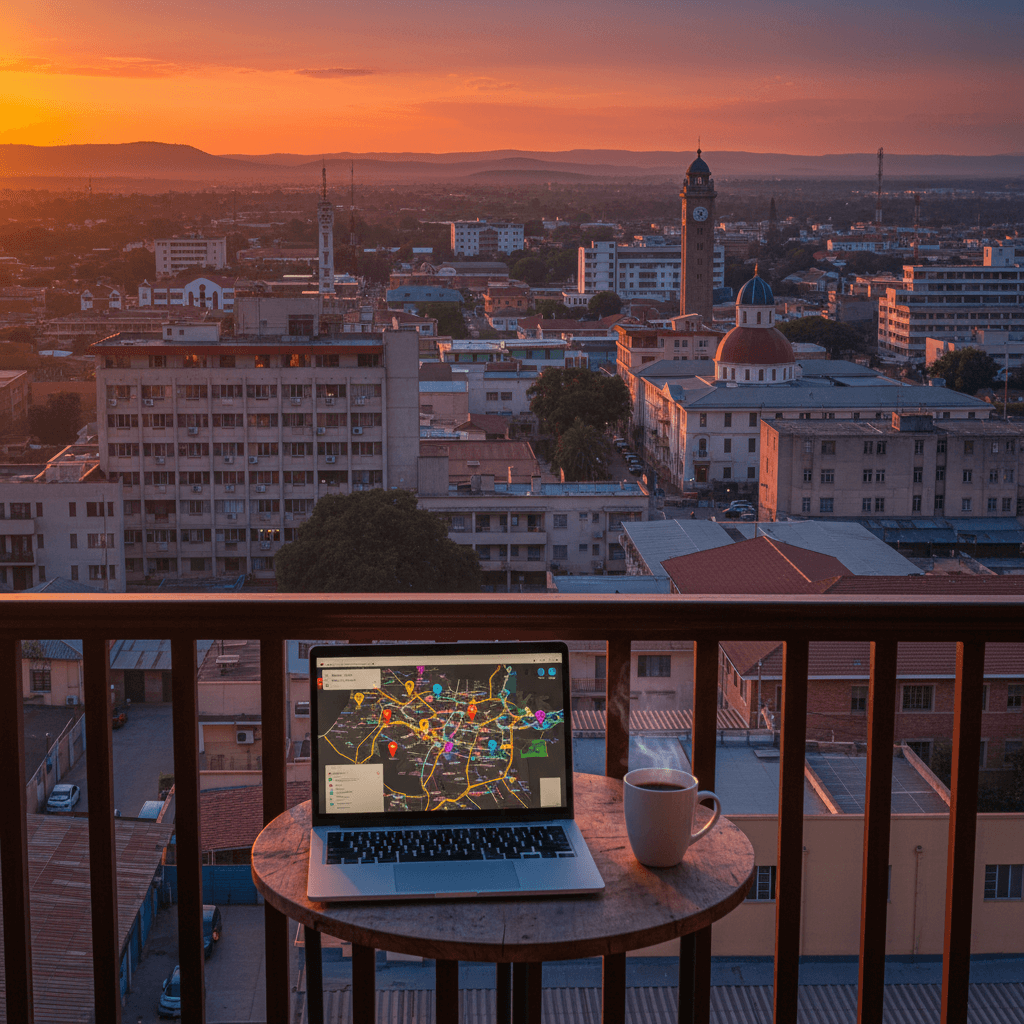
Bulawayo
🇿🇼 Zimbabwe
Bulawayo moves at its own pace. It's Zimbabwe's second city, but it doesn't feel like it's competing with anyone and that's honestly its whole appeal. While Harare hums with political noise and commercial urgency, Bulawayo just gets on with things, quietly, on wide tree-lined streets with almost no traffic.
The city's Art Deco bones give the CBD a faded grandeur that's genuinely striking. Walking through the center, you get the smell of street braai smoke mixing with diesel from the kombis, the low rumble of minibuses calling out stops and the occasional burst of Ndebele from a shopkeeper greeting a regular. It's unhurried in a way that takes a few days to stop feeling strange.
Most nomads who land here weren't planning to stay long, turns out many end up extending. The cost of living is low, locals are warm without being performative about it and the streets in neighborhoods like Famona and Hillside are walkable enough that you don't need a car for daily life. Expats tend to cluster in Khumalo and Burnside for the space and quiet, but those suburbs can feel a bit isolated if you're solo.
The tradeoffs are real, though. Internet is, honestly, the city's biggest frustration, 5 to 20 Mbps on 4G on a decent day and power cuts happen without warning, so a backup battery or UPS isn't optional, it's just the reality. Dedicated coworking is thin on the ground; Innovation Hub and The Bounge exist, but many nomads end up working from Indaba Book Cafe on Josiah Tongogara Avenue, which does good coffee and doesn't rush you.
What makes Bulawayo different from other African nomad spots isn't one big thing, it's the accumulation of small ones. Matobo Hills is 30-40 minutes away, a genuinely extraordinary landscape of ancient rock formations and white rhinos. The art scene punches above its weight. And there's a low-key civic pride here, people care about this city, it shows in how they talk about it.
It's not for everyone. If you need fast fiber, a buzzing expat scene and reliable everything, Bulawayo will frustrate you. But if you can work with its quirks, it rewards patience in ways most cities don't bother to.
Bulawayo is, honestly, one of the more affordable cities you'll find in southern Africa. Most nomads land somewhere between $600 and $900 a month and that's a comfortable life, not a spartan one. Drop below $600 and you're eating local, taking kombis everywhere and watching your data closely. Push past $900 and you've got a furnished apartment in Famona or Hillside, reliable mobile data and enough left over for weekend trips to Matobo Hills.
Rent is the biggest variable. A one-bedroom in the city center runs around $180 a month; push out to the suburbs and that drops closer to $108. Studios in Famona or the CBD sit in the $100 to $200 range and they're generally decent, though load-shedding means you'll want to ask about backup power before you sign anything.
- Rent (1BR, city center): ~$180/month
- Rent (outskirts/suburbs): ~$108/month
- Street food or fast food: $4 to $5 per meal
- Mid-range dinner for two: ~$30
- Local kombi ticket: $0.50
- Monthly transport pass: ~$30
- Taxi (8km): ~$19
- Home internet (50Mbps+): ~$24/month
- Mobile data bundle (1 to 5GB): $5 to $20
Food is cheap if you eat like a local. Sadza and grilled meat from a street stall will run you $3 to $5, it fills you up and turns out it's genuinely good. Indaba Book Cafe on Josiah Tongogara Avenue is the go-to for breakfast and coffee, popular with expats and locals alike, though it's not exactly street-food pricing.
Coworking is, weirdly, the city's weakest point. Dedicated spaces like MybizSpace start at $100, but most nomads frankly just end up working from cafes at $3 to $5 a day. It works, though it's not ideal for long calls or focus-heavy days.
USD cash is king here. ATMs at CBZ and Stanbic dispense dollars, EcoCash handles mobile payments, but carry physical cash for anything outside the main commercial areas. Budget carefully the first month, the city's cheap but the gaps in infrastructure add up quietly.
For Digital Nomads: Famona and Hillside
Famona is, honestly, the default choice for most nomads landing in Bulawayo for the first time. It's close to the CBD, walkable on good days and studios run $100-200 a month, which is hard to argue with. The streets smell like red dust and charcoal smoke in the evenings, there's a rhythm to it that feels lived-in rather than transient.
Hillside is the quieter alternative. Lush, leafy, genuinely calm. You won't find a coworking space on your doorstep in either neighborhood, so most nomads end up at Indaba Book Cafe on Josiah Tongogara Avenue for morning coffee and a semi-reliable connection. Budget $3-5 a day for that setup and keep your Econet SIM topped up as a backup because the cafe Wi-Fi will disappoint you eventually.
For Expats: Burnside
Burnside is the prestige pick. Large plots, tree-lined streets, serious privacy, the kind of neighborhood where the houses have names instead of numbers. Rent climbs to $400 and up, which stings compared to the rest of the city and commercial spots are thin on the ground so you're driving for most errands.
Expats with corporate packages or remote incomes that travel well tend to cluster here. It's quiet in a way that, turns out, you either love or find suffocating within a month.
For Families: Khumalo
Khumalo is the family neighborhood. Full stop. Schools nearby, spacious homes, a peaceful feel that holds up even on weekdays. Rent runs $300 and above and buying sits around $120,000, so it's not cheap, but you're getting wide streets and actual green space in exchange.
The trade-off is that Khumalo sits a bit further from the city center, so you're relying on kombis at $0.50 a ride or ride-hailing apps like QuickDrive for daily movement. Most families find that, weirdly, the low traffic makes the distance feel shorter than it looks on a map.
Quick Comparison
- Famona: $100-200/month rent, walkable, best CBD access
- Hillside: $150-250/month rent, quiet, suburban, green
- Burnside: $400+/month rent, upscale, private, car-dependent
- Khumalo: $300+/month rent, family-friendly, near schools
Bulawayo's internet situation is, honestly, the thing most nomads complain about first. 4G/LTE through Econet (the best carrier in town) runs 5-20Mbps depending on the day, the weather and seemingly the mood of the universe. That's workable for email and video calls, not great for uploading large files or anything that demands consistent throughput.
Home fibre is available and surprisingly affordable at around $24/month for 50Mbps+, so if you're staying longer than a few weeks, getting a fixed line sorted is worth the hassle. Power outages are the bigger problem, they'll cut your connection mid-call with zero warning, so a power bank and a strong mobile data backup plan aren't optional.
For SIMs, go straight to Econet. Pick one up at the airport or any city branch for $1-2 (bring your passport), then load a data bundle. Around $20 gets you 30GB, which goes further than you'd think given the speeds. Telecel and NetOne exist, turns out their coverage in Bulawayo is noticeably patchier, so don't bother.
The dedicated coworking scene is thin. Genuinely thin. A few options do exist:
- The TechVillage: A central hub for the local tech community and startups.
- The Oasis: A creative and collaborative space with a relaxed atmosphere.
- MybizSpace: The most formal option, offering professional office setups.
Most nomads skip the coworking spaces entirely and just work from cafes, the costs are lower and the coffee is better. Indaba Book Cafe on Josiah Tongogara Avenue is the go-to spot, good wifi, decent breakfast and a quiet enough atmosphere that you can actually think. Budget $3-5 for a day's worth of coffee and you're set.
Famona and the CBD are your best bets for cafe-working proximity, walkable streets, less traffic noise bleeding through the windows. Hillside works too if you're based there, it's quieter, though you'll need a taxi or kombi to reach most spots.
Bottom line: Bulawayo won't win any awards for digital infrastructure, it's a city that rewards patience and preparation. Get Econet, find a backup power source and claim a corner table at Indaba. You'll manage fine.
Bulawayo is, honestly, one of the safer cities in Zimbabwe, but that doesn't mean you switch your brain off. Petty crime is the main concern: pickpocketing in busy markets, the occasional mugging near quieter streets after dark. Stick to well-lit areas at night, don't flash expensive gear and avoid wandering through parks alone once the sun drops. Tourist areas are generally fine, most travelers move around without incident, but solo night walks are just not worth the risk.
Protests flare up occasionally and can turn unpredictable fast, so if you see a crowd gathering with any political energy, walk the other way. That's not paranoia, that's just good sense.
Emergency numbers to save immediately:
- Police: 995
- Ambulance: 993
- United Bulawayo Hospitals: +263 29 2252111 (handles emergency, trauma, orthopaedics)
Healthcare is where things get complicated. United Bulawayo Hospitals covers emergencies and can handle trauma reasonably well, private clinics around the city are fine for minor stuff like infections, stomach issues, the usual travel ailments. But for anything serious, a surgical emergency or a condition needing specialist care, you're looking at evacuation to South Africa. That's not a maybe, that's the standard expectation. Get travel insurance that covers medical evacuation before you land, not after.
Pharmacies are easy to find. City Pharmacy sits at the corner of 8th Ave and Josiah Tongogara, Emergency Chemist is on Robert Mugabe Way if you need something outside normal hours. Basic medications are available and cheap, though specialized prescriptions can be hit or miss, so bring a solid supply of anything you depend on regularly.
Malaria risk in Bulawayo itself is low compared to northern Zimbabwe, it's drier and higher altitude here, but if you're heading out to Matobo Hills or anywhere rural, take precautions. Mosquito repellent, long sleeves at dusk and a chat with your doctor about prophylactics before you travel.
Tap water is, turns out, unreliable for drinking. Locals boil it, most expats just buy bottled. Budget a few dollars a week and don't overthink it.
Bulawayo is, honestly, one of the easier African cities to move around in. Traffic is light, the CBD grid is logical and you can walk between most central spots without much hassle. That said, your options beyond walking are a bit limited, so it pays to know what's actually available before you arrive.
Kombis (minibuses) are the city's main public transport. They're $0.50 a ride, they run constantly and they're how most locals get around. Crowded, loud, occasionally driven with alarming confidence, but they work. A monthly pass runs about $30 if you're using them daily.
For anything more comfortable, there are a few ride-hailing apps worth downloading: QuickDrive, Click A Ride and ZimRideZW all operate here. Fares are negotiable and generally cheap, though don't expect the slick Uber experience. It's more informal than that, prices vary and response times can be slow outside the center.
Taxis are the go-to for airport transfers. Joshua Mqabuko Nkomo International is about 20-25km from the city center, so budget $20 to $30 for the ride, it's best to pre-arrange rather than hope for a queue outside arrivals. Most guesthouses and hotels can sort this for you.
Walking is genuinely viable in the CBD and neighborhoods like Famona, the streets are wide, traffic doesn't grind and the Art Deco blocks make it pleasant enough. Suburbs like Hillside and Khumalo are walkable too, though distances between spots stretch out and the sun gets serious by mid-morning. Bike and scooter rentals are, weirdly, almost nonexistent here. Don't count on finding them.
A few practical notes:
- Kombis: $0.50 per ride, $30/month pass. Cash only, exact change preferred.
- Ride-hailing: QuickDrive, Click A Ride, ZimRideZW. Fares negotiable.
- Airport taxi: $20 to $30 for the 20-25km run to the CBD. Pre-book it.
- Walking: Works well in the CBD and Famona. Less practical in outer suburbs.
- Bikes/scooters: Turns out, not really a thing here. Plan around taxis and apps.
Most nomads find they rely on a mix of walking and ride-hailing for daily life, keeping kombis for when they want to move like a local and spend basically nothing.
English is the official language and it's spoken, honestly, by nearly everyone you'll meet in Bulawayo. Shopkeepers, kombi drivers, cafe staff, locals chatting outside the supermarket. You won't struggle.
That said, Ndebele is the dominant local language here and Bulawayo is its heartland. Shona is spoken too, though less so than in Harare. Most conversations you overhear on the street, in markets, between friends at Indaba Book Cafe, will be in Ndebele and it's a warm, rhythmic language that sounds nothing like you'd expect if you're coming in cold.
You don't need to learn Ndebele to get by, but a few words go a long way with locals who appreciate the effort. A simple greeting in Ndebele opens doors in a way that English alone doesn't, it signals respect and people notice. Try these:
- Sawubona , hello (to one person)
- Salibonani , hello (to a group)
- Ngiyabonga , thank you
- Kulungile , it's fine / okay
- Unjani? , how are you?
Shona phrases pop up too, especially in writing and signage. "Mhoro" (hello) and "Ndiri bho" (I'm fine) are worth knowing, they turn up in mixed conversations more than you'd think.
Communication outside of face-to-face is, weirdly, where things get patchier. WhatsApp is the default for everything here, business, social plans, apartment hunting, negotiating with landlords. If someone gives you their contact, assume they mean WhatsApp, not a phone call. Email is used but slowly, don't expect same-day replies.
Google Translate handles Ndebele and Shona reasonably well for written text, less reliably for audio. Download both language packs offline before you arrive, mobile data can cut out at the worst moments and you don't want to be fumbling for signal mid-conversation.
One thing travelers consistently underestimate: Bulawayo locals are, frankly, some of the most patient communicators you'll encounter anywhere. Misunderstandings get sorted with good humor, directions come with genuine effort, nobody makes you feel stupid for not knowing something. That's not a small thing when you're somewhere new.
Bulawayo sits at roughly 1,340 meters above sea level, so the heat never gets as oppressive as you'd expect from a city this far into southern Africa. That said, October is, honestly, brutal. Temperatures push well past 35°C, the air tastes like dust and the sun feels personal. Most travelers who arrive in October leave wishing they'd waited a month.
The dry season runs May through October and that's when you want to be here. Days are clear, skies are wide and blue and the light in the late afternoon is genuinely something. Nights in June and July get cold fast though, dropping to around 8-10°C, so pack a layer you'd actually wear.
The rainy season kicks in around November and runs through April, peaking in December and January when you can expect 13 or more wet days per month. These aren't gentle showers either, they're loud, fast, dramatic thunderstorms that roll in mid-afternoon, dump everything they have and disappear by evening. The rain on corrugated iron rooftops is weirdly satisfying the first few times. By week three, less so.
Here's a rough breakdown of what each period actually means for visitors:
- May to August (peak dry season): Best all-round conditions, cool and clear, Matobo Hills is at its most hikeable, accommodation can book out faster than you'd think.
- September to October (late dry, pre-rains): Still dry but increasingly hot; wildlife is easier to spot near water sources, turns out this is a popular game-viewing window despite the heat.
- November to April (rainy season): Landscapes go green almost overnight, prices drop, crowds thin out considerably; roads to rural areas can get rough after heavy rain.
For most people, June through August is the sweet spot. The weather's cooperative, the air is dry and clean and you're not competing with peak-season crowds. May and September are solid too, they're shoulder months that give you most of the upside without the school-holiday pricing.
If you're planning around Matobo Hills specifically, avoid the height of the rains. The tracks get slippery, some areas close and the whole experience is more frustrating than it needs to be.
USD cash is king here, full stop. ATMs exist (CBZ and Stanbic are your best bets for USD withdrawals), but they run dry without warning, so carry more cash than you think you'll need. EcoCash mobile money is widely accepted at local shops and markets, it's worth setting up early because vendors often don't have change for larger bills.
For a SIM, go straight to Econet. It's got the best coverage in the city and out toward Matobo Hills. A SIM costs $1-2 at airport shops or any Econet outlet, bring your passport and a 30GB data bundle runs around $20. Internet is, honestly, 5-20 Mbps on a good day, which is workable for calls and email but will frustrate you during large uploads or video-heavy days. Home fibre at 50Mbps+ runs about $24/month if you're staying long-term.
Power cuts are real and they're annoying. Load shedding happens unpredictably, so a power bank for your devices isn't optional, it's just part of the routine. Most guesthouses and mid-range apartments have backup generators or inverters, ask specifically before you book.
Getting around is cheap and low-stress. Kombis (minibuses) run for $0.50 a ticket, they're loud and packed but they get you there. For anything more comfortable, the ride-hailing apps QuickDrive, Click A Ride and ZimRideZW all operate here with negotiable fares. A taxi from Joshua Mqabuko Nkomo International Airport to the city center runs $20-30, it's about 20-25km, pre-arrange it or grab one of the apps rather than haggling curbside.
For finding a flat, Property.co.zw and Propertybook.co.zw are the go-to sites. Expect to pay around $180/month for a one-bedroom in the CBD or closer to $300-400 if you want Khumalo or Burnside. Most landlords want USD cash upfront for one to two months.
- Emergency numbers: Police 995, Ambulance 993
- Hospital: United Bulawayo Hospitals for emergencies; private clinics for minor issues
- Pharmacy: City Pharmacy (Cnr 8th Ave and Josiah Tongogara) or Emergency Chemist (86C Robert Mugabe Way)
- Serious medical issues: Evacuate to South Africa, local facilities have real limits
One last thing: greet people properly. A warm hello goes a long way in Bulawayo, locals are friendly and turns out a little effort with basic Ndebele or Shona phrases opens doors faster than anything else will.
Need visa and immigration info for Zimbabwe?
🇿🇼 View Zimbabwe Country GuideEasy Landing
Settle in, no stress