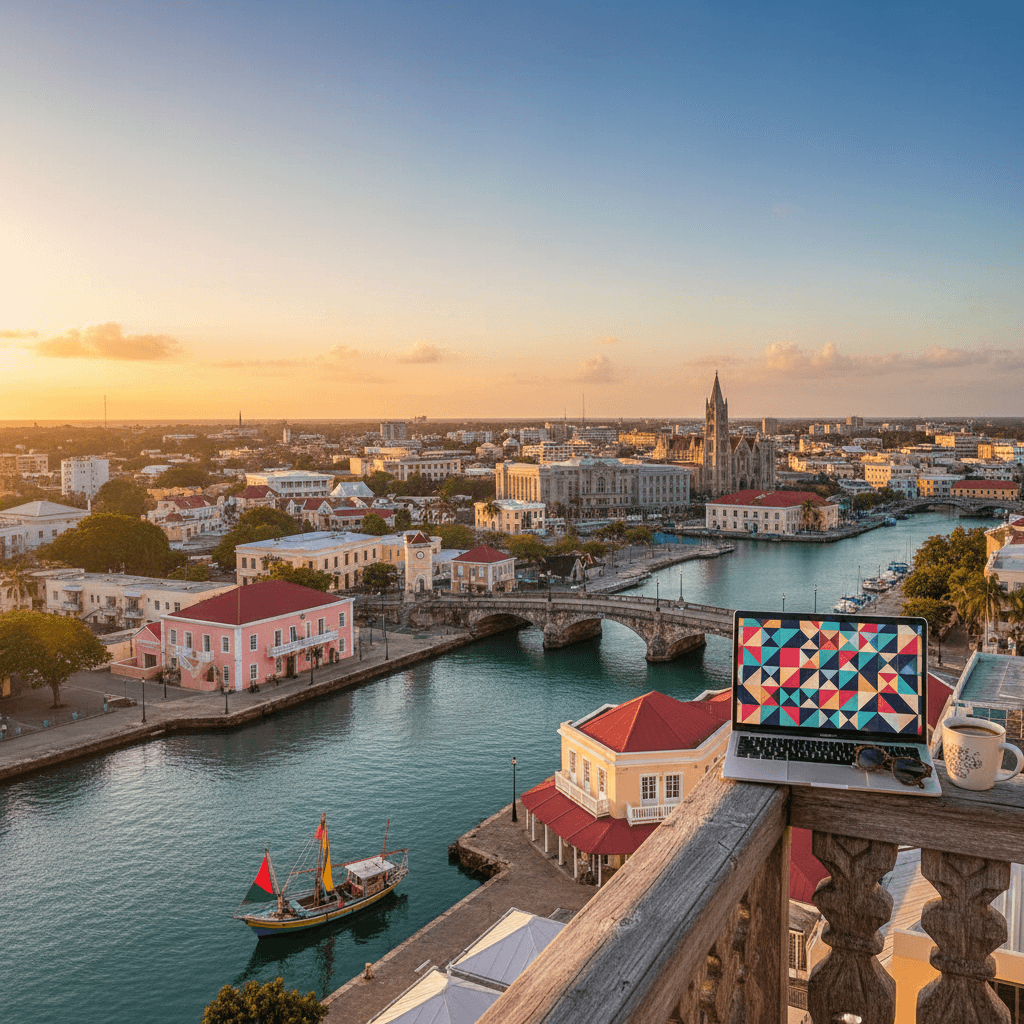
Bridgetown
🇧🇧 Barbados
Bridgetown is, honestly, a place that gets under your skin faster than you'd expect. It's not trying to be Bali or Medellín. It's something quieter and more self-assured, a small Caribbean capital that runs at its own pace and doesn't particularly care if you keep up.
The air hits you first. Thick, warm, salt-heavy, the kind of humidity that makes your shirt stick within ten minutes of stepping outside. Then the sounds: ZR minibuses blaring soca from open windows, vendors calling out near the Careenage, the low crash of the Atlantic somewhere behind the buildings. It's a sensory pile-on, but a pleasant one.
What makes Bridgetown genuinely different from other nomad spots is the layering. British colonial architecture sits a block from rum shops where dominoes slap on wooden tables. The Bajan dialect, turns out, takes real adjustment even for native English speakers. "Wuh gine on?" and "Cheese on bread!" aren't phrases you'll decode on day one and locals find it charming when you try.
The friendliness is real, not performative. Most nomads say the social barrier drops faster here than almost anywhere else in the Caribbean, locals are genuinely curious about who you are and what you're doing there. That said, Bridgetown isn't a party-first destination. The nightlife exists, Harbour Lights and St. Lawrence Gap handle that, but the real draw is slower: morning swims at Carlisle Bay, afternoon work sessions at a cafe with 100+ Mbps WiFi, fish cutters for lunch at BBD 40.
The cost is the honest downside. Budget is a stretch here, mid-range is the realistic floor for most people and monthly expenses typically land between $2,800 and $4,200 USD once rent is factored in. That stings compared to Southeast Asia or Latin America.
Still, what you're paying for is real infrastructure: fast internet, English everywhere, a functioning healthcare system and a Welcome Stamp visa that actually works for remote workers. No language scramble, no bureaucratic nightmare, no power cuts every afternoon.
Bridgetown suits nomads who want stability with a side of rum punch, not chaos with a side of cheap rent. If that trade-off works for you, it's a genuinely good base.
Barbados isn't budget travel. A single nomad spending carefully will still land around $2,000,$2,800 USD a month and if you want a decent apartment in a central neighborhood, that number climbs fast. The Barbadian dollar is pegged to the USD at roughly 2:1, so the math is straightforward, the prices are just genuinely high.
Rent is the main culprit, honestly. A one-bedroom outside the center runs about BBD 2,033 a month (around $1,000 USD), while something in Bridgetown proper or near Carlisle Bay pushes BBD 2,367 or more. Go upscale toward Holetown on the Platinum Coast and you're looking at BBD 4,333 for a three-bedroom, which is expat territory, not nomad territory.
Budget Tier (around $2,000 USD/month)
- Rent: BBD 2,033 for a studio or 1BR outside the center
- Food: Street food like flying fish cutters for BBD 40; cook at home most nights
- Transport: ZR minibuses at BBD 3.50 per ride
- Coworking: Cafe WiFi (Coffee Barbados is reliable and free)
Mid-Range Tier (around $3,000 USD/month)
- Rent: BBD 2,367 for a 1BR in the center
- Food: Mix of street food and sit-down meals; dinner for two at a mid-range spot runs BBD 200
- Transport: pickUP or Bolt app for short trips at roughly BBD 12 each
- Coworking: Spaces or Commonworks hot desk at BBD 139/day or BBD 346/month
Comfortable Tier ($4,000+ USD/month)
- Rent: BBD 4,333 for a larger place or west coast apartment
- Food: Upscale dining at places like The Tides runs BBD 100+ per person
- Transport: Pre-booked taxis; airport transfers alone cost BBD 60
Food costs, turns out, vary wildly depending on how you eat. Street food keeps things manageable, groceries are pricey because most of it's imported and eating out regularly will quietly wreck your budget. Mobile data runs about BBD 75 for 10GB through Digicel or Flow, which isn't cheap either.
Most nomads find the mid-range tier realistic for a comfortable stay, it just requires being honest about what you're walking into. Barbados rewards people who plan for the cost, not people who assume Caribbean means affordable.
Bridgetown doesn't have one neighborhood that works for everyone, it has four distinct zones that each suit a different kind of stay. Pick the wrong one and you'll spend your whole trip in a taxi.
Nomads: Bridgetown Center
The capital itself is, honestly, the most practical base for remote workers. Coworking at Commonworks or Spaces in Warrens is a short ride away, the ZR minibuses run constantly and you're close to Carlisle Bay when you need to decompress between calls. Modern apartments outside the center run around BBD 2,033 a month, which is the budget-friendly end of what's available here.
Petty theft does happen, don't wander unlit side streets at night. Stick to populated areas and you'll be fine most of the time.
Solo Travelers: St. Lawrence Gap
The Gap is loud. Friday nights smell like fried fish and spilled rum, the music from Harbour Lights carries until well past midnight and that's exactly why solo travelers love it. Restaurants, beach bars and food trucks are all within walking distance, which means you're never stuck somewhere dull.
It's touristy, turns out that's not always a bad thing when you're trying to meet people quickly. Rentals here command a premium because of the location, budget for it or look slightly inland.
Expats: Holetown and Speightstown
The Platinum Coast is where long-term expats land when cost isn't the main concern. Holetown is polished, safe and has a strong international community with good grocery options and private healthcare nearby. Speightstown is quieter and, weirdly, more charming for it.
Very expensive. A 1BR in the center here can push well past BBD 4,000 a month and upscale dining at places like The Tides adds up fast. Come here knowing that.
Families: Worthing and Hastings
Worthing and Hastings sit on the south coast between the chaos of The Gap and the expense of the west, which makes them genuinely good middle-ground options for families or anyone wanting a slower pace without total isolation. There's an established expat scene, mid-range restaurants and calm beach access.
It's less urban than Bridgetown center, so if you need coworking daily you'll want reliable transport sorted before you commit to a lease here.
Connectivity in Barbados is, honestly, better than most Caribbean islands. Speeds average 71 to 193 Mbps on a decent connection, which is more than enough for video calls, large uploads or whatever else your workflow demands. Mobile data is solid too, Digicel offers 4G coverage across most of the island with fiber bundles pushing 400 Mbps in some areas.
For SIMs, pick up a Digicel or Flow card at the airport or any high street store, you'll need your passport. Around BBD 75 gets you roughly 10GB of mobile data per month, which is fine as a backup but you wouldn't want to rely on it as your primary connection. Holafly eSIMs work if you want something sorted before you land.
Coworking Spaces
- Spaces/Regus (Bridgetown and Warrens): The most established option on the island. Hot desks run BBD 38 to 139 per day depending on the location and package; a dedicated hot desk membership comes in around BBD 346 per month. The Warrens location is quieter and slightly more professional in feel.
- Commonworks (Historic Bridgetown): Smaller, more community-oriented and sits right in the UNESCO-listed historic district. Good for nomads who want a bit of atmosphere with their productivity.
- Cafes: Coffee Barbados gets mentioned constantly by nomads for its reliable free WiFi and decent espresso. It's not a coworking space, but it functions like one most mornings.
The coworking scene here is, turns out, pretty thin for a capital city. Two real options isn't a lot, so most nomads end up mixing between a monthly Spaces membership and cafe mornings to keep costs down and avoid cabin fever.
Day passes at BBD 139 add up fast. If you're staying more than two weeks, the monthly hot desk at BBD 346 makes more financial sense, even if you don't use it every day.
One practical note: power outages happen, weirdly more often than the infrastructure would suggest. A lightweight UPS or a fully charged laptop battery before heading out isn't paranoia, it's just smart. Most coworking spaces have backup power, most cafes don't.
Barbados is, honestly, one of the safer Caribbean islands for travelers and nomads. The safety index sits around 58/100, which sounds middling but translates to a pretty relaxed day-to-day reality if you're sticking to populated areas. Petty crime picks up during tourist season, mostly pickpocketing around Bridgetown's busier streets, so don't flash expensive gear at the Careenage or leave bags unattended on Carlisle Bay beach.
The parts that catch people off guard are the outskirts. Isolated stretches of road after dark in Bridgetown's edges are genuinely sketchy, most nomads learn this the hard way after one uncomfortable walk back from a bar. Stick to licensed taxis or the pickUP app at night, it's not worth saving BBD 10 to feel unsafe.
A few habits that actually matter:
- Taxis: Use licensed cabs or pickUP Barbados. Unmarked cars aren't regulated and fares become a negotiation you don't want.
- Beaches: Carlisle Bay and the south coast are fine. Quiet, unlit beaches on the outskirts at night aren't.
- Valuables: Leave the laptop at home when you're bar-hopping in St. Lawrence Gap. It's lively there, it's also touristy and bags disappear.
- General vibe: Daytime in Bridgetown and the south coast feels safe and easy. Standard awareness is enough.
Healthcare is adequate, not exceptional. Queen Elizabeth Hospital is the main public facility, expect longer waits and a system that feels stretched. Bayview Hospital is the private option and significantly better for non-emergencies, but you're paying out of pocket and cash is often expected upfront. Every parish has a polyclinic for minor issues, which is genuinely useful for something like an ear infection or a skin reaction from the sun.
Travel insurance is non-negotiable here. Turns out, even a basic ER visit at a private facility can run several hundred USD and Queen Elizabeth's wait times make it a poor option if you're actually sick rather than just inconvenienced. Get coverage that includes medical evacuation before you land.
Overall, Barbados doesn't require paranoia. It requires the same common sense you'd apply anywhere: don't wander alone at 2am in unfamiliar areas, keep your phone in your pocket and have a plan for medical care before you need it.
Getting around Bridgetown is, honestly, easier than most Caribbean capitals. The public transport system runs on ZR minibuses (the small white vans you'll hear before you see them, music thumping, horn blaring at every stop) and larger blue government buses, both costing BBD 3.50 flat anywhere on the island. Bus 27 from the airport gets you to the city center in about 35 minutes, which is the obvious budget move on arrival.
The center of Bridgetown and St. Lawrence Gap are walkable, you won't need a vehicle for daily errands if you're based there. The south coast has bike and scooter rentals too and that's genuinely the most enjoyable way to move between beaches on a dry afternoon.
For anything faster or later at night, ride-hailing works well here. Uber operates, but most nomads and expats recommend the pickUP Barbados app instead, it's local, drivers know the roads and short trips run around BBD 12. Bolt is also available. Pre-book your airport taxi though, turns out showing up and haggling doesn't go well and a licensed taxi from the airport to the city runs about BBD 60, that's the standard rate, not a tourist markup.
A few practical points worth knowing before you go:
- ZR minibuses: BBD 3.50 flat fare, routes are numbered, frequent during the day but thin out after dark
- Government buses: Same fare, more reliable schedules, less chaotic than ZRs
- Ride-hailing (pickUP/Uber/Bolt): ~BBD 12 for short trips, best for evenings
- Licensed airport taxi: BBD 60 to city center, pre-book to avoid stress
- Bike and scooter rentals: Available on the south coast, good for beach-hopping
Skip renting a car unless you're planning regular day trips to Bathsheba or the east coast, parking in Bridgetown is a genuine headache and fuel isn't cheap. For the Oistins fish fry on a Friday night, a ZR from the city gets you there for pocket change, which is weirdly satisfying when everything else on this island costs a small fortune.
English is the official language, so you won't hit a communication wall here. That said, Bajans speak their own dialect and it can genuinely throw you off at first, especially when someone's talking fast over the sound of a ZR bus rattling past.
Bajan dialect is, honestly, a mix of English structure with West African rhythms and its own vocabulary that doesn't always map to anything you'd recognize. A few phrases come up constantly:
- "Wuh gine on?" What's going on? Standard greeting.
- "Ga so." Go that way. You'll hear this giving or getting directions.
- "Cheese on bread!" An exclamation of surprise, roughly "oh my god."
Most locals switch naturally toward standard English when they're talking to visitors, so day-to-day errands, coworking spaces, restaurants, none of it requires any translation. The dialect is more prominent in casual street conversation and among older Bajans outside the tourist areas.
Google Translate won't help you much with Bajan, it's not a recognized input language, so your best tool is just paying attention and asking people to repeat themselves. Nobody minds. Bajans are, turns out, genuinely patient with confused visitors and asking someone to explain a phrase usually leads to a five-minute conversation and a recommendation for somewhere to eat.
Written communication is fully standard English. Signs, menus, government forms, bank documents: all clear. Phone and WhatsApp are the dominant communication tools locally and most landlords, coworking contacts and service providers expect you to reach out that way rather than by email.
A few things worth knowing about communication culture specifically:
- Greetings matter. Walking into a shop and going straight to your question without saying "good morning" first reads as rude, not efficient.
- Pace is slower. Don't expect immediate replies or rapid-fire back-and-forth, it's just not the local style.
- Directness is fine. Bajans are friendly but not vague, they'll tell you straight if something isn't possible.
Honestly, the language side of Bridgetown is one of the easier adjustments you'll make, the dialect is charming once your ear adjusts and the warmth behind it makes the learning curve feel pretty short.
Barbados sits in the southeastern Caribbean, which means it's, honestly, less hurricane-prone than most of its neighbors. That doesn't mean you're off the hook entirely, but the island dodges the worst of the Atlantic storm track more often than not.
The temperature barely moves year-round, hovering between 26-29°C (79-84°F) regardless of the month. What does move is the humidity and in the rainy season it clings to everything. Your clothes, your laptop bag, the walls of your apartment. You get used to it, most nomads do, but don't expect to feel dry in September.
Dry Season: December to May
This is the sweet spot. Rainfall drops to 34-60mm per month between February and April, the trade winds keep things bearable and the beaches are genuinely pleasant rather than just tolerable. December and January get busy with tourists, so expect higher short-term rental prices and more competition for good coworking spots, but the weather makes it worth the trade-off if you can swing the budget.
Rainy Season: June to November
Rain peaks in September at around 175mm and the showers are the heavy, sudden kind that soak you in thirty seconds flat, then stop. August through November is also hurricane season, though Barbados sits far enough east that direct hits are rare, they're not impossible. Travel insurance isn't optional during these months, it's just common sense.
The upside? Prices drop noticeably, the tourist crowds thin out and the island feels more like itself. Locals are friendlier when they're not navigating peak-season foot traffic and you'll find better deals on monthly rentals without much negotiation.
Month-by-Month Snapshot
- Jan to May: 26-27°C, 34-61mm rainfall, dry and breezy
- Jun to Nov: 28-29°C, 87-175mm rainfall, humid with afternoon downpours
- Dec: 27°C, 46mm, shoulder season with improving conditions
Skip August and September if heat and rain genuinely bother you, turns out most nomads who leave do so in those two months specifically. If you're flexible, arriving in late November catches the tail end of low-season pricing with noticeably drier days already settling in.
Barbados runs on the Barbadian dollar, pegged at 2 BBD to 1 USD, so the math is always easy. ATMs are everywhere in Bridgetown; pull out BBD 1,000 at a time to avoid repeat fees, most machines accept Visa and Mastercard without issue. Wise works well here for transfers, Canadian banks have a solid presence on the island and you won't struggle to find a branch.
For a SIM, head to a Digicel or Flow store with your passport. Around BBD 75 gets you roughly 10GB of mobile data, which is honestly enough for backup coverage when you're not on WiFi. If you'd rather skip the errand, Holafly sells eSIMs before you fly, it's not the cheapest option but it works from the moment you land.
Finding an apartment takes a little patience. Airbnb covers the short-term end, but for stays longer than a month, Facebook Marketplace and local expat groups are where the real listings live. Rents aren't cheap, a 1BR in central Bridgetown runs around BBD 2,367 a month, so budget accordingly before you commit to anything.
Getting around is straightforward once you know the system. The ZR minibuses cost BBD 3.50 flat and go almost everywhere, they're loud and fast and the drivers know every shortcut. For anything more comfortable, download the pickUP Barbados app; most expats prefer it over flagging taxis because the pricing is upfront and you're not haggling at the curb. Airport transfers by taxi run about BBD 60, pre-book one.
A few customs worth knowing before you settle in:
- Greetings: Say hello when you walk into a shop or pass someone on the street. Not doing so reads as rude, turns out locals notice immediately.
- Tipping: 10% is standard at restaurants, don't skip it.
- Dress: Cover up when visiting churches or inland villages, beachwear stays at the beach.
- Dialect: Bajan English is thick at first. "Wuh gine on?" means what's up, "Cheese on bread!" is weirdly the local version of oh my god. You'll catch on fast.
The Welcome Stamp visa is worth applying for if you're planning a stay longer than the standard 90-day tourist entry. It's designed for remote workers and frankly, it removes a lot of uncertainty about overstaying.
Need visa and immigration info for Barbados?
🇧🇧 View Barbados Country GuideEasy Landing
Settle in, no stress