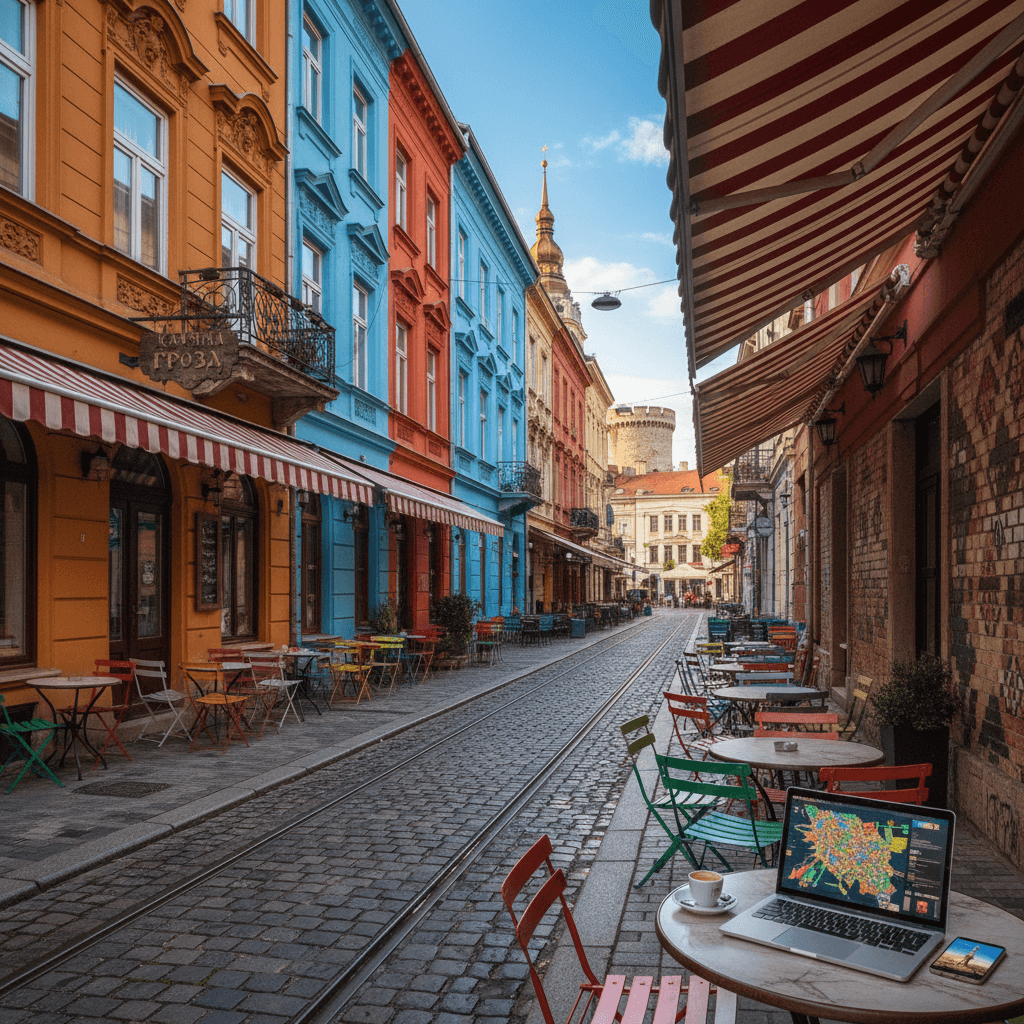
Belgrade
🇷🇸 Serbia
Belgrade doesn't ease you in gently. You step out of the airport and immediately there's horns, cigarette smoke drifting from every café doorway and a city that moves at whatever pace it feels like that day, which could be frantic or completely stopped depending on nothing in particular. It's chaotic in a way that's honestly hard to explain until you've sat in a kafana for three hours because nobody brought the check and nobody seemed to care, including you.
That's the city's strange power. Belgrade has a post-war resilience that you feel more than see, a grit underneath the cheap beer and riverside party boats that makes other European capitals feel a little soft by comparison. Nomads who click with it tend to stay longer than planned, those who don't leave after two weeks frustrated by the smoking, the pollution and the sense that infrastructure is always one step behind.
The cost is, turns out, the main draw for most people. A comfortable mid-range life runs around $2,500 a month, covering a one-bedroom in Dorcol, daily café lunches, coworking at Smart Office and a nightlife budget that'd be laughable in Lisbon or Berlin. Budget travelers can push it down to $1,500, though apartment quality at that price point is genuinely variable, think communist-era concrete with intermittent hot water.
Winters are brutal. Not just cold (January averages around 3°C) but grey and polluted, the air quality index regularly hitting levels that make you want to stay inside, which is fine until you remember that inside means cigarette smoke. May through September is when the city makes sense, warm evenings on the Sava, splavovi pumping bass across the water, café terraces packed until 2am on a Tuesday.
English is widely spoken, especially under 40, so you won't struggle to order food or ask directions. Locals are direct, weirdly warm once you get past the initial bluntness and genuinely welcoming to foreigners in a way that doesn't feel performative. The café culture isn't just a lifestyle cliché here, it's frankly the social infrastructure of the city, where business gets done, friendships form and afternoons disappear.
Belgrade rewards patience. It's not polished, it doesn't pretend to be and that's exactly why a certain kind of traveler falls hard for it.
Belgrade is, honestly, one of the most affordable European capitals you can base yourself in right now. That said, "affordable" covers a wide range depending on how you live.
Most nomads land somewhere in the $2,000-$2,500/month range once rent, food, coworking and a social life are factored in. Budget travelers who don't mind shared housing and street food can push that down to $1,500, expats who've figured out the local workarounds often settle around $1,950 and anyone wanting a nice central apartment with upscale dinners a few nights a week should budget $4,000 or more.
Budget Tier (~$1,500/month)
- Rent: $400-600 for a room or studio outside the center
- Food: ~$200 eating street pljeskavica ($5-7 a pop) and cooking at home
- Transport: Free via the Beograd +plus app for buses and trams
- SIM card: ~$11/month with MTS or Yettel
Mid-Range Tier (~$2,500/month)
- Rent: $800-900 for a 1BR in Dorcol or Stari Grad
- Food: ~$400 mixing home cooking with mid-range dinners out
- Coworking: $260-300 at Smart Office or Impact Hub
- Utilities: ~$100, though winter heating bills creep up
Comfortable Tier ($4,000+/month)
- Rent: $1,000+ for a nicer apartment, turns out quality varies wildly in older buildings
- Food: $600+ with regular dinners at places like Ebisu or Corvo Ancora
- Private office: $700+ per month
Eating out is genuinely cheap, a sit-down dinner for two with wine rarely tops $30 at a mid-range spot. Taxis are weirdly affordable too, $3 gets you most crosstown trips via CarGo or Yandex Go.
Where costs sting is coworking. $260-300 a month for a hot desk isn't budget territory, it's comparable to cities with much higher overall costs of living. Apartments are the other variable, communist-era buildings dominate the rental stock and "renovated" can mean anything from genuinely updated to fresh paint over old pipes.
Still, the math works. You're getting a real European capital, not a compromise.
For Digital Nomads: Dorcol and Savamala
Most nomads end up in Dorcol and honestly, it makes sense. The neighborhood's got bohemian cafes where you can nurse a coffee for two hours without anyone bothering you, walkable streets and enough English speakers that daily life doesn't become an exhausting translation exercise. Rent runs higher than the rest of the city, around €520-900 for a 1BR, but you're paying for convenience and a social scene that's genuinely easy to plug into.
Savamala is the grittier alternative. It's artsy, it's cheap, it smells like last night's beer at 10am and it's where the creative crowd gravitates. The coworking options nearby, turns out, are solid too. Smart Office and Impact Hub are both worth a look, with hot desks running around €240-270 a month.
One real frustration: the apartment quality in both neighborhoods is inconsistent. Communist-era builds are common and "renovated" can mean anything.
For Expats: Vracar
Expats who've been in Belgrade a while tend to migrate toward Vracar. It's quieter, greener and has the kind of upscale cafes and museums that make a city feel livable rather than just survivable. Safety's not really a concern here, the streets feel calm and there's a settled neighborhood energy that Dorcol, weirdly, never quite achieves despite its polish.
It's more residential than central, so you won't stumble into nightlife accidentally, which is either a pro or a con depending on your situation.
For Families: Savski Venac
Families consistently point to Savski Venac. Elegant streets, parks, good schools nearby and a pace of life that doesn't feel chaotic. It's farther from the center, so you're more car-dependent, but the tradeoff is space and quiet that's genuinely hard to find closer in.
For Solo Travelers: Stari Grad
Stari Grad is the obvious base for short stays. It's central, it's historic, restaurants and bars are everywhere and you won't need to think too hard about logistics. It gets crowded and touristy, it can feel a little performative, but for a week or two it does the job well. Skip the most obvious spots on Knez Mihailova; the side streets are where Belgrade actually lives.
Belgrade's internet is, honestly, better than you'd expect for a city with this many other infrastructure frustrations. The citywide fixed broadband average is around 86 Mbps, fiber connections run €10-20 a month and most coworking spaces are fast enough for video calls without drama. Cafes are a different story, though: smoky, loud and the wifi is inconsistent enough that you wouldn't want to depend on one for a deadline.
The coworking scene, turns out, is one of Belgrade's genuine strengths. Smart Office is the top pick for most nomads who stay longer than a week, with a solid community and reliable infrastructure. Impact Hub draws a more startup-leaning crowd, ICT Hub skews technical and The Office Belgrade offers flexible pricing around €90 for 40 hours or €150 for full-time monthly access. Hot desks generally run €240-270 a month across the better spaces, private offices jump to €700 and up.
For SIMs, grab an MTS, Yettel or A1 card at any kiosk or the airport, no ID required, plans with 10GB run €10-15. If you're only passing through for a week or two, Holafly or Yesim eSIMs save you the hunt. MTS tends to have the strongest signal in the center, which matters more than you'd think when you're in a basement bar trying to pull up a map.
A few things to plan around:
- Hot desks: €240-270/month at Smart Office or Impact Hub
- Private offices: €700+/month
- The Office Belgrade: €90 for 40 hours, €150 full-time monthly
- SIM cards: €10-15 for 10GB, no ID needed at kiosks
- Home fiber: €10-20/month if you're renting long-term
Working from cafes is doable in Dorcol or Vracar, where the spots are airier and the crowds thinner, but the smoking indoors is a real issue, not a minor annoyance. After a few hours, you'll feel it. Most nomads who stay more than a couple weeks end up getting a coworking membership just to have somewhere they can breathe and think clearly.
The infrastructure isn't perfect. It works, though and for the price, that's a fair trade.
Belgrade is, honestly, pretty safe for a city its size. Petty theft happens, pickpocketing mostly, concentrated around the bus and train stations, Knez Mihailova on busy afternoons and crowded markets. Don't flash expensive gear in those spots and you'll largely be fine. The center feels relaxed, even late at night, though expats recommend avoiding the main bus station area after dark because it gets genuinely sketchy in a way that's hard to describe until you're standing there.
Women traveling solo report mixed experiences. Most days are uneventful, the catcalling is less aggressive than in some regional cities, but it's there. The LGBTQ+ situation is similarly complicated: Belgrade has a Pride parade now, locals under 40 are mostly indifferent, but public affection outside of Savamala or Dorcol can draw unwanted attention. Use your read of the room.
Protests flare occasionally, usually near the Assembly building in Stari Grad, they're rarely violent but the crowds get dense fast, so check local social media if you see police cordons going up.
Healthcare is a split picture. Private clinics are genuinely good, which is why medical tourists fly in specifically for dental work and cosmetic procedures at a fraction of Western prices. For a nomad who chips a tooth or needs a checkup, private dental care runs roughly $40-80 per visit, no insurance needed, just walk in. Public hospitals are functional but slow and the language barrier is real, most staff won't speak much English. Pharmacies are everywhere, though, usually marked with a green cross and pharmacists are surprisingly helpful for minor issues. Emergency number is 194.
The bigger health concern most nomads don't think about until January: air pollution. Belgrade's annual AQI averages around 65, with winter spikes higher and on cold, windless days the air smells like coal smoke and diesel, it physically sits in your chest. If you're sensitive to air quality, winter here will wear on you.
- Emergency (ambulance): 194
- Police: 192
- Private dental visit: roughly $40-80
- Pharmacies: ubiquitous, green cross signage, no prescription needed for most basics
- Winter AQI: ~65 annual average, worse December through February
Pack a good air quality app. Seriously.
Belgrade's center is walkable, honestly more walkable than most European capitals its size and if you're staying in Dorcol or Stari Grad you can cover a lot of ground on foot. The streets smell like exhaust and fresh burek in roughly equal measure, trams clatter past every few minutes and the general vibe is controlled chaos.
For longer distances, public transit is free if you use the Beograd +plus app, which covers buses, trams and trolleybuses across the city. Coverage isn't great outside the center, though and the routes can be confusing when you're new. Most nomads figure it out within a week, then mostly walk anyway.
Taxis are cheap. Seriously cheap. Skip the street cabs entirely and use CarGo or Yandex Go instead; rides across town typically run €3-6 and the airport to center is €12-25 depending on traffic and surge. Street taxis will quote you a flat rate, it's almost always a rip-off, don't bother.
For the airport specifically, Bus 72 exists and it's slow, bumpy and stops roughly everywhere between here and eternity. A private transfer is, turns out, worth every euro when you're hauling luggage.
Bikes and scooters are limited. There's no mature bike-share system and drivers don't exactly yield, so cycling here takes some nerve. Most people don't bother.
Getting Around: Quick Reference
- Walking: Best option in Dorcol, Stari Grad, Savamala; center is compact
- Public transit: Free via Beograd +plus app; buses, trams, trolleybuses; patchy coverage
- Ride-hailing: CarGo or Yandex Go; €3-6 city rides, €12-25 airport run
- Airport bus: Bus 72; cheap, very slow, fine for solo light travel
- Private transfer: €20-25; worth it with luggage or an early flight
- Bikes/scooters: Limited infrastructure; not recommended unless you're comfortable in aggressive traffic
One thing that catches people off guard: traffic in Belgrade is genuinely aggressive, horns going constantly, pedestrian crossings treated as suggestions. You adapt fast, it just takes a few near-misses to recalibrate your street-crossing instincts.
Serbian is the official language, written in both Cyrillic and Latin scripts and you'll see both on street signs, menus and storefronts. Don't stress about learning Cyrillic before you arrive, it's genuinely helpful but not required to get around.
Belgrade's English proficiency is, honestly, impressive for a city its size. It ranks among the top 15 countries globally for English fluency and in Belgrade specifically, anyone under 40 tends to speak it comfortably, sometimes very well. Café staff, coworking receptionists, Airbnb hosts, most of them will switch to English without hesitation, you won't feel like you're constantly miming your way through interactions.
Older residents are a different story. Taxi drivers over 50, market vendors, pharmacists in quieter neighborhoods, expect more friction there. Google Translate handles the gap fine, though the camera translation feature is what you'll actually use most, turns out pointing your phone at a Cyrillic menu is faster than typing anything out.
A few words go a long way socially. Locals notice the effort, even if it's minimal:
- Hvala: Thank you
- Molim: Please (also used for "you're welcome")
- Izvinite: Excuse me / Sorry
- Gdje je...?: Where is...?
- Jedan, dva, tri: One, two, three (useful at markets)
Communication style in Belgrade is direct. Frankly, blunt by some standards. Don't read curtness as rudeness, that's just how conversations tend to go, especially in shops or with older locals. Smiling first and saying hvala at the end smooths most interactions considerably.
One topic to avoid entirely: the 1999 NATO bombing. It's not ancient history here, it's still raw for a lot of people and bringing it up casually as a foreigner rarely goes anywhere good.
For day-to-day nomad life, English is more than sufficient in Dorcol, Savamala and Stari Grad. Step outside those neighborhoods and a translation app becomes your best tool. Download Google Translate offline packs for Serbian before you land, airport Wi-Fi is unreliable and you'll want it working the moment you clear customs.
Belgrade has a continental climate, which means proper hot summers and genuinely cold winters. July and August sit between 28 and 32°C (82 to 90°F), the kind of heat that radiates off the pavement and makes afternoon work sessions miserable without AC. January drops to around 3°C (37°F), though the wind off the Danube makes it feel colder than that.
The bigger winter problem, honestly, isn't the cold. It's the air. Belgrade's pollution spikes badly from December through February, a mix of coal heating, traffic and geography that traps smog over the city for days at a stretch. The AQI regularly hits levels that'll have you noticing a faint chemical taste in the back of your throat, it's not dangerous short-term but it's unpleasant and it's one of the main reasons long-term nomads tend to time their stays carefully.
May through September is the sweet spot. Spring brings mild temperatures, the cafe terraces fill back up and the splavovi on the river start their season. June gets the most rain of the warmer months, around 65mm across roughly ten wet days, so pack accordingly, though showers tend to be short and the rest of the day clears up fast.
Month-by-Month Snapshot
- January: 3°C avg high, 49mm rain, heavy pollution, quiet city
- April: 17°C, low rain, terraces reopening, good shoulder value
- June: 26°C, wettest warm month at 65mm, still very livable
- July/August: 29 to 32°C, peak heat, peak nightlife, peak crowds
- October: 18°C, cooling fast, fewer tourists, arguably the nicest month
- December to February: Cold, grey, smoky, best avoided for extended stays
Most nomads land in April or May, turns out that's when the city feels most alive without the summer heat making everything feel like a slog. October is weirdly underrated, the crowds thin out, prices soften slightly and the light over Kalemegdan fortress in the late afternoon is genuinely something.
Skip winter unless you're on a tight budget and don't mind the grey. The savings aren't worth breathing that air for two months straight.
Belgrade runs on cash more than you'd expect, so pull RSD from ATMs rather than exchanging at the airport. Revolut and Wise both work well here and save you on conversion fees, most ATMs dispense around 10,000 RSD (roughly $90) per transaction, which is honestly a bit annoying when you need larger amounts.
For a SIM, grab an MTS, Yettel or A1 card at any kiosk or the airport arrivals hall. No ID required. A 10GB plan runs about €10,15, it'll last most nomads a week or two depending on usage. If you're only here short-term, Holafly eSIMs work fine before you land.
Apartments are cheaper than you think, but the quality varies wildly. Communist-era blocks dominate the market, think cold tile floors, dated plumbing, windows that don't quite seal. Search HaloOglasi for longer stays because Airbnb prices don't reflect what locals actually pay. A decent 1BR in Dorcol or Savamala runs €400,600 per month if you negotiate directly.
Smoking indoors is legal and extremely common. Cafes, bars, some coworking spaces, all fair game. If your lungs or eyes are sensitive, this isn't a minor inconvenience, it's a daily grind that turns out to be the top complaint among nomads who stay longer than a month. Coworking at Smart Office or Impact Hub gives you a cleaner escape, hot desks run around €240,270 per month.
A few cultural things worth knowing before you arrive:
- Tipping: Not expected. Rounding up is fine, nobody's waiting on a 20%.
- Coffee culture: Ordering one coffee and sitting for three hours is completely normal, don't feel rushed.
- Communication style: Direct, sometimes blunt. Don't mistake it for rudeness.
- War topics: Skip anything about 1999. It's still raw for a lot of people.
- Public transport: Free via the Beograd Plus app, weirdly underused by expats who default to CarGo or Yandex Go for rides.
Winter air quality is genuinely bad, AQI regularly hits 100+ from December through February, coal heating and traffic stack up fast. If you're sensitive to pollution, plan your stay between May and September. Summers get hot, 30°C plus, but the splavovi on the river make it bearable.
English proficiency is strong, especially under 40. You won't need Serbian to get by, a few words like hvala (thanks) go a long way though.
Need visa and immigration info for Serbia?
🇷🇸 View Serbia Country GuideEasy Landing
Settle in, no stress