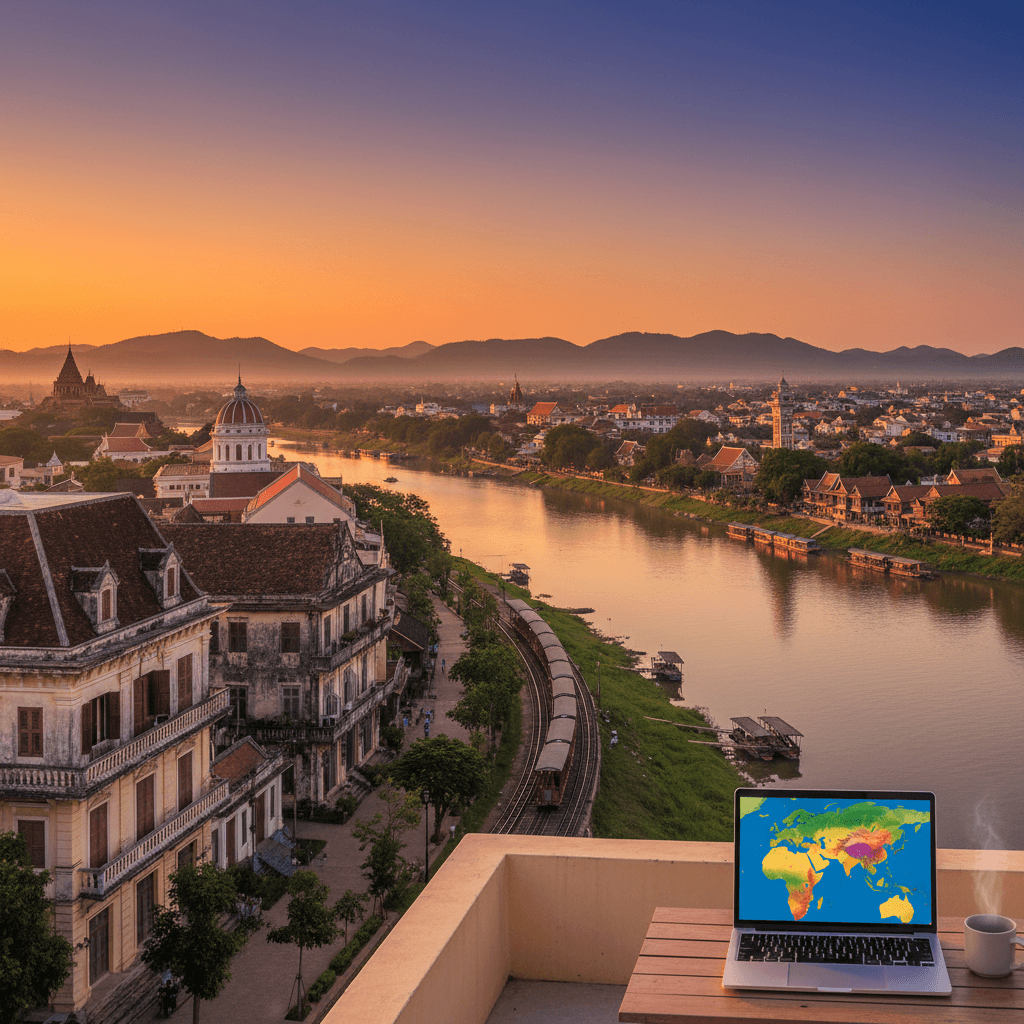
Battambang
🇰🇭 Cambodia
The Low-Slower Alternative
If Phnom Penh is the chaotic heart of Cambodia and Siem Reap is its tourist-heavy playground, Battambang is the soul. It’s the country’s second-largest city, but it feels more like a sprawling riverside town where the 20th century just decided to stop and stay a while. You won't find skyscrapers or high-speed metro lines here. Instead, you get ochre-colored French colonial villas, wide boulevards, and a river that moves as slowly as the local pace of life.
Most nomads arrive here expecting to stay for three days and end up staying for three months. There is a specific creative energy in the air that you won't find elsewhere in Southeast Asia. It’s the kind of place where you spend your mornings working from a quiet cafe and your afternoons cycling past rice paddies to find ancient ruins that don't have ticket booths or crowds. It’s authentic, unpretentious, and deeply Khmer.
The Creative Pulse
The vibe here is defined by its arts scene. This is the home of Phare Ponleu Selpak, a world-class circus and arts school that has turned the city into a magnet for painters, musicians, and performers. You’ll feel this influence in the street art tucked away in alleys and the small galleries scattered around the center. It gives the city a "bohemian" edge without the high prices or pretension usually attached to that label.
Expats often describe the atmosphere as "gentle." People still have time to talk to you, and the local community is incredibly welcoming if you show even a passing interest in the culture. It’s a place for deep focus, long dinners, and a total lack of FOMO.
Cost of Living & Logistics
Living here is remarkably affordable, even by Cambodian standards. A comfortable monthly budget for a nomad usually hovers around $1,060. This covers a decent apartment, plenty of meals out, and your daily caffeine fix. While you can find luxury, the real charm is in the mid-range lifestyle that feels like a steal.
- Studio Apartment: $250 to $450 per month depending on AC and Western amenities.
- Local Meal: $2 to $4 at a market or street stall.
- Western Meal: $7 to $12 at a nice bistro or cafe.
- Monthly Scooter Rental: $60 to $90.
One thing to keep in mind is the "foreigner price." It isn't malicious, but it's common. You’ll likely pay a bit more for a tuk-tuk or at the market than a local would. A polite smile and a little bit of Khmer language go a long way in negotiating a fair rate.
Work and Connectivity
The digital infrastructure is surprisingly solid. You can expect internet speeds around 52 mbps in many guesthouses and cafes. However, the city does struggle with its power grid. Power outages aren't a daily occurrence, but they happen often enough that you should keep your laptop charged and maybe have a local SIM card with a data plan as a backup. Smart and Cellcard are the go-to providers for reliable 4G coverage.
While dedicated coworking spaces are still a developing concept here, the cafe culture is excellent. You’ll find plenty of spots with strong Wi-Fi and comfortable seating where nobody will mind if you camp out with a laptop for a few hours. The lack of a formal "nomad hub" actually makes it easier to integrate with the local community rather than staying in a bubble.
Safety and Health
Battambang is generally very safe. Violent crime is rare, and most expats feel comfortable walking or cycling around at night. Petty theft, like bag snatching, can happen, so just keep your wits about you in crowded areas. The biggest "danger" is usually the traffic or the heat.
Healthcare is the main trade-off for the low cost of living. Local clinics are fine for a cold or a minor scrape, but for anything serious, you’ll likely need to head to Phnom Penh or even Bangkok. Most long-termers carry robust health insurance that includes medical evacuation just in case. It’s a small price to pay for the peace and quiet you get in return.
The Price of the Quiet Life
Battambang is one of those rare places where your dollar stretches remarkably far without forcing you to sacrifice the small comforts of modern nomad life. While it's the second largest city in the country, the prices feel more like a sleepy riverside town. Most digital nomads find they can live comfortably on about $1,062 per month. This budget covers a decent apartment, eating out frequently, and plenty of weekend trips to the surrounding countryside.
One thing you'll learn quickly is that pricing isn't always fixed. Expats recommend getting comfortable with friendly negotiation, especially in the local markets or when hiring a long term tuk tuk driver. There is often a "foreigner price" for the uninitiated, so knowing the local going rates will save you a significant chunk of change over a six month stay.
Housing and Neighborhoods
The rental market is straightforward, but you won't find many high rise condos here. Instead, you'll be looking at renovated colonial villas or modern Khmer style apartments. Most rentals include perks like weekly cleaning and laundry services, and it's surprisingly common for larger expat homes to come with a local cook included in the monthly arrangement.
Wat Kor Area
- Vibe: Traditional, quiet, and upscale. This is where you find the beautiful wooden heritage houses.
- 1BR Apartment: $350 to $500 per month for a high end space.
- Local Meal: $2 to $4 at neighborhood spots.
City Center (Near Phsar Nat)
- Vibe: Right in the heart of the French Quarter, close to cafes and the central market.
- 1BR Apartment: $250 to $400 per month depending on the level of renovation.
- Western Meal: $6 to $10 at popular nomad hangouts.
Daily Expenses and Lifestyle
Your biggest variable will be how often you crave home comforts. Local Khmer dishes like Bai Sach Chrouk or a bowl of noodles will only set you back about $1.50 to $3. If you're heading to spots like Jaan Bai or Choco L'Art Cafe for high quality coffee and fusion food, expect to pay closer to $7 to $12 per person. A local Angkor beer is usually $1 during happy hour, making social life very affordable.
Transportation is another area where costs stay low. A ten minute tuk tuk ride across town usually costs between $2 and $3. For those who want more freedom, renting an e-bike from a shop like Ovelocity costs about $10 per day, though you can usually negotiate a much lower monthly rate if you're staying for the season.
Connectivity and Coworking
While Battambang doesn't have the massive coworking hubs you'll find in Canggu or Chiang Mai, the infrastructure is surprisingly reliable. Most nomads work from cafes or their apartments using fiber connections that average around 52 mbps. Mobile data is incredibly cheap; a local SIM card with a heavy data package rarely costs more than $10 to $15 per month. Just keep a power bank handy, as brief power outages can happen during the peak of the dry season.
A Note on Healthcare
This is the one area where you shouldn't try to save money. Local clinics are fine for a cold or a basic prescription, but they aren't equipped for serious emergencies. Most expats keep a dedicated "evacuation fund" or premium insurance that covers a transfer to Bangkok or Phnom Penh. Budgeting about $50 to $100 a month for a high quality international health insurance policy is a non negotiable expense for most long term residents here.
For Digital Nomads: The Riverside & Central Market
If you're in town to work, you'll want to stay close to the Sangkae River, specifically on the West Bank near the Central Market (Phsar Nath). This is the heart of the city's French Colonial District. It's where the most reliable Wi-Fi lives and where you can walk between cafes without breaking too much of a sweat. While Battambang doesn't have a massive corporate coworking scene, KM Hotel and Choco L'Art Cafe serve as the unofficial hubs for remote workers.
- The Vibe: Walkable, historic, and social. You'll see plenty of other remote workers tucked into corner tables with laptops and iced coffees.
- Internet: Most cafes here clock in around 50 mbps, though power cuts can happen during the rainy season.
- Rent: You can find serviced apartments or boutique guesthouse rooms for $350 to $500 per month.
- Food: You're steps away from Lan Chov Khorko Miteanh (the famous hand-pulled noodle shop) where a solid lunch costs about $2.50.
For Long-Term Expats: Wat Kor & The South
Expats who plan on staying for six months or more usually migrate south toward the Wat Kor Village area. It’s quieter, greener, and feels much more like "real" Cambodia. This neighborhood is famous for its preserved wooden stilt houses and boutique stays like Maisons de Wat Kor. It's far enough from the center to escape the tuk-tuk noise but close enough that a $2 ride gets you back to the bars in five minutes.
- The Vibe: Residential, lush, and peaceful. It’s the place to be if you want a garden and a bit of space between you and your neighbors.
- Rent: Larger traditional houses or modern villas go for $400 to $700. Many of these include a local cook or cleaning services twice a week.
- Local Tip: This area is perfect for those who want to integrate. You'll get to know the local fruit sellers and the monks at the nearby pagodas.
For Families: East Bank (Sangkae District)
Crossing the bridge to the East Bank offers a bit more breathing room and a slightly more local neighborhood feel. It’s home to the Phare Ponleu Selpak circus school, which is a massive draw for families. The streets are wider and there's less traffic than the market side, making it safer for kids. You'll find more gated properties here that offer the security and privacy families usually look for.
- The Vibe: Creative and community-oriented. There’s a strong focus on the arts and education in this pocket of the city.
- Amenities: You're close to the Bambusa restaurant, a favorite for expat families who need a break from street food.
- Rent: Expect to pay $500 to $800 for a three-bedroom house with a yard.
For Solo Travelers: Near 115 Street
If you're traveling solo and want to meet people without staying in a rowdy hostel, the streets around 115 and 121 are your best bet. This area is packed with small galleries, bars like Miss Wong, and social spots like Pomme. It’s the epicenter of the city's nightlife, such as it is, and is very safe for late-night walks back to your room.
- The Vibe: High energy and artistic. It’s easy to strike up a conversation with someone at a gallery opening or over a craft beer.
- Transport: You won't need a scooter here. Everything is within a ten-minute walk. If you do head further out, an e-bike rental from local shops will run you about $10 a day.
- Rent: Guesthouses and "flashpacker" spots are affordable, typically ranging from $15 to $30 per night for a private room.
Connectivity and Speed
Battambang isn't the high-tech hub you'll find in Bangkok or even Phnom Penh, but it holds its own for most remote work needs. You can generally expect download speeds to hover around 52 mbps on a stable connection. Most guesthouses and boutique hotels along the riverfront offer decent Wi-Fi, though it's wise to have a backup plan. The city deals with occasional power outages, particularly during the peak of the dry season when the grid is under pressure. These spikes and dips can knock your router offline for a few minutes or, in worse cases, a few hours.
To stay connected, grab a local SIM card immediately. Smart and Cellcard are the two big players here. Most nomads prefer Smart for its consistent 4G coverage within the city limits. You can pick up a SIM for a few dollars and load it with a data plan for about $10 to $15 a month, giving you more than enough juice to hotspot through a blackout. Just keep your devices charged; when the fans stop spinning, your laptop battery becomes your best friend.
Dedicated Workspaces
The coworking scene in Battambang is intimate rather than industrial. You won't find massive, multi-story tech hubs here. Instead, the community tends to gravitate toward specialized spaces within hotels or quiet cafe corners. It's a focused environment where the coffee is strong and the air conditioning is reliable for those settling in for a longer stint.
For a more relaxed vibe, many expats head to the cafes clustered around the Central Market area and the French Quarter. These spots are used to seeing laptops, provided you're ordering food and drinks. Kinyei Cafe is a legendary local haunt that serves some of the best coffee in Cambodia. It's an open-air social enterprise, so while it lacks AC, the atmosphere and community vibes are top-tier. If you need a cooler environment, Feel Good Coffee is another solid choice with plenty of power outlets and a reliable connection.
The Cafe Office Culture
Working from cafes is the standard operating procedure in Battambang. The pace is slow, and most owners don't mind if you camp out for a few hours. However, the midday heat is real. Between 12:00 PM and 3:00 PM, you'll want to be somewhere with a heavy-duty ceiling fan or a dedicated AC room. Here are a few spots favored by the digital nomad crowd:
- Kinyei Cafe: Great for morning deep-work sessions and meeting other creative types.
- Feel Good Coffee: Reliable AC and a more Western-style cafe menu, perfect for long afternoons.
- Lonely Tree Cafe: Offers a mix of good Wi-Fi and a quiet upstairs area that's usually less crowded.
- Jaan Bai: Excellent for a "working lunch" with high-quality food, though it can get busy during peak dining hours.
One thing to keep in mind is the local "Samyang" or "PassApp" culture for getting around. If you're hopping between cafes, download the PassApp or Grab apps. A quick ride across town to a different workspace usually costs between $1 and $2, making it easy to switch scenery if the Wi-Fi at your first stop starts acting up. Most nomads find that as long as they have a loaded SIM card and a backup battery, the infrastructure is more than enough to manage a full-time remote career while enjoying the slower Khmer lifestyle.
Staying Safe on the Streets
Battambang is one of those rare places where you can actually relax. It lacks the frantic energy of Phnom Penh and the aggressive tourist hustle of Siem Reap. Most nomads find the city incredibly safe, even when walking home after a late dinner. Violent crime against foreigners is practically unheard of here, though you should still keep your wits about you.
The main thing to watch out for is petty theft, specifically bag snatching. This usually happens when someone on a motorbike zooms past a pedestrian or a tuk-tuk and grabs a loose strap. To avoid this, keep your bag on the side away from the road and don't dangle your phone out while checking maps. If you're riding in a tuk-tuk, keep your belongings in the middle of the seat rather than near the open sides.
- Emergency Number: Dial 117 for police, though don't expect English fluency.
- Local Police Station: Located near the riverfront, just south of the Governor's Residence.
- Night Safety: Stick to the well-lit areas near the Central Market and the riverside after 10:00 PM.
The biggest physical danger you'll likely face is the traffic. Cambodian road rules are more like suggestions. If you're renting an e-bike from a spot like Ovelocity for $10 a day, wear a helmet and stay predictable. Intersections can be chaotic, so just follow the lead of the locals and move slowly.
Healthcare and Medical Realities
While the city is charming, the medical infrastructure is basic. You can get treated for a cold, a minor infection, or a small scrape at local clinics, but anything serious requires a trip elsewhere. Expats generally recommend heading to Siem Reap or, ideally, Bangkok for major procedures or complex diagnostics.
For day-to-day needs, pharmacies are everywhere. You'll find that many medications that require a prescription back home are available over the counter here. Always check the expiration dates on the packaging, as some smaller shops aren't great about rotating their stock. For more reliable service, look for pharmacies near the Psar Nat area.
- Emergency Evacuation: This is a non-negotiable. Ensure your insurance covers a flight to Thailand or Singapore.
- Water Safety: Never drink the tap water. Stick to bottled water, which usually costs about $0.50 for a large bottle.
- Vaccinations: Most long-termers stay up to date on Hepatitis A, B, and Typhoid.
If you need a doctor, the Battambang Provincial Referral Hospital is the primary public facility, but it's often crowded and under-resourced. Most expats prefer smaller private practices for initial consultations. If you have a true medical emergency, your first call should be to your insurance provider to coordinate a transfer to a Western-standard facility in a larger city.
Environmental Health
The heat is a real factor here, especially during the dry season when temperatures regularly climb above 35 degrees Celsius. Heat exhaustion can sneak up on you if you're out exploring temples all day. Drink more water than you think you need and take advantage of the afternoon "siesta" hours when the sun is at its peak.
Mosquito-borne illnesses like Dengue fever do occur, particularly during the rainy season. There isn't a vaccine for it, so your best bet is prevention. Use repellent with DEET if you're sitting outside at dusk, and try to stay in accommodation that has screens on the windows or provides mosquito nets.
The Tuk-Tuk Economy
In Battambang, the tuk-tuk is the undisputed king of the road. Unlike the chaotic swarm of Phnom Penh, the drivers here are generally more laid back, though you still need to sharpen your haggling skills. A standard ten minute hop across town usually lands between $2 and $3. Most expats find that establishing a relationship with one or two reliable drivers is better than flagging a random ride every time. If you find someone who knows the backstreets and doesn't overcharge, keep their number on Telegram.
While the Grab app has made inroads in Cambodia, its presence in Battambang is hit or miss compared to the capital. It is worth having on your phone for price benchmarking, but don't be surprised if you're waiting a while for a driver to accept. PassApp is the more common local alternative for on-demand rides, often utilizing the smaller, three wheeled Indian style rickshaws which are slightly cheaper than the traditional pulled carriages.
Pedal Power and Electric Alternatives
The city center is surprisingly compact and flat, making it one of the few places in Cambodia where walking isn't an extreme sport. However, the heat will eventually get to you. For daily errands, many nomads opt for a bicycle. Most guesthouses around the Riverside area rent basic cruisers for about $2 a day, but if you are staying long term, buying a second hand mountain bike at the local market is a smarter play.
- E-Bike Rentals: Companies like Ovelocity are popular for those who want to cover more ground without the noise of a petrol engine. Expect to pay around $10 per day for a well maintained electric bike.
- Scooter Rentals: You can find small 125cc scooters for roughly $7 to $10 per day. Be aware that police occasionally stop foreigners to check for licenses near the market; usually, a small "fine" settles the matter, but it's easier to just wear your helmet and drive slowly.
- The Bamboo Train: While technically a tourist attraction rather than a commute, the Norry is a piece of local transport history. It is a flat wooden platform powered by a small engine that zips along old colonial tracks. It's loud, bumpy, and costs about $5 per person, but it is a rite of passage here.
Regional Connections
Battambang doesn't have a functioning commercial airport, so you will be arriving by land or water. The bus station is a bit of a chaotic hub located just outside the main center. For the trip to Siem Reap or Phnom Penh, most expats avoid the "local" buses which stop every five minutes to pick up chickens or sacks of rice. Instead, look for minivan companies like Virak Buntham or Mekong Express. These are faster, have functioning AC, and usually cost between $10 and $15 depending on the destination.
If you aren't in a rush, the boat from Siem Reap is a legendary, if grueling, way to arrive. It takes anywhere from 5 to 8 hours depending on the water levels of the Sangkae River. It costs about $20 to $25 and offers a front row seat to the floating villages, but the wooden benches will test your patience by hour four. For those who prefer a private experience, a taxi to Siem Reap usually runs about $40 to $50 and takes roughly three hours on the paved highway.
Navigation Tips
Street names in Battambang follow a grid, but locals rarely use the numbers. Most people navigate by landmarks like the Central Market (Phsar Nat), the Sangkae Bridge, or the "Black Statue" (Ta Dumbong). If you tell a driver a street number, expect a blank stare. Pointing at a map on your phone or naming a nearby hotel is much more effective. The city is divided by the river; the west bank is where you'll find the colonial architecture and most cafes, while the east bank is quieter, more residential, and where the cheaper long term rentals are tucked away.
The Khmer Language Barrier
In Battambang, Khmer is the primary language spoken by almost everyone you'll encounter. While the city has a growing arts scene and a steady stream of expats, it hasn't reached the level of English saturation you'll find in Siem Reap or Phnom Penh. Most older locals won't speak much English at all, though you'll find that younger students and hospitality staff at places like Kinyei Cafe or Jaan Bai are quite proficient.
You can get by with English in the central market area and at most expat-leaning establishments, but a few Khmer phrases go a long way here. Locals genuinely appreciate the effort, and it often helps when you're negotiating prices at Phsar Nath. Expect to use a lot of hand gestures and smiles when dealing with older vendors or tuk-tuk drivers who don't frequent the tourist hotels.
Essential Communication Tools
Don't rely on being able to ask for directions in English once you leave the city center. You'll want a local SIM card immediately upon arrival. Most nomads recommend Cellcard or Smart for the best coverage in the Battambang province. You can pick up a SIM for about $2 to $5, and data packages are incredibly cheap, often giving you 20GB or more for around $10 a month.
- Google Translate: The camera feature is a lifesaver for translating menus that aren't in English, though Khmer script can sometimes be tricky for the AI to read.
- PassApp: This is the go-to ride-hailing app in Cambodia. It removes the language barrier entirely for transportation since you pin your destination on the map.
- Telegram: This is the unofficial national communication app. From your landlord to the local water delivery guy, everyone uses Telegram.
Cultural Nuances and Non-Verbal Cues
Communication in Battambang is as much about what you don't say as what you do. The "Sampeah" (placing your palms together in a prayer-like gesture) is the traditional way to greet people. While many men will shake hands with foreigners, a Sampeah accompanied by a slight bow is the most respectful way to greet elders or monks.
Saving face is a major part of the local culture. If you run into an issue with a bill or a service, stay calm and keep a smile on your face. Raising your voice or showing outward frustration is considered a massive social failure and will usually result in the other person shutting down or walking away rather than helping you. A soft-spoken approach gets things done much faster in this part of the country.
Learning the Basics
If you're staying for more than a month, it's worth learning the numbers and basic greetings. Prices in markets are often quoted in Riel for small items or US Dollars for larger ones, and being able to understand "how much" in Khmer can sometimes prevent the "foreigner tax" from being applied. Many long-termers find that taking a few informal lessons from a local tutor helps bridge the gap. You can often find tutors by asking around at Lotus Gallery or checking the community boards at popular cafes.
- Choum Reap Sour: Formal Hello
- Orkun: Thank you
- Bo man: How much?
- Chhnganh: Delicious (perfect for street food stalls)
Living here feels much more "local" than the bigger cities. You'll find that the slower pace of life extends to how people talk. Conversations are rarely rushed, and taking the time to say hello to your neighbors every morning will quickly integrate you into the community.
The Seasonal Rhythm
Battambang follows the classic Southeast Asian tropical cycle, but its inland location means the heat can feel a bit more intense than on the coast. You'll experience two main seasons here: the dry season and the monsoon. While you can visit year-round, the experience changes drastically depending on when you land.
The peak window for most nomads is between November and February. This is the "cool" season, though cool is a relative term in Cambodia. Expect daytime temperatures around 26°C to 30°C (79°F to 86°F) with low humidity and clear blue skies. It is the best time for cycling through the countryside or taking the bamboo train without melting. Since this is the high season, expect slightly higher prices for boutique guesthouses and more travelers in the cafes around the Central Market.
Handling the Heat
If you stay into March, April, and May, prepare for a serious spike in temperature. This is the hottest time of year, with the mercury frequently hitting 35°C to 40°C (95°F to 104°F). The air feels heavy, and the dust from the surrounding farmland can get thick. Most long-termers plan their workdays around the heat, staying in air-conditioned spaces like Kinyei Cafe or Lonely Tree during the afternoon and only venturing out after 5:00 PM when the breeze picks up along the Sangkae River.
The Monsoon Experience
The rains typically arrive in June and last through October. Don't let the "wet season" label scare you off. Usually, it doesn't rain all day. You'll get bright, sunny mornings followed by a massive, dramatic downpour in the late afternoon that lasts an hour or two.
There are some perks to visiting during the monsoon:
- Lush Landscapes: The surrounding rice paddies turn an incredible, electric green that you won't see in the dry season.
- Lower Prices: You can often negotiate better monthly rates on apartments or long-stay hotels.
- Fewer Crowds: You'll have the ancient temples like Wat Banan almost entirely to yourself.
- Cleaner Air: The rain washes away the dust and pollen, making the air quality much better for morning runs.
Key Considerations for Digital Nomads
Power outages are a reality in Battambang, particularly during the peak of the dry season when the electrical grid is stressed by everyone running air conditioning. They also happen during heavy monsoon storms. Most expats recommend having a backup battery for your laptop and a decent data plan on your phone. Smart and Cellcard are the go-to providers; a $10 data SIM will usually get you through a workday if the Wi-Fi drops.
If you are planning a move, keep April in mind. This is when Khmer New Year happens. The city shuts down for several days, prices for transport spike, and you will definitely get soaked in water fights if you step outside. It is a fantastic cultural experience, but a difficult week for hitting deadlines.
For the best balance of manageable weather and social activity, aim for late October or early November. The rain is tapering off, the landscape is still green, and the evening temperatures are perfect for a beer by the riverfront.
Connectivity and Power
Internet speeds in Battambang are surprisingly reliable, often hitting around 52 mbps on fiber connections. While you won't find a massive selection of dedicated coworking spaces like you would in Chiang Mai, most nomads set up shop at Kinyei Cafe or Choco L'Art Cafe. These spots have become unofficial hubs for remote workers who appreciate a quiet atmosphere and strong caffeine.
The real challenge isn't the speed; it's the stability of the grid. Power outages happen, especially during the peak of the dry season when the demand for air conditioning spikes. It is a smart move to keep your laptop charged and have a local SIM card ready for hotspots. Smart and Cellcard are the two main providers expats use. You can pick up a SIM at most small shops for a few dollars, and data packages are incredibly cheap, often costing less than $5 to $10 for a month of heavy usage.
Money and Banking
Cambodia operates on a dual-currency system using US Dollars and Cambodian Riel. For anything over a few dollars, you will likely pay in USD, but you will get your change back in Riel. Most ATMs in town, like those from ABA Bank or Canadia Bank, dispense US currency. ABA is the favorite among expats because their mobile app is excellent and widely accepted for QR payments at local stalls.
Expect to pay a fee of $4 to $6 per withdrawal if you are using a foreign card. To avoid carrying piles of cash, many long-termers open a local account with ABA, which is relatively straightforward if you have a valid business visa. For day-to-day life, keep small denominations on you; trying to break a $50 bill at a street food stall is a quick way to frustrate a vendor.
Getting Around the City
The city is flat and manageable, but the heat makes walking long distances a chore. Tuk-tuks are the lifeblood of local transport. A quick ten-minute zip across town usually costs between $2 and $3. While you can hail them on the street, downloading the PassApp or Grab apps is the best way to ensure you are paying the fair local rate rather than the "tourist price."
For more freedom, many nomads rent e-bikes from Ovelocity for about $10 a day. It is a quiet, eco-friendly way to explore the outskirts without the noise of a petrol engine. If you are planning to stay for a few months, look into renting a small scooter for around $60 to $80 a month. Just be aware that local traffic rules are more like suggestions, so keep your wits about you and always wear a helmet.
Health and Safety
Battambang is generally very safe, and violent crime against foreigners is rare. Petty theft, like bag snatching, can happen occasionally, so don't leave your phone sitting loosely in the front basket of a bicycle. The most common "danger" you will face is likely a stray dog or a rogue pothole after a heavy rain.
Healthcare is where you need to be cautious. While there are local clinics for minor issues like a cold or a small cut, the facilities are not up to international standards for anything serious. For major emergencies, most expats head to Siem Reap or Phnom Penh. It is non-negotiable to have solid travel insurance that covers medical evacuation to Bangkok, as that is the standard procedure for serious medical incidents in this part of the country.
Daily Logistics
Finding an apartment usually happens through word of mouth or local Facebook groups rather than formal listing sites. Many rentals include cleaning and laundry services in the price, which is a massive perk. If you are lucky, your landlord might even have a local cook who can prepare meals for a small extra fee. For groceries, Phsar Nath is the central market where you can get fresh produce, but be prepared to negotiate. Prices aren't always fixed, and as a foreigner, you will often be quoted a higher starting price until you become a familiar face.
Need visa and immigration info for Cambodia?
🇰🇭 View Cambodia Country GuideHidden Gem
Worth the effort