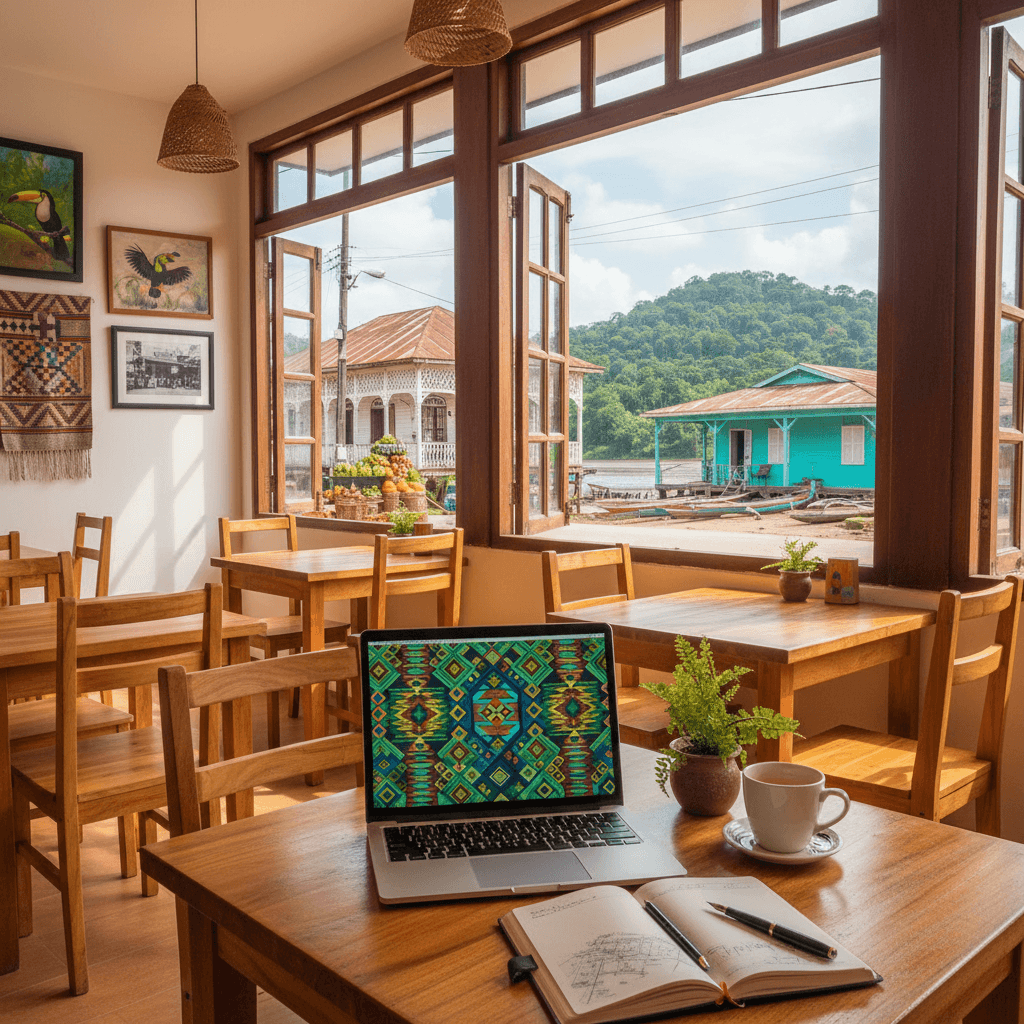
Bartica
🇬🇾 Guyana
The Gateway to the Interior
Bartica isn't your typical digital nomad hub. You won't find minimalist cafes with oat milk lattes or glass-walled coworking spaces here. Instead, you get a raw, frontier energy where the Essequibo and Mazaruni rivers collide. It is a town built on the grit of the gold mining industry, serving as the last stop for those heading deep into the Amazonian rainforest. For the traveler who thrives on "off the grid" authenticity, it’s a fascinating, red-dirt outpost that feels entirely separate from the coastal polish of Georgetown.
The vibe is a unique blend of relaxed riverside living and high-stakes commerce. By day, the town moves to the rhythm of the stelling, the central wharf where speedboats from Parika deposit travelers and supplies. You'll see miners in mud-caked boots rubbing shoulders with market vendors selling fresh river fish and Guyanese soul food. It’s loud, it’s dusty, and the air smells like a mix of diesel and tropical rain, but there is an undeniable warmth in the local hospitality that makes you feel like more than just a tourist.
What to Expect on the Ground
Living here means trading modern infrastructure for pure adventure. Most nomads who venture this far stay for a week or two rather than months. They come for the "red earth" beaches and the proximity to the jungle, using the town as a base to explore BK Falls or kayak through the black-tea colored tributaries. You'll likely spend your afternoons at the wharf restaurants, eating $5 plates of curry or fried fish while watching the river traffic go by.
- The Pros: Incredible natural beauty, a truly immersive local experience, and a much lower cost of living than the capital.
- The Cons: The internet is spotty at best, the roads are rough, and the environmental impact of nearby quarrying can be a jarring sight for eco-conscious travelers.
- The Reality: You’re coming here to disconnect and see a side of South America that hasn't been sanitized for Instagram.
The Neighborhood Breakdown
Bartica is compact enough that "neighborhoods" aren't really a thing. Everything revolves around the Stelling Wharf area. This is the heart of the action where you'll find the gold dealers, the markets, and the most reliable (though still basic) lodging. If you’re staying here, you’re in the thick of it.
Downtown & The Wharf
- Rent: Expect to pay between $200 and $400 for a basic one-bedroom or studio near the center.
- Food: Local market eats cost $3 to $5, while a sit-down meal at a mid-range wharf spot runs about $10.
- Vibe: Chaotic, industrious, and central. It’s the only place to be if you want easy access to transport and supplies.
The Practicalities of River Life
Getting here is half the experience. You’ll take a $15 speedboat ride from Parika, a one-hour dash across the massive Essequibo River. Once you arrive, don't look for Uber. You’ll rely on local taxis, which usually charge around $40 for a round trip to inland sites like the waterfalls. Cash is king here; while there is a Scotia Bank in Parika, ATMs in Bartica can be unreliable, so carry enough Guyanese dollars to cover your stay.
Connectivity is the biggest hurdle for remote work. While Guyana averages 20 to 125 Mbps in the city, Bartica often sits at the lower end of that scale. Most visitors find that a Digicel prepaid SIM with a data bundle is more reliable than hotel Wi-Fi. If you have a deadline, get it done before you leave Georgetown, or use your time here to focus on photography and scouting the wilderness.
The best time to visit is during the dry season from February to April. When the rains hit between May and August, the red dirt turns to thick mud and the rivers rise, making the inland trails much harder to navigate. It’s a tropical, 30°C environment year-round, so pack for humidity and bring a sturdy pair of boots for the backcountry.
The Price of Adventure
Bartica isn't your typical digital nomad hub with high-speed fiber and glass-walled coworking spaces. It's a rugged gateway to the interior, and your budget will reflect that transition from urban convenience to rainforest reality. While Georgetown can easily drain $2,900 a month from your bank account, Bartica is significantly kinder to your wallet if you're willing to live like a local. Expect to spend between $1,200 and $1,800 a month depending on how much you prioritize private transport and imported comforts.
Most travelers find that cash is king here. While you might use apps to book a flight to Ogle or an eSIM through Nomad for about $9.50, the day to day rhythm of Bartica runs on Guyanese Dollars. You'll want to hit the Scotia Bank ATM in Parika before boarding your boat, as local banking options are limited and often unreliable for international cards.
Monthly Budget Tiers
- The Backpacker: $1,200/month. This covers a basic room near the wharf, sticking to street food like fresh fish and local delicacies from the market, and getting everywhere on foot.
- The Mid-Range Nomad: $1,800/month. This gets you a private one bedroom apartment, a mix of market cooking and wharf-side restaurant meals, and regular taxi trips to nearby nature spots.
- The Comfortable Explorer: $2,500/month. At this level, you're paying for air conditioning, guided tours into the Cuyuni-Mazaruni region, and the occasional imported grocery item brought in from the capital.
Housing and Neighborhoods
You won't find sleek apartment listings on mainstream platforms here. Most nomads negotiate short-term stays once they arrive or rely on local guesthouses and word-of-mouth recommendations. The town is compact, so "neighborhoods" are really just distances from the Stelling wharf.
Downtown / Wharf Area
- Estimated Rent: $200 to $400 for a basic studio or one bedroom.
- Vibe: High energy, red dirt roads, and the constant hum of the mining industry.
- The Trade-off: You're steps away from the markets and boat transport, but it's noisy and the infrastructure is very basic.
Food and Dining
Eating in Bartica is one of the biggest cost savers. The local markets are filled with fresh river fish and produce that costs a fraction of what you'd pay in a Western city. Street food and market stalls usually run between $3 and $5 per meal. If you head to the restaurants lining the wharf for a sit-down dinner, expect to pay between $8 and $12. There aren't any upscale or "fine dining" establishments, so your food costs stay relatively flat regardless of your budget tier.
Transport and Connectivity
Getting here is half the adventure. A speedboat from Parika costs roughly $10 to $15 for a one way trip. Once you're in town, most of the central area is walkable, though the red earth can get messy after a tropical downpour. For trips further afield, like a visit to BK Falls, a roundtrip taxi will cost you about $40 (roughly 8,000 GYD) because of the rough road conditions.
Internet is the main "hidden" cost if you need to stay productive. Since there are no coworking spaces, you'll likely be tethering to a Digicel prepaid plan. These data bundles are affordable, but you'll burn through them quickly if you're uploading video or taking long calls. Most solo adventurers recommend having a backup eSIM ready to go, though speeds rarely exceed 70 Mbps and can dip significantly during peak hours or heavy rain.
Solo Adventurers and Short-Term Explorers
Bartica isn't your typical digital nomad hub with curated cafes and high-speed fiber. It's a rugged gateway to the interior, and for solo travelers, the Stelling Wharf area is the only place to be. This is the town's heartbeat, where speedboats from Parika dock and the "red earth" streets begin. You'll be right in the thick of the mining culture, surrounded by gold dealers and river commuters. It's chaotic, loud, and authentic.
Staying near the wharf means you're walking distance to the best local food stalls and the transport you'll need for inland treks. Most solo travelers find that a few days here is the sweet spot. You can snag a basic room for $200 to $400 a month if you're staying long-term, though most stick to short-term guesthouses. Expect to spend about $5 for a plate of fresh river fish at the market. It's safe if you keep your wits about you, but the infrastructure is raw; you'll be relying on a Digicel SIM card or a Nomad eSIM for data because reliable Wi-Fi is a rare luxury here.
- Vibe: High-energy, industrial, and adventurous.
- Best for: Networking with local guides and photography.
- Top Spot: The riverside markets for handcrafted goods and Guyanese delicacies.
Digital Nomads and Remote Workers
If you're trying to clock a forty-hour work week, Bartica will challenge you. There are no formal coworking spaces, so nomads usually set up shop in the few restaurants overlooking the Essequibo River. The Downtown grid is your best bet for proximity to the strongest cell towers. You'll want to budget around $1,800 a month for a mid-range lifestyle that includes private housing and frequent taxi trips out to the falls when the heat gets intense.
The lack of a dedicated nomad scene means you won't find weekly meetups or networking events. Instead, social life happens over a cold banks beer at a wharf-side cookshop. Most remote workers treat Bartica as a "productive detox" destination. You get the work done using a mobile hotspot, then spend your afternoons kayaking or hiking to BK Falls. A roundtrip taxi to the falls usually costs about $40, or $8,000 GYD, which is a steep but necessary expense given the rough inland roads.
- Internet: Expect speeds between 20 and 70 Mbps on a good day.
- Pro Tip: Buy a local Digicel bundle via their app; it's more reliable than hotel Wi-Fi.
- Atmosphere: Unfiltered Guyanese life without the polish of Georgetown.
Families and Long-Term Expats
Bartica is a tough sell for traditional families or expats looking for international schools and paved suburbs. The town lacks the modern amenities found in the capital, and the environmental impact of nearby quarrying can be a deterrent for those seeking a pristine eco-retreat. Most families who visit choose to stay in more established lodges on the outskirts rather than the town center to avoid the noise of the mining trade.
For those committed to the "red earth" lifestyle, the residential pockets slightly inland from the wharf offer a bit more quiet. You won't find luxury condos, but you can find modest houses that offer a true immersion into the community. Life here is slow and revolves around the river's rhythm. You'll be trading convenience for some of the most unspoiled scenery in South America, but keep in mind that for any serious medical needs, you'll be taking a $15 speedboat ride back to Parika and then heading to Georgetown.
- Housing: Limited to basic apartments and local rentals.
- Daily Life: Heavy reliance on the 1-hour speedboat connection to the mainland.
- Experience: Best suited for families who enjoy off-grid living and outdoor education.
If you are looking for a sleek, glass walled office with ergonomic chairs and bottomless espresso, you are in the wrong part of Guyana. Bartica is a frontier town. It is the gateway to the interior, built on gold, timber, and river trade. Consequently, the digital infrastructure is functional but remains several steps behind the urban standard of Georgetown. You won't find a single dedicated coworking space here, so your productivity will depend entirely on your own gear and a flexible mindset.
Connectivity and Speeds
Internet in Bartica is best described as serviceable for basic remote work but risky for high stakes video calls. While Georgetown sees speeds up to 125 Mbps via fiber, Bartica usually hovers between 20 Mbps and 70 Mbps. Most of this comes through local Wi-Fi provided by guest houses or mobile hotspots. Expect occasional latency, especially during heavy tropical rainstorms when the signal can struggle to penetrate the thick atmosphere.
Most nomads who pass through recommend having two different backup plans. Don't rely on your accommodation's Wi-Fi alone; it is often shared among all guests and slows to a crawl in the evenings. Instead, treat your phone as your primary modem. Local providers like Digicel offer prepaid data bundles that are surprisingly generous. You can top these up easily through their app, which is the preferred method for anyone staying more than a few days.
Mobile Data and SIM Cards
For a seamless arrival, many travelers now opt for an eSIM. The Nomad app offers a Guyana plan starting around $9.50 for 1GB valid for 7 days. It is a great way to have 4G or 5G data the second you step off the speedboat at the Stelling wharf, but for long term stays, a local physical SIM is much more cost effective.
- Digicel: Generally has the best coverage in the Cuyuni Mazaruni region. Their prepaid plans are flexible and the LTE signal is reliable enough for sending emails or managing Slack from the riverside.
- E-Networks: They are the leaders in high speed fiber in the capital, but their footprint in Bartica is limited. Always ask your landlord or hotel host specifically which provider they use before booking.
Where to Work
Since there are no formal "Tech Hubs" or coworking offices, you will have to get creative. The cafe culture is minimal; most spots are geared toward a quick meal rather than a four hour laptop session. However, the Stelling wharf area has a few informal eateries where you can grab a table near the water. The breeze helps since air conditioning is not a guarantee in every establishment.
Most successful nomads here follow a specific routine: work from their private rentals or hotel rooms during the heat of the day and head out once the sun dips. If you need a more professional environment for a day, you will likely have to take the 1 hour speedboat back toward Parika or head all the way into Georgetown to use established coworking spaces and business centers. In Bartica, your best bet is a private guest house with a solid veranda and a view of the Essequibo.
Practical Power Tips
Electrical stability can be an issue in rural Guyana. Power outages aren't a daily occurrence, but they happen often enough to be annoying. If you are serious about working from here, a high capacity power bank for your laptop and phone is a mandatory piece of kit.
- Data Costs: Expect to pay roughly $30 to $50 a month for a robust mobile data plan if you are tethering daily.
- Hardware: Bring any adapters or cables you might need. There are small shops near the market selling basic electronics, but specialized MacBook chargers or high end peripherals are non existent.
- Atmosphere: It is loud. Between the boat engines at the wharf and the bustle of the gold dealers, noise canceling headphones are the only way you will get any deep work done.
Ultimately, Bartica is a place to "work lite." It is perfect for clearing your inbox between jungle treks or waterfall hikes, but it is not the place to lead a 20 person Zoom seminar. Embrace the slower pace, stick to asynchronous tasks, and enjoy the fact that your office view is one of the most powerful river confluences in South America.
Staying Safe in the Gateway to the Interior
Bartica doesn't feel like Georgetown, and that's generally a good thing for your peace of mind. While the capital has a reputation for street crime, Bartica operates on a different frequency. It's a gold mining hub where everyone knows everyone, creating a self-policing environment that feels surprisingly secure for solo travelers. You'll see plenty of activity around the Stelling wharf, where the energy is high but the vibes are generally welcoming.
That said, the town's wealth comes from the surrounding gold and diamond fields. This means there's a lot of cash moving through the markets and "gold shops" downtown. Most nomads find that basic situational awareness is enough to stay out of trouble. Don't flash expensive camera gear or stacks of Guyanese dollars near the docks, especially after dark. If you're heading inland to spots like BK Falls, travelers recommend hiring a local guide. It's not just about safety from people; it's about not getting turned around in the dense Cuyuni-Mazaruni bush.
- Solo Safety: Solo female travelers often report positive interactions with locals, though you should expect some curiosity. Stick to well-lit areas near the wharf if you're out late.
- Walking: The town is compact and walkable, but the "red earth" roads can be uneven. Watch your step to avoid a twisted ankle, which is a much more likely "threat" than a mugging.
- Nightlife: While there isn't a traditional club scene, the local bars near the water can get rowdy on weekends when miners return from the interior. It's best to enjoy the atmosphere and head back to your guesthouse before things get too boisterous.
Healthcare and Medical Realities
Healthcare in Bartica is basic. There are small pharmacies near the main market area where you can pick up essentials like rehydration salts, bandages, or malaria prophylaxis. For anything beyond a minor scrape or a stomach bug, you'll find the local facilities aren't equipped for high-level care. Most expats and long-term travelers keep a strictly "evacuate to Georgetown" mindset for serious medical issues.
If you have a genuine emergency, your best bet is to coordinate a speedboat back to Parika and then a car to the capital. The trip takes about two to three hours depending on river conditions. Because of this gap, it's vital to have travel insurance that specifically covers medical evacuation by boat or small plane. Many nomads use SafetyWing or World Nomads for this region because they understand the logistical hurdles of the Guyanese interior.
Health prep starts before you arrive. Malaria is a real consideration in the Cuyuni-Mazaruni region. While the town itself is less risky than the deep jungle mining camps, you'll still want a strong repellent with DEET and perhaps a mosquito net if your accommodation is particularly rustic. Yellow Fever vaccination is also a standard requirement for entry into Guyana and is highly recommended for anyone spending time near the rivers.
Practical Logistics and Cash
Money and health are linked here because you'll need hard currency for any private medical help or emergency transport. Bartica is a cash-heavy economy. While there are bank branches in town, the ATMs can be temperamental or may not accept foreign cards. Before boarding the speedboat, verify current Scotia Bank Parika branch hours and ATM availability before recommending it as a primary banking option. Consider adding alternative banking methods, such as carrying sufficient cash from Georgetown, to ensure you have enough GYD to cover your stay.
- Emergency Contacts: Keep the number for your embassy in Georgetown saved, along with the contact for a reliable local taxi driver who can help you navigate the town in a hurry.
- Water Safety: Never drink the tap water. Stick to bottled water, which is readily available at every small shop in the wharf area for about $1 to $2 per large bottle.
- Sun Protection: The equatorial sun reflecting off the Essequibo River is brutal. Heat exhaustion is a common "medical" issue for newcomers, so pack high-SPF sunscreen and a hat.
Getting to Bartica is an adventure in itself, and once you arrive, you will quickly realize that the river is the true highway of the region. This isn't a city of ride-hailing apps or organized public transit. It is a rugged gateway to the interior where logistics require a bit of patience and a lot of local coordination.
The Gateway: Speedboats from Parika
Most travelers reach Bartica via the Stelling wharf. Since there are no direct roads from Georgetown, you will first need to take a taxi or minibus to the town of Parika. From the Parika stelling, you will hop on a covered speedboat for the 58km journey up the Essequibo River. The trip usually takes about one hour and costs between $10 and $15 one-way.
These boats are the lifeblood of the commute, but they can be a bumpy ride when the river is choppy. Most solo adventurers recommend arriving at the Parika stelling early in the morning to catch the most frequent departures. Once you pull into the Bartica wharf, you are right in the heart of the action, surrounded by gold traders and market stalls.
Navigating the Town
Bartica is relatively compact and centered around the downtown area near the river. If you are staying near the wharf, the town is largely walkable, though you should prepare for the "red earth" dust that gives the town its name. The streets are often chaotic with mining trucks and local traffic, so keep your wits about you.
- Walking: Best for exploring the markets and waterfront. Wear sturdy shoes that you don't mind getting stained by the red dirt.
- Taxis: Local cars are available for hire and are the standard way to get around if you are heading away from the immediate wharf area. There are no apps like Uber or Lyft here; you will need to hail a driver or ask your guesthouse to call a trusted contact.
- Bikes and Scooters: There are no formal rental shops for two-wheeled transport. Most nomads find that walking or short taxi hops suffice for daily needs.
Heading Inland: BK Falls and Beyond
If you want to see the natural sights like BK Falls, which is about 10km inland, you will need to hire a taxi for a dedicated trip. The roads leading out of town are notoriously rough and unpaved. A roundtrip to the falls typically costs around $40 (GYD 8,000). Drivers often act as informal guides, but it is wise to negotiate the price and the waiting time before you set off.
Logistics for the Long Haul
For those coming from further afield, the journey involves flying into Eugene F. Correia International Airport (Ogle) in Georgetown. From there, it is a full day of travel to coordinate the car to Parika and the subsequent boat to Bartica. Because the town relies heavily on cash for transport, make sure you hit an ATM in Georgetown or Parika. The Scotia Bank in Parika is often the last reliable spot to grab Guyana Dollars before you head deep into the Cuyuni-Mazaruni region.
Travelers often say that while the lack of infrastructure can be frustrating, the local hospitality makes up for it. If you get stuck, just ask a local at the market; the community is tight-knit and someone always knows a guy with a boat or a 4x4 heading your way.
The Linguistic Landscape
English is the official language in Guyana, and Bartica is no exception. You can put away the translation apps for the most part because you will be able to navigate the markets, negotiate boat fares, and chat with gold miners in your native tongue. It is one of the few places in South America where you won't face a massive language barrier the moment you step off the boat.
While the formal language is English, the soul of the town speaks Guyanese Creole. It is a rhythmic, fast paced dialect that blends English vocabulary with African, Indian, and indigenous influences. You will hear it everywhere from the Stelling wharf to the local rum shops. It is mostly intelligible if you listen closely, though the speed can be a challenge for newcomers. Locals appreciate it when you try to pick up the cadence, but sticking to standard English is perfectly fine and expected for travelers.
Indigenous Roots and Local Terms
The name Bartica itself comes from an Amerindian word meaning red earth. This is a nod to the rusted, iron rich soil that defines the town's landscape. You will notice heavy indigenous influences in the names of surrounding rivers and landmarks, particularly the Mazaruni and Cuyuni. Understanding these roots helps you connect with the history of the region, which is a unique blend of mining grit and deep seated heritage.
When you are out and about, you might encounter specific local terminology related to the geography. A "stelling" is a pier or wharf, and it is the most important word to know since it is the town's primary gateway. If someone mentions "the interior," they are referring to the deep rainforest and mining concessions located past the town limits.
Communication and Connectivity
Staying connected in Bartica requires a bit of planning since the town lacks the high speed fiber optics found in Georgetown. Most nomads rely on mobile data rather than hotel Wi-Fi, which can be spotty or non existent in budget guesthouses. Digicel is the preferred provider for most travelers here. Their prepaid bundles are generous and can be managed easily through their app.
- Digicel Prepaid SIM: Best for consistent coverage across the river regions.
- Nomad eSIM: A convenient digital option, starting around $5-$9.50 for 1GB over 7 days.
- Local Signal: Expect speeds between 20 and 71 Mbps depending on your proximity to the town center.
You won't find dedicated coworking spaces or "laptop cafes" in Bartica. The communication style here is face to face and very social. If you need to get work done, your best bet is to set up a personal hotspot at a quiet table near the wharf or in your accommodation. Most communication with local guides or taxi drivers for trips to BK Falls happens via WhatsApp, so make sure you have a local number linked to your account.
Social Etiquette
The people in Bartica are known for being incredibly warm and direct. A simple "good morning" or "good afternoon" goes a long way when entering a shop or boarding a speedboat. Since the town is a hub for the mining industry, the vibe is rugged but hospitable. Solo travelers often report that locals are eager to share stories about the river life if you are willing to listen.
While English gets you through the day, being aware of the local "red earth" culture is key. People are proud of Bartica's status as a gateway to the falls and the rainforest. Engaging with them about the natural beauty of the Essequibo will usually open doors and lead to much better travel tips than any guidebook could provide.
The Tropical Rhythm
Bartica sits at the intersection of three massive rivers, meaning the weather here isn't just a backdrop; it dictates the entire pace of life. Like the rest of Guyana, the town follows a tropical cycle dominated by two distinct rainy seasons. You can expect temperatures to hover consistently between 25°C and 32°C year round. While the heat is heavy, the riverside location provides a breeze that makes the humidity more bearable than the concrete jungle of Georgetown.
The primary wet season hits hard from May through August. During these months, the Essequibo and Mazaruni rivers swell, turning a deep, dark tea color from the tannins washed down from the jungle floor. While the rain brings a lush, cinematic beauty to the Cuyuni Mazaruni region, it makes the red earth roads around town notoriously difficult to navigate. If you're planning to trek to BK Falls or explore the inland mining trails, the mud can turn a quick taxi ride into a genuine logistical challenge.
A secondary, shorter rainy period often occurs between December and January. These rains are usually less intense but can still disrupt boat schedules from Parika. Most travelers prefer the primary dry season from February to April, or the secondary window from September to November. This is when the "red earth" beaches are at their best and the forest trails are firm enough for hiking without losing a boot to the sludge.
When to Book Your Boat
If you want the best balance of manageable heat and accessible nature, aim for March or October. During these months, the water levels are stable, making the one hour speedboat commute from Parika much smoother. It's also the best time for photography; the light hitting the confluence of the rivers is crisp, and you won't be constantly diving under a wharf awning to escape a tropical downpour.
- High Season (February to April): The most reliable weather for outdoor enthusiasts. Expect dry trails and clear skies, though prices for guided forest tours might see a slight bump due to demand.
- Shoulder Season (September to November): A great window for solo adventurers. The heavy mid year rains have subsided, the markets are full of fresh produce, and the town feels less chaotic.
- Wet Season (May to August): Best avoided if you're on a tight schedule. While the waterfalls are at their most powerful, the inland infrastructure often struggles with the deluge.
Practical Seasonal Realities
Nomads should keep in mind that "dry season" in a rainforest environment doesn't mean zero rain. You'll still see sudden, violent afternoon showers that disappear as quickly as they arrived. Always carry a dry bag for your laptop and gear, especially when hopping on the speedboats. Locals don't stop for the rain, and neither do the gold dealers, but your electronics won't be as resilient.
During the peak dry months, the dust on the red dirt roads can become a nuisance. If you're sensitive to air quality, the wharf area can get a bit gritty. Conversely, during the wet months, the humidity spikes significantly, which can make working from a guesthouse without air conditioning a sweaty endeavor. Most expats recommend prioritizing accommodation with good ventilation or AC if you plan on staying through the humid peaks of June and July.
Since Bartica doesn't have a formal "tourist season" in the traditional sense, you won't see massive fluctuations in prices for food or transport. A taxi to the falls will likely stay around $40 USD roundtrip regardless of the month, though you might have to negotiate harder when the roads are washed out. The town's rhythm is tied more to the price of gold and the river tides than a holiday calendar, giving it a raw authenticity that stays consistent year round.
Bartica isn't your typical digital nomad hub with sleek glass offices and high speed fiber. It is a rugged, red earth gateway where the Essequibo and Mazaruni rivers meet. Life here revolves around the river and the gold mines, creating a frontier atmosphere that is high on adventure but low on traditional infrastructure. If you are coming here, you are doing it for the immersion, not the ergonomics.
Money and Cost of Living
Expect to spend significantly less than you would in Georgetown, but keep in mind that "budget" here means basic. Most transactions are cash-based, so hit the Scotiabank ATM in Parika before you board the speedboat. You will struggle to find working ATMs once you land at the Stelling.
- Budget Tier: Around $1,200 per month. This covers a basic guesthouse or shared room near the wharf, eating mostly street food like fresh fried fish or Guyanese pastries, and getting around on foot.
- Mid-range Tier: Roughly $1,800 per month. This gets you a private one bedroom apartment, a mix of local restaurants and market cooking, and regular taxi trips to nearby nature spots.
- Comfortable Tier: Up to $2,500 per month. This allows for frequent guided tours into the rainforest, imported goods, and better quality lodging if you can find it.
Local meals at the wharf restaurants usually run between $8 and $12, while a quick snack from a market vendor will only set you back about $3 to $5.
Connectivity and Workspace
There are no dedicated coworking spaces in Bartica. You will be working from your accommodation or a local cafe, though the "cafe culture" is more about eating than camping out with a laptop. Speeds generally range from 20 to 71 Mbps, which is enough for emails and basic calls but might stutter during heavy video conferencing.
- SIM Cards: Pick up a Digicel prepaid SIM. Their app makes topping up data bundles easy, and they generally have the most reliable coverage in the region.
- eSIMs: If you want to hit the ground running, Nomad offers 1GB plans for about $9.50, though physical local SIMs are cheaper for long stays.
- Pro Tip: Power outages can happen. Always keep your devices charged and have a backup power bank ready if you have a deadline.
Getting Around
The journey to Bartica is an experience in itself. Most travelers take the one hour speedboat from Parika, which costs roughly $10 to $15 one way. Once you arrive at the Stelling wharf, the town is compact enough to explore on foot, though the red dirt roads can get messy after a downpour.
For trips further afield, like a visit to BK Falls, you will need to hire a local taxi. A round trip usually costs about $40 (8,000 GYD). The roads are rough, so prepare for a bumpy ride. There are no ride hailing apps here, so it is best to find a driver you trust and keep their number for the duration of your stay.
Safety and Health
The vibe in Bartica is generally welcoming, especially if you take the time to chat with the locals at the markets. Solo travelers report feeling safe, but the wharf area is chaotic and busy. Keep your valuables tucked away and be mindful of your surroundings, especially at night when the mining crowds gather at local bars.
Healthcare facilities are limited to basic clinics and pharmacies near the main market. For anything serious, you will need to take a boat and a car back to Georgetown. Most expats recommend carrying a basic first aid kit and any specific medications you need, as local stock can be unpredictable.
When to Visit
The tropical climate means it is hot year round, usually between 25 and 32°C. The best time to visit is during the dry seasons from February to April or September to October. Avoid June and July if possible; the heavy rains turn the roads into sludge and make hiking to waterfalls nearly impossible.
Need visa and immigration info for Guyana?
🇬🇾 View Guyana Country GuideHidden Gem
Worth the effort