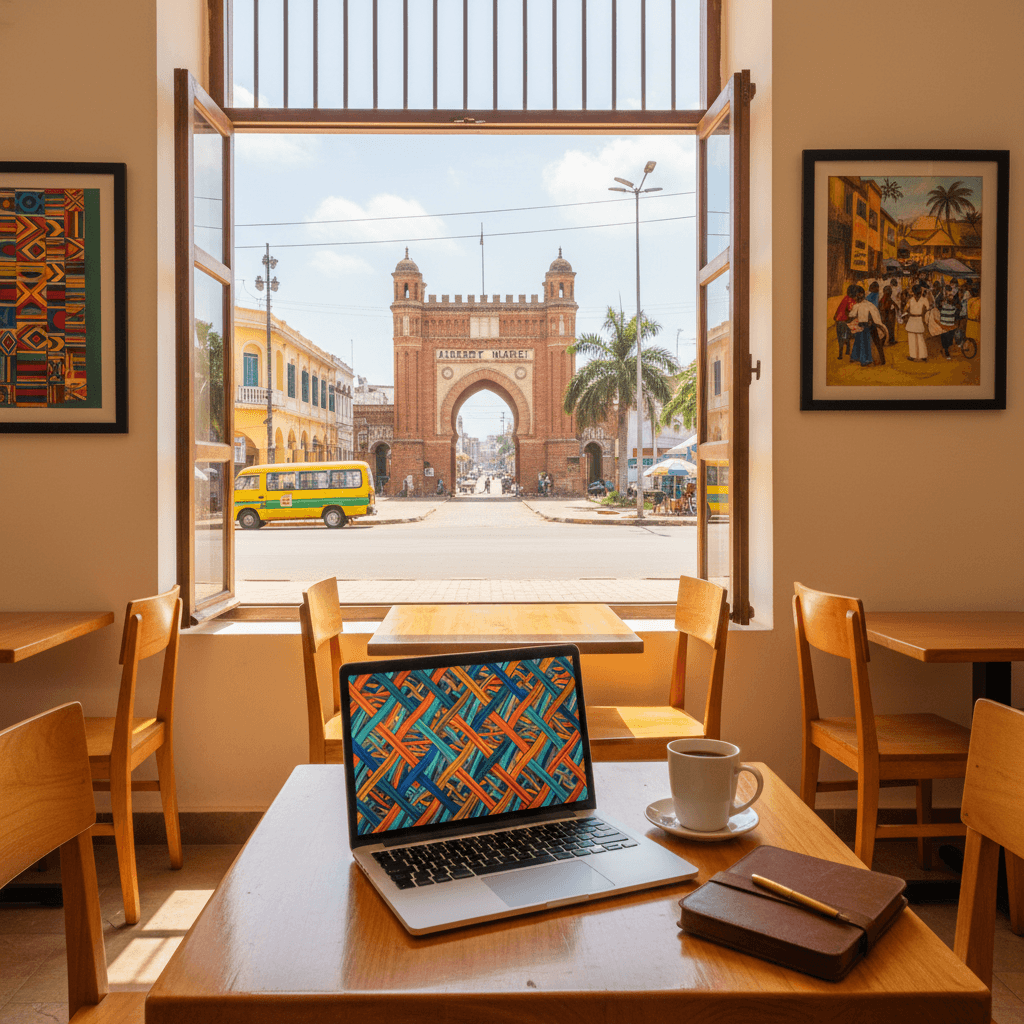
Banjul
🇬🇲 Gambia
Banjul moves slowly. That's not a complaint, it's just the reality and honestly, it's part of what makes this place so disarming once you stop fighting it. The pace here is genuinely unhurried in a way that most cities only pretend to be, where afternoons dissolve into the smell of domoda simmering on charcoal and the sound of Wolof radio drifting from open doorways.
This is West Africa's smallest capital, sitting on a small island at the mouth of the Gambia River and it carries that smallness in the best and worst ways. The markets are loud and close and real, the riverfront cafés are cheap and warm, the locals are, turns out, some of the most genuinely welcoming you'll find on the continent. But the infrastructure is rough. The internet is, frankly, borderline unusable at 0.5 to 1 Mbps average, the hospitals are underpowered and the roads are dangerous enough that most expats treat them as a daily gamble.
Most nomads don't actually base themselves in Banjul proper. They end up in Fajara or Kololi, which sit about 20 minutes south and have better housing, actual restaurants and a loose expat community worth plugging into. Central Banjul is cheaper and more culturally alive, it's also less safe at night and has the worst connectivity of any neighborhood here.
The cost of living is genuinely low. A mid-range month, studio rent plus mixed dining plus occasional rideshares, runs around $800, you can do it for $500 if you're disciplined. That's the draw. Not the coworking scene (it's thin), not the nightlife (Kololi's strip is fun but touristy), not the digital infrastructure. It's the price tag and the pace.
Culturally, Banjul sits at the intersection of Mandinka, Wolof and Fula traditions, which shapes everything from how you greet someone to what's on the street food menu. Greet first, always. Use your right hand. Don't rush anyone.
The dry season, November through May, is when this city actually makes sense for nomads: 27 to 28°C, low humidity, clear skies. August is brutal, hot and soaked and sticky in a way that clings to you all day. Come in the dry season, leave before the rains arrive.
Banjul is, honestly, one of the cheapest places you can base yourself in West Africa. Most nomads land somewhere between $800 and $1,200 a month depending on how they live and budget travelers who eat street food and share housing have gotten by on $500. That's not a stretch, that's a realistic number.
Rent is where you feel the difference most. A studio in central Banjul runs around $137 a month, the smell of open-air markets drifting through the window whether you want it or not. Move out to Fajara or Kololi where the expat crowd clusters and you're looking at $650 or more, but you get better infrastructure, actual grocery stores and neighbors who speak English. Most nomads end up in Fajara for the balance of comfort and sanity.
Food is cheap, full stop. Street domoda and rice dishes run $1 to $4 and they're good, the kind of slow-cooked thing you'd pay $18 for back home. Mid-range spots like Cabana's or Paradiso land around $5 to $10 a meal. Upscale options with imported ingredients will push higher, but you'd have to actively seek that out.
Here's a rough breakdown by lifestyle:
- Budget ($500/month): Shared housing in central Banjul, street food daily, shared taxis everywhere
- Mid-range ($800/month): Studio apartment, mixed dining, occasional rideshare through Gamride or 1Bena
- Comfortable ($1,200+/month): Fajara one-bedroom, coworking at Disruptive Lab in Bakau (around $30 to $80 a month), upscale meals a few nights a week
Transport is weirdly affordable, taxis run about $2 for a short trip and the ride-hailing apps negotiate fares rather than meter them. Mobile data from Africell or QCell costs around $6 for 10GB, which turns out to be your most reliable internet option anyway since fixed-line speeds are frustratingly slow across the board.
ATMs cap withdrawals at roughly $137 per transaction, so cash management is a genuine annoyance. Fintech options are sparse, bring a card with no foreign transaction fees and withdraw often. The low costs are real, the financial friction is real too.
Banjul's neighborhoods aren't interchangeable. Where you land shapes your entire experience, so pick based on what you actually need, not just what's cheapest on the map.
For Nomads: Fajara
Fajara is, honestly, the default choice for anyone trying to get work done here. It's got the most reliable (relative term) internet options, walkable streets that smell like frangipani and frying fish and enough cafes to rotate through when your connection drops. Most nomads who've tried Central Banjul first end up migrating here within a month.
- Rent (1BR): ~$650/month
- Best for: Coworking access, international food, beach proximity
- Watch out for: It's pricier and "pricier" in Banjul still means modest by global standards
For Expats and Families: Fajara (Again)
Expats keep landing here for a reason. International schools, private clinics and a small but real community of long-termers who've figured out the workarounds. The streets are quieter than Kololi, the housing stock is better and you won't wake up to a bar pumping music at 2am.
It's not perfect, the infrastructure still frustrates, but it's the closest Banjul gets to a functioning expat base.
For Solo Travelers: Kololi / Senegambia
Kololi is loud, touristy and turns out it's actually fun if you're only here for a few weeks. The Senegambia Strip has bars, restaurants, beach access and enough foot traffic that you'll meet people without trying. GTS Bar draws a mixed local and expat crowd, the food at Paradiso won't disappoint, petty theft is real though so don't flash anything valuable at night.
- Rent: Mid-range, between Fajara and Central
- Vibe: Social, a little chaotic, never boring
- Skip: Leaving valuables unattended anywhere near the strip
For Budget Nomads: Central Banjul
Cheap. Genuinely cheap, a studio runs around $137/month and street domoda costs less than a dollar. The tradeoff is real though: internet is borderline unusable, safety after dark is a concern and there's frankly not much to do beyond the Albert Market and the riverfront.
Come here to save money, not to build a routine.
Let's be direct: the internet in Banjul is, honestly, bad. We're talking 0.5 to 1 Mbps on a typical day, which isn't slow so much as it's basically decorative. Most nomads who try to tough it out on home broadband spend more time watching the loading spinner than actually working, it's genuinely maddening.
Your best bet is a local SIM for tethering. Africell and QCell are the two worth grabbing; pick one up at the airport or any street vendor, then dial *2025# to load a data bundle. Ten gigabytes runs around $6, speeds are inconsistent but far better than anything coming through a wall socket. If you need a fixed line, Insistnet's "Na Korda" package offers 4 Mbps unlimited for roughly €35 a month, which sounds reasonable until you realize 4 Mbps is the ceiling, not the floor.
For coworking, the options are thin. Genuinely thin.
Disruptive Lab in Bakau is the most functional setup in the city, with hot desks from around D 2,250 per month (roughly $30) and private offices around D 6,000 ($80). The space is quiet, the power supply is more reliable than most and it's where you'll find the small local tech community if you want to meet people who actually know the city. JokkoLabs is a looser setup, more coffee shop than coworking, but it's open and works for a few focused hours.
Cafés are a mixed bag. QuantumNet and Cassy's both offer internet access for around D 20 per 30 minutes ($0.30), turns out the speeds vary wildly depending on the time of day and how many people are connected. Don't count on video calls from either.
- Best for reliability: Disruptive Lab, Bakau
- Best for casual work: JokkoLabs
- Best mobile data: Africell or QCell SIM, bundle via *2025#
- Fixed broadband: Insistnet Na Korda, ~€35/month, 4 Mbps
- Café access: QuantumNet or Cassy's, ~$0.30 per 30 min
Banjul isn't a city you come to for fast internet, it's a city you come to despite the internet. If your work requires anything above basic email and document editing, sort out your SIM situation before you arrive and keep your expectations calibrated accordingly.
Banjul isn't particularly safe and most nomads who've spent time here will tell you that directly. Petty crime is real, especially in Kololi and the Senegambia Strip where tourist-targeting is common, so keep your phone in your pocket and don't wander unlit streets after dark. The tourist police do patrol Senegambia and can be reached at 220-358-1502, but response times are, honestly, unpredictable at best.
For emergencies, 117 reaches police and 118 is fire and rescue. Don't expect fast. Expats generally say the emergency services function as a last resort rather than a first call, which is why most long-termers in Fajara rely on their own networks and private clinics for anything serious.
Edward Francis Small Teaching Hospital is the main public facility and the quality is low enough that travelers with any significant medical condition should think hard before coming here without solid evacuation insurance. Pharmacies are widespread and often the first stop for minor issues, which works fine for basic care, a stomach bug or a skin infection won't leave you stranded. Anything beyond that, you'll want to be in Dakar or back home.
A few practical habits that, turns out, make a real difference here:
- Avoid isolated areas at night: Central Banjul especially gets quiet and dark fast once the market closes.
- Use apps for transport: 1Bena and Gamride reduce the friction of negotiating fares with strangers, which also reduces your exposure as an obvious tourist.
- Get travel insurance with medical evacuation: Standard trip insurance won't cut it. You want a policy that can fly you out.
- Carry small bills: Flashing large notes at markets draws attention you don't want.
Fajara is weirdly calm compared to the rest of the metro, with a more settled expat community and better access to private clinics. If health or safety is a real concern for you, that's the neighborhood to base yourself in, not Central Banjul.
The honest summary: Banjul rewards cautious, aware travelers and punishes careless ones. Keep your head up, get good insurance and don't treat it like a resort town.
Banjul doesn't have a subway, a tram or anything close to a reliable bus network. What it does have is a chaotic, loud, surprisingly functional patchwork of yellow taxis, shared vans and ride-hailing apps that, once you figure them out, gets you around just fine.
The yellow taxis are everywhere, honking constantly, weaving through streets that smell of exhaust and fried plantain. Most trips within Banjul or between Fajara and Kololi run about $2 for a 3km ride, though you'll need to negotiate before you get in. Drivers will quote tourist prices, it's not personal, just haggle calmly and you'll land somewhere reasonable.
For something more predictable, the 1Bena and Gamride apps are your best options. 1Bena handles both rides and food delivery, Gamride lets you negotiate fares in-app which, honestly, removes most of the friction. Expats in Fajara swear by them for airport runs, which take around 15 to 25 minutes depending on traffic and which part of the coast you're staying in.
Shared vans (called "gelly-gellys" locally) are the cheapest option by far, but they stop constantly, they're packed and getting on with a laptop bag is more trouble than it's worth. Skip them unless you're traveling light and have nowhere specific to be.
Central Banjul and Fajara are both walkable in the dry season, the heat is manageable and the streets are compact enough that you won't need a car for short errands. Kololi is more spread out, so you'll want a taxi or app for most trips there. Bike and scooter rentals exist but they're limited and, frankly, the roads are genuinely dangerous, potholes, erratic drivers, no real lane discipline.
- Yellow taxis: Negotiate before entering, roughly $2 per short trip
- 1Bena app: Rides and food delivery, most reliable option
- Gamride / Gamride Pro: In-app fare negotiation, good for airport transfers
- Shared vans (gelly-gelly): Cheapest, but slow and crowded
- Walking: Works well in central Banjul and Fajara, less so in Kololi
One thing most travelers don't expect: turns out the airport is genuinely close. If you're staying anywhere on the coastal strip, you're looking at 20 minutes on a clear morning, less if you book a ride the night before through 1Bena.
English is the official language, but don't expect fluency everywhere you go. Most locals speak it well enough for basic transactions, though nomads consistently report that proficiency drops off fast outside tourist areas and hotels. That's not a dealbreaker, it's just something to factor in.
The languages you'll actually hear on the street are Wolof and Mandinka, sometimes Fula, depending on the neighborhood. Markets in central Banjul are a wall of sound, rapid Wolof exchanges, the thwack of fish on cutting boards, vendors calling out prices you won't understand. Learning even a handful of local phrases, honestly, changes everything about how people respond to you.
A few Wolof phrases worth memorizing:
- Jamano , Hello (general greeting)
- Ndax dégg nga angale? , Do you speak English?
- Deemal! , Go away (useful, turns out, more than you'd hope in tourist spots)
Greeting people first before any transaction isn't optional here, it's the expected baseline of respect and skipping it will get you noticeably colder service. Take the ten seconds. Gambians are weirdly warm once you get that part right and conversations that start with a proper greeting tend to go somewhere genuinely interesting.
Google Translate handles Wolof reasonably well for written text, though the audio pronunciation is hit or miss, so don't rely on it in a fast-moving market situation where you're already flustered and someone's waiting. Download an offline language pack before you land, because mobile data speeds here are slow enough that real-time translation can stall at the worst moment.
Phone communication is straightforward. SIM cards from Africell or QCell are sold at the airport and most street stalls, data bundles cost approximately D65 per 1GB with Africell or QCell (roughly $0.87 per GB), so 10GB runs around D650 (~$8.67) and WhatsApp is the default communication tool for pretty much everyone, locals, expats, landlords, taxi drivers. If someone gives you their number, assume WhatsApp first. SMS is frankly an afterthought at this point and calling without messaging ahead is considered a bit abrupt by local standards.
Banjul runs on two seasons and the gap between them is, honestly, dramatic. The dry season stretches from November through May, bringing warm days around 27 to 28°C (81 to 82°F), low humidity and skies that stay clear for weeks at a stretch. The rainy season, June through October, flips everything: the air gets thick and sticky, temperatures climb to 33°C (91°F) or higher and August dumps around 282mm of rain in a single month. That's not a light shower, that's rain hammering tin roofs so loud you can't hold a conversation.
November and December are the sweet spot. The heat is manageable, the humidity drops to something you can actually breathe through and the beaches aren't packed. Birding is exceptional during this window too, which draws a surprising number of wildlife travelers through the area. Most nomads who've done a longer stint here arrive in November and leave before July.
If you're considering a visit outside that window, January and February are still solid, just slightly cooler and drier. March and April stay dry but start warming up noticeably. May is the turning point, you'll feel the humidity creeping back in, the air gets heavier and afternoon thunderstorms start appearing.
July and August are, frankly, rough. It's not just the rain, it's the combination of heat, constant moisture and the way everything feels damp all the time. Mold is a real issue in apartments, roads flood unpredictably and the general pace of the city slows even further than usual. Skip it if you can.
- Best months: November, December, January
- Acceptable: February, March, April
- Shoulder (manageable but warm): May, early June
- Avoid: July, August, September (peak rain and humidity)
Year-round temperatures sit between 27 and 36°C, so it's never cold, turns out even "cool season" here still calls for light clothing at all times. Pack a light rain jacket if you're arriving anywhere near the June to October window, you'll need it and an umbrella won't cut it.
Banjul runs on its own clock, so adjust your expectations before you arrive. Service is slow, ATMs are scarce and the internet is, honestly, close to unusable for serious work. That said, once you stop fighting it, the low costs and warm pace make it livable.
Money is mostly cash-based. ATMs cap withdrawals at GMD 10,000 (roughly $137) per transaction, so pull cash frequently rather than counting on one big withdrawal. Fintech options are sparse, carry backup funds.
For a SIM, grab an Africell or QCell card at the airport before you leave arrivals. Dial *2025# to browse data bundles; a 10GB top-up runs around D650 (~$8.67) with current 2026 pricing. Mobile data is, turns out, your most reliable internet option in this city, so tether liberally. Home ISPs like Insistnet promise 4 Mbps for around €35 a month, which sounds fine until you're on a call at 9am and it drops to nothing.
For coworking, Disruptive Lab in Bakau offers hot desks from around D 2,250 a month and is the closest thing to a proper workspace you'll find. JokkoLabs works if you just need a table and coffee. Skip the cafes for anything deadline-critical, the speeds are weirdly inconsistent and the D20 per 30 minutes adds up fast.
Safety needs a realistic read. Petty crime is common in tourist areas like Kololi, don't flash gear or leave bags unattended on the Senegambia Strip. Avoid isolated streets after dark, it's not dramatic advice, it's just sensible. Tourist police operate in Senegambia (call 220-358-1502); for general emergencies dial 117, though response times are slow.
Hospitals are a genuine concern. Edward Francis Small Teaching Hospital is the main public facility and the quality is low, so travel insurance with medical evacuation coverage isn't optional here. Stock a basic kit and identify the nearest private clinic in Fajara before you need one.
- Customs: Greet before asking anything, it's considered rude not to
- Dress: Modest clothing outside beach areas, especially in markets
- Left hand: Don't use it for eating or passing items
- Tipping: 10% is standard at restaurants
- Transport apps: 1Bena and Gamride for rides; negotiate fares on standard taxis
The best time to arrive is November through February, dry air, manageable heat, no rain hammering tin roofs at 2am. August is frankly miserable, 33°C with humidity that clings to everything.
Need visa and immigration info for Gambia?
🇬🇲 View Gambia Country GuideWild Card
Expect the unexpected