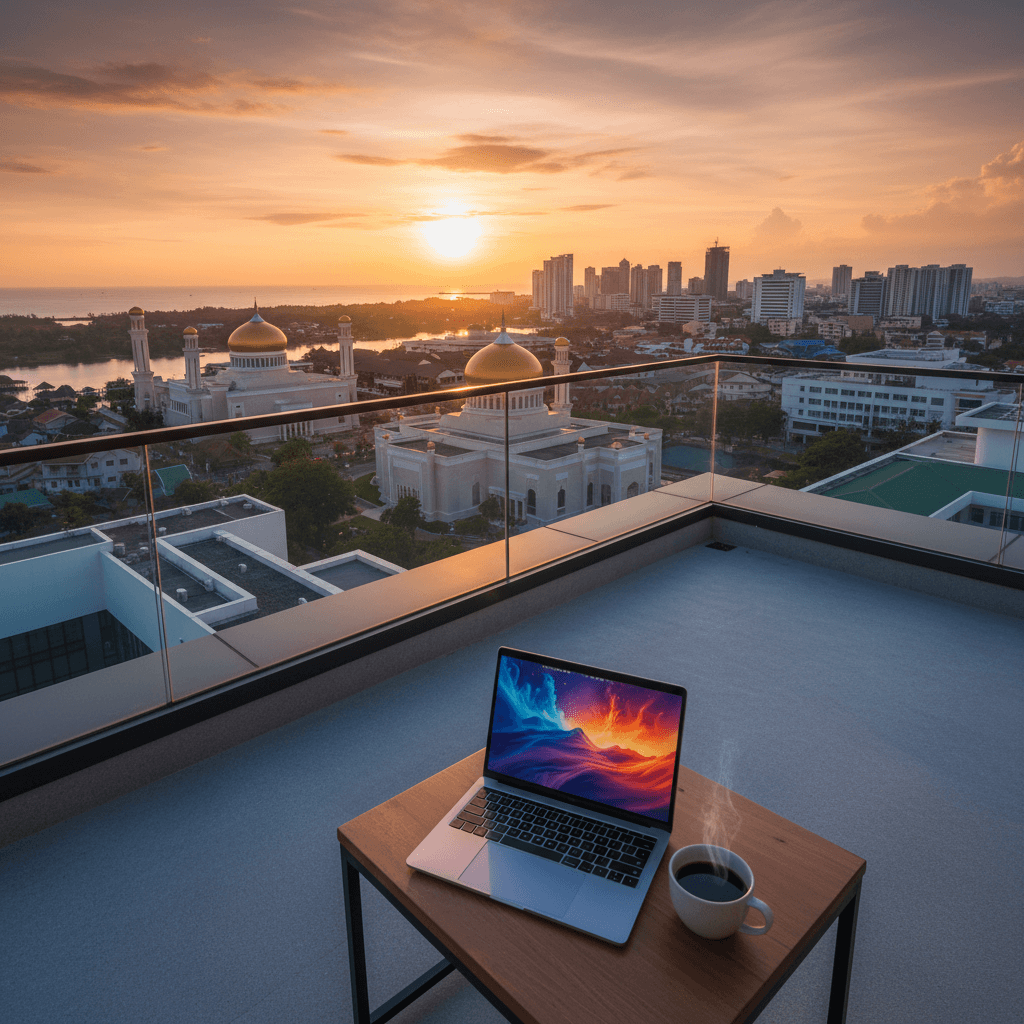
Bandar Seri Begawan
🇧🇳 Brunei
The Quiet Capital
Bandar Seri Begawan, or BSB as most of us call it, isn't your typical Southeast Asian digital nomad hub. You won't find the chaotic traffic of Jakarta or the neon-soaked nightlife of Bangkok here. Instead, Brunei's capital feels like a serene, well manicured garden city where the call to prayer echoes over gold domed mosques and the pace of life remains refreshingly slow.
The vibe is undeniably conservative but deeply welcoming. It is a place where wealth is quiet and the community is tight knit. For a nomad, the attraction lies in the lack of distractions. If you are looking to grind on a project while surrounded by pristine rainforests and incredible Islamic architecture, this is your spot. Just keep in mind that Brunei is a dry country. There are no bars or clubs, so your social life will revolve around night markets, coffee shops, and private gatherings.
Life on the Water and in the Jungle
What makes BSB truly unique is the contrast between its modern city center and Kampong Ayer, the massive stilt village sitting right on the Brunei River. Living here means you can spend your morning working from a cafe with high speed internet and your afternoon taking a water taxi through a centuries old floating community. It is a strange, beautiful duality that you won't find anywhere else in the region.
The city feels incredibly safe, almost like a small town despite being a national capital. You can wander around at night without a second thought, and the locals are genuinely curious and helpful. It is the kind of place where people actually stop to let you cross the street, a rare luxury in this part of the world.
Cost of Living Breakdown
Brunei uses the Brunei Dollar (BND), which is pegged 1:1 to the Singapore Dollar. This makes it more expensive than neighboring Malaysia, but still quite manageable for those earning in USD or EUR. Most nomads find they spend between $1,086 on a tight budget and $2,374 for a more comfortable, mid range lifestyle. If you are going all out on luxury rentals and private tours, costs can climb toward $5,700 per month.
- Budget Nomad: Around $1,100 per month. This covers a modest room, eating mostly at local markets like Gadong, and using public buses.
- Mid Range Lifestyle: Approximately $2,400 per month. This gets you a nice apartment, regular cafe visits, and frequent weekend trips to the jungle.
- Daily Coffee: Expect to pay about $4.00 to $6.00 at specialty shops.
- Local Meal: A solid plate of Nasi Katok will only set you back about $1.00 to $3.00.
Connectivity and Staying Productive
Internet in BSB is generally reliable, though it can be a bit pricier than in neighboring countries. You will find the best speeds, often reaching up to 90 Mbps, in the city center and near the Omar Ali Saifuddien Mosque. Most expats and long term travelers recommend picking up a local eSIM immediately to stay connected. Providers like DST and Progresif are the go to choices, and you can often find prepaid travel eSIMs that are 50% cheaper than the big global roaming brands.
While there aren't dozens of dedicated coworking spaces yet, the cafe culture is strong. You will see plenty of people working from their laptops in the Gadong and Kiulap areas. The connection is rock solid in these commercial districts, and as long as you keep ordering coffee, nobody will mind you staying for a few hours to clear your inbox.
The Daily Damage
Living in Brunei capital doesn't have to break the bank, but it's a unique market where your spending habits dictate everything. If you're living like a local, eating at Gerai Makan stalls and sticking to regional produce, you can get by on roughly $1,100 a month. Most digital nomads find that a comfortable, mid range lifestyle sits closer to $2,400. This covers a modern apartment, frequent dining out, and the occasional weekend escape into the rainforest.
The local currency, the Brunei Dollar (BND), is pegged 1:1 with the Singapore Dollar. This means you get Singaporean stability without the eye watering Singaporean price tags. You'll find that while imported luxuries and cars are pricey, the basics like fuel and electricity are heavily subsidized and incredibly cheap.
Breaking Down the Monthly Budget
To give you a clearer picture of what hits your wallet each month, here is how a typical nomad budget shakes out:
- Housing: A decent one bedroom apartment in areas like Gadong or Kiulap usually runs between $700 and $1,200.
- Groceries: Expect to spend about $350 if you shop at supermarkets like Supa Save for western imports.
- Dining Out: A meal at a local coffee shop (kopitiam) costs about $4 to $7, while a dinner at a nicer spot in the city center will be $20 to $35.
- Connectivity: A solid mobile data plan and home fiber connection will set you back roughly $80 to $120 depending on your speed requirements.
- Transport: Since public transit is limited, most expats rely on Dart (the local ride hailing app). Budget around $150 a month if you aren't renting a car.
Connectivity and Remote Work Costs
Staying online is straightforward but requires a bit of strategy. For your phone, skip the international roaming and grab a local eSIM from providers like DST or Progresif. You can often find prepaid travel deals through GOHUB that are about 50% cheaper than the big global brands. These allow you to scan a QR code and get moving the second you clear immigration.
If you're working from the city center, you'll find the most reliable speeds near the Omar Ali Saifuddien Mosque. Speeds generally hover between 10 and 35 Mbps, though some high end apartments and dedicated workspaces can push up to 90 Mbps. It isn't the fastest in Southeast Asia, but it's stable enough for Zoom calls and uploading content.
Lifestyle Perks and Hidden Savings
One of the biggest perks of basing yourself here is the lack of "sin taxes" on things like sugar or tobacco, though you won't find alcohol for sale anywhere in the country. This naturally lowers your entertainment budget. Instead of bar hopping, social life revolves around the night markets and cafe culture.
The Gadong Night Market is a local legend for a reason. You can fill a container with grilled fish, satay, and fresh fruit for under $10. It's the ultimate hack for keeping your food costs low while eating some of the best food in the city. If you're heading out to Kampong Ayer, the water taxis only cost about $1 for a trip across the river, making it one of the cheapest commutes you'll ever have.
For Digital Nomads: Gadong
If you want to be where the action is, Gadong is your best bet. It is the commercial heartbeat of the city, packed with shopping malls, cafes, and the famous Gadong Night Market. Most nomads gravitate here because it feels the most connected to the modern world, and you are never more than a five minute walk from a caffeine fix or a decent data signal.
- Estimated Rent: $700 to $1,200 for a modern apartment.
- Vibe: Fast paced by Brunei standards, convenient, and great for foodies.
- Best for: People who need to be near gyms, supermarkets, and late night eats.
The Mall Gadong serves as a central landmark where you can find local SIM cards from providers like DST or Progresif. While there are not many formal coworking spaces in the city, the cafes in Gadong are accustomed to people working on laptops for a few hours. The internet coverage around the central business blocks is generally the most stable in the country, often hitting those higher 90 Mbps speeds.
For Expats and Long Termers: Kiulap
Kiulap sits right next to Gadong but offers a slightly more polished, upscale feel. It is a favorite for expats who want a walkable neighborhood that does not feel quite as chaotic as the main shopping districts. The area is filled with boutique shops, specialized clinics, and some of the best international dining options in the city.
- Estimated Rent: $900 to $1,500 for larger, well maintained units.
- Vibe: Trendy, professional, and slightly more relaxed than Gadong.
- Best for: Remote workers who want a higher standard of living and easy access to specialty grocers.
Living here means you are centrally located between the administrative center and the commercial zones. It is a great middle ground if you plan on staying for more than a month and want a neighborhood that feels more like a community and less like a tourist stop.
For Solo Travelers and Culture Seekers: Downtown (Pusat Bandar)
The city center is where you will find the iconic Omar Ali Saifuddien Mosque and the waterfront. It is surprisingly quiet at night, but during the day, it is the most walkable part of Bandar Seri Begawan. You can easily catch a water taxi to Kampong Ayer, the massive stilt village across the river, for just a few dollars.
- Estimated Rent: $500 to $900 for older apartments or guesthouses.
- Vibe: Historic, scenic, and very quiet after 8:00 PM.
- Best for: Short term stays and photographers who want to be near the landmarks.
Staying downtown puts you at the hub of the public bus system, though most residents rely on the Dart app for rides. The connectivity here is rock solid, especially near the mosque and the main plazas, making it easy to upload photos or take a quick call while exploring the waterfront.
For Families: Berakas
Berakas is a sprawling residential area closer to the airport and the national stadium. It is where you will find more landed houses rather than high rise apartments. It is much greener than the city center and offers easy access to recreational spots like Tasek Lama Park.
- Estimated Rent: $1,200 to $2,000+ for a multi bedroom house.
- Vibe: Suburban, quiet, and family oriented.
- Best for: Those with children or anyone looking for a peaceful retreat away from the shops.
Since this area is more spread out, you will definitely need a car or a consistent budget for ride hailing apps. It is the right choice if you value space and want to be near the international schools or the airport for frequent regional travel.
Connectivity and Speed
Brunei has made massive strides in its digital infrastructure, moving away from the sluggish speeds that used to define the region. In downtown Bandar Seri Begawan, you can expect average download speeds between 30 Mbps and 90 Mbps on fixed lines. While it isn't Seoul or Singapore, it is more than enough for video calls and heavy cloud uploads.
Most nomads find the local 4G networks surprisingly reliable even when venturing toward the water villages. You will see the best performance around the Omar Ali Saifuddien Mosque and the central business district. If you are heading out to the rainforest or deeper into Kampong Ayer, expect those speeds to dip, though you will rarely lose signal entirely in the city limits.
Mobile Data and eSIMs
Don't rely on international roaming here; it is notoriously expensive. Instead, grab a local SIM or set up an eSIM before you touch down. The two main players are DST and Progresif. Both offer solid coverage, but DST is often cited by expats as having the slightly better edge in rural areas.
- DST Easi: Their prepaid plans are straightforward. You can pick up a physical SIM at the airport for about $10, which usually includes some initial credit.
- Progresif: They often have competitive data "add-ons" that are perfect for a month-long stay.
- eSIM Options: If your phone supports it, look into GOHUB. Their Brunei-specific travel eSIMs are often 50% cheaper than the big global providers and allow you to bypass the kiosks at the airport entirely.
The Coworking Scene
You won't find a massive variety of dedicated coworking franchises in BSB yet. The scene is still developing, which means most remote workers gravitate toward a few key hubs or high-end cafes. Anggerek Desa Technology Park houses iCentre, a startup incubation space by BEDB offering facilities primarily for approved programs.
For a more casual vibe, the Gadong area is your best bet. It is packed with cafes that have reliable Wi-Fi and power outlets. Local favorites include Roasted Sip and Coffee Bean & Tea Leaf, which are accustomed to people staying for a few hours with a laptop. Just be mindful of the prayer times; some businesses may close briefly or shift their service hours, especially on Fridays between 12:00 PM and 2:00 PM.
Tips for Staying Connected
Power outages are rare in the capital, but the humidity is no joke for your hardware. If you are working from a terrace or a non-air-conditioned space, keep an eye on your laptop's fan. The heat can throttle your performance faster than a slow internet connection will.
Public Wi-Fi is available in major malls like The Mall Gadong or Times Square Shopping Centre, but it is often throttled or requires a local phone number to authenticate. It is always better to have your own hotspot as a backup. Prepaid data is cheap enough that most nomads just tether from their phones when the cafe Wi-Fi gets crowded during the lunch rush.
Digital Nomad Essentials
- Average Monthly Data Cost: Expect to spend $25 to $45 for a generous data package.
- Power Plugs: Brunei uses the Type G plug (the three-pin UK style), so bring an adapter if you are coming from the US or Europe.
- Peak Hours: Internet traffic peaks in the early evening, around 7:00 PM, when locals get home. If you have a massive file to upload, try to do it during the morning hours.
A Culture of Respect and Safety
You'll quickly notice that Bandar Seri Begawan is one of the safest capitals in Southeast Asia. Violent crime is exceptionally rare, and most nomads feel perfectly comfortable walking around at night. The city operates on a foundation of Malay Islamic Monarchy values, which translates to a polite, reserved, and law-abiding atmosphere. You won't deal with the aggressive touts or tourist scams common in neighboring regions.
Petty theft like pickpocketing is also uncommon, but it pays to stay sensible in crowded spots like the Gadong Night Market. Since Brunei is a dry country, you won't find the rowdy, alcohol-fueled environments that often lead to trouble elsewhere. The biggest "danger" you’re likely to face is the tropical sun or the occasional stray dog in suburban areas.
The legal system is strict, and it's important to respect local customs. Public displays of affection should be kept to a minimum, and dressing modestly is the norm, especially when visiting government buildings or religious sites like the Omar Ali Saifuddien Mosque. If you follow the local lead and stay respectful, you'll find the residents incredibly welcoming and helpful.
Healthcare Standards and Facilities
Brunei has a high standard of medical care, and the facilities in the capital are modern and well-equipped. For most digital nomads, the first point of contact for emergencies or specialist care is Raja Isteri Pengiran Anak Saleha (RIPAS) Hospital. It’s the main public hospital, centrally located, and handles everything from routine check-ups to complex trauma.
If you prefer a more streamlined experience with shorter wait times, private clinics are the way to go. Jerudong Park Medical Centre (JPMC) is the premier private hospital in the country. It’s located about 20 minutes from the city center and feels more like a luxury resort than a clinic. They offer excellent diagnostic services, dental care, and outpatient consultations.
- RIPAS Hospital: Best for emergency services and affordable public care.
- Jerudong Park Medical Centre: The top choice for private insurance holders and expats.
- Gleneagles JPMC: A specialized cardiac center located within the JPMC campus.
- Panaga Health: Often used by the expat community for primary care.
Pharmacies and Prescriptions
Pharmacies are easy to find in shopping areas like The Mall Gadong or Kiulap. Guardian and Jaya are the most common chains. Most standard over-the-counter medications are available, but if you require specific prescription drugs, it’s a good idea to bring a copy of your doctor's note. Prices for medicine are generally reasonable, though imported brands can carry a premium.
Health Insurance and Costs
While public healthcare is heavily subsidized for citizens, foreigners will need to pay. A standard consultation at a private clinic might cost between $30 and $70, while more specialized tests at JPMC can run into the hundreds. Most nomads find that a global health insurance policy covering private facilities is the best way to avoid unexpected out-of-pocket costs.
Tap water in the city is generally considered safe to drink after boiling, but most expats and locals stick to bottled or filtered water for daily consumption. Staying hydrated is your main job here; the humidity is intense, and heat exhaustion can sneak up on you if you're out exploring Kampong Ayer for too long during midday.
The Ride-Hailing Reality
In most Southeast Asian hubs, you can walk out of your door and hail a bike or car in seconds. Bandar Seri Begawan operates a bit differently. The city is built for cars, and the tropical heat combined with a lack of continuous sidewalks means you won't be doing much walking between districts. Most nomads and expats rely heavily on Dart, which is Brunei's answer to Grab or Uber. It is the only reliable ride-hailing app in the country, and you should download it the moment you land at the airport.
A typical 10 to 15 minute trip across the city usually costs between $5 and $10 BND. While there are traditional purple taxis, they are notoriously difficult to find on the street and often charge higher flat rates. Stick to the app for transparency and better pricing. If you plan on staying longer than a month, many expats find it more economical to rent a car. You can find basic rentals starting around $35 to $50 BND per day, with significant discounts for long term monthly agreements.
Navigating the Water Taxis
You can't talk about getting around this city without mentioning the iconic water taxis. These long, wooden speedboats are the lifeblood of the connection between the city center and Kampong Ayer, the massive stilt village on the river. You don't book these through an app; you simply head to the waterfront near the Mercu Dirgahayu 60 monument and wave one down.
A quick hop across the river generally costs $1 BND. If you want a more scenic route or a trip further into the mangroves to spot proboscis monkeys, you can negotiate a private tour for about $20 to $30 BND per hour. It is a loud, breezy, and surprisingly efficient way to bypass land traffic during the afternoon rush.
The Public Bus System
Brunei has a public bus system known locally as the Franchise Bus. These are easily identifiable by their bright colors, with different routes assigned specific shades like purple, green, or blue. While it is the most budget friendly way to move, with fares costing a flat $1 BND, it isn't always the most practical for a tight schedule.
The buses generally run from 6:00 AM to 8:00 PM, but frequencies can be unpredictable. The main hub is the BSB Bus Terminal located on Jalan Cator in the heart of the city. Most nomads find the bus system useful for getting to specific spots like Gadong or The Mall, but they usually switch back to Dart when the sun goes down or they're in a hurry.
Driving and Infrastructure
If you decide to get behind the wheel, you'll find the roads are in excellent condition. Gas is incredibly cheap, often costing less than $0.60 BND per liter, which makes driving the most cost effective way to explore the outskirts or head toward Ulu Temburong. Traffic is generally mild, though things get congested around 7:30 AM and 4:30 PM near school zones and government offices.
- Dart App: Essential for daily travel, prices start around $5 BND.
- Water Taxis: $1 BND for river crossings, available from sunrise to late evening.
- Public Buses: $1 BND flat fare, best for those with flexible schedules.
- Car Rentals: Roughly $500 to $800 BND per month for a long term lease.
Parking in the city center is usually easy to find and inexpensive. Most shopping centers and public areas offer ample space, though you might need to use a parking coupon system in certain municipal zones. Overall, while the lack of a metro system might seem like a hurdle, the efficiency of Dart and the low cost of fuel make getting around relatively stress free.
The Linguistic Landscape
You'll find that getting around Bandar Seri Begawan is surprisingly easy if you speak English. While Standard Malay (Bahasa Melayu) is the official language, the local dialect, Brunei Malay, is what you'll hear most often in the markets of Gadong or the water taxis of Kampong Ayer. It has its own distinct rhythm and vocabulary, but unless you're planning on staying for years, you won't need to master it to survive.
English is widely spoken and serves as the primary language for business and higher education. Most signs, menus, and official documents are bilingual. You'll notice Jawi, the Arabic script for Malay, on street signs and storefronts, usually positioned above the Latin text. It adds a beautiful aesthetic to the city, even if you can't read it.
The city also has a significant Chinese population, so you'll frequently hear Hokkien, Cantonese, and Mandarin in commercial areas. Because of the diverse expat workforce, it's not uncommon to hear Tagalog or Hindi in service sectors too. This melting pot makes the capital feel more international than its quiet reputation suggests.
Staying Connected
Brunei's telecommunications have improved significantly, and you won't have to hunt hard for a signal. The main mobile providers are DST, Progresif, and imagine (under UNN). For most nomads, grabbing a prepaid SIM is the first order of business after landing at Brunei International Airport.
- DST (Easiest for Tourists): Their Easi prepaid plans are popular. You can get a starter pack for around $10 BND, which usually includes some initial credit.
- Progresif: Often seen as the "lifestyle" brand, they offer competitive data add ons. Their OnePlan options are flexible if you're staying for a month or more.
- eSIMs: If your phone supports it, GOHUB or local digital portals allow you to set up data before you even clear immigration. It's often 50% cheaper than using a global roaming provider.
Speeds generally hover between 20 Mbps and 90 Mbps depending on your location. If you're working near the Omar Ali Saifuddien Mosque or in the Kiulap commercial area, the connection is rock solid. Even out on the wooden stilts of Kampong Ayer, 4G coverage remains surprisingly stable.
Communication Etiquette
Bruneians are generally soft spoken and polite. Communication is often indirect to avoid causing "malu" or shame to others. It's best to keep your voice at a moderate volume in public spaces, especially near religious sites. When meeting someone, a light handshake is common, though some locals may prefer the salam, where they lightly touch your hand and then bring their hand to their chest. If a woman doesn't offer her hand to a man, a simple nod and smile is the respectful way to go.
Digital communication is dominated by WhatsApp. Whether you're booking a tour, ordering food, or messaging a new contact, WhatsApp is the default. Most local businesses don't rely on email for quick inquiries; they'll expect a text. For getting around, make sure you download Dart. It's Brunei's version of Uber or Grab, and it's the most reliable way to communicate your location to a driver without language barriers.
Essential Local Phrases
While English gets you 95% of the way there, dropping a few Malay words goes a long way with the locals. It shows you're not just passing through but actually respect the culture.
- Terima Kasih: Thank you. (Response: Sama sama).
- Apa Khabar?: How are you?
- Berapa?: How much? (Useful at the Gadong Night Market).
- Inda: No. (Specific to Brunei Malay, whereas "Tidak" is standard).
- Lurus: Correct or straight.
Most nomads find that the combination of high English proficiency and reliable 4G makes Bandar Seri Begawan one of the lower stress cities in Southeast Asia for communication. You won't find the frantic energy of Bangkok or Jakarta, but you also won't find the language barriers that often come with quieter regional capitals.
Tropical Realities and the Humidity Factor
Brunei sits just a few degrees north of the equator, so you can stop checking for seasonal temperature shifts. It is hot and humid year round, with daily highs consistently hovering around 32°C (90°F). The real differentiator here isn't the heat, it is the rain. You are moving into a tropical rainforest climate where the concept of a dry season is relative at best.
Most nomads find that the humidity is the biggest adjustment. Walking between cafes in the Gadong district at noon will leave you drenched, which is why the city’s social life and commerce revolve so heavily around air conditioned malls and indoor spaces. If you are planning to do outdoor photography at the Omar Ali Saifuddien Mosque, aim for the golden hour shortly after sunrise to beat both the haze and the stifling midday sun.
The Best Window: January to March
If you have the flexibility to time your arrival, aim for the window between January and March. This period is technically the dry season, though in Borneo, dry just means it rains less frequently. You will see more blue skies and enjoy slightly lower humidity levels, making it the most comfortable time for exploring the Ulu Temburong rainforest or taking water taxis through Kampong Ayer.
During these months, the evenings are actually quite pleasant. Expats often gather at outdoor spots like the Jerudong Park area or waterfront boardwalks once the sun dips, as the breeze off the South China Sea finally makes the air feel breathable. This is also the peak period for outdoor events and festivals, as the weather is most predictable.
Navigating the Monsoon Seasons
Brunei experiences two distinct monsoon periods that you should keep on your radar when booking your stay. The Northeast Monsoon hits from October to January, bringing the heaviest rainfall of the year. Expect sudden, violent downpours that can turn streets into rivers in minutes. While the infrastructure in the capital handles it well, these storms can disrupt boat travel to the more remote jungle areas.
- October to December: The wettest months. Expect rain almost every afternoon, often accompanied by impressive lightning displays.
- June to August: The Southwest Monsoon. It is less intense than the year end rains but brings hazy conditions due to regional agricultural burning.
- April and May: Transitional months where the heat peaks. These are often the most uncomfortable months for those not used to the tropics.
Cultural Timing: Ramadan and Hari Raya
The best time to visit isn't just about the rain; it is about the lunar calendar. Brunei is a deeply observant Islamic sultanate, and Ramadan significantly changes the city's rhythm. During this holy month, eating, drinking, or smoking in public during daylight hours is strictly prohibited, even for non Muslims. Many restaurants close or offer only takeaway services until sunset.
However, the period immediately following Ramadan, known as Hari Raya Aidilfitri, is a spectacular time to be in the city. This is the only time of year the Istana Nurul Iman, the Sultan’s palace, opens its doors to the public. For three days, thousands of people line up to meet the royal family and enjoy a massive buffet. If you don't mind the crowds, it is a cultural experience you won't find anywhere else on the planet.
Packing Essentials for the Nomad
Your packing list should prioritize breathability over everything else. Linen and light cotton are your best friends here. Even though it is hot, remember that Brunei is a conservative country. Most nomads recommend dressing modestly to show respect and to gain easier entry into government buildings or mosques. A light sweater is also a must, not for the weather, but because the air conditioning in malls and cinemas is often set to "arctic" levels.
Connectivity and Getting Online
Staying connected in Bandar Seri Begawan is straightforward, but you need to be smart about your provider. Most nomads find that the airport is the easiest place to get sorted immediately. You should look for DST or Progresif counters. If you want to skip the physical SIM card shuffle, grab an eSIM from GOHUB before you land. It usually costs about half of what the big international roaming brands charge, and it activates via a QR code the second you touch down.
Internet speeds generally hover around 20 to 35 Mbps, though you can find spots hitting 90 Mbps if you're near the city center. Coverage is rock solid around the Omar Ali Saifuddien Mosque and even extends quite reliably into the Kampong Ayer water village. If you're planning on working from a cafe, always have a backup hotspot; while the infrastructure is stable, public Wi-Fi isn't as ubiquitous as it is in Bangkok or Bali.
Entry and Logistics
Brunei has moved most of its entry processes online. Before you show up at the immigration desk, you have to complete the E-Arrival submission. Don't rely on the airport Wi-Fi to do this on the fly. Fill it out a day before and take a screenshot of the confirmation. You'll also need at least 6 months of validity on your passport, or they won't even let you board the flight.
The local currency is the Brunei Dollar (BND), which is pegged 1:1 to the Singapore Dollar. In fact, you can use Singaporean notes in most shops here, which is a handy tip if you're coming in from a layover at Changi. While cards are accepted at larger hotels and malls, you'll want cash for the water taxis and markets.
Daily Costs and Budgeting
Your monthly burn rate here can swing wildly depending on how much you lean into the local lifestyle. A budget-conscious nomad can get by on roughly $1,100 per month, while a more comfortable setup with a modern apartment and frequent dining out will land you closer to $2,400. If you're going for a high-end expat lifestyle, costs can climb toward $5,700.
- Local Meal: $4 to $8 BND
- Coffee at a cafe: $5 to $7 BND
- Water taxi ride: $1 to $2 BND
- Monthly budget apartment: $600 to $900 BND
Social Norms and Safety
Brunei is a conservative Islamic sultanate, and the "Practical Tips" section wouldn't be complete without mentioning the dry law. You won't find alcohol for sale anywhere in the city. Non-Muslims are allowed to bring in a limited amount for private consumption, but there are no bars or nightclubs. Social life usually revolves around the night markets, like Gadong, or private gatherings.
Dress modestly when you're out and about. While you don't need to be fully covered, keeping your shoulders and knees covered is respectful and will save you from unwanted attention. On the plus side, the city is incredibly safe. Crime rates are very low, and you can walk around most neighborhoods at night without a second thought. It's a quiet, slow-paced environment that suits people looking to get deep work done rather than those looking for a party scene.
Need visa and immigration info for Brunei?
🇧🇳 View Brunei Country GuideHidden Gem
Worth the effort