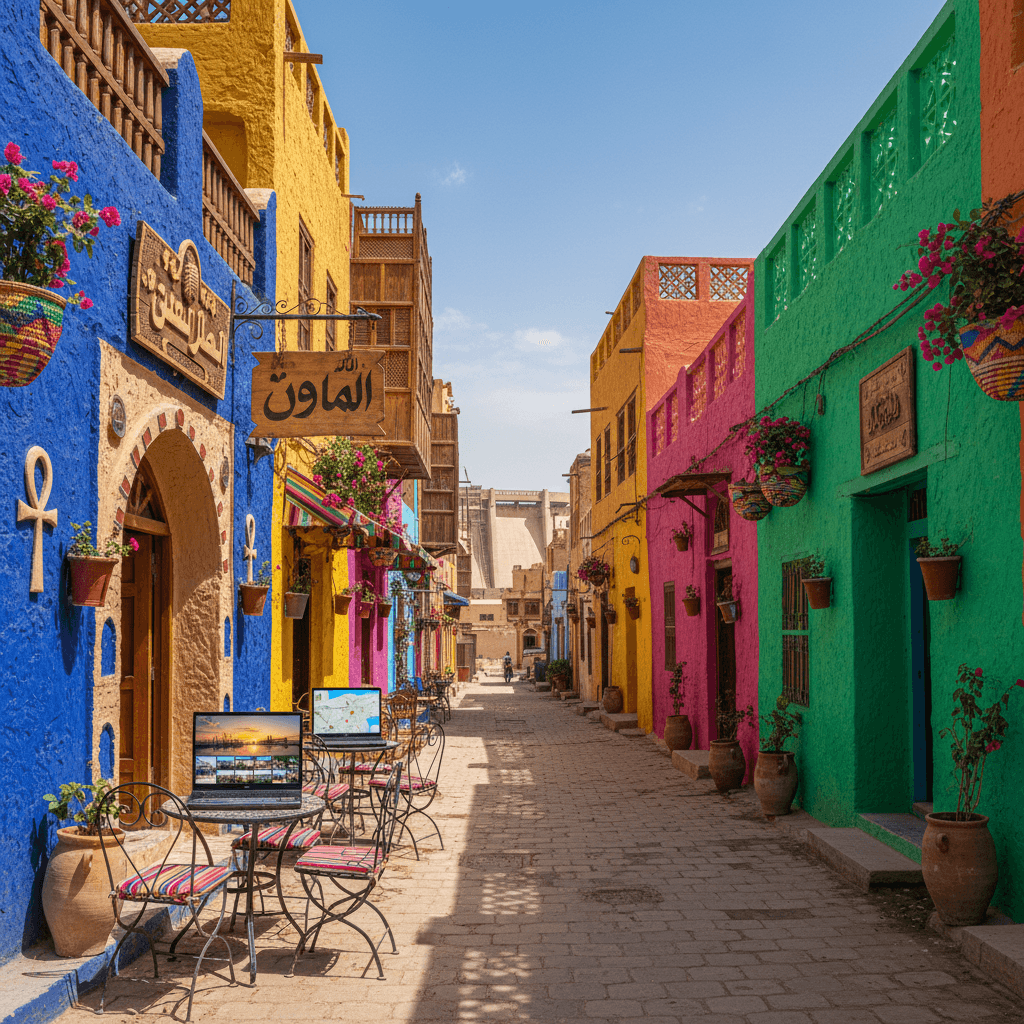
Aswan
🇪🇬 Egypt
Aswan isn't Cairo. There's no honking gridlock, no exhaust-thick air, no sense that the city is perpetually about to boil over. What you get instead is the Nile moving slow and silver in the late afternoon, the smell of grilled fish drifting up from the Corniche, the call to prayer echoing off sandstone cliffs that have been standing since the pharaohs. It's quieter here and that quiet is, honestly, the whole point.
For nomads and long-stay travelers, Aswan sits in an interesting middle ground. It's cheap, genuinely friendly and visually unlike anywhere else on earth, with Nubian villages painted in cobalt and ochre spilling down toward the water, feluccas cutting silently across the current, desert starting almost immediately where the green stops. Most nomads who end up here weren't planning to stay long, then stretched a week into three.
That said, it's not without friction. The internet is inconsistent outside hotels and Corniche cafes, there's no dedicated coworking space to speak of and summers are brutally hot. We're talking 40°C-plus days where stepping outside at noon feels like opening an oven door, the air dry and gritty, the light almost violent. October through April is when this city actually makes sense for working remotely.
The pace here is slow by design, not by accident and that shapes everything from how landlords negotiate to how long it takes to get a sim card sorted. Expats who've done stints here say you have to recalibrate your expectations, the city runs on its own clock and fighting that's a losing battle. Lean into it and Aswan is genuinely wonderful, resist it and you'll be miserable within a week.
What makes Aswan different from other budget nomad spots isn't just the price point, it's the texture of the place. Nubian culture is distinct from mainstream Egyptian culture, warmer in some ways, more communal and locals are, turns out, remarkably patient with outsiders who show basic respect. Dress modestly, learn a few Arabic phrases, tip reasonably and you'll be welcomed in ways that don't happen in more tourist-saturated cities.
This is a place for people who want to actually slow down, not just say they did.
Aswan is, honestly, one of the cheapest places you can base yourself in Egypt. Most nomads land somewhere between $450 and $600 a month for a comfortable solo setup and that figure includes rent, food, transport and the odd Nile-view cafe session with your laptop open.
Rent is where the savings really stack up. A studio or one-bedroom in a central spot along the Corniche runs around E£5,000 a month (roughly $100) and if you're willing to head out toward the Nubian Village outskirts, that drops to E£3,000 to 4,000 ($60 to 80). Aqarmap.eg and PropertyFinder.eg are where most expats search, landlords are generally flexible on short-term stays and a furnished place with AC is easy to find in cooler months.
Food is cheap, sometimes weirdly cheap. Street koshari or a falafel wrap runs E£20 to 50 (under a dollar), a solid plate of Nile fish at a mid-range cafe is E£100 to 200 ($2 to 4) and even a dinner at somewhere like the 1902 Restaurant won't break $10 to 15 per person. Cook occasionally and you'll spend very little, eat out every day and it's still manageable.
Transport costs almost nothing. Careem handles most airport runs and cross-city trips for $1 to 2, the Corniche is walkable for daily errands and you're looking at maybe $15 a month total if you're not going far. There's no coworking scene here, that's just the reality, so nomads work from Corniche cafes at around E£120 ($2.50) per session or rely on hotel lobbies.
Here's a rough breakdown by budget tier:
- Budget ($450/mo): Shared flat or Nubian Village room, street food daily, cafe work sessions, SIM data only
- Mid-range ($550/mo): Corniche studio, mix of eating out and cooking, occasional Careem rides
- Comfortable ($700+/mo): Nile-view apartment with reliable AC, dining at better restaurants, fewer compromises
One thing to factor in: summers drive up electricity bills fast, AC running all day in 40°C heat isn't free and some landlords charge separately for utilities. Ask upfront, it saves an awkward conversation later.
For Digital Nomads
The Corniche is where most nomads land and honestly, it makes sense. You've got Nile-view cafes that double as workspaces, walkable streets smelling of grilled fish and shisha smoke and enough foot traffic to feel connected without the chaos of Cairo. Rent for a studio here runs around E£8,000-E£15,000 a month (~$160-$320), the tradeoff is tourist crowds and the occasional aggressive tout.
There's no dedicated coworking space in Aswan. None. So your office is whatever cafe table you can claim, typically for around E£120 ($2.50) in coffee, with internet that's, turns out, decent inside hotels and cafes but drops off fast everywhere else. Get a Vodafone or Orange SIM with 4G the day you arrive, it'll carry you when the cafe WiFi doesn't.
For Expats
Expats with longer stays tend to drift toward the Nubian Villages on the west bank or the outskirts near Atlas/New Aswan. Rents in the villages typically range from E£5,000-E£10,000 (~$100-$210), landlords are welcoming and the community feel is genuinely warm. You'll hear Nubian music drifting through open windows at dusk, kids playing in the painted alleyways, the whole thing feels quieter and more real than the Corniche.
New Aswan is, frankly, less charming but more functional: larger apartments, modern buildings and a bit more breathing room in the summer heat. It's a solid base if you're prioritizing square footage over atmosphere.
For Families
Families do best in New Aswan, where 70 to 150 square meter apartments are available through Aqarmap and PropertyFinder. It's calmer, safer for kids and the streets don't have the tourist-area hustle. The downside is it's hotter in summer, further from the Nile and weirdly lacking in character.
For Solo Travelers
Elephantine Island is the pick for solo travelers who want genuine quiet. You get to it by boat, that's the only way and that small inconvenience keeps the crowds away. Work spots are limited, but the pace is slow and the views across the Nile are worth the logistical friction. Short stays only, it's not built for long-term practicality.
Aswan's internet situation is, honestly, functional but fragile. You'll get decent speeds in hotels along the Corniche and in the better cafes, enough to handle video calls and file uploads without losing your mind, but step outside those spots and it gets patchy fast. Don't expect fiber-optic reliability. This isn't that kind of city.
There are no dedicated coworking spaces in Aswan. None. Most nomads work from Corniche cafes, where you can smell the Nile and hear the faint hum of feluccas, order tea for a few pounds and camp for hours without anyone bothering you. The unspoken day rate is roughly E£120 (~$2.50) in food and drinks, which is a reasonable price for a Nile-view office, it's just not a professional setup.
If you need a proper desk with reliable infrastructure, your best option is booking through the nearest Regus or similar in Cairo (no confirmed Luxor location), so plan accordingly. Aswan is, turns out, a city you work around rather than plug into.
For mobile data, grab a SIM on arrival. Vodafone and Orange are the two worth considering:
- Vodafone: strongest 4G signal in central Aswan and along the Corniche; most nomads default to this one
- Orange: solid coverage, slightly cheaper on some plans, good backup option
- Etisalat (e&): works fine, less popular with travelers but available at most phone shops
Plans are cheap, weirdly cheap, around $1.30 for 3.5GB over 30 days. You'll need your passport to register and the airport kiosks are the easiest place to sort it on arrival. Top-ups are available at small shops everywhere.
4G signal is genuinely strong in the city center and tourist areas, it drops off in Nubian Village and on Elephantine Island, so factor that in if you're considering those neighborhoods for longer stays. A local SIM plus a cafe habit is, frankly, the whole internet strategy in Aswan. It's not glamorous, but most nomads make it work, especially those who front-load heavy tasks in the morning before the heat kills any motivation to leave the room.
Aswan is, honestly, one of Egypt's calmer cities to be in. Crime is low, locals are genuinely friendly and most travelers and nomads report feeling comfortable walking around at night in the core areas like the Corniche. That said, petty theft happens in crowded markets and tourist spots, so keep your bag in front of you and don't flash expensive gear.
One area worth knowing: the desert west of the Aswan-Luxor road is isolated enough that you shouldn't head out there alone, especially on foot. It's not a common tourist zone anyway, so this rarely comes up, but it's the kind of thing nobody tells you until after.
Emergency numbers to save immediately:
- Police: 122
- Ambulance: 123
Healthcare is where things get more complicated. Aswan has hospitals and pharmacies are genuinely everywhere, you'll smell the antiseptic-clean interiors before you see the green cross sign. Pharmacists here are surprisingly knowledgeable and will handle minor issues, stomach bugs, skin infections, basic wound care, without you needing a doctor's appointment. For anything routine, that's your first stop.
For serious or intensive care, though, Aswan's hospitals aren't where you want to be. Most expats and long-term nomads are blunt about this: if something goes wrong badly, you're looking at a medevac to Cairo. That's not a worst-case scare tactic, it's just the reality of a mid-size city with limited specialist infrastructure. Travel insurance with medical evacuation coverage isn't optional here, it's the one thing you shouldn't skip.
Day-to-day health risks are manageable with basic precautions. The heat is the biggest one. Summers push above 40°C and the dry air is deceptive because you don't feel yourself sweating the way you would in humidity. Dehydration sneaks up fast. Drink more water than feels necessary, avoid being outside between noon and 4pm in summer and keep oral rehydration salts in your bag.
- Water: Drink bottled only. Tap water isn't safe to drink.
- Food safety: Street food is generally fine if it's hot and freshly cooked. Avoid anything that's been sitting out.
- Sun protection: SPF 50 minimum. The Nile light reflects and doubles the burn.
Aswan's compact enough that you won't need much. The Corniche stretches along the Nile for a couple of kilometers and most cafes, restaurants and shops sit within easy walking distance of each other, so many nomads honestly never bother with transport at all during a typical workday.
That said, the heat will stop you cold. In summer, a ten-minute walk at noon feels like standing inside a fan oven, so you'll want a ride even for short trips. Careem is the go-to app here, more reliable than Uber for local routes and fares are genuinely cheap, most in-city trips run under $1-2. Drivers know the Corniche well, they're less familiar with Nubian Village addresses, so have your destination written in Arabic if you're heading that way.
Taxis are everywhere too, turns out they're often faster than waiting for Careem to match you, just agree on a price before you get in. The airport sits about 18km from the city center, roughly a 20-minute ride and you're looking at $1-2 by app or a negotiated taxi fare of similar range.
Microbuses run fixed routes around the city and cost almost nothing, but the system is, frankly, opaque if you don't speak Arabic. Routes aren't posted anywhere obvious, drivers shout destinations out the window and the whole thing moves on its own logic. Most nomads skip it entirely.
- Walking: Best along the Corniche; manageable Oct-Apr, brutal Jun-Aug
- Careem: Preferred ride app; $1-2 for most city trips
- Taxis: Widely available; always negotiate the fare upfront
- Microbuses: Cheap but confusing without Arabic; skip unless you're staying long-term
- Feluccas and ferries: Only way to reach Elephantine Island; small boats run constantly from the Corniche, fares are a few Egyptian pounds
There are no bike or scooter rentals to speak of, which is a real gap, especially given how flat the Corniche is. Elephantine Island requires a short boat hop, the ferries run regularly and cost almost nothing, it's a pleasant two-minute crossing with Nile views in every direction.
Bottom line: Careem plus your own two feet covers 90% of what you'll need here.
Arabic is the language you'll hear everywhere in Aswan, specifically the Egyptian dialect, which sounds noticeably softer and slower than Cairo's rapid-fire version. English, turns out, gets you surprisingly far in tourist-heavy zones like the Corniche, where most cafe owners, hotel staff and felucca captains have picked up enough to handle transactions without much friction. Step into the residential backstreets or the Nubian villages on the west bank, though and that English evaporates fast.
Most nomads find Google Translate handles the gap reasonably well, especially with the camera mode for reading menus or signs. Download the Arabic language pack offline before you arrive, because you won't always have signal when you actually need it.
A handful of phrases genuinely changes how locals treat you. Not fluency. Just effort.
- As-salaamu alaykum: Standard greeting, use it constantly
- Shukran: Thank you
- Min fadlak / Min fadlik: Please (male / female speaker)
- El-Hesab, min fadlak: The bill, please
- Bikam da?: How much is this?
- Fin...?: Where is...? (pair it with a hand gesture and you're fine)
- La, shukran: No, thank you (useful when vendors get persistent)
Nubian Arabic is honestly a different thing entirely, spoken in the villages around Elephantine Island and the west bank communities. It's not mutually intelligible with Egyptian Arabic, locals switch between the two depending on who they're talking to, so don't be surprised if a conversation sounds completely unfamiliar even after you've picked up some basics.
Written Arabic on signs uses Modern Standard Arabic, which differs from the spoken dialect, so even phonetic transliterations won't always match what you hear. Signage in tourist areas is almost always bilingual, so navigation in the core city isn't a real problem.
One practical note: bargaining happens in Arabic and vendors in the souk will, weirdly, quote higher prices in English before switching to lower ones in Arabic once they clock that you're not leaving. Learning numbers one through ten is, frankly, one of the most useful twenty minutes you'll spend before arrival. Wahid, itnein, talata. It signals you're paying attention and that alone shifts the dynamic.
Aswan is, honestly, one of the hottest cities on Earth. That's not a figure of speech. Summers here are brutally hot, with June through August regularly hitting above 40°C (104°F) and the dry desert air doesn't make it feel any better. The sun is relentless, the ground radiates heat by midday and stepping outside feels like opening an oven door.
The good news is that October through April is genuinely excellent. Days sit around 22-26°C (72-79°F), nights cool down enough to sleep without AC and the light over the Nile in the late afternoon is something else entirely. Most nomads and long-stay travelers plan around this window, it's when Aswan actually makes sense as a base.
January is the coolest month, averaging around 15°C, which sounds mild but can feel cold after dark, especially on the water. Pack a layer. Felucca rides at night in January are beautiful, they're also chilly in a way that catches most visitors off guard.
Rain is, weirdly, almost a non-event. Aswan gets fewer than 2mm of annual rainfall on average, so you're not planning around wet seasons here. What you are planning around is dust. Desert winds occasionally push gritty sand through the city, it coats everything, gets into your laptop vents and turns the sky a hazy orange-yellow for a day or two.
Here's how the seasons break down practically:
- October to April: Best window for remote work and sightseeing; comfortable temperatures, manageable crowds, no AC dependency during the day
- May and September: Shoulder months; warm but survivable, cheaper accommodation, fewer tourists at Philae and the High Dam
- June to August: Skip it if you can; heat is punishing, productivity drops and even locals slow to a crawl in the afternoons
If you're planning a longer stay, arrive in October. You'll get the best of Aswan before the winter tourist peak hits in December and January, when prices tick up slightly and the Corniche gets noticeably busier. The sweet spot is, turns out, November through early February.
Pick up a SIM card the moment you land. Vodafone and Orange both have airport kiosks, you'll need your passport and a 3.5GB/30-day plan runs around $1.30. That's, honestly, one of the cheapest data deals you'll find anywhere. Strong 4G covers the Corniche and city center without issue, though signal gets patchy once you're out toward the desert edges.
For banking, ATMs on the Corniche accept Visa and Mastercard without much drama. Cards work at hotels and upscale spots like the Mövenpick, but smaller street vendors and local markets are cash-only, so keep Egyptian pounds on you. Wise handles transfers well here, it's the go-to for most nomads who don't want to get burned on exchange rates.
Apartment hunting happens mostly through Aqarmap.eg and PropertyFinder.eg. Expect to browse in Arabic on Aqarmap, turns out Google Translate handles it well enough to filter listings. Studios near the Corniche run around E£5,000 a month (~$100), while Nubian Village outskirts drop to E£3,000-4,000 (~$60-80) if you're willing to be farther from the cafes you'll likely be working from anyway.
Dress modestly outside tourist zones, particularly in markets and Nubian villages. That means covered shoulders and knees for everyone, not just women. Tipping (baksheesh) is woven into daily life here, E£5-20 for small services is standard, arguing about it will get you nowhere and honestly just sours the interaction.
A few phrases worth knowing:
- Shukran: Thank you
- Min fadlak / Min fadlik: Please (male / female)
- El-Hesab: The bill
- Fin...?: Where is...?
- As-salaamu alaykum: Standard greeting, use it and locals warm up fast
Summers are brutally hot, we're talking above 40°C/104°F regularly from June through August. If you're planning a longer stay, October through April is the window that makes sense. January nights can dip to 15°C, which, surprisingly, feels cold after a week of desert sun.
Emergency numbers: 122 for police, 123 for ambulance. Pharmacies are widespread and well-stocked for most basics. For anything serious, Cairo is the realistic option, Aswan's hospitals are fine for routine care but don't have the specialist capacity you'd want in a real emergency.
Need visa and immigration info for Egypt?
🇪🇬 View Egypt Country GuideHidden Gem
Worth the effort