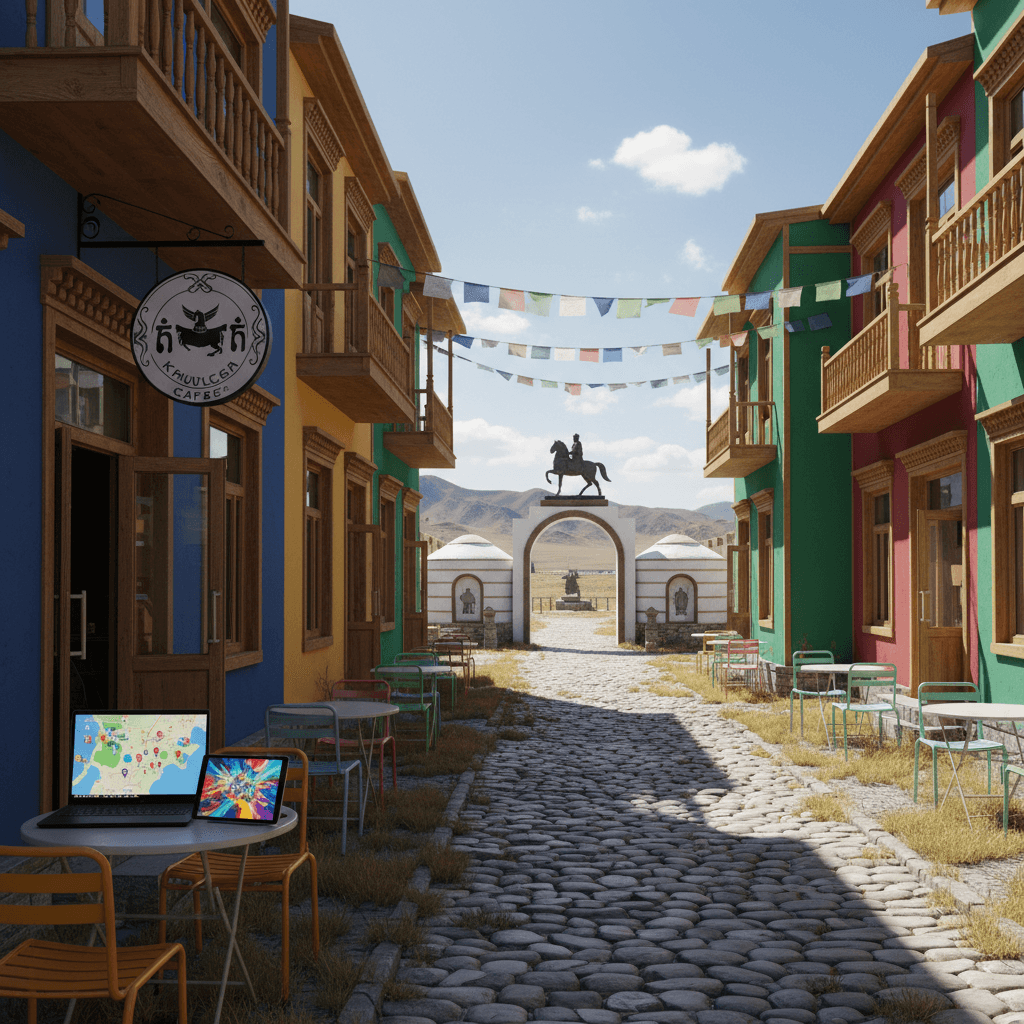
Arvaikheer
🇲🇳 Mongolia
The Vibe: Authentic Steppe Soul
Arvaikheer isn't your typical digital nomad hub. It's a rugged, functional provincial capital that feels more like a frontier outpost than a remote work destination. Sitting at the crossroads of the central steppe and the Gobi Desert, the town has a raw, unpolished energy. You won't find avocado toast or artisanal espresso here. Instead, you'll find the smell of coal smoke in the winter, the sound of motorcycles buzzing toward the grasslands, and a local population that is deeply connected to the nomadic traditions of the surrounding Ovorkhangai province.
Living here feels like stepping back from the digital grid. The pace is slow, dictated more by the weather and the livestock markets than by Slack notifications. It's a place for the nomad who is burnt out on Bali and Lisbon and wants to experience Mongolia without the heavy smog and traffic of Ulaanbaatar. You'll spend your afternoons walking through the dusty central market or visiting the local museum, which houses impressive artifacts from the nearby Orkhon Valley. It’s quiet, safe, and undeniably authentic.
The Reality Check: Infrastructure and Connectivity
Let's be real about the work setup: Arvaikheer is a "deep work" destination, meaning you better have your projects downloaded and your offline tools ready. There are no dedicated coworking spaces, and the cafe culture is virtually non-existent. You'll likely be working from a desk in a local hotel or a basic guesthouse. Internet speeds are modest, often hovering around 5 Mbps, and while 4G coverage exists, it can be spotty during the frequent steppe winds.
Most nomads use Arvaikheer as a "buffer zone." It's the place where you recharge your batteries, restock your supplies, and send a few emails before heading out on a multi-day trek to the Shankh Monastery or the Gobi. If you need lightning-fast fiber optics and a community of tech entrepreneurs, you'll want to stay in Ulaanbaatar and just visit Arvaikheer for a week of quiet immersion.
Cost of Living
Your dollar goes incredibly far here, mostly because there isn't much to spend it on. It is significantly cheaper than the capital, with costs running 30% to 50% lower across the board. Cash is king; while some shops in the center might take a card, you'll want a thick stack of Mongolian Tugrik (MNT) for daily life.
- Budget Tier: $800 to $1,200 per month. This covers a bed in a local guesthouse, plenty of meat-heavy local meals, and basic transport.
- Mid-Range Tier: $1,500 to $2,000 per month. This gets you a private room in the best hotel in town, frequent taxi rides, and high-quality gear for desert excursions.
- Comfortable Tier: $2,500+ per month. At this level, you’re likely paying for private drivers and guided tours into the Orkhon Valley while maintaining a base in town.
The Emotional Experience
There is a specific kind of loneliness in Arvaikheer that some travelers find meditative and others find crushing. You are 350km away from the nearest "Western" comforts. English is rarely spoken, so you'll be relying on Google Translate and hand gestures to buy your groceries. But there’s a payoff: the hospitality. It’s common for locals to invite you for salty milk tea or a bowl of khuushuur (fried meat pastries) just because you look like an interesting stranger.
The best time to be here is between June and August. The weather is warm and dry, and the surrounding hills turn a brilliant green. Avoid the winter months from December to March unless you are prepared for temperatures that regularly drop to -20°C. During the summer, the town feels like a gateway to adventure. You’ll see overland trucks filled with explorers and local herders coming into town to trade, creating a unique mix of global wanderlust and ancient tradition.
Practical Logistics
- Getting Around: The town center is small and walkable. For longer trips, use the UBCab app if you can find a driver, or head to the local transport hub to negotiate a ride in a shared van.
- Connectivity: Don't rely on hotel Wi-Fi. Pick up an Airalo e-SIM or a local Unitel SIM card before you leave Ulaanbaatar.
- Health: There is a local hospital for emergencies, but for anything serious, you'll be heading back to the capital. Always carry SafetyWing or similar travel insurance.
- Social Life: Your social life will revolve around the people you meet on tours or the families you encounter at the market. There are no expat bars, but the local spirit is welcoming if you're willing to make the first move.
The Reality of the Steppe
Arvaikheer isn't your typical digital nomad hub. It's a rugged, functional provincial capital that serves as the gateway to the Gobi and the Orkhon Valley. You won't find artisanal espresso or high-speed fiber optics here. Instead, you get a front-row seat to the authentic Mongolian steppe lifestyle at a fraction of the cost of Ulaanbaatar.
Most travelers use the town as a 48-hour pitstop to restock supplies, but if you're looking for extreme isolation and a rock-bottom budget, a longer stay is doable. Just be prepared for a "digital detox" vibe, as the infrastructure isn't built for heavy Zoom calls or large file uploads.
Monthly Budget Breakdown
Since there's no established expat market, prices are geared toward locals. You can expect your daily spend to be 30% to 50% lower than in the capital. Cash is king here; while some shops take cards, you'll want a thick stack of Tugrik (MNT) for markets and guesthouses.
- Budget Tier ($800 - $1,200/month): This covers a bed in a local guesthouse or a very basic apartment, plenty of mutton-based street food, and getting around on foot. It's a "live like a local" lifestyle.
- Mid-Range Tier ($1,500 - $2,000/month): This gets you a private room in the best hotel in town, like the Arvaikheer Hotel, and daily meals at the few sit-down restaurants available.
- Comfortable Tier ($2,500+): Frankly, it's hard to spend this much in Arvaikheer. You'd likely be paying for private drivers and high-end tours into the nearby wilderness every weekend.
Key Expenses
Prices fluctuate based on the season, but these are the benchmarks for 2025-2026 planning. Keep in mind that "upscale" options are almost non-existent.
Accommodation
- Local Guesthouse: $200 - $300 per month
- Standard Hotel Room: $400 - $600 per month
- Private Apartment: Negotiable locally, typically $350 - $500
Food and Drink
- Local Meal (Khuushuur or Buuz): $2 - $4
- Mid-range Dinner: $6 - $12
- Domestic Beer (0.5L): $1.50 - $2.50
- Coffee: $2 (available in limited spots)
Connectivity and Logistics
Don't rely on hotel Wi-Fi. It's often spotty or nonexistent. Your best bet is to grab an Airalo e-SIM before you arrive or pick up a local Unitel or Mobicom SIM in Ulaanbaatar. Data is cheap, but speeds in Arvaikheer rarely exceed 5 Mbps, which is fine for emails but frustrating for video.
For getting around, the town is small enough to walk. If you need a lift, there are no formal ride-sharing apps like Uber. Locals use UBCab in the capital, but here you'll mostly rely on informal "gypsy" taxis. A short ride across town shouldn't cost more than $2 or $3. For trips back to Ulaanbaatar, use the TapaTrip app to book a seat on a long-distance bus, which is much more reliable than trying to wing it at the station.
Practical Survival
Healthcare is limited to a basic local hospital. For anything serious, you'll be heading back to Ulaanbaatar. Most nomads carry SafetyWing or similar insurance that covers emergency evacuation. Also, remember that Arvaikheer is a cash-heavy environment. While there are a few ATMs near the central market, they occasionally run out of bills or reject foreign cards, so always have a backup stash of USD or Tugrik.
The Nomad Perspective: Central Hub
Arvaikheer isn't a city of distinct districts or trendy suburbs. It is a compact provincial center where everything revolves around the Central Square and the main market area. For nomads, the "neighborhood" to aim for is the small pocket of paved streets near the Arvaikheer Museum and the local government buildings. This is where you'll find the most reliable electricity and the town's local hotels near Central Square.
- Rent: Expect to pay $300 to $500 for a long term hotel arrangement, as private apartment listings for foreigners are virtually non existent.
- Vibe: Dusty, authentic, and quiet. You are here for the silence, not the networking.
- Connectivity: There are no coworking spaces. Your best bet is using an Airalo e-SIM or a local Unitel card, but don't expect speeds over 5 Mbps.
The Expat Choice: The Southern Fringe
Expats, mostly those working in education or development, often gravitate toward the newer housing clusters on the southern edge of town. This area feels slightly less congested than the central market zone. It provides easier access to the open steppe for evening walks while remaining within a 15 minute walk of the Delgerekh Market for supplies. Living here requires a "boots on the ground" approach; you'll need to talk to locals or check physical notices at the market to find a rental, as there are no digital platforms for this region.
- Pros: Quick access to the countryside and lower noise levels.
- Cons: No high end amenities; you'll be cooking most of your meals with ingredients from the local stalls.
- Transportation: Entirely walkable, though you'll want the UBCab app for the rare local driver or for organizing trips out to the Orkhon Valley.
For Families: Near the Parks
If you are bringing a family, stay close to the Children’s Park area. It is one of the few places with a bit of dedicated green space and recreational equipment. While Arvaikheer is generally safe and has a low crime rate, the lack of international schooling means most families only stay here for short stints. Healthcare is limited to a basic provincial hospital, so families usually keep a "medication kit" and a plan to head back to Ulaanbaatar for anything serious.
- Daily Life: Shopping is a daily social event at the local markets where you can find fresh dairy and meat.
- Cost of Living: A family can live comfortably on $1,200 a month, including a private driver for weekend excursions.
Solo Travelers: The Market District
Solo travelers should stick to the guesthouses immediately surrounding the main market. This is the heartbeat of Arvaikheer. Staying here puts you at the center of the action for catching shared vans to Karakorum or the Gobi Desert. It is easy to meet people at the local eateries serving khuushuur (fried meat pastries) or buuz (steamed dumplings). Since English is rarely spoken, have Google Translate ready with the Mongolian Cyrillic pack downloaded.
- Safety: Very high, though the "neighborhood" can feel dark at night due to limited street lighting.
- Budget: You can get by on $25 to $40 a day including food and a basic room.
- Top Tip: Use the TapaTrip app to pre book your bus tickets back to the capital, as the central station gets crowded quickly.
If you are planning to clock forty hours a week of high bandwidth video calls from Arvaikheer, you might want to rethink your strategy. This is a rugged provincial outpost, not a digital hub. While it serves as a vital supply stop for those venturing into the Gobi or the Orkhon Valley, the infrastructure for remote work is skeletal at best. You are here for the silence of the steppe, not the speed of the fiber optics.
The Connectivity Reality
Expect internet speeds to hover around a frustrating 5 Mbps on a good day. While Ulaanbaatar is slowly modernizing, rural towns like Arvaikheer still struggle with consistency. Most local Wi-Fi, where it exists, is found in the few hotels near the town center. It is usually enough for checking emails or sending a few Slack messages, but uploading large video files will likely result in a timeout.
Most travelers and nomads who pass through recommend bypasssing local Wi-Fi entirely in favor of a robust data plan. Here is how to stay online:
- Airalo E-SIM: This is the most seamless option for 2025. It allows you to skip the hunt for a physical SIM card and provides decent coverage within the town limits.
- Local SIMs: If your phone isn't E-SIM compatible, look for Unitel or Mobicom kiosks. You will need your passport, and it is best to handle this in Ulaanbaatar before heading south, as English speaking support is rare in Arvaikheer.
- Hotspotting: Your phone will likely be your primary router. Bring a high quality power bank, as power fluctuations in the steppe can happen during summer storms.
Coworking and Work-Friendly Cafes
Searching for a dedicated coworking space in Arvaikheer is a fruitless task. There are no desks for rent, no ergonomic chairs, and certainly no community managers. This is a town of approximately 25,000 people focused on trade and livestock, not tech startups. If you need to work, you will be doing it from your accommodation.
The "cafe culture" here is almost non-existent in the Western sense. You won't find a row of people on MacBooks sipping oat milk lattes. Instead, you'll find local eateries serving salty milk tea and mutton dumplings. These spots are great for a quick meal, but they aren't designed for lingering with a laptop. Most nomads choose to stay in one of the central hotels and use the lobby or their room as a makeshift office.
Practical Work Setup Tips
Since you won't have a professional office to lean on, your gear becomes your lifeline. Experienced nomads in Mongolia suggest a few specific workarounds for the rural interior:
- Offline Mode: Download everything you need while you are still in Ulaanbaatar. Assume the internet will be down for hours at a time.
- VPN: While Mongolia doesn't have the same strict censorship as its neighbors, a VPN is still a smart move for security when using open hotel networks.
- Timing: If you have a sync meeting, try to schedule it for early morning. Network congestion tends to peak in the evenings when locals are streaming content.
Ultimately, Arvaikheer is a place to disconnect. Most remote workers treat it as a "low-admin" zone, using their time here to catch up on writing or deep work that doesn't require a constant connection. If your job demands high speed reliability, keep your stay here short and head back to the capital for your heavy lifting.
Safety Overview
Arvaikheer is a quiet provincial hub where the biggest risks are more likely to be a sudden dust storm or a stray dog than a pickpocket. It's a tight knit community where everyone knows everyone, making it exceptionally safe for solo travelers and nomads who want to escape the urban grit of Ulaanbaatar. Violent crime against foreigners is almost unheard of here, though you should exercise the usual common sense when wandering the local markets or darker side streets at night.
The real safety concerns in the steppe are environmental. If you're heading out of town for a day trip to the Orkhon Valley or Camel Valley, the weather can flip from sunny to freezing in an hour. Travelers often find that the isolation is the most "dangerous" part of the experience. If your vehicle breaks down or you lose your way, help isn't always around the corner. Always let someone at your guesthouse know where you're going if you're venturing into the grasslands alone.
Healthcare Facilities
Don't expect western style medical centers in Arvaikheer. The town has a basic provincial hospital and several pharmacies along the main road that can handle minor issues like stomach bugs, infections, or small injuries. However, for anything serious or for specialized care, you'll need to head 350km north to Ulaanbaatar. Most expats recommend the Intermed or SOS Medica clinics in the capital for English speaking staff and modern equipment.
- Pharmacy availability: Good for basics like Ibuprofen or bandages, but carry your own prescription meds.
- Language barrier: Doctors in Arvaikheer rarely speak English. Have Google Translate ready or ask a local guide to accompany you.
- Water safety: Stick to bottled or filtered water. While locals drink the tap water, your stomach might not appreciate the mineral content or bacteria levels.
Emergency Contacts
If you find yourself in a bind, memorize the local emergency numbers. Response times can be slow due to the rural setting, so being self reliant is your best bet. Most nomads use SafetyWing or similar travel insurance that covers emergency medical evacuation, which is a must have for this part of the world.
- Police: 102
- Ambulance: 103
- Fire and Emergency: 101 or 105
Practical Tips for Staying Healthy
The air quality in Arvaikheer is significantly better than Ulaanbaatar's notorious winter smog, but the dry, dusty steppe air can still irritate your throat and eyes. Pack a good moisturizer and saline nasal spray. If you're visiting during the winter months of December to March, the extreme cold is your primary health hazard. Temperatures can plummet to -20°C, so high quality thermal gear isn't optional, it's a survival requirement.
Lastly, be mindful of the local diet. It's heavy on mutton and dairy, which is delicious but can be a shock to the system if you aren't used to high fat meals. Many travelers recommend carrying a small supply of electrolytes and probiotics to help your digestion adjust to the nomadic fare.
Getting Around Arvaikheer
Arvaikheer isn't your typical digital nomad hub with a grid of metro lines and scooter shares. It is a compact, dusty provincial center where the steppe meets the street. Most of the town is easily navigable on foot. Since the center is where you'll find the main shops, the local museum, and the central market, you can reach almost everything you need within a 15 to 20 minute walk.
Local Taxis and Ridesharing
You won't find Uber or Bolt here. While Ulaanbaatar residents rely on the UBCab app, its utility in Arvaikheer is limited. Local transport usually involves informal taxis. You can stand on a main road and wave your hand down; a local driver will likely pull over. Expect to pay around 1,000 to 2,000 MNT ($0.30 to $0.60) for a short hop across town. It is helpful to have your destination pinned on Google Maps or written in Cyrillic, as English proficiency among drivers is very low.
Inter-City Travel
Most travelers arrive in Arvaikheer as part of a larger overland tour or via the paved road from Ulaanbaatar, which is about 350km to the north. If you are traveling independently, the TapaTrip app is a lifesaver for booking inter-city bus tickets. It allows you to skip the confusion at the bus station and secure a seat in advance, which is necessary during the peak summer months of July and August.
- Public Bus: Reliable and cheap, connecting to the capital in about 6 to 7 hours.
- Private Vans: Often found near the markets, these "purgons" or minivans leave when full and are a gritty, authentic way to reach smaller villages.
- Shared Jeeps: The standard for heading south into the Gobi or north to the Orkhon Valley. Prices are negotiated per seat.
Navigation Tips
The town layout is fairly straightforward, but the lack of traditional street signs can be disorienting. Download offline maps for the entire Ovorkhangai province before you arrive. Since mobile data can be spotty once you leave the town limits, don't rely on a live connection for navigation. If you are heading into the wilderness for a day trip to Shankh Monastery or the Camel Valley, hiring a local driver is much safer than attempting to navigate the unmarked steppe tracks yourself.
Practical Essentials
- Walking: Free and the best way to soak in the local atmosphere. Wear sturdy shoes as the terrain is often uneven and unpaved.
- Cash: Always keep small denominations of Tugrik (MNT) for taxi fares. Drivers rarely have change for large bills and almost never accept cards.
- Language: Use Google Translate's offline Mongolian pack. Pointing to a map works, but being able to say "Sain baina uu" (Hello) goes a long way with local drivers.
- Emergency Numbers: Police: 102, Ambulance: 103, Fire: 101.
Air Travel
There are currently limited or no regular commercial flights serving Arvaikheer. Your primary gateway remains Chinggis Khaan International (UBN). From there, you'll need to arrange a private transfer or take the long distance bus. Most expats and long term travelers recommend stocking up on supplies in Ulaanbaatar before making the trek down, as the vehicle options in Arvaikheer are geared more toward rugged utility than comfort.
The Language Barrier
Expect a significant shift in communication once you leave the bubble of Ulaanbaatar. In Arvaikheer, Mongolian is the only language you'll hear on the streets. While the younger generation in the capital might speak decent English, that's rarely the case here in the heart of the steppe. Most locals use the Cyrillic script, so being able to phonetically read signs for "Bank" or "Pharmacy" will save you a lot of headache.
Most travelers find that interactions are incredibly friendly but limited to gestures and basic phrases. If you're staying at one of the local guesthouses or the few hotels in town, the staff might know a few words of English, but don't count on it for complex requests. It's a place where patience and a smile go further than a loud voice.
Digital Tools for Survival
Since English isn't widely spoken, your smartphone is your best friend. You'll want to download Google Translate and the Mongolian language pack for offline use. The camera translation feature is a lifesaver when you're staring at a menu full of mutton dishes or trying to figure out which bottle in the market is milk and which is yogurt.
For getting around, the UBCab app is the standard in Mongolia, though its utility in Arvaikheer is hit or miss compared to the capital. It's still worth having because it uses a map interface that helps you show drivers exactly where you want to go. If you're booking transport to nearby sites like the Orkhon Valley, the TapaTrip app is the go-to for checking bus schedules and securing seats without having to negotiate in broken Mongolian at the station.
Essential Phrases
Learning a few keys words will open doors and earn you a lot of respect from the locals. Start with these:
- Sain baina uu? (Pronounced: SIGN-be-noo): Hello.
- Bayarlalaa (Pronounced: Buy-ar-la-la): Thank you.
- Zaa (Pronounced: Zah): This is the most versatile word in the country. It means okay, understood, or sure.
- Uuchlaarai (Pronounced: Ooch-la-ray): Sorry or excuse me.
- Ene yamar unetei ve? (Pronounced: En yam-ar oon-tay ve?): How much is this?
Connectivity and SIM Cards
Staying connected is the biggest hurdle for nomads in this region. Arvaikheer is a provincial hub, so you'll get decent 4G coverage in the town center, but it drops off quickly once you head into the grasslands. Most digital nomads recommend grabbing an Airalo e-SIM before you arrive. It's the most frictionless way to get data without hunting for a physical shop that might not have staff who can help you set it up.
If you prefer a local physical SIM, look for Unitel or Mobicom kiosks. You'll need your passport to register. While data is cheap, usually around $5 to $10 for a generous monthly plan, the speeds are rarely high enough for heavy video calls. If you're planning to work, do it from your hotel or a quiet corner of a cafe using a mobile hotspot, as public Wi-Fi is almost non-existent in this part of the country.
Cultural Communication
Communication in rural Mongolia is as much about etiquette as it is about words. If you're invited into a home or a ger, there are a few unspoken rules. Never lean against the support pillars of a ger, and always accept food or tea with your right hand, often supporting your right elbow with your left hand. It’s a sign of respect that speaks louder than any phrasebook. Even if you don't want the fermented mare's milk, taking a small sip is the polite way to say "thank you" without saying a word.
Survival of the Fittest: The Seasonal Cycle
Arvaikheer sits in the heart of the Mongolian steppe, where the weather isn't just a topic of conversation; it's the primary factor in whether you can actually get work done. The town experiences extreme continental shifts. You'll deal with bone-chilling winters where temperatures frequently plummet to -20°C (-4°F) or lower in January and February. Most travelers and digital nomads avoid the region entirely during this window, as the infrastructure isn't always up to the task of keeping you warm and connected when the ground is frozen solid.
Spring is a bit of a wild card. April and May bring the infamous steppe winds. These aren't just light breezes; they're dusty, sustained gusts that can make walking to a local market feel like a trek across a construction site. While the snow starts to melt, the landscape remains brown and the air quality can be hit or miss depending on local heating habits.
The Golden Window: June to August
If you're planning a stint in Arvaikheer, aim for the summer months. June, July, and August are easily the best times to visit. Daytime temperatures hover around a comfortable 20°C (68°F), though it can occasionally spike higher. This is the only time of year when the surrounding grasslands turn a brilliant green, providing the "soul-stirring" backdrop most people come to Mongolia to find.
Rain is rare in this arid climate, but when it does fall, it usually happens in July. These are typically short, sharp bursts rather than days of drizzle. This is also the season for the Naadam Festival in mid-July. While the biggest party is in Ulaanbaatar, the local celebrations in Arvaikheer offer a much more intimate, authentic look at wrestling, horse racing, and archery without the massive tourist crowds.
Shoulder Season and the Big Freeze
September is the "secret" month for those who like it quiet. The summer crowds (mostly overland tour groups) thin out, and the days remain crisp and clear. You'll need to pack serious layers, though, as night temperatures can drop toward freezing even in early autumn. By October, the town begins its transition back into deep winter mode.
- High Season (June–August): Best weather, green landscapes, and active local festivals. Expect higher prices for the few available guesthouses.
- Shoulder Season (May & September): Cool and windy. Good for those who want total solitude, but some regional tours might stop running.
- Low Season (October–April): Brutally cold. Not recommended for remote work unless you have a high tolerance for isolation and potential power or internet flickers.
Most nomads find that a two-week stay in July provides the perfect balance. You get the best of the weather for day trips to the Orkhon Valley or Shankh Monastery, while avoiding the logistical nightmares of a Mongolian winter. Just remember that even in the height of summer, the steppe is unpredictable. Always carry a windbreaker and a warm fleece, because once the sun dips behind the horizon, the temperature drops fast.
Survival Basics
Arvaikheer isn't your typical nomad hub. It's a rugged provincial center that serves as the gateway to the Gobi and the Orkhon Valley. If you're coming here, you're trading high-speed fiber for wide-open steppe. Most travelers use it as a 48 to 72 hour pit stop to restock supplies and get a hot shower between desert expeditions.
Cash is king here. While Ulaanbaatar is increasingly digital, you'll want plenty of Mongolian Tugrik (MNT) in your pocket for Arvaikheer's local markets and guesthouses. There are ATMs near the central square, but they occasionally run out of bills or reject international cards, so don't wait until you're down to your last 500 Tugrik to withdraw more.
Cost of Living
Your bank account will love Arvaikheer, even if your productivity doesn't. Prices here are roughly 30% to 50% lower than in the capital. You won't find luxury lofts, but your daily burn rate will be remarkably low.
- Budget Tier: $800 to $1,200 per month. This covers a bed in a local guesthouse for about $250 and plenty of mutton-based street food for $3 a meal.
- Mid-Range Tier: $1,500 to $2,000 per month. This gets you a private room in a local hotel like the Arvaikheer Hotel for $500 a month and more frequent private transport.
- Comfort Tier: $2,500+ per month. Since there isn't much to buy, you'll likely spend this on private 4x4 drivers and high-end tours into the surrounding wilderness.
Connectivity and Workspace
Let's be real: you aren't coming here to lead Zoom calls. Average speeds hover around 5 Mbps, and that's if the weather is clear. There are no dedicated coworking spaces in town. Your best bet is to work from your hotel lobby or use a local SIM card as a hotspot.
Skip the physical SIM hunt and download Airalo before you arrive. It’s the easiest way to stay connected, though coverage gets spotty once you leave the town limits. If you need a local number, Unitel and Mobicom have the best reach in this part of the country.
Getting Around
Arvaikheer is small enough that you can walk almost everywhere within the central grid. For longer trips or when the steppe winds get too dusty, local taxis are cheap but informal. You won't find Uber here. Instead, download UBCab, though it's mostly focused on Ulaanbaatar. For inter-city travel, use the TapaTrip app to book bus tickets back to the capital or toward the Gobi; it saves you from the chaos of the local ticket windows.
Safety and Health
The town is generally safe and locals are incredibly hospitable. The biggest "dangers" are the extreme weather and the isolation. If you get sick, there's a local provincial hospital for basics, but for anything serious, you'll want to head 350km north to Ulaanbaatar. Always carry SafetyWing or similar travel insurance that covers emergency medical evacuation. If you have an emergency, dial 105 for police or 103 for an ambulance.
Social Life and Language
Don't expect a nightlife scene. Socializing happens over milk tea in family homes or at the central market. English proficiency is very low here compared to the capital. You'll need Google Translate and a few key phrases like "Sain baina uu?" (Hello) and "Bayarlalaa" (Thank you) to get by. Respect is huge in nomadic culture; if someone offers you food or tea, it's polite to accept it with your right hand, even if you only take a small sip.
Best Time to Visit
The window for a comfortable stay is narrow. Aim for June through August when the steppe is green and the temperatures are a pleasant 20°C (68°F). Avoid December through March unless you're prepared for -20°C (-4°F) temperatures and brutal winds that can shut down local transport for days.
Need visa and immigration info for Mongolia?
🇲🇳 View Mongolia Country GuideWild Card
Expect the unexpected