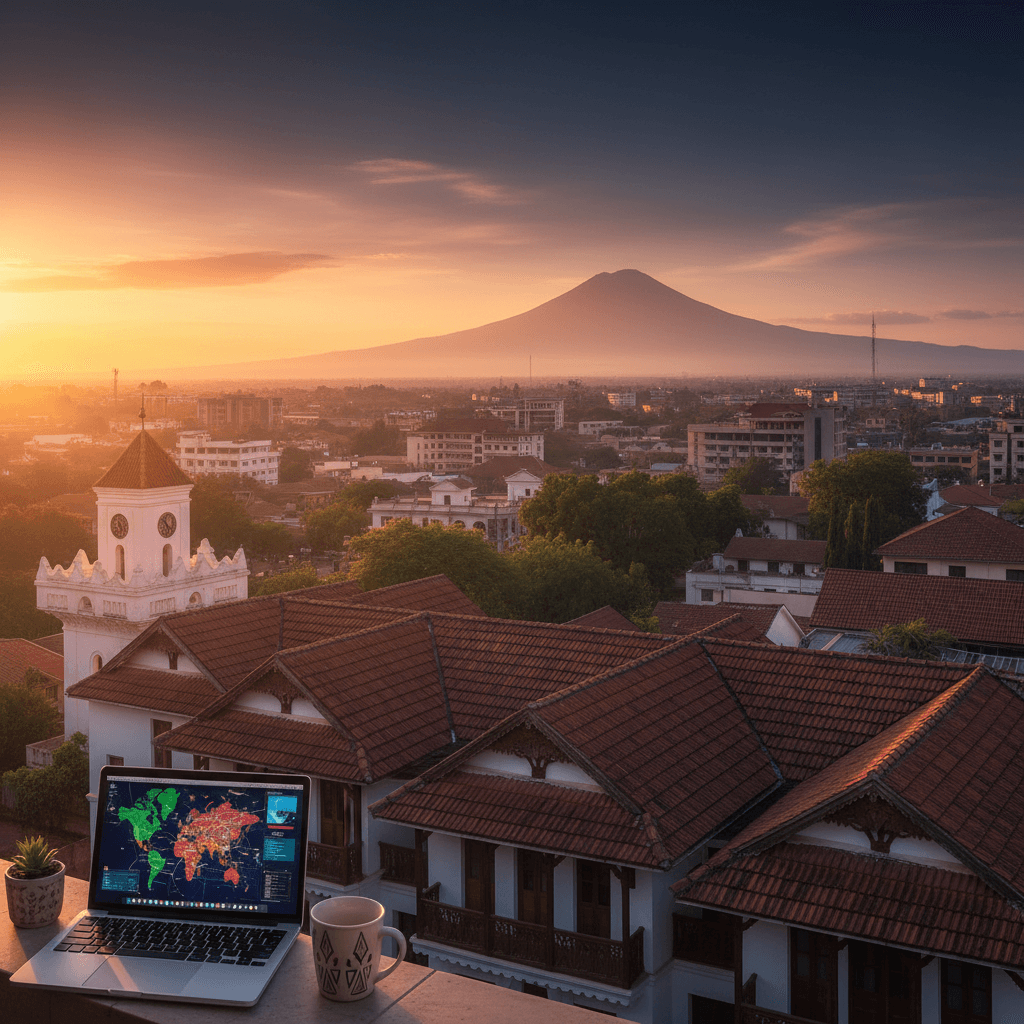
Arusha
🇹🇿 Tanzania
The Gateway to the Wild
Arusha isn't your typical concrete jungle. Nestled at the base of Mount Meru and acting as the staging ground for Serengeti expeditions, it feels more like a sprawling, lush outpost than a frantic metropolis. For nomads, the draw here is the balance of a slower pace and the constant hum of adventure. You'll wake up to the smell of Tanzanian coffee and the sight of mist rolling off the mountains, knowing that a world class safari is just an hour away.
The vibe is a unique blend of local Swahili life and an international nonprofit scene. Because it's the hub for many NGOs and conservation groups, you'll find a community of expats and travelers who are actually doing something, rather than just passing through. It's a place where you can spend your morning on a Zoom call at Obuntu Hub and your afternoon tracking giraffes in Arusha National Park.
What You'll Spend
Arusha is remarkably kind to the wallet, especially compared to the coastal heat of Dar es Salaam. Most nomads find they can live comfortably on $1,200 to $1,800 per month, though you can certainly push that higher if you prefer upscale lodges and private drivers.
- Budget ($800 to $1,200): You'll be staying in central studio apartments for around $300 to $500, eating plenty of $3 nyama choma (grilled meat) from street vendors, and using local transport.
- Mid-range ($1,200 to $1,800): This covers a nice one bedroom apartment for $500 to $800, frequenting cafes like Fifi's, and using ride hailing apps to get around.
- Comfortable ($1,800 to $2,500+): Expect high end serviced apartments for $800+, private transfers, and dinners at upscale lodges where meals run $30 to $50.
Where to Plant Your Flag
The city doesn't have a single "nomad district," but most remote workers gravitate toward a few specific pockets depending on their tolerance for noise and traffic.
Central Arusha
- Best for: Social butterflies and those who want to walk to work.
- The Draw: This is where you'll find Obuntu Hub, the city's premier coworking space. It's close to the best cafes and social spots.
- The Trade-off: It gets loud, the traffic can be a headache, and you'll need to keep a close eye on your phone and wallet in crowded markets.
Expat Outskirts
- Best for: Families or solo travelers seeking peace and quiet.
- The Draw: These areas are greener and much closer to the entrance of the national parks. It's quiet enough to actually hear the birds.
- The Trade-off: You're looking at a longer commute for social events and limited nightlife options.
Connectivity and Coffee
Internet in Arusha is surprisingly capable if you know where to go. While the infrastructure can be inconsistent outside the urban core, the city center offers 4G+ speeds of 20 to 35 Mbps. Most nomads recommend grabbing a Vodacom or Airtel SIM card immediately; $25 usually gets you a month of unlimited data.
When you need to escape your apartment, Obuntu Hub provides a focused environment with reliable desks. For a more relaxed afternoon, Blue Heron and Fifi's Cafe are the go-to spots. They consistently hit 10+ Mbps and serve some of the best coffee in the region. It's common to see a row of laptops at these spots, making it easy to strike up a conversation with a fellow traveler.
Life on the Ground
Getting around is an adventure in itself. The local dala-dalas (minibuses) are incredibly cheap at $0.50 per ride, but they're often packed to the rafters. Most expats stick to ride hailing apps or local motorcycle taxis known as boda-bodas. A taxi from Kilimanjaro International Airport to Arusha typically costs $45-$60 USD for the one-hour drive.
Safety is generally good, provided you use common sense. Petty theft happens in busy markets, so don't flash your latest iPhone. Stick to well lit areas at night and avoid walking alone in the outskirts after dark. For healthcare, there are decent private clinics in the center that stock common medications, but for anything serious, travelers usually head to the larger hospitals or ensure their insurance covers medical evacuation.
The weather is one of Arusha's best features. It stays warm year round, averaging 32°C. The sweet spot is July to September, when the days are a perfect 25°C and the rain stays away. If you visit between March and May, prepare for heavy downpours that can turn the unpaved side streets into muddy rivers.
The Monthly Budget
Living in Arusha is significantly more affordable than the coastal hub of Dar es Salaam, making it a favorite for nomads who want their dollars to stretch further while staying close to the gate of the Northern Safari Circuit. Most digital nomads find that a monthly budget between $1,200 and $1,800 allows for a comfortable lifestyle, including a private apartment, frequent cafe visits, and a few weekend excursions. If you are on a tighter budget, you can get by on roughly $800 to $1,200 by sticking to local markets and basic studio rentals.
For those who prefer a bit of luxury, $2,500 or more per month covers an upscale villa on the outskirts, private drivers, and dining at high end lodges. Here is a breakdown of what to expect for your monthly spend:
- Budget Tier ($800 to $1,200): Studio rent in central areas for $300 to $500, street food meals like nyama choma for $3, and local transport via dala-dalas.
- Mid-range Tier ($1,200 to $1,800): A one-bedroom apartment for $500 to $800, meals at spots like Fifi's Cafe for $10, and regular ride-hailing services.
- Comfortable Tier ($1,800 to $2,500+): Upscale housing for $800+, fine dining at $30 to $50 per meal, and private airport transfers.
Housing and Neighborhoods
Arusha doesn't have a single "nomad district," so your choice of neighborhood depends on whether you value proximity to the office or a view of the mountains. Expats generally recommend looking for rentals via Airbnb or Nomad Stays to ensure reliable Wi-Fi before you commit to a long term lease.
Central Arusha
- Best For: Walkability and social connections.
- Rent: $400 to $700 for a decent 1BR.
- Vibe: You are close to Obuntu Hub and popular cafes. It is convenient but can be noisy with traffic and carries a slightly higher risk of petty theft in crowded markets.
The Outskirts (near Arusha National Park)
- Best For: Nature lovers and families.
- Rent: $600 to $900+ for larger, green properties.
- Vibe: Quiet and lush with easy access to day trips. You'll need a reliable driver or your own wheels, as it is a trek from the city center's nightlife.
Connectivity and Coworking
Internet in Arusha is surprisingly capable for video calls, typically hovering between 20 and 35 Mbps on 4G+ networks. Obuntu Hub is the go-to coworking space, offering a quiet environment and reliable desks for roughly $50 to $100 a month. If you prefer the cafe scene, Blue Heron and Fifi's Cafe are nomad staples where the Wi-Fi stays consistently above 10 Mbps.
For mobile data, travelers suggest grabbing a Vodacom or Airtel SIM card immediately. An unlimited monthly data bundle will set you back about $25. It is a smart backup for those days when the local power grid decides to take an unscheduled break.
Day-to-Day Expenses
Getting around is cheap if you are brave enough for the $0.50 dala-dala rides, but most nomads opt for ride-hailing apps like inDriver or local boda-bodas. A taxi from Kilimanjaro International Airport to the city center typically costs $45-$60 USD and takes about an hour.
Food costs are a highlight here. You can eat a filling meal of ugali and grilled meat on the street for under $5. If you are grocery shopping, stick to the local markets for produce, as imported goods at expat supermarkets will quickly inflate your grocery bill. For banking, most expats use Wise or Grey for international transfers and rely on M-Pesa for daily mobile payments at shops and restaurants.
The Nomad Hub: Central Arusha
If your priority is being within walking distance of a reliable espresso and a solid Wi-Fi connection, stay near the city center, specifically the area surrounding Obuntu Hub. This is the heartbeat of the local nomad scene where you can snag a desk for around $50 to $100 a month. Most remote workers gravitate here because it cuts down on the city's notorious traffic and puts you close to Fifi's Cafe and Blue Heron, two spots where the internet hits 10 Mbps consistently.
- Rent: $300 to $500 for a central studio.
- Vibe: Social, fast-paced, and convenient.
- Best for: Networking and those who don't want to rely on transport for daily needs.
Living here means you're never far from a Vodacom or Airtel shop to top up your data, which usually costs about $25 for a month of unlimited usage. Just keep your wits about you in the local markets; petty theft happens, so don't flash your MacBook while walking between cafes.
The Expat Enclave: Outskirts & Green Belts
Expats who plan on staying more than a few months often migrate toward the leafier outskirts, particularly the residential pockets heading toward Arusha National Park. These areas feel like a different world compared to the dusty city core. It is quiet, lush, and offers a much-needed break from the heat, with temperatures hovering around 25°C during the dry season from June to October.
- Rent: $500 to $800 for a 1-bedroom apartment or small house.
- Vibe: Peaceful, green, and private.
- Best for: Long-term stays and those who prioritize nature over nightlife.
The trade-off is the commute. You'll likely need to rely on ride-hailing apps like inDriver or local Boda drivers to get into town. If you choose this area, ensure your Airbnb or rental has a verified backup power source, as infrastructure can get spotty the further you get from the center.
The Family Perimeter: Safe & Spacious
Families usually look for gated communities or serviced apartments on the northern edge of the city. These spots provide more square footage and a sense of security that is harder to find in the dense urban center. You are closer to international schools and the upscale lodges where a meal might run you $30, but the quality is top-tier.
- Rent: $800 to $1,500+ for larger, upscale 1BR or 2BR units.
- Vibe: Secure, suburban, and quiet.
- Best for: Those with children or nomads with a higher budget who want "home" comforts.
Healthcare is also more accessible here, with private clinics favored by the international community nearby. While dala-dalas are a cheap $0.50 way to get around, most families opt for private transfers or monthly car rentals to avoid the crowded public vans.
The Solo Traveler Spot: City Center
For solo travelers who want to be in the thick of it, the immediate city center is the move. You'll be steps away from nyama choma (grilled meat) stalls where a meal costs just $3. It is noisier and more chaotic than the outskirts, but it is the best place to meet people and find last-minute safari deals to the nearby national parks for around $100.
- Rent: $10 to $20 per night for short-term serviced rooms.
- Vibe: Energetic, authentic, and slightly gritty.
- Best for: Short-term stays and budget-conscious solo explorers.
The social scene here revolves around the bars and pubs that stay lively well into the night. It is the easiest place to navigate on foot, though you should avoid walking alone on unlit streets after dark. Stick to the well-traveled paths near the main hotels and you'll find Arusha to be a welcoming, albeit busy, base for your Tanzanian stint.
Connectivity and Speeds
Arusha is surprisingly reliable for remote work if you stick to the urban center. You can expect 4G+ speeds between 20 and 35 Mbps, which is plenty for Zoom calls and standard workflows. While the fiber infrastructure isn't as robust as Dar es Salaam, the mobile data networks are the real heroes here.
Most nomads skip the hotel Wi-Fi and head straight for a Vodacom or Airtel SIM card. You can pick these up at the airport or in town for about $10. A monthly unlimited data bundle usually runs around $25. It's smart to have a backup hotspot from a different provider because local power cuts can occasionally knock out a specific tower for an hour or two.
Top Coworking Spots
The coworking scene in Arusha is small but high quality. Obuntu Hub is the undisputed favorite for anyone staying long term. It has a peaceful atmosphere that feels worlds away from the city traffic. You'll find a mix of social entrepreneurs, nonprofit workers, and tech nomads here. Monthly memberships generally fall between $50 and $100, depending on how much desk time you need.
If you prefer a more corporate environment, there are serviced offices near the city center, but they lack the community feel that Obuntu provides. Most people find that a combination of a home setup and a few days a week at the hub keeps them productive without feeling isolated.
Laptop-Friendly Cafes
Arusha has a fantastic cafe culture thanks to the local coffee industry. When the walls of your Airbnb start closing in, these spots are your best bets:
- Blue Heron: This is a staple for the expat community. It has a lush garden setting and consistent speeds hitting 10+ Mbps. It's perfect for deep work sessions, though it gets busy during the lunch rush.
- Fifi's Cafe: Located in the heart of town, Fifi's is great for a morning of emails. The Wi-Fi is reliable, the coffee is strong, and a mid-range meal will cost you about $10.
- Gran Melia Arusha: If you need a high-end "office" for a day with a view of Mount Meru, their lounge areas are excellent. The coffee is pricier, but the connection is some of the fastest in the city.
Practical Logistics for Digital Nomads
Power stability is the one thing that can catch you off guard. While the central areas are generally fine, it's a good idea to ask your host if their building has a backup generator. If they don't, make sure your laptop and power banks are topped up every night.
For payments, most cafes and hubs take cards, but you'll want M-Pesa for everything else. This mobile money system is king in Tanzania. You can load it up at any small kiosk using your Vodacom SIM. It's the easiest way to pay for everything from your latte to a quick ride across town without fumbling for cash.
If you're looking for a place to stay with verified internet, check Nomad Stays or look for Airbnbs in the Central Arusha area. Staying near the clock tower or the expat-heavy outskirts ensures you're never more than a ten-minute ride from a solid connection and a good cup of Tanzanian coffee.
Street Smarts and Safety
Arusha is generally a welcoming base for nomads, especially if you stick to the central districts and tourist hubs. Most travelers feel comfortable walking around during the day, but the vibe changes after dark. Like many growing urban centers, petty theft is the primary concern here. Bag snatching and pickpocketing can happen in crowded spots like the Central Market or near the dala-dala stations. Most expats recommend leaving expensive jewelry at home and keeping your phone tucked away when you're on the street.
Avoid walking alone on unlit outskirts or quiet residential streets once the sun goes down. If you're heading out for dinner at Fifi's Cafe or a late drink, it's smarter to use a ride-hailing app rather than walking. While violent crime against foreigners is rare, it pays to be cautious. If you're staying in more remote areas near Arusha National Park, ensure your accommodation has basic security measures like a gated compound or a night watchman, which is standard for most mid-range rentals.
Healthcare Basics
The healthcare system in Arusha is functional but tiered. For anything beyond a minor scrape, you'll want to head to a private clinic or hospital. Facilities near the city center are the preferred choice for the nomad community. These private centers are better equipped to handle common tropical ailments or sudden infections. If you have a complex pre-existing condition, you might find the specialized care a bit limited compared to Western standards.
Pharmacies are plentiful in the urban core and usually well-stocked with basics. However, if you rely on specific brand-name medications, bring a three-month supply with you. Local pharmacists can often suggest equivalents, but having your own stash saves a lot of stress. Always double-check that your travel insurance covers medical evacuation for serious emergencies, as the nearest high-level trauma centers are often across the border or in larger cities like Nairobi.
Staying Healthy on the Ground
Don't drink the tap water. Most nomads rely on large 18-liter bottled water jugs for their apartments, which are cheap and easy to swap out. For eating out, the general rule of "boil it, cook it, or peel it" applies, though most established cafes and upscale lodges have high hygiene standards. If you're diving into the local street food scene for some nyama choma, look for vendors with a high turnover of customers to ensure the meat is fresh.
Malaria is a factor in Tanzania, though Arusha's higher elevation means fewer mosquitoes than the coastal regions. Still, it's wise to use repellent in the evenings and sleep under a net if your room isn't screened. Most long-term travelers keep a few malaria test kits and a course of treatment in their first aid kit just in case. Before you fly in, make sure you're up to date on Hepatitis A, Typhoid, and Yellow Fever vaccinations; you might even be asked for your Yellow Fever certificate at the airport depending on where you're arriving from.
Emergency Contacts and Insurance
The general emergency number is 112, but response times for public services can be inconsistent. Most expats keep the direct number of a private ambulance service or their preferred clinic saved in their phone. Digital nomad insurance is a non-negotiable here. Make sure your policy specifically covers "adventure activities" if you plan on trekking Mount Meru or heading out on a multi-day safari, as standard plans often exclude these. It's also worth registering with your embassy upon arrival, a quick task that provides an extra layer of security during your stay.
Getting Around Arusha
Arusha is the gateway to the northern safari circuit, but it functions at a noticeably slower pace than the chaotic energy of Dar es Salaam. While the city core is surprisingly walkable, you'll need a mix of local transport and digital savvy to move between your coworking space and the lush outskirts where many expats reside.
The Airport Arrival
Most nomads fly into Kilimanjaro International Airport (JRO), which sits about an hour east of the city. A private taxi from Kilimanjaro International Airport to Arusha typically costs between $45 and $60 USD. If you are watching your budget, shared shuttles are a reliable alternative and significantly cheaper. Once you reach the city center, the layout becomes manageable, though the lack of sidewalks in some areas means you'll be sharing the road with various two and four wheeled vehicles.
Local Ride-Hailing
You won't find Uber here. Instead, download inDriver or local equivalents to secure rides. It’s the standard way for nomads to get home after dinner at Fifi's Cafe or a late session at Obuntu Hub. Always confirm the price in the app before the driver arrives to avoid any awkward negotiations at your destination. For short hops during the day, Boda Bodas (motorcycle taxis) are everywhere. They are fast and cost a fraction of a car ride, but they come with higher safety risks. If you use them, stick to daylight hours and well traveled routes.
The Dala-Dala Experience
The dala-dala is the backbone of Tanzanian transit. These are white minibuses with colored stripes that follow set routes for about $0.50 per ride. They are notoriously crowded and don't operate on a fixed schedule; they leave when they're full. While they're the most authentic way to see the city, they aren't ideal if you're carrying a laptop bag or need to be on a Zoom call. Most nomads use them for the novelty or for very short, familiar trips across town.
Walking and Biking
The city center is relatively compact. If you're staying near the clock tower or the central markets, you can reach most cafes and banks on foot. However, Arusha's infrastructure is inconsistent. You'll encounter potholes, open drainage, and dusty paths. If you prefer two wheels, you can find bike or scooter rentals near the center for roughly $10 a day. It's a great way to explore the greener, quieter neighborhoods near Arusha National Park, but stay alert for aggressive traffic on the main arteries.
Practical Transit Tips
- Avoid night walks: Even in expat heavy areas, petty theft occurs. Use a taxi or ride-hailing app if you're moving around after dark.
- Keep small change: If you're using dala-dalas or bodas, keep small denominations of Tanzanian Shillings. Drivers rarely have change for large bills.
- Traffic peaks: Arusha experiences heavy congestion during school drop-off and pick-up times. Plan your commutes to coworking spaces accordingly.
- Offline Maps: Download the Arusha region on Google Maps. Signal can be spotty when you venture toward the outskirts or the base of Mount Meru.
For weekend escapes, most travelers book private transfers or join group safaris. A trip to the nearby national park is only an hour away, but the roads can be rough, making a sturdy 4x4 the preferred choice over a standard city taxi.
The Swahili Standard
In Arusha, Swahili isn't just the official language; it's the heartbeat of the city. While you can get by with English in professional circles, the local culture values the effort of a proper greeting. You'll find that a simple Jambo (hello) or Habari (how are you) opens doors and softens negotiations at the local markets. Most nomads find that learning a few phrases isn't just a courtesy, it's a practical tool for daily life.
The pace of conversation here is slower than in Western hubs. People take the time to acknowledge one another before diving into business. If you're heading to a meeting at Obuntu Hub or grabbing a coffee at Fifi's Cafe, expect a few minutes of pleasantries before the "real" talk begins. It's a refreshing change of pace that reflects the city's relaxed atmosphere.
English in the Nomad Scene
You won't have much trouble communicating in English within the expat and tourism sectors. Staff at popular spots like Blue Heron or the various safari lodges are usually quite proficient. Because Arusha serves as the gateway to the Serengeti and Mount Kilimanjaro, the service industry is well attuned to English speakers. Most digital nomads find they can manage complex tasks, like setting up a bank account or discussing a rental agreement, without a translator.
However, once you step away from the central hubs and tourist zones, English proficiency drops off. If you're taking a dala-dala or exploring the local markets for nyama choma, you'll rely more on Swahili and hand gestures. It's a good idea to download the Swahili language pack on Google Translate for offline use, as data can sometimes be spotty when you're on the move.
Staying Connected
Reliable communication relies on your mobile setup. Most expats recommend skipping the international roaming and picking up a local SIM card immediately. You can find kiosks for the major providers at the airport or throughout the city center.
- Vodacom: Generally considered the most reliable for data coverage, especially if you plan on taking weekend trips to the outskirts. Expect to pay around $25 for a monthly unlimited data bundle.
- Airtel: A solid alternative with competitive pricing. A starter SIM usually costs about $10, with data packages similar to Vodacom.
- Halotel: Often praised for having the best reach in rural areas, though its speeds in the city might lag behind the big two.
Digital Communication and Etiquette
WhatsApp is the undisputed king of communication in Tanzania. Whether you're booking a taxi, ordering food, or networking with other nomads, it happens over WhatsApp. Many local businesses don't even use traditional email for quick inquiries; they'll just list a mobile number for messaging.
When it comes to social etiquette, Tanzanians are generally modest and polite. Handshakes are the standard greeting, often lasting a bit longer than you might be used to in Europe or the US. If you're speaking with an elder, a slight nod or a more formal Shikamoo (a respectful greeting) goes a long way. Most travelers say that showing this level of respect makes a massive difference in how you're treated by the community.
Key Phrases for Your First Week
While you'll pick up the basics quickly, having these Swahili essentials ready will help you navigate your first few days in Arusha:
- Asante: Thank you (use Asante sana for "thank you very much").
- Karibu: Welcome. You'll hear this constantly.
- Bei gani?: How much? (Useful for market shopping).
- Hapana asante: No thank you (perfect for politely declining street vendors).
- Pole pole: Slowly, slowly. It's the unofficial motto of life here.
The Sweet Spot: June to October
If you want the quintessential Arusha experience, aim for the dry season between June and October. This is when the weather settles into a predictable, pleasant rhythm with daytime temperatures hovering between 25°C and 28°C. The air is crisp, the sky is usually clear, and you won't be battling the humidity that hits the coast.
For digital nomads, this window is perfect because the power grid tends to be more stable when it isn't raining. It is also the peak time for safari enthusiasts. Since Arusha is the gateway to the Northern Circuit, you can easily tether a Friday afternoon zoom call at Obuntu Hub and be inside Arusha National Park by sunrise on Saturday. Just keep in mind that July and August are the busiest months for tourism, so book your serviced apartments or Airbnbs a few weeks in advance to avoid the price hikes.
The Short Rains and Shoulder Season
From November to February, the "short rains" arrive. Don't let the term scare you off; these are usually brief afternoon bursts that clear the dust and turn the landscape an incredible shade of neon green. Temperatures actually climb a bit during this time, often reaching 30°C or 32°C.
Many expats actually prefer January and February. The holiday crowds have thinned out, the dust hasn't quite reached its peak, and the weather is warm enough to enjoy a cold Safari Lager on the patio at The Blue Heron. It’s a solid time for budget conscious travelers to negotiate better long term rates on housing since the high season pressure has cooled off.
When to Brace for the Downpour
The period from March to May brings the heavy rains. We aren't talking about a light drizzle; these are tropical deluges that can turn unpaved backroads into muddy obstacle courses. If you are staying in the city center or near Fifi's Cafe, you'll be fine, but if your heart is set on a quiet villa on the outskirts near the park, the commute can become a headache.
While the rain makes the scenery lush, it can occasionally interfere with internet stability in certain neighborhoods. If you do visit during these months, make sure your accommodation has a backup power source. On the bright side, this is the cheapest time to be in town. You can often find luxury lodges or upscale apartments that usually go for $1,500 a month dropping their rates significantly just to keep the rooms filled.
Packing and Preparation
Because Arusha sits at a higher altitude than Dar es Salaam, the nights get surprisingly chilly, especially in June and July. You will want a decent fleece or a light jacket for those 15°C evenings. Most nomads find that a "layers" strategy works best here. You'll start the day in a hoodie, move to a t-shirt by noon, and be back in that hoodie by dinner time at a nyama choma spot.
- Peak Season (Jun to Oct): Best for wildlife, stable outdoor working, and social events.
- Shoulder Season (Nov to Feb): Great for warmer weather and fewer tourists.
- Low Season (Mar to May): Best for deep discounts, though you'll need to navigate some mud and rain.
Connectivity and Workspace
Internet in Arusha is surprisingly capable if you know where to set up. You can expect speeds between 20 and 35 Mbps on a 4G+ connection in the urban center. Most nomads skip the hotel Wi-Fi and head straight to Obuntu Hub, which is the gold standard for a quiet desk and reliable power. If you prefer the cafe scene, Fifi's Cafe and Blue Heron are local favorites where the signal stays strong enough for video calls while you grab a $10 lunch.
Don't rely on your home roaming plan. Pick up a Vodacom or Airtel SIM card as soon as you arrive. A monthly unlimited data bundle costs about $25, and having a local number is necessary for using M-Pesa, the mobile money system everyone uses for everything from groceries to taxi rides.
Cost of Living Breakdown
Arusha is significantly more affordable than Dar es Salaam or Nairobi. A typical nomad budget sits between $1,200 and $1,800 per month, though you can live on $800 if you stick to local markets and modest studios.
- Budget Lifestyle ($800 to $1,200): Central studio apartments for $300 to $500, street food meals like nyama choma for $3, and using public transport.
- Mid-range Lifestyle ($1,200 to $1,800): A proper one-bedroom apartment for $500 to $800, dining at expat cafes, and regular coworking memberships.
- Comfortable Lifestyle ($1,800 to $2,500+): Upscale apartments in green outskirts for $800+, private drivers, and high-end lodge dining at $30 per plate.
Where to Plant Your Roots
The city doesn't have a single "nomad district," but most remote workers cluster in a few specific areas based on their priorities.
Central Arusha
- Best for: Walkability and social life.
- Pros: You are steps away from Obuntu Hub and the best coffee shops.
- Cons: It gets noisy, and traffic can be a headache during peak hours.
The Outskirts (Near Arusha National Park)
- Best for: Peace, quiet, and nature lovers.
- Pros: Lush greenery and easy access to weekend safari trips.
- Cons: You will need a private driver or a rental to get into town for supplies.
Getting Around the City
The local dala-dalas (minibuses) are the cheapest way to move at $0.50 a ride, but they are often cramped and slow. For daily commutes, use ride-hailing apps like InDriver or local motorcycle taxis known as bodas. If you are flying into Kilimanjaro International (JRO), expect to pay between $50 and $100 for the hour-long taxi ride into Arusha. Many travelers find that walking works well in the city center, though it is best to avoid unlit streets after dark.
Navigating Daily Life
While Swahili is the heartbeat of the city, you will get by easily with English in cafes, hotels, and coworking spaces. Learning a few phrases like Jambo (hello) and Asante (thank you) goes a long way with locals. For banking, most expats use Wise or Grey to manage international transfers, then withdraw Tanzanian Shillings from local ATMs that accept Visa and Mastercard.
The weather is generally warm, hovering around 32°C. The sweet spot for visiting is the dry season from June to October. If you visit between March and May, be prepared for heavy rains that can make the unpaved roads in the outskirts quite muddy. When you need a break from the screen, a day trip to Arusha National Park costs between $100 and $300 and is the easiest way to see giraffes and buffalo without a week-long expedition.
Need visa and immigration info for Tanzania?
🇹🇿 View Tanzania Country GuideHidden Gem
Worth the effort