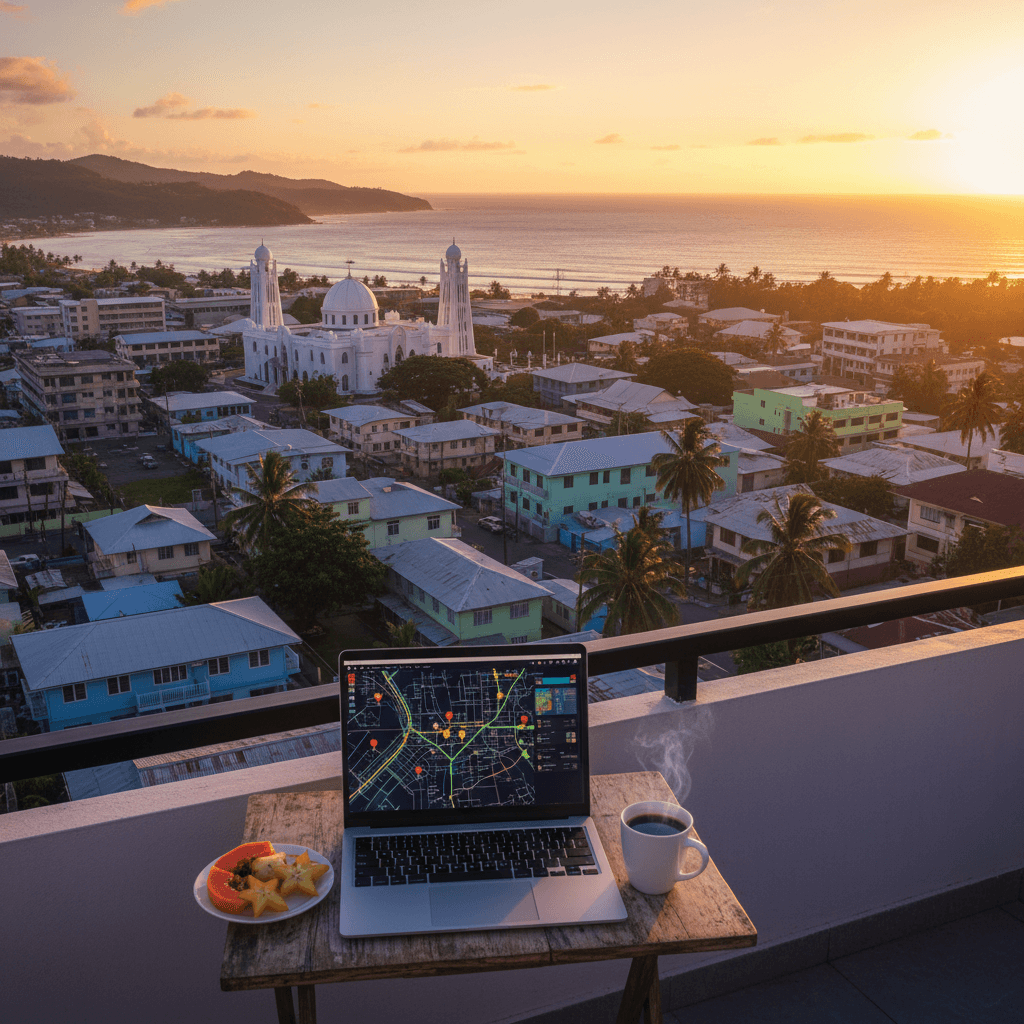
Apia
🇼🇸 Samoa
Apia feels slow in a way that can be a relief, then a nuisance, then strangely addictive. The city runs on fa'a Samoa, family matters, church schedules and whatever the weather decides to do, so you get church bells, market chatter, diesel fumes and rain hammering tin roofs all in the same afternoon.
It isn't a polished nomad base. Internet can be fine in central Apia, then weirdly shaky once you drift out toward the edges and modern comforts cost more than you'd expect because so much gets imported. Still, the tradeoff is real, you get waterfall day trips, warm water, friendly locals and proper Samoan meals instead of another glossy expat bubble.
The city works best if you lean into the pace instead of fighting it, because trying to make Apia behave like Chiang Mai or Lisbon will just annoy you. Most nomads stick close to Apia Central or Matautu for easier access to cafes, markets and decent connectivity, while Vaitele suits people watching their budget and Motootua is quieter, especially if you're near the hospital.
What you’ll feel on the ground
- Daily rhythm: Slow, social and family-first, with Sunday still treated like a real pause.
- Internet: Good enough in town, patchy outside it and coffee shop work is common.
- Costs: Not cheap for a Pacific island, with a solo monthly budget around $800 if you keep it simple.
- Food: Cheap BBQ chicken, rice and yams under $5 or sit-down dinners that climb fast.
Apia Central is noisy and practical, with markets, buses and hospitals nearby, though petty theft after dark is enough of a reason to stay sharp. Matautu feels a little more comfortable and walkable, but you'll pay for it and Vaitele is the budget pick if you can live with a less scenic, still-developing setup.
Food is one of the best parts, honestly. Fugalei Market smells like smoke, grill fat and sweet fruit and the cheap street stalls are where a lot of locals actually eat, while nightlife stays fairly contained around Beach Road, so don't expect a wild scene every night.
Apia suits people who want culture with their remote work, not just a place to open a laptop and disappear. If you can handle the heat, the occasional slow admin errand and a few rough edges, it gets under your skin in a good way.
Apia isn’t dirt cheap and if you’re coming from Southeast Asia or parts of Latin America, the sticker shock can be real. A solo nomad can live here on about $791 a month with rent, but that assumes you’re keeping things pretty tight, cooking some meals and not treating taxis like a daily habit.
Rent is the biggest swing factor. A studio or 1BR in Apia Central runs around $262, outskirts drop closer to $183 and Matautu gets pricier fast, often $400 or more for a nicer place with harbor access, better walkability and fewer headaches, though you’ll pay for it in cash and, honestly, sometimes in noise too.
Typical Monthly Spend
- Food: About $380 if you’re mixing groceries with casual meals, street BBQ is cheap, but imported groceries can sting.
- Transport: Roughly $96, buses are inexpensive but unreliable and taxis add up fast.
- Utilities and internet: Around $48, which feels fair until your connection drops during a call.
- Coworking: Day passes are about $6, monthly memberships around $44.
Eating out can still be easy on the wallet, just don’t expect every meal to be a bargain. Street food, like BBQ chicken with rice or yams, is often under $5, while a mid-range dinner for two lands around $41 and that’s before you go anywhere fancy where the menu gets weirdly expensive for an island capital.
Getting Around
- Local bus: $3.67 a ticket, cheap, noisy and not exactly on your schedule.
- Monthly bus pass: About $24.
- Taxi: Around $50 for 8 km, so use them sparingly.
The day-to-day math is simple, Apia rewards people who keep expectations low and routines practical. Budget nomads can scrape by around $800 a month, mid-range travelers usually sit near $1,200 and if you want a nicer 1BR, more taxis and better restaurants, $1,600 or more feels realistic, because imports, convenience and comfort all cost extra here.
Nomads
Matautu is the one most remote workers ask about first, because the harbor views are good, you can walk to cafés and basic services and the area feels a little more polished than central Apia. Rent stings here, though, so if you're staying a month or two, don't pretend it's budget-friendly, because it isn't.
- Best for: Nomads who want walkability and a nicer base.
- Rent: Around $400+ for upscale places.
- Vibe: Quiet, scenic and a bit pricier.
Vaitele works better if you care more about cost than scenery, honestly and it's where people go when they want a simpler setup and don't mind being farther from the postcard side of Apia. The roads can feel a little industrial and the upside is that you're not paying Matautu money for every month.
Expats
Apia Central is where daily life actually happens, with markets, banks, clinics, buses and enough movement to keep things convenient, though the noise and evening foot traffic can get old fast. There's petty theft risk at night, so stay on the main roads, keep your phone tucked away and don't wander around the darker side streets half-asleep.
- Best for: People who want everything close by.
- Rent: City-center studios and 1BRs run about $262.
- Downside: It can be noisy and nights feel less relaxed.
Motootua suits expats who want a quieter pocket and easy access to Tupua Tamasese Meaole Hospital, which, surprisingly, matters a lot once you've dealt with a tropical scrape, a fever or a kid who needs help quickly. It isn't the place for nightlife, but it does feel calmer, with less engine noise and more of that warm, sleepy suburb feel.
Families
Motootua is the safer bet for families, because it's calmer, closer to healthcare and less chaotic than downtown, so school runs and doctor visits don't turn into a full-day mission. Apia Central can still work if you need services close at hand, but the noise, traffic and after-dark mess aren't ideal with kids.
- Best for: Families who want quieter streets and hospital access.
- Transport: Taxis are easy, but they're not cheap for daily use.
- Day-to-day: Markets, pharmacies and clinics are within reach.
If you're staying longer, check the outskirts too, because larger rentals are sometimes easier to find there and monthly costs can drop below the center's price band. Just know that the tradeoff is less scenery and more time spent getting into town, which, frankly, gets old if you do it every day.
Solo Travelers
Apia Central is the most practical base for solo travelers, because you can get to the Fugalei Market, bus routes, cafés and cheap eats without fuss and the place has enough movement that you don't feel stranded. Still, keep your guard up after dark, because empty streets and dim corners are where problems start.
- Best for: First-timers who want convenience.
- Food: Street meals can be under $5.
- Internet: Good enough in town, patchier outside it.
If you want calmer evenings, Matautu is the nicer splurge, while Vaitele is the cheaper compromise when you don't care about being right in the middle of things. Either way, Apia works best when you stay near the center and treat Sunday, rain and slow service like part of the package, because that's just how the city moves.
Apia’s internet is decent in the center and patchy once you drift out toward quieter streets. Speeds average 25-55 Mbps in central Apia, with 5G available, which is enough for video calls and cloud work, but a bad rainstorm, a power hiccup or just being in the wrong part of town can knock things sideways, honestly. The upside is that cafes and coworking spots here are used to laptop people, so you won’t feel like a complete oddity tapping away over a flat white.
For a capital that still feels relaxed and a bit old-school, that’s pretty usable. Not perfect. If you need stable uploads every day, plan around a proper workspace instead of assuming your apartment Wi-Fi will behave, because in Apia, that assumption will bite you.
Coworking Spots
- Onelook Studio: The most straightforward option for nomads, with AC, coffee, flexible desks and a monthly rate around $44. It’s a good fit if you want a predictable chair, a cooler room and less of the fan hum and road noise you get in many apartments.
- Day passes: ~ST$20-50 ($8-20) at listed spaces, which works well if you’re only in town briefly or just need a backup for a heavy-work day. Frankly, it’s cheaper than sitting through a weak connection and losing an afternoon.
Most people work from cafes too and that part’s easy enough, especially around Apia Central where staff are used to laptops lingering over one drink. The smell of espresso mixes with fried food, diesel and the sea air near Beach Road, which, surprisingly, can make a workday feel calmer than it should.
SIM Cards and Mobile Data
- Digicel: Easy to find at the airport and in town, handy if you want a quick setup on arrival.
- Vodafone: Often the better coverage pick in Apia and locals tend to recommend it first.
- Buying in town: Plans are usually cheaper in Apia than at the airport, so if you can wait, do that.
If you’re staying more than a few days, get a local SIM early and test it in your actual apartment, not just near the shop counter. Weirdly, one street can be fine while the next is sluggish, so don’t assume a good speed near McDonald’s means your place in Motootua or Vaitele will hold up the same way.
Best Areas for Working
- Apia Central: Best for easy access to cafes, markets and services, though it can get noisy and the night streets feel sketchier.
- Matautu: Better for harborside living and expats who want a slightly nicer base, but rent climbs fast.
- Vaitele: Cheaper and practical, though it’s less scenic and feels more spread out.
If your income depends on being online, Apia’s center is still the smartest bet. You’ll hear buses rattling past, dogs barking and the occasional honk outside, but at least you’ve got the best shot at staying connected without spending half your life troubleshooting Wi-Fi.
Safety & Healthcare
Apia feels calm during the day and most travelers move around without drama, but don’t get lazy after dark. Central business streets, the bars near downtown, unlit industrial patches and quiet side roads are where trouble tends to show up, so stick to the main roads and keep your phone and cash tucked away.
That’s the honest version. In the center, you’ll hear scooters buzzing, buses coughing at the curb and the occasional late-night shout, so use the same street smarts you’d use anywhere with patchy lighting and a bit of petty theft.
Police: 911
Main hospital: Tupua Tamasese Meaole in Motootua, open 24/7 with specialists
Pharmacies: Usually 9am to 4pm on weekdays, then things get patchy
Most nomads stay in Apia Central or Matautu and sleep fine, though the outskirts can feel quieter in a good way and a little too quiet after sunset. Motootua is the smart pick if you want to be near the hospital and frankly, that matters if you’re here for more than a quick stop.
Neighborhood Safety Notes
- Apia Central: Handy for markets, hospitals and beaches, but petty theft risk goes up at night.
- Matautu: More upscale and walkable, with harbor views, but you’ll pay for the privilege.
- Vaitele: Cheaper and practical, though it’s less scenic and still feeling its way into a proper residential feel.
- Motootua: Quieter, close to the main hospital and usually a better sleep than downtown.
Healthcare is decent for a small island capital and the hospital covers serious stuff, but don’t expect slick private-clinic convenience on every corner. You’ll find pharmacies around town, just remember they’re often closed earlier than you’d like, which, surprisingly, makes simple meds feel more urgent than they should.
If you get sick, move early, because tropical dehydration and stomach bugs hit faster in the humidity than they do back home. Carry water, sunscreen and basic meds, then don’t gamble on a long wait if you’ve got fever, infection or a nasty cut.
Practical Advice
- Night walking: Keep to lit roads and avoid empty stretches, especially downtown.
- Cash and phones: Don’t flash them around in quiet areas.
- Medical prep: Bring your usual prescriptions, plus a small first-aid kit.
- Insurance: Get coverage that includes evacuation, because serious cases can get expensive fast.
Apia isn’t dangerous, but it isn’t the kind of place where you want to wander around half asleep, either. The rule is simple, stay alert, stay on the main routes and if a street feels off after dark, trust that instinct and turn back.
Getting around Apia is pretty simple in the center, then annoying once you drift outward. The town is walkable in patches, though the heat hangs heavy, dogs bark from yards and the road shoulders can feel rough if you’re on foot for long.
Public buses leave from Apia Market on Beach Road and they’re cheap, loud and a little chaotic, with painted mini-buses rattling past while drivers call out routes. They’re fine if you’ve got time, but they’re unreliable enough that most nomads don’t plan anything tight around them.
- Bus fare: ST$0.50-$3 per ride.
- Taxi from the airport: ST$60-80 (~$22-29) to Apia, about an hour depending on traffic and stops.
- Ride-hailing: Maua Taxi is the app people actually use, with real-time tracking.
- Bikes: rentals run ST30 to 100 a day, e-bikes about ST140 to 170.
Taxis are the easiest backup when the rain starts hammering down on the tin roofs or you’re carrying groceries back in humidity that sticks to your shirt. Taxis cost ST$3-6 for short trips around Apia. Maua Taxi works better than flagging a random cab, frankly, because you can see where the car is and avoid the usual waiting game.
Walking works in Apia Central, Matautu and parts of Motootua, but don’t expect flat pavement everywhere. The roads tilt, sidewalks disappear and after dark the quieter streets get sketchy enough that people just stay on the main roads, keep moving and call it a night.
Best areas for getting around
- Apia Central: Best for walking to markets, banks and cafes, though it’s noisy and petty theft is more of a concern at night.
- Matautu: Good if you want harbor views and easy access to central amenities, but you’ll pay more for the convenience.
- Motootua: Quieter and handy for the hospital, though you’ll usually need transport to reach downtown.
- Vaitele: Cheaper and practical for long stays, but you’ll rely on buses or taxis more often.
For day-to-day life, most nomads mix walking, buses and the occasional taxi, because that’s the least irritating setup. If you’re staying outside central Apia, budget for transport, since that extra distance adds up fast and buses don’t always show up when you want them.
One last thing, the airport transfer is straightforward, the ferry and outer-island logistics are a different story. Inside Apia, though, the rhythm is easy enough, just don’t count on speed, because in Samoa, the whole point is that nobody seems in a hurry.
Language & Communication
English gets you by in Apia, but Samoan carries real weight, especially outside the main commercial strip. Talofa for hello, fa'afetai for thank you and e fia le tau? for how much, that alone will save you from a few awkward moments at the market.
Most shop staff, taxi drivers and hotel workers speak solid English, honestly better than you might expect for a Pacific capital, though the pace can be slow and the accent takes a minute to tune into. Don’t rush people and don’t talk over them, because in Samoa that reads as rude fast.
On the street, communication is usually easy, but the vibe matters as much as the words. People are warm and direct, though not pushy and if you show a little patience, you’ll get it back, often with a smile and a proper answer instead of a rushed one.
- Main language: Samoan
- English: Widely spoken in Apia and tourist areas
- Useful phrases: Talofa, Fa'afetai, E fia le tau?
- Best translation app: Google Translate works fine for quick checks
For digital nomads, the practical side is pretty simple, most things happen in English if you stay in central Apia, but the moment you’re dealing with village visits, family events or older residents, Samoan becomes the friendlier choice. Weirdly, a few words go a long way here and locals notice when you try.
Texting and phone calls are straightforward once you’ve got a local SIM from Digicel or Vodafone and you’ll see plenty of WhatsApp use for arranging rides, meetups and casual plans. Internet is decent in town, but if you’re trying to work from a café on the edge of the city, turns out the connection can wobble just when you need it most.
Public communication has a slower rhythm than many nomad hubs, so don’t expect instant replies or tightly scheduled everything. Meetings drift, buses don’t always show and people often prefer a relaxed conversation over a hard yes or no, which, surprisingly, can be more honest than a polished promise.
Learn a little Samoan before you arrive. It helps.
Apia stays warm all year, but the feel changes a lot between the wet and dry months. The wet season runs from November to April, with heavy rain, steamy afternoons and humidity that clings to your clothes the second you step outside, while May to October is drier, easier and frankly much less annoying for day-to-day life.
Best months: May to October. Worst stretch: January, when the rain can keep coming for days and the streets get slick fast.
Daytime temperatures sit around 30 to 31°C, so don't expect cool weather even in the "dry" season. Sea temperatures stay near 29°C, which is lovely if you like swimming, though the trade-off is constant warmth, bright sun and that sweaty, salt-air feeling that never really goes away.
Dry Season, May to October
- Weather: Less rain, more reliable beach days and easier trips to waterfalls and outlying villages.
- Feel: Still hot, just less sticky, with clearer mornings and better odds of getting things done without a tropical downpour.
- Best for: Longer stays, remote work, island trips and anyone who doesn't want to hear rain hammering on a tin roof at 2 a.m.
Wet Season, November to April
- Weather: Heavier rain, higher humidity and the occasional all-day soak that turns roads glossy and miserable.
- Feel: Lush and green, yes, but also muggy, with puddles, mud and that damp smell that creeps into apartments and backpacks.
- Best for: Travelers who don't mind getting caught in sudden storms and want greener scenery, though honestly most nomads get fed up with it.
If you’re staying a few months, aim for June through September. You’ll still sweat, because this is Apia, but you’ll get more usable days, less storm disruption and fewer moments where you’re racing home with groceries while thunder cracks over the harbor, weirdly close and a little dramatic.
One thing that catches people out, the shoulder months can be mixed, so you might get a run of gorgeous mornings followed by a violent afternoon shower that ends as quickly as it started. Pack light rain gear, sandals that dry fast and a plan for indoor work when the skies open up.
Apia feels easy until you need Wi-Fi or cash, then the island pace shows up fast. Keep your paperwork, bank card and SIM sorted early, because running around in the heat with a dead phone gets old quickly and honestly, the humidity will have you sweating through your shirt by mid-morning.
Money, rent and day-to-day costs
- Studio or 1BR: about $262 in the center, closer to $183 on the outskirts, while Matautu climbs past $400 if you want the nicer harbor-side spots.
- Monthly budget: around $791 for one person, though most nomads spend more once taxis, imported snacks and a few café habits creep in.
- Meals: street food can be under $5, but a proper dinner for two at a mid-range place lands around $41 and yes, imported food stings.
- Transport: buses are cheap but messy, taxis for an 8 km hop can hit about $50, which feels steep until the rain starts hammering the road.
Apia isn’t expensive by Pacific standards, but it isn’t cheap either. A lot of the pain comes from imports, so milk, cheese, wine and random pantry basics cost more than you’d expect and that’s where budgets quietly blow up.
Where to stay
- Apia Central: best for being close to markets, hospitals and the waterfront, but it gets noisy and petty theft is more of a night problem.
- Matautu: pricier, walkable and better if you want harbor views without feeling too cut off.
- Vaitele: better value for long stays, though it’s less scenic and still growing into itself.
- Motootua: quieter and handy for the hospital, so families and longer-term stays often prefer it.
Internet, banking and transport
Vodafone generally has the edge on coverage, though Digicel is easy to grab at the airport or in town. Speeds sit around 20 to 46 Mbps in Apia, which is fine for calls and normal work, then the connection gets flaky once you drift too far out, which, surprisingly, still catches people off guard.
- Coworking: Onelook Studio runs around $44 a month and some day passes start near $6.
- ATMs: ANZ and Westpac are your safest bets on Beach Road and at the airport.
- Getting around: buses leave from Apia Market, but they’re unreliable, so Maua Taxi is the app most people end up using.
Culture and etiquette
Fa’a Samoa matters here. Take off your shoes before entering a fale, keep Sundays quiet and don’t treat church time or family time like optional extras, because locals won’t love that and open PDA gets side-eye fast.
Easy day trips
When the city starts to feel sticky and loud, get out. Waterfalls, beaches and the Robert Louis Stevenson museum are all straightforward day trips and the bus or a taxi is enough if you don’t feel like hiring a car.
Need visa and immigration info for Samoa?
🇼🇸 View Samoa Country GuideEasy Landing
Settle in, no stress