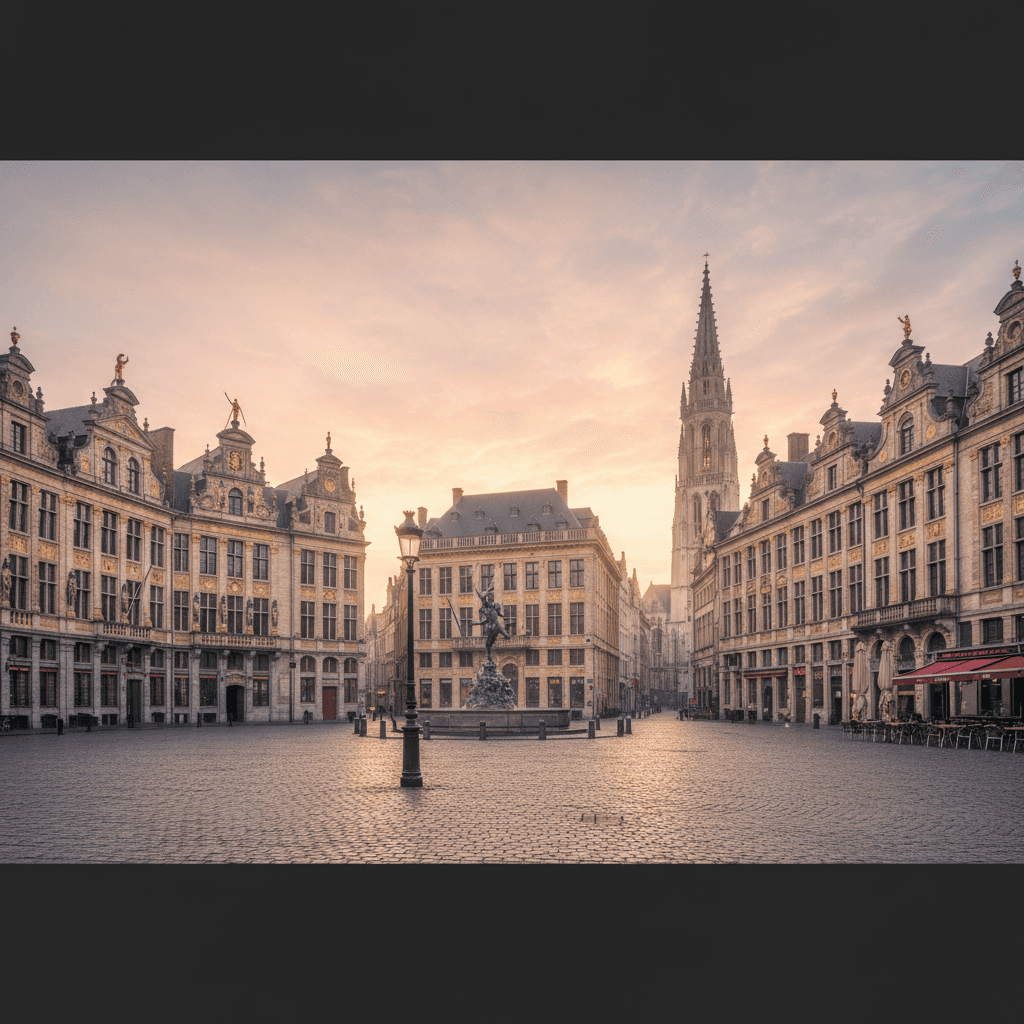
Antwerp
🇧🇪 Belgium
Antwerp isn't trying to impress you. That's, honestly, part of the appeal. While Brussels performs for diplomats and tourists, Antwerp just gets on with it, a port city that's been trading, building and arguing about art for centuries and doesn't particularly need your validation.
The pace is moderate, lively without tipping into exhausting. You'll hear Flemish Dutch at the bakery counter, French on a tram, Arabic near the station, English everywhere else. The city's multicultural texture isn't surface-level, it runs through the food, the neighborhoods, the faces in the coworking spaces. Most nomads find it surprisingly easy to feel at home within a week or two.
What makes it different from other mid-size European cities is the combination of things that shouldn't work together but do. High fashion sits next to medieval guild houses. Diamond traders in suits walk past street artists in 't Zuid. There's a serious cafe culture, the kind where you're expected to sit for two hours over one coffee and that suits remote workers just fine.
The sensory experience of the city is specific. Cobblestones slick with morning drizzle near Grote Markt, the smell of frites from a corner frietkot, tram bells cutting through the fog on a grey November afternoon. Winters here are genuinely cold and damp, the kind of damp that gets into your coat and anyone who tells you otherwise hasn't spent a February in Antwerp.
The downsides are real. It's not cheap, rent in 't Zuid runs €1,100 to €1,400 a month for a decent one-bedroom and the tourist zones around the cathedral can feel oppressively crowded on summer weekends. The city's also small enough that you'll exhaust the obvious spots quickly, which means you either dig deeper or get restless.
Most nomads who stay longer than a month do dig deeper, turns out that's when Antwerp actually opens up. The jazz bars in the Theater District, the Sunday flea market at Sint-Jansvliet, the gallery openings in South Antwerp that nobody advertises. It rewards curiosity, it doesn't reward passivity and that's a fair trade.
Antwerp isn't cheap. Most nomads land here expecting mid-tier European costs and leave surprised by the bill, so it's better to go in with realistic numbers than to adjust painfully after signing a lease.
The average monthly spend for a solo nomad runs around €1,700 to €1,900, rent included. That figure, turns out, assumes you're cooking most nights, using public transport and not going wild at the upscale restaurants in 't Zuid. Meals out add up fast here, a sit-down lunch at a mid-range spot runs €20 to €30 per person and dinner for two somewhere decent pushes €50 before wine.
Street food is honestly your best budget lever. Frites with mayo from a corner frituur costs €5, a solid kebab or falafel wrap runs €8, you can eat well without touching a restaurant at all. But Antwerp's cafe culture is strong and the temptation to linger over a €4 coffee and a €6 pastry is real, those small hits compound.
Here's how the monthly budgets break down in practice:
- Budget (€1,500/month): Shared housing, street food and home cooking, De Lijn monthly tram pass at €56, no coworking
- Mid-range (€2,000/month): One-bedroom outside the center, mix of home cooking and mid-range dining, a coworking desk at The Attic or Spaces around €100 to €200
- Comfortable (€3,000+/month): Central apartment, regular restaurant meals, premium coworking like Silversquare at €200 or more
Rent is, frankly, where most people feel the pinch. A studio in the city center averages €890 a month, outside the center drops to around €711, but neighborhoods like 't Zuid run €1,100 to €1,400 for a one-bedroom, which is London-adjacent pricing for what's still a mid-sized Belgian city.
Coworking ranges from €100 a month part-time at The Attic up to €400 at OFFIS, day passes at Spaces or Regus run about €25, which isn't bad for a one-off. Internet at home is fast and reliable, 50Mbps connections cost around €54 a month, speed isn't something you'll worry about here.
Budget tightly. Antwerp rewards it.
Antwerp's neighborhoods are, honestly, pretty distinct from one another, so where you land matters a lot. The city's compact enough that you're never far from anything, but each area has its own personality and price tag.
For Digital Nomads: 't Zuid
't Zuid is the one. Galleries, coffee shops that don't mind you staying three hours and enough street-level energy to keep things interesting without being chaotic. Rent runs €1,100 to €1,400 for a one-bedroom, which stings, but you're walking distance from everything you need.
- Rent (1BR): €1,100,1,400/month
- Vibe: Artsy, young, walkable; strong cafe-working culture
- Watch out for: It fills up fast on weekends, the noise carries
For Expats and Long-Term Stays: Diamantbuurt
The Diamond District sits right near Antwerp Centraal and is, turns out, more livable than its tourist reputation suggests. It's multicultural in a real way, not a curated way, with halal butchers next to Belgian bakeries and actual green space nearby. Rents are more forgiving at €900 to €1,200 and the train connections make day trips to Brussels or Ghent genuinely painless.
- Rent (1BR): €900,1,200/month
- Vibe: Practical, diverse, well-connected
- Watch out for: Urban noise, especially near the station
For Solo Travelers: Historic Center
Staying near Grote Markt makes sense if you're only here a few weeks. Walkable to nearly everything, weirdly charming once the tour groups thin out after 6pm and the architecture alone justifies the slightly inflated rents around €890 for a studio. Don't expect quiet mornings, the cobblestones echo.
- Rent (studio): ~€890/month
- Vibe: Central, historic, convenient but touristy
- Watch out for: Pickpockets around the Grote Markt and main station
For Families: Theater District
Quieter than 't Zuid, with a cultural bent that families with older kids tend to appreciate, it's not the most family-optimized neighborhood in Europe, but the arts scene is genuine and rents are slightly softer. Younger children might find it short on parks compared to Diamantbuurt.
- Rent (1BR): €800,1,100/month
- Vibe: Artsy, calmer, walkable to culture
- Watch out for: Limited playgrounds, fewer family-specific amenities
Antwerp's connectivity is, honestly, one of its quiet strengths. Speeds regularly hit 50Mbps and above on home fiber connections, mobile coverage is solid throughout the city center and you'd struggle to find a cafe that doesn't have decent WiFi. The three main carriers are Proximus, Base and Orange; tourist SIMs from Orange run around €15 for 5GB and you can pick them up at the airport or any carrier store in the Diamantbuurt.
The coworking scene is compact but well-developed, with options ranging from slick corporate setups to low-key monthly desks. Most nomads staying longer than a week find a dedicated space worth it, because cafe-hopping gets old fast when you need a real monitor or a quiet call.
- Silversquare Antwerp Tower: The premium option. Floor-to-ceiling views, fast infrastructure, professional atmosphere. Starts around €200/month, goes up depending on your desk type.
- The Attic: More relaxed, part-time desk access around €100/month, communal kitchen, good WiFi. Popular with freelancers who don't need a full-time setup.
- Spaces / Regus: Standard global-chain reliability. Day passes around €25, monthly memberships from €199. Not exciting, but it works.
- OFFIS: The priciest at around €400/month. Turns out it's aimed more at established small teams than solo nomads, so weigh that before committing.
For cafe working, 't Zuid is the neighborhood to be in. The streets around the Royal Museum of Fine Arts are lined with coffee spots that don't rush you out, the espresso is good and the ambient noise is the kind that actually helps you focus rather than the chaotic clatter you'd get near Grote Markt.
One honest caveat: coworking costs add up quickly here and Antwerp isn't cheap to begin with. Budget €100 to €400 monthly for a proper workspace, which sits on top of already-high rents. That math matters if you're planning a longer stay.
Mobile data is reliable enough that some nomads skip fixed coworking entirely and just tether, especially on short visits. A Proximus or Base SIM gives you better local coverage than Orange in some outer neighborhoods, it's a small difference but worth knowing if you're working near the port or the suburbs.
Antwerp is, honestly, one of the safer cities you'll find in Western Europe. The center feels relaxed during the day, pickpockets are the main thing to watch for around Grote Markt and Centraal Station and most nomads go months without any real incident. That said, the port districts and some outer suburbs have a low-level gang presence tied to the drug trade, so wandering unfamiliar streets late at night isn't smart.
There aren't no-go zones in the tourist sense. Just use the same judgment you'd apply anywhere: if a street's empty, poorly lit and you're not sure where you are, turn around. The inner neighborhoods, 't Zuid, Diamantbuurt, the Historic Center, they're all fine at night.
Air quality is decent for a port city, though you'll notice a faint industrial edge on certain wind days near the docks. Not unpleasant, just there.
Healthcare
The healthcare system is solid. Pharmacies are everywhere, they're usually your first stop for minor issues and the pharmacists are knowledgeable and almost always speak English. For anything more serious, the University Hospital (UZA) is the main reference point and the standard of care is genuinely good, turns out Belgium consistently ranks among Europe's top healthcare systems.
The catch is access. If you're not registered as a Belgian resident, you're paying out of pocket until your insurance kicks in and EU health cards (EHIC) cover emergencies but not routine care. Get travel health insurance before you arrive, not after you need it.
- Emergency number: 112 (EU-wide, works everywhere)
- Police: 101
- Main hospital: UZA (Universitair Ziekenhuis Antwerpen), south of the city center
- Pharmacies: Open daily in rotation; a sign on any closed pharmacy lists the nearest open one
- Insurance: Travel or expat health coverage is non-negotiable for non-EU residents
Mental health services exist but waiting lists are long, this is frankly a problem across Belgium, not specific to Antwerp. Private therapists with English-language practices are available but expensive, typically €80 to €120 per session.
Overall, Antwerp won't stress you out from a safety standpoint. Stay aware, get covered and you'll be fine.
Antwerp's compact center is, honestly, one of the easiest in Europe to get around without a car. Most nomads find they can walk between the Historic Center, 't Zuid and the Theater District without much thought, the streets are that manageable. That said, you'll still want to know your options.
De Lijn runs the tram and bus network and it works well. A single ticket is €3.00, a monthly pass is €57 (increased from €56 in February 2026) and that covers most of what you'll need day to day. Trams are frequent, the stops are clearly marked and the network connects the main neighborhoods without drama. For longer trips out of the city, NMBS trains run from Antwerp-Centraal, which is, weirdly, one of the most beautiful train stations you'll ever pass through.
Cycling is worth taking seriously here. Velo, the city's bike-share system, logged over 7 million rides in 2025 alone, it's clearly not just for tourists. The dedicated lanes aren't as extensive as Amsterdam, but the flat terrain makes it forgiving. Pick up a Velo subscription if you're staying more than a week, it pays for itself fast.
For ride-hailing, Bolt is your go-to. Uber operates but with limited availability, don't count on it during peak hours. Taxis exist but they're not cheap and rarely necessary given everything else on offer.
Getting to the airport is straightforward. Antwerp International is only about 5km from the center, a tram or bus gets you there or a taxi runs around €25. Not bad. Brussels Airport is also an option for international flights, roughly 45 minutes by train from Antwerp-Centraal.
A few practical notes:
- Tram/bus pass: €57/month via De Lijn app or ticket machines
- Single ticket: €3.00, validate before boarding or you'll get fined
- Velo bikes: Available across the city, turns out the docking stations are dense enough that you're rarely far from one
- Bolt: Main ride-hailing app, works reliably
- Airport taxi: Around €25 to Antwerp International
One thing to know: bike lanes get busy during morning commutes, pedestrians and cyclists share some stretches and the friction is real. Stay alert.
Dutch is the official language in Antwerp, specifically the Flemish dialect, which sounds noticeably different from the Dutch you'd hear in Amsterdam. Flemish has a softer, rounder quality to it, more melodic, less clipped. Don't expect to pick it up in a week.
The good news: English proficiency here is, honestly, some of the highest in continental Europe. Antwerp scores remarkably well on the EF English Proficiency Index and in practice that means baristas, landlords, coworking receptionists and shop owners will switch to English without hesitation or attitude. Most nomads find they can operate entirely in English without friction, which is convenient but also means you can go months without learning a word of Dutch if you're not careful.
French exists on the periphery. Belgium's linguistic politics are complicated and Antwerp is firmly Flemish territory, so don't walk in speaking French expecting warmth. It'll work in a pinch, it won't win you any goodwill though.
A few Dutch phrases go a long way socially:
- Hallo / Goeiedag: Hello / Good day
- Dank je wel: Thank you
- Alsjeblieft: Please or "here you go"
- Spreek je Engels? Do you speak English?
- De rekening, alsjeblieft: The bill, please
Locals genuinely appreciate the effort, even if they immediately respond in perfect English. It's a small thing, turns out it signals a lot about whether you're treating Antwerp as a place to live or just a backdrop for your laptop.
For translation, Google Translate handles Dutch well and the camera feature is useful for menus and signage. DeepL is, weirdly, more accurate for nuanced text if you're dealing with lease agreements or official documents.
One practical note: official documents and government communications arrive in Dutch only. If you're registering as a resident or dealing with local bureaucracy, budget time for translation. The city hall staff in central Antwerp speak English, but the paperwork doesn't care. Expats recommend keeping DeepL open and a Dutch-speaking contact on speed dial for anything administrative, because the forms are dense and the stakes occasionally matter.
Antwerp has a sub-oceanic climate, which is a polite way of saying it's damp a lot of the time. Winters are genuinely grey and cold, January sitting around 3°C (37°F), with a persistent drizzle that soaks through your jacket before you realize it's raining. Summers are mild rather than warm, July averaging 18°C (64°F) with occasional stretches of real sunshine, though even July is, turns out, the wettest month of the year at around 80mm of rainfall.
Don't come expecting Mediterranean heat. That's not what this city is.
Best Time to Visit
June through August is the sweet spot. Days stretch to eight hours of usable sunshine, cafe terraces along the Grote Markt fill up and the city genuinely feels alive in a way it doesn't in February. Most nomads who stay longer than a week try to time their arrival for late spring or early summer and honestly, that instinct is right.
September and October are underrated. The summer crowds thin out, temperatures stay comfortable around 14°C (57°F) and you can actually move through 't Zuid without dodging tour groups. The light in October has that low golden quality that makes the Flemish architecture look like a painting, which sounds corny but is accurate.
Seasons at a Glance
- Spring (Mar-May): Unpredictable. Some lovely days, some cold snaps, expect rain. Layers are non-negotiable.
- Summer (Jun-Aug): Best weather, most events, highest accommodation prices. Book ahead.
- Autumn (Sep-Nov): Quieter, cooler, still very workable. Good value on short-term rentals.
- Winter (Dec-Feb): Cold, dark and wet. Christmas markets add some atmosphere in December, but January and February are, frankly, a slog.
Pack a waterproof jacket regardless of when you arrive, the weather here shifts fast and the locals don't slow down for it. Trams run through the rain, coworking spaces stay warm, the city keeps moving, you should too.
If you're weighing Antwerp against somewhere sunnier for a winter base, be honest with yourself about how much grey sky you can handle, it matters more than people admit when you're working remotely and staring out a window all day.
Get your SIM sorted before you leave the airport. Proximus, Orange and Base all have kiosks there, tourist SIMs run €15 to €20 for 5 to 10GB and honestly that's enough for a week of casual use. If you're staying longer, an eSIM works fine too, just load it before you land.
For banking, most nomads skip Belgian accounts entirely and just use N26 or Revolut, which work seamlessly here. ATMs are everywhere, card acceptance is near-universal, you won't feel the friction you'd get in cash-heavy cities.
Finding an apartment is, turns out, less painful than in some European cities, but you still need to move fast on listings. HousingAnywhere handles furnished short-term rentals well; Immoweb is where the longer-term stuff lives. Expect to pay €890 or more for a studio in the center, landlords here don't negotiate much on price, they just wait for the next applicant.
Day trips are genuinely easy. Brussels is 35 minutes by NMBS train, Ghent is about the same and both are worth a half-day without much planning. On Sundays, the Sint-Jansvliet flea market is a good low-cost morning out, it's weirdly satisfying to wander with a coffee while the city's still quiet.
A few cultural things to know before you accidentally annoy someone:
- Bikes have priority: step into a bike lane without looking and you'll hear about it immediately.
- Greetings: a handshake is standard for first meetings; Flemish people are direct, that's not rudeness, it's just how conversations go.
- Language: Dutch is the official language, but English proficiency here is frankly excellent. Most locals will switch without being asked.
- Useful phrases: "Hallo" (hello), "Dank je" (thanks), "Spreken jullie Engels?" (Do you speak English?) will get you surprisingly far in the few situations where you need them.
Winters are cold and damp in a way that gets into your bones after a few weeks, pack layers and a genuinely waterproof jacket, not just a stylish one. Summer, though, is when Antwerp earns its reputation. Warm, long evenings, terraces packed, the whole city feels like it's been waiting for it.
Need visa and immigration info for Belgium?
🇧🇪 View Belgium Country GuideNomad Haven
Your home away from home