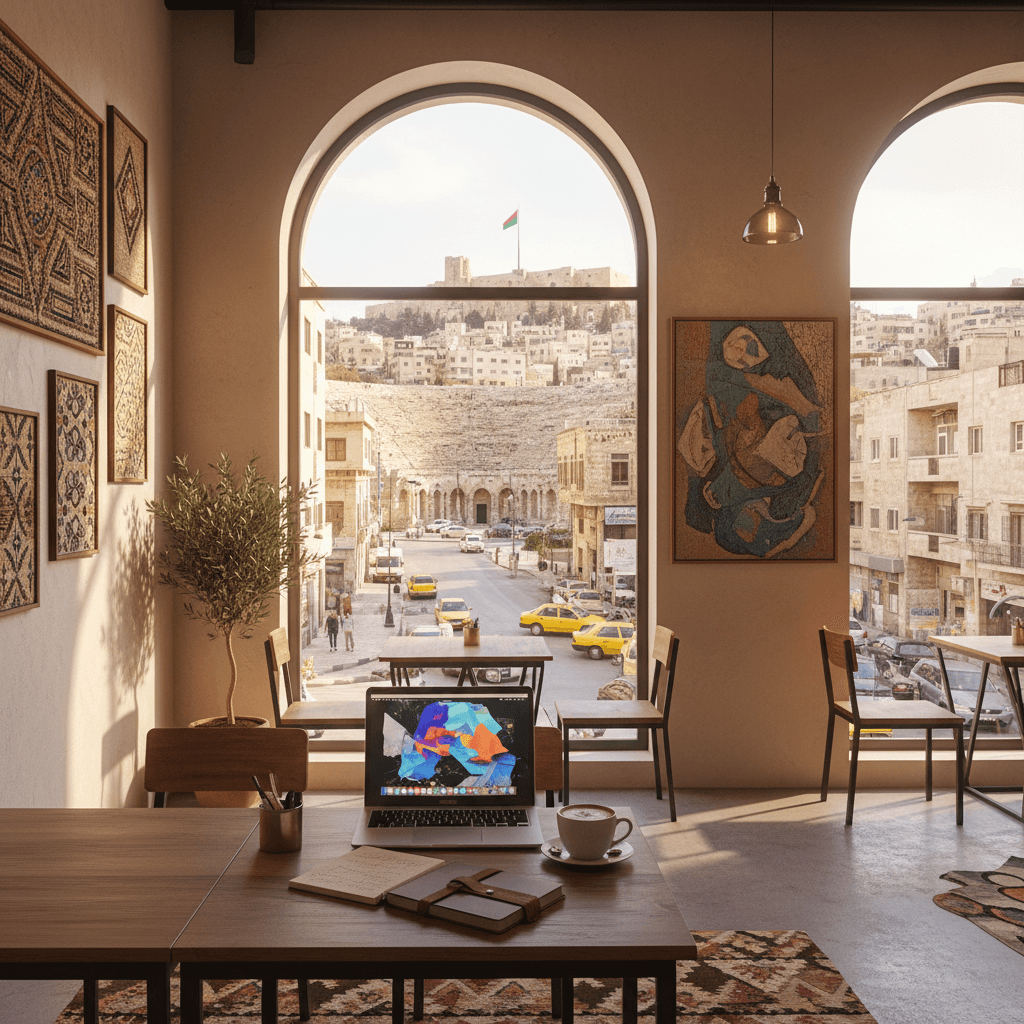
Amman
🇯🇴 Jordan
The White-Stone Labyrinth
Amman doesn't try to impress you with glass skyscrapers or artificial glitz. Built across seven steep hills, the city is a monochromatic sea of limestone buildings that glow a dusty gold at sunset. It feels ancient and lived in, yet there is a sharp, modern intellectualism bubbling underneath. Most nomads find that Amman lacks the frantic, over-caffeinated energy of Cairo or Beirut; instead, it offers a grounded, slower pace where people actually take the time to talk to you.
The city's personality is split between East and West. To the east, you have the historical core and the chaotic markets near the Roman Theater. To the west, you find leafy streets, contemporary art galleries, and the kind of high-end infrastructure that makes remote work seamless. It is a place where you can spend your morning on a high-speed fiber connection and your afternoon eating $3 falafel in a shop that hasn't changed its recipe in fifty years.
The Nomad Experience
While Amman isn't a massive "nomad hub" like Lisbon or Bali, that’s exactly why people stay. You aren't trapped in a tourist bubble. You’ll likely find yourself working alongside local entrepreneurs and artists at Manara Arts & Culture in Weibdeh, or grabbing a craft beer on Rainbow Street. The community is welcoming, and unlike many other regional capitals, Amman is remarkably safe and stable. You can walk home at night without a second thought, though your calves will definitely feel the burn from those steep staircases.
The emotional rhythm here is defined by hospitality. It is common for a shopkeeper to offer you tea or for a neighbor to invite you for mansaf, the national dish of lamb and fermented yogurt. It is a city that rewards the curious traveler who is willing to look past the beige exterior to find the creative, warm heart underneath.
Cost of Living Breakdown
Living here is mid-range. It’s significantly cheaper than Western Europe or the US, but pricier than Southeast Asia. Most nomads budget around $1,100 to $1,300 per month for a comfortable lifestyle.
- Rent (Studio/1BR): Expect to pay $500 to $800 in popular areas like Jabal Amman or Weibdeh. If you want luxury in Abdoun, prices jump to $900+.
- Daily Meals: Street food like shawarma or falafel costs $2 to $5. A nice sit-down dinner with mezze and grills usually runs between $12 and $18.
- Connectivity: A monthly coworking membership averages $200, though many nomads just work from cafes for the price of a $4 latte.
- Transportation: Ride-hailing apps like Uber and Careem are the standard. Short hops across town are usually $3 to $6.
Where to Plant Your Flag
Amman is a city of distinct neighborhoods, and where you live will completely dictate your experience. Most remote workers gravitate toward these three spots:
- Jabal Weibdeh: This is the bohemian soul of the city. It’s packed with jasmine-scented courtyards, independent bookstores, and small cafes. It’s the most walkable part of Amman and has a strong community of expats and local creatives.
- Jabal Amman: Centered around the famous Rainbow Street, this area is better for those who want nightlife and trendy restaurants. It’s livelier and a bit more expensive, but you’re never more than five minutes from a great terrace view.
- Abdoun: If you need high-end gyms, modern malls, and proximity to embassies, this is the place. It feels very international and polished, though it lacks the historic charm of the hills.
The Digital Infrastructure
Don't let the ancient ruins fool you; the internet in Amman is surprisingly robust. Fiber optic lines are common in the western neighborhoods, with average speeds hitting 121 Mbps. Mobile data is also cheap and reliable. Most travelers recommend picking up a Zain or Orange SIM card at the airport, or using an eSIM for immediate data upon landing. Whether you are taking Zoom calls from a balcony in Weibdeh or uploading files from a coworking space in Abdoun, the tech side of things rarely skips a beat.
The Bottom Line
Living in Amman won't drain your bank account like Dubai or Tel Aviv, but it isn't quite as cheap as Cairo or Southeast Asia. For 2025-2026, most solo nomads find that a monthly budget of $1,118 allows for a comfortable lifestyle without much compromise. If you're coming with a family of four, expect to spend between $1,900 and $2,800 per month if you stay away from the high-end luxury pockets.
The local currency is the Jordanian Dinar (JOD), which is pegged to the US Dollar. This makes budgeting predictable, though you'll want to keep cash on hand for older markets and smaller shops. Most expats rely on Wise or Revolut for daily spending, but ATMs are easy to find in modern hubs like Abdoun and Jabal Amman.
Housing and Neighborhoods
Rent is your biggest variable. If you want to be where the action is, Jabal Amman and Jabal Weibdeh are the go-to spots. They're walkable, full of cafes, and have a solid expat community. If you prefer a more polished, suburban feel with modern malls, Abdoun is the place, though you'll pay a premium for it.
- Jabal Amman (The Trendy Choice): Expect to pay $500 to $800 for a one-bedroom apartment. It's the heart of the nomad scene, especially around Rainbow Street.
- Jabal Weibdeh (The Artistic Choice): Prices here are slightly more accessible, ranging from $450 to $700. It's quieter than Jabal Amman but still very social.
- Abdoun (The Upscale Choice): Modern studios and apartments here start at $800 and can easily climb over $1,200. You're paying for proximity to embassies and high-end gyms.
- Downtown (The Budget Choice): You can find basic spots for $300 to $500, but be prepared for noise, crowds, and older buildings.
Dining and Groceries
Food is where Amman really shines for the budget-conscious. You can eat like a king on street food or spend significantly more at fusion restaurants in the western part of the city. Most nomads mix it up, grabbing a quick $3 shawarma for lunch and hitting a mid-range grill for dinner.
- Budget Meals: Local staples like falafel, hummus, and shawarma cost between $2 and $5.
- Mid-Range Dining: A solid meal of mansaf or mixed grills at a sit-down restaurant usually runs $10 to $15.
- Upscale Spots: Fancy dinner dates or international fusion meals will set you back $25 or more per person.
- Coffee: A latte at a nomad-friendly spot like Manara Arts & Culture costs about $4.
Connectivity and Workspace
Internet speeds in Amman are surprisingly good, with fiber connections in many apartments reaching 121 Mbps. Mobile data is also affordable and reliable. Most nomads pick up a local SIM from Zain or Orange at the airport, or use an eSIM like Ubigi for immediate data.
Coworking isn't as saturated as in Bali or Lisbon, but the options are high quality. A monthly membership at a dedicated space usually costs between $200 and $300. If you prefer the cafe route, many spots in Weibdeh are welcoming to laptops as long as you keep the coffee orders coming.
Getting Around
Amman is famously hilly, so you probably won't be walking between neighborhoods often. While there's a bus system that costs about $20 for a monthly pass, it can be confusing for newcomers. Most nomads rely on ride-hailing apps like Uber or Careem. A typical ride across town costs between $5 and $10. If you're using traditional yellow taxis, always make sure they turn the meter on to avoid overpaying.
The Nomad Hub: Jabal Amman & Rainbow Street
If you want to be in the thick of things, Jabal Amman is where you'll likely land. It's the city's most walkable pocket, centered around the famous Rainbow Street. Most nomads gravitate here because you can hop between a dozen different cafes with reliable 121 Mbps fiber without ever needing a taxi.
The vibe is a mix of old stone villas and trendy rooftop bars. It's the best spot for solo travelers looking to meet people, as the expat community is dense and active in the local pubs. Keep in mind that "walkable" in Amman still involves steep hills, so your calves will get a workout.
- Rent: Expect to pay $500 to $800 for a decent one bedroom apartment.
- Coworking: You'll find plenty of people working from Wild Jordan Center or local cafes, though dedicated desks run about $200 a month.
- The Downside: It gets loud on Thursday nights, and you'll pay a "tourist tax" on rent compared to other districts.
The Creative Soul: Jabal Weibdeh
Expats and artists usually prefer Weibdeh over the flashier Jabal Amman. It feels more like a neighborhood and less like a tourist destination. It's home to Manara Arts and Culture, which is widely considered the best place to work in the city. You can sit on the terrace with a coffee, look out over the Citadel, and stay productive until 11:00 PM.
The community here is tight knit. You'll find yourself recognizing the same faces at the local bakery or the small galleries tucked into side streets. It's slightly more affordable than the Rainbow Street area, making it a favorite for those staying three months or longer.
- Rent: Mid range apartments typically go for $450 to $700.
- Atmosphere: Quiet, artistic, and heavily residential with a great cafe culture.
- Pro Tip: Use the Careem app to get here; while it's near downtown, the climb up the hill is brutal in the summer heat.
Upscale Living: Abdoun
For families or expats with a higher budget, Abdoun is the standard choice. This is where the embassies, international schools, and high end gyms are located. It doesn't have the historic charm of the older hills, but it trades that for modern infrastructure and luxury apartments. If you need a quiet environment with a private parking spot and a modern kitchen, this is your place.
It's not very walkable, so you'll rely on Uber or Careem for everything. However, it's the safest and most polished part of the city. You're also close to the best private hospitals and premium grocery stores that stock international brands.
- Rent: Modern studios start at $800, while family sized flats easily clear $1,500.
- Best For: Those who want Western style amenities and a quiet night's sleep.
- Dining: Home to the city's best fusion restaurants and upscale bistros, with meals averaging $25 per person.
Budget & History: Downtown and Ras Al Ain
Solo travelers on a budget or history buffs often stick to the edges of Downtown (Al Balad) or Ras Al Ain. Downtown is chaotic, loud, and smells like spices and exhaust, but it's where you'll find $2 falafel sandwiches and the best gold markets. Ras Al Ain is a bit more paved and quiet, hosting the Jordan Museum and several cultural centers.
Living here is an immersion experience. You won't find many "digital nomad" cafes, but you will find authentic Amman. It's perfect for a short stay if you want to be steps away from the Roman Theater and the Citadel.
- Rent: You can find basic spots for $300 to $500.
- Food: This is the capital of street food; you can eat well for under $10 a day.
- The Trade off: Internet can be spotty in older buildings, and the noise levels are constant from dawn until late at night.
Internet Speeds and Connectivity
Amman is surprisingly modern when it comes to the digital backbone. You'll find that fiber optics are standard in most apartment buildings in Jabal Amman and Abdoun, with citywide averages hitting a solid 121 Mbps. Most nomads find that even without a dedicated fiber line, a standard cafe connection pulls around 56 Mbps, which is more than enough for Zoom calls or heavy uploads.
For mobile data, don't rely on your home roaming plan. Pick up a local SIM from Zain or Orange as soon as you land at Queen Alia International. If you prefer the convenience of an eSIM, Ubigi has great coverage across the city. 4G is widespread, and you'll even get decent reception while exploring the Roman Theater or the Citadel. Expect to pay around $15 to $25 for a month of generous data.
The Coworking Scene
Amman doesn't have a massive "nomad hub" feel yet, which is part of its charm. The spaces here are professional and often double as community centers for local entrepreneurs and artists. Most memberships run between $200 and $300 a month, though many spots offer day passes for around $15.
- Manara Arts & Culture: Located in the artsy Jabal Weibdeh, this is the gold standard for many remote workers. It's a cafe and workspace hybrid with a terrace that offers some of the best sunset views in the city. They're open from 9:00 AM to 11:00 PM, making it perfect if you're working on a US time zone.
- The Office: A more traditional corporate coworking space in the Jabal Amman area. It's quiet, professional, and has the kind of ergonomic chairs your back will thank you for after a week of working from cafe stools.
- Zinc (Zain Innovation Campus): If you want to be surrounded by the local tech scene, this is the place. It's often free or very low cost, though it can get crowded with students and startup founders.
The Cafe Culture
If you prefer the "laptop and a latte" lifestyle, Amman's cafe culture is elite. Unlike some cities where staff might glare at you for staying two hours, Amman's hospitality is legendary. As long as you keep ordering the occasional Turkish coffee or mint tea, you're usually welcome to stay as long as you like.
Rainbow Street is the classic choice. It's packed with spots like Turtle Green Tea Bar, which has been a nomad staple for years due to its reliable WiFi and plenty of power outlets. In Weibdeh, look for smaller, quieter spots tucked away from the main squares where the internet is less strained by crowds. Just remember that many cafes don't open until 10:00 AM, so early birds might need to stick to their apartments for the first few hours of the day.
Power and Reliability
Power outages are rare in the capital, but they do happen occasionally during heavy winter storms. Most high end coworking spaces have backup generators, but if you're working from an older stone house in the hills, it's smart to keep your laptop charged and have a mobile hotspot ready. The city's hilly terrain can sometimes create "dead zones" for mobile signals in basement apartments, so always check the signal strength before signing a long term lease.
One pro tip for the summer: Amman gets hot, and not every cafe has strong air conditioning. If you're planning a heavy work day in July or August, head to the modern malls or the dedicated coworking spaces in Abdoun where the climate control is guaranteed to keep you productive.
Safety in the City
Amman is widely regarded as one of the safest hubs in the Middle East. Most nomads find the city incredibly welcoming, characterized by a culture of hospitality where locals often go out of their way to help foreigners. While you might encounter some persistent street vendors in heavy tourist spots, aggressive behavior is rare. It's a city where you can generally walk around without worry, though it's always smart to stay aware of your surroundings in crowded markets like Downtown.
Violent crime is statistically very low. Most expats feel comfortable walking through neighborhoods like Jabal Amman or Weibdeh at night. However, travelers often suggest avoiding isolated, poorly lit areas on the outskirts of the city after dark. If you're a solo female traveler, you'll likely feel secure, but sticking to busier streets and using reputable apps for transport adds an extra layer of comfort.
For getting around safely, stick to ride-hailing apps like Uber or Careem. They provide transparent pricing and tracked routes, which beats haggling with yellow taxi drivers who might "forget" to turn on the meter. Dial 911 for general emergencies including police and medical assistance.
Healthcare Standards
If you need medical attention, you're in good hands. Amman is a regional leader for medical tourism, and the private healthcare system is excellent. Most doctors and specialists in the city speak fluent English, having trained in the UK or the US. You'll find the highest concentration of modern facilities in the Abdoun and Jabal Amman areas.
- Private Hospitals: Facilities like the Jordan Hospital or Khalidi Medical Center are top choices for expats. They offer high-tech equipment and efficient service.
- Pharmacies: These are everywhere. You can find a pharmacy on almost every major block in neighborhoods like Sweifieh. Many pharmacists are highly trained and can provide advice or over-the-counter remedies for minor ailments without a doctor's visit.
- Costs: While healthcare isn't free, out-of-pocket costs for a standard GP visit are reasonable, usually ranging from $30 to $50. However, for anything serious, you'll want comprehensive travel or international health insurance to cover private hospital stays.
Staying Healthy
The most common health hiccup for newcomers is "Amman belly," usually caused by a change in diet or water. While the tap water is technically treated, most nomads and locals stick to bottled or filtered water for drinking. It's cheap and readily available at any "dukan" (small grocery store).
Air quality can occasionally be an issue during the "Khamasin" season in spring, when dust storms blow in from the desert. If you have asthma or respiratory sensitivities, keep an eye on weather reports during these periods. Also, the sun is deceptively strong due to the city's elevation. Even on cooler days in March or April, you'll want to wear sunscreen if you're out exploring the Citadel or Roman Theater.
Emergency Contact Quick List
- General Emergency (Police, Fire, Ambulance): 911
- Ambulance specific: 193
- Top Private Hospital: Jordan Hospital (located near the 4th Circle)
- Pharmacy App: Many use Glovo or local delivery apps to get basic medical supplies delivered directly to their apartment.
Getting Around Amman
Amman is built on seven steep hills, which means your step count will skyrocket if you try to traverse the city on foot. While neighborhood pockets like Jabal Amman and Jabal Weibdeh are charmingly walkable, moving between districts requires wheels. The city lacks a robust metro system, and while public buses exist, they are often confusing for newcomers and lack fixed schedules.
Ride-Hailing: The Gold Standard
Most nomads and expats rely almost exclusively on ride-hailing apps. It's the most stress free way to navigate the winding, hilly streets without haggling over prices. Uber and Careem (the regional favorite) are the dominant players here. Expect to pay between $5 and $10 for most cross city trips.
- Careem: Often has better availability and allows you to book "Lulu" (budget) or "Max" (larger) cars.
- Uber: Reliable and familiar, though sometimes slightly more expensive during peak traffic.
- Peak Hours: Traffic in Amman can be brutal between 8:00 AM and 9:30 AM and again from 4:00 PM to 6:00 PM. Plan your coworking commutes accordingly.
Yellow Taxis
You'll see bright yellow taxis everywhere. They are cheap, but they come with a learning curve. Drivers are supposed to use the meter, but some might "forget" or try to negotiate a flat rate with foreigners. If you use them, ensure the meter is on before the car moves. Most nomads find the extra dollar or two for a Careem is worth avoiding the negotiation entirely.
Airport Transfers
Queen Alia International Airport is about 30km from the city center. You have three main options to get to your rental:
- Careem/Uber: Usually costs between $20 and $30. This is the most convenient door to door option.
- Airport Express Bus: These run every 30 to 60 minutes and cost around $5. They drop you at the North Bus Station or 7th Circle, from where you'll need a taxi to reach your final destination.
- Official Airport Taxis: These have fixed prices displayed on a board at the terminal, typically around $30 to $35.
Walking and Micromobility
Walking is a mixed bag. In Jabal Amman, specifically around Rainbow Street, the sidewalks are decent and the atmosphere is great for a stroll. However, the city's topography is relentless. You'll frequently encounter "stairs" that serve as streets, which are efficient shortcuts but a serious workout. Micromobility like electric scooters or bikes hasn't really taken off here due to the steep inclines and aggressive driving culture.
Car Rentals and Driving
If you're planning frequent weekend trips to the Dead Sea, Petra, or Wadi Rum, renting a car is a solid move. Within the city, however, driving is a test of nerves. Local drivers view lanes as suggestions rather than rules, and parking in popular areas like Weibdeh is a nightmare. For daily nomad life, stick to ride-hailing and save the rental car for your desert adventures.
Transport Budget Summary
- Monthly Budget (Ride-hailing): Plan for $50 to $100 if you're out and about daily.
- Single Trip (City Center): Usually $3 to $6.
- Airport Trip: $20 to $30 depending on the time of day.
The Language Landscape
In Amman, you'll find a city that speaks two languages fluently: Arabic and hospitality. While Modern Standard Arabic is used for official business and news, the streets hum with the Levantine dialect. It's a melodic, softer version of the language that's shared with neighbors like Lebanon and Syria. Most nomads find that while they can get by with English, learning a few local phrases acts like a skeleton key for better service and genuine smiles.
The English proficiency in Amman follows a clear geographic and social divide. In West Amman neighborhoods like Jabal Amman, Abdoun, and Jabal Weibdeh, English is the unofficial second language. You won't have any trouble ordering an oat milk latte at Manara Arts & Culture or discussing WiFi speeds with a coworking manager. However, if you're haggling for spices in the Downtown (Balad) markets or taking a local bus, your English might be met with polite confusion.
Digital Communication and Apps
Communication isn't just about what you say, it's about the tools you use. Jordan is a WhatsApp economy. From booking a haircut to messaging your landlord or ordering water delivery, everything happens through WhatsApp. If you don't have it installed, you'll find yourself out of the loop very quickly.
- Google Translate: The camera feature is a lifesaver for reading menus in smaller, traditional eateries or deciphering labels at the grocery store.
- Careem: This is the regional equivalent of Uber. It's indispensable because it allows you to set your destination digitally, bypassing the need to explain complex directions in Arabic to a driver.
- Local SIMs: Don't rely on roaming. Pick up a Zain or Orange SIM at Queen Alia International Airport upon arrival. A month of heavy data usually runs around $15 to $25. If you prefer the digital route, Ubigi offers reliable eSIM coverage for Jordan that nomads frequently recommend for immediate connectivity.
Essential Phrases for Your First Week
Locals are incredibly patient and usually thrilled when an expat tries to speak the language. Even if your pronunciation is off, the effort is seen as a sign of respect. Start with these basics to smooth over your daily interactions:
- Shukran: Thank you. You'll use this dozens of times a day.
- Min fadlak (to a man) / fadlik (to a woman): Please.
- Salam or Marhaba: Hello.
- Kam? How much? (Useful for those market trips).
- Yalla: Let's go or hurry up. You'll hear this everywhere, from taxi drivers to parents.
- Khalas: Enough, finished, or stop. It's the perfect word when a street vendor is being a bit too persistent.
The Social Context
Communication in Jordan is often indirect and deeply rooted in politeness. It's common to spend five minutes on pleasantries before getting to the point of a business conversation. If you're invited for tea or coffee, it's a genuine gesture. Accepting at least one cup is considered good form. If you're done, gently jiggle your cup from side to side to signal you've had your fill, otherwise, your host will keep pouring.
For those staying longer than a month, expats often recommend joining a language exchange or taking a few classes at a center in Weibdeh. It's one of the fastest ways to break out of the expat bubble and understand the subtle nuances of life in the capital.
The Sweet Spot: Spring and Autumn
If you want to experience Amman at its absolute best, aim for the shoulder seasons. March to May and September to November are the goldilocks months for nomads. During spring, the hills around the city actually turn green, and the air is crisp, with daytime temperatures hovering between 20°C and 25°C. It is the perfect weather for working from the outdoor terrace at Manara Arts & Culture without breaking a sweat.
Autumn is equally pleasant. The summer heat breaks in late September, making the steep walks between Jabal Amman and Downtown much more manageable. You can comfortably spend your afternoons hopping between cafes on Rainbow Street or exploring the Citadel ruins without the sun beating down on you.
Surviving the Summer Heat
From June to August, Amman gets hot. You can expect temperatures to climb between 32°C and 38°C. Unlike the humid heat you might find in Southeast Asia, Amman's heat is very dry. While it is intense during the day, the city’s elevation means temperatures often drop significantly at night, providing some relief.
Most nomads shift their schedules during these months. You will find the city comes alive after sunset when the air cools down. If you are visiting during this time, prioritize an apartment in Abdoun or Jabal Amman with reliable air conditioning, as older buildings in areas like Weibdeh might only have fans.
Winter: More Than Just a Chill
Many travelers are surprised by how cold Amman gets from December to February. It is not uncommon for temperatures to dip to 5°C, and the city occasionally sees snow. This is the rainy season, and the gray, damp days can make the hilly streets quite slick.
The real challenge in winter isn't the outdoor temperature, but the indoor setup. Many older apartments lack central heating, relying instead on portable gas heaters. If you are planning a winter stay, check that your rental has a solid heating solution. On the plus side, this is the best time to head down to the Dead Sea or Aqaba, where it stays a balmy 20°C to 25°C while Amman shivers.
Climate Breakdown by Month
- January and February: The coldest months. Expect rain and occasional wind. Highs around 12°C to 15°C. Great for hunkering down in cozy cafes with a hot tea.
- March and April: Peak season. Wildflowers bloom and the weather is ideal for day trips to Petra. Highs reach 18°C to 23°C.
- May: Transition month. It starts getting warmer, but it is still very comfortable for walking.
- June to August: Peak summer. Very dry and sunny. Highs often exceed 35°C. Outdoor activity is best reserved for early mornings or late evenings.
- September and October: The heat fades. These are some of the most popular months for expats to arrive and get settled.
- November and December: The transition to winter. You will see more rain and a noticeable drop in evening temperatures.
A Note on Ramadan
When planning your trip, check the dates for Ramadan, which shifts every year. During this holy month, many cafes and restaurants close during daylight hours, and the city’s rhythm changes entirely. While it is a fascinating cultural experience and the "iftar" feasts at night are incredible, it can be a bit more challenging for nomads who rely on cafe hopping for their workspace during the day.
Connectivity and Gear
You won't have to hunt for a signal here. Amman’s infrastructure is surprisingly robust, with average fiber speeds hitting 121 Mbps. Most nomads find the cafe culture in Jabal Amman and Weibdeh perfect for a deep work session. Manara Arts and Culture is the neighborhood favorite; it has a terrace with killer sunset views and stays open until 11:00 PM.
For your phone, skip the roaming charges. Grab a local SIM from Zain or Orange at Queen Alia International Airport when you land. If you prefer digital, Ubigi offers reliable eSIM plans that cover the whole country. Expect to pay around $200 to $300 a month if you want a dedicated desk at a premium coworking space in Abdoun.
Money and Budgeting
Amman is a mid range destination. You can live comfortably on about $1,118 a month as a solo traveler. While high end spots in Abdoun will eat your budget quickly, the local lifestyle is very affordable. Cash is still king in the markets and smaller shops, so keep Jordanian Dinars (JOD) on hand. Cards like Wise or Revolut work at most ATMs for withdrawing local currency without getting hammered on fees.
- Street Food: $2 to $5 for a solid meal of falafel or shawarma.
- Mid Range Dining: $10 to $15 for a spread of hummus and grilled meats.
- Studio Rent: $300 to $500 on the edges of Downtown; $800+ in upscale areas.
- Coffee: $3 to $5 in trendy nomad cafes.
Getting Around the Seven Hills
The city's topography is no joke. It's built on steep hills, so while Rainbow Street is walkable, moving between neighborhoods on foot is a workout you probably didn't sign up for. Public buses exist but they're a bit of a puzzle for newcomers. Most expats and nomads stick to Uber or Careem. A typical cross town ride costs between $5 and $10. If you're coming from the airport, a Careem will set you back about $20 to $30 for the 30km trip.
Social Etiquette and Safety
Jordan is one of the safest spots in the region. Violent crime is rare, though it's smart to avoid isolated outskirts after dark. The culture is hospitable but conservative. You'll see a mix of styles in Jabal Amman, but generally, it's respectful to dress modestly. During Ramadan, avoid eating or drinking in public during daylight hours out of respect for those fasting.
English is widely spoken in the startup and cafe scenes. However, learning a few Levantine Arabic phrases goes a long way. Use Shukran for thank you and Min fadlak for please. If you're shopping in the Downtown souks, knowing Kam? (How much?) will help you navigate the local pricing.
Health and Logistics
The healthcare system is high quality, especially the private hospitals in Abdoun. Pharmacies are everywhere and many pharmacists speak fluent English. If you have an emergency, dial 911 for police or 193 for an ambulance. For housing, check Bayut.jo or join local expat Facebook groups, as many of the best deals never hit the major international booking sites.
Plan your stay around the weather. March to May and September to November are the sweet spots with temperatures around 20 to 25°C. If you visit in July or August, be prepared for dry heat reaching 38°C. Winters are short but can get surprisingly chilly and rainy, so pack a decent jacket if you're arriving in January.
Need visa and immigration info for Jordan?
🇯🇴 View Jordan Country GuideEasy Landing
Settle in, no stress